South Australia’s drop in electricity consumption partly due to solar panels
 Solar Panels Reducing South Australia’s Electricity Consumption by Energy Matters, 2 Sept 13, Expected growth in energy consumption in South Australia over the next decade has been lowered; thanks in part to solar PV.
The 2013 South Australian Electricity Report (SAER), prepared by the Australian Energy Market Operator (AEMO), says the state’s annual energy consumption was 13,330 gigawatt hours (GWh) in 2012-13; down by 42 GWh compared to 2011-12.
Looking ahead, electricity consumption is forecast to decrease by 0.1% per year over the 10-year outlook period……. http://www.energymatters.com.au/index.php?main_page=news_article&article_id=3919
South Australia on track to lead the world in renewable energy use
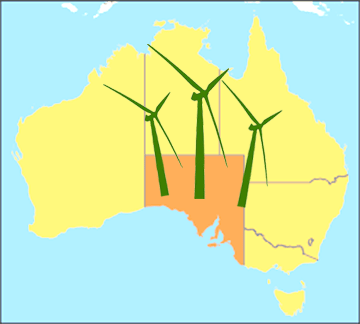

it would make South Australia the most advanced industrialised economy in the world in the adoption of variable renewables, and a test case for the incorporation of such energy sources into a broader grid.
South Australia heads to 50% renewables within a decade, (excellent graphs) http://reneweconomy.com.au/2013/south-australia-heads-to-50-renewables-within-a-decade-21296 REneweconomy By Giles Parkinson on 2 September 2013 Already, one in five houses in South Australia has rooftop solar PV, and a new AEMO document predicts this could treble by 2022. With wind already supplying 27% of power, and new wind farms coming on, the state will likely have 50% of wind and solar within 10 years.
The state of South Australia is emerging as one the leading regions in the world in the take-up of variable renewable energy sources such as wind energy and rooftop solar PV, and could be the first industrial economy to reach 50 per cent variable renewable generation.
According to figures included in a report by the Australian Energy Market Operator, that could happen well within a decade. That would make it the most advanced industrialised economy in the world in the adoption of variable renewables.
In a special report on the state released late last week, AEMO noted that 31 per cent of the state’s energy consumption was met by wind and solar in 2012/13, with more than 1,250MW of large scale wind farms, and a further 400MW of solar PV installed on one out of every five homes in the state. Continue reading
Radio: Adelaide the hub of military industrial intelligence nuclear complex
The issue isn’t nuclear power. The issue is processing uranium for nuclear power that then can be used for defence
You have to understand this in terms of in terms of Adelaide, -it’s a military industrial intelligence complex
Simons is connected to the University College of London but basically he’s a front man for business interests, We can clearly question what he is doing given the fact that he’s getting funding from indirect corporate sources.

 AUDIO: https://radio.adelaide.edu.au/nuclear-power-in-south-australia-a-golden-age/ Nuclear Power in South Australia – a golden age? Radio Adelaide 23 Aug 13 Chris Komorek spoke with Dr David Palmer from Flinders University to explore the changing landscape. Produced by Ian Newton. TRANSCRIPT by Christina Macpherson
Chris Komorek As the uranium debate heats up, so does the destroyed reactor in Fukushima, Japan.The International Energy Policy Institute at the University College London’s Adelaide campus is advocating a ramped up nuclear industry here in South Australia. We’re joined by Dr David Palmer from Flinders University.
Crippling losses for US nuclear weapons company’s uranium mine in Australia
 Fukushima fallout for uranium stings Heathgate Resources Financial Review, SIMON EVANS, 26 Aug 13 Heathgate Resources, the owner of the Beverley uranium mine in northern South Australia, has suffered losses totalling a whopping $60 million over the past two years.
Heathgate has operated Beverley since 2000, but has been hit hard in its past two financial years by a plunge in global uranium prices.Beverley is one of four uranium mines in Australia, and Heathgate is also involved in the nearby Four Mile uranium project, set to become the nation’s fifth uranium mine as regulatory approvals move a step closer.
Uranium prices fell by more than 50 per cent after the meltdown at the Fukushima nuclear plant in Japan in March 2011, and have failed to recover . Heathgate Resources made a loss of $34.5 million in calendar 2012 according to its latest financial statements lodged with the Australian Securities and Investments Commission.
This followed a loss of $25.6 million in 2011.
Heathgate’s total revenue in calendar 2012 was $59 million, according to its financial statements, a substantial slump from the 2011 when total revenue was $84.6 million.
Heathgate president Craig Bartels declined to comment on the results and the operating performance.
Heathgate is owned by the US-based global nuclear giant General Atomics, as is one of Heathgate’s stablemates, Quasar Resources, which holds a 75 per cent stake in the Four Mile project. The other 25 per cent of Four Mile is owned by ASX-listed Alliance Resources, but the two groups are still involved in court action over past disagreements about how best to develop the resource…… http://www.afr.com/p/australia2-0/fukushima_fallout_for_uranium_stings_7q6Q2t7EXWB2IaLsOu5w0L
Wind power bonanza from windy weather in South Australia, NSW, and Tasmania
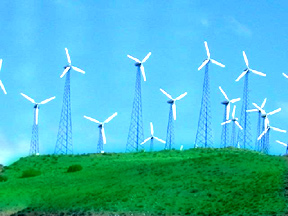 Blustery Weather Generated A Wind Power Bonanza http://www.energymatters.com.au/index.php?main_page=news_article&article_id=3907 25 Aug 13, Wind farms in Australia’s National Electricity Market cranked a record amount of power for the week beginning August 11.
During the period, 47% of South Australia’s power was supplied by the wind and Victoria’s wind farms contributed 10% to that state’s electricity needs. Tasmania and New South Wales had their second and third highest levels of wind power generation respectively.
While the blustery conditions caused havoc for emergency services, it’s an ill wind that blows nobody any good as they say.
“The positive was the large amount of clean energy that was produced by the wind farms on Australia’s southern coastline, breaking records for the amount of wind power generated in a single week in South Australia and Victoria,” said Clean Energy Council Policy Director Russell Marsh.
“What this shows is that wind power is working. It generates very useful amounts of power and also helps farmers who host wind turbines by providing them with income.” Mr. Marsh says based on data sourced from the Australian Electricity Market Operator (AEMO); wind power provided a record 7.6 per cent of all power generated across the entire National Electricity Market during that week; the equivalent of supplying more than 2.3 million homes.
Under normal conditions, South Australia’s wind farms contribute about one quarter of the state’s total electricity production. In 2011/12, wind generationblew past coal to become the second largest source of electricity in South Australia. The state, which has around 40% of Australia’s installed wind capacity, reached its target of generating 20% of electricity from renewable energy in 2011.
South Australia now has its sights set on producing one third of its electricity from renewable sources by 2020. Like its previous target, that is expected to be met well ahead of schedule.
BHP’s Olympic Dam uranium mine expansion again rears its ugly head
BHP ‘determined’ to push ahead with Olympic Dam but only after new mining techniques are thought through, CHRISTOPHER RUSSELL THE ADVERTISER AUGUST 22, 2013 BHP Billiton is “absolutely determined” to find a way to go ahead with expanding Olympic Dam, the company’s top executive in South Australia says.
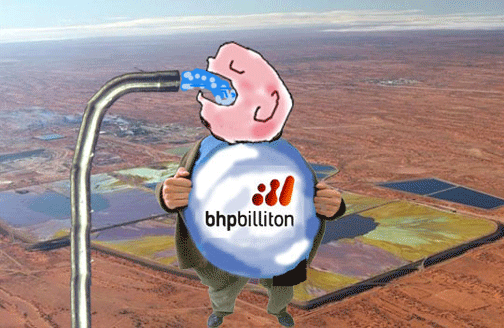
There were two key objectives for BHP in South Australia, asset president of Olympic Dam Darryl Cuzzubbo told a mining conference in Port Pirie.In his first public speech since taking command in SA, Mr Cuzzubbo said the priority was to make sure the existing Olympic Dam copper/uranium/gold operation was running at world-leading efficiency standards.
If not, he would have no credibility when asking the BHP Billiton board to fund the expansion. Secondly, the key was to make the economics of the expansion work. “We are absolutely determined to find the best way to expand Olympic Dam that competes against other investment opportunities,” he said…….
Since being granted a four-year extension by the State Government on the indenture covering the mine expansion, BHP has been working hard at rescoping the project……. There were three areas to be resolved he said – to work out a more effective mining method to get down 350m to reach the ore, to process the minerals at less cost and to split the project into “bite-size” pieces so it could generate revenue along the way.
The original expansion method envisaged spending about $30 billion but not reaching the top of the ore body for four or five years.
Wind energy facts – including 47% of South Australia’s energy last week
 Wind supplied 47% of South Australia’s energy last week http://reneweconomy.com.au/2013/wind-supplied-47-of-south-australias-energy-last-week-67550 By Ketan Joshi on 20 August 2013 VERY GOOD GRAPHS in this article
Science Week was from August 10-18, inclusive. The Australian Energy Market Operator (AEMO) makes 5-minute generation data available through a gargantuan database. I’ve chosen to focus on South Australia and Victoria, states which lead the way in installed wind generation – there are 22 wind farms I’ve obtained generation data for, summarised in the table below.
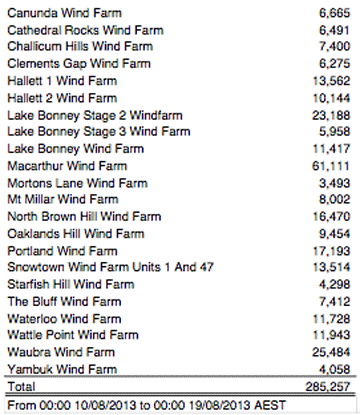
The total generation of those 22 wind farms was 285,257 megawatt hours. But what does that deliver to the energy market? The average Sydney household consumes 11.6 KWh per day, or 0.104 MWh over 9 days. So, the generation of wind farms throughout science week could power ~2.7 million homes – enough for all of Greater Sydney, and all of Greater Adelaide. That statistic alone is a firm reminder that wind power is a formidable player in the supply of energy. Continue reading
Shabby history of destruction of Aboriginal culture and land ownership
Rudd and Abbott charge the north Eureka Street Dean Ashenden | 19 August 2013 “……..Credit for getting this history under way goes to the pastoral grandees of the colony of South Australia. In the 1860s they funded an obsessive-compulsive alcoholic Scotsman to find out what lay between their northern border and the far coast, and how it could be got. John McDouall Stuart’s six expeditions found little to encourage them, but lust trumped reason, and South Australia set itself to be the first colony in history to found a colony. The two would fuse, in time, to become the Great Central State.
Dreams of imperial glory and speculative fortunes turned almost immediately into a long-running mixture of farce and nightmare. Eventually South Australia got lucky. In 1911 it managed to palm off its colony onto the newly-constituted Commonwealth of Australia. Astonishingly, the Commonwealth even agreed to pay serious money for it, nearly four million pounds, plus another 2.2 million for a railway line that had not even reached South Australia’s northern border, let alone made any money.
Believing, as had the South Australians before them, that there must be a way to turn space into land, the Commonwealth did what South Australia had done, with the same result. An official inquiry report in 1937 was scathing. It found that in the 25 years since the takeover the federal government had spent more than 15 million pounds and was heading further into the red. The previous year’s production had brought in 100 000 pounds less than the Government’s outlay for the year of 600,000 pounds.
But the inquirers nonetheless found that it can be done, if it’s done right. It prescribed the familiar medicine: ports, roads, bridges, railways, ports, industry development boards, the lot.
Much of what the inquiry wanted soon came to pass, but not in result of its proposals. In 1939, war saw tens of thousands of troops stream north to build roads, airfields, a port and other infrastructure. For the first time the white population exceeded the black.
Soon motor vehicles, aircraft, air conditioning and buckets of public money transformed the look and feel of the Territory, but ‘development’ remained elusive. In the Territory, and more particularly in neighbouring tropical Queensland and Western Australia, mining was the only big earner, not necessarily to the advantage of government revenues.
The kind of on-the-ground industries apparently envisaged by Rudd and Abbott — horticulture and agriculture particularly — were confined to coastal enclaves or to the margins of viability. Much of the north proved too hot, too wet, too dry, too far from markets, too barren or too pestilential, with the happy consequence that the frontier failed to do its grim work.
Instead of a near-obliteration of Aboriginal populations of the kind seen on the eastern and southern seaboards, northern Australia witnessed a slow-motion saga of sporadic violence and accommodation, of advance and retreat. Neither side ever looked liked winning, and neither ever looked like giving up.
In the aftermath of the Coniston massacres of 1928 both sides abandoned violence for other means, and since then both have used the law, politics, money and public opinion in hundreds of struggles over land and ‘culture’, some famous or notorious, most not, one side straining to gain ground, the other to resist and to recover.
That 160-year struggle now seems to be reaching a new stage. We like to think that the devastation of one population and culture by another is all in the past, but the apparent failure of Rudd and Abbott to notice that northern Australia is shared country suggests that there might be more to come.http://www.eurekastreet.com.au/article.aspx?aeid=37087#.UhP0g9Jwo6I
Nuclear Weapons company gets go-ahead for South Australian uranium mine

 Final environmental OK for Four Mile World Nuclear news, 16 August 2013 The start of operation of the Four Mile uranium mine in South Australia has moved a step closer with final environmental approval. However, the project partners have yet to agree on a development plan.
| r) |
The state Environmental Protection Authority (EPA) has now granted a mining and mineral processing licence for Four Mile. The licence also covers radiation and radioactive waste management plans for the in-situ leach (ISL) mine…..
The Four Mile project is a joint venture between Alliance Resources (25%) and Quasar Resources (75%). The project is managed by Heathgate Resources affiliate Quasar. Both Quasar and Heathgate are subsidiaries of US-based General Atomic Technologies Corp.….
Disputes delay start-up
The start of production from the project has been stymied by legal disputes between Alliance, Quasar and Heathgate. There are on-going Federal Court proceedings by Alliance seeking restitution of its full ownership of the Four Mile deposit due to delays and disagreements.
In May 2012, Alliance said it had agreed to form a strategic alliance with Japanese trading house Itochu Corporation. Under the terms of this, Itochu will have the right to acquire a 14.9% shareholding in Alliance within six months of all litigation being finally determined. Furthermore, within 12 months of that final determination, Itochu will have an option to acquire a further 25.1% shareholding in Alliance.
Four Mile uranium project – Australia’s dirtiest and most dangerous uranium connection
 (Christina Macpherson, originally posted on 4 Nov 2012) Leaving aside its nasty little internal squabbles, Australia’s fifth uranium mine Four Mile uranium project in South Australia is without doubt the most striking example of all that is wrong about Australia’s uranium industry. Well, next door, is Beverley mine – equally bad. But they’re practically the same, in that they are both practically owned by USA’s General Atomics. Neal Blue is the chairman of Quasar Resources, which is affiliated with General Atomics, a major United States weapons and nuclear energy corporation. He is CEO of Heathgate Resources. a 100 per cent-owned subsidiary of General Atomics (GA) which owns Beverley uranium mine. He is Chairman of the Board of Directors for General Atomics
General Atomics has a murky history It develops nuclear technologies including arms manufacture. Especially those Predator drones which kill anybody that the Pentagon thinks is “suspicious” in Iraq and Afghanistan. Neal Blue was one of the designers of Predator. At its uranium processing plant on an Indian reservation in Oklahoma, General Atomics for years covered up radioactive water and gas leaks.
General Atomic has spent $thousands’ lobbying and ferrying of USA politicians to Australia, , and Australian federal and state politicians to USA . In 2000 Heathgate applauded police brutality against environmentalists and local Aboriginal people. An online video clip details this brutality. the police action (in a 2000 media release which is no longer available online). After a 10-year legal case, 10 people were awarded a total of $700,000 damages.
General Atomics flew a group from the US Congress to Australia, accompanied by company executives, to persuade the Federal Government to buy the company’s Predator unmanned aircraft
As well as its interest in unmanned spy planes, General Atomics has employed human spies. In 2008 it was caught hiring a former undercover police officer turned private investigator to infiltrate Australian environment groups and report on their actions.
In 2008 General Atomics and Neal Blue were sued for fraudulently hiking uranium prices and manipulating costs. In the settlement One of General Atomics’s customers, Exelon, received $US41 million from the company. It is estimated Mr Blue made $US200 million by breaking the contracts and selling uranium on the spot market
Heathgate Resources have been promoting the view that low-level radiation is beneficial, and funding the Australian visits of people like Dr Doug Dr Boreham prepared to promote those views.
Heathgate is not required to clean up Four Mile uranium mine. and there is no requirement it decontaminate the Beverley site when mining ceases. Christina Macpherson 25 Oct 12,
Go-ahead for disputed uranium joint venture BY: BARRY FITZGERALD From: The Australian October 25, 2012 THE much-delayed Four Mile uranium project in South Australia – a joint venture between ASX-listed Alliance Resources (25 per cent) and US group Heathgate (75 per cent) – is finally being developed.
South Australia’s renewable energy success, despite planned cutbacks in solar feed-in tariff
SA’s love affair with renewables isn’t just solar-focused; the state also has the largest wind power capacity in the nation. According to the Australian Energy Market Operator, approximately 29% of South Australia’s electricity came from renewable energy sources in 2012.
South Australia Solar Feed In Tariff Countdown http://www.energymatters.com.au/index.php?main_page=news_article&article_id=3872 5 Aug 13, South Australia’s feed in tariff will be slashed for new applications soon. To avoid the inevitable applications rush; households intending going solar may want to make a move now.
South Australia’s current solar feed in tariff for surplus exported electricity is comprised of two parts- a retailer contribution of 9.8c and a 16 cent component paid by SA Power Networks. Continue reading
Plutonium blown up at Maralinga, in secret “Vixen B” tests
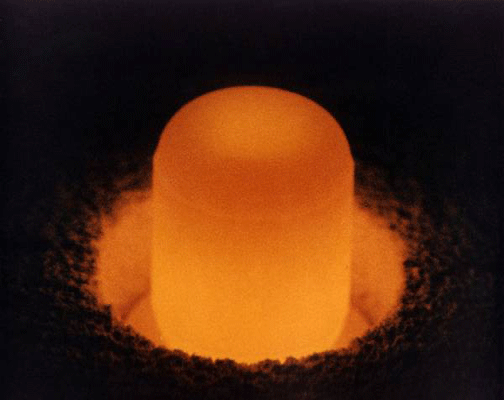 Dig for secrets: the lesson of Maralinga’s Vixen B The Conversation, Liz Tynan, 26 July 13 “……….The tests of far greater consequence were the 12 Vixen B tests, only held at Maralinga These experiments used TNT to blow up simulated nuclear warheads containing a long-lasting form of plutonium.
Vixen B scattered 22.2kg of plutonium-239 around the Maralinga test site known as Taranaki. This form of plutonium has a half-life of over 24,000 years. The extreme persistence of radiation and the threat of cancer posed by inhaling small particles in dust at the site make it especially dangerous.
The Vixen B tests took place amid total secrecy in 1960, 1961 and 1963. Maralinga’s toxic legacy can be summed up in one word: plutonium. When the Maralinga Rehabilitation Technical Advisory Committee (MARTAC) reported in 2002 on efforts to remove contamination from the area it said “Plutonium … was almost entirely the contaminant that determined the scope of the [Maralinga rehabilitation] program.”
The British carried out some clean-up operations after Vixen B and provided a report (by British physicist Noah Pearce) in 1968 that made claims about the level of plutonium contamination at the site. The Pearce report provided the technical basis for the Australian Government to release the UK from any further liability for the Maralinga site.
The technical advisory committee later confirmed that the plutonium contamination at Taranaki was wrong by a factor of 10: “A comparison between the levels reported by the UK at the time (Pearce 1968) and the field results reported by the Australian Radiation Laboratory…(Lokan 1985) demonstrates an underestimate of the plutonium contamination by about an order of magnitude.”……..” http://theconversation.com/dig-for-secrets-the-lesson-of-maralingas-vixen-b-15456
South Australian govt considers council rate charges for wind farms on private properties
Council rates bid for wind farm turbines on private property http://www.abc.net.au/news/2013-07-19/council-rates-bid-for-wind-farm-turbines-on-private-property/4830326 Jul 19, 2013
Mr Parnell is on the committee and says farmers pay rates on infrastructure such as sheds, but multi-million-dollar wind farms are currently exempt as they are considered to be plant and equipment.
“A big part of the wind farm debate has been how we share the benefits of renewable energy, so one of the things we have to look at is how do we make sure the returns from wind farms are spread through the community?” he said.
“Rates is one way of doing it, community development funds is another way of doing it. “We’ll see at the end of the day which one the committee recommends.”
Radiation leak plans at Olympic Dam uranium mine – 15 years out of date
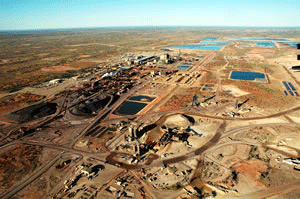 Olympic Dam mine radiation leak plan 15 years out of date news.com.au by: Miles Kemp The Advertiser July 07, 2013 THE radiation plans for Olympic Dam are more than 15 years out of date because of an administrative bungle, the Environment Protection Authority has revealed.The plans are needed because between 2003 and 2012, BHP-Billiton reported 31 radiation leaks at its Olympic Dam mine, totalling more than 3000 cubic metres of material, or the volume of a large hot-air balloon.
Responding to a Freedom of Information application that exposed the problem, the EPA could only find plans from 1997 and 1998 and has stated: “We acknowledge that an update is overdue and action is being taken to address this situation”. Greens MLC Mark Parnell said he sought a copy of the management plan to monitor how BHP-Billiton dealt with radiation leaks to protect workers and the environment.”Workers at Olympic Dam are at risk because the EPA and BHP-Billiton have failed to update their practices for over 15 years,” he said. “What sort of oversight is there by the EPA at Olympic Dam when the basic management plan required under the National Code is ridiculously out of date?”
The EPA searched its records for 10 months before responding that there was no up-to-date plan and it needed a new one. “All these plans should be available in the public realm and not have to be chased using FOI application,” Mr Parnell said.
He said there had been six triggers since 1998 that should have prompted an updated plan, including an expansion in the mine’s capacity.”Between 1998 and 2013, an extraordinary amount of change has occurred in the regulation of radioactive material, with increasing awareness of the risks to workers and the natural environment and advances in processing,” he said…….. http://www.adelaidenow.com.au/national-news/south-australia/olympic-dam-mine-radiation-leak-plan-15-years-out-of-date/story-fnii5yv4-1226675659296#ixzz2YU1PMjCI
Democratic process stops the uranium mining rush into Woomera area
Senate slows deal to give mineral explorers access to Defence’s Woomera testing grounds Adelaide Now, CHRISTOPHER RUSSELL Business Editor June 21, 2013 “…..Laws to keep Defence as the prime user and controller of access to Woomera Prohibited Area but giving certainty to mineral explorers were this week shunted into a Senate committee inquiry after earlier clearing the Lower House with bipartisan support.
The Foreign Affairs, Defence and Trade committee now will seek new public submissions on the pact, which had been negotiated over several years between industry, government and Defence following an inquiry by former public servant Allan Hawke.
The committee is only due to report back on August 20, just weeks before the federal election. That means the reform Bill will lapse and have to await being reintroduced by the next Federal Government……..
Greens MP Adam Bandt said his party was “absolutely opposed to mining uranium” and also had concerns about Aboriginal issues.SA Senator David Fawcett said it was quite appropriate for the Bill to go to a committee inquiry and it should not be rushed.”If it’s not dealt with this week – and clearly it won’t be – it’ll be an issue for whoever forms government after September,” he said.
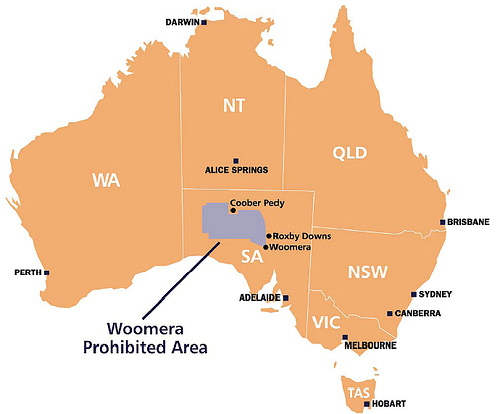
Senator Fawcett, who came to politics from a military career which included working in Woomera, said the area was crucial to Defence testing.
“Just because we have a State Government and mining lobby who are saying let’s go on with it, I don’t see that – short of a national emergency – we should be circumventing the democratic process,” he said…… http://www.adelaidenow.com.au/business/sa-business-journal/senate-slows-deal-to-give-mineral-explorers-access-to-defence8217s-woomera-testing-grounds/story-e6fredel-1226667870070
1 This month


Help Aunty Sue Protect Her Land and Sacred Sites From Destructive Rocket Testing.
.

Australians deserve the truth
about
AUKUS – https://aukuspublicinquiry.com/

PETITION – To: Prime Minister Anthony Albanese and the Australian Labor Government

of the week – Australians for War Powers Reform (AWPR)
To see nuclear-related stories in greater depth and intensity

