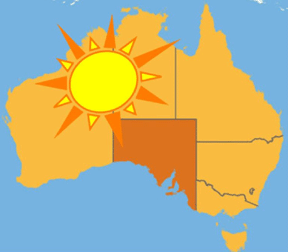
Woomera’s 10,000 nuclear waste barrels have ‘low levels’ of radiation, says CSIRO, ABC News 30 July18 Ten thousand barrels of radioactive waste stored at Woomera in South Australia’s far north have no significant levels of radiation, according to thelatestassessment from Australia’s leading scientific research agency.
The finding from the Commonwealth Scientific and Industrial Research Organisation (CSIRO) comes more than two years after a report raised concerns about the possible leaking of nuclear waste at the site.
In April, 2016, the Australian Radiation Protection and Nuclear Safety Agency (ARPANSA) inspected the Woomera site and reported a number of concerns surrounding many of the barrels, which hold material from tests at Melbourne’s Fisherman’s Bend dating back to the 1950s.
Woomera was a rocket testing base in the 1950s and is still a defence systems testing facility…….
Once analysed, any low or intermediate-level nuclear waste at Woomera would likely be moved to the proposed national nuclear waste management storage facility.
Movement of waste ‘a risk’ Mara Bonacci, of the Conservation Council of South Australia, said the issues with the barrels highlighted the dangers of nuclear waste storage.
“It’s a shame that after only 30 years, the 10,000 barrels have been stored there are already compromised and potentially dangerous,” Ms Bonacci said.”It doesn’t instil a great deal of confidence in Australia’s handling of radioactive waste at all, which leads to concerns about the current federal proposal for the radioactive waste management facility.
“I’m glad they’re onto it but it’s a shame that it has to happen at all and it’s going to cost the taxpayer $30 million.
Ms Bonacci said the movement of the waste to a proposed waste management storage facility at either Kimba or Hawker in South Australia was a risk.
“They want to move intermediate level waste — which is higher level waste to what is at Woomera — they want to move that from Lucas Heights … to a remote area for interim storage and then move it again.
Communities are concerned that waste will be forgotten about, that it may be compromised.
“It’s expensive, it’s double-handling and it doesn’t make sense.
“If the Woomera waste hasn’t been handled that well and it is deteriorating then it doesn’t instil confidence in the proposal to move it to a remote community.”
…….. The spokesperson for the Department of Industry, Innovation and Science said the transport, storage and disposal of nuclear would be under strict regulations enforced by the Australian Radiation Protection and Nuclear Safety Agency (ARPANSA).
The Australian Radiation Protection and Nuclear Safety Agency (ARPANSA) declined ABC requests to comment.
Remediation could take years
Dr Mallants said a study into the structural integrity of the barrels was ongoing in conjunction with experts including the Australian Nuclear Science and Technology Organisation (ANSTO).
“We’re using very small robots and vehicles that can drive underneath the stack of drums they have cameras so they can look for leaks, we also have some robots that have the ability to measure the level of radiation under those drums.”
JimMcDowell, most recently CEO of BAE Systems Saudi Arabia, now chair of Australian Nuclear Science and Technology Organisation
South Aust gets new public sector boss,
Former BAE Systems chief executive Jim McDowell has been appointed to head up South Australia’s Department of Premier and Cabinet.
Premier Steven Marshall described Mr McDowell as a talented leader with decades of international business experience in industries critical to South Australia’s future prosperity.
“Mr McDowell is well placed to guide the South Australian public sector as we seek to take full advantage of the Commonwealth’s naval shipbuilding program and other defence contracts based in South Australia,” Mr Marshall said on Thursday.
$31 million boost for nuclear location, The Transcontinental, Marco Balsamo -23 July 18 The Flinders Ranges community could receive up to $31 million through a Community Development Package if the Wallerberdina Station site is chosen to host the National Radioactive Waste Management Facility.
Initially touted to be about $10M, federal government has more than tripled the package to be awarded to the selected community.
Federal Minister for Resources and Northern Australia Matt Canavan said the improved package would support the people and industries surrounding the facility.
“This enhanced package will ensure the successful community is ready and able to take advantage of the benefits of hosting this facility both during construction and the lifetime of its operation,” he said.
“What shipbuilding or aircraft bases do for some communities, and steel-making or mining does for other towns, the National Radioactive Waste Management Facility will do for its host town in terms of employment, opportunities for new careers in trades and university qualified positions and flow-on benefits.”
The package includes a $20M National Radioactive Waste Management Facility Community Fund, delivering infrastructure and development benefits to the community………
The announcement from federal government has been slammed by Australian Greens Senator Sarah Hanson-Young, who recently visited the Wallerberdina Station site.
“Resources Minister Matt Canavan should be ashamed of himself for trying to bribe the community in return for dumping radioactive waste on them,” Ms Hanson-Young said.
“Putting money on the table, just weeks before the Kimba and Hawker communities vote on whether they want a nuclear waste dump in their front yard smacks of desperation and bribery.
“Polling shows the majority of South Australians want our state to put a stop to this project. Nuclear waste is not welcome in Kimba or the Flinders Ranges, and the rest of the state is behind these two communities in their fight against this proposal.”
Ms Hanson-Young also questioned why the Liberal government has not revealed how much profit former Liberal Senator Grant Chapman, who owns the Wallerberdina Station site, would earn from a successful bid.
The Wallerberdina Station site is one of three nominated locations for the national facility, with the other two both based in Kimba.
A postal ballot is set to commence on August 20 to measure the community support for the three nominated sites.
Federal Member for Grey Rowan Ramsey said the successful community would have the opportunity to “create a long-term future for itself”.
“Now, coupled with the commitment of a minimum 45 jobs on site, it will really give the citizens of both communities something to contemplate before next month’s vote,” Mr Ramsey said.
South Australia on track to meet 75% renewables target Liberals promised to scrap, Guardian, Adam Morton , 26 July 18
Liberal energy minister, who inherited policy criticised as a mix of ‘ideology and idiocy’, says he’ll ensure it does not come at too high a price
South Australia’s energy minister says the state is on track to have 75% of its electricity from renewable sources by 2025 – the target set by the former Labor premier Jay Weatherill and once rejected by his Liberal government. And Dan van Holst Pellekaan pledged to ensure it does not come at too high a price.
But several expert analyses have found the state is likely to meet or nearly meet the aspirational target, which was not tied to a policy mechanism. The Australian Energy Market Operator has projected South Australia would have 73% renewable power by 2020/21 while consultants Green Energy Markets found it could reach 74% by 2025 without any additional policies being introduced.
The South Australian energy and mining minister, Dan van Holst Pellekaan, said that was also his understanding. “That’s what the reports I’ve read are saying,” he said. “We need to harness it properly so consumers aren’t paying too high a price along the way.”
Van Holst Pellekaan has responsibility for shaping the future of energy in a state that already gets about half its electricity from variable sources such as wind and solar – a situation that Weatherill described in 2015 as “a big international experiment”. The new minister has inherited some of Labor’s proposed solutions, including a giant lithium-ion battery, a 20-year power purchase contract to underwrite a solar thermal plant with built-in storage and a “virtual power plant” of solar and batteries across public housing sites. ……..
Speaking in his electorate office in Port Augusta, home to the state’s coal power until the last plant closed in 2016, and now with up to 13 clean energy at varying stages of development including the solar thermal project, van Holst Pellekaan said the shift from coal to more clean energy in South Australia had been messier than it needed to be, but was inevitable.
“We must transition away from fossil fuels towards renewable energy,” he said. “There’s no doubt about it. And we need to do it sensibly.”
……… South Australia is also backing small-scale storage. Under a deal signed by Labor, the government is installing a “virtual power plant” – initially 1,100 solar panels and Tesla batteries in public housing backed by a $30m loan from taxpayers.
Van Holst Pellekaan announced last week an initial trial had been a success, increasing supply and the reliability of the network and lowering cost at times of peak demand. He said delivering Labor’s full promise of 50,000 public housing systems depended on private-sector financing and Tesla and the government signing off on the final program design.
The Labor scheme will sit alongside a Liberal-pledged $100m plan to subsidise batteries at 40,000 private homes. Details are promised in coming months………
He stressed the importance of improved connection between the states, particularly a long-mooted link between South Australia and New South Wales, to improve grid efficiency and reliability. The transmission company ElectraNet has recommended a $1.5b interconnector between South Australia’s mid-north and Wagga Wagga.
Individual landowners offered their land to the Turnbull Government for a radioactive waste storage site and the Government’s National RadioactiveWaste Management Facility (NRWMF) team swung into action.
There’s quite a hurry on, about this. Resources Minister Matt Canavan announced that, on 20 August, there will be a local ballot to gauge community support for a nuclear waste dump.
Following that, said Canavan:
“The decision will be made in the second half of this year … We do not want this overlapping with a Federal election.”
Much can be said about this plan, not least that it contravenes South Australian law. One might ask, too, why the inquiry stipulates South Australia when the waste to be stored would have to travel 1,700 km from the Lucas Heights nuclear reactor in Sydney? However, the most notable immediate ramifications concern its impact on Eyre Peninsula rural communities.
As one local resident put it:
‘Stress levels are through the roof for a lot of people within our communities. People are getting sick, and some are just sick and tired of hearing about it, with many wanting the dump to just go away!’
And in the words of another resident:
‘Before a nuclear waste dump came into our lives, people enjoyed cultural activities together … Today it isn’t like that, a once close family ruined and torn apart all because of a proposed nuclear waste dump that could be put on Adnyamathanha traditional lands, which will destroy our culture and … cause cultural genocide.’
Community division is obvious when one reads the submissions that local and Eyre Peninsula residents have sent to a Senate Committee of Inquiry. The Inquiry called for submissions, stipulating fairly narrow Terms of Reference (TOR), about the ‘Selection process for a national radioactive waste management facility in South Australia’.
Among the 40 supporters of the plan, most are local residents, enthusiastic about hosting the waste dump.
Repeatedly, their submissions include phrases like ‘no negative impacts’ and ‘comfortable and satisfied with the prospect of hosting the proposed nuclear waste facility’
Numbers below in brackets refer to the submission numbers listed on the Senate website. John Hennessy( No 7), is “bubbling with enthusiasm” for nuclear waste dump in Hawker. “Hawker has “ a once in a lifetime opportunity”
Jessica Morgan, (no.37) ” I have stood [at ANSTO] next to and touched the canister containing the intermediate level waste with my 9 month old baby in a carrier on my chest, feeling totally confident of my own safety and that of my child.”
Annie Clements, (No 35) – happy to see nuclear waste dump “powering Kimba community into the future”.
And here we come to another aspect of their support for the waste dump plan. It’s not just that Kimba might be “powered into the future”. It’s the thought that Kimba might not have a future unless it hosts the dump.
Again and again this argument appears in the pro nuclear submissions:
This repository would ensure our towns survival – Ian Carpenter.( No 3 )
Kimba is struggling, population is declining,… we are in need of a life line …. The possibilities this facility could provide a small failing community is endless – Jodie Joyce (No 33)
this project will ensure the long term viability of this small country town – Janice McInnis, ( No 4 )
it will save Kimba ” for many more generations to come– Melanie Orman (No 77)
A third, much repeated, theme in these submissions is that this matter concerns only the local community.
This is frequently expressed with the dismissal of the opinions of people outside the immediate area and also, at times, with downright hostility to those who oppose the dump:
‘People outside our area could be influenced by anti-nuclear scare campaigns and wild allegations that have no relevance to this facility.’ ~ Annie Clements (35)
‘Activists and politicians who have been using [this] project as a vehicle for their anti-nuclear stance should not be entitled to any say …’ ~ Heather Baldock (64)
Outsiders do not care if Hawker dies a slow death due to lack of employment etc – Chelsea Haywood (No. 2)
‘We disagree that we need “broader community views” and the need to stretch the boundaries outside of our District Council. What is happening in our Community is exactly that: our community.’ As residents of Kimba for the last 43 years, plus ++ We see no reason that the rest of SA has a right to tell us what we can and can’t have. It is our back yard, not theirs. ….. . It’s a shame we have to have this inquiry. ~ Margaret and Charlie Milton (34)
These three themes – enthusiasm for the project, distrust of critics, and resistance to the involvement of outsiders, merge into a kind of strong local patriotism allied to trusting loyalty to the federal government, which has run a huge informational campaign in the towns.
As to the 58 submissions opposing the plan, at least half come from residents of the Eyre Peninsula. As with the rest of the opponents, they do express a variety of arguments, but local submissions are most often concerned with the local area.
Above all, they are dissatisfied with the community consultation process, and the lack of clarity about what is meant by “broad community support”. They want the wider community, Eyre Peninsula, South Australia, to be consulted, and, indeed they see the federal nuclear waste facility as a national issue. They also do not believe that the project has Indigenous support.
Readers of all 98 submissions can’t fail to notice that, on the whole, these 55 opposing ones have more comprehensive, detailed, and referenced writing, as compared with the pro nuclear ones. And this is certainly true of the very thoughtful and measured arguments of the farmers from the local areas concerned.
These raise some issues which are rarely mentioned on the pro-nuclear side:
concern about co-location of low and intermediate level wastes, especially the prospect of stranded “temporary” wastes, with no plan for final disposal;
transport dangers;
seismic and flood dangers;
impacts on agricultural markets and tourism; and
the fear that this waste dump would lead to a full-scale commercial importation of nuclear waste.
Kay Fels, a Flinders Ranges farmer.(No 63) ‘s submission is representative of the concerns of many others:
our stock (sheep and cattle) may also be stigmatised by the proximity of the waste dump and our organic status compromised Agriculture and tourist industries will be jeopardised as the clean, green image of the Flinders Ranges is tarnished . The sites are located in an area where the underground water table is almost at surface level. This could lead to contamination of the underground water source, so vital to the region. The location is also on a piedmont plain and prone to flooding
Given that the proposal is to store low level waste in an above ground facility, and temporarily store intermediate waste in that same facility, it seems ludicrous that this is even considered given the geological and environmental features and risks involved.
The consultation phase was a tokenism with ANSTO telling us what will be happening, how safe it is and pushing the affirmative – not a true reflection of the community’s views and concerns. The consultative committee is a rubber stamp
Many are strongly sceptical of the consultations held by the Department of Industry Innovation and Science (DIIS), and of the information campaign by Australian Nuclear Science and Technology Organisation (ANSTO) . There is strong criticism of the nomination of Wallerberdina property by non-resident former Liberal Senator Grant Chapman, with close links to the nuclear industry. They also claim hypocrisy of DIIS in biased and misleading information, and dismissal and indeed, exclusion of critics.
‘
I am not against having a LLW facility in Australia. I am against the way in which DIIS have gone about finding a quick fix for something that will affect all South Australians for centuries to come. It should not be up to a small council area to overrule our Prohibition Act 2000, if we are to vote for something of such national importance.” My problem is a complete lack of trust with DIIS in the way in which they have treated ordinary people from Quorn, Hawker and Kimba – Leon Ashton (No 73)
there are far too many discrepancies in the information, consultation process and long term impacts to have such a facility based at Kimba (or Hawker). the consultation process has been an insult to the intelligence of rural people. – Leanne Lienert (No. 50)
Sue Tulloch (no 32) makes a scathing criticism of the federal nuclear waste dump process and “shambolic “Barndioota Consultative Committee.
Aboriginal voices are passionate, at the same time as providing factual information and references:
The Senate took a long time to publish this one – perhaps because they recognised it as the most important one? Regina McKenzie (No 107) , a very well informed traditional indigenous owner of the selected are at Barndioota, focuses on the cultural heritage rights and interests of identified traditional owners and the State/Federal obligations regarding those rights. The Department of Industry, Innovation and Science (DIIS) has ignored Australia’s commitment to United Nations Declaration on the Rights of Indigenous Peoples. DIIS has poorly assessed Aboriginal cultural heritage, and engaged inappropriate consultants. –
In this article, I have avoided the wider arguments expressed in the submissions, including the ones from organisations on both sides of the argument. Through studying 98 submissions, I have tried to get to the feelings of the communities involved – to what it must be like, to be part of a community caught in this dilemma.
Our biggest worry of this process is the detrimental effect it will have and is already having on the local community as a whole. Along with my family we have never seen an event in this area cause so much angst and division in a once very proud close knit community which was the envy of many other communities. – Philip Fels (No 84)
The mental health and well-being of communities is completely ignored in this process and this is a serious issue that needs to be addressed in future frameworks and guidelines. This process makes communities feel powerless – no support is given to those with opposing views, it is a process that is heavily favoured towards those pro-nuclear and when the rules keep changing to suit those in favour it really gives people a sense of hopelessness. Chloe Hannan, Kimba : (No. 61)
As an outsider, I can’t really gauge this social situation. But, whatever the outcome of the federal government’s plan, Kimba and Hawker communities will never be quite the same again
South Australia rejects Liberal Government’s nuke waste dump
Australian Greens nuclear spokesperson Senator Sarah Hanson-Young has slammed the Liberal Government’s bribe to the Hawker and Kimba communities as they tries to find a home for their nuclear waste dump. Polling commissioned by the Greens shows that the majority of South Australians want to stop the nuclear waste dump from being built in their state.
“Resources Minister Matt Canavan should be ashamed of himself for trying to bribe the community in return for dumping radioactive waste on them. Putting money on the table, just weeks before the Kimba and Hawker communities vote on whether they want a nuclear waste dump in their front yard smacks of desperation and bribery,” Senator Hanson-Young said.
“Polling shows the majority of South Australians want our state to put a stop to this project. Nuclear waste is not welcome in Kimba or the Flinders Ranges, and the rest of the state is behind these two communities in their fight against this proposal.
“The tourism industry in the Flinders Ranges and South Australia’s export gain market is all at risk if this dump goes ahead, along with the destruction of sacred aboriginal land and special women’s sites.
“A lack of community consultation and transparency cannot be forgotten just because the Minister pulls out his chequebook.
“While the community is being offered at one off $31m bribe, the Government is keeping secret how much money the individual owners of the chosen site, including former Liberal Senator Grant Chapman will personally pocket. This is poor form, the neighbours deserve to know how much profit Mr Chapman and others will get from selling out the rest of the community.
“Why won’t the Government reveal how much their Liberal mate will pocket from taxpayers ahead of the community ballot next month?
On Saturday it was revealed the Lucas Heights nuclear waste facility was rife with safety hazards, and today, Matt Canavan is tripling the offer to pay a community off so he can dump nuclear waste out of sight, out of mind. This is despicable, contemptuous behaviour from a Minister desperate to find tick something off his to-do list.”
Senator Hanson-Young visited the Flinders Ranges and the community of Hawker on Friday. She spent time talking with local business owners and tourism operations and was taken on a site visit by the local aboriginal leaders.
“The Flinders Ranges community has been put through extreme stress through this long, divisive process. The Flinders Ranges is one of the jewels in South Australia’s tourism crown – that would be lost if it is turned into a nuclear waste dump,” Senator Hanson-Young said.
“The Flinders Ranges is a pristine, untouched wilderness. We should be investing in tourism which would benefit our whole state, not dumping radioactive waste in the middle of it.
“It is horrifying that the Federal Government is planning to build a nuclear waste dump on a sacred women’s site. The brave Adnyamathanha women fighting to protect this site are standing up for preserving thousands of years of cultural significance, and they must be listened to.
“The Greens stand with those fighting this nuclear waste dump plan and commend their bravery for standing up to the Government to stop it.”
Life after coal: the South Australian city leading the way
It was a coal town, predicted to be wiped out by the closure of two ageing power plants. Now Port Augusta has 13 renewable projects in train, Guardian by Adam Morton20 July 18
The largest solar farm in the southern hemisphere lies on arid land at the foot of the Flinders Ranges, more than 300km north of Adelaide. If that sounds remote, it doesn’t do justice to how removed local residents feel from what currently qualifies as debate in Canberra.
As government MPs and national newspapers thundered over whether taxpayers should underwrite new coal-fired power, mauling advice from government agencies as they went, residents of South Australia’s Upper Spencer Gulf region have been left to ponder why decision-makers weren’t paying attention to what is happening in their backyard.
In mid 2016, this region was on the brink, hit by the closure and near collapse of coal and steel plants. Now it’s on the cusp of a wave of construction that investors and community leaders say should place the region at the vanguard of green innovation – not just in Australia but globally. There has been an explosion in investment, with $5bn spread over the next five years. There are 13 projects in various stages of development, with more than 3,000 construction and 200 ongoing jobs. The economy of this once-deflated region has been transformed and those who live here are starting to feel hopeful again….
In simple terms, the Upper Spencer Gulf transition story goes like this. ……
At the same time, further around the gulf, the steel town of Whyalla was teetering precipitously after the owner, Arrium, put the mill in voluntary administration facing debts of more than $4bn.
Yet as the doom hit, there were also rays of hope as several clean power projects were mooted for the surrounding area.
Two years on, the Port Augusta city council lists 13 projects at varying stages of development. And Whyalla has unearthed a potential saviour in British billionaire industrialist Sanjeev Gupta, who not only bought the steelworks but promised to expand it while also spending what will likely end up being $1.5bn in solar, hydro and batteries to make it viable.
Gupta says the logic behind his investment in solar and storage is simple: it’s now cheaper than coal.
Johnson says he expects the Upper Gulf region to receive $5bn in clean energy investment over the next five years. “My gut feel – and I’m an optimist – is that they will all go ahead,” he says. “They are different technologies and they are playing in different markets, so they are not competing for power purchase agreements.”By any measure, theBungala solar power plantis vast. Once its second stage is complete, 800,000 photovoltaic modules will cover an area the size of the Melbourne central business district……
Bungala is nearing completion, with work on the $425m plant expected to be finished by January. Its first section started feeding into the national electricity grid in May. Further west, ground has been broken on the 59-turbine, 212MW Lincoln Gap wind farm, though progress has temporarily stalled after developer Nexif Energy discovered unexploded ordnance from historic military testing on site.
As Guardian Australia visited the region, the South Australian Liberal government gave final approval for a $600m hybrid wind-and-solar energy park on the south-eastern edge of Port Augusta that proponent DP Energy says will be the largest development of its kind in the country. A second stage with more solar and a 400MW battery is slated to follow.
The world is going slow on coal, but misinformation is distorting the facts
At Cultana, just north of Whyalla, Energy Australia is investigating building the country’s firstsaltwater pumped hydro energy storage plant. It would draw water from the Spencer Gulf, pump it uphill when energy is plentiful and cheap, and convert it to hydro electricity at times of high demand. A decision on the project is expected in 2019.
All are potentially agenda setting, but none are as anticipated as the Aurora solar thermal power station. It is the culmination of a push that began in 2010. A research paper by advocacy group Beyond Zero Emissions formed the basis for the creation of Repower Port Augusta, a community group that built widespread support for bringing the developing technology to the region among councils, business and unions.
US developer SolarReserve took notice. It plans to use a field of mirrors to heat a molten salt system inside a 234-metre tower. It will both generate electricity and store eight hours of energy that can be sent out when the sun isn’t shining. The company says the $650m plant, to be built at the Carriewerloo sheep station about 30km north of Port Augusta, will be the world’s largest solar tower with storage and provide 5% of the state’s energy needs.
Aurora is not the only solar-thermal project linked to the region. Port Augusta is already home to a small concentrated solar-thermal plant owned by Sundrop Farms that it uses to run a hydroponic greenhouse that provides Coles with tomatoes.
Also on the horizon, and just as unique design-wise, is a proposal by Solastor, chaired by former Liberal party leader John Hewson. It promises new graphite-based technology to capture solar energy and store it in a load-shifting battery. Hewson says it will be a world-class project. “Solar thermal will take the market, there’s no doubt about that,” he says.
Why are developers choosing the Upper Spencer Gulf? Investors say it has several things going for it: great sunshine; a history of electricity generation that left strong connections into the national grid; nearby industry – particularly mine developments – demanding reliable energy; strong facilitating support from the Weatherill Labor government that has continued under the new Liberal premier, Steven Marshall.
…………“The Upper Spencer Gulf happens to be a very good place to start,” Garnaut says. “Some coal generation regions have good renewables and others don’t, and no others have them as good as Port Augusta. [But] the Port Augusta developments could be replicated in any region that has good solar and wind resources.”
The inclusion of solar thermal is crucial as it means jobs on a semi-industrial scale. Wind and solar photovoltaic plants bring plenty of jobs in construction, but few in operation. Solar thermal has more in common in operation with coal, using steam to spin a turbine. SolarReserve expects to have a 50-strong permanent workforce at the Aurora plant. …….https://www.theguardian.com/environment/2018/jul/20/life-after-coal-the-south-australian-city-leading-the-way
As the HCDB is now neutral in concern to the NRWMF until the formal vote is counted this page will now be going into recess until this has occurred. Future meeting dates will be advertised on ‘Get About’ Hawker and in the town Crier. See you all again in September
Everybody For A NUclear Free Future, 14 July 18, After claiming there was no aboriginal heritage issues at the proposed Kimba suppositories, DIIS denies entry to Barngarla Native Title Representative Body.
“We wrote to the department on 21 February requesting access for sites, for the purposes of that assessment being carried out, and advising that the DAC would contact the department after that assessment had been complete for the purpose of working a way forward for these consultation processes. The department advised that they couldn’t provide access to the sites. You’ve been provided a redacted version of the report. The material that was provided following our initial submissions—I think that was only provided to you in the last few days—is somewhat compromised, but it has identified that there are nine confirmed sites and nine potential sites that are affected.
As part of that assessment team, which included some of the DAC board members here. Mr Brandon McNamara, who’s a Barngarla elder, invited the department to come along to a board meeting on 3 March and that invitation was declined. There were also statements made to the assessment team that the engagement of Dr Gorring to carry out the assessment was premature, which we find quite surprising. If the department has already issued statements that there’s no heritage and not provided information about what heritage assessments of its own it has made, to then make a comment that for Barngarla to carry out its own heritage assessments was premature is a bit surprising.”
Michael Skeet KilowskyFight To Stop Nuclear Waste Dump In Flinders Ranges SAEyre Peninsula, SA, ML 4.5 1998 February 26, 14:13 UT
(Friday, February 27, 12:43 am CDST)
This earthquake occurred north of Cleve and south of Kimba on the Eyre Peninsula in South Australia, about 250km northwest of Adelaide. It was felt over northern Eyre Peninsula, and on Yorke Peninsula at a distance of about 110km from the epicentre. The maximum reported intensity was Modified Mercalli Intensity 4. Located by Sutton Earthquake Centre, PIRSA Adelaide. https://www.facebook.com/groups/344452605899556/?ref=bookmarks
Paul Waldon Fight To Stop Nuclear Waste Dump In Flinders Ranges SA, July 2
An excerpt from Rowan Ramsey’s news letter…
[“Minister Josh Frydenberg visit to Wilpena and Rawnsley Park.” Members of the SA Department for Environment and Water discussed their pursuit of a nomination for World Heritage for parts of the Flinders ranges with Federal Environment Minister Josh Frydenberg, Rowan and State Tourism Minister David Ridgeway in May.
The department is engaged in conversations with stakeholders to proceed. Both the Minister and Rowan also attended the 50 year celebration of tourism at Rawnsley Park. Congratulations to the Smith family on the world class experience they have created and their role in increasing the profile of tourism in the Flinders Ranges.] So I put it to everyone, what is Josh Frydenberg’s and his coterie’s sudden interest in World Heritage, Tourism or the environment of the Flinders, and politics.? https://www.facebook.com/groups/344452605899556/
Eastern Eyre Peninsula was rocked by a 3.7 magnitude earthquake on Sunday morning.
At 11.57am, an earthquake occurred north east of Cleve towards Mangalo, at a depth of 10 kilometres.
The earthquake is the fourth to occur in the Eastern Eyre region in 2018, and the second in the state for the week, following one that occurred Laura on June 25.
According to Geoscience Australia, the earthquake could have been felt by people up to 47 kilometres away.
Did you feel the shake? Did you receive any damage? Let us know!
Barb Walker shared a post. NO Nuclear Waste Dump For South Australia , 1 July 18
Flinders Ranges residents, Adnyamathanha Yura and property owners, please read this carefully and make sure you are eligible to vote in the upcoming Ballot in August. This notice is specific to the October Council elections but you will still need to do the same checking for the August Ballot before July 31st.
Voting in council elections is open to a broader range of people than state and federal elections.
The voters’ roll for council elections consists of two components – the House of Assembly (State) roll, and the council supplementary roll.
If you are on the State (House of Assembly) electoral roll you will automatically receive a voting pack in the mail in late October 2018.
If you are not enrolled on the House of Assembly roll you may be eligible to register on the council supplementary roll if:
You have been resident at your current address for one month and are not on the State Electoral Roll;
You are a sole owner/occupier of rateable property;
You are NOT an Australian Citizen but you have been a resident at your current address for one month;
You are a landlord for rateable property;
You are an organisation/business owner or occupier of rateable property; or
You are a group of owners or occupiers of rateable property.
To register for Council’s Supplementary Voters Roll please download the appropriate form from Councils website here: http://www.frc.sa.gov.au/election
Nuclear Waste Storage Facility (Prohibition) Act 2000. – No public money to be used to encourage or finance construction or operation of nuclear waste storage facility
13. Despite any other Act or law to the contrary, no public money may be appropriated,
expended or advanced to any person for the purpose of encouraging or financing any activity
associated with the construction or operation of a nuclear waste storage facility in this State.
Prohibition against construction or operation of nuclear waste storage facility
8. A person must not construct or operate a nuclear waste storage facility.
Prohibition against importation or transportation of nuclear waste for delivery to nuclear waste storage facility
9. A person must not—
(a) bring nuclear waste into the State; or
(b) transport nuclear waste within the State,
for delivery to a nuclear waste storage facility in the State
Brett Stokes – Appendices to Submission to Senate on Selection process for a national radioactive waste management facility in South Australia
Appendix A
Breaches of s13 of the NWSF(P) Act 2000:
During 2015 and 2016, s13 has been breached by spending of public money on many promotional and planning aspects of nuclear waste importation, in particular the “Business Case” prepared by JacobsMCM for Kevin Scarce (Attorney General’s Department tender AGD 027852).
This “single-quote” Business Case document has been criticised because it was prepared by people with vested interests.
This “single-quote” Business Case document contains economic predictions which have been challenged by UniSA economists Barbara Pocock and Richard Blandy and by many others.
These economic predictions have been promoted as “facts” by Kevin Scarce and associates.
The amendment to s13 in early 2016 did not allow “spruiking” for nuclear waste importation, said Mark Parnell MLC.
– “The law now says that the Government can use public money to consult the community but they’re not to use public money for promoting or designing or even buying land for a nuclear waste dump.” – Mark Parnell MLC, April 2016
Many people have spoken out about the biased information and processes involved with the public funded Nuclear Schools Engagement Program, the public funded KNOW Nuclear advertising campaign, the public funded Your Say Nuclear advertising campaign and the public funded Nuclear Citizens Juries.
Therefore s13 has been breached during 2016 by participants in the Nuclear Schools Engagement Program, the KNOW Nuclear advertising campaign, the Your Say Nuclear advertising campaign and the Nuclear Citizens Juries.
The Nuclear Schools Engagement Program involved indoctrination of young children who were not all fooled:
“Listen to us more rather than spend days like today talking to us. Answer questions that deal with the negatives. Many questions were dodged by the experts.” Mt Lofty/Bridgewater Primary School.
“The day has provided an opportunity to find out more about nuclear storage in SA, but we feel as though the information has been biased and pro-nuclear” Streaky Bay/Ceduna.
“It was great to be given the opportunity and it was informative but all information has been very bias toward pro-nuclear. The other side needs to be heard!” Cleve Area School and Cowell Area School.
Appendix B
Threats and conspiracy to commit offences prohibited under s8 and s9 of the NWSF(P) Act 2000:
Since early 2016, there has been an open conspiracy to breach s8 and s9, with planning and promotion of importation and storage of nuclear waste into South Australia.
Detailed plans for importation and storage of nuclear waste into South Australia were produced in the “Business Case” prepared by JacobsMCM for Kevin Scarce (Attorney General’s Department tender AGD 027852).
These plans were then promoted by Kevin Scarce and associates.
From: Professor Chris von der Borch
For distribution: The Advertiser, The Transcontinental, The Town Crier, Quorn Out and About, The Mercury and Get About – Hawker.
Received: Sunday, June 24th 2018
Subject: Proposed nuclear waste dump near Hawker.
“A site on the western slopes of the Flinders Range west of Hawker is one of the key areas currently under consideration for storage of low level, and the much more dangerous intermediate level, nuclear waste. A number of distinguished geological colleagues and myself, who collectively share many decades of geological research in the proposed area, are very concerned that the one of the suggested storage sites, in the Barndioota region, ticks “all the wrong boxes” as a fail-safe option.
Such nuclear waste, which would have a radioactive half-life of tens of thousands of years, needs a careful consideration of the geological parameters of a proposed responsible storage site, rather than what appears to be “political expediency”! And the site under consideration would certainly not satisfy these geological considerations.
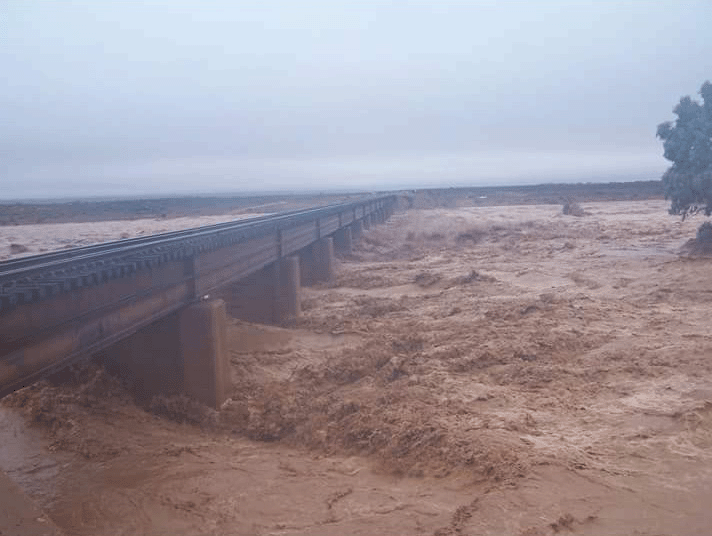
It lies in one of the most seismically active regions of Australia. It lies in a zone which is subject to catastrophic flash-flooding and mudflow activity. The area is adjacent to a major saline lake, Lake Torrens, which is a “terminal drainage area”, meaning that all surface and underground run-off from the ranges ends up in the periodically drying surface lake sediments. So the bottom line is that, were such a storage site were to break down within the next several thousand years, radioactive material would end up in the surface sediments of Lake Torrens. Dry desert winds would then have the potential to disperse radioactive dust over large areas which may well be occupied by humans in the future.” https://www.facebook.com/search/top/?q=Fight%20To%20Stop%20Nuclear%20Waste%20Dump%20In%20Flinders%20Ranges%20SA