South Australia’s Liberal Premier “open to nuclear power”
 Marshall still open to nuclear power, IN Daily, 11 April 19 Premier Steven Marshall says establishing a nuclear generation industry in South Australia is not on his “short-term” radar but it could “come back onto the agenda further down the track” as he considers “every option to ensure we have lower energy prices”.
Marshall today embarked on his third regional tour since seizing office at last month’s election, visiting the South-East seat of Mount Gambier where Liberal-turned-Independent MP Troy Bell is a firm advocate for nuclear power.
Marshall and Bell broke bread this morning, their second face-to-face meeting since election day.
Bell quit the party after being charged with dishonesty offences following an ICAC investigation. He is pleading not guilty in an ongoing court case.
Marshall told InDaily he was “looking forward to a close working relationship with all the crossbenchers”, and that Bell was “the duly elected member for Mount Gambier and as such I’ll be treating him with respect”.
“I’ve always worked with Troy Bell… it’s quite obvious we share a lot of common aspirations for the people of the South-East,” he said.
One of those aspirations could yet be the establishment of a nuclear generator after Marshall last year flagged his interest in considering the industry, despite Royal Commissioner Kevin Scarce rejecting it as a commercially viable option “in the foreseeable future”.
“There will be a time when it may become viable, and desperate times call for desperate solutions – and we are in a desperate situation,” Marshall told media in February 2017.
Bell, who spearheaded the Liberals’ South-East fracking moratorium before he left the party-room, is a strong advocate for nuclear power and told InDaily he was “absolutely happy to lead the discussion” about establishing a local 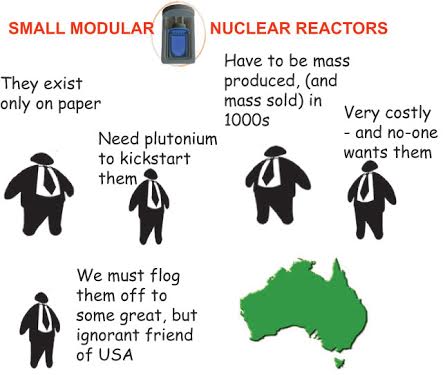 industry.
Asked if he would advocate for a nuclear generator in the South-East, he said: “A small modular one – yes definitely.”…..
Bell said he was “very interested” in the nuclear option, insisting that “with modern technology and advancements there’s more discussions that need to be had in that space”.
“The problem is nobody wants it in their backyard,” he said.
……….Marshall told InDaily today nuclear power was “not on the short-term agenda of the Government”.
“We’ve got a very robust plan for energy [and] we’re already well on the [record] for saying we want to be neutral on that issue,” he said……https://indaily.com.au/news/local/2018/04/11/marshall-still-open-nuclear-power/
South Australia’s record prolonged heat wave
 Prolonged SA heat could break records, Herald Sun Caitlin Guilfoyle, Australian Associated Press, April 7, 2018
Justine Major: Radioactive waste dump should NOT be on agricultural land -Submission to Senate
Both these documents show that the facility should not be located on agricultural land, and yet both nominated sites at Kimba are specifically located on farms. Directly next to farming country, and entirely neighboured by productive farms.
 Submission to Senate Inquiry: Selection process for a national radioactive waste
  management facility in South Australia by Mrs Justine Major I am a fourth generation farmer in Kimba, South Australia. I have a strong understanding of the project being put forward for consideration, and whilst am not against the idea of the consolidation of radioactive waste into one facility, I do not believe it needs to be located in a food producing region. Personally, this process has been one of ongoing stress, additional workload and a steep learning curve into the political machinations of an Australian Government project.
Please find following my response to the Terms of Reference of this Inquiry.
B) How the need for ‘broad community support’ has played and will continue to play a part in the process, including; a. The definition of ‘broad community support’, and b. How ‘broad community support’ has been or will be determined for each process advancement stage;
The definition of ‘broad community support’ has been a moving target that has never been clearly defined in the Radioactive Waste Management Facility project. The hallmarks of a well developed project include the establishment of standardised measurable milestones that allow all stakeholders to have a clear understanding of the path being traversed as well as clear acknowledgement that these milestones have or have not been achieved. The constantly moving goal posts throughout this process has been an ongoing source of frustration to those of us trying to work within the Governments framework.
Despite numerous requests, the Government has continued to refuse to provide clarity around what factors would be included in their consideration when determining if broad community support had been achieved; what weighting each of the factors would contribute to this outcome, or what the required result in percentage terms was necessary to allow this process to proceed to the next stage
There has been an ongoing lack of clearly defined, factual, measurable targets that are defendable from both sides of the debate, accepted by both sides of the debate and not able to be influenced by the results put before it. The Minister advised that the vote would not be the only determining factor for progressing the Kimba site through to the second stage, however when looking at the statistics surrounding alternate factors it is hard to see where any other factor has been included. All media that I have seen surrounding Minister Canavans decision simply continued to reference the 57.4% in favour of progressing result of the vote. Based on the data included in the “National Radioactive Waste Management Facility (NRWMF) Phase 1 Summary Report, Kimba 2017” showing the results of the community consultation on which the decision to progress to Phase 2 was made, written submissions received throughout this phase were seen to be 86% opposed to the facility. Had both factors been taken into consideration equally, there would have been 35.7% approval rating to this project. Should we even provide a 20% weighting to the written submissions and 80% weighting to the vote, the outcome would achieve a 48.7% approval. None of this comes close to being “broad community consent”.
Another area included in “broad community support” is supposedly the opinions of neighbours. In the first round of community consultation the definition of neighbour, was any property or person within a 10km radius. When the second round of community consultation occurred in December 2016 it was reduced to neighbours within a 5km radius, and at the time of the vote the definition of neighbour was those who immediately bordered the nominated parcel of land. This continuous shift in parameters appears to me to have occurred in order to reduce those included in the sample of neighbours, resulting the Department able to make the statement included in the “National Radioactive Waste Management Facility (NRWMF) Phase 1 Summary Report, Kimba 2017” that “Neighbour support around the proposed sites is strongly supportive”. This ongoing lack of defined measureables and the Ministers ability to make a decision as to what the pass mark is after the results have been declared is disingenuous.
D) Whether and/or how the Governments ‘community benefits program’ payments affect broad community and Indigenous community sentiment;
The removal of incentive payments would absolutely change the support levels found within a community. The idea of the Radioactive Waste Management Facility being sited in Kimba was promoted along the lines of “think what this money could do for us”. All the way through this process has been a money grab. There is anecdotal evidence of people saying that they would vote “Yes” to going through to the second round of this process in order to receive the $2M Community Benefit Funds, with the plan to say “No” at the next vote. They have no intention of wanting the facility located at Kimba, but think they are playing a game whereby they can “get $2M for nothing”.
There is speculation of strategies in play to prolong the Phase 2 process to ensure it pushes into the second financial year in order to gain a further $2M. For those of us who are against the location of this facility in the Kimba region, regardless of the funds thrown around, this is a difficult process. We are defending our position against the facility being located in our region, with genuine concern regarding our business and livelihoods, whilst community members are playing a game to access funding. I also believe that the $10M one-off payment included in the Act will be paid to the State Government has not been clearly highlighted throughout this process. Most people within the community believe the money will be coming to the community directly, with complete access to, and management of, the funds. When people discover this money is to be paid to the State Government, their opinion on the matter changes very quickly.
F) Any other related matters
The Code for Disposal of Solid Radioactive Waste provided by ARPANSA clearly states that the siting of a Radioactive Waste Management Facility should not be on agricultural land: “Section 3.1.29 (a) the immediate vicinity of the facility has no known significant natural resources, including potentially valuable mineral deposits, and which has little or no potential for agriculture or outdoor recreational use.”
The National Radioactive Waste Management Facility, Nomination of Land Guidelines, November 2016 also clearly states in Attachment A, Section A8 under the Community Well Being Objective the criteria: “Is the site located within an area that is likely to be expanded upon for community or industrial use or for natural/agricultural use in the foreseeable future”. The weighting to this criteria when taking site selection into consideration according to the guidelines was stipulated as “High”. Both these documents show that the facility should not be located on agricultural land, and yet both nominated sites at Kimba are specifically located on farms. Directly next to farming country, and entirely neighboured by productive farms. That this part of the ruling is not being enforced is beyond me. It would be apparent to most people that under best practice the production of food should be separated from the production or storage of nuclear waste. That it is not the case in other countries does not provide adequate reason as to why Australia should lower their standards with regards to this. It is imperative that this part of the legislation is upheld and made mandatory, rather than being optional.
South Australia’s new Liberal MP Dennis Hood will push for nuclear dump
Defecting Lib MP to push for nuclear dump
New Liberal MP Dennis Hood will agitate for the State Government to revive plans to store high-level nuclear waste in SA, after he abandoned Cory Bernardi’s Australian Conservatives in a shock post-election move….
Joining the Liberals enhances Mr Hood’s chances of securing another eight-year term at the 2022 state election. The Conservatives had a poor showing at this month’s election and it appears unlikely their Upper House candidate, Rob Brokenshire, will be returned.
Mr Hood said his old party’s 3.5 per cent Upper House vote “is not going to get anyone anywhere”.
“If you want to stay with something that’s heading down that path, then pretty soon you will find that they have no members in parliament and no impact,” he said.
Mr Hood said still supported the expansion of nuclear industries in SA, despite Mr Marshall rejecting the proposal over fears it would expose taxpayers to high risk.
“One of the great things about the Liberal Party … is it is okay for individual members to disagree on policies,” Mr Hood said. “I do support a nuclear waste repository in SA. “I will support the party position.
“That doesn’t mean that I won’t agitate internally for that position. In fact, I will. http://www.adelaidenow.com.au/news/sa-election-2018/australian-conservatives-south-australian-upper-house-member-dennis-hood-to-join-liberals/news-story/98314affd5cba34c71ea63b0654543b0
Dumping nuclear waste is illegal in South Australia: South Australians will resist imposition of dump
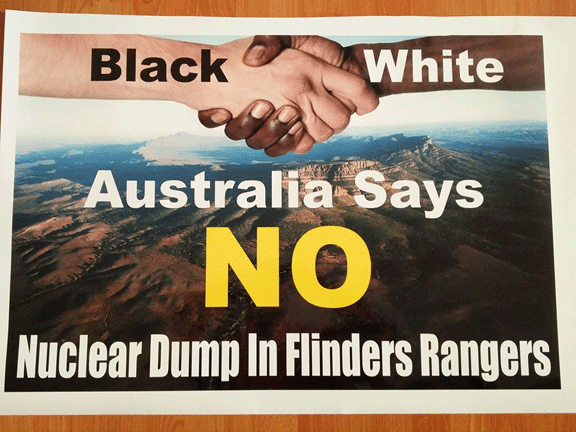
 David Noonan shared a link. Fight To Stop Nuclear Waste Dump In Flinders Ranges SA, 24 Mar 18
www.arpansa.gov.au/code-disposal-solid-radioactive-waste-rp…
Including my brief 3 pager, Summary:
To be credible, a finalised ARPANSA Code must mandate the best practice Principal of Non-Imposition of nuclear waste disposal facilities on community.
It is untenable for this Code to countenance Disposal Facility Siting in an area of special cultural heritage significance to Aboriginal people. Proposed NRWMF siting in the iconic Flinders Ranges must stop. A finalised ARPANSA Code must respect Aboriginal people’s rights and interests.
ARPANSA needs to recognise the Storage and Disposal of nuclear wastes affects the rights, interests and safety of all South Australians and is prohibited in our State under the Nuclear Waste Storage (Prohibition) Act 2000.
Any imposition of Disposal Facility Siting in SA will be strongly resisted by community across SA.
at: https://www.arpansa.gov.au/…/4206–62d45b57e7ea1b50ccb30956… https://www.facebook.com/groups/344452605899556/
Anniversary of radiation accident at Lucas Heights – a warning to South Australia
 Paul Waldon No Nuclear Waste Dump Anywhere in South Australia, 18 Mar 18
 High Level nuclear waste by the name of Intermediate Level is just as corrosive to “dry cask containers”
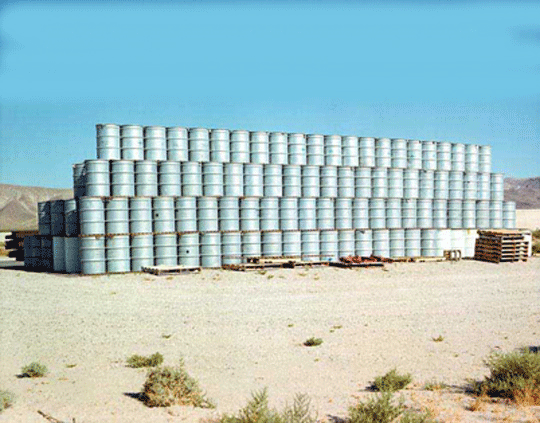 Paul Waldon Fight To Stop Nuclear Waste Dump In Flinders Ranges SA “A rose by any other name would smell as sweet.” High Grade waste by any other name would be such a risk.
There has been one, only one successful test of a dry cask to find its safe threshold and that was a recorded drop from 10 meters, all other tests have failed to record the threshold for compromising a dry-cask.
Holtec industries had a reported failure in nine yes 9 different areas of construction of dry-casks, about the time Australia had some nuclear fuel vitrified, so ask yourself did we buy a poor quality dry-cask. Hidry buildup on nuclear fuel and its cladding in the dry-cask is a forever real explosive threat to the integrity of such containment vessels, this has a problem with no current tests able to monitor such issues.
The nuclear industry has acknowledged that stainless steel is susceptible to Chloride induced corrosion with cracking of dry-casks. These minor cracks are likely to develop into truwell cracks that can compromise the dry-casks. The president of one company that produces dry-casks for the nuclear industry whom was present at a Citizens Engagement Panel meeting in Orange County was reported to say “If there was a truwell crack, even a microscopic crack million of curies of radiation would escape through the crack, and it would be impossible to get near the canister or repair it, and he went on to say its not practical to repair these things when they start cracking.”
Transportation of the dry-casks in America is dangerous and illegal if the fuel or cask is damaged. https://www.facebook.com/groups/344452605899556/
An angry response from Eyre Peninsula resident to media coverage of South Australia nuclear dump plan
 Rebecca Higgins Fight To Stop Nuclear Waste Dump In Flinders Ranges SA, 24 March 18 On the news last night they made it sound like the dump was just a question of WHERE not IF.
This new government is pushing hard and fast. As someone living on the Eyre Pen. I am 100 percent opposed to this and can not understand why a few money hungry farmers in kimba get a vote and we don’t.
This will affect all of us we should all get a vote. Those of us not benefiting from this toxic nightmare would surly oppose it. Anyone with half a brain can see this is both unnecessary and dangerous. Anyone in Kimba who thinks this is a good thing needs a lobotomy and FAST. Greedy bastards. Ranges SA https://www.facebook.com/groups/344452605899556/
South Australian clean energy businesses launch power-trading platform using blockchain
 Business News 23rd March 2018, A group of small and medium-size South Australian businesses plan to launch a first-of-its-kind power trading platform using blockchain technology in an attempt to save money and buy and sell local clean energy.
Blockchain-based microgrid developer LO3 Energy, of New York, is working on the project with solar and electrical firm Yates Electrical Services, of Paringa, South Australia, a region known for its vineyards, almond and fruit orchards — and incredibly high electricity prices.
The blockchain, perhaps best known as the technology behind the digital currencies Bitcoin
and Etherium, is a decentralized ledger that enables and tracks all transactions across a peer-to-peer network. The technology uses encryption to ensure that transactions and data are secure, and provides verification and validation to users.
https://www.businessgreen.com/bg/news/3029020/south-australian-businesses-launch-blockchain-app-to-cut-costs-trade-local-clean-energy
South Australia’s new Liberal Premier Marshall backs nuclear waste dump, despite community discord
 SA Government indicates support for nuclear waste dump as communities remain split about proposal http://www.abc.net.au/news/2018-03-23/sa-gov-backs-nuclear-waste-dump-amid-community-tensions/9262948
New Premier Steven Marshall made the comments this week after his cabinet was sworn in at Government House.
“That’s a federal issue. We need to be assured the host community is satisfied with that,” Mr Marshall said.
“The Labor Party has held the same position that we have.”
The Federal Government is looking to store low-level nuclear waste and temporarily store intermediate level waste at one of two locations near Kimba, or one at Barndioota, near Hawker, in the Flinders Ranges.
The Australian Radiation Protection and Nuclear Safety Agency (ARPANSA) held informal community consultations in both towns this week.
ARPANSA is the independent federal agency that would assess any application made by the Federal Government for a nuclear waste repository.
The ABC understands the Federal Government wants to make a decision on the location of the nuclear waste facility before the end of the year.
Kimba community split over proposal
Kimba local Audrey Lienert opposes the facility, but attended the ARPANSA session to gain further information about the process.
“It has split the community terribly,” Mrs Lienert said.
She said there was a common concern among those who did not support the facility at Kimba.
“If the word gets out that we’ve got nuclear here in our farming land, what [will] our market be overseas, and what will that do to our prices?”
But not all locals are against the proposal.
Lifelong Kimba farmer Trevor Cliff said the economic benefits could not be overstated for the small farming community of 600.
“Every country town is struggling with numbers. It’s hard to attract industry,” Mr Cliff said.
“To me, it’s something that can help the town employment-wise.”
He is convinced the facility and the transport of nuclear waste will be safe.
“I’m very happy to accommodate it here. I have no fear of the actual product.
“It’s well-contained, well before it gets to Kimba.”
He admitted the issue had been contentious, but disputed the town had been split.
“One of my best mates, he’s trapped on the no side and we talk about it,” Mr Cliff said.
“He can have his side, and I say my side — that’s democracy for you.”
Hawker locals battle over culture and economic growth
The Flinders Local Action Group (FLAG) comprises members who are against the facility being built in the Flinders Ranges.
FLAG member Greg Bannon said the group was strongly opposed to the potential Wallerberdina Station site near Hawker.
“That stretch of land between Lake Torrens and the ranges is totally unsuitable for something that will have to be managed for at least 300 years,” Mr Bannon said.
He pointed to further concerns from local traditional owners, the Adnyamathanha people, and regular seismic activity in the region as more evidence the site was poorly suited.
But Barndioota Economic Working Group chairman Malcom McKenzie said the potential for jobs could not be understated.
“If everything’s all safe to do I’m for that facility to go ahead because I want to see jobs for that region,” he said.
“I want to see opportunities for Aboriginal people and for the people of the area. And it’s a great opportunity I think we’re going to proceed with.”
ARPANSA’s role ‘informal’ for the momentARPANSA chief executive Carl-Magnus Larsson said the organisation would assess any application carefully.
“A facility will not go ahead unless we’re convinced it can go ahead and that protection of health and safety of people is taken care of,” Dr Larsson said.
He stressed recent meetings between the communities and ARPANSA had been informal because no official application had been lodged by the Federal Government.
He said if the agency were to receive an application, it could take between six and 12 months to decide whether to grant a licence for the facility.
A federal Senate inquiry into the process of site selection is ongoing, with submissions closing on April 3.
The findings of the inquiry are due in August.
Floating solar array included in South Australia Water’s big move into solar power
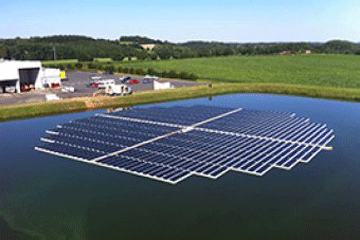 SA Water set to add another 5MW solar, including floating PV array http://reneweconomy.com.au/sa-water-set-add-another-5mw-solar-including-floating-pv-array-85781/ By Sophie Vorrath on 22 March 2018 One Step Off The Grid
South Australia’s largest water and sewerage services supplier, SA Water, is set to install another 5MW of solar PV, including a floating solar plant, after local outfit Enerven was awarded the tender for the job.
Enerven said on Wednesday that it had won a Stage 1 contract to design and construct ground-based solar installations at facilities in Hope Valley, Christies Beach and Glenelg, and to develop a floating solar PV array.
SA Water, which has targeted zero net energy by 2020, began its shift to solar last year, with a tender to install 100kW solar and 50kWh battery storage at its Crystal Brook Workshop site.
The utility, which manages more than 27,000km of water mains, including 9,266 km in the Adelaide metropolitan area, said it was installing the solar and storage system to manage periods of high electricity prices, and to ensure safe and sustainable delivery of water to customers.
Ultimately, the company aims to get its on-site renewable energy generation to the point where it is equal to the total annual amount of energy used by SA Water’s buildings and desalination operations.
And it is not alone in its quest. As we have reported on One Step Off The Grid, a number of Australian water utilities are turning to solar and/or wind energy to lower costs and help guarantee supply.
In Queensland, Logan City Council has installed an off-grid solar and battery storage system as part of a micro-grid powered “electro-chlorinator” that will help maintain local drinking water quality 24 hours a day.
The solution – delivered by the Logan Water Infrastructure Alliance and solar installer CSR Bradford – combined a 95kWh Tesla Powerpack with 323 PV panels at the site of the relatively new 20 Megalitre Round Mountain Reservoir, which provides drinking water for residents in Flagstone, Yarrabilba, North Maclean, Spring Mountain and Woodhill.
In the regional Victorian city of Portland, Wannon Water has installed a 100kW solar system on a water tank at its treatment plant at Hamilton that was expected to cut the plant’s grid electricity consumption by 25 per cent.
In NSW, a community-funded 100kW floating solar array has been installed at the East Lismore Sewage Treatment Plant in NSW.
And Queensland’s City of Gold Coast is proposing to install a series of floating solar PV arrays on its network of wastewater ponds – both to help power the city’s wastewater treatment plants and to cut evaporation from the ponds.
Enerven says design of the SA Water solar project has commenced, and is due for completion in September 2018.
This article was originally published on RenewEconomy’s sister site, One Step Off The Grid, which focuses on customer experience with distributed generation. To sign up to One Step’s free weekly newsletter, please click here.
Leave Lucas Heights nuclear waste AT Lucas Heights – Mark Parnell
 Fight To Stop Nuclear Waste Dump In Flinders Ranges SA 20 Mar 18, “The real game here is Lucas Height’s nuclear waste. …. It’s been at Lucas Heights for decades, it can stay there. We don’t need to move it to South Australia” At least one of our politicians “gets it”. Marc Parnell on ABC radio yesterday. I know many people here don’t like the Greens. For those people, listen to the video below (last 2 minutes), write down his words and then send them to your favourite Labor/Liberal politician until they “get it” too. https://www.facebook.com/abcadelaide/videos/10160320509745604/
“Rather than looking for a site, we need to go back to first principles and say “what waste are we talking about?”, “where is it currently stored?”, “and is there a pressing reason to move it somewhere else?”. Now people talk about medical waste and hospital waste most of that ends up in landfill because it is very short lived radioactive isotopes.
A powerful statement of warning against a nuclear waste dump for Kimba, south Australia
Heather Pepper ABC North and West 21 Mar 18 Don’t listen to them ! Nuclear waste stored in farm land areas or underground water areas will not be safe. The radiation will leak and enter the food chain.
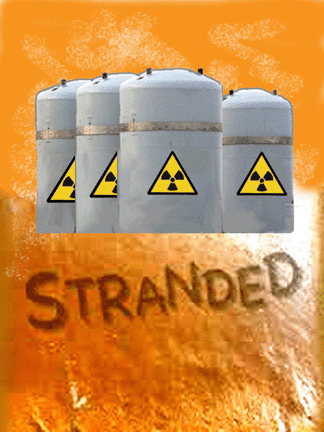 They intend to store this waste in metal barrels above ground until scientists can come up with a feasible way to store it underground.
Remember South Australia had a huge conference and committee over this very issue and at the end it was a resounding No!
This information is all available on the government website unless the liberals have removed it. It was very interesting and extremely frightening reading. Just remember also that this waste will be shipped across Australia from all the other states who point blank refuse to have it stored in their states either by rail, trucks and ships!
Our roads are already a disgrace and a death trap with many of these routes that they will take going  through little farming towns , can you imagine the fallout if there was an accident? The aim of the federal government has always been for South Australia to take not only Australia’s waste but also the worlds waste but couldn’t push this through under a labor government but now no matter what we the people say about this matter it’s going to happen and Turnbull and co are laughing all the way to retirement!
This mess will be with South Australians for thousands of years as that’s how long it will take o naturalise the waste to a harmless waste. Boy if you thought SA was the joke of the country before wait till this becomes a reality. https://www.facebook.com/northandwest/?hc_ref=ARR9p52A9mIR0O7YlgghLJngxi5oyS8ri4yZAnl1Gyx2tRtSXM_iMQaqCySvzM57kiQ&fref=nf&hc_location=group
Busting the pro nuclear spin to regional South Australia, by the visitors from Lucas Heights
 Roni Skipworth ABC North and West 21 Mar 18, The very first meeting re Waste Dump in farmland of Kimba thru Rowan Ramsay’s idea to put on his land or in Buckleboo area a small railway siding, the old RAH came into the conversation. They told the audience the Hospital will be demolished since there are high Nuclear Wastage within from Nuclear Medicine eg masks aprons gloves clothing. The bricks n other building materials will be crushed n loaded in drums.
Since that idea collapsed as it would’ve been Conflict of Interest on Rowan’s side. Then these 2 new sites have come up on the table, my suspicion is these people who own the properties are friends of Rowan Ramsay. I live 79kms away from Kimba, 30kms from one property who has put their land up to be destroyed as it is closer to the Wudinna Shire boundary than Kimba itself.
These visitors from Lucas Heights are bullshitting us South Aussies as their lease is drawing to a close and need to move because of surrounding land being turned into residential and it’s been outgrown.
Now that Liberals are everywhere the fight to not have it in the sites earmarked is going to be harder with Rowan rubbing his hands together n pushing either sites in Kimba because in the end people only see the $$$$ signs instead of the destruction of Mother Earth, some of the best farmland in the Kimba Shire and the people who live and travel through Kimba.
I wonder what will happen when there is a leakage n contaminated areas as Kimba is situated in the middle of Aust between Sydney and Perth. What happens the area gets contaminated? Vehicles travelling on Eyre Hwy (a few years ago I did a Tourism Course and found out over 24 hour timeframe 1400 vehicles travel on Eyre Hwy) won’t be able to travel thru this area.
I would like to know where r the other sites around Australia where they have put there hands up to have a Waste Dump Site. Also it isn’t just up to the Community of Kimba or Hawker it is up to the residents of South Australia.
Typical Gov of State Federal and Local Council trying to isolate the decision. It is up to all of US https://www.facebook.com/northandwest/?hc_ref=ARR9p52A9mIR0O7YlgghLJngxi5oyS8ri4yZAnl1Gyx2tRtSXM_iMQaqCySvzM57kiQ&fref=nf&hc_location=group

Nuclear propaganda tour across regional South Australia – AUSTRALIAN RADIATION PROTECTION AND NUCLEAR SAFETY AGENCY
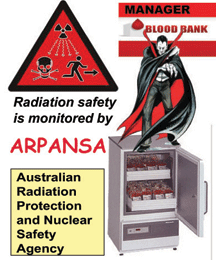 ABC North and West 20 Mar 18 AUSTRALIAN RADIATION PROTECTION AND NUCLEAR SAFETY AGENCY BEGIN WEEK LONG ROAD TRIP ACROSS REGIONAL SA
Do you believe regional SA should be home to a nuclear waste management facility?
Federal Government agency ARPANSA visited Kimba last night, and will visit Hawker in the Flinders Ranges later in the week.
The Kimba community is divided on the issue, with local Audrey Lienert saying she’s concerned about what the facility will do to farming land.
But ARPANSA’s Chief of Radiation Services, Gillian Hirth says locals have nothing to fear, and the organisations primary aim is to protect the community and environment from the harmful effects of radiation. https://www.facebook.com/northandwest/?hc_ref=ARR9p52A9mIR0O7YlgghLJngxi5oyS8ri4yZAnl1Gyx2tRtSXM_iMQaqCySvzM57kiQ&fref=nf&hc_location=group
1 This month

of the week – Australians for War Powers Reform (AWPR)
To see nuclear-related stories in greater depth and intensity
 Antinuclear