 Heather Mckenzie Stuart Fight To Stop Nuclear Waste Dump In Flinders Ranges SA, 5 May Why is ANSTO and DIIS bringing a yaninjanha yura from Darwahl tribe in NSW to Hawker in the Flinders Ranges, making trouble saying urdnus are the only ones protesting against the proposed nuclear waste dump at Barndioota and are using yuras?
We go to protests and we will keep going to protests we will stand against the vartani. Anyway who gives that man the right to come here and talk in Adnyamathanha country, Wilyaru mirus and Adnyamathanha artuyani yarta. This is our ancestors lands, he has no shame we wouldnt go and talk in his yarta about his country. Dont come here pushing a nuclear waste dump on us, keep the poison in your country. You ANSTO and DIIS keep that yura in his country and let him dribble his rubbish over there in NSW. Hands off our sacred sites and stay in your yarta!! Ps his cultural consultancy means nothing to us, he want to stay at Lucas Heights.
May 5, 2018
Posted by Christina Macpherson |
aboriginal issues, Federal nuclear waste dump, South Australia |
Leave a comment
 Colin Mitchell Submission to the Senate Standing Committee on Economics re the selection process for a national radioactive waste management facility from Colin Mitchell (independent campaigner)
I believe that the site selection process for a national radioactive waste management facility (NRWMF) is flawed because:
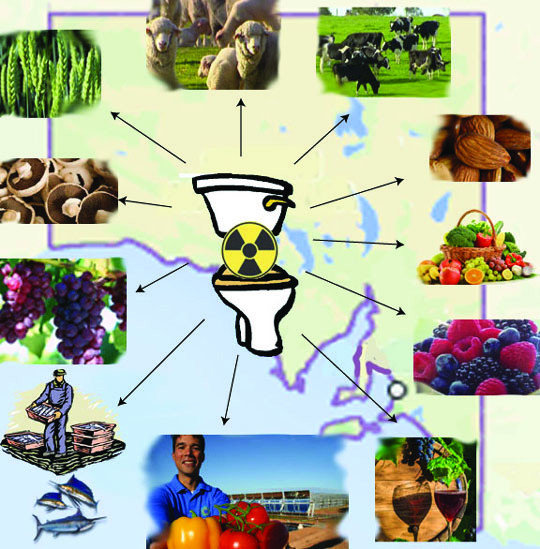
- The notion of ‘broad community support’ is considered far too narrowly as applying only to the local community.The NRWMF is a National project which could have environmental consequences extending far beyond the local community to encompass large areas of SA and beyond into other States of Australia, potentially effecting the whole nation. For example, leakage of radioactive material into the water table could spread over time causing disastrous effects on human and animal health, as well as agricultural crops. Also escape of radioactive material into the atmosphere could have similar negative consequences across wide areas of Australia and beyond. This is a decision which involves far more than the welfare of the immediate local community, rather the welfare of all the people of SA and all the people of Australia should be considered.
Recommendations: ‘Broad community support’ should extend to include the people of SA as a whole. Community opinion in other States of Australia should also be considered
Community support should be gauged by multiple methods including wide-ranging telephone and internet polling, acceptance of petitions and public meetings in Adelaide and all other major cities and towns in SA.
This process should be carried out by an independent body, not controlled by the government organisations involved in the establishment of a NRWMF. (ie not controlled by ANSTO or ARPANSA)
The consultation process should be thorough, be conducted over a long period (suggest a year) and incorporate the provision of full and open information about the project, including plans for both the low-level waste disposal facility and the above-ground store for intermediate level waste to be co-located at the same site.
The establishment of a NRWMF should not proceed without overwhelming support from the population of SA – at least 90% – (as well as 100% support from the local community), because the consequences of an unwise decision, flaws in the design of the facility, accidental releases of radioactive material, or an inability to properly maintain the facility over hundreds or even thousands of years, could be extremely serious to present or future generations.
- The site-selection process is also also flawed because insufficient information about the proposed NRWMF has been provided to the communities consulted. There has been a lack of transparency and bias in the presentation of information.1. Emphasis has been placed on medical isotope waste and there is insufficient information about the proposed co-location of intermediate level nuclear waste from Lucas Heights at the same site. The consultation process is deceitful because of the bias towards discussion of only the low-level waste and failure to properly inform the community about the colocation of Intermediate – level waste.
Recommendation: The co-location of Intermediate level nuclear waste should be mentioned every time the NRWMF is mentioned to avoid the false impression that this is only a low-level waste facility.
2. the communities have not been informed that the Intermediate-level waste to be colocated at the site is much more highly radioactive and has to be isolated for thousands of years compared with hundreds of years for low-level waste.
3. There are no plans presented for the “temporary” above-ground store to hold the intermediate-level waste.
4. The communities are not informed how the intermediate level waste is to be dealt with after “temporary” storage. There are no plans presented for long-term storage or final disposal of this waste.
5.The communities are not informed that the intermediate-level waste may be later disposed of in a deep geological disposal facility which may be built at the site of the NRWMF.
6. The communities are not informed that the construction of a deep geological disposal facility may lead to the importation of intermediate and high level nuclear waste from overseas in the future ie an international nuclear waste dump on the site (as advocated by government advisor Richard Yeeles in his submission to the recent Nuclear Fuel Cycle Royal Commission in SA “……it is open to your Royal Commission to recommend that the South Australian Government actively pursue the State’s further involvement in the nuclear industry with an initial focus on national and international radioactive waste management…….That as a demonstration of its strong interest in, and commitment to the further development of a safe and sustainable Australian nuclear industry, and as a first step in such further development, the South Australian Government offers to host a national facility for the storage and disposal of Australia’s own low and intermediate-level radioactive waste with the ultimate aim of securing Federal Government support for hosting an international radioactive waste management facility in South Australia.”
R.Yeeles, submission to Nuclear Fuel Cycle Royal Commission.)
- By failing to properly inform the communities about the co-location of the intermediate level waste the consultation process leaves itself open to the charge of deceit and thus undermines trust in the process and the agencies conducting the process as well as the government.
- Hazards of transporting nuclear waste over land/water are not being considered.
- Communities are not informed that intermediate-level waste can be securely stored at Lucas Heights itself. There is no advantage to moving this waste to another location and in fact moving the waste increases the risk of hazardous spills.
- Communities are not informed that there is not general agreement that a NRWMF is needed at all in Australia. They are not informed that there is a significant body of opinion that Australia’s nuclear waste should stay where it is and that, in particular, the intermediate-level waste at Lucas Heights is best stored at Lucas Heights where there are the resources and expertise to store this waste securely as it has been for many years. They are not informed that there is a significant body of opinion that there is nothing to be gained from moving this waste across country to another location because it is not presently known how to safely dispose of intermediate or high-level radioactive waste for the thousands of years it remains dangerously radioactive.Recommendation: the deficiencies in the information provided to communities mentioned above should be remedied. An independent community consultation body should be created which can provide full information on the proposed NRWMF in an open transparent manner including plans for the low-level facility and the intermediate-level above-ground store. This body should be independent from ANSTO or ARPANSA.
April 28, 2018
Posted by Christina Macpherson |
Federal nuclear waste dump, South Australia |
Leave a comment
 Disease threat forces SA Health to prioritise adapting to climate change
HEALTH threats from extreme weather events and diseases spread by mosquitoes have prompted SA Health to prioritise adapting to climate change in a new blueprint. http://www.news.com.au/technology/environment/climate-change/disease-threat-forces-sa-health-to-prioritise-adapting-to-climate-change/news-story/fc734296a4580dda2c60320f8e8ac463#.ajdi8 Matt Smith
Chief medical officer Paddy Phillips has told The Advertiser the frequency and severity of heatwaves and bushfires, and the increased risk of the spread of disease by insects and bugs, meant climate change threatened the wellbeing of South Australians.
His warning comes as SA Health released its draft State Public Health Plan for the period from 2019-2024. Professor Phillips said multiple government agencies needed to consider the impact of climate change when developing policies and strategies to manage and prevent public health risks.It should also be front of mind when agencies assessed the suitability of health infrastructure and assets.
“Variations in our climate have increased the frequency and severity of weather events such as floods, droughts, bushfires, storms (and) periods of extreme heat, as well as the spread of vector-borne diseases,” Prof Phillips said.
“These events threaten the wellbeing of our communities, especially in vulnerable populations.”
Increases in diseases transmitted by mosquitoes, sandflies, triatomine bugs, blackflies, ticks, tsetse flies, mites, snails and lice have in recent years been linked to climate change on Australia’s east coast.
The draft report, that has been published for public consultation, lists four priorities:
CREATE healthier neighbourhoods and communities.
PROTECT against public and environmental health risks and adapt to climate change.
PREVENT chronic disease, communicable disease and injury.
FURTHER develop and maintain the statewide public health system.
Health and Wellbeing Minister Stephen Wade said he would review the plan, which was drawn up on the watch of the former Labor state government, to determine if any additional issues needed to be addressed. Mr Wade welcomed the inclusion of climate change as a priority. “It is prudent for public health plans to consider the impact of climate change,” he said.
SA Greens leader Mark Parnell said a suite of measures, including better town planning and the design of individual homes to be more resilient to changing climatic conditions, was needed.
That would help South Australia adapt to the challenge of climate change.
“We know that with a hotter climate comes more health problems including increased hospitalisations and premature deaths from increasing heatwaves,” he said.
April 27, 2018
Posted by Christina Macpherson |
climate change - global warming, health, South Australia |
Leave a comment
 No nuclear waste groups stand together, https://www.eyretribune.com.au/story/5362658/no-nuclear-waste-groups-stand-together/ 24 Apr 18
No nuclear waste dump groups from Kimba and the Flinders Ranges came together in Port Augusta last week in response to the recent announcement by federal Resources Minister Matt Canavan that a community vote for a planned national radioactive waste management facility would begin on August 20.
The groups discussed shared concerns and committed to increase their efforts against the plan including through an open debate featuring the federal department, the Australian Nuclear Science and Technology Organisation (ANSTO), Traditional Owners and public policy and health professionals.
People at the meeting included Adnyamathanha community members, representatives from Kimba, Hawker, Whyalla and Quorn along with members of the Flinders Local Action Group and No Radioactive Waste on Agricultural Land in Kimba or SA.
Peter Woolford from Kimba said the “flawed federal process” was failing the communities.
“Minister Canavan is fast-tracking a plan that does not have broad community support”.
The groups committed to highlight community concern and opposition to the federal plan ahead of the August vote and urged residents in the wider region to stand up and speak out.
Former federal member for Grey Barry Wakelin said it was a national issue, “not something that a regional community should be left to deal with”.
“The current federal plan lacks evidence and poses a threat to our existing industries – we need a better way,” Mr Wakelin said.
“This has been a productive meeting and it is heartening to see regional South Australians stepping up to the challenge, taking action and working together.”
April 25, 2018
Posted by Christina Macpherson |
aboriginal issues, Federal nuclear waste dump, opposition to nuclear, South Australia |
Leave a comment
 Selection Process for a National Radioactive Waste Management Facility in South Australia – Submission From: Barngarla Determination Aboriginal Corporation ICN 8603 : 3 April 2018
The Barngarla Determination Aboriginal Corporation (BDAC) is the prescribed body corporate for the Barngarla native title holders as defined in the Barngarla Determination of Native Title made by the Federal Court in Croft’ on behalf of the Bamgar/a Native Title Claim Group v State of South Australia (N0 2) [2016] FCA 724 (SAD 60/11/998) on 23 June 2016.
We attach a map [on original]of the Barngarla Determination Area, as Schedule I. It clearly shows that the Barngarla are the native title holders for the two nominated sites near Kiinba, namely the Lyndhurst and Napandee nominated sites.
BDAC believes that community consultation in relation to the site selection rocess for a National Radioactive Waste Management Facility (NRWMF) has been patently inadequate, bordering on non-existent.
We hold this view given the lack of contact by the Federal Government and the Department of Industry, Innovation and Science (the Department) from the outset. The chronology of consultation is contained in our letter to the Department of 21 February 2018 (which is attached [on original] along with all other correspondence as Schedule 2), for the sake of ease of reading we reproduce a version of it below:
On 7 April2017, three months after the Lyndhurst and Napandee sites were nominated, Barngarla made contact with the Department. Prior to this letter, the Department had made no contact with the Aboriginal traditional owners or native title holders of the area.
Notwithstanding this complete lack of contact, the Department was asserting that there were no Aboriginal heritage issues in the area. Therefore, the Barngarla letter of 7 April2017 sought to correct the Department and indicated that Barn aria needed to be engaged with. Barngarla further indicated that the failure to consult to date was unacceptable.
On 4 May 2017, Barngarla received a pro forma letter from Mr. Bruce Wilson (the date April2017 had been crossed out with May inserted). The letter contained three general paragraphs and did not in any way address the Barngarla’s concerns.
On 10 July 2017, Barngarla sent a response to Mr. Wilson, requesting s ecific information on the following:
ll proposed activities, which the Department seeks to undertake for the purposes of the proj’ect, ‘what protocols, if any, the Department intends to apply in respect of Aboriginal Heritage; and Selection process for a national radioactive waste management facility in South Australia Submission any assessment that the Department has undertaken in respect of the impact of the proposal on Aboriginal Heritage in the Bamgar/a Determination Area.
On 14 August 2017 (originally dated 11 August, with the 11 crossed out and replaced with a hand written 14), Barngarla received a particularly uriconstructive letter from Mr. Bruce MCCleary. We do not repeat it here, but a longer description of this letter i contained in our letter of 21 contained in our letter of 21 February 2018.
Barngarla responded to the 14 August 20171etter, on 13 October 2017, providing the Department with all of the information (that the Commonwealth already had) indicating the status of BDAC, and Norman Waterhouse’s role as the Solicitors for Barngarla.
Barngarla did not receive a response to their letter of 13 October 2017. The next item of correspondence we received was a further pro forma letter from Mr. Bruce MCCleary, dated 31 October 2017, confirming the Solicitor for Barn arla’s a arent “nomination” for the Kiinba Consultative Committee (although Mr Llewellyn-Jones himself did not nominate for this Committee). It is obvious from reviewing the correspondence, that this letter was not a response to any of the letters sent by Bamgarla and was just a misaddressed pro forma letter of no substance.
Bamgarla received no further correspondence from the Department in 2017
Barngarla finally received a letter on 20 February 2018, congratulating BDAC for its status as a PBC (somewhat out of date, given that this had occurred approximately one year earlier) and advising that the Department would like to present to the BDAC Board. However, this letter.
Did not address any of the substantive matters raised by Barngarla on 7 A in 2017 or, O July 2017; in particularit does not answer how the Department could assert a lack of any Barngarla Aboriginal heritage given that there had been no discussions or engagement with Barngarla;
Did not answer the express questions put to the Department on 10 July 2017; and ,
Suggested that the first consultation with Barngarla should occur some 14 months after the Lyndhurst and Napandee sites were nominated, even though the Department had been making representations about the Barn aria and Aboriginal heritage during this time.
It is Barngarla’s position that the entire consultation process has been completelyl inappropriate and, in most cases, has involved being copied into pro forma correspondence, which is not relevant to any of the issues raised by Barngarla.
As can be seen above, BDAC has repeatedly contacted the Department to address Barngarla heritage concerns as the traditional owners in the Kiinba area. Correspondence was instigated by BDAC, not by the Department. Again, as indicated above, Barngarla’s most recent letter to the Department on 21 February 2018 provides a chronological outline of BDAC’s communication with the Department. All relevant correspondence is enclosed with this submission.
The correspondence largely speaks for itself, and so forms part of this submission. Most concerning, apart from the Department not having made contact with the Aboriginal traditional owners or native title holders for the area, was the Department’s assertion that there were no Aboriginal heritage issues in the area surrounding Lyndhurst and Napandee. ‘ This assertion was made without any consultation with these traditional owners. Further, Barngarla have repeatedly asked, on three separate occasions, for the Department to provide the basis of this assertion, which the Department has failed to do. It is not the case that there is no Aboriginal heritage in the area. Given the complete inactivity of the Department to engage with Barngarla, BDAC retained out of its own funds, the services of Dr Dee Gorring to conduct a heritage assessment of the area. This took place on 27 February 2018 to 3 March 2018. Preliminary conclusions from Dr Gorring indicated that there are a number of sites that have been identified surrounding the site of Lyndhurst and spanning across to the site of Napandee.
Accordingly, as per terms of reference:
The Department has not even engaged with Barngarla to establish whether there is any relevant Indigenous support for the NRWMF. Therefore, in respect of the Committee’s terms of reference paragraph (c), the need for Indigenous support has so far not played a part in the Department’s site selection process at all in respect of the sites near Kiinba.
The Barngarla are not aware of the Government ‘community benefit program payments referred to in the Committee’s terms of reference paragraph (d). These have therefore had no impact upon the sentiment of the Barngarla Community.
However, irrespective of any community benefit package, Barngarla would not support the NRWMF in the area. This indicates that the Committee’s terms of reference paragraph (b) have not been met; there is no ‘broad community support’ in respect of the NRWMF from Barngarla.
The proposed NRWMF does not have the support of BDAC nor does the NRWMF have the support of the broader Barngarla Community.
As seen above, there has been no appropriate consultation process. The approaches made by BDAC have been rebuffed by a combination of meaningless pro forma correspondence, bureaucratic tangents, and obfuscation, which has resulted in a contrived consultation process completely lacking in transparency.
April 25, 2018
Posted by Christina Macpherson |
Federal nuclear waste dump, South Australia |
Leave a comment
 Paul Waldon –No Nuclear Waste Dump Anywhere in South Australia https://www.facebook.com/groups/344452605899556/

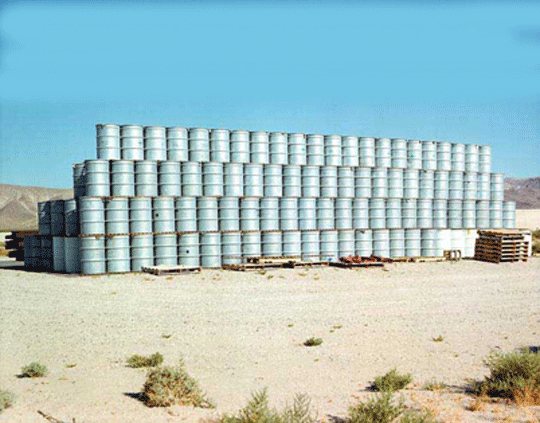
If government can’t show that it can cleanup, or even finance a $30 million cleanup of 9,8000 leaking rusty barrels of radioactive waste abandoned at Woomera, what reason would any adroit person have to believe that the government’s $10 million incentive package to manage a radioactive dump in Hawker or Kimba is nothing more than a 79 cents a week contract to abandon high grade waste under the guise of being called intermediate waste, for the next 244,000 years of its hazard.
April 22, 2018
Posted by Christina Macpherson |
Federal nuclear waste dump, South Australia |
Leave a comment
 Looks like the bribery has been successful. $2M approved for 33 Kimba projects, Eyre Tribune 16 Apr 18
More than 30 projects in the Kimba district will share in $4 million from the National Radioactive Waste Management Facility Community Benefit Program.
Resources Minister Matt Canavan announced the successful projects near Kimba and Wallerberdina Station near Hawker on Wednesday, with 33 out of the successful 45 projects located in Kimba.
The successful projects include big projects such as a new palliative care wing at the Kimba Hospital, and smaller projects like air-conditioning in the Kelly Pioneer Memorial Hall.
The projects vary from new infrastructure and upgrades to existing infrastructure, community projects, feasibility studies and trials.
Mr Canavan said the two communities, which were being consulted about hosting the facility, were invited to submit projects that “deliver social and economic benefits to their area”.
“Two million dollars for each community is a significant investment, designed to help offset the time and resources they are devoting to the detailed consultation program underway,” Mr Canavan said……..
- “Beneficiaries include local sporting clubs, community organisations, and projects focussed on everything from tourism to health, agriculture and mobile phone coverage. ……
-
“Two sites in Kimba and one at Wallerberdina Station volunteered to host the facility, and are currently in a detailed community and technical assessment process.
“The Community Benefit Program is a key part of the process.”…….
https://www.eyretribune.com.au/story/5336162/2m-approved-for-33-kimba-projects/?cs=5806
April 18, 2018
Posted by Christina Macpherson |
Federal nuclear waste dump, South Australia |
Leave a comment
ATLA opposes UCG in Leigh Creek, The Transcontinental, , 16 Apr 18
The Adnyamathanha Traditional Lands Association (ATLA) has declared that “enough is enough”, voting unanimously against underground coal gasification (UCG) in Leigh Creek and the proposed radioactive waste management facility near Hawker.
ATLA CEO Vince Coulthard said it is time to “heal this area, not fill it with poison”.
“We don’t want the dangerous gasification project at Leigh Creek and we don’t want the toxic nuclear waste dump either,” he said.
“Our country has had enough, it is time for healing, we don’t want any further destruction at Leigh Creek.
 “This is a very important Muda (spirituality) and the desecration of this site has to stop.”……….ATLA’s vote against a nuclear waste dump at Barndioota comes after a recent visit to the site by Minister for Resources and Northern Australia Matt Canavan.
The Minister declared that a postal vote would commence on August 20 to measure the community support for the proposed national radioactive waste management facility.
April 18, 2018
Posted by Christina Macpherson |
Federal nuclear waste dump, South Australia |
Leave a comment
 Marshall still open to nuclear power, IN Daily, 11 April 19 Premier Steven Marshall says establishing a nuclear generation industry in South Australia is not on his “short-term” radar but it could “come back onto the agenda further down the track” as he considers “every option to ensure we have lower energy prices”.
Marshall today embarked on his third regional tour since seizing office at last month’s election, visiting the South-East seat of Mount Gambier where Liberal-turned-Independent MP Troy Bell is a firm advocate for nuclear power.
Marshall and Bell broke bread this morning, their second face-to-face meeting since election day.
Bell quit the party after being charged with dishonesty offences following an ICAC investigation. He is pleading not guilty in an ongoing court case.
Marshall told InDaily he was “looking forward to a close working relationship with all the crossbenchers”, and that Bell was “the duly elected member for Mount Gambier and as such I’ll be treating him with respect”.
“I’ve always worked with Troy Bell… it’s quite obvious we share a lot of common aspirations for the people of the South-East,” he said.
One of those aspirations could yet be the establishment of a nuclear generator after Marshall last year flagged his interest in considering the industry, despite Royal Commissioner Kevin Scarce rejecting it as a commercially viable option “in the foreseeable future”.
“There will be a time when it may become viable, and desperate times call for desperate solutions – and we are in a desperate situation,” Marshall told media in February 2017.
Bell, who spearheaded the Liberals’ South-East fracking moratorium before he left the party-room, is a strong advocate for nuclear power and told InDaily he was “absolutely happy to lead the discussion” about establishing a local 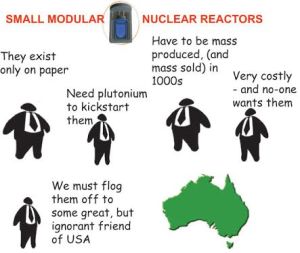 industry.
Asked if he would advocate for a nuclear generator in the South-East, he said: “A small modular one – yes definitely.”…..
Bell said he was “very interested” in the nuclear option, insisting that “with modern technology and advancements there’s more discussions that need to be had in that space”.
“The problem is nobody wants it in their backyard,” he said.
……….Marshall told InDaily today nuclear power was “not on the short-term agenda of the Government”.
“We’ve got a very robust plan for energy [and] we’re already well on the [record] for saying we want to be neutral on that issue,” he said……https://indaily.com.au/news/local/2018/04/11/marshall-still-open-nuclear-power/
April 11, 2018
Posted by Christina Macpherson |
politics, South Australia |
Leave a comment
Prolonged SA heat could break records, Herald Sun Caitlin Guilfoyle, Australian Associated Press, April 7, 2018
A total fire ban has been issued for parts of South Australia amidst a wave of warm weather that could break records.
Above-average temperatures are expected through the weekend until Tuesday and that is “most unusual” at this time of year, Bureau of Meteorology duty forecaster Peter Webb says.
“I think three days over 33 in a row would be a new record, if it happens,” he told AAP on Saturday.
“Prolonged heat like this is pushing the boundaries.”
Temperatures are expected to reach up to 40 degrees in the far west, while the mercury will likely climb into the high 30s in northern parts of the state……http://www.heraldsun.com.au/news/breaking-news/heat-wind-leads-to-total-fire-ban-in-sa/news-story/a7446a9b478d413f0c013deb78cf7bbd
April 8, 2018
Posted by Christina Macpherson |
climate change - global warming, South Australia |
Leave a comment
Both these documents show that the facility should not be located on agricultural land, and yet both nominated sites at Kimba are specifically located on farms. Directly next to farming country, and entirely neighboured by productive farms.
Submission to Senate Inquiry: Selection process for a national radioactive waste 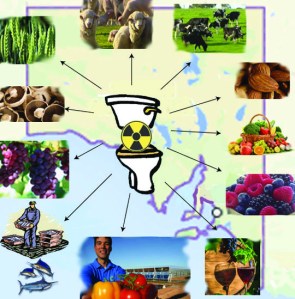 management facility in South Australia by Mrs Justine Major I am a fourth generation farmer in Kimba, South Australia. I have a strong understanding of the project being put forward for consideration, and whilst am not against the idea of the consolidation of radioactive waste into one facility, I do not believe it needs to be located in a food producing region. Personally, this process has been one of ongoing stress, additional workload and a steep learning curve into the political machinations of an Australian Government project.
Please find following my response to the Terms of Reference of this Inquiry.
B) How the need for ‘broad community support’ has played and will continue to play a part in the process, including; a. The definition of ‘broad community support’, and b. How ‘broad community support’ has been or will be determined for each process advancement stage;
The definition of ‘broad community support’ has been a moving target that has never been clearly defined in the Radioactive Waste Management Facility project. The hallmarks of a well developed project include the establishment of standardised measurable milestones that allow all stakeholders to have a clear understanding of the path being traversed as well as clear acknowledgement that these milestones have or have not been achieved. The constantly moving goal posts throughout this process has been an ongoing source of frustration to those of us trying to work within the Governments framework.
Despite numerous requests, the Government has continued to refuse to provide clarity around what factors would be included in their consideration when determining if broad community support had been achieved; what weighting each of the factors would contribute to this outcome, or what the required result in percentage terms was necessary to allow this process to proceed to the next stage
There has been an ongoing lack of clearly defined, factual, measurable targets that are defendable from both sides of the debate, accepted by both sides of the debate and not able to be influenced by the results put before it. The Minister advised that the vote would not be the only determining factor for progressing the Kimba site through to the second stage, however when looking at the statistics surrounding alternate factors it is hard to see where any other factor has been included. All media that I have seen surrounding Minister Canavans decision simply continued to reference the 57.4% in favour of progressing result of the vote. Based on the data included in the “National Radioactive Waste Management Facility (NRWMF) Phase 1 Summary Report, Kimba 2017” showing the results of the community consultation on which the decision to progress to Phase 2 was made, written submissions received throughout this phase were seen to be 86% opposed to the facility. Had both factors been taken into consideration equally, there would have been 35.7% approval rating to this project. Should we even provide a 20% weighting to the written submissions and 80% weighting to the vote, the outcome would achieve a 48.7% approval. None of this comes close to being “broad community consent”.
Another area included in “broad community support” is supposedly the opinions of neighbours. In the first round of community consultation the definition of neighbour, was any property or person within a 10km radius. When the second round of community consultation occurred in December 2016 it was reduced to neighbours within a 5km radius, and at the time of the vote the definition of neighbour was those who immediately bordered the nominated parcel of land. This continuous shift in parameters appears to me to have occurred in order to reduce those included in the sample of neighbours, resulting the Department able to make the statement included in the “National Radioactive Waste Management Facility (NRWMF) Phase 1 Summary Report, Kimba 2017” that “Neighbour support around the proposed sites is strongly supportive”. This ongoing lack of defined measureables and the Ministers ability to make a decision as to what the pass mark is after the results have been declared is disingenuous.
D) Whether and/or how the Governments ‘community benefits program’ payments affect broad community and Indigenous community sentiment;
The removal of incentive payments would absolutely change the support levels found within a community. The idea of the Radioactive Waste Management Facility being sited in Kimba was promoted along the lines of “think what this money could do for us”. All the way through this process has been a money grab. There is anecdotal evidence of people saying that they would vote “Yes” to going through to the second round of this process in order to receive the $2M Community Benefit Funds, with the plan to say “No” at the next vote. They have no intention of wanting the facility located at Kimba, but think they are playing a game whereby they can “get $2M for nothing”.
There is speculation of strategies in play to prolong the Phase 2 process to ensure it pushes into the second financial year in order to gain a further $2M. For those of us who are against the location of this facility in the Kimba region, regardless of the funds thrown around, this is a difficult process. We are defending our position against the facility being located in our region, with genuine concern regarding our business and livelihoods, whilst community members are playing a game to access funding. I also believe that the $10M one-off payment included in the Act will be paid to the State Government has not been clearly highlighted throughout this process. Most people within the community believe the money will be coming to the community directly, with complete access to, and management of, the funds. When people discover this money is to be paid to the State Government, their opinion on the matter changes very quickly.
F) Any other related matters
The Code for Disposal of Solid Radioactive Waste provided by ARPANSA clearly states that the siting of a Radioactive Waste Management Facility should not be on agricultural land: “Section 3.1.29 (a) the immediate vicinity of the facility has no known significant natural resources, including potentially valuable mineral deposits, and which has little or no potential for agriculture or outdoor recreational use.”
The National Radioactive Waste Management Facility, Nomination of Land Guidelines, November 2016 also clearly states in Attachment A, Section A8 under the Community Well Being Objective the criteria: “Is the site located within an area that is likely to be expanded upon for community or industrial use or for natural/agricultural use in the foreseeable future”. The weighting to this criteria when taking site selection into consideration according to the guidelines was stipulated as “High”. Both these documents show that the facility should not be located on agricultural land, and yet both nominated sites at Kimba are specifically located on farms. Directly next to farming country, and entirely neighboured by productive farms. That this part of the ruling is not being enforced is beyond me. It would be apparent to most people that under best practice the production of food should be separated from the production or storage of nuclear waste. That it is not the case in other countries does not provide adequate reason as to why Australia should lower their standards with regards to this. It is imperative that this part of the legislation is upheld and made mandatory, rather than being optional.
April 7, 2018
Posted by Christina Macpherson |
Federal nuclear waste dump, South Australia |
Leave a comment

Defecting Lib MP to push for nuclear dump
New Liberal MP Dennis Hood will agitate for the State Government to revive plans to store high-level nuclear waste in SA, after he abandoned Cory Bernardi’s Australian Conservatives in a shock post-election move….
Joining the Liberals enhances Mr Hood’s chances of securing another eight-year term at the 2022 state election. The Conservatives had a poor showing at this month’s election and it appears unlikely their Upper House candidate, Rob Brokenshire, will be returned.
Mr Hood said his old party’s 3.5 per cent Upper House vote “is not going to get anyone anywhere”.
“If you want to stay with something that’s heading down that path, then pretty soon you will find that they have no members in parliament and no impact,” he said.
Mr Hood said still supported the expansion of nuclear industries in SA, despite Mr Marshall rejecting the proposal over fears it would expose taxpayers to high risk.
“One of the great things about the Liberal Party … is it is okay for individual members to disagree on policies,” Mr Hood said. “I do support a nuclear waste repository in SA. “I will support the party position.
“That doesn’t mean that I won’t agitate internally for that position. In fact, I will. http://www.adelaidenow.com.au/news/sa-election-2018/australian-conservatives-south-australian-upper-house-member-dennis-hood-to-join-liberals/news-story/98314affd5cba34c71ea63b0654543b0
March 27, 2018
Posted by Christina Macpherson |
Federal nuclear waste dump, politics, South Australia |
Leave a comment
 David Noonan shared a link. Fight To Stop Nuclear Waste Dump In Flinders Ranges SA, 24 Mar 18
ARPANSA have now belatedly released the rest of public submissions to draft Code on radioactive waste disposal, at:
www.arpansa.gov.au/code-disposal-solid-radioactive-waste-rp…
Including my brief 3 pager, Summary:
To be credible, a finalised ARPANSA Code must mandate the best practice Principal of Non-Imposition of nuclear waste disposal facilities on community.
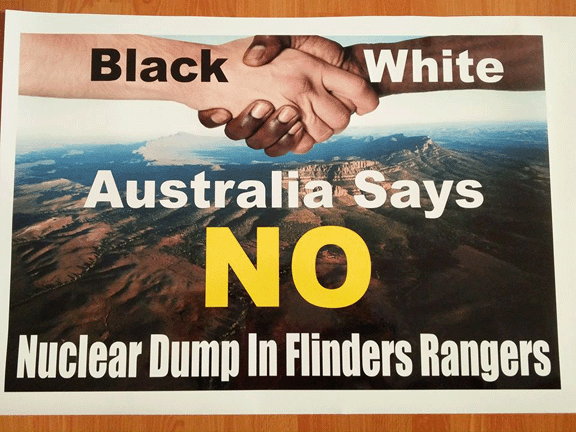
It is untenable for this Code to countenance Disposal Facility Siting in an area of special cultural heritage significance to Aboriginal people. Proposed NRWMF siting in the iconic Flinders Ranges must stop. A finalised ARPANSA Code must respect Aboriginal people’s rights and interests.
ARPANSA needs to recognise the Storage and Disposal of nuclear wastes affects the rights, interests and safety of all South Australians and is prohibited in our State under the Nuclear Waste Storage (Prohibition) Act 2000.
Any imposition of Disposal Facility Siting in SA will be strongly resisted by community across SA.
at: https://www.arpansa.gov.au/…/4206–62d45b57e7ea1b50ccb30956… https://www.facebook.com/groups/344452605899556/
March 23, 2018
Posted by Christina Macpherson |
Federal nuclear waste dump, South Australia |
Leave a comment
 Paul Waldon No Nuclear Waste Dump Anywhere in South Australia, 18 Mar 18
Today the 18th of March is another red letter day in the nuclear arena with the 31st anniversary of a accident at Lucas Heights.
But first lets jump forward 29 years to the Hawker nuclear community meeting on the 6th of May 2016, where a man named Bruce Wilson from the DIIS who chaired such meeting, a man who could be a totally inept clairvoyant, a nuclear decision psychopath, a misinformed government payed nuclear spruiker, or just a sad ignorant man, this is a man whom said “We will NOT have accidents” .
The opposing dichotomy believes in the old dictum “Pray for the best, prepare for the worst” and the such dichotomy keeps giving a resounding NO to a deadly radioactive dump, which keeps falling on deaf ears of the liars who said they would walk away from a community that doesn’t want to accept it.
Now lets return to the anniversary of the 1987 accident where a fire at Lucas Heights nuclear research laboratory resulted in the contamination of two workers and the discharge of radioactive gas into the atmosphere over populated areas. Yes, Bruce this was a accident, however there was an event two years prior to such accident that may be called a purpose when alleged vandals dodged security patrols and smashed a underground pipe, releasing radioactive effluent into river ways. (What was this pipe made of, maybe brittle 2mm plastic?).
Are we to believe, Bruce, that there wont be anymore accidents, maybe because accidents will be suppressed, or called a planed event, or re-classed as “Technically produced anomalies” just like the erroneous, magniloquent re-classing of high grade waste to intermediate waste in an attempt to try and push through a egregious program while attempting to insult the intelligence of the majority of informed South Australians who don’t want a risky radioactive dump here? https://www.facebook.com/groups/1314655315214929/
March 23, 2018
Posted by Christina Macpherson |
Federal nuclear waste dump, secrets and lies, South Australia |
Leave a comment
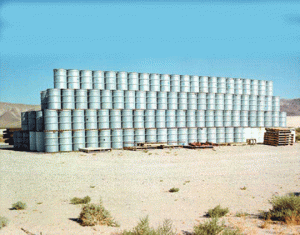 Paul Waldon Fight To Stop Nuclear Waste Dump In Flinders Ranges SA “A rose by any other name would smell as sweet.” High Grade waste by any other name would be such a risk.
There has been one, only one successful test of a dry cask to find its safe threshold and that was a recorded drop from 10 meters, all other tests have failed to record the threshold for compromising a dry-cask.
Holtec industries had a reported failure in nine yes 9 different areas of construction of dry-casks, about the time Australia had some nuclear fuel vitrified, so ask yourself did we buy a poor quality dry-cask. Hidry buildup on nuclear fuel and its cladding in the dry-cask is a forever real explosive threat to the integrity of such containment vessels, this has a problem with no current tests able to monitor such issues.
The nuclear industry has acknowledged that stainless steel is susceptible to Chloride induced corrosion with cracking of dry-casks. These minor cracks are likely to develop into truwell cracks that can compromise the dry-casks. The president of one company that produces dry-casks for the nuclear industry whom was present at a Citizens Engagement Panel meeting in Orange County was reported to say “If there was a truwell crack, even a microscopic crack million of curies of radiation would escape through the crack, and it would be impossible to get near the canister or repair it, and he went on to say its not practical to repair these things when they start cracking.”
Transportation of the dry-casks in America is dangerous and illegal if the fuel or cask is damaged. https://www.facebook.com/groups/344452605899556/
March 23, 2018
Posted by Christina Macpherson |
Federal nuclear waste dump, South Australia |
Leave a comment