Nuclear future off the agenda in Port Augusta, as locals turn to renewables and mining
ABC News, By Kathryn Bermingham, Stateline, 15 May 25
In short:
Port Augusta was thrust into the spotlight when it was announced as one of several sites earmarked, under a Coalition election pledge, to host a nuclear reactor.
While the Coalition has not formally abandoned the plan, its resounding defeat at the recent federal election suggested voters did not embrace the idea.
What’s next?
As Port Augusta looks ahead, locals say its future could lie in several directions, including renewables and mining…………………………………………………………………………………………….
Nuclear off the agenda
Port Augusta was thrust into the national spotlight last year when it was announced as one of the sites earmarked to host a nuclear reactor under a Coalition election pledge.
While the Coalition has not formally abandoned the plan, its resounding defeat at the recent federal election suggested voters did not embrace the idea……………………….
………………………. A future in power generation
Greg Bannon felt the region had scarcely settled one nuclear debate — the now-scrapped proposal to build a low-level nuclear waste dump near Kimba — when the Coalition’s plan was put forward.
“It was really like a punch in the guts,” he said.
Mr Bannon, who lives 40 kilometres from Port Augusta at Quorn and had campaigned against the dump, said Port Augusta has had to reinvent itself in the past and could do so again.
“We also had a very big railway workshop here, it was a huge employer with lots of apprenticeships,” he said.
“Railways built everything. So that was a big loss when that was taken away and of course the most recent large employer has been the coal-fired power station.”
He said the transition to renewables had been more economically beneficial than some gave it credit for — and maintained that Port Augusta’s future was still in energy generation.
“Renewables have provided jobs,” he said.
“We’ve got Sundrop Farm down there, which … grows tomatoes from gulf water that’s been desalinated and solar mirrors.”………………………………………………….. https://www.abc.net.au/news/2025-05-15/nuclear-off-the-table-for-port-augusta/105285976
South Australia Liberals who first pushed 100 pct renewables – then went nuclear – now reverse course after poll wipeout
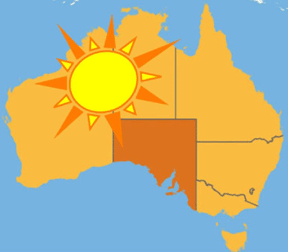
ReNewEconomy, May 5, 2025, Joshua S Hill
The South Australian Liberal party, which set the state’s first 100 per cent renewables target when in government six years ago, before embracing nuclear while in opposition, has reversed course again after the federal poll wipeout and the loss of a long time Liberal seat in Adelaide.
South Australia leads the world in the uptake of variable renewables, with a 72 per cent share of local demand over the last 12 months.
The then Liberal state government in 2019 set a target of reaching 100 per cent “net” renewables by 2030, before the current Labor government accelerated that target to 2027, and enshrined it into law, based on the planning for new wind and solar projects, battery storage and transmission.
New state Liberal leader Vincent Tarzia reversed course on renewables last year, supporting the federal Coalition’s plan to build nuclear power at seven sites across Australia, including at Port Augusta in South Australia, the site of the coal fired power stations that closed nearly a decade ago.
However, speaking to ABC Radio Adelaide, Tarzia has now backed away from his party’s election commitment to hold a Royal Commission into nuclear energy, saying it was clear that the technology has been “comprehensively rejected” by the electorate.
A potential nuclear future had been a top priority for the South Australian Liberal Party, promising in June last year to hold yet another Royal Commission into the technology. This was followed in August by the appointment of Stephen Patterson, the state MP for Morphett, as spokesman for Nuclear Readiness.
Tarzia’s comments came after the Liberals lost the last of their Adelaide based federal seats, including the once safe seat of Sturt, in last weekend’s federal election campaign…………………………………. https://reneweconomy.com.au/s-a-liberals-who-first-pushed-100-pct-renewables-then-went-nuclear-reverse-course-after-poll-wipeout/
Greens fear AUKUS overreach as State Development Coordination and Facilitation Bill 2025 passes SA parliament

A new $4m planning office will be granted unprecedented powers, sparking calls to temper the power of the four bureaucrats set to wield them.
Sweeping new powers will be invested in a $4m office to fast track “significant” SA projects including housing and AUKUS – raising fears they could avoid tougher planning checks.
The State Government is planning to appoint four staff to the office, including an AUKUS expert, with unprecedented powers to “case manage” projects.
Premier Peter Malinauskas has flagged this would allow faster approvals in designated “go zones” for projects like the AUKUS nuclear-powered submarines, housing and renewable energy projects.
The move flared concerns about existing heritage, environment, coastal protection and pastoral land act processes being downgraded after the State Development Coordination and Facilitation Bill 2025 passed this week.
Mr Malinauskas previously said the law meant the State Government could designate “state development areas” as “go-zones”.
Regulatory work in these zones would be completed before developers moved in “allowing for quicker approvals within them once an application is made”.
This was meant to save time in passing “urgent and significant projects”.
A government spokesperson assured provisions meant the new office must perform any assessment independently and it could not be directed “by any Minister to either approve or reject any application.”
The office could not deal with nuclear waste projects.
And the Adelaide Parklands was protected by the Adelaide Parklands Act and the new bill states it “may never be designated as a state development area”.
But SA Greens party co-leader Robert Simms was still concerned.
He feared the inclusion of an AUKUS expert meant approvals for the project would bypass usual safety guards.
“SA parliament has just given the Malinauskas Government the biggest blank cheque in South Australian history,” he said.
“This bill gives an unelected office the power to override South Australian laws to enable controversial projects, including AUKUS, yet it passed the Upper House in the blink of an eye.”
“This bill isn’t about facilitating housing developments, it’s about giving the state government the power to ride roughshod over the community. It’s a power grab of epic proportions that should have been given much more scrutiny.”
It was confirmed in the senate the office would cost $4m a year to operate.
State Liberals nuke nuclear promise

The SA Liberals have broken a key election promise with just 10 months to go until the state poll, with Liberal leader Vincent Tarzia dumping his party’s only energy policy.
5 May 25,https://www.premier.sa.gov.au/media-releases/news-items/state-liberals-nuke-nuclear-promise
In a stunning backdown, Mr Tarzia admitted on ABC Radio Adelaide that the Liberals’ election commitment to hold a Royal Commission into nuclear energy would be dumped in the wake of the federal election:
Rory McClaren: That’s what I was going to ask you… should nuclear from a Liberal Party policy perspective now be parked?
Vincent Tarzia: Yes, at the moment it’s been comprehensively rejected and we know the thing is with the energy transition, in three years’ time we will be in another position again.
The State Liberals made the pursuit of nuclear power their top priority, announcing their pursuit of a Royal Commission as their key commitment in their Budget Reply speech in June.
In August, Liberal Leader Vincent Tarzia appointed Stephen Patterson as Shadow Minister for Nuclear Readiness.
Now, just eight months later, the promise has been abandoned.
The 2016 Nuclear Fuel Cycle Royal Commission found nuclear power was not commercially viable in South Australia.
Quotes
Attributable to Tom Koutsantonis
What do the South Australian Liberals stand for?
They’re breaking election promises even before they’ve got to an election.
Only a few months ago, they were making the pursuit of nuclear energy their sole energy policy focus. Now, they’ve dumped it.
Vincent Tarzia must now dump his Shadow Minister for Nuclear Readiness, who has absolutely no policy offering other than the pursuit of an energy source that evidence shows will drive up bills for South Australians.
At a time when the Opposition should be outlining its policy platform ahead of the 2026 State Election, the State Liberals are instead ditching their only energy policy.
Election Lesson: Coalition Must Dump Nuclear Policy

Friends of the Earth Adelaide Federal Election Campaign, Philip White May 5, 2025
Friends of the Earth Adelaide ran a targeted campaign in two marginal seats leading up to the federal election. We created an election leaflet advising voters about the dangers of nuclear power and asking them to “vote nuclear free”.
We are pleased that the Australian people rejected the nuclear option. We hope the Coalition gets the message and dumps its nuclear energy policy and becomes a constructive supporter of real climate action. Let this election mark an end to the climate wars.
Boothby
We delivered 50,000 of our leaflets to the letterboxes of voters in Boothby, a marginal seat in southern Adelaide held by Labor on a 3.3% margin prior to the election. Our aim was to prevent Boothby falling to a pro-nuclear candidate. We are very grateful to a grant from FOE Australia which paid for much of the printing and distribution of 45,000 of the leaflets by Australia Post. The remaining 5,000 leaflets were delivered by hand by our volunteers, who we are also very grateful to. We considered that a good reach of the 80,000 letterboxes in Boothby.
We are very pleased that Boothby was retained by an anti-nuclear candidate (Louise Miller-Frost for Labor, with Joanna Wells of the Greens also doing well). That’s one more seat to keep Australia free from nuclear power. We hope that the large loss the Coalition received means they will drop nuclear power as a policy.
Sturt
In late April a bus load of Traditional Owners from Port Augusta came to the city for a meeting in the marginal eastern Adelaide suburb of Sturt, held by the Liberals on a 0.5% margin prior to the election. Their aim was to appeal to Sturt voters for their support in keeping Port Augusta nuclear free. Friends of the Earth Adelaide co-hosted the meeting along with Don’t Nuke Port Augusta, with financial help from CANA. Traditional Owners spoke strongly of their lives and love for Port Augusta’s land and waterways, and of the tragic intergenerational consequences for their families of the nuclear testing in SA in the 1950s. The meeting was videoed and can be seen at https://www.youtube.com/live/lJ1tpcfkZIU and many great photos are on the Don’t Nuke Port Augusta Facebook page.
The Port Augusta contingent were prominent at the May Day Worker’s Right’s rally the following day. They got a great shoutout from the MC, the SA Unions Secretary, and huge applause and appreciation from the crowd of unionists. Also, that evening, they staged a demonstration at the Arkaba Hotel where Peter Dutton was promoting the Liberal candidate for Sturt. They said, “If Dutton won’t visit us, we’ll come to him.”
Response to Submarine Construction Yard Environmental Impact Statement
Friends of the Earth Adelaide 31 Mar 2025
Our submission raised questions about assumptions made about the nuclear submarine agreements:
“The Environmental Impact Statement (EIS) is premised on the assumption that the proposed AUKUS nuclear submarines are in Australia’s strategic interest (pp. 9-10) and South Australia’s economic interests (pp. 12-13). Both these premises are false.
Many highly qualified defence experts argue that nuclear submarines are not in Australia’s strategic interest. [1]
Along with these experts, and retired senior politicians like Paul Keating, Gareth Evans and Malcolm Turnbull, we believe that Australia will be less safe if it acquires nuclear powered submarines. Although it is the federal government that has made this strategic blunder, the EIS should not lend it any credence (as in section 1.5.4).…
AUKUS submarines will also be prejudicial to our economic interest. Some of the abovementioned analysts don’t think Australia will actually ever get the promised nuclear submarines, certainly not in a reasonable time frame. This is a view not restricted to left-leaning people. Conservative commentator Greg Sheridan has criticised AUKUS for this reason.[2]”
[1] Hugh White, “From the submarine to the ridiculous”, The Saturday Paper, 18 September 2021 https://www.thesaturdaypaper.com.au/2021/09/18/the-submarine-the-ridiculous/163188720012499#mtr
Major General Michael G Smith AO (Ret’d), ‘How should Australia defend itself in the 21st century? Silencing the drums and dogs of war’, The New Daily, May 26, 2023 https://thenewdaily.com.au/news/world/2023/05/26/how-should-australia-defend-itself-in-the-21st-century-silencingthe-drums-and-dogs-of-war/
Sam Roggeveen, ‘Spiky questions remain for AUKUS proponents’, Inside Story, 19 March 2024 https://insidestory.org.au/spiky-questions-remain-for-aukus-proponents/[2] Greg Sheridan, ‘Our nuclear subs fantasy adds up to military net zero’, The Australian, 6 October 2021. https://www.theaustralian.com.au/commentary/our-nuclear-subs-fantasy-adds-up-to-military-net-zero/newsstory/cec3b5e94c5bacac405a5eb535b3a628
Read our full submission: 250314AUKUS EIS – FoEAdelaide
Response to Osborne Submarine Construction Yard Strategic Assessment
Friends of the Earth Adelaide 1 April 25
Our recommendations:
1. Correct the factual errors regarding the effects of radiation.
2. Include active commissioning in the assessment.
3. Include the disposal of radioactive waste in the assessment and publish plans for management, storage and disposal of all streams of radioactive waste, including intermediate and high-level waste and spent nuclear fuel.
4. Include a proper analysis of the risks and consequences of incidents and accidents that could lead to a release of radioactive material into the environment.
5. Inform the public about the potential for exposure to radiation and the levels of radiation they could be exposed to.
6. The Commonwealth Government should consult with other levels of government, the Australian Radiation Protection and Nuclear Safety Agency, emergency services and with the general public to develop a response plan for radiological emergencies.
7. Publish the Strategic Assessment Plan before finalizing the Strategic Impact Assessment Report.
Read our full submission: https://adelaidefoe.org/wp-content/uploads/2025/03/250314AUKUS-SIA-FoEAdelaide.pdf
Nuclear energy inquiry draws emotional response in Port Augusta

By Annabel Francis and Arj Ganesan, ABC North and West SA, 7 Dec 24
In short:
The select committee conducting an inquiry into nuclear power generation in Australia has triggered strong opinions from both sides of the fence.
Aboriginal leaders, resident representatives, and leaders from the mining and energy sector have spoken during a hearing at Port Augusta.
What’s next?
Should the opposition win the next election, it has promised to hold a two-and-a-half year consultation period over its nuclear plans.
The federal government’s select committee inquiry into nuclear power generation at Port Augusta has stirred strong emotions among those making a submission.
For anti-nuclear activist and Yankunytjatjara Anangu woman Karina Lester, it is a debate she is tired of having.
“Governments change, committee members change … organisations, company members, CEOs of companies change,” Ms Lester said.
“Those of us that are in the frontline are constantly needing to remind governments of the impacts of nuclear in our communities.
“Aboriginal people of South Australia have always said no to nuclear.”
Ms Lester, who gave evidence at a select committee hearing in Adelaide, describes herself as a survivor of the Emu Field nuclear tests.
She said Indigenous people had seen the impacts of nuclear technology first-hand.
Her father, Yami Lester, went blind at the age of 16 following British weapons testing in Maralinga in South Australia in the 1950s.
Ms Lester said she feared Indigenous groups would suffer if the federal opposition’s nuclear plans went ahead.
“Aboriginal communities are always the solution or pressured to be the solution for the waste issues,” she said.
“The history shows us that locations identified are locations that are First Nations or Aboriginal people’s traditional lands.”
Port Augusta’s former coal power station was one of seven sites that was earmarked as a possible location for the opposition’s nuclear energy plan.
The Nukunu Wapma Thura Aboriginal Corporation, which holds native title over the proposed site, has voiced strong opposition to any nuclear proposal.
“Aboriginal people throughout the region and state of South Australia have historically and overwhelmingly opposed nuclear energy, and the storage of its waste,” a spokesperson said.
Greg Bannon from the Flinders Local Action Group gave evidence at the public hearing in Port Augusta about the potential risk of a nuclear accident.
He has opposed nuclear technology for decades and said the time to switch to nuclear energy had passed. “I think it’s old technology, and I don’t think we need it,” he said.
Mr Bannon said any accident or error would not only have a devastating impact on the local community but also on vulnerable marine ecologies, such as the giant Australian cuttlefish that aggregates about 50 kilometres away from Port Augusta……………………………https://www.abc.net.au/news/2024-12-06/nuclear-energy-hearing-emotional-port-augusta/104694596
Plan to dispose of nuclear waste from Aukus submarines unanimously rejected by Adelaide council

City of Port Adelaide Enfield’s mayor says she hadn’t received correspondence about storage or disposal before or after bill passed federal parliament
Guardian Petra Stock, 18 Nov 24
Plans to dispose of low-level nuclear waste from Aukus submarines at an Adelaide naval facility have been unanimously opposed by the local council for the area, who say they weren’t consulted.
The Osborne naval shipyard, 25km north of Adelaide CBD, and HMAS Stirling at Garden Island 50km south of Perth in Western Australia, have both been designated as “radioactive waste management facilities” for nuclear waste from Aukus submarines under the Australian naval nuclear power safety bill, which passed parliament in October.
Last week, the City of Port Adelaide Enfield – responsible for the area surrounding the Osborne shipyard – voted to unanimously oppose the storage and disposal of radioactive waste at the site.
Its mayor, Claire Boan, said council had been briefed on aspects of the Aukus project but it had not received any correspondence or communication about management and disposal of nuclear waste at the site.
“While the decision-making regarding this is out of the control of the council, we will continue to advocate for our community and lobby for community consultation throughout the process,” she said.
Rex Patrick, a former independent senator for South Australia, said the situation highlighted the lack of consultation and transparency regarding Aukus nuclear waste.
“Albanese called for Dutton to disclose where he was going to put his nuclear power reactors, and yet there’s been complete secrecy around the entire process associated with where they’ll put the high-level waste from naval reactors,” he said.
No public announcements have been made about the site selection or consultation process for dealing with the high-level nuclear waste associated with the Aukus submarines, which the government agreed Australia would dispose of in March last year……………………….. https://www.theguardian.com/environment/2024/nov/18/plan-to-dispose-of-nuclear-waste-from-aukus-submarines-unanimously-rejected-by-adelaide-council
Adelaide residents blindsided by decision to store AUKUS nuclear waste at submarine shipyards
The act allows radioactive waste to be stored at both sites but does not define what level
the legislation was also ambiguous about the disposal of nuclear material from UK and US nuclear submarines.
By Angelique Donnellan 7.30 ABC
In short:
Federal parliament has passed legislation that allows for nuclear waste to be stored and disposed of at a shipping yard in Adelaide.
Residents said they were not consulted or told of the plan.
What’s next?
Construction of nuclear submarines is expected to start in Adelaide by the end of the decade.
The $368 billion AUKUS pact is promising thousands of jobs and the return of submarine construction to South Australia.
But residents have just learned the deal also means nuclear waste will be stored on their doorstep.
“It’s madness. It’s not only close to a residential area, but it’s right on a waterway,” Adelaide resident Eileen Darley told 7.30.
Last month legislation quietly passed the federal parliament that will allow for the storage and disposal of nuclear waste at the Adelaide shipyard in Osborne, which is 25 kilometres north-west of the city’s CBD and near the popular seaside suburb of Semaphore and historic Port Adelaide.
Residents said it was the first time they heard about plans for the waste facility.
Nuclear submarine construction at Osborne is expected to start by the end of the decade.
“There’s 30,000 people that live in this area,” Ms Darley, who runs the local action group Port Adelaide Community Opposing AUKUS, said.
“All the childcare centres, all the schools and the families that live in this area, but also waterways that feed the mangroves, that is a dolphin sanctuary, and so forth.
“None of us in this area have been consulted about it at all.”
The Osborne shipyard is in federal Health Minister Mark Butler’s safe Labor electorate of Hindmarsh.
In an interview with 7.30, he said residents would be consulted closer to when the facility would be established but stated the waste facility would go ahead even if residents did not want it.
“This is going to happen,” he said.
“The government and parliament have decided that the future defence strategy of the country will involve nuclear-propelled submarines.”
Indigenous elder criticises government’s ‘sly and conniving’ moves
The state Labor government is in lock-step with the Commonwealth on AUKUS but community concerns are growing.
The Port Adelaide Enfield Council has resolved to oppose any nuclear waste storage or disposal at Osborne and is calling for widespread community engagement.
Local resident and Indigenous elder Margaret Brodie said she was disappointed the government legislated the facility without people having a say. The shipyard is on the traditional lands of the Kaurna people.
“It’s sly and conniving. That’s how I feel about it,” she told 7.30.
“As an Indigenous woman I think I get used to it, government being underhanded, not telling us anything, or not asking.
“If you talk about closing the gap, they’re not going to close the gap by doing things like this.”
The legislation declares the Osborne Shipyard as well as the HMAS Stirling naval base near Perth as designated naval nuclear propulsion facilities.
The act allows radioactive waste to be stored at both sites but does not define what level……………………………………………………………………………
Ms Darley was sceptical.
“It does not allay our concerns to hear that the government is saying that it’s temporary and it’s low level,” she said.
“We’re the people who are most affected if something goes wrong.”
The Naval Nuclear Power Safety Regulator, which reports to the defence minister, would grant the licence for the operation of the waste facilities.
Waste from UK and US subs
Greens senator David Shoebridge told 7.30 the legislation was also ambiguous about the disposal of nuclear material from UK and US nuclear submarines.
“One of the key amendments we wanted was to prohibit the storage of high-level nuclear waste from any foreign country, the United Kingdom or the United States, and that was aggressively resisted by both the government and the opposition,” he said.
“Neither the UK or the US have any permanent solution for their nuclear waste, and the UK is the one that’s in the most trouble … and they have seen with AUKUS a potential sucker down here in Australia who’s literally put their hand up and said, ‘Yeah, we’ll take some of that. We’ll help out.'”
There is also opposition to the waste facility at Perth’s naval base, which needs to be up and running as early as 2027 when one UK nuclear submarine and up to four US boats start regular rotations.
But Mr Butler stated it would also only hold low-level nuclear waste taken from UK or US submarines which came to Australia.
“Intermediate and high-level waste [from overseas] will not be stored in Australia,” he said.
………………………………………………………………………………………………………………………………………………………………………………………………………………. In South Australia, the Port Adelaide Community Opposing AUKUS said it was prepared for a fight ahead of next year’s federal election.
“How far are we prepared to go? Well, I think we’re in it for the long haul. That’s for sure,” Ms Darley said.
“We don’t want our children, our grandchildren, to have to deal with this in the long run.
“We’ll definitely be making this an election issue.” https://www.abc.net.au/news/2024-11-18/aukus-nuclear-waste-to-be-stored-adelaide-suburbs/104605640
Low-level nuclear waste from submarines to be stored at Osborne, South Australia
Adelaide Now, 30 Oct 24
Legislation passed will see a “radioactive waste facility’’ built in an Adelaide suburb, but federal and state ministers maintain it will only house “low level’’ material. Have your say.
Low-level radioactive waste generated by the building of the AUKUS nuclear submarines will be stored at Port Adelaide after legislation passed the federal parliament allowing for the construction of a “waste management facility’’.
However federal Defence Minister Richard Marles and his state counterpart Stephen Mullighan both denied any “intermediate’’ or “high-level” waste will be stored at the Osborne submarine facility, in Adelaide’s western suburbs
A spokesperson for Mr Marles said “submarine construction, test and commissioning activities planned for Osborne will generate small amounts of low-level radioactive waste’’, including personal protective equipment.
“This low-level radioactive waste will need to be managed and temporarily stored in a licensed facility,’’ the spokesperson said. “No intermediate-level waste or high-level radioactive waste (spent nuclear fuel) will be managed or stored in the facility.’’
Both the Albanese Labor government and the Peter Dutton-led Liberal opposition voted in favour of the Australian Naval Nuclear Power Safety Bill. The Bill ‘’regulate activities relating to conventionally armed, nuclear powered submarines’’.
Do you support a “radioactive waste facility’’ being built at the Osborne submarine base
Yes: It’s the right spot for it
69 %
No, I don’t want it anywhere in SA
31 %
563 votes
It names Osborne as a “designated zone’’ where “a facility for managing, storing or disposing of radioactive waste’’ could be built. The legislation does not specify what level of radioactive waste could be stored.
The legislation has sparked a community backlash, with a change.org petition started by former Liberal candidate Jake Hall-Evans already reaching almost 4000 signatures.
Mr Hall-Evans said there had been a lack of transparency about the possibility of a nuclear waste dump at Osborne.
“The people of Port Adelaide were promised submarine jobs, not a nuclear waste dump,’’ Mr Hall-Evans said.
He said Australia had struggled to find a suitable location for low-level radioactive waste, with a proposed facility at Kimba on the state’s Eyre Peninsula knocked back last year.
Premier Peter Malinauskas also opposed the dump at Kimba.
South Australian Greens Senator Sarah Hanson-Young said the new law was a “dangerous disaster for our state’’.
“This is toxic for South Australia,’’ Ms Hanson-Young, who is holding a nuclear forum at the Burnside Town Hall in the marginal seat of Sturt on Thursday.
“Peter Dutton not only wants nuclear reactors across Australia – he wants Adelaide to be an international dumping ground for nuclear waste,’’ she said.
A spokesperson for Port Adelaide Enfield Council said it had “not been consulted or advised of any licences being approved for a radioactive or nuclear waste storage site at Osborne’’.
Defence Minister Stephen Mullighan said there was “no proposal or capacity for nuclear waste, including low-level waste to be stored in the long term’’. term’’.
BHP’s untenable extraction of Great Artesian Basin waters for the Olympic Dam copper-uranium mine.
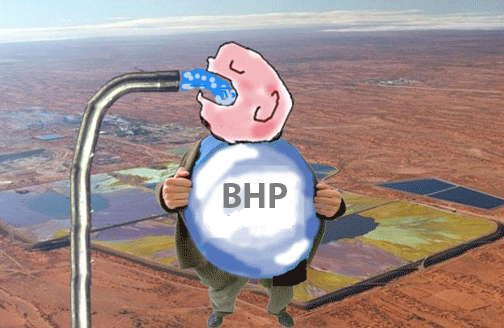
Jim Green, 26 Oct 24. BHP has had to move on Mound Springs protection issues regarding untenable extraction of GAB waters for the Olympic Dam copper-uranium mine, and an important Springs Study had now been released by SA Gov modelling reduced water extraction scenarios and affects on Springs & GAB waters.
A significant – if belated and partial – formal public commitment from BHP:
Milestone : FY2030 – cease abstraction from Wellfield A through switching to coastal desalination supply in partnership with the South Australian Government on the Northern Water Supply Project.
This partial win is a key if limited step toward proper protection for the unique and fragile Mound Springs of the GAB in SA, requiring:
is a key if limited step toward proper protection for the unique and fragile Mound Springs of the GAB in SA, requiring:
- closure of untenable BHP Wellfield A operations as soon as possible, that is warranted far sooner than by end of FY2030;
- BHP could prioritise and pay for whatever extent of water recovery at Olympic Dam to replace continued extraction from Wellfield A, which is projected to be run at 3.9 million litres a day ( Ml/d ) over next few years – about 10% of the volume BHP water take from the GAB;
- a campaign path to realise a phase out of the far larger adversely impacting Wellfield B operations that runs at 32 Ml/day, at least from when Northern Water supply becomes available at/after 2028 (this is difficult as BHP & SA Gov now think closing Wellfield A is all they have to do);
- a continued public interest campaign building on a lot of people’s roles and contributions over time…
an important Springs Study:
“Potential Impacts of Reducing Groundwater Abstraction from the Southwestern Great Artesian Basin: Modelled Aquifer Pressure and Spring Flow Response”
By Daniel Partington, Andrew Love, Daniel Wohling, Mark Keppel.
Goyder Institute for Water Research Technical Report Series No. 2024/01https://yoursay.sa.gov.au/84866/widgets/401081/documents/297652
see an extract from Goyder Institute Springs Study (at p.21 of doc & at p.31 of the pdf file, my bold below) citing the BHP commitment:
3.5 Output From the Modelled Scenarios Six experimental abstraction scenarios were proposed by Infrastructure SA to provide a spectrum of stimuli to assess the responsiveness of the aquifer to a change in abstraction volumes. The future abstraction rates from Wellfield A and B have not been confirmed, however there has been public commitment to cease abstraction from Wellfield A if water from the Northern Water project is available (see Olympic Dam Context- Based Water Targets).
South Australia sets spectacular new records for wind, solar and negative demand
Giles Parkinson, Sep 30, 2024, https://reneweconomy.com.au/south-australia-sets-spectacular-new-records-for-wind-solar-and-negative-demand/
Records continue to tumble across Australia’s main grids as the spring weather boosts the output of wind and solar and mild weather moderates demand, but none are as spectacular as those being set in South Australia.
The state’s unique end-of-the-line grid already leads the country, and arguably the globe, in the integration of variable wind and solar, with an average of more than 70 per cent of its demand over the last year and a world-first target of 100 per cent net renewables by 2027.
On Sunday, at 9.35 am, the state set a new milestone, setting a new record share of wind and solar (as a percentage of state electricity demand) of 150.7 per cent, beating a record set on Christmas Day last year, when – for obvious reasons – there was little electricity demand.
As Geoff Eldridge, from GPE NEMLog, notes, this means that the rooftop PV, along with large scale wind and solar farms, were generating 50.7 per cent more power than the state’s total electricity demand at the time.
The scale of excess output was further crystallised later in the day with a new minimum record for instantaneous residual demand, which hit minus 927 megawatts at 12.35pm.
Eldridge says residual demand is what’s left for other generators to supply after wind and solar have met a share of the demand. A negative residual demand means wind and solar were producing more electricity than SA needed, resulting in excess renewable generation which can be managed by exporting and battery charging. The remainder is curtailed.
Of the surplus 927 MW, the state was exporting 685 MW to Victoria, while another 163 MW was being soaked up by the state’s growing fleet of battery storage projects, and 730 MW of output was curtailed. Prices at the time were minus $47/MWh, a good opportunity for batteries to charge.
A further 84 MW was being produced by a couple of gas generators – not because their power output was needed, but because the state, at least for the moment, relies on them for essential grid services such as system strength and fault current.
That will be reduced considerably when the new link to NSW is completed in a few years, and it will allow the state to both export more, and import more when needs be.
“Balancing the system with such high renewable penetration is challenging but necessary as the energy transition progresses,” Eldridge says. “Managing excess generation through exports, storage, and curtailment is critical to keeping the grid stable and efficient.”
It wasn’t the only record to fall over the weekend. In Queensland, the country’s most coal dependent state in terms of annual share of demand and generation, large scale solar hit a record share of 34 per cent, and coal output – in megawatt terms – hit a record low of 2,882 MW.
The Queensland coal fleet capacity is more than 8,000 MW, so that is about as low as it can run until more units are closed down.
In Victoria on Saturday, just before the AFL grand final, rooftop solar also hit a new record output of 3,164 MW – although it did not push operational demand down low enough for the market operator to enact Minimum System Load protocols and possibly switch off some rooftop solar panels to maintain grid stability.
It had flagged a potential MSL event on Friday but cancelled it in the morning. Those events will likely occur at other times in spring and over the summer holidays, although the market operator is now working on new rules for big batteries to avoid a potentially unpopular and unwieldy solar switch off.
South Australia joins Denmark in elite club of two, “pushing the boundaries” of renewable energy integration
Sophie Vorrath, Sep 20, 2024, https://reneweconomy.com.au/south-australia-joins-denmark-in-elite-club-of-two-pushing-the-boundaries-of-renewable-energy-integration/
[excellent tables and graphs]
South Australia has joined an elite global club, after being listed alongside Denmark as the only other energy system in the world to be successfully managing significant volumes of surplus variable renewable energy across the year – albeit with a lot of hard work ahead.
In its latest global stocktake of variable renewable energy (VRE) integration across 50 power systems, the International Energy Agency says South Australia has joined the ranks of grids with the highest share of solar and wind in the world.
On the IEA’s scale, this puts South Australia in Phase 5 of the integration of renewables (Phase 6 is the top ranking), managing a share of solar and wind that averages out to be higher than fossil fuels over most of the year and at times surpasses 100% of local demand.
And while this is an achievement to be extremely proud of – of the 50 systems analysed by the IEA, 25 are in Phases 1 or 2, representing around 60% of global electricity generation – it also puts South Australia at the pointy end of renewable energy integration, where big changes need to happen fast, to keep the transition on track.
“A growing number of power systems are pushing the boundaries of VRE integration, successfully managing very high shares of variable renewables,” the report says.
But these “frontrunner systems” face complex challenges related to stability and flexibility, which the IEA says call for a transformation of how power systems are operated, planned and financed.
Certainly, South Australia is facing numerous challenges to get its grid from where it is now, to net 100 per cent renewables. And, as the report notes, some of these challenges are uniquely complex.
“In contrast to the case of Denmark, South Australia has limited interconnections with its neighbours, and the impact of solar PV on the net load is more visible,” it says.
“High VRE periods resulting in surplus generation are managed by a combination of measures including energy exports via interconnection to the
neighbouring state, storage with battery energy storage systems (BESS), demand response and curtailment.
“High ramps at sunrise and sunset hours resulting from solar PV generation are managed predominantly by fast-acting gas turbines and the BESS, as well as accessible resources in the rest of the NEM through the interconnector.”
To this end, Project EnergyConnect – a “nation critical” new transmission project that will join up key renewable energy zones in South Australia,
New South Wales and Victoria – is expected to help.
Meanwhile, other parts of Australia are not far behind – the IEA says Australia, as a nation, should be well into Phase 4 by 2030, where it will face “key operational challenges” to the way the power system responds to maintain stability immediately following disruptions in supply or demand.
Just this week in New South Wales, the state’s “potential output” of renewables – that is, the amount available for use or storage in ideal circumstances – was clocked at 99.8 per cent of native demand just before 11am on Sunday, with a combination of sunny weather and strong winds across most of the state.
But, as Renew Economy editor Giles Parkinson notes here, that level of variable renewables currently can’t be accommodated on the NSW system, for a combination of technical and economic reasons. And it is precisely this problem that the IEA report is hoping to address.
“By 2028 the main case of our renewables forecast shows that a range of countries …reach unprecedented annual shares of generation originating from wind and solar power plants – some above 65%,” the report says.
“This development calls for a better understanding of how this could affect electricity systems even further, and what measures can be taken on several fronts to ensure that those higher levels of VRE are integrated in an affordable and secure manner.”
And it warns that a failure to solve these challenges could derail the global climate effort.
“Should integration measures fail to be implemented in line with a scenario aligned with national climate targets, up to 2,000 terawatt-hours (TWh) of global VRE generation would be at risk by 2030, endangering achieving national energy and climate pledges,” the report says.
“This potential loss – equivalent to the combined VRE output of China and the United States in 2023 – stems from possible increases in technical and economic curtailment, as well as potential project connection delays.
“Consequently, the share of solar PV and wind in the global electricity mix in 2030 would reach 30%, lower than the 35% in the case where integration measures are implemented on time. If this decrease is compensated by increased reliance on fossil fuels, it could lead to up to a 20% smaller reduction of carbon dioxide (CO 2) emissions in the power sector.”
It is comforting to note, however, that Australia is not alone in the challenges it faces – even if it is at the leading edge of some of them.
The IEA says successfully integrating higher levels of solar and wind energy into the grid will increasingly rely on measures taken to meet two “critical
requirements:” electricity grids, and procuring flexibility from a broad range of assets.
Grid congestion is a worldwide issue, the IEA notes, considering that global investment in renewables almost doubled between 2010 and 2023, while from 2015 grid investment has stagnated at $US300 billion a year until 2024, when it rose to $US400 billion.
“As a result of insufficient grid investment, at least 1,500 GW of solar and wind projects at an advanced stage were waiting for grid connection as
of mid-2023,” the report says.
“Further, many countries are facing grid congestion issues, which are expensive to address due to the high cost of dispatching power plants to overcome
immediate issues and because of the large amount of investment necessary to overcome congestion in the future.
“It is crucial for countries to accelerate grid expansion and upgrades, as it enables benefits beyond solely integrating VRE, such as improved electricity access and supporting overall demand growth.”
But, as Australia is experiencing, grid development takes a long time to materialise, the report adds, which means any and all complementary solutions with shorter lead times must be tapped to improve the integration of solar and wind.
On power system flexibility, the IEA says most of these needs will be met by solutions that are already in use, such as batteries, demand response and, to a smaller extent, curtailment.
Flexibility also extends beyond conventional generators, the report adds, encompassing storage, new electricity-based end uses, and grid infrastructure, all of which vary regionally.
“This report calls for strategic government action, enhanced infrastructure, and regulatory reforms to ensure the successful large-scale integration of solar PV and wind in order to meet global energy transition targets,” the IEA says.
“Robust data, stakeholder collaboration and government prioritisation of integration measures are essential for overcoming these challenges and achieving a sustainable energy future.”
Sophie Vorrath Sophie is editor of One Step Off The Grid and deputy editor of its sister site, Renew Economy. She is the co-host of the Solar Insiders Podcast. Sophie has been writing about clean energy for more than a decade.
South Australia is aiming for 100% renewable energy by 2027. It’s already internationally ‘remarkable’
Experts say the state’s approach could provide a template for what can be achieved elsewhere.
Eight years ago, South Australia’s renewable energy future was in doubt as an extraordinary statewide blackout saw recriminations flow.
On 28 September 2016, a catastrophic weather event sent the entire state into system black. Around 4pm, some 850,000 homes and businesses lost power as supercell thunderstorms and destructive winds – some travelling up to 260km/h – crumpled transmission towers, causing three major power lines to trip.
Almost immediately, and despite advice to the contrary, members of the federal government sought to blame the blackout on wind and solar, with the then prime minister, Malcolm Turnbull, saying several state governments had set “extremely aggressive, extremely unrealistic” renewable energy targets.
Instead of relenting,SA chose to persevere. It now leads the world in the integration of variable, or weather-dependent, renewables.
Wind and solar power in South Australia grew to 75% in 2023, with few other systems reaching comparable levels. For instance, frontrunner Denmark achieved 67% in the same year.
The International Energy Agency says demonstrating the ability to power a large grid with wind and solar is crucial in the context of climate change, and South Australia’s share is “remarkable”.
The state government is now attempting to legislate a target of 100% renewable energy by 2027. Experts say the state’s approach could provide a template for what can be achieved elsewhere.
Energy specialist Dr Gabrielle Kuiper says powering a jurisdiction of almost 2 million people with majority wind and solar is a globally significant achievement.
“One of the most impressive things about that feat, from a technical point of view, is there have also been periods, starting in September last year, where the entire state was powered by rooftop solar alone,” Kuiper says.
On New Year’s Eve 2023, rooftop solar met 101.7% of South Australia’s energy needs for 30 minutes. Australia’s energy operator says that’s a world record for a grid of that size. Its engineering roadmap seeks to enable similar milestones throughout the national grid.
Daniel Westerman, chief executive of the Australian Energy Market Operator, says the “world-leading” rooftop solar contribution is made possible by power system equipment providing security, smarter connections between rooftop solar and the grid, and policies which protect consumers from unwanted disruptions.
Dr Susan Close, South Australia’s deputy premier and climate change minister, was a government minister during the 2016 statewide blackout. She believes the then federal government’s reaction at the time, blaming the state’s renewable energy, was “unfair and unsubstantiated”.
But if anything, she says the unhelpful response from Canberra hardened the state’s resolve. “In South Australia, the vast majority of people were proud of what we were doing, and simply wanted us to make sure that it was as secure and stable as possible,” Close says.
Close says the state’s energy shift hasn’t happened by chance. World-leading climate laws, consistent policy and a supportive planning system attracted investment and helped the state gain an early advantage under federal renewable energy targets. High retail power prices combined with a generous feed-in tariff scheme (now finished) to drive early uptake in rooftop solar. Now every second home in the state has solar installed.
Johanna Bowyer, lead analyst at the Institute for Energy Economics and Financial Analysis, said while South Australia does have fantastic wind and solar resources, “that’s the case for a lot of Australia”. Crucially, coal power stations were allowed to close under market conditions, she said. “They didn’t subsidise it to stay open for longer, like what is happening in New South Wales with Eraring.”
As coal generation was phased out, renewable energy grew to fill the gap.
Proposed changes to South Australia’s Climate Change Act include a 100% net renewable energy target, formalising statements by the energy minister earlier in the year.
The “net” terminology recognises that interstate transmission lines – connecting South Australia to Victoria and eventually NSW – will continue to share electricity across state borders.
The amendments also include a 60% emissions reduction target by 2030 – compared to 43% federally, and 50% in Queensland, NSW and Victoria – and a framework for timely updates along the pathway to net zero by 2050.
Kirsty Bevan, chief executive of the Conservation Council of SA, says the state’s “trailblazing renewable energy transition” puts it in a unique position to adopt much stronger emissions targets than other state governments. The council supports the renewable energy and 2030 emissions targets, but is keen to see the net zero target date brought forward.
“We should be proud of our past renewable energy accomplishments, but also build upon and capitalise on those accomplishments – to the benefit of all South Australians, our nature, and our shared planet,” Bevan said.
The state government’s focus is on stability, flexibility and reliability, with more large-scale battery storage following in the footsteps of the Hornsdale battery (the world’s biggest when it was activated), and hydrogen part of the plan to soak up excess wind and sun.
Kuiper says the secure and reliable system is made possible thanks to investment in storage, smarter management and grid flexibility. But the key to SA’s success isn’t merely technical, she says, it’s also political.
“The bipartisan support for renewable energy in South Australia has been really significant. It’s given investors a sense of certainty,” Kuiper said.
“I think there are lessons at a federal level, particularly for the federal opposition, about what can be achieved if you provide consistent support to this vitally important industry – that’s important for the domestic economy and for Australia’s development of export industries into the future.”
The aim of 100% net renewables was initially set under the Marshall Liberal government, with the Malinauskas Labor government bringing the date forward.
Close acknowledges the opposition’s part in supporting the state’s decarbonisation, adding that the current bill protects to a degree from “a sudden shift in temperament from the other side of politics.”
She says there’s no reason the energy and cultural transition in South Australia couldn’t be replicated in other parts of the country.
“The sooner you start, the easier it is,” she said. “The real cost is in being the last ones to make the change. And so we wish our interstate colleagues well in making that shift.”
1 This month


Help Aunty Sue Protect Her Land and Sacred Sites From Destructive Rocket Testing.
.
Australians deserve the truth
about
AUKUS – https://aukuspublicinquiry.com/

PETITION – To: Prime Minister Anthony Albanese and the Australian Labor Government

of the week – Australians for War Powers Reform (AWPR)
To see nuclear-related stories in greater depth and intensity

