Jeff Baldock looks to four times value of his land to host nuclear waste dump: others not so keen.
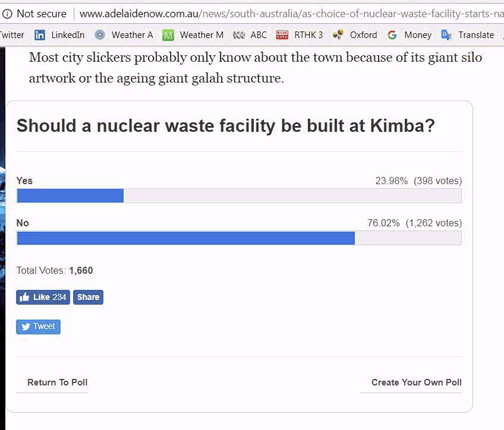
Opinion poll results 8 Jan 17 “3.30 pm – “NO vote is currently up to 76.75%
The Advertiser, South Australia is running an opinion poll – Should a nuclear waste facility be built at Kimba? on their article
As choice of nuclear waste facility starts narrowing, people of Kimba are either excited or disgusted
[Ed note 12 Jan – at a later date, the “NO” vote jumped to 85%]
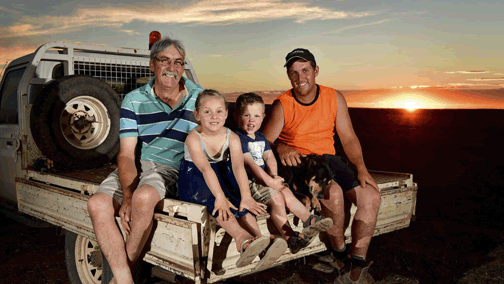
Jeff Baldock and family: A Kimba nuclear waste dump on their property would be a bonanza for them
But what would it do for the market’s perception of South Australia’s farm produce?
Kimba town hopes to win top environmental award – but wants nuclear waste dump !!

where do we want to see Kimba in 300 years? We’ll be a national centre for rubbish.
The community is a finalist for the Australian title of KESAB’s Sustainable Communities top town…..the award honours the community that does the most to protect the environment [!!!]
As choice of nuclear waste facility starts narrowing, people of Kimba are either excited or disgusted, Erin Jones, Sunday Mail (SA) January 6, 2018 IF there are two words that can split an already isolated South Australian town and destroy lifelong friendships, they are “nuclear waste”.
Kimba, on the northern edge of the Eyre Peninsula’s vast grain-growing belt, is home to two of the three proposed sites where the nation’s radioactive waste might be stored.
Most city slickers probably only know about the town because of its giant silo artwork or the ageing giant galah structure. But it is where farming is the lifeblood of the community and where the proposal to use agricultural land as a nuclear site weighs heavily on some residents in the town of 650.
“We were a really tight-knit community but now we’re just a town,” says farmer Amy Koch. “We’re not even a community anymore.”
Everything changed two years ago when the owners of two farms nominated to be the site for a nuclear waste repository. The move has had a polarising effect. Long-time friendships have broken down, businesses have been boycotted and people deliberately avoid each other in the street and at events.
Mrs Koch’s friend, Rachel Yates, also a farmer, says the division between residents is palpable.
“When you go into town, you make sure you know a friend is going to be there and you have someone to talk to,” Mrs Yates says. “I’ve never seen anything like this that has divided the whole town.” The women are part of No Radioactive Waste on Agricultural Land in Kimba or SA — a group started in response to the two farming families offering their land.
If approved, the successful farm will hold low-level waste from the Lucas Heights nuclear facility, in NSW, and Australia’s intermediate-level waste such as that from industrial, medical and research applications. (Ed. note: no mention of the high level nuclear waste from the Lucas Heights nuclear reactor, which will also come)
Many see the facility as a way forward, helping to boost the local economy and creating jobs.
Others say there will be little economic benefit and the town’s reputation will be tarnished.
Third-generation farmer Jeff Baldock defends his decision to offer 100ha of his Napandee property, 25km northwest of Kimba, despite some resistance.“When this process first started I felt physically ill going to Kimba and my family would feel really uncomfortable going to functions,” he says.“Twelve months ago I asked if it’s worth it but one of our neighbours said ‘If you believe in it you just have to keep going’. “Now we feel more than happy to go to town.
“Ninety per cent of people are still chatting away merrily to whoever but there is a group that has decided that they don’t want to be a part of that.
“I still say ‘G’day’ to everybody — if they choose not to say it back, that’s up to them.”
Mr Baldock and his wife, Jenny, nominated another of their properties last year but it was ruled out by the Federal Government following the assessment process and opposition.
As a result, they nominated their Napandee property, where they live with their children and five grandchildren. If successful, they will be paid four times the value of the land — believed to be about $400,000 — and Mr Baldock says they aim to crop the site’s 60ha buffer zone to put money back into the community through the local Agricultural Bureau and Lions Club.
But Mr Baldock believes the real benefit of the repository will be for the town’s residents in safeguarding them financially in the event of drought.
About 50 per cent of residents are employed in agriculture, according to figures from the Australian Bureau of Statistics. “This is an industry that doesn’t rely on agriculture, that’s the big thing,” Mr Baldock says.
“Seven of the last 10 years have been good but it won’t keep going that way and it might be a bit ugly if we have two or three droughts.
“We see this as drought-proofing the community.”
An Electoral Commission ballot of Kimba residents found 57 per cent of the 698 respondents — there are 1100 residents in the council area — agreed the sites should progress to the next round of consultation.
The process included a 90-day consultation period and the Government said there was widespread support from direct neighbours of the nominated properties, with all but one supporting proceeding to the next phase.
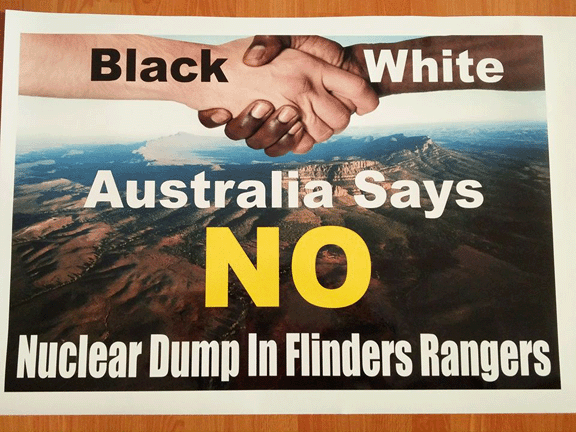 The Kimba properties have now joined Wallerberdina Station, near Hawker, to advance to stage two of consultation but the Flinders Ranges site is facing strong opposition from the Adnyamathanha people — the traditional owners — for cultural reasons.
Both communities now have access to $2 million worth of grants — from the Government’s community benefit fund for local projects to create economic or social benefits — in recognition of any disruption during the assessment process.
 A $10 million fund for community development projects has been promised to the area of the final chosen site — expected to be announced in the second half of this year — which critics fear is a sweetener to encourage the waste facility’s approval.
Michelle Rayner believes the nuclear debate has already had positive benefits in town, including accommodation being filled with government workers and the media visiting on a regular basis.
Mrs Rayner, who owns Eileen’s cafe just off the main street, and her husband, Brett, proposed their Lyndhurst farming property as the other potential site to become the repository. That decision resulted in them being castigated by former acquaintances. but Mrs Rayner said the town needed something to boost its economic prospects.
“My husband wasn’t interested in it all initially but then he came to a community meeting and was blown away by the opportunities for the town,” she says.
“To become a government town, you’re guaranteed to have a decent hospital, better infrastructure and better internet communications.”
The Federal Government says wherever the facility is located, it will bring a minimum of 15 jobs in
administration, waste management and security.
As well, a facility of this scale would likely have additional investment in infrastructure such as roads and telecommunications.
Mayor Dean Johnson does not skirt around the issues and the importance of finding new ways to bring more people to the town, which currently has dozens of empty houses. “The truth is our population is on a slow decline and if we can’t turn that around our sustainability will be questioned,” he says.
“While we have the agriculture roots — and it will always be the main industry in Kimba [Ed note: Not when then market learns about the radioactive trash dump nearby]— any opportunity to diversify the economy and bring more jobs into the town should be investigated.
“That’s not saying this definitely is the thing but we believe we have to investigate it fully and the community has supported that view.”
The stage two consultation process was announced in June and, last month, 16 community members were appointed to a local consultative committee by the Federal Government.
In total, 51 people applied and explained why they wanted to be part of the committee to act as a link to
the government, the Department of Industry, Innovation and Science and residents.
The committee is to provide advice on jobs and business opportunities, relay information on the project’s technical aspects and review nominations for the $2 million community benefit fund.
TEACHER Meagan Lienert — one of the committee members — supports the waste facility because of the benefits she believes it will bring, especially to the school’s 174 students.
 She says medical and nuclear experts had run science lessons at the school and there was talk of access to scholarships at the Australian Nuclear Science and Technology Organisation, at Lucas Heights.
But she understands some people fear nuclear waste because they believe it will affect farming land.
“From my research, I can see the facility is safe and I know it won’t have any affect on the things around it but the fear some people have is real,” Mrs Lienert says.
“I don’t take that away from anyone but I hope to be able to help people gain a bit of understanding and perhaps relieve some of that fear through the consultative committee.”
No Radioactive Waste on Agricultural Land in Kimba or SA secretary Toni Scott is also on the consultative committee and raises concerns about whether the process will be fair.
Mrs Scott says there is a struggle to get information from the Government on why federal land is not used and how many jobs the waste facility will create, saying the number has fluctuated from 15 to 30.
“How do we trust the Government building this facility when we can’t even trust the process?” Mrs Scott says.
“We’re trying to get in writing that if there’s another vote what percentage the Minister needs for this to go ahead. The department head said he would need more than 65 per cent to build the facility but it has never reached 60 per cent.”
FOR two years, Mrs Scott has represented the group’s 204 financial members to oppose the facility, including  making representations at Parliament House in Adelaide and Canberra.
“The key concerns we have are for our farming and our produce; we live in a big country and only 4 per cent is arable farming land — and we sit within that,” she says. “We think we don’t need to risk productive land when there is so much non-arable land. They should try a bit harder to find a suitable site because people aren’t very happy here and it feels like two years of a government process has been forced upon you.”
Kimba farmer and former federal Liberal MP Barry Wakelin is a member of the anti-nuclear group and believes the Government is struggling to find a suitable site — an issue plaguing successive governments since 1992.
“This is their third go after Woomera, Mataranka, and now we have the Kimba/Hawker situation,” Mr Wakelin says.
“The Federal Government has so many other options; it’s absurd to have a community divided on this issue.
“The other thing that weighs heavily on people’s minds is where do we want to see Kimba in 300 years?
We’ll be a national centre for rubbish.” Federal Minister for Resources Matt Canavan told the Sunday Mail
no final decision on the site had been made. He says the Kimba community will get another vote on whether they support a facility — but says there is no “arbitrary figure” which will determine whether it will go ahead.
“The people of Kimba will have a chance to have their say again through another vote after this more comprehensive consultation period concludes,” he says. “There is no arbitrary figure for each step but I have always said there must be broad community support.” Mr Canavan says the process has been rigorous and transparent and a decision would not be made without consultation.
NEW LANDMARK PRAISED
KIMBA locals are forever trying to attract more visitors to their town — and now their efforts are gaining national attention.
The community is a finalist for the Australian title of KESAB’s Sustainable Communities top town — previously the Tidy Towns competition — after being named state winner in November.
The award — to be announced in April — honours the community that does the most to protect the environment, enhance their town and embrace sustainability.
Kimba Community Development Group chairwoman Heather Baldock says their entry included the Igniting Kimba arts project, which included stunning artwork on the town’s grain silos — a refreshing foil to the better-known but now tired-looking Big Galah.
“In a community where sport has always been important, art adds a whole other element to our community and it’s excited the locals even more than we expected,” she says.
“The media interest from across Australia regarding our silo art has been amazing and I think it’s something the whole community is quite proud of.
“We saw a 35 per cent increase in traffic when it was finished (in September) which was over 600 vehicles, so we’re pretty pleased with that.
“Anything that can make people stop for an extra night or two will help us economically because we have businesses that are struggling.”
The award also recognises the town’s grey nomad program, encouraging travelling retirees to work alongside local volunteers, pass on skills and, in return, stay for free….., http://www.adelaide now.com.au/news/south-australi a/as-choice-of-nuclear-waste-f acility-starts-narrowing-peopl e-of-kimba-are-either-excited- or-disgusted/news-story/ 8460ea159b77d47d915dc0abfc362b 37
Timeline of present and recent plans to dump radioactive trash in the Flinders Ranges
 As choice of nuclear waste facility starts narrowing, people of Kimba are either excited or disgusted, http://www.adelaide now.com.au/news/south-australi a/as-choice-of-nuclear-waste-f acility-starts-narrowing-peopl e-of-kimba-are-either-excited- or-disgusted/news-story/ 8460ea159b77d47d915dc0abfc362b 37Erin Jones, Sunday Mail (SA)
January 6, 2018 “………..1998: The Howard Government announces plans for two low-level nuclear waste sites in SA, both at Woomera. Low level nuclear waste includes items like contaminated clothing, rags, tools, medical tubes and swabs.
2003: The SA Government passes a Bill banning the establishment of a low-level waste dump, but the Commonwealth tries to acquire the land at Woomera.
2004: The Federal Court rules that the acquisition is unlawful and the Commonwealth abandons its SA plans.
February, 2015: SA Premier Jay Weatherill announces a royal commission into the role the state could play in the nuclear future, including establishing a high-level waste facility in SA. High level waste includes spent nuclear fuels and waste from the vitrification process.
May, 2015:Mr Weatherill decides upon a citizen’s jury process, to decide whether SA should pursue a high-level dump.
November, 2015:Six sites across Australia, including two at Kimba and one in the Flinders Ranges, are short-listed for a low-level nuclear waste site.
April, 2016: Wallerberdina Station, near Hawker, in the Flinders Ranges, goes to the next stage of the consultation phase — ahead of the five other sites.
November, 2016:The majority of Citizen’s Jury participants vote against a high-level waste dump.
June, 2017 Mr Weatherill formally abandons his high-level nuclear waste push.
■ Two more properties at Kimba nominate to be a low-level nuclear waste site and also progress to the next stage of consultation. http://www.adelaide now.com.au/news/south-australi a/as-choice-of-nuclear-waste-f acility-starts-narrowing-peopl e-of-kimba-are-either-excited- or-disgusted/news-story/ 8460ea159b77d47d915dc0abfc362b 37
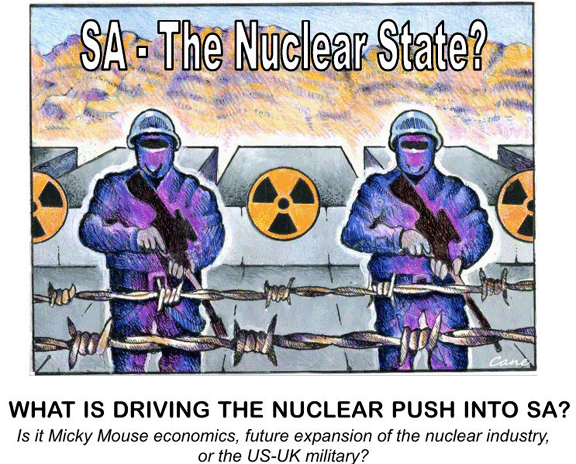
The politics behind the nuclear push in South Australia is complicated indeed.
 Some nuclear-free sleuths on the Facebook site Nuclear Fuel Cycle Watch South Australia– help unravel the complexities.
While the South Australian Liberal Party’s official position was opposition to the Labor government’s 2016 plan to import nuclear wastes, Liberal politicians as well as Labor were funded by the Taiwanese government for trips to Taiwan to promote the cause of importing nuclear wastes.
MPs and MLCs visiting Taiwan:
During the financial year 2014-2015, Tom Kenyon and his wife received travel, accommodation and food courtesy of the Government of Taiwan. The Members Register of Interests for that year contains the information in the clipping below.
UPDATE – Other Parliamentarians to visit Taiwan and discuss nuclear industry include:
– Tom Kenyon (Newland) in 2006 (funding: GoT)
– Liz Penfold (Flinders) in 2007 (funding: unknown)
– Trish White (Taylor) in 2006-2007 (funding: GoT)*
– Michael Atkinson in March 2011 (funding: GoT)*
– Stephen Griffiths in March 2011 (funding: GoT)*
– Tom Kenyon (Newland) in 2014-2015 (funding: GoT)
– MLC Tung Ngo in 2016 (funding: unknown)
* Those marked with ‘*’ have not had the purpose of their travel confirmed.
Tom Kenyon’s visit to Taiwan in 2006, during which he claims he embraced the idea for South Australia to import spent nuclear fuel for storage and disposal, was paid for by the Government of Taiwan.
The supporting evidence was found in the 2007 Members Register of Interests, held by the SA Parliament.
Thanks to Sandra Kanck for suggesting that the Register might contain such details, and to the administrators at the SA Parliament for making past Members Registers of Interests available at my request.
Dan Monceaux , 6 Jan 18 Trish White also travelled to Taiwan in 2006-2007 at the expense of the Government of Taiwan. It was documented in an Erratum to the Members Register of Interests for that year.
More recently, White was a signatory on the latest Open Letter hosted by Bright New World, calling for the door to be kept open on the consideration of spent nuclear fuel importation to SA.
Her Wikipedia biography states that she was an engineer and project manager before entering the SA parliament. She also worked with DSTO. After leaving the Parliament, she became a senior exec. with engineering consultants, WorleyParsons.
I wonder if she traveled with Tom Kenyon on this occasion?
Just days after Premier Jay Weatherill’s citizens’ jury last month overwhelmingly dumped on plans for nuclear storage in SA, amid concerns about trust, Mr Hamilton-Smith insisted he had met with Taiwanese officials who expressed a “clear message” of interest in investment.
“There’s clearly a demand and our neighbours may be in a position to put hundreds of millions, if not billions, into infrastructure and then paying to dump waste on an ongoing basis,” he said.
However, correspondence from state-owned power company Taipower and the country’s Atomic Energy Council to government party MP Su Chih-Feng rejects Mr Hamilton-Smith’s claim.
While they note there was a meeting with Mr Hamilton-Smith on November 10, Taipower says his spin of the events in Adelaide three days later was “a false information”.
The translation from Mandarin to English was done by a Taiwanese NGO and provided to The Advertiser by antinuclear activists Friends of the Earth Australia. It states Taipower was interested in using a dump which had been established, but not paying to help set one up.
“A foreign solution is one of the options for Taipower. However, foreign solution is also sensitive case in terms of international relationships,” the letter states.
“Therefore, foreign solutions should carefully consider both domestic and foreign regulations.
“Foreign solutions is a sensitive case with a lot of uncertainties.
“Taipower will consider to be a ‘customer’ after the country has developed a disposal facility.”
Taiwan’s Atomic Energy Council also said Mr Hamilton-Smith’s claim was “a false information”……
http://www.adelaidenow.com.au/…/87d59e1b045388a83ead14d..
In an earlier Advertiser report – “Investment and Trade Minister Martin Hamilton-Smith said he was delivered a “clear message” that the tiny island nation would be interested in investing in nuclear storage infrastructure and making ongoing payments to dump waste overseas.” “our neighbours may be in a position to put hundreds of millions, if not billions. into infrastructure” – http://www.adelaidenow.com.au/news/south-australia/taiwan-first-country-to-consider-storing-nuclear-waste-at-a-facility-in-sa/news-story/9934181587580b42e35e2276980e299f
South Australia’s renewable energy powerhouses to come – Whyalla and Port Augusta
Whyalla and Port Augusta could be a renewables powerhouse, says local mayor, ABC North and West By Tom Rohde , 4 Jan 18
SA’s clean-energy projects
- A hybrid power station is being built at Coober Pedy. The hope is that the outback community can be powered solely by solar, wind and diesel energy
- Investors have funded a $300m solar battery-power plant at Roxby Downs
- A wind, solar and battery farm is planned at Crystal Brook in the state’s mid north
- A 100 megawatt solar powered facility is being built at Tailem Bend
- US-based company Solar Reserve is seeking federal support for a $650 million solar-thermal project in Port Augusta
- Zen Energy wants to build a solar power plant in the Upper Spencer Gulf
Whyalla Mayor Lyn Breuer said she hoped her city could team up with Port Augusta 80 kilometres away to make the plan a reality.
Regional South Australian cities have seen several energy projects announced over the past year, with construction on a new solar thermal power station in Port Augusta to start early this year.
In October last year, Whyalla steelworks owner Sanjeev Gupta announced that he had approved a plan worth up to $700 million for solar, battery storage and pumped hydro, with 200 megawatts of solar photovoltaics at Whyalla……..
Port Augusta’s mayor Sam Johnson said he believed the region was already becoming a hub for renewable energy.
“Port Augusta will, and I believe actually is becoming the renewable capital of Australia and there’s no doubt that Whyalla is a direct link into that.
“There’s some really great synergies between Port Augusta and Whyalla in what’s becoming a new and exciting industry.”…. http://www.abc.net.au/news/2018-01-05/sa-cities-could-become-australian-renewable-energy-centre/9306318
Federal Nuclear Waste Dump: Locals NOT WELCOME to attend the Barndioota Consultative Committee December Meeting
 Tim Bickmore, Fight To Stop Nuclear Waste Dump In Flinders Ranges SA, 14 Dec 17, This week some locals tried to attend the Barndioota Consultative Committee December Meeting – but were not welcome. They were advised that 1] there were no protocols for allowing such, & 2] should the BCC formulate observer
  guidelines then there was a high probability that peeps would need to sign a confidentiality agreement.
This is a joke, right? Isn’t it a foundation purpose of the committee to provide an interface? What business could they have which requires official secrets remain hidden from the rest of us?
http://www.radioactivewaste.gov.au/…/Barndioota%20Consultat…
Significant wins by the Greens for the nuclear free cause in South Australia
 Mark Parnell MLC , Parliamentary Leader, Greens SA, 6 Dec 17,
The last couple of sitting weeks of the year in State Parliament have been huge, and the Greens have had some significant wins
A win for democracy
My amendment to the South Australian Constitution to make it fairer to all parties and candidates passed both Houses of Parliament. Under the mis-leadingly named “fairness clause” in the Constitution, the boundaries of electorates were required to be rigged so that one of the two major parties would form a government. This is despite the fact that a growing number of South Australians don’t vote for either of the old parties.
For elections beyond 2018, the review of electorate boundaries will have regard to population, one-vote-one-value, geography, communities of interest and other relevant factors but won’t be artificially rigged to favour the old parties. The Greens have ensured that future elections will be more democratic and better reflect the will of the people of South Australia.
No more public money to spruik nukes
A big majority in Parliament passed my Greens Private Members Bill to prohibit the Government spending public money on spruiking the benefits of nuclear waste dumps in SA. We won the campaign against the high level international nuclear waste dump but we still have the national dump proposed for the Flinders Ranges and Kimba. Not only are these dumps illegal in SA, but now it is also illegal to use public money to encourage or finance nuclear waste dumps……..
Biodiversity can no longer be ignored
Another Greens’ Bill that passed last week ensures that biodiversity is properly considered in all planning decisions.
There is a real crisis in biodiversity in South Australia, which is under threat from many sides including loss of habitat and climate change. Whilst passing a law for a new State Biodiversity Planning Policy won’t fix the problem overnight, it sends an important message to State and Local Governments that they can’t ignore the natural environment when making decisions about development or rezoning land.
Can SA be 100% renewable?
Absolutely! Despite attempts by some opportunistic MPs to blame renewable energy for the Statewide electricity blackout last year and other weather-related outages, a Parliamentary Inquiry has found that renewable energy was not to blame. What’s more, there is now a clear pathway to achieving 100% renewable energy in South Australia. The key is to use wind and solar energy backed by batteries, pumped hydro and solar thermal storage. This is achievable without compromising system reliability, security and affordability for consumers. With our State’s national leadership on renewables and our fantastic wind and solar resources, the future is looking bright. My report is at p.42 of the Committee’s Report.
Over 1000 protest in Adelaide against Federal nuclear waste dump plan
1000+ at an Adelaide rally yesterday to protest Canberra’s plans to dump Sydney’s nuclear waste in SA … People travelled from Hawker and Kimba regions of South Australia today to come and protest about the Federal Government’s plans to dump nuclear waste around their land and farms. All the speakers were very angry and cynical about the way that the Federal Government was behaving towards the people in this State.
Yami Lester’s daughters continue his fight against the nuclear industry
Yami’s daughters take up anti-nuclear fight https://nit.com.au/yamis-daughters-take-anti-nuclear-fight/ – Wendy Caccetta –reporter@nit.com.auSisters Karina and Rose Lester know all too well the tragedy nuclear weapons can bring.
Their late father Yami Lester, a Yankunytjatjara man of northern South Australia, lost his sight after  being exposed as a boy to nuclear testing by the British Government at Maralinga in remote SA.
He went on to become a prominent anti-nuclear campaigner.
Now his daughters have taken up the battle, collecting and sharing stories that have helped the International Campaign to Abolish Nuclear Weapons (ICAN) win a Nobel Peace Prize.
The prestigious prize will be presented in Oslo on December 10, with an event at Melbourne Town Hall to be held the same day.
 Karina Lester, who lives in Adelaide, said when she was growing up her father did not talk much at home about what had happened to him as a boy when the nuclear testing took place.
But in public Mr Lester, who passed away in July at the age of 75, felt it was important to share with the world the events that shook the Wallatina community in the ’50s.
“There’s a role a parent plays in protecting your children from really knowing some of the sad, sad stories that did take place across our community,” Ms Lester said.
“He spoke a bit about where the camp was, he remembers that day, he remembers the ground shaking and this black mist rolling and the fear in the community.
“There was a huge loss for us as an Aboriginal community and we were so badly done by when the British came in and tested in our backyard that we still suffer to this day.”
Ms Lester said conditions in the community deteriorated over a week after the testing.“When the fallout happened, that evening, people were violently ill,” she said. “There was a lot of vomiting going around in the camp. People became sick. Their eyes started getting sore and tender.
“By day two, people were really starting to suffer. By week two, people’s eyes were either burnt out or people had bad burns on their bodies. “There were lots of rashes appearing and there was a trail of black-like soot that fell over the whole of the community.
“The oranges had shrivelled up and by that week were non-edible.”
Ms Lester said the story was a painful one, but needed to be heard. She said it was important to take a stand against anything nuclear from weapons to waste storage facilities. The Lester sisters gave NIT permission to reproduce the photo of their late father.
Hot weather in South Australia: Tesla battery turned on a day ahead of schedule
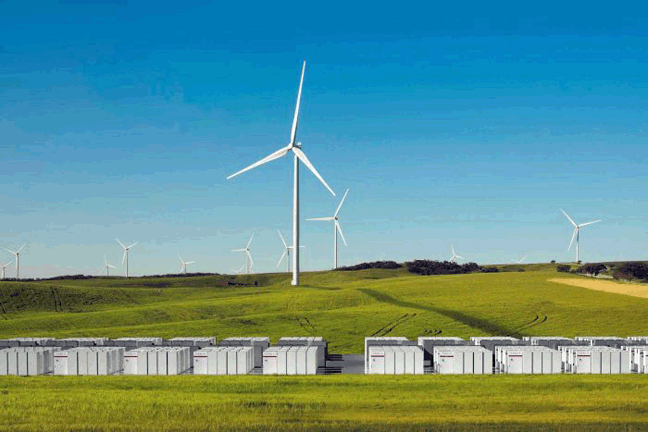 South Australia’s Tesla battery called on a day ahead of schedule as hot weather takes hold, ABC News 30 Nov 17 By politics reporter Nick Harmsen, South Australia’s giant Tesla battery has begun dispatching stored wind power into the electricity grid a day ahead of its scheduled switch-on.
Premier Jay Weatherill will visit the battery site — alongside the Hornsdale windfarm near Jamestown in the state’s mid north — on Friday, to mark its official opening on the first day of summer.
But with temperatures across South Australia and Victoria hitting the mid 30s, and output from the state’s wind farms low, the battery was called upon early to help meet Thursday afternoon’s peak demand.
The battery dispatched a maximum of 59 megawatts of power. The 100MW/129MWh battery is capable of powering about 30,000 homes for a little over an hour.
The manufacturer, Tesla says the lithium-ion device — made up of PowerWall 2 batteries — is both the “largest” by storage and “most powerful” of its type in the world……..http://www.abc.net.au/news/2017-11-30/sa-tesla-battery-begins-producing-power-a-day-ahead-of-schedule/9212794
South Australian law: government now prohibited from spending money to promote nuclear waste importing
29 Nov 17, Today the Lower House of the SA Parliament passed my Greens Private Members Bill to remove the clause in the Nuclear Waste Storage Facility (Prohibition) Act 2000 that allowed the Government to spend public money on spruiking the benefits of an international high-level nuclear waste dump in SA.
That means that this will now become South Australian law as it has passed both Houses of the SA Parliament.
The Government will no longer be able to spend public money on pursuing an international nuclear waste dump.
With the focus now on fighting the Turnbull Federal Government’s plans for an intermediate-level nuclear waste dump in Kimba or the Flinders Ranges, it’s important to show your opposition to these plans. Come along to the “Don’t Dump on SA Rally” at 11am this Saturday, 2 December 2017 on the steps of Parliament House.
I will be speaking at the rally, outlining the Greens position on this important issue.
The Greens stand with the people of South Australia who choose a nuclear-free future for our State.
BHP aims to make a decision about a $2.76 billion expansion of Olympic Dam in the next few years
Cameron England, Business Editor, The Advertiser, 28 Nov 2017
BHP is considering a $2.76 billion expansion at Olympic Dam which it expects to make a decision on by mid 2020.
The company also said it has already started a $1 billion program to upgrade surface infrastructure as part of the Southern Mine Area Expansion, currently under way, which will increase its copper production to 230,000 tonnes per year.
The mine produced 166,000 tonnes last financial year which is expected to drop to 150,000 this year due to a major smelter upgrade. At an investor briefing in Adelaide today, Jacqui McGill, asset president Olympic Dam, said the company was working on a three phase expansion plan for Olympic Dam
The first phase — the SMA — will increase production to 230,000 tonnes of copper equivalent by 2020.
The term “copper equivalent” refers to the value of the mine’s production when also taking into account the gold, silver and uranium it produces.
The second phase of the project — brownfield expansion or BFX — would cost $US2.1 billion with the company currently running the numbers on the project with a view to making a decision on going ahead in mid 2020…. http://www.adelaidenow.com.au/business/jobs/bhp-aims-to-make-a-decision-about-a-276-billion-expansion-of-olympic-dam-in-the-next-few-years/news-story/1a9f517cb561e7f46ea58cfbdc7983f3
Proposed Federal nuclear waste dump threatens South Australia’s environment and economy
Susan Craig Fight To Stop Nuclear Waste Dump In Flinders Ranges SA November 22
• The current uranium waste storage facility is at Lucas Heights, NSW which has the capacity to continue storage for another 30 years. We are asking that this facility continue to be used until we have established a sound and safe resolution for the disposal of this waste and in collaboration with community and all interested parties.
• The waste dump proposed is not for underground storage, but rather a precarious and interim above ground storage site.
• Should the waste dump for Flinders Ranges be achieved, it will open the flood gates for the world to use South Australia as a dumping ground for many years to come, knowing they can dispose of their radioactive waste away from their own countries.
• South Australia has WORLD CLASS agriculture, food, wine, fibre and forestry industries.
• These industries are S.A’s LARGEST EXPORT INDUSTRIES and our products are transported directly to more than 100 countries.
• Our production systems are sustainable and makes use of CLEAN and SAFE environments.
• These industries are well supported and well positioned to meet the GROWING GLOBAL demand for CLEAN and SAFE food and wine.
• The total value of Australia’s farm exports is expected to hit a NEW RECORD OF $48.7 BILLION in 2016-17, $1 billion higher than the previous year.
• The value of Australia’s agricultural sector is tipped to BREAK ANOTHER RECORD this financial year, peaking at $63.8 BILLION
• Gross wine revenue increased by $329 million to $2.11 BILLION
• The value of wine exports increased by $119 million to $1.34 BILLION
• The value of the tourism market in the FLINDERS RANGES is worth $421 MILLION
• FLINDERS RANGES is the SECOND MOST VISITED regional site in South Australia.
• The value of S.A’s tourism market is worth $6.3 BILLION
• These industries show significant growth on previous years and forecast to CONTINUE GROWING, but a radioactive waste facility in our state will threaten all of this.
• Say NO to nuclear waste in South Australia and keep our farming, our tourism, our people and our future safe. https://www.facebook.com/groups/344452605899556/
www.dontdumponsa.net #dontdumponsa #sa2good2waste
Australia’s govt and nuclear lobby soften up South Australians for nuclear waste dumping
 National Radioactive Waste Management Facility:21 November 2017
Industry has one week left to tender for Site Characterisation Works
Industry is invited to get involved in the process to build a National Radioactive Waste Management Facility, with tenders now open for Site Characterisation works.
The tender is to deliver a range of technical assessments that will form part of Phase Two of the process in relation to the proposed National Radioactive Waste Management Facility, including:
- Assessing flora and fauna, geology, seismic activity, risks, the surrounding environment, transportation and other infrastructure.
- Inputting into the Detailed Business Case, with reference to the site specific design and cost estimates that arise from site characterisation.
- An additional option, following site characterisation, for the preparation and development of submissions for licensing and approvals process…….
Bruce McCleary, General Manager of the National Radioactive Waste Management Facility Taskforce said that site characterisation is an important activity in the next part of the project.
“Three sites, two in Kimba and one at Wallerberdina Station were voluntarily nominated by their landowners and moved to Phase Two assessment after the community supported continuing the discussion,” McCleary said.
“Phase Two involves building a detailed understanding of the nominated sites, through in depth community consultation and technical assessments.
“Community consultation is now well underway, including appointment of locally engaged officers and establishment of site offices at both sites, creation of committees and working groups, and regular visits from members of the project team and experts to provide information on the project.
1 This month


Help Aunty Sue Protect Her Land and Sacred Sites From Destructive Rocket Testing.
.

Australians deserve the truth
about
AUKUS – https://aukuspublicinquiry.com/

PETITION – To: Prime Minister Anthony Albanese and the Australian Labor Government

of the week – Australians for War Powers Reform (AWPR)
To see nuclear-related stories in greater depth and intensity


