“With the solar potential of Port Augusta being similar to that of the Negev Desert, this project can provide a number of valuable lessons for ARENA as they consider proposals for Australia’s first solar thermal plant.” ARENA is evaluating a solar thermal plant in Port Augusta in SA to replace the closure of two coal-fired power stations in recent years……….http://www.afr.com/news/politics/frydenberg-backs-negevstyle-solar-thermal-plant-for-port-augusta-20170425-gvrs8u
South Australian Premier Jay Weatherill declares the nuclear waste importing plan “dead”
 There’s no foreseeable opportunity for this”: Jay declares nuke dump “dead” INDaily, Tom Richardson @tomrichardson, 7 June 17,
Premier Jay Weatherill has officially walked away from one of the major policy hallmarks of his term in Government, pronouncing the nuclear waste dump “dead” and vowing he will not revisit it if he wins another term in office.
The position appears a significant rhetorical shift from his stance last November, when he pledged to keep the debate alive ahead of a future referendum on the issue of nuclear waste storage, after his own Royal Commission found establishing a local industry could net a “$100 billion income in excess of expenditure”.
At the time, his position was seen by critics both inside the Labor Party and more broadly as a refusal to abandon the nuclear dream.
But asked about the future of the nuclear dump at a public forum in Victor Harbor this week, Weatherill declared the project “dead”.
“Yeah it is,” he reaffirmed to InDaily today……..
After the Victor Harbor forum, Conservation SA chief executive Craig Wilkins said the rhetorical shift should be enshrined in Labor policy, calling on Weatherill to “bury the nuke dump plan for good”.
South Australia reaches its renewable energy target 8 years in advance
 South Australia already at 57% wind and solar in 2016/17, http://reneweconomy.com.au/south-australia-already-57-wind-solar-201617/ By Giles Parkinson on 6 June 2017
The South Australian government’s official target for renewable energy is 50 per cent of local demand by 2025. According to the Australian Energy Regulator, it didn’t just reach that target in 2016/17, eight years early, it is literally blowing past it.
Data released in the AER’s state of the energy market report released last week suggests that the combined contribution of large scale wind power and rooftop solar PV has already reached 57 per cent in the first nine months of 2016/17.
The report showed that wind power accounted for 38 per of the state’s demand in 2015/16, jumped to about 43 per cent in calendar 2016, and then jumped even further in 2016/17 as new wind farms such as Snowtown and Hornsdale came on line.
“In the nine months to 31 March 2017, the contribution of wind generation was even greater, supplying 50 per cent of South Australia’s electricity,” the AER says.
Add in the at least 7.6 per cent contribution from rooftop solar – the AER report says that the 728MW of rooftop solar contributed 7.6 per cent of South Australia’s annual energy requirements in 2015–16 – that takes the state up to at leat 57 per cent for the nine months to the end of March.
That figure is expected to jump again as households and businesses continue to add rooftop solar, and as the third 109MW stage of the Hornsdale wind project comes on line.
Over the next year, the 220MW Bungala solar project and the 212MW Lincoln Gap wind farm, both near Port Augusta, will also come on line, taking the state up towards 65 per cent renewables, and there are numerous other projects said to be near the point of financial close.
As we reported in April, The Australian Energy Market Operator predicts that the state is heading towards 80 per cent renewable energy by 2021/22, saying that capacity of large scale renewables (wind and solar) will double to around 3,100MW over the next five years.
Those additions could be affected, however, by the structure of the state’s proposed energy security target, and whether it allows wind and solar farms to be paired with battery storage, or whether its insistence on “real inertia) (i.e. from spinning turbines) results in curtailment of wind and solar.
AEMO also expects the amount of rooftop solar capacity in South Australia to double and reach over 1500 MW by 2025, by which time the state’s minimum demand could on occasions be met entirely by rooftop solar, suggesting the need for something smarter to happen with battery storage.
Interestingly, the AER notes that the wild swings in prices often attributed to high renewable energy penetration are in fact being matched by states with rely almost exclusively on coal and gas.
This is because the prices are, in the end, set by the high price of gas-fired generation, and often manipulated when states have few major generators. Both South Australia and Queensland are dominated by just two or three major generation companies, and this is seen as a major cause of the problem
The AERs analysis shows that the most number of price spikes occurred in Tasmania in recent years, thanks to the failure of its Basslink cable, the drought that depleted its hydro resources and the subsequent reliance on fossil fuel generation.
The number of price spikes in South Australia and Queensland is roughly even, although the South Australia number is higher for the latest year after the work on the upgrade to the inter-connector to Victoria saw the gas generators in the state push prices to the maximum level on multiple occasions.
Major commercial shopping sites in NSW and South Australia to go solar
Four shopping centres to go behind the meter in major commercial solar deal, REneweconomy, By Sophie Vorrath on 6 June 2017 One Step Off The GridOne of Australia’s biggest shopping centre owners, SCA Property Group, has joined the march to solar, after signing a deal to power four of its major commercial sites cross regional New South Wales and South Australia with a combined total of 2.9 MW of rooftop PV.
In an ASX announcement on late last week, Queensland-based solar supplier ReNu Energy said it had entered an agreement with SCA Property to own and operate solar PV and embedded network systems across four shopping centres, for a period of 10 years with an additional three, five year options……..http://reneweconomy.com.au/four-shopping-centres-to-go-behind-the-meter-in-major-commercial-solar-deal-31391/
Calls to cut support for coal mines after latest Great Barrier Reef report
 Greens believe Great Barrier Reef future at crucial crossroads after new report released, Brisbane Times Toby Crockford
 JUNE 3 2017 The Greens have issued an ultimatum to the state and federal governments after the latest report expressed “serious concern” regarding the Great Barrier Reef rescue plan.UNESCO, which advises the World Heritage Committee, said on Saturday that key targets in the Reef 2050 plan “are not expected to be achieved” and urged Australia “to accelerate efforts”. In response to the fresh concerns, Queensland Greens Senator Larissa Waters launched a scathing attack on the state and federal governments.
“Meanwhile, Queensland Labor and Turnbull roll out the red carpet and public money for Adani for their deadly mega-coal mine,” Senator Waters said.
“As many scientists have said, our governments must choose between new coal or the reef.
“Will the two old parties back the 70,000 people with reef jobs? Or will they pay back the millions in donations from the mining industry, sign the reef’s death warrant and continue to back Adani?”
Queensland Environment Minister Steven Miles admitted progress had been slow in implemented measures outlined in the reef rescue plan, particularly towards 2018 targets.
In a report released in Paris on Saturday, UNESCO praised progress in the inception and initial implementation of the rescue plan but said reef rescue work “must move faster”.
“Progress towards achieving water quality targets has been slow and the most immediate water quality targets … are not expected to be achieved within the foreseen time frame,” the report said.
A previous report revealed coral bleaching at the Great barrier Reef in 2016 was even worse than expected. The most severe bleaching was found north of Port Douglas where an estimated 70 per cent of shallow water corals had died. http://www.brisbanetimes.com.au/queensland/greens-believe-great-barrier-reef-future-at-crucial-crossroads-after-new-report-released-20170603-gwjrgv.html
Ross Garnaut – green energy will be win-win for South Australia
 Ross Garnaut: SA has little choice over green energy and can be a low carbon superpower http://www.adelaidenow.com.au/news/opinion/ross-garnaut-sa-has-little-choice-over-green-energy-and-can-be-a-low-carbon-superpower/news-story/1de5289d11018f29eefa271b913b118f Ross Garnaut, The Advertiser June 1, 2017 OF the many challenges facing South Australia, it’s hard not to look past how the state plans to deal with a more secure electricity supply.
IMPOSITION of ANSTO reactor nuclear wastes onto South Australian community
 28 May 2017, Submission by David Noonan, B.Sc., M.Env.St. To:Senator The Hon Matthew Canavan RE: Proposed Federal government imposition onto community in South Australia of an illegal “100 year” Store for ANSTO’s “10 000 year” irradiated Nuclear Fuel Wastes.
Storage of nuclear wastes affects the rights, interests and safety of all South Australians and is prohibited in our State under the Nuclear Waste Storage (Prohibition) Act 2000.
Proposed imposition of ANSTO reactor nuclear wastes is a major public interest concern in SA and detracts from public trust and confidence in the Federal government, in ARPANSA and in ANSTO.
The National Radioactive Waste Management Facility (NRWMF) comprises two co-located waste management facilities: an above ground 100 year Store for wastes that ARPANSA states require isolation for 10 000 years, AND a Disposal Facility for wastes requiring isolation for up to 300 years.
This submission focuses on the proposed imposition of the illegal Store & consequences thereof.
The Store is primarily for ANSTO irradiated Nuclear Fuel Wastes (NFW) and other existing and proposed reactor wastes, with only minor projected future arising’s of Intermediate Level Wastes (ILW) from States & Territories or from other Commonwealth agencies.
ARPANSA’s CEO (May 2015) has formally considered the proposed NRWMF Store and stated:
“This plan will have the provision for ILW storage above ground for approximately 100 years.”
This indefinite storage plan compromises safety in importing nuclear waste to SA without a waste disposal capacity or even a requisite program for disposal of NFW and ILW.
ARPANSA’s Radiation Health and Safety Advisory Council (April 2010) has provided formal advice which concluded: “that Australia’s current policy of indefinite storage for intermediate level waste does not appear to be consistent with International best practice.”
The import, transport, storage and disposal of ANSTO irradiated Nuclear Fuel Wastes is illegal in SA and was prohibited under the leadership of Liberal Premier John Olsen in 2000:
“The Objects of this Act are to protect the health, safety and welfare of the people of South Australia and to protect the environment in which they live by prohibiting the establishment of certain nuclear waste storage facilities in this State”
Since April 2016 the NRWMF project has exclusively targeted community and environment in SA in an attempt to again impose an illegal Store for ANSTO’s irradiated Nuclear Fuel Waste in our State. 2
The Minister’s release “Kimba 90-day consultation begins”(20 March 2017) invited submissions on potential approval under the National Radioactive Waste Management Act 2012 of two nominated sites near Kimba for assessment as potential sites for the proposed NRWM Facility.
This is in-parallel with the Federal government targeting the iconic Flinders Ranges on the country of the Adnyamathanha people in a serious threat to their human rights and cultural interests.
These are fundamentally State level public interest issues and represent a multi-generational threat to community in SA: including intended Federal requisition of an as yet unnamed SA port for imposition of decades of irradiated Nuclear Fuel Wastes imports, along with affected stakeholders on transport routes, in addition to the rights & interests of community around a potential Store site.
The Federal government has unacceptably failed to take up the recent Advice of the ARPANSA Nuclear Safety Committee (4 Nov 2016) for transparency and for the essential “ongoing requirement to clearly and effectively engage all stakeholders, including those along transport routes”.
This Store also exposes SA to unresolved security and potential terrorist risks in shipping, transport and indefinite above ground storage of irradiated Nuclear Fuel Wastes and other reactor wastes.
However, Lucas Heights is Australia’s best placed institution and facility to responsibly manage ANSTO’s Nuclear Fuel Wastes and can do so through-out the operating period of the Opal reactor.
An “Interim Waste Store” built at Lucas Heights in 2015 has a design life of 40 years and an approved purpose to take both the Nuclear Fuel Waste from France (NFW received Dec. 2015) and NFW to be received from the UK in circa 2020. The ARPANSA license for this Store “is not time limited” and has Contingency options to retain these NFW’s at ANSTO “until the availability of a final disposal option”.
The policy agenda to impose a NFW Store in SA is a flawed, unnecessary, contested and unsafe plan.
A broad public interest campaign protected SA rights and interests from prior Federal government attempts to impose nuclear waste facilities onto our State over 1998 to 2004 – and can do so again.
That “National Store Project” was abandoned – just as this NRWMF Store will have to be set aside.
Further, the Federal government’s flawed policy agenda for imposition of nuclear waste effectively precludes a long term resolution to Australia’s “low level” radioactive waste responsibilities.
The Minister has an obligation to learn the lessons from experience in failure of prior projects in Australia and internationally and not to deny or override key public interest community concerns.
My background includes experience as an Australian Conservation Foundation (ACF) Campaigner over 1996 to 2011 based in Adelaide.
The military connection to the push for advanced nuclear reactors in South Australia
With a nuclear waste dump in South Australia that accepts international shipments, the full range of the “nuclear industry” in the state would be complete, truly making it the “Defense State” that has become the state motto.[9]
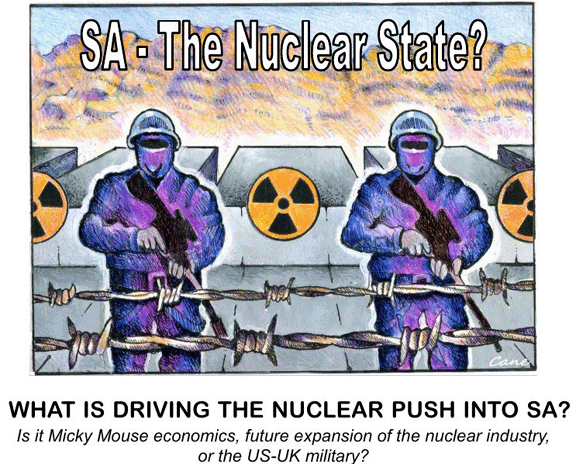
 SOUTH AUSTRALIA’S NUCLEAR MILITARY-INDUSTRIAL COMPLEX: THE GLOBAL CONTEXT, Spirit of Eureka ,Talk by David Palmer at “SA The Nuclear State” forum 03 May 2017 “……..If citizens – the people – whether they are in the Fukushima region of Japan or in Adelaide, South Australia – have a right to speak out on the dangers of the nuclear industry, then who are the elites promoting the nuclear industry? If we look at prominent figures in government the institutional linkages become all too clear. Consider the example of Kevin Scarce, Governor of South Australia until 2014, a Rear Admiral retired from the Royal Australian Navy, current Chancellor of the University of Adelaide, and Deputy Chairman of Seeley International, the largest air conditioning company in Australia that is known for energy-efficiency. Scarce led the Nuclear Fuel Cycle Royal Commission and was the primary author of the report that recommended the South Australian government accept a nuclear waste dump. All the links are there in Scarce’s connections and positions: military, university, corporate, and government.
Furthermore, the Royal Commission did not focus solely on a nuclear waste dump. It considered possible expansion of nuclear industries in the state that encompassed mining, enrichment, and power generation. The Royal Commission report states that “The activity under consideration is the further processing of minerals, and the processing and manufacturing of materials containing radioactive and nuclear substances (but not for, or from, military uses) including conversion, enrichment, fabrication or reprocessing in South Australia.”[3]
But during the time this Royal Commission report was being prepared and finally delivered, Adelaide became the focal point for naval shipbuilding contracts, particularly submarines. Both Labor and Liberal politicians sought to outdo each other in pushing for submarines to be built in Adelaide. They will be diesel powered, but the majority of submarines internationally use nuclear power propulsion. Potential overseas contractors also use designs geared for nuclear power. There are those in Australian naval circles who would like to see these Australian subs with nuclear, not diesel, power. And where will these submarines be used, and with what international interests? We know the answer to that question, as recent events in the Western Pacific have confirmed. The USS Carl Vinson, the nuclear powered air craft carrier, was on exercises in the Indian Ocean in early April with Australia’s HMAS Ballarat, when it was ordered to the Korean peninsula this month in response to the North Korean threat to explode a nuclear bomb.[4] This latest development is just one example of the escalating naval tensions on our side of the Pacific. Crises like this will potentially increase pressure for Australia to build submarines – and possibly other naval vessels – that are nuclear powered.
What does the corporate profile of the “nuclear industry” look like? Continue reading
Citizens must get informed, and speak out against the dangerous nuclear industry
These women defy the illusion that you have to have a Ph.D. in nuclear physics or in nuclear engineering – that you must be a Ben Heard – to have a legitimate voice about nuclear power and the potential dangers of nuclear industry accidents. Our movement needs scientific experts, but all of us can gain basic knowledge and speak out
SOUTH AUSTRALIA’S NUCLEAR MILITARY-INDUSTRIAL COMPLEX: THE GLOBAL CONTEXT, Spirit of Eureka Talk by David Palmer at “SA The Nuclear State” forum 03 May 2017 There are other speakers and participants here today who have more expertise in the scientific and engineering details of this controversy than I do. My comments are aimed, instead, at those powerful elite stakeholders who are at the core of what we know as the military-industrial complex – here in South Australia, our country, but also globally, with its centre in the United States.Is this issue of a nuclear waste dump advocated for South Australia just about jobs and economic prosperity, as Premier Wetherill claims? Or is it far broader? The words of Ben Heard, former executive director of pro-nuclear power lobby group Bright New World, sum it up well: “We must be a full service provider to the nuclear back-end.”[1] Adelaide’s Advertiser reported last month that “a new open letter [has been sent] to state MPs, 42 influential people demand[ing] the State Government commits to completing first-stage investigations of the proposed high-level repository.”[2] Many of these “influential people” signed a similar letter back in December demanding the same thing, through Ben Heard’s pro-nuclear Bright New World.
But just what is this “nuclear back-end” – the back end of what? Nuclear materials have a wide range of uses, including medical and commercial ones that are distinct from their main uses for power generation and weapons. The vast majority of government expenditures related to nuclear materials goes toward nuclear weapons and military uses (such as naval propulsion systems), and nuclear power. In the United States, virtually all nuclear-related industries and products in the energy and military-application areas are joint operations involving private companies working under government contracts and regulations. The scientific and engineering knowledge required for the nuclear industry means that universities and university-linked research centres play a major role in bringing these two institutions – private companies and government – together. In South Australia, Ben Heard (who is connected to University of Adelaide) is symbolic of this key link connecting networked institutions and elites. Continue reading
What is driving the nuclear industry to dump its nuclear waste in South Australia
By Annie McGovern. 23rd April 2017 (this is an extract from the Adelaide Forum held very recently, to discuss this question) “….ENDNOTE These observations have been gleaned from a fairly  random search for relevant information which was also confined by the time available to process and present these findings. These are offered at this time as an additional body of information that may help fill some of the gaps in the thrust to force further nuclear energy production and waste disposal on the people of S. A.
Amongst the many recommendations of the Nuclear Fuel Cycle Royal Commission there were 3 major points which raise concerns regarding the possible imminent changes to Legislation in S.A. The Royal Commission has urged the State Government to fast-track these Legislative changes, even though there are no current viable plans for any nuclear industry developments in S.A. at this time.
- Modification of the State Waste Dump Prohibition Laws. This Legislation was almost immediately amended following presentation of the Royal Commission’s findings, to allow Government spending on proposals for the Waste Dumps. The further question of approval of nuclear waste dumps in S.A. was put to the Labour State Conference and became a stalemate to which no decision could be made. Progress of changes to Legislation on this proposal was interrupted.
- Legislation that would allow contracts of Uranium sales to be tied to obligations on S.A. taking back the resultant waste. The Royal Commission sees this possibility as an enhancement to capture sales of Uranium, despite there being no approval for waste disposal in S. A. at this time, and, the fact that no such facility would be capable of fulfilling the contract until well into the future. The Royal Commission appears to be determined to place the people of S.A. into an intractable situation where industry is forcing obligation through contractual arrangements. However, a caveat might be placed on such contracts that are not plausible…an explicit caveat and the risk is borne by the signing parties. A letter of advice is provided to the signatory and the Annual AGM of companies involved informed of this unethical business practice.
- Legislative changes to allow Nuclear Power production. Despite there being no overt plans for these developments within the foreseeable future, the Royal Commission is encouraging making changes now for future development. The absence of a ready nuclear waste disposal dump has historically been a constraint on Australia and the world in the development of greater Nuclear ambitions. Reports of illegal dumping and covert placement of radioactive waste abound both here and across the world. Reports of French waste being held at Lucas Heights and American wasteat Pine Gap are recent additions to these claims.Despite peoples’ efforts over many generations to call for and act on Peaceful Principles in our World, Environmental Sustainability and Productivity based on Need rather than Greed, capitalism and its theory of perpetual growth continues to drive forward in an overtly destructive manner.
The continued focus on South Australia to perpetuate the nuclear travesty on our planet is acknowledged through this Forum and collectively we stand against this invasion. We walk with the Protectors of Country with Respect for Life.
Hawker schoolkids given tax-payer funded nuclear promotional trip to Australian Nuclear Science and Technology Organisation (ANSTO) in Sydney.
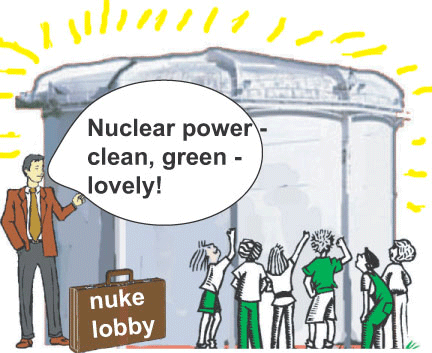 Hawker School Students Visit ANSTO Ten students aged 11 to 17 from Hawker School are travelling across the country, to explore some of Australia’s most significant science infrastructure at the Australian Nuclear Science and Technology Organisation (ANSTO) in Sydney.
On Wednesday and Thursday next week, the students and two teachers from Hawker School will spend their days not in their science classrooms, but near Australia’s multi-purpose nuclear research reactor.
Their trip will start in the nearby Royal National Park, with Les Bursill, an elder of the Dharawal community, who will share with them the rich traditional heritage of the land surrounding ANSTO.
Les is the Elder in Residence at the University of Wollongong, and has worked closely with ANSTO to ensure that the many sites of indigenous importance around the Lucas Heights campus are protected.
The students will then head to the ANSTO Discovery Centre, which welcomes 15,000 visitors a year, to learn more about radiation and radioactivity through an interactive workshop.
The OPAL reactor will be the next stop, where students will see the reactor pool up-close, before they tour the wider ANSTO campus, seeing the advanced technology used and the low level and intermediate level waste stores.
On Thursday, engineering will be the subject of choice as the students find out more about all different types of engineering, and take part in hands-on activities as part of Discover Engineering Day.
“ANSTO is thrilled to be welcoming our young South Australian visitors next week,” said Discovery Centre Leader, Rod Dowler.
“Every week we have visits from students, from Kindergarten through to university students, but it is always an exciting time when we are welcoming out-of-state visitors.
“Bringing the kids out to Lucas Heights to see the facilities and to show them the work being done at ANSTO will let them know more about the front end of the nuclear cycle – the research, medicine and innovation that nuclear science enables.
“At ANSTO we produce nuclear medicines that are needed by approximately one in two Australians in their lifetime, for the diagnosis and treatment of cancers, and heart, lung, muscular, and skeletal conditions.
“Researchers also use nuclear research techniques to support research into improving human health, understanding our environment and supporting Australian industries.
“For example, nuclear research supports the agriculture industry through helping to understand the sustainability of Australia’s groundwater reservoirs, by determining their age and the ‘recharge rate’ of water, which helps farmers around the country.
“We’ll also talk to students about radiation, and how it is all around us in everyday household items like potting mix, kitty litter, bananas, granite benchtops and even bricks in houses – and, it also occurs in things we produce, like nuclear medicines and its by-products.
“We’ll be talking about all things nuclear from start to finish, so that the students get a really good understanding of all the steps, people, products and by-products generated by Australia’s nuclear industry.
“We are really looking forward to having the students from Hawker in Lucas Heights, and we can’t wait to show them around.”
Port Augusta Mayor speaks at Parliament house rally for solar thermal power
 Demonstrators rally for Port Augusta solar thermal power plant http://www.adelaidenow.com.au/news/south-australia/demonstrators-rally-for-port-augusta-solar-thermal-power-plant/news-story/0c142b68f658a89d7c455202a4021d56 April 30, 2017 MORE than 200 people turned out on the steps of Parliament House on Sunday, with their own makeshift solar panels, urging the State Government to back a solar thermal power plant at Port Augusta.
Decked with mirror panels to mimic solar panels, the demonstrators were led by Port Augusta Mayor Sam Johnson and former coal power station worker Gary Rowbottom.
The Federal Government has committed $110 million in funding through a loan for the project, but the State Government is yet to commit any money.
Mr Johnson said a power purchase plan from the government would make it viable and secure jobs for the Far North city. “Our community has pushed for solar thermal for years,” he said. “Now, it’s time for action from the State Government. Federal funding is now locked in for solar thermal in Port Augusta so it’s time for the Premier to make solar thermal a reality.
“Building solar thermal won’t just help Port Augusta, it will create manufacturing jobs for SA, regional jobs and balance our electricity grid with big storage.”
Mr Rowbottom said the project would provide much-needed stimulus for Port Augusta. “This is Jay Weatherill and the SA Government’s chance to support our community for the long term, helping us build a new future and becoming the clean energy powerhouse of SA now the coal station has closed,” he said.
Energy Minister Tom Koutsantonis said solar thermal power was “absolutely in the mix” for the State Government going forward.
Australia’s solar rooftop hotspot – South Australia
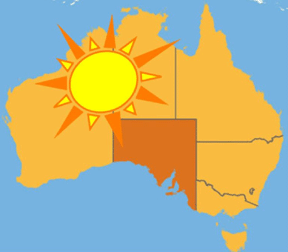 South Australian households and businesses are installing solar panels as rising electricity prices and blackouts take their toll http://www.adelaidenow.com.au/business/jobs/south-australian-households-and-businesses-are-installing-solar-panels-as-rising-electricity-prices-and-blackouts-take-their-toll/news-story/4bda132bfbd5532d68ec9c13a2d6e8ec, Jade Gailberger, The Advertiser, 26 Apr 17
SOLAR uptake has reached new records across the nation, as South Australian households and businesses put in solar installations at almost double the rate of last year.
Solar analysts say the industry has experienced one of its strongest quarters, driven by increased knowledge, high electricity prices, and fear the Federal Government will cut incentives in the future.There is now six gigawatts of solar power installed across Australia — enough to meet the needs of 1.3 million average households — figures released today by the Australian Photovoltaic Institute show.“Solar power now makes up 11 per cent of our country’s total electricity generation capacity,” Australian Photovoltaic Institute chair Dr Renate Egan said.
South Australia has the highest penetration among dwellings at 32 per cent, with Aberfoyle Park identified as the state’s “solar rooftop hotspot”. More than 22,618 new solar installations have been made in SA as of April — 7000 more than the same time last year.
SunWiz managing director Warwick Johnston said small-scale residential and commercial solar installations will continue to grow because of an increased awareness of renewable energy.
“Particularly in SA given the context of all the blackouts that happened … people are moving towards being independent of the grid.”
He expects another 800MW will be installed across Australia this year, and said a boost from solar farm projects will equate to another gigawatt added to the grid. Continue reading
Australia’s Minister for Environment and Energy, Josh Frydenberg, backs Port Augusta solar thermal plan
Frydenberg backs Negev-style solar thermal plant for Port Augusta AFR 27 Apr 17
“……..Mr Frydenberg, who is on a trip to Israel and visited the 121 megawatt Ashalim solar thermal power project in the Negev desert, said Australia could learn from the collaboration between the Californian-based BrightSource Energy, General Electric and NOY Infrastructure and Energy Investment Fund.
“The Ashalim solar plant is impressive in scope and scale. When it is operational it will be the tallest and fifth largest solar thermal plant in the world,” Mr Frydenberg said from Israel.
Gas generators ordered on as South Australia’s wind production peaked
SA power: Gas generators ordered on as South Australia’s wind production peaked http://www.abc.net.au/news/2017-04-26/gas-generators-ordered-to-turn-on-in-sa/8474188 By political reporter Nick Harmsen The Australian Energy Market Operator (AEMO) was forced to intervene in South Australia’s electricity market on Anzac Day to guarantee security of the grid as the state recorded record levels of wind energy production.
Wind power peaked at a new high of 1,540 megawatts close to midnight on Tuesday, more than meeting the state’s public holiday electricity demand.
The wind production was so high that earlier in the day AEMO took steps to ensure two gas generators remained on.
“A combination of high wind generation and low demand had resulted in the de-commitment of synchronous plants below the required levels,” an AEMO spokeswoman said.
AEMO would not confirm which gas generators were subject to AEMO’s directions, but the ABC understands they were AGL’s Hallett Power Station and one unit at Torrens Island.
A requirement for two large synchronous power stations to remain online at all times was put in place in the aftermath of the September 28 statewide blackout.
In that instance, when South Australia unexpectedly separated from the rest of the National Electricity Market, there were too few synchronous generators operating to keep the grid frequency in balance, forcing lights out across the state.
Synchronous generation is typically provided by gas, coal and hydro power plants. None of the wind farms currently operating in South Australia provide synchronous characteristics.
AEMO’s decision to order on two gas generators means their owners will be compensated under special rules, as opposed to taking the prevailing wholesale price for the electricity produced.
The direction for one of the generators remained in place until midday today.
The decision meant AEMO was also forced to constrain the output of two other generators to keep supply and demand in balance. The market operator would not reveal whether those constrained generators were wind farms.
Renewable energy leader South Australia could lead some more, with pumped hydro storage
 Could South Australia be the nation’s hydrogen state, too? REneweconomy, By Valdis Dunis on 24 April 2017 South Australia is already tops for solar and wind use in Australia, crossing over its 50 per cent generation goal from these clean renewable sources last year – eight years ahead of schedule.
Soon the state is will be Australia’s (and a world) leader in battery storage, led by its government’s new tender for a 100MW/100MWh battery system for the state’s grid, plus the other private initiatives from the Lyon Group, AGL’s 1,000 battery virtual power plant in Adelaide, and other companies building large storage systems in the state.
It also is likely to become a leader in new large scale pumped hydro storage thanks to Energy Australia’s detailed work now being done on the feasibility of building a 100MW version near Whyalla in the state’s North, thanks to support funding from ARENA.
Finally, the most high-profile and long-fought-for renewable project in the state – the 24/7 despatchable solar thermal plant near Port Augusta – will now hopefully get over the line, thanks to a new $110M low-cost loan that SA Senator Nick Xenophon was able to wrench out of the federal government last month.
However, South Australia might soon have a new clean feather to add to its cap:
Last Friday, the state’s Energy Minister Tom Koutsantonis surprised most at a CEDA lunch to announce the state will also now go heavily in to implementing a hydrogen industry, leveraging the state’s increasing supply of clean and low cost- renewable energy to power the creation of this fuel from water.
Hydrogen is well known as a clean way to power transport – from cars to trucks to trains and eventually planes potentially, and for driving power turbines and other equipment needing large amounts of power quickly on demand. Best of all is that it does it all without the pollution (assuming water vapour from the tailpipe noone considers pollution!).
The Minister presented a set of slides on this new goal, with the “aim to capitalise on our abundance of renewable resources to become the green hydrogen capital of Australia”.
The hydrogen fuel would not just be for local state use, but as a new export industry both to other states and internationally. The Minister conceded Victoria was currently ahead of South Australia, but said the state will be able to leverage its existing strong engineering expertise in gas processing, pipelines and storage. He also said Asia, in particular Korea and Japan, are large potential markets for hydrogen. …….http://reneweconomy.com.au/could-south-australia-be-the-nations-hydrogen-state-too-11243/
1 This month

of the week – Australians for War Powers Reform (AWPR)
To see nuclear-related stories in greater depth and intensity
 Antinuclear