“With the solar potential of Port Augusta being similar to that of the Negev Desert, this project can provide a number of valuable lessons for ARENA as they consider proposals for Australia’s first solar thermal plant.” ARENA is evaluating a solar thermal plant in Port Augusta in SA to replace the closure of two coal-fired power stations in recent years……….http://www.afr.com/news/politics/frydenberg-backs-negevstyle-solar-thermal-plant-for-port-augusta-20170425-gvrs8u
Citizens must get informed, and speak out against the dangerous nuclear industry
These women defy the illusion that you have to have a Ph.D. in nuclear physics or in nuclear engineering – that you must be a Ben Heard – to have a legitimate voice about nuclear power and the potential dangers of nuclear industry accidents. Our movement needs scientific experts, but all of us can gain basic knowledge and speak out
 SOUTH AUSTRALIA’S NUCLEAR MILITARY-INDUSTRIAL COMPLEX:
  THE GLOBAL CONTEXT, Spirit of Eureka Talk by David Palmer at “SA The Nuclear State” forum 03 May 2017 There are other speakers and participants here today who have more expertise in the scientific and engineering details of this controversy than I do. My comments are aimed, instead, at those powerful elite stakeholders who are at the core of what we know as the military-industrial complex – here in South Australia, our country, but also globally, with its centre in the United States.
Is this issue of a nuclear waste dump advocated for South Australia just about jobs and economic prosperity, as Premier Wetherill claims? Or is it far broader? The words of Ben Heard, former executive director of pro-nuclear power lobby group Bright New World, sum it up well: “We must be a full service provider to the nuclear back-end.”[1] Adelaide’s Advertiser reported last month that “a new open letter [has been sent] to state MPs, 42 influential people demand[ing] the State Government commits to completing first-stage investigations of the proposed high-level repository.”[2] Many of these “influential people” signed a similar letter back in December demanding the same thing, through Ben Heard’s pro-nuclear Bright New World.
But just what is this “nuclear back-end” – the back end of what? Nuclear materials have a wide range of uses, including medical and commercial ones that are distinct from their main uses for power generation and weapons. The vast majority of government expenditures related to nuclear materials goes toward nuclear weapons and military uses (such as naval propulsion systems), and nuclear power. In the United States, virtually all nuclear-related industries and products in the energy and military-application areas are joint operations involving private companies working under government contracts and regulations. The scientific and engineering knowledge required for the nuclear industry means that universities and university-linked research centres play a major role in bringing these two institutions – private companies and government – together. In South Australia, Ben Heard (who is connected to University of Adelaide) is symbolic of this key link connecting networked institutions and elites. Continue reading
What is driving the nuclear industry to dump its nuclear waste in South Australia
By Annie McGovern. 23rd April 2017 (this is an extract from the Adelaide Forum held very recently, to discuss this question) “….ENDNOTE These observations have been gleaned from a fairly  random search for relevant information which was also confined by the time available to process and present these findings. These are offered at this time as an additional body of information that may help fill some of the gaps in the thrust to force further nuclear energy production and waste disposal on the people of S. A.
Amongst the many recommendations of the Nuclear Fuel Cycle Royal Commission there were 3 major points which raise concerns regarding the possible imminent changes to Legislation in S.A. The Royal Commission has urged the State Government to fast-track these Legislative changes, even though there are no current viable plans for any nuclear industry developments in S.A. at this time.
- Modification of the State Waste Dump Prohibition Laws. This Legislation was almost immediately amended following presentation of the Royal Commission’s findings, to allow Government spending on proposals for the Waste Dumps. The further question of approval of nuclear waste dumps in S.A. was put to the Labour State Conference and became a stalemate to which no decision could be made. Progress of changes to Legislation on this proposal was interrupted.
- Legislation that would allow contracts of Uranium sales to be tied to obligations on S.A. taking back the resultant waste. The Royal Commission sees this possibility as an enhancement to capture sales of Uranium, despite there being no approval for waste disposal in S. A. at this time, and, the fact that no such facility would be capable of fulfilling the contract until well into the future. The Royal Commission appears to be determined to place the people of S.A. into an intractable situation where industry is forcing obligation through contractual arrangements. However, a caveat might be placed on such contracts that are not plausible…an explicit caveat and the risk is borne by the signing parties. A letter of advice is provided to the signatory and the Annual AGM of companies involved informed of this unethical business practice.
- Legislative changes to allow Nuclear Power production. Despite there being no overt plans for these developments within the foreseeable future, the Royal Commission is encouraging making changes now for future development. The absence of a ready nuclear waste disposal dump has historically been a constraint on Australia and the world in the development of greater Nuclear ambitions. Reports of illegal dumping and covert placement of radioactive waste abound both here and across the world. Reports of French waste being held at Lucas Heights and American wasteat Pine Gap are recent additions to these claims.Despite peoples’ efforts over many generations to call for and act on Peaceful Principles in our World, Environmental Sustainability and Productivity based on Need rather than Greed, capitalism and its theory of perpetual growth continues to drive forward in an overtly destructive manner.
The continued focus on South Australia to perpetuate the nuclear travesty on our planet is acknowledged through this Forum and collectively we stand against this invasion. We walk with the Protectors of Country with Respect for Life.
Hawker schoolkids given tax-payer funded nuclear promotional trip to Australian Nuclear Science and Technology Organisation (ANSTO) in Sydney.
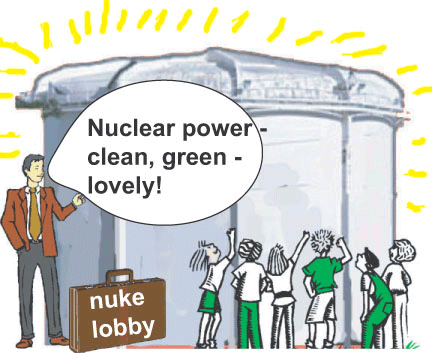 Hawker School Students Visit ANSTO Ten students aged 11 to 17 from Hawker School are travelling across the country, to explore some of Australia’s most significant science infrastructure at the Australian Nuclear Science and Technology Organisation (ANSTO) in Sydney.
On Wednesday and Thursday next week, the students and two teachers from Hawker School will spend their days not in their science classrooms, but near Australia’s multi-purpose nuclear research reactor.
Their trip will start in the nearby Royal National Park, with Les Bursill, an elder of the Dharawal community, who will share with them the rich traditional heritage of the land surrounding ANSTO.
Les is the Elder in Residence at the University of Wollongong, and has worked closely with ANSTO to ensure that the many sites of indigenous importance around the Lucas Heights campus are protected.
The students will then head to the ANSTO Discovery Centre, which welcomes 15,000 visitors a year, to learn more about radiation and radioactivity through an interactive workshop.
The OPAL reactor will be the next stop, where students will see the reactor pool up-close, before they tour the wider ANSTO campus, seeing the advanced technology used and the low level and intermediate level waste stores.
On Thursday, engineering will be the subject of choice as the students find out more about all different types of engineering, and take part in hands-on activities as part of Discover Engineering Day.
“ANSTO is thrilled to be welcoming our young South Australian visitors next week,” said Discovery Centre Leader, Rod Dowler.
“Every week we have visits from students, from Kindergarten through to university students, but it is always an exciting time when we are welcoming out-of-state visitors.
“Bringing the kids out to Lucas Heights to see the facilities and to show them the work being done at ANSTO will let them know more about the front end of the nuclear cycle – the research, medicine and innovation that nuclear science enables.
“At ANSTO we produce nuclear medicines that are needed by approximately one in two Australians in their lifetime, for the diagnosis and treatment of cancers, and heart, lung, muscular, and skeletal conditions.
“Researchers also use nuclear research techniques to support research into improving human health, understanding our environment and supporting Australian industries.
“For example, nuclear research supports the agriculture industry through helping to understand the sustainability of Australia’s groundwater reservoirs, by determining their age and the ‘recharge rate’ of water, which helps farmers around the country.
“We’ll also talk to students about radiation, and how it is all around us in everyday household items like potting mix, kitty litter, bananas, granite benchtops and even bricks in houses – and, it also occurs in things we produce, like nuclear medicines and its by-products.
“We’ll be talking about all things nuclear from start to finish, so that the students get a really good understanding of all the steps, people, products and by-products generated by Australia’s nuclear industry.
“We are really looking forward to having the students from Hawker in Lucas Heights, and we can’t wait to show them around.”
Port Augusta Mayor speaks at Parliament house rally for solar thermal power
 Demonstrators rally for Port Augusta solar thermal power plant http://www.adelaidenow.com.au/news/south-australia/demonstrators-rally-for-port-augusta-solar-thermal-power-plant/news-story/0c142b68f658a89d7c455202a4021d56 April 30, 2017 MORE than 200 people turned out on the steps of Parliament House on Sunday, with their own makeshift solar panels, urging the State Government to back a solar thermal power plant at Port Augusta.
Decked with mirror panels to mimic solar panels, the demonstrators were led by Port Augusta Mayor Sam Johnson and former coal power station worker Gary Rowbottom.
The Federal Government has committed $110 million in funding through a loan for the project, but the State Government is yet to commit any money.
Mr Johnson said a power purchase plan from the government would make it viable and secure jobs for the Far North city. “Our community has pushed for solar thermal for years,” he said. “Now, it’s time for action from the State Government. Federal funding is now locked in for solar thermal in Port Augusta so it’s time for the Premier to make solar thermal a reality.
“Building solar thermal won’t just help Port Augusta, it will create manufacturing jobs for SA, regional jobs and balance our electricity grid with big storage.”
Mr Rowbottom said the project would provide much-needed stimulus for Port Augusta. “This is Jay Weatherill and the SA Government’s chance to support our community for the long term, helping us build a new future and becoming the clean energy powerhouse of SA now the coal station has closed,” he said.
Energy Minister Tom Koutsantonis said solar thermal power was “absolutely in the mix” for the State Government going forward.
Australia’s solar rooftop hotspot – South Australia
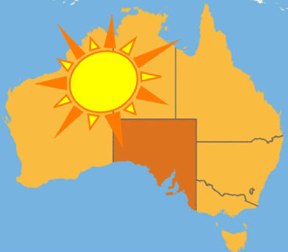 South Australian households and businesses are installing solar panels as rising electricity prices and blackouts take their toll http://www.adelaidenow.com.au/business/jobs/south-australian-households-and-businesses-are-installing-solar-panels-as-rising-electricity-prices-and-blackouts-take-their-toll/news-story/4bda132bfbd5532d68ec9c13a2d6e8ec, Jade Gailberger, The Advertiser, 26 Apr 17
SOLAR uptake has reached new records across the nation, as South Australian households and businesses put in solar installations at almost double the rate of last year.
Solar analysts say the industry has experienced one of its strongest quarters, driven by increased knowledge, high electricity prices, and fear the Federal Government will cut incentives in the future.There is now six gigawatts of solar power installed across Australia — enough to meet the needs of 1.3 million average households — figures released today by the Australian Photovoltaic Institute show.“Solar power now makes up 11 per cent of our country’s total electricity generation capacity,” Australian Photovoltaic Institute chair Dr Renate Egan said.
South Australia has the highest penetration among dwellings at 32 per cent, with Aberfoyle Park identified as the state’s “solar rooftop hotspot”. More than 22,618 new solar installations have been made in SA as of April — 7000 more than the same time last year.
SunWiz managing director Warwick Johnston said small-scale residential and commercial solar installations will continue to grow because of an increased awareness of renewable energy.
“Particularly in SA given the context of all the blackouts that happened … people are moving towards being independent of the grid.”
He expects another 800MW will be installed across Australia this year, and said a boost from solar farm projects will equate to another gigawatt added to the grid. Continue reading
Australia’s Minister for Environment and Energy, Josh Frydenberg, backs Port Augusta solar thermal plan
Frydenberg backs Negev-style solar thermal plant for Port Augusta AFR 27 Apr 17
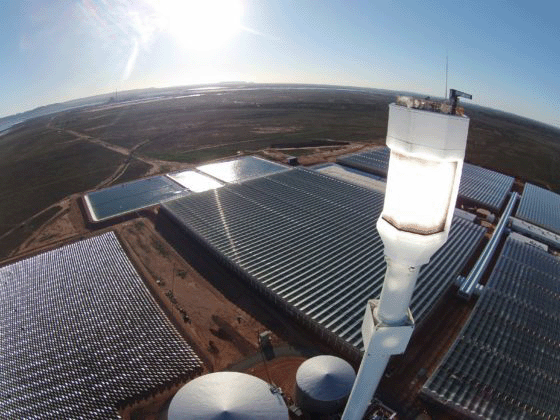
“……..Mr Frydenberg, who is on a trip to Israel and visited the 121 megawatt Ashalim solar thermal power project in the Negev desert, said Australia could learn from the collaboration between the Californian-based BrightSource Energy, General Electric and NOY Infrastructure and Energy Investment Fund.
“The Ashalim solar plant is impressive in scope and scale. When it is operational it will be the tallest and fifth largest solar thermal plant in the world,” Mr Frydenberg said from Israel.
Gas generators ordered on as South Australia’s wind production peaked
SA power: Gas generators ordered on as South Australia’s wind production peaked http://www.abc.net.au/news/2017-04-26/gas-generators-ordered-to-turn-on-in-sa/8474188 By political reporter Nick Harmsen The Australian Energy Market Operator (AEMO) was forced to intervene in South Australia’s electricity market on Anzac Day to guarantee security of the grid as the state recorded record levels of wind energy production.
Wind power peaked at a new high of 1,540 megawatts close to midnight on Tuesday, more than meeting the state’s public holiday electricity demand.
The wind production was so high that earlier in the day AEMO took steps to ensure two gas generators remained on.
“A combination of high wind generation and low demand had resulted in the de-commitment of synchronous plants below the required levels,” an AEMO spokeswoman said.
AEMO would not confirm which gas generators were subject to AEMO’s directions, but the ABC understands they were AGL’s Hallett Power Station and one unit at Torrens Island.
A requirement for two large synchronous power stations to remain online at all times was put in place in the aftermath of the September 28 statewide blackout.
In that instance, when South Australia unexpectedly separated from the rest of the National Electricity Market, there were too few synchronous generators operating to keep the grid frequency in balance, forcing lights out across the state.
Synchronous generation is typically provided by gas, coal and hydro power plants. None of the wind farms currently operating in South Australia provide synchronous characteristics.
AEMO’s decision to order on two gas generators means their owners will be compensated under special rules, as opposed to taking the prevailing wholesale price for the electricity produced.
The direction for one of the generators remained in place until midday today.
The decision meant AEMO was also forced to constrain the output of two other generators to keep supply and demand in balance. The market operator would not reveal whether those constrained generators were wind farms.
Renewable energy leader South Australia could lead some more, with pumped hydro storage
 Could South Australia be the nation’s hydrogen state, too? REneweconomy, By Valdis Dunis on 24 April 2017 South Australia is already tops for solar and wind use in Australia, crossing over its 50 per cent generation goal from these clean renewable sources last year – eight years ahead of schedule.
Soon the state is will be Australia’s (and a world) leader in battery storage, led by its government’s new tender for a 100MW/100MWh battery system for the state’s grid, plus the other private initiatives from the Lyon Group, AGL’s 1,000 battery virtual power plant in Adelaide, and other companies building large storage systems in the state.
It also is likely to become a leader in new large scale pumped hydro storage thanks to Energy Australia’s detailed work now being done on the feasibility of building a 100MW version near Whyalla in the state’s North, thanks to support funding from ARENA.
Finally, the most high-profile and long-fought-for renewable project in the state – the 24/7 despatchable solar thermal plant near Port Augusta – will now hopefully get over the line, thanks to a new $110M low-cost loan that SA Senator Nick Xenophon was able to wrench out of the federal government last month.
However, South Australia might soon have a new clean feather to add to its cap:
Last Friday, the state’s Energy Minister Tom Koutsantonis surprised most at a CEDA lunch to announce the state will also now go heavily in to implementing a hydrogen industry, leveraging the state’s increasing supply of clean and low cost- renewable energy to power the creation of this fuel from water.
Hydrogen is well known as a clean way to power transport – from cars to trucks to trains and eventually planes potentially, and for driving power turbines and other equipment needing large amounts of power quickly on demand. Best of all is that it does it all without the pollution (assuming water vapour from the tailpipe noone considers pollution!).
The Minister presented a set of slides on this new goal, with the “aim to capitalise on our abundance of renewable resources to become the green hydrogen capital of Australia”.
The hydrogen fuel would not just be for local state use, but as a new export industry both to other states and internationally. The Minister conceded Victoria was currently ahead of South Australia, but said the state will be able to leverage its existing strong engineering expertise in gas processing, pipelines and storage. He also said Asia, in particular Korea and Japan, are large potential markets for hydrogen. …….http://reneweconomy.com.au/could-south-australia-be-the-nations-hydrogen-state-too-11243/
19 big South Australian industrial users join to buy electricity in bulk: a path to more wind and solar projects?
 Industrial bulk-buy could open path for more wind and solar projects, REneweconomy
By Giles Parkinson on 21 April 2017 A ground-breaking initiative from some of South Australia’s biggest industrial users of electricity could pave the way for more wind and solar farms in the state, and finally open the Australian market for more corporate deals with wind and solar farm developers.
The South Australian Chamber of Mines and Energy (SACOME) this week won approval from the Australian Competition and Consumer Commission for 19 big industrial users to band together to negotiate long-term electricity contracts, having grown tired of the soaring prices and short-term contracts being offered by the state’s retail oligopoly.
The companies – which include Nyrstar, Arrium, Oz Minerals, and a collection of high profile auto groups, food companies, retailers, wineries and universities (see full list below) – account for 15 per cent of the state’s electricity demand.
Most have been hit with electricity price rises of between 30 and 80 per cent in the last year, and are now paying between 8c/kWh and 15c/kWh for their electricity, and are unable to get any long-term contracts.
SACOME’s Rebecca Knol says the tender is not designed to favour one technology or another, and they would welcome either renewables or gas. “We are not predicting the outcome,” she told RenewEconomy. “We don’t have a preference.”
The move, she says, is more about challenging the pricing power of the retail oligopoly. “By aggregating their load, they will improve their individual bargaining position and be able to establish more cost-competitive supply contracts,” Knol said.
But a quick glance at prices for new wind and solar farms, and for gas generation, puts renewables in the driving seat.
Wind and solar farms are being delivered for around 7c/kWh, but even the short-run marginal cost of gas generators (i.e.. the fuel and maintenance cost) ranges from 7c/kWh to more than 12c/kWh………
The total load of 19 industrial users (19 companies, 24 installations) is 246MW at peak, and represents annual demand of 1,957GWh. Most interestingly for the wind and solar plants, the businesses are offering an 11 year contract – a length of contract that has been all but impossible to secure from large retailers.
“We are looking for opportunities to improve the electricity price so our businesses can stay competitive,” Knol says. “What we are hoping is that they do see this as opportunity to change the wholesale market. It could bring on a new generator, or it could be with an existing generator.”
Australian corporates have been slow to engage with renewable energy developers – possibly given the fact that the fall in wind and solar costs below the prevailing wholesale price of electricity is only very recent.
Queensland zinc refiner Sun Metals, that state’s largest single energy user, is one exception, having decided to build its own 116MW solar farm, rather than commission a third party. The Sunshine Coast Council is also building its own 15MW solar farm in south-east Queensland…..
The original application included: Nyrstar, Arrium, OZ Minerals, Hillgrove Resources, Rex Minerals, Seeley International, SMR Automotive, Thomas Foods and Intercast & Forge.
Since the application was made in January 2017, Peregrine Corporation, Foodland, Independent Grocers of Australia (IGA), Pernod Ricard Winemakers, Orora Glass, Brickworks, Flinders University and the University of South Australia have also come on board. http://reneweconomy.com.au/industrial-bulk-buy-could-open-path-for-more-wind-and-solar-projects-22023/
Opposition in South Australia to $500 million solar and wind farm
 Beetaloo Valley residents to fight against planned $500 million solar and wind farm by Neoen Erin Jones, Regional Reporter, The Advertiser April 17, 2017 SOUTHERN Flinders Ranges residents are vowing to stop a 50-turbine wind farm from ruining the landscape, fearing the project will be fast-tracked because of the state’s energy crisis.
Port Augusta highlights the energy transformation now happening in Australia
Leading the transformation, though, is the city of Port Augusta in South Australia……Nothing highlights the clean energy transformation more dramatically than what is happening in that city.
Tide turns as solar, storage costs trump ideologues and incumbents, REneweconomy, By Giles Parkinson on 13 April 2017
Looking at the machinations over the proposed Adani coal mine in Queensland’s Galilee Basin this week, or seeing certain Coalition Senators howling at the moon over wind turbine “emissions”, or the Treasurer brandishing a lump of coal in parliament, it is hard to imagine that any sort of progress has been made in Australia in what all but a determined few accept is the inevitable clean energy transition.
But there is no doubt that the transition is happening. Over the last few months, small but significant gains have been made as key politicians, regulators, market operators and many incumbents realise just how quickly the cost of new competition technologies are falling, and how quick the transition to a smarter, cleaner, more reliable and cheaper grid might be.
Awareness about the plunging costs of wind energy, solar energy and battery storage, along with the enabling software that could lead to a complete redesign of the way we generator, share, transport and use energy, is growing each day.
Politicians – both to the left and the right – are starting to embrace this change. The public is supportive, while the fossil fuel incumbents are slowly and surely losing their social licence, both due to the pollution levels of their plant and their manipulation of prices. Even the regulatory barriers that currently protect their business models are starting to unwind.
This is not to say that victory is at hand, or that this transformation will suddenly be complete within a few years. It won’t. But change is starting to happen quickly, old plant is being replace by new, rules are being changed, industry leaders are starting to talk of a new energy vision. Consumers are picking up new technology with increasing speed.
And here are a bunch of key developments in Australia over the last few months that indicate that the plunging cost of key technologies costs will trump the resistance of conservative ideologues and fossil fuel incumbents: Continue reading
South Australian businesses set to jointly purchase electricity
South Australian energy users club together for energy purchasing, AFR, by Angela Macdonald-Smith Simon Evans, 13 Apr 17, Cement maker Adelaide Brighton, steelmaker Arrium and 22 other major energy users in South Australia have won draft clearance from the competition regulator to jointly purchase electricity in a significant move that looks set to change the balance of power in the state’s fragile energy market. Continue reading
Kimba South Australia: Neighbours still opposed to nominated nuclear waste facility sites
 Mrs Woolford said she and other members of the No Radioactive Waste on Agricultural Land in Kimba or SA group had tried to organise a community forum with all sides represented but said the government did not want to participate.
“A debate with everyone represented would be a fair way for the government to allow people in the community to make up their minds, not just a continuous sell of the alleged benefits.
“People should have the right for their government to provide all sides not just one to suit its purpose,” Mrs Woolford said. .
Neighbours in Kimba are still opposed to nominated nuclear waste facility sites, Eyre Tribune, 10 Apr 2017, DISTRUST in the federal government and the process of nominations in the search for a national low to intermediate radioactive waste site are just some of the reasons Austin Eatts is against the facility being placed at Kimba.
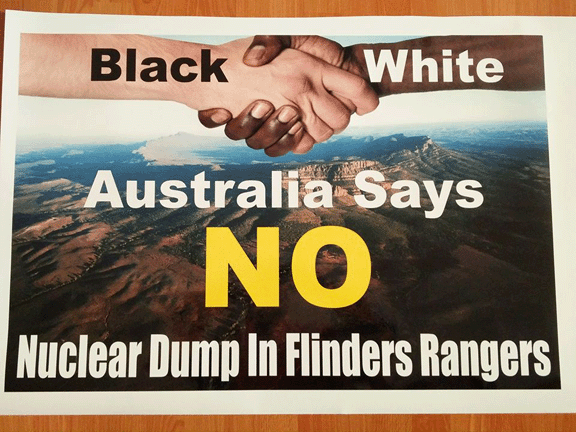
Mr Eatts is a direct neighbour to one of the newly nominated sites in the Kimba district and said the national nuclear waste facility was not something rural or regional people should be responsible for.
He said Eyre Peninsula had a long memory for the impact of politicians’ “dishonesty” during and after nuclear bombs were tested at Maralinga, to the north west of Eyre Peninsula “There is a long history of dishonesty about politicians, they told us then and after that Maralinga was safe. “This is the same message they are giving us now, things will be safe, why should we believe them?“My feelings about Eyre Peninsula and the state having anything nuclear has not changed since then,” Mr Eatts said.
He said he did not want the responsibility of making a decision that would impact generations for hundreds of years not only for Kimba or Eyre Peninsula residents but statewide.
“Once we accept this site here, we have opened the door to further nuclear activity.”
Mr Eatts said the vote to be undertaken by the South Australian Electoral Commission would settle the issue for him however he was concerned if the vote was against further progression it would not be the end of the matter.
“Will it be the end of it for those who want it? “They have already brought it back once after we settled it as a community we didn’t want it,” he said. “Two million dollars (offered to the community by the government) is a lot of money to you and I but for a community it is not much and no amount of money will fix the division in the community.” Continue reading
How Prime Minister Robert Menzies, and Sir Ernest Titterton sold us all out for British nuclear testing
Australian tolerance of the British and their obsessive secrecy may be explained by the deference and loyalty to the ‘motherland’. Prime Minister Menzies identified so strongly with Britain that he considered British national interest as Australia’s national interest.
Another factor which underlay Australian deference during the course of the testing program was the role of Sir Ernest Titterton.
The full legal and political implications of the testing program would take decades to emerge. The secrecy which surrounded the British testing program and the remoteness of the tests from major population centres meant that public opposition to the tests and awareness of the risks involved grew very slowly.
 Wayward governance : illegality and its control in the public sector / P N Grabosky
Canberra : Australian Institute of Criminology, 1989
“…..Admittedly, in the 1950s knowledge of radiation hazards was not as advanced as it is today. At the time it was not generally recognised that small doses of low level radiation might increase the risk of cancer years later. But even in the light of knowledge of the time, the information on which Menzies based his decisions was seriously deficient.
There seems little doubt that the secrecy in which the entire testing program was cloaked served British rather than Australian interests. Continue reading
Huge 300MW solar farm begins construction near Port Augusta,
 Isn’t this a brilliant outcome? For the last few years, the nuclear lobby has been touting Port Augista as the place for a nuclear power station. Following the absolute defeat of the shonky South Australian Nuclear Fuel Cycle Royal Commission, and thanks to all those who fought against it, so brilliantly – South Australia now could become a world leader in modern clean energy.

REneweconomy, By Giles Parkinson on 11 April 2017 The first two stage of a 300MW solar farm – Australia’s biggest – has begun construction near Port Augusta in South Australia after its developers last Friday reached financial close on the project, and agreed to sell it to two of Europe’s biggest investors in renewables, Italy’s Enel Green Energy and the Dutch Infrastructure Fund.
The first two stages, totalling 220MW, of the Bungala project is being built around 12kms from Port Augusta, where the state’s last coal fired generator closed last May. Ironically, project developer Reach Energy is headed by Tony Concannon, the former head of the owners of the Hazelwood brown coal generator in Victoria which closed late last month.
The two first stages of Bungala will be completed late in 2018, and will be built by Spanish company Elecnor, which recently completed the 57MW Moree project in NSW and the smaller 21MW Barcaldine project in Queensland.
Bungala will be built “battery storage ready”, and will also likely be the first major solar farm to participate in Australia’s FCAS market (frequency control and ancillary services), using SMA inverter technology to provide voltage control for the grid.
Concannon says the remaining 80MW of capacity could be built – along with battery storage – should the company win a South Australian government tender for 25 per cent of its electricity needs with “dispatchable” renewables.
Reach has submitted proposals for both 20MWh of battery storage and 100MWh, although it did not participate in the other tender for a separate 100MWh battery unit. If the tender is not successful, there are also discussions with other potential off-takers in train…….
The new plant, he says, will be designed to provide FCAS – even at night, after the sun has gone down. “What a number of people don’t realise is that you can design ancillary services for solar plants to operate at night time.
“We can draw in power from the grid at night, and use the inverter technologies to regulate voltage, and that helps stabilise the system, even when the sun is not shining.”
Unlike battery storage in households, which he describes as mostly “passive” and focused on converting the output of solar panels from DC power to AC power so it can be put into the grid, utility-scale inverter technologies are able to shape voltage and current very quickly and in a very flexible manner. Modern wind farms are also using the same technologies.
“The inverter changes phase between the voltage and current … inverters can pull the current in, and change the phase to what grid wants.”
Concannon, a power engineer, says it is a tricky subject to try and explain, but says a lot of the articles he has read in the media – about wind and solar not being able to provide grid services – are wrong……..http://reneweconomy.com.au/huge-300mw-solar-farm-begins-construction-near-port-augusta-63411/
1 This month



Help Aunty Sue Protect Her Land and Sacred Sites From Destructive Rocket Testing.
.

Australians deserve the truth
about
AUKUS – https://aukuspublicinquiry.com/

PETITION – To: Prime Minister Anthony Albanese and the Australian Labor Government

of the week – Australians for War Powers Reform (AWPR)
To see nuclear-related stories in greater depth and intensity

