Some enthusiasts for nuclear waste dump at Kimba, but many opponents
The couple [ Megan and Matt Lienert]say the federal government consultation process has only tried to sell the positives. “It’s like they’re here to sell a car,” James says. “Oh, you don’t want it? Here’s some free seat covers.”
Jacinta jumps in: “Here’s $2m to go to the next stage.
“[The federal government provides] the facts from one side, that’s all we’ve got since day dot. They don’t bring anybody here so people can make an informed decision.
 Who’d want to dump Australia’s nuclear waste here? Well, this guy At Kimba in the heart of the country, a community is divided – in one case literally so – over a plan to deposit the national stockpile of radioactive waste, Guardian, Max Opray, 4 Apr 17, At a point almost halfway between the east and west coasts of Australia, a mob of emus scamper along the Napandee property fenceline. The mallee scrub out this way appears otherwise deserted, the kind of remote location where one could hide a dead body and get away with it – but what about an entire country’s radioactive waste?
Landowner Jeff Baldock is determined to find out. Speaking in a considered gravelly tone through a bristling grey moustache, the third-generation farmer has an Ian Chappell-esque air about him as he defends the decision to formally nominate his land in Kimba, South Australia, as a site for the federal government’s national radioactive waste management facility. It would serve as a repository for intermediate-level waste from the Lucas Heights nuclear site in New South Wales and low-level waste from across Australia.
“We’ve got five grandkids living here on the properties with us,” he says. “If we thought it was dangerous we wouldn’t do this. If I thought it’d upset our grain or sheep we wouldn’t be doing it.”
If his property is selected, Baldock stands to be paid four times the value of 100 hectares of the land, but he says the real advantage would be providing economic benefit to the thousand or so residents of a struggling agricultural district.
“It’s a once-in-a-lifetime opportunity for our town – sorry, our community,” he says. “The antis talk about farmers versus the townies. To me it’s one community.”
It isn’t the first time Baldock has nominated land for consideration. Last year the federal government ruled out another property of his after the assessment process was abandoned because of local resistance. But Baldock says those against the proposal didn’t give it a chance………
In nominating again along with another landowner, Baldock has reopened wounds that were only just starting to heal in a community tightly bound by the challenges of an isolated life in the northern reaches of the Eyre peninsula. Last year Kimba held two of the six possible locations flagged by the government for the nuclear waste site, with one other in SA, and one each in Queensland, NSW and the Northern Territory.
Only one of those, the Barndioota site in SA’s Flinders Ranges, advanced to stage two, but it is meeting considerable resistance from Adnyamathanha traditional owners owing to its proximity to significant Indigenous cultural sites. The return to Kimba suggests the choices are narrowing – or vanishing. In March the resources minister, Matt Canavan, launched the new consultation on Kimba, …….. Continue reading
Port Augusta ‘buzzing’ over deal for solar power plant
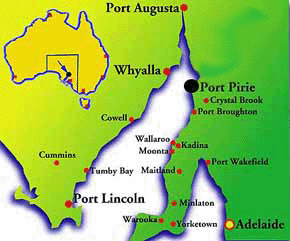 Port Augusta mayor Sam Johnson ‘absolutely ecstatic’ solar power plant will be finally funded Adam Langenberg, Political reporter, Sunday Mail (SA) April 2, 2017 THE city at the centre of South Australia’s power crisis is “buzzing” after a highly anticipated plan to build a 100MW solar thermal plant took one huge leap closer to reality.
Excited locals say the promise of a $110 million concessional loan to proponents is “absolutely huge” and 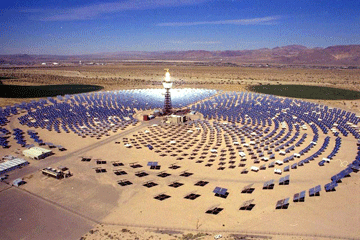 transformative for the city, while project backers say the State Government must award its power supply contract to provide certainty.
Mayor Sam Johnson said he was “absolutely ecstatic” the project was a step closer but he took a shot at the Federal Government for only delivering on its promise as part of a deal with Senator Xenophon to support its company tax cut package.
“There was certainly a buzz around town because it’s no secret we’ve had a few bad shots in the arm in the last 18 months,’’ Mr Johnson said.
“We’re looking for that positivity and we know we can deliver the next chapter.”
Senator Xenophon said Prime Minister Malcolm Turnbull had assured him the project “was a goer” and welcomed the Government’s clear commitment to solar thermal generation at Port Augusta. “It will transform the town and be a beacon of hope. It will also change the way we look at energy, by providing virtual baseload with a molten salt storage,” Senator Xenophon said. “I just want it to happen. I’m happy to work with the Prime Minister………
..Repower Port Augusta Dan Spencer reiterated both proponents, SolarReserve and Solarstor, needed to clinch an electricity supply deal with the State Government before progressing further.
“It puts the ball right in Jay’s (Premier Weatherill) court,” Mr Spencer said.
“They’ve got the guarantee of the federal loan so they can lock it in now by providing the power contract.”
Energy Minister Tom Koutsantonis said applications for the electricity contract were being assessed and the Government had “numerous policies in place to support a potential solar thermal plant.”http://www.adelaidenow.com.au/news/south-australia/port-augusta-mayor-sam-johnson-absolutely-ecstatic-solar-power-plant-will-be-finally-funded/news-story/55acc17df92d7f9cef77b6548aae488c

Australian govt commits $110m for Port Augusta solar towers
 Last year, Australia’s clean energy movement had a major victory, with South Australia’s resounding
  rejection of the plan for nuclear waste importation, (and later for, nuclear power). Some nuclear proponents also looked to Port August as the place for a nuclear power station.
The Liberal Coalition government now supports a solar power station instead. Of course, they were dragged kicking and screaming, into this, by a piece of deft politicking from Senator Nick Xenophon. But – so keen was PM Turnbull, to get new legislation on tax passed, that he had to swallow his aversion to non fossil-fuel energy. We wait to see how well the govt carries out this commitment
Coalition commits $110m for Port Augusta solar towers http://reneweconomy.com.au/coalition-commits-110m-for-port-augusta-solar-towers-11045/ By Giles Parkinson on 31 March 2017 The federal Coalition government has announced that it will provide $110 million in concessional loans to a solar tower and molten salt storage project in Port Augusta, as part of last minute negotiations with the Nick Xenophon Party to pass major tax cuts.
The commitment was announced by finance minister Mathias Cormann as part of a deal with the NXT to approve tax cuts for businesses with revenue of less than $50 million.
Senator Cormann says the Coalition will provide a confessional loan of $110 million in 3 per cent interest rate to an unspecified solar thermal project. He said the government will call for formal proposals via the Australian Renewable Energy Agency and the Clean Energy Finance Corp.
The front runner for the deal is the 110MW solar tower and molten salt storage project proposed by the US company SolarReserve. Other proposals are likely to come from Vast Solar and others.
“We welcome the announcement today from the Senate, and it is critical step in progressing the project – but the key outcome is to obtain a long term power purchase agreement,” said Daniel Thompson, the Australian development manager for SolarReserve.
Earlier, the energy minister Josh Frydenberg announced that the CEFC would invest $80 million in the 113MW Bodangora wind farm near Wellington in NSW.
“This investment in large-scale renewable energy projects such as Bodangora, is part of the Turnbull Government’s technology neutral, non-ideological approach to provide affordable, reliable electricity as we transition to a lower emission future,” he said in a statement.
The $236 million Bodangora wind farm is expected to be operational in the latter half of 2018.
Solar-storage hub proposed for Adelaide
 Carnegie teams with Samsung, Lend Lease for battery storage hub http://reneweconomy.com.au/carnegie-teams-with-samsung-lend-lease-for-battery-storage-hub-23948/ By Giles Parkinson on 31 March 2017
In a joint announcement with energy minister Tom Koutsantonis and premier Jay Weatherill in Adelaide on Friday morning, Carnegie CEO Michael Ottaviano said the company has teamed up with Lend Lease Services and South Korea’s Samsung for the proposal.
It proposes to build a 100MW/100MWh lithium-ion battery, using Samsung technology, and wants to do this in Adelaide in a centre that will evolve into a “battery storage” hub, building new battery systems and doing R&D and integration work.
“This is an opportunity to build an industry for the future,” Ottaviano told journalists in Adelaide. “This will be the first 100MW battery, not the last.”
Carnegie’s is just one of a number of proposals for the state government tender, which closed at 12 noon local time on Friday. Others include the $1 billion solar and battery storage project unveiled by Lyon Solar on Thursday, and rival offers from Zen Energy/Greensmith, Tesla, LG Chem, Adelaide-based silicon storage developer 1414 and many more.
Koutsantonis said the tender had elicited an “unprecedented” response with more than 200 downloads from nine different countries. Final numbers will be revealed on Monday. “It has captured international attention for people to see opportunities with our remarkable renewable energy power,” Koutsantonis said. “You can hand around lumps of coal, or you can move forward with new technologies. Storage will become the norm and we will be at the forefront of that.”
Ottaviano says the battery storage hub would be powered by a “multi-megawatt” rooftop solar system – and could employ 300 people to deliver the project, including electricians and engineers from sunset manufacturing industries in South Australia.
He said Carnegie would own the battery storage unit, and use it to trade energy, arbitraging opportunities in the market, and also playing in the FCAS (frequency and ancillary services) market when not being called upon by the government to provide grid support.
But he said such installations would rely on government support until market rules were changed that would level the playing field for battery storage.
“As renewable energy penetration inevitably increases across the country, the need for utility-scale energy storage will grow in lockstep,” Ottaviano said in a later statement.
“The deployment of utility-scale battery systems creates an opportunity for South Australia and Australia to develop a new local industry and export this capability throughout our region.”
Weatherill told journalists that battery storage was exciting because it sourced “free energy” from the wind and the sun, and would create the jobs of the future.
$1billion battery and solar farm for South Australia’s Riverland
Lyon Group announces $1b battery and solar farm for South Australia’s Riverland, ABC News, By political reporter Nick Harmsen, 30 Mar 17 A $1 billion battery and solar farm will be built at Morgan in South Australia’s Riverland by year’s end in a project the proponents describe as “the world’s biggest”.
The builder, Lyon Group, has already proposed a smaller solar farm and battery storage facility, named Kingfisher, in the state’s north.
Lyon partner David Green said the project was 100 per cent equity financed and construction would begin within months, employing 270 workers.
“Riverland Solar Storage’s 330-megawatt solar generation and 100-megawatt battery storage system will be Australia’s biggest solar farm with 3.4 million solar panels and will also include 1.1 million batteries,” he said.
Mr Green said land had already been secured and grid connection was already well advanced.
Work on Lyon’s 120 megawatt Kingfisher project is slated to begin in September next year……
Lyon to bid for SA battery tender
The Lyon Group has already signalled its intention to bid for a SA Government tender to build a battery storage system with 100-megawatt output. The tender arrangement would give the Government the right to tap the battery storage at times of peak demand, but allow the project owner to sell energy and stability into the market at other times.
An expressions of interest process closes on Friday.
Other companies, including Carnegie, Zen Energy and Tesla, have all suggested they could be interested in bidding…….http://www.abc.net.au/news/2017-03-30/new-solar-project-announced-for-sa-riverland/8400952
South Australian Government’s Bill to give Energy Minister power over AEMO
 SA power: Government introduces bill giving Energy Minister power over AEMO, ABC News, 28 Mar 17 By Sara Garcia and Nick Harmsen The South Australian Government has introduced legislation to give the Energy Minister the power to direct electricity generators to turn on when required — a move it says would have prevented the September statewide blackout.
The measure has been born out of frustration that the Australian Energy Market Operator (AEMO) ordered a power cut to tens of thousands of homes in February during a heatwave, when a shortfall in supply was looming. A second unit at Pelican Point sat idle at the time, and the Government said AEMO should have directed it to switch on.
Energy Minister Tom Koutsantonis said the powers would have also prevented the statewide blackout on September 28 as he would have ramped up generation in South Australia in preparation for the catastrophic event.
“We would have constrained the interconnector in the morning as I asked AEMO and there would have been more South Australian generation on,” Mr Koutsantonis said.”[I asked and they responded] there wasn’t a credible contingency to constrain the interconnector.”
Mr Koutsantonis said the powers the Government was seeking currently exist under a state of emergency.But he said he needed the power to prevent a state of emergency in the first place.”What we’re doing is extending those powers before an emergency situation exists to make sure we can avoid it,” he said.”These powers will give me the ability to direct either AEMO or direct generators individually and direct individuals.”That power will ensure that market power is not the driving aspect of our energy security in this state.”
Premier Jay Weatherill said the current system was “broken” and put “profits before people”.”We’re taking back control and putting South Australians first,” he said.
The Government introduced the bill this morning and called on an immediate debate.The Opposition tried to block the debate, but failed.”I don’t mind that they don’t have a plan, but get out of the way and don’t stop us from implementing our plan,” Mr Weatherill said……http://www.abc.net.au/news/2017-03-28/sa-governments-power-legislation-gives-energy-minister-control/8393608
Rapid fall expected in price of solar plus battery storage for South Australia
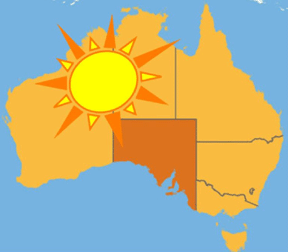 S.A. network says solar plus battery storage to cost just 15c/kWh, REneweconomy, By Giles Parkinson on 28 March 2017 The price of rooftop solar and battery storage for household and business consumers will fall to just 15c/kWh within a few years, leading to a dramatic reshaping of the energy grid, according to a leading network operator. Rob Stobbe, the head of SA Power Networks, which operates the local network in South Australia, says rooftop solar has already fallen to around 5c/kWh for households and businesses. Continue reading
Giles Parkinson on need for battery storage to be configured properly
Batteries not configured to remove demand peaks, network says[good graphs], REneweconomy. By Giles Parkinson on 27 March 2017 SA Power Networks, currently running the largest residential battery storage trial in the country, says its early finding suggest that battery storage devices are not configured to help reduce network peaks. In fact, in some ways they may be making the situation worse.
SAPN last year installed 100 batteries in customer premises in the city of Salisbury, in what is the largest virtual power plant installed to date, and is now getting some early results from the three-year trial.
The most dramatic finding is represented in this graph below [on original] . It shows how solar affects grid demand and what happens when battery storage is added. Rather than smoothing out the peaks, it can actually make the “ramp up” periods more abrupt.
According to Mark Vincent, SAPN’s head of network investment strategy and planning, this is not a good outcome.
Vincent told RenewEconomy during a recent visit to SAPN’s innovation centre in Adelaide that it underlines the need for new algorithms to be put in place to change the behaviour of battery storage devices so it takes the peaks – both bottom and low……….
Battery storage will be crucial for the SA network, because the state has traditionally had the highest volatility, and with the introduction of more wind and solar, will reduce its dependence on traditional fossil fuel plants.
That leaves battery storage to play a crucial role in meeting peak demand and providing grid stability, and SAPN hopes that it will help offset further investment in new poles and wires or equipment upgrades.
Already, the state has 650MW of rooftop solar, accounting for nearly 6 per cent of its demand in 2015/16, and within a decade the output of rooftop solar is expected to be more than minimum demand in the state………
“To maximise the benefits of solar PV/battery installations, smarter algorithms in battery management software are needed to slow down the rate of charging of the batteries and their rate of energy discharge so we can lop off the demand and generation peaks.
“In turn, we need to make sure that our tariffs are designed to encourage battery vendors to configure their systems in this way, and so that customers will also see a benefit.
“Without those changes to the configuration of batteries so that they charge and discharge in smarter ways, widespread uptake of batteries has the potential to lead to inefficiencies that will require a significant response from us as distribution network managers.”
SAPN says that while it “doesn’t make financial sense” for most customers to invest in batteries just yet – contrary to some private estimates – it admits that prices are reducing rapidly.
“We think it’s inevitable that customers will invest more and more in battery systems. Our challenge is to make sure that they operate these systems in ways that reduce and don’t increase network costs to all customers.” http://reneweconomy.com.au/batteries-not-configured-remove-demand-peaks-network-says-64339/
Adnyamantha Aboriginal elder considering legal action against federal government’s proposed nuclear waste dump

 Aboriginal Elder Tony Clark concerned with nuclear waste facility, Transcontinental, 23 Mar 2017, Adnyamantha and Kujani Traditional Elder Tony Clark says if the federal government’s proposed nuclear waste facility at Barndioota continues to the next stage, a federal court legal intervention may take place.
Mr Clark has previously led the charge of the Kujani people’s Federal Court win against the federal government’s proposed nuclear waste facility for Woomera in 2004.
The potential intervention would come from a group of Adnyamantha and Kujani people who are concerned the proposed facility holds a significant risk to the survival of the Pungu Purrungha song line.
The songline travels across a body of water more than 70 kilometres in length from Hawker to Lake Torrens, and is an important piece of local Aboriginal history.
It’s also believed to be at least 85,000 years old.
Mr Clark said he’s opposed to the facility and that he and others are not afraid of taking potential legal action. “If they proceed to the next step on our country … then we would look towards seeking legal intervention in the federal courts,” he said.
The proposed site,130 kilometres north of Port Augusta, will store low-level and some intermediate-level nuclear waste. The low level purpose-built repository would be about the size of four Olympic size swimming pools with a 100 hectare buffer on the 25,000 hectare property.
Designs have not been prepared for the national repository but it will be modelled on above-ground storage and disposal facilities overseas……
Mr Clark said the ‘cultural and spiritual well-being’ of the Adnyamantha people is at risk if the facility proceeds, and he believes section 47 of the Pastoral Land Management and Conservation Act (1989) plays an important role in the facility’s future.
The act states an Aboriginal person may enter, travel across or stay on pastoral land for the purpose of following the traditional pursuits of the Aboriginal people.
Mr Clark said the Adnyamantha people’s cultural and spiritual well-being may be at risk if they can’t access the Pungu Purrungha song line and that this section shows no Pastoralist can stop Aboriginal people accessing a traditional site like the Pungu Purrungha song line.
“Our cultural and spiritual well-being is at risk, along with our physical contact to the land under various acts of parliament, including section 47 of the Pastoral Land Management and Conservation Act (1989).”
A Spokesperson for the Department of Industry, Innovation and Science said the (federal) government has said it will deliver a National Radioactive Waste Management Facility in a centralised, purpose-built repository.
“The government has not formed a view that it should be located in Barndioota,” the spokesperson said…..http://www.transcontinental.com.au/story/4547617/nuclear-proposal-may-go-to-courts/
Rooftop solar the unsung hero in recent South Australia blackouts.
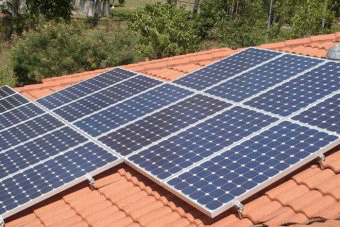 Regional home and business owners driving Australia’s solar energy boom, ABC PM By Angela Lavoipierre , 23 Mar 17
“……….Rooftop solar panels do not necessarily power the buildings they are attached to.Most of the time, the power generated by those panels is sold straight back to the energy market.
Generous state-based schemes designed to tempt people into the market paid handsomely for that energy in the past, but those deals all but disappeared.
At another time in Australian history, that change might have had a chilling effect on solar uptake, but soaring energy prices have made sure that is not the case. To those who own their own homes, with mounting power bills, solar still looks pretty tempting, even if it is just for your own personal use. The rapid pace of growth in rooftop solar has slowed.
But Hugh Saddler, an energy analyst based at the Australian National University, said Australia could expect to see an ongoing boom in the uptake of small-scale solar for businesses.
“The steady or in more case rapid increase in the commercial sector is being driven to a significant degree by the steadily falling cost of installing a solar system,” Dr Saddler said.
There are currently industry-based schemes, paid for by consumers, to encourage businesses to go solar.
Dr Saddler predicts those schemes, once they end, could prove to be a hiccup in the growth of Australia’s solar industry, but little more. “I suppose one challenge will be whether it will still be an attractive investment when the small renewable energy scheme comes to an end and I’m sure that it will be because the prices are coming down all the time,” he said.
If 2.8 per cent does not sound like much, Dr Saddler makes the case that rooftop solar was the unsung hero in recent SA black outs. “If it hadn’t been for the rooftop solar making a very large contribution at about 4 o’clock in the afternoon … then that peak would have been about 7 per cent higher than the peak demand on the grid two hours later,” he said.
“And that would have roughly doubled the number of consumers that had to be cut off for load shedding.” http://www.abc.net.au/news/2017-03-23/regional-australia-drives-solar-boom/8377670
Victoria and South Australia embrace grid-scale storage for power reliability
Two Australian states embrace grid-scale storage for power reliability, http://www.utilitydive.com/news/two-australian-states-embrace-grid-scale-storage-for-power-reliability/438073/ Peter MaloneyDive Brief:
- Two Australian states are ramping up energy storage to address rising electricity costs and rolling blackouts, according to media reports.
- In South Australia, the government says it will hold a competitive solicitation for a 100 MW battery storage installation and construct a 250 MW gas plant, according to Energy Storage News reports.
- The state of Victoria is also investing $20 million in an effort to boost energy storage to 100 MW by the end of next year, ABC News reports.


South Australia has been suffering from rolling blackouts brought about by high heat and a lack of baseload power. The situation has attracted developers like ZEN Energy and Tesla, who say that battery storage could go a long way toward integrating renewables into the state’s grid and solving grid instability problems.
South Australia officials also announced plans for a 250 MW gas-fired generator to act as backup for intermittent renewables.
Officials said the gas plant would be turned on only when power shortfalls are forecasted, according to ABC. A bill is reportedly in the works to give the state energy minister more control over power dispatch, after criticisms of the Australian grid operator stemming from the power outages.
Victoria, meanwhile, is looking at a range of energy storage solutions, including batteries, pumped hydro storage and solar thermal technology. The $20 million investment will come on top of a separate $5 million solicitation for a 20 MW energy storage system issued last month.
Radioactive Repeat: federal radioactive waste Groundhog Day increases uncertainty
 A small town on South Australia’s Eyre Peninsula is again in the frame as a site for Australia’s nuclear waste despite being ruled out of consideration less than one year ago because of deep community concern and opposition to the plan.
Yesterday federal Resource Minister Matt Canavan formally accepted two revised site nominations and initiated a 90 day process to measure community views on a planned facility for the disposal of low level and extended storage of higher level radioactive wastes. Last April two previously nominated sites in the region were ruled out of federal consideration.
“This plan is simply not the best way to advance responsible radioactive waste management in Australia”, said ACF nuclear campaigner Dave Sweeney.
“Revisiting a community that has already made its view clear looks more like Canberra’s frustration than community consultation.
“Less than a year ago Minister Canavan’s predecessor Josh Frydenberg ruled the Kimba region out, now it is back on the table. This radioactive waste is a direct hazard for many thousands of years – far longer than any politician’s promise. Short term thinking about long term waste is not good policy or practise.”
ACF joined other environment and public health representatives in the Kimba area last week in a visit that included a public meeting, stakeholder meetings and a regional tour. There is clear and continuing community concern and opposition to the waste plan.
The plan will put further pressure on an already stressed community and further highlights the continued uncertainty in the governments wider approach given it is also exploring a controversial site in the Flinders Ranges at the same.
“There has never been an independent assessment of long-term management options in Australia, rather just a decades long search for a postcode,” said Dave Sweeney. “It is time to stop repeating past mistakes and adopt a new and better approach”.
ACF supports a wide civil society and stakeholder call for Australia’s radioactive waste to be managed in improved storage facilities at existing federal sites to allow for a credible, comprehensive and open exploration of the full range of future management options.
Federal Government running amok in SA communities over nuclear waste
 The Federal Government’s decision to advance two sites at Kimba on the Eyre Peninsula for assessment to house Australia’s nuclear waste will cause stress, division and uncertainty for SA communities.
Less than a year ago two proposed sites near Kimba were removed from a national shortlist because of community opposition.
“The Federal Government is toying with the lives of South Australian communities,” said Conservation SA Chief Executive Craig Wilkins.
“Kimba’s original nominations were scrapped due to a lack of broad community support and that opposition remains. This process is damaging and dividing our towns. It is thoughtless, inconsiderate and inconsistent.”
The planned national facility would store intermediate level radioactive waste currently at Lucas Heights in Sydney and dispose of low level waste and contaminated soil from Woomera.
Wallerberdina, a highly contested site in the Flinders Ranges, has been the focus of the federal site search to date and remains on the table despite community opposition.
“The expansion of the site search to Kimba is also a federal vote of no confidence in the Wallerberdina site,” said Mr Wilkins.
“Instead of causing more division and stress across our regional communities the Federal Government should take all the sites off the table. We need a responsible and inclusive approach to radioactive waste management where a proper process is prioritised over our key farming and tourist postcodes.”
South Australia has a history of resistance to radioactive waste projects, from defeat of a plan to establish a facility in the north of the state under the Howard Government to widespread public backlash over the recent push to import and store international nuclear waste.
“We have long-standing state legislation that prevents the establishment of radioactive waste dumps. We will use this and more in our work to support regional communities and keep South Australia free of nuclear waste dumps,” concluded Mr Wilkins.
Virtual power plant achievable within 5 years – AGL Energy’s Andy Vesey
‘Virtual power plant’ is here, says AGL Energy’s Andy Vesey, AFR, 17 Mar 17 Home storage batteries will be cheap enough within five years to make the “virtual power plant” achievable, revolutionising energy and making investment in traditional plant harder to justify, AGL Energy chief executive Andy Vesey says.

Mr Vesey said that batteries would be about the same $3500 price that AGL is charging 1000 Adelaide householders for its virtual power plant trial, a fraction of the $16,000 full price of the Sunverge batteries used in the trial. They could pay themselves off in about five years.
“It’s coming,” he told an American Chamber of Commerce lunch. He said grid scale batteries proposed by Tesla and others already offer value in the right circumstances.
Virtual power plants – “behind the meter” energy resources such as batteries, solar panels, software and smart thermometers managing power-hungry appliances – are one way to ease pressure on the grid and help prevent blackouts such as those plaguing South Australia. ….
Mr Vesey said on Friday that adding storage to solar homes was like adding refrigeration to agriculture, changing the way consumers interact with the power grid and the investment equation for energy companies….
He said when you put 1000 rooftop solar households with batteries together and control them in the cloud “you fundamentally have a 5 megawatt peaking plant on the edge of the grid. It changes everything”. …… http://www.afr.com/news/economy/virtual-power-plant-is-here-says-agl-energys-andy-vesey-20170316-gv0564
Seawater pumped hydro could help South Australia
 Snowy Hydro gets a boost, but seawater hydro could help South Australia, ABC News, 17 Mar 17 The Conversation By Roger Dargaville, University of Melbourne “………could this technology help to ease South Australia’s energy crisis?
The Melbourne Energy Institute (MEI) report on Pumped Hydro Opportunities identifies several potential seawater PHES locations in South Australia.
This includes a very promising site at the northern end of the Spencer Gulf, with significant elevation close to the coast and close to high-capacity transmission lines.
The Department of Defence manages this land, and discussions are ongoing as to how the project might be designed to not interfere with the department’s operations on the site. A win–win development is the primary design aim.
The MEI study suggests that PHES could be delivered at around $250 per kWh of storage.
This compares well with utility-scale lithium ion battery storage, which currently costs of the order of $800 per kWh, although recent announcements on Twitter from Elon Musk suggest this might be coming down towards $500 per kWh.
The Spencer Gulf site has the potential to provide at least 100 megawatts of dispatchable generation, effectively making the wind and solar generation in South Australia significantly more reliable.
The Australian Renewable Energy Agency (ARENA) will help fund a feasibility study into the technology, working with partners Energy Australia, Arup and MEI.
If the facility is ultimately built, it could become a key element in SA’s bid to avoid future power blackouts.
Dr Roger Dargaville is the Deputy Director of the Melbourne Energy Institute. He is an expert in energy systems and climate change.
Originally published in The Conversation http://www.abc.net.au/news/2017-03-17/how-seawater-hydro-could-help-south-australia/8363054
1 This month

of the week – Australians for War Powers Reform (AWPR)
To see nuclear-related stories in greater depth and intensity
 Antinuclear