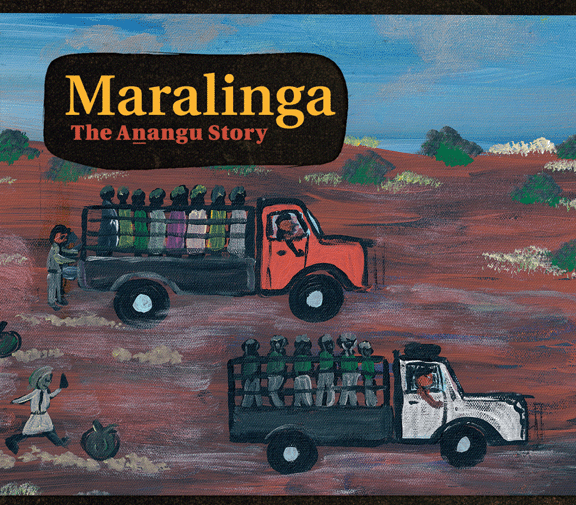
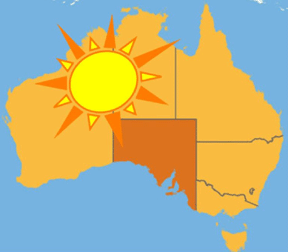
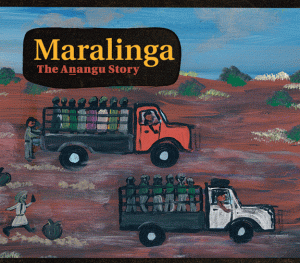
 Australia’s hospitality, largesse and loyalty to Britain were not without their costs. Moreover, the sacrifices made by Australians on behalf of the ‘motherland’ were not equally borne. Whilst low population density and remoteness from major population centres were among the criteria for the selection of the testing sites, the Emu and Maralinga sites in particular were not uninhabited. Indeed, they had been familiar to generations of Aboriginal Australians for thousands of years and had a great spiritual significance for the Pitjantjatjara and Yankunytjatjara people.
A variety of factors underlay the harm to public health, Aboriginal culture and the natural environment which the British tests entailed. Perhaps most significant was the secrecy surrounding the testing program.
During the entire course of the testing program, public debate on the costs and risks borne by the Australian public was discouraged through official secrecy, censorship, misinformation, and attempts to denigrate critics
Wayward governance : illegality and its control in the public sector / P N Grabosky
Canberra : Australian Institute of Criminology, 1989 “……. In 1950, Labor Prime Minister Clement Atlee sent a top secret personal message to Australian Prime Minister Menzies asking if the Australian government might agree to the testing of a British nuclear weapon at the Monte Bello Islands off Western Australia. Menzies agreed in principle, immediately; there is no record of his having consulted any of his Cabinet colleagues on the matter.
The Monte Bello site was deemed suitable by British authorities, and in a message to Menzies dated 26 March 1951 Atlee sought formal agreement to conduct the test. Atlee’s letter did not discuss the nature of the proposed test in minute detail. He did, however, see fit to mention the risk of radiation hazards:
6. There is one further aspect which I should mention. The effect of exploding an atomic weapon in the Monte Bello Islands will be to contaminate with radio activity the north-east group and this contamination may spread to others of the islands. The area is not likely to be entirely free from contamination for about three years and we would hope for continuing Australian help in investigating the decay of contamination. During this time the area will be unsafe for human occupation or even for visits by e.g. pearl fishermen who, we understand, at present go there from time to time and suitable measures will need to be taken to keep them away. We should not like the Australian Government to take a decision on the matter without having this aspect of it in their minds (quoted in Australia 1985, p. 13).
Menzies was only too pleased to assist the ‘motherland’, but deferred a response until after the 195 1 federal elections. With the return of his government, preparations for the test, code-named ‘Hurricane’, proceeded. Yet it was not until 19 February 1952 that the Australian public was informed that atomic weapons were to be tested on Australian soil. On 3 October 1952 the British successfully detonated a nuclear device of about 25 kilotons in the Monte Bello Islands. Continue reading →
April 10, 2017
Posted by Christina Macpherson |
aboriginal issues, AUSTRALIA - NATIONAL, history, reference, South Australia, weapons and war |
Leave a comment
 Tim Bickmore Fight To Stop Nuclear Waste Dump In Flinders Ranges SA
Don’t get sucked in by the “medical gloves & gowns” Canberra con-job:
FACT 1 – South Australia’s current hospital waste storage regimen WILL REMAIN in-situ;
FACT 2 – Radioactive metal from the 1940’s British Montebello Atom Bomb Tests IS DESTINED for the suppository;
FACT 3 – Radioactive concrete & steel from the de-commissioned Lucas Heights HIFAR reactor WILL ALSO be supposited;
FACT 4 – If/when the 10,000 Woomera barrels arrive, Radon gas WILL LEAK. This heavy invisible radioactive odourless & poisonous gas flows like water & accumulates in low-lying areas;
FACT 5 – The so-called Intermediate Level Waste ALSO RELEASES invisible radioactive odourless gasses;
FACT 6 – The lowest area in the Wallerberdina precinct is the Hookina Creek line;
FACT 7 – GLOVES & GOWNS WILL BE A MINOR FRACTION OF THE LOW LEVEL WASTE INVENTORY.https://www.facebook.com/groups/344452605899556/
April 8, 2017
Posted by Christina Macpherson |
Federal nuclear waste dump, South Australia |
Leave a comment
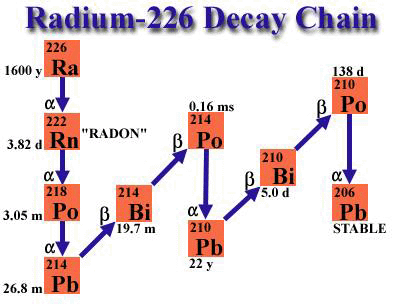 Fight To Stop Nuclear Waste Dump In Flinders Ranges SA In April 2016 ARPANSA discovered that Radium had leaked from the 10,000 barrels stored at Woomera. http://www.arpansa.gov.au/…/inspections/2016/R16-05292.pdf This means that Radon gas is being released into the environment. Radon is heavy & tends to flow to the lowest point & accumulate. After about 4 days it transforms into a solid & infects the ground surface. As time passes more & more Radon converts to a solid that builds up & continuously increases the radioactivity wherever it may happen to land – which is at the place it arrives at after about 4 days. This will continue to happen for at least 16,000 years. https://www.facebook.com/groups/344452605899556/
April 8, 2017
Posted by Christina Macpherson |
environment, South Australia, wastes |
Leave a comment
the biggest unanswered question is whether the planned facility is the best way to manage Australia’s radioactive waste. Extraordinarily, that question has never been asked.
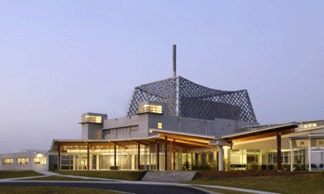 ANSTO [in Sydney] is better placed than a pastoral station or the back paddock of a wheat farm to house this material.
Advantages of storing it at the ANSTO facility include that
- it enjoys assured tenure there;
- has a secured site with a high-level Australian Federal Police presence;
- is currently building new storage capacity;
- has already received reprocessed spent nuclear fuel returns from Europe;
- has the best radiation monitoring and nuclear response capacity in the nation; and
- the fact that the waste is there now answers double handling and transport concerns.
Importantly, the Federal nuclear regulator – Australian Radiation Protection and Nuclear Safety Agency (ARPANSA) – has confirmed there is no regulatory constraint to the waste continuing to be managed at ANSTO “for decades“.
Picking the postcode for a radioactive wasteland https://independentaustralia.net/environment/environment-display/picking-the-postcode-for-a-radioactive-wasteland,10177 Dave Sweeney 5 April 2017, ‘The Federal focus on finding a postcode for a [nuclear waste] facility has been at the expense of independently testing the assumptions behind the need for one.’
ACCORDING to the fridge magnets and stickers in the shop beside the ageing Big Galah sculpture, the small farming town of Kimba in South Australia’s Eyre Peninsula is the half way point on the east-west journey across Australia.
But right now, the local talk is more about half-lives, following the recent decision by Federal Minister for Resources Matt Canavan to further explore two places in the region as possible sites for a national radioactive waste facility.
The search for a place for Australia’s radioactive waste has been in train – and often off the rails – for more than 20 years. Over that time, successive Federal governments have had multiple fights at multiple sites — mainly across South Australia and the Northern Territory. Currently, there are three South Australian sites under consideration.
For the better part of a year, a site near Hawker in the Flinders Ranges has been under examination. The site, on a pastoral station leased by former Liberal senator and long-time nuclear facility supporter Grant Chapman has been strongly contested by many in the wider community. Critical voices include local Adnyamanthanha Traditional Owners, pastoralists and people concerned about the impacts of the region’s steadily growing tourism sector.
Now the inclusion of two parcels of agricultural land at Kimba has seen new tension in a town that has previously been highly divided over the Federal plan.
Last year, two previously nominated Kimba land options were not taken further by then Minister for Resources Josh Frydenberg because of a lack of community support.
However, supporters of a facility have made a new pitch and have found an ear in the new minister.
The planned facility would be in two parts — a repository for the disposal of low-level radioactive waste (LLW) and an above ground store to hold the more serious and problematic long-lived intermediate level waste (ILW). The store would operate for 100 years, at which time a decision would be made about how and where to future manage this long-lived waste, which needs to be isolated from people and the wider environment for thousands of years.
For a project that has had many configurations over many years, there remains considerable uncertainty about the plan.
Part of the series of unanswered questions include:
- final facility design;
- acceptance criteria;
- employment and governance arrangements; and
- longer term plans for managing Australia’s highest level radioactive waste.
Continue reading →
April 7, 2017
Posted by Christina Macpherson |
AUSTRALIA - NATIONAL, Federal nuclear waste dump, South Australia |
Leave a comment
Who’d want to dump Australia’s nuclear waste here? Well, this guy. At Kimba in the heart of the country, a community is divided – in one case literally so – over a plan to deposit the national stockpile of radioactive waste, Guardian, Max Opray, 4 Apr 17 “…..Hefin Griffiths, chief nuclear officer at the Australian Nuclear Science and Technology Organisation, says the facility is needed for the organisation’s gradually accumulating stockpile of radioactive waste at Lucas Heights, where measures are being rolled out to temporarily increase storage space at the 70-hectare site, which is reaching capacity this year.
According to Griffiths, most the waste earmarked for the new facility would be of low-level radioactivity, such as clothes worn by people working in nuclear medicine, or soil now stored at Woomera.
That would only be hazardous for a “short period”, he says, but the intermediate-level waste needs to be  stored for far longer. “We’ve got reprocessed residues that have come back from France which will remain radioactive for many thousands of years,” he says.
The returned waste consists of 20 canisters containing 170 litres each, generated by the High Flux Australian reactor, which ran for nearly 50 years before being decommissioned in 2007.
Intermediate-level waste will continue to be generated by the Open Pool Australian Lightwater research reactor and the under-development Synroc waste treatment plant.
The proposed nuclear waste management facility would hold this intermediate waste above-ground for a few decades until a longer term solution can be found. Griffiths says another structure along the lines of the $5.3bn deep-storage facility in Finland will eventually need to be built.
As for the facility that would hold the waste in the meantime, Griffiths says only a detailed technical assessment could confirm Kimba’s suitability, but proximity to agricultural land and the 1,700km journey from Lucas Heights would not be insurmountable obstacles.
Craig Wilkins, the chief executive of the Conservation Council of South Australia, argues a study should be undertaken on the prospect of storing the waste at Lucas Heights, close to nuclear experts, rather than “out of sight, out of mind”.
“We also have concerns about how incredibly divisive this process is on communities already doing it tough,” he says. “When you have individual landowners putting it forward to kickstart the local conversation it pits neighbour against neighbour.
“Last time it nearly tore Kimba apart. It is clear from last time there is significant community opposition.”
Successive federal governments over decades have failed to lock down a remote-area site to store nuclear waste because of regional opposition, and in a separate process the SA Labor government has struggled to sell a plan to develop a high-level nuclear waste storage facility, with a citizen’s jury last year resoundingly rejecting the concept.
Kimba was first floated as a potential location by the Liberal federal member for Grey, Rohan Ramsay, who in 2015 volunteered his property near the town before it was rejected owing to perceived conflict of interest………..https://www.theguardian.com/environment/2017/apr/04/whod-want-to-dump-australias-nuclear-waste-here-well-this-guy?CMP=share_btn_tw
April 7, 2017
Posted by Christina Macpherson |
AUSTRALIA - NATIONAL, Federal nuclear waste dump, South Australia |
Leave a comment

 Off The Record: Orchestra now in baton race to replace young gun, The Advertiser April 1, 2017 “…….Hitting voters with ion fist OUR atomic adventure might be dead and buried, but a series of targeted nuclear strikes are about to be launched by the Liberals.
Having last November torpedoed Premier Jay Weatherill’s half-hearted push for an international nuclear waste dump, the Libs will now attack him for secret plans to put the dump in various sites across the state, Off the Record has learned.
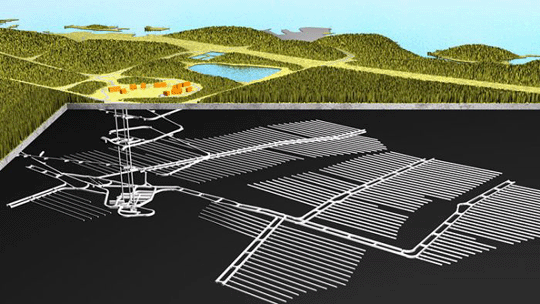
A localised digital and leaflet campaign will accuse Mr Weatherill and his high-level waste dump of risking the destruction of agricultural industry and the environment through toxic nuclear leaks.
The advertising blitz will expand closer to next March’s election.
Regional areas likely to host a dump will be the focus, along with women worried about their children’s futures and those once known as “doctors’ wives” – affluent inner-city Liberal types concerned about the environment and social issues.
Of course, as no site was earmarked by the nuclear royal commission in its final report last May, the Liberals have fertile ground to declare any community could be at risk from the nuclear ogre…… http://www.adelaidenow.com.au/news/opinion/off-the-record-orchestra-now-in-baton-race-to-replace-young-gun/news-story/22c63df9efeb84f31fe3adf21ca65aa9
April 7, 2017
Posted by Christina Macpherson |
NUCLEAR ROYAL COMMISSION 2016, politics, South Australia, wastes |
Leave a comment
The potential location of the proposed National Radioactive Waste Management Facility at Wallerberdina Station near Hawker would have no impact on the World Heritage proposal for the Flinders Ranges.
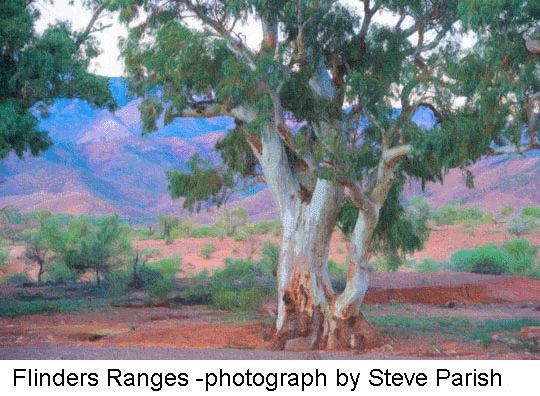
World Heritage for the Flinders Ranges Natural resources, SA Arid lands Over 600 million years old, the Flinders Ranges is one of Australia’s magnificent landscapes. This diverse landscape is world-renowned for its wealth of natural, cultural, historic and scenic values making it an iconic tourism destination with unparalleled visitor experiences.
Particularly extraordinary are the fossils and geology of the Flinders Ranges, which display the history of our planet and the evolution of life on Earth. Some of this critical evidence spans more than 300 million years and includes the world’s finest example of the Ediacaran explosion of life, when the earliest forms of complex multicellular animal life evolved. It is these outstanding geological and palaeontological forms within the Flinders Ranges that make it an important site to pursue for World Heritage Listing.
Pursuing World Heritage Listing for the Flinders Ranges provides an exciting opportunity to recognise this site on a global scale, to celebrate these outstanding values and create economic benefits for the region. Continue reading →
April 7, 2017
Posted by Christina Macpherson |
environment, South Australia |
Leave a comment
The couple [ Megan and Matt Lienert]say the federal government consultation process has only tried to sell the positives. “It’s like they’re here to sell a car,” James says. “Oh, you don’t want it? Here’s some free seat covers.”
Jacinta jumps in: “Here’s $2m to go to the next stage.
“[The federal government provides] the facts from one side, that’s all we’ve got since day dot. They don’t bring anybody here so people can make an informed decision.
“We’re not stupid just because we live out here – we can make informed decisions, but we need the facts to do that … if they’d had a group for it and a group against it, the community go discuss it and come back and decide. That would have been much fairer and it wouldn’t have destroyed the place.”
Leading the local fight against the facility is the No Radioactive Waste on Agricultural Land in Kimba or SA committee, which believes the media has underplayed rather than overplayed the conflict.
 Who’d want to dump Australia’s nuclear waste here? Well, this guy At Kimba in the heart of the country, a community is divided – in one case literally so – over a plan to deposit the national stockpile of radioactive waste, Guardian, Max Opray, 4 Apr 17, At a point almost halfway between the east and west coasts of Australia, a mob of emus scamper along the Napandee property fenceline. The mallee scrub out this way appears otherwise deserted, the kind of remote location where one could hide a dead body and get away with it – but what about an entire country’s radioactive waste?
Landowner Jeff Baldock is determined to find out. Speaking in a considered gravelly tone through a bristling grey moustache, the third-generation farmer has an Ian Chappell-esque air about him as he defends the decision to formally nominate his land in Kimba, South Australia, as a site for the federal government’s national radioactive waste management facility. It would serve as a repository for intermediate-level waste from the Lucas Heights nuclear site in New South Wales and low-level waste from across Australia.
“We’ve got five grandkids living here on the properties with us,” he says. “If we thought it was dangerous we wouldn’t do this. If I thought it’d upset our grain or sheep we wouldn’t be doing it.”
If his property is selected, Baldock stands to be paid four times the value of 100 hectares of the land, but he says the real advantage would be providing economic benefit to the thousand or so residents of a struggling agricultural district.
“It’s a once-in-a-lifetime opportunity for our town – sorry, our community,” he says. “The antis talk about farmers versus the townies. To me it’s one community.”
It isn’t the first time Baldock has nominated land for consideration. Last year the federal government ruled out another property of his after the assessment process was abandoned because of local resistance. But Baldock says those against the proposal didn’t give it a chance………
In nominating again along with another landowner, Baldock has reopened wounds that were only just starting to heal in a community tightly bound by the challenges of an isolated life in the northern reaches of the Eyre peninsula. Last year Kimba held two of the six possible locations flagged by the government for the nuclear waste site, with one other in SA, and one each in Queensland, NSW and the Northern Territory.
Only one of those, the Barndioota site in SA’s Flinders Ranges, advanced to stage two, but it is meeting considerable resistance from Adnyamathanha traditional owners owing to its proximity to significant Indigenous cultural sites. The return to Kimba suggests the choices are narrowing – or vanishing. In March the resources minister, Matt Canavan, launched the new consultation on Kimba, …….. Continue reading →
April 7, 2017
Posted by Christina Macpherson |
Federal nuclear waste dump, South Australia |
Leave a comment
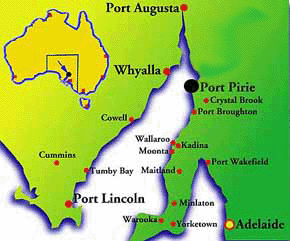 Port Augusta mayor Sam Johnson ‘absolutely ecstatic’ solar power plant will be finally funded Adam Langenberg, Political reporter, Sunday Mail (SA) April 2, 2017
 THE city at the centre of South Australia’s power crisis is “buzzing” after a highly anticipated plan to build a 100MW solar thermal plant took one huge leap closer to reality.
Excited locals say the promise of a $110 million concessional loan to proponents is “absolutely huge” and  transformative for the city, while project backers say the State Government must award its power supply contract to provide certainty.
Mayor Sam Johnson said he was “absolutely ecstatic” the project was a step closer but he took a shot at the Federal Government for only delivering on its promise as part of a deal with Senator Xenophon to support its company tax cut package.
“There was certainly a buzz around town because it’s no secret we’ve had a few bad shots in the arm in the last 18 months,’’ Mr Johnson said.
“We’re looking for that positivity and we know we can deliver the next chapter.”
Senator Xenophon said Prime Minister Malcolm Turnbull had assured him the project “was a goer” and welcomed the Government’s clear commitment to solar thermal generation at Port Augusta. “It will transform the town and be a beacon of hope. It will also change the way we look at energy, by providing virtual baseload with a molten salt storage,” Senator Xenophon said. “I just want it to happen. I’m happy to work with the Prime Minister………
..Repower Port Augusta Dan Spencer reiterated both proponents, SolarReserve and Solarstor, needed to clinch an electricity supply deal with the State Government before progressing further.
“It puts the ball right in Jay’s (Premier Weatherill) court,” Mr Spencer said.
“They’ve got the guarantee of the federal loan so they can lock it in now by providing the power contract.”
Energy Minister Tom Koutsantonis said applications for the electricity contract were being assessed and the Government had “numerous policies in place to support a potential solar thermal plant.”http://www.adelaidenow.com.au/news/south-australia/port-augusta-mayor-sam-johnson-absolutely-ecstatic-solar-power-plant-will-be-finally-funded/news-story/55acc17df92d7f9cef77b6548aae488c
April 3, 2017
Posted by Christina Macpherson |
solar, South Australia, storage |
Leave a comment
 Last year, Australia’s clean energy movement had a major victory, with South Australia’s resounding
  rejection of the plan for nuclear waste importation, (and later for, nuclear power). Some nuclear proponents also looked to Port August as the place for a nuclear power station.
The Liberal Coalition government now supports a solar power station instead. Of course, they were dragged kicking and screaming, into this, by a piece of deft politicking from Senator Nick Xenophon. But – so keen was PM Turnbull, to get new legislation on tax passed, that he had to swallow his aversion to non fossil-fuel energy. We wait to see how well the govt carries out this commitment
Coalition commits $110m for Port Augusta solar towers http://reneweconomy.com.au/coalition-commits-110m-for-port-augusta-solar-towers-11045/ By Giles Parkinson on 31 March 2017 The federal Coalition government has announced that it will provide $110 million in concessional loans to a solar tower and molten salt storage project in Port Augusta, as part of last minute negotiations with the Nick Xenophon Party to pass major tax cuts.
The commitment was announced by finance minister Mathias Cormann as part of a deal with the NXT to approve tax cuts for businesses with revenue of less than $50 million.
Senator Cormann says the Coalition will provide a confessional loan of $110 million in 3 per cent interest rate to an unspecified solar thermal project. He said the government will call for formal proposals via the Australian Renewable Energy Agency and the Clean Energy Finance Corp.
The front runner for the deal is the 110MW solar tower and molten salt storage project proposed by the US company SolarReserve. Other proposals are likely to come from Vast Solar and others.
“We welcome the announcement today from the Senate, and it is critical step in progressing the project – but the key outcome is to obtain a long term power purchase agreement,” said Daniel Thompson, the Australian development manager for SolarReserve.
Earlier, the energy minister Josh Frydenberg announced that the CEFC would invest $80 million in the 113MW Bodangora wind farm near Wellington in NSW.
“This investment in large-scale renewable energy projects such as Bodangora, is part of the Turnbull Government’s technology neutral, non-ideological approach to provide affordable, reliable electricity as we transition to a lower emission future,” he said in a statement.
The $236 million Bodangora wind farm is expected to be operational in the latter half of 2018.
April 1, 2017
Posted by Christina Macpherson |
AUSTRALIA - NATIONAL, solar, South Australia, storage |
Leave a comment
 Carnegie teams with Samsung, Lend Lease for battery storage hub http://reneweconomy.com.au/carnegie-teams-with-samsung-lend-lease-for-battery-storage-hub-23948/ By Giles Parkinson on 31 March 2017
Perth-based Carnegie Clean Energy is proposing to set up a solar-storage energy hub in South Australia as part of its pitch for the state government’s ground-breaking battery storage tender.
In a joint announcement with energy minister Tom Koutsantonis and premier Jay Weatherill in Adelaide on Friday morning, Carnegie CEO Michael Ottaviano said the company has teamed up with Lend Lease Services and South Korea’s Samsung for the proposal.
It proposes to build a 100MW/100MWh lithium-ion battery, using Samsung technology, and wants to do this in Adelaide in a centre that will evolve into a “battery storage” hub, building new battery systems and doing R&D and integration work.
“This is an opportunity to build an industry for the future,” Ottaviano told journalists in Adelaide. “This will be the first 100MW battery, not the last.”
Carnegie’s is just one of a number of proposals for the state government tender, which closed at 12 noon local time on Friday. Others include the $1 billion solar and battery storage project unveiled by Lyon Solar on Thursday, and rival offers from Zen Energy/Greensmith, Tesla, LG Chem, Adelaide-based silicon storage developer 1414 and many more.
Koutsantonis said the tender had elicited an “unprecedented” response with more than 200 downloads from nine different countries. Final numbers will be revealed on Monday. “It has captured international attention for people to see opportunities with our remarkable renewable energy power,” Koutsantonis said. “You can hand around lumps of coal, or you can move forward with new technologies. Storage will become the norm and we will be at the forefront of that.”
Ottaviano says the battery storage hub would be powered by a “multi-megawatt” rooftop solar system – and could employ 300 people to deliver the project, including electricians and engineers from sunset manufacturing industries in South Australia.
He said Carnegie would own the battery storage unit, and use it to trade energy, arbitraging opportunities in the market, and also playing in the FCAS (frequency and ancillary services) market when not being called upon by the government to provide grid support.
But he said such installations would rely on government support until market rules were changed that would level the playing field for battery storage.
“As renewable energy penetration inevitably increases across the country, the need for utility-scale energy storage will grow in lockstep,” Ottaviano said in a later statement.
“The deployment of utility-scale battery systems creates an opportunity for South Australia and Australia to develop a new local industry and export this capability throughout our region.”
Weatherill told journalists that battery storage was exciting because it sourced “free energy” from the wind and the sun, and would create the jobs of the future.
April 1, 2017
Posted by Christina Macpherson |
solar, South Australia, storage |
Leave a comment
Lyon Group announces $1b battery and solar farm for South Australia’s Riverland, ABC News, By political reporter Nick Harmsen, 30 Mar 17 A $1 billion battery and solar farm will be built at Morgan in South Australia’s Riverland by year’s end in a project the proponents describe as “the world’s biggest”.
The builder, Lyon Group, has already proposed a smaller solar farm and battery storage facility, named Kingfisher, in the state’s north.
Lyon partner David Green said the project was 100 per cent equity financed and construction would begin within months, employing 270 workers.
“Riverland Solar Storage’s 330-megawatt solar generation and 100-megawatt battery storage system will be Australia’s biggest solar farm with 3.4 million solar panels and will also include 1.1 million batteries,” he said.
Mr Green said land had already been secured and grid connection was already well advanced.
Work on Lyon’s 120 megawatt Kingfisher project is slated to begin in September next year……
Lyon to bid for SA battery tender
The Lyon Group has already signalled its intention to bid for a SA Government tender to build a battery storage system with 100-megawatt output. The tender arrangement would give the Government the right to tap the battery storage at times of peak demand, but allow the project owner to sell energy and stability into the market at other times.
An expressions of interest process closes on Friday.
Other companies, including Carnegie, Zen Energy and Tesla, have all suggested they could be interested in bidding…….http://www.abc.net.au/news/2017-03-30/new-solar-project-announced-for-sa-riverland/8400952
March 31, 2017
Posted by Christina Macpherson |
solar, South Australia, storage |
Leave a comment
 SA power: Government introduces bill giving Energy Minister power over AEMO, ABC News, 28 Mar 17 By Sara Garcia and Nick Harmsen The South Australian Government has introduced legislation to give the Energy Minister the power to direct electricity generators to turn on when required — a move it says would have prevented the September statewide blackout.
The measure has been born out of frustration that the Australian Energy Market Operator (AEMO) ordered a power cut to tens of thousands of homes in February during a heatwave, when a shortfall in supply was looming. A second unit at Pelican Point sat idle at the time, and the Government said AEMO should have directed it to switch on.
Energy Minister Tom Koutsantonis said the powers would have also prevented the statewide blackout on September 28 as he would have ramped up generation in South Australia in preparation for the catastrophic event.
“We would have constrained the interconnector in the morning as I asked AEMO and there would have been more South Australian generation on,” Mr Koutsantonis said.”[I asked and they responded] there wasn’t a credible contingency to constrain the interconnector.”
Mr Koutsantonis said the powers the Government was seeking currently exist under a state of emergency.But he said he needed the power to prevent a state of emergency in the first place.”What we’re doing is extending those powers before an emergency situation exists to make sure we can avoid it,” he said.”These powers will give me the ability to direct either AEMO or direct generators individually and direct individuals.”That power will ensure that market power is not the driving aspect of our energy security in this state.”
Premier Jay Weatherill said the current system was “broken” and put “profits before people”.”We’re taking back control and putting South Australians first,” he said.
The Government introduced the bill this morning and called on an immediate debate.The Opposition tried to block the debate, but failed.”I don’t mind that they don’t have a plan, but get out of the way and don’t stop us from implementing our plan,” Mr Weatherill said……http://www.abc.net.au/news/2017-03-28/sa-governments-power-legislation-gives-energy-minister-control/8393608
March 29, 2017
Posted by Christina Macpherson |
politics, South Australia |
1 Comment
 S.A. network says solar plus battery storage to cost just 15c/kWh, REneweconomy, By Giles Parkinson on 28 March 2017 The price of rooftop solar and battery storage for household and business consumers will fall to just 15c/kWh within a few years, leading to a dramatic reshaping of the energy grid, according to a leading network operator. Rob Stobbe, the head of SA Power Networks, which operates the local network in South Australia, says rooftop solar has already fallen to around 5c/kWh for households and businesses. Continue reading →
March 29, 2017
Posted by Christina Macpherson |
solar, South Australia, storage |
2 Comments