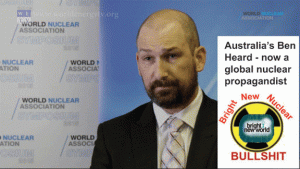
 Advertiser reporter Paul Starick apparently wrote this. But pro nuclear lobbyist Ben Heard claimed
  credit for it tweeting:
“New push for nuclear industry in South Australia: This effort was brought to you by Bright New World “
New push for high-level international nuclear waste dump in South Australia Paul Starick, Chief Reporter, The Advertiser March 2, 2017 FORMER Port Adelaide Football Club chief Brian Cunningham and Economic Development Board chairman Raymond Spencer are among prominent South Australians launching a fresh push to progress a proposed $257 billion international nuclear waste repository.
In a new open letter to state MPs, 42 influential people demand the State Government commits to completing first-stage investigations of the proposed high-level repository.
The group, which also includes Adelaide Football Club chairman Rob Chapman and renowned brewer Tim Cooper, urges modest expenditure to investigate the proposal’s viability.
This would include assessing whether other countries were willing to participate and contribute financially, analysing potential competitors and developing a clear exit strategy……..
Many of the signatories were behind a similar open letter in December last year, which demanded political leaders not block study of the proposed repository, which would involve a purpose-built waste storage and disposal facility for international used nuclear fuel…….
Opposition Treasury spokesman Rob Lucas has questioned the repository’s $257 billion revenue forecast and warned taxpayers might have to spend more than $600 million and still decide not to proceed with the dump……http://www.adelaidenow.com.au/news/south-australia/new-push-for-highlevel-international-nuclear-waste-dump-in-south-australia/news-story/fcc16323dfc87c46d83dc358f8c7f59a
March 3, 2017
Posted by Christina Macpherson |
media, South Australia |
Leave a comment
After all the negative comments from State and Federal politicians and the media about renewable energy not providing synchronous generation I find it ironic that this “event” was 99% related to synchronous thermal (coal and gas) electricity generators. Ill-informed comment from politicians and journalists exposes the subjective ideological underpinning of these commentators.
Dennis Matthews 1 Mar 17, INTRODUCTION The AEMO report (, 1 DECEMBER 2016) is shockingly (!) written.
It’s full of jargon and acronyms with no easy way of finding what the acronyms mean. We could be forgiven for thinking that AEMO publications are intended to be read only by industry experts rather than concerned consumers.
Its charts are frequently unreadable, with minute characters used to label the axes, the axes overcrowded with labels, and five figure labels such as 200.00 where 200 would have sufficed.
The continual use of the words “incident” and “event” are reminiscent of the nuclear industry’s description of its many serious accidents and failures.
AEMO has uncovered gross inadequate performance by the electricity industry from electricity transmission to fossil fuel electricity generation to systems needed to maintain the integrity of the overall generation-distribution-transmission system. At no stage is there even a hint that severe penalties should be incurred by those responsible. I suspect, even if there were penalties that these would be recovered through increased prices. Competition is almost totally lacking in the industry.
At no stage was the cause of the “separation event” (failure of the Heywood interconnector from Victoria to SA) the fault of wind or solar electricity generators, quite the opposite. Wind powered electricity generators contributed 6% to power supply and the interconnector failure led to the shutdown of 2 wind farms in Victoria.
The following discussion uses the same section notation as the AEMO report.
1. OVERVIEW Continue reading →
March 3, 2017
Posted by Christina Macpherson |
energy, politics, South Australia |
Leave a comment
 Treaty: South Australian Government enters historic discussions with Aboriginal nations, The World Today By Caroline Winter 15 Dec 2016 South Australia is making history, with the State Government entering treaty discussions with Aboriginal nations to help address past injustices.
The Government has set aside $4.4 million over five years to support the treaty process and the appointment of an independent commissioner for treaty. At this stage it is unclear what the treaties will cover or whether compensation will be included, but South Australian Indigenous leaders said the process would set a positive course for the future.
Major Sumner, a Ngarrindjeri man at the Murray mouth, said the word treaty alone has important meaning. “Even just with a mention of treaty, that opens up a different world for us to talk and put things in place, do all sorts of negotiations around how we structure our lives,” he said.
Mr Sumner joined other Aboriginal elders at the start of historic negotiations between the State Government and Indigenous communities. The chairman of Narungga nations on the Yorke Peninsula, Tauto Sansbury, wants an open, transparent process about everything that has affected Aboriginal people. “I think it’s going to mean the satisfaction of acknowledging that Australia was basically invaded,” he said.
“And that the process of sitting down and negotiating a final outcome for us — because we’ve been totally dispossessed of everything — and coming up with a good solution that could move our community, children and families forward.”
The South Australia Government said negotiations would be open-ended, but what form any treaty would take or whether compensation would be included, is not yet clear.
The State’s Aboriginal Affairs Minister, Kyam Maher, said it was hoped a treaty would be signed off on by the end of next year. Continue reading →
February 27, 2017
Posted by Christina Macpherson |
aboriginal issues, South Australia |
Leave a comment
“If a project of this scale, a pumped hydro project of this scale, had been available recently in South Australia, there wouldn’t have needed to been the load shedding that occurred there,” Mr Turnbull said.
Pumped hydro power station ideal for SA Spencer Gulf site, EnergyAustralia says http://www.abc.net.au/news/2017-02-22/pumped-hydro-power-in-spencer-gulf-energy-australia/8292596 PM By Khama Reid A desert site at the top of Spencer Gulf in South Australia is perfect for a pumped hydro venture, EnergyAustralia chief executive Catherine Tanna has said.
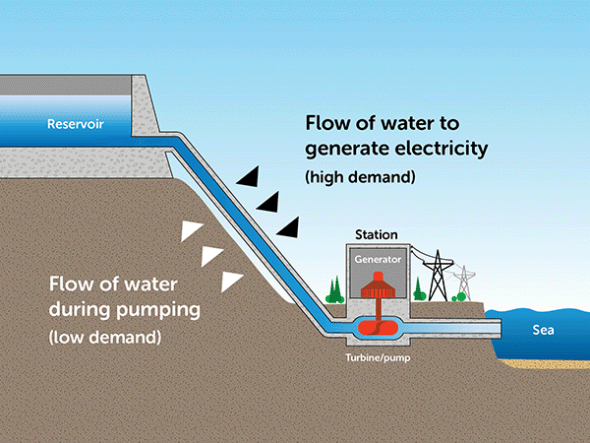
 What is pumped hydro?
- Power is generated by releasing sea water from a top dam, through a turbine, into a lower dam
- During times of plentiful energy on the network, seawater is pumped up into the top dam, like charging a battery
- The top dam would hold about eight hours of power which can be switch on at short notice
Backed by federal funding, the company and its partners will investigate the proposal further, with hopes it could be operational by the end of the decade.
“What’s required is to find a site, obviously being pumped hydro, that has water, but we also look for a site that has the right geography and topography … elevation, but also a site that has proximity to transmission,” Ms Tanna said.
Using $450,000 received from the Australian Renewable Energy Agency, the company will look at whether it is feasible to put a 100 to 200-megawatt power station close to Port Augusta and Whyalla. Continue reading →
February 24, 2017
Posted by Christina Macpherson |
South Australia, storage |
Leave a comment
EnergyAustralia outlines plans for 100MW pumped hydro plant in SA http://reneweconomy.com.au/energyaustralia-outlines-plans-for-100mw-pumped-hydro-plant-in-sa-68973/ By Sophie Vorrath on 21 February 2017 Having chalked up three major solar power purchase agreements in as many months, EnergyAustralia is talking large-scale energy storage this week, in a briefing with the federal government on the potential for a massive pumped hydro project in the renewables rich state of South Australia.
EnergyAustralia managing director Catherine Tanna, along with the company’s executive for energy, Mark Collette, were in Sydney on Tuesday updating the Cabinet Energy Committee on the progress they have made, along with their research partners Melbourne Energy Institute and Arup Group, investigating the viability of a pumped hydro energy storage plant using seawater.
In a statement on Tuesday, Arup Group said that the proposed South Australia project would have the capacity to produce around 100MW of electricity with six-to-eight hours of storage – the equivalent of 60,000 home battery systems, EnergyAustralia says, but at “one-third of the cost.”
Pumped hydro, one of the oldest and most basic and low-cost forms of energy storage, converts electrical energy into potential energy by pumping water up to the top of a hill, storing it there in a reservoir, and then using it when needed to generate electricity at very high efficiency.
Most recently in Australia, it has been linked with a ground-breaking project being developed by Genex Power, which proposes to convert an old gold mine into a 330MWh pumped hydro storage project, to go alongside a 150MW solar PV array.
But its potential for Australia has come into sharper focus in recent months, as governments and electricity market operators grapple with the problem of how to support the smooth transition of electricity networks to renewable energy generation. Continue reading →
February 22, 2017
Posted by Christina Macpherson |
South Australia, storage |
Leave a comment
 SA power bills rose less in past decade than coal states, REneweconomy By Sophie Vorrath on 21 February 2017 A new report charting Australia’s rising power prices over the past decade has undermined claims that South Australia’s high electricity prices have been driven by the state’s uptake wind and solar, showing that its rises have been less than in coal dependent states.
The argument that South Australia’s high electricity prices are a result of its pursuit of wind and solar is an argument prosecuted by conservative media and politicians alike, but the new report from the Australian National University underlines the fact that its prices have always been high, but have moderated since its investment in renewable energy.
The ANU report, commissioned by News Limited, but available here, shows that average household electricity bills have increased less in the renewables-rich state of South Australia over the past 10 years than they have in Australia’s eastern states, which are predominantly powered by coal and gas-fired generation…….. http://reneweconomy.com.au/sa-power-bills-rose-less-past-decade-coal-states-95588/
February 22, 2017
Posted by Christina Macpherson |
energy, South Australia |
Leave a comment
Solar power battery storage would solve SA’s electricity problems, company says, ABC News, By Claire Campbell, 21 Feb 17, The company behind a $100-million solar plant with battery storage says its project could solve South Australia’s energy woes as the Federal Government announces a $445,000 investment into a pumped hydro-station for the state.
South Australia’s power supply has been scrutinised since the state was plunged into darkness last September, and was forced to “load shed” during a recent heatwave.
South Australian-based renewable energy company Zen Energy is working to build a $100-million solar power plant with 100 megawatts of battery storage in the region.
Chairman Professor Ross Garnaut said the battery would “solve most” of the state’s energy problems and if increased by a further 50MW it would solve “all” energy issues.
“The blackouts of the past year would not have happened if this was in place,” he said.
“We think that it can make a major contribution both to grid stability and also to provide a buffer for when peak demand for power exceeds supply from other sources.”…… http://www.abc.net.au/news/2017-02-21/solar-power-battery-storage-could-have-prevented-sa-blackout/8290304
February 22, 2017
Posted by Christina Macpherson |
South Australia, storage |
Leave a comment
 Tim Bickmore , Fight to stop Nuclear Waste Dump in South Australia February 18 There is also another elephant in the room which is yet to rate a mention. At Lucas heights there are 2 reactors – OPAL & HIFAR. OPAL is the working reactor, whilst HIFAR is the old one now undergoing de-commissioning – which includes dealing with more radioactive waste. Is the HIFAR waste
  (= old reactor parts) also destined for the dump? Considering the decommission schedule, this seems highly probable & where else would it go……
“HIFAR is currently being decommissioned and will be totally decommissioned by 2018.” HTTPS://WWW.FACEBOOK.COM/GROUPS/344452605899556/
February 20, 2017
Posted by Christina Macpherson |
Federal nuclear waste dump, New South Wales, South Australia |
Leave a comment
Artists paint the truth of SA nuclear la la land https://www.eurekastreet.com.au/article.aspx?aeid=50616#.WKpGiNJ97Gg Michele Madigan | 12 February 2017
‘It will be your artists: the poets, painters, actors, dancers, musicians, orators — they will be the ones to lead the changes.’ It was one of the many international invited guests, a Maori woman speaker, who made this prediction to the huge 40,000 strong crowd; to the 30,000 First Nations people from across the nation and 10,000 of us non-Aboriginal supporters who had joined them enroute to Hyde Park, Sydney, on 26 January 1988.
In South Australia almost 30 years later, this prophecy continues to unfold in the ongoing high-stakes battle for country that surrounds the proposed nuclear waste dump.
The orators have been long leading the way. ‘We can’t sell that country — we can’t sell it. Just like selling your own kid, own grandmother, own grandfather,’ said Arabunna Elder Kevin Buzzacott at the 1998 Global Survival and Indigenous Rights Conference in Melbourne 1998.
Tjunmutja Myra Watson told the Olympic Games international media, Botany Bay, 2000: ‘We already lost everything at Maralinga’ — the site of the 1950s and 1960s British nuclear tests.
‘We thought that Maralinga would be the last one … We love our land … We got the Dreaming, we got the songs and we got the culture. We’re going to fight to keep it. Let’s keep it, let’s keep the country, not this man coming in and digging up our spirit and our land and all our songs. They’re spoiling it when they put the poison in. They’re taking everything and they did it before.’
They are joined in the struggle by other artists: painters Eileen Wani Wingfield and Eileen Unkari Crombie; dancers Eileen Kampakuta Brown, Edie Nyimpula King and other Kupa Piti Kungka Tjuta, dancing for protection of country in the bush; singers like Ivy Makinti Stewart, whose astonishing voice filled the Adelaide Town Hall with the lament of the Seven Sisters: Irati Wanti — the poison — leave it! Continue reading →
February 20, 2017
Posted by Christina Macpherson |
art and culture, South Australia |
Leave a comment
 It is extraordinary that some French wine producers are accompanying the Australian and French nuclear promoters spruiking the benefits of nuclear waste dumping to the community in the Barndioota region of South Australia. Not only are many vital questions unanswered as ENuFF SA (Everyone for a Nuclear Free Future SA) has shown, but this propaganda campaign completely ignores both the opposition to nuclear waste dumping, in France and the radioactive danger to France’s Champagne vineyards
“The Champagne producers are facing two nuclear timebombs – one already leaking at Soulaine, and one planned at Bure. The wine producers in the Rhone region stood up to the nuclear state in France and won. The Champagne region needs to act fast before it’s too late,” said Fred Marillier of Greenpeace France. “The French Government must stop this madness. The new facility must not accept any more waste, and an immediate investigation launched into how to stop further contamination of ground water.”
Radioactive waste leaking into Champagne Water Supply, Levels set to rise warns Greenpeace, Greenpeace 30 May, 2006 Greenpeace today revealed that France’s iconic sparkling wine, Champagne, is threatened by radioactive contamination leaking from a nuclear waste dumpsite in the region. Low levels of radioactivity have already been found in underground water less than 10 km from the famous Champagne vineyards.
Problems at the dumpsite, including water migration leading to fissures in the storage cells have been reported to French nuclear safety agency in recent weeks (1). Greenpeace has written to the Comita des Producteur de Champagne to warn them that their production risks contamination, as experienced by dairy farmers in la Hague, Normandy.
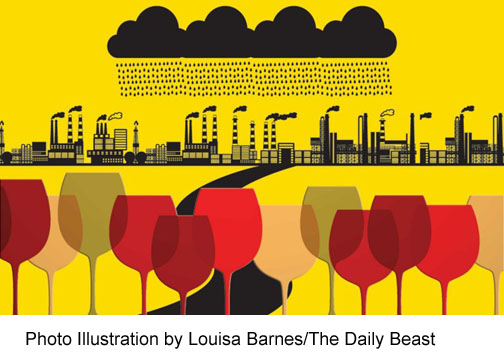
The waste dump, Centre Stockage l’Aube (CSA) in Soulaine eastern France, contains mostly waste from Electricite de France (EdF) and AREVA, but also includes foreign nuclear waste disposed of illegally under French law (2). Every week nuclear waste is trucked across France to the Champagne site. Once full, the dumpsite will be one of the world’s largest with over 1 million cubic meters of waste, including plutonium and other radionuclides.
ANDRA, the national nuclear waste agency operating the site, stated that it would not release any radioactivity into the environment when given permission for the dumpsite in the late 1980’s. Greenpeace research released last week showed levels of radioactivity leaking from another dumpsite run by ANDRA in Normandy were up to 90 times above European safety limits in underground water used by farmers, and that the contamination was spreading into the countryside Continue reading →
February 10, 2017
Posted by Christina Macpherson |
Federal nuclear waste dump, South Australia |
Leave a comment
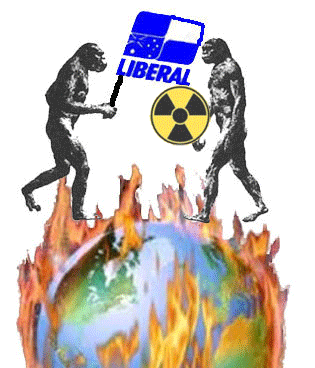 SA power cuts: Nuclear energy should be considered as solution, state Liberals say, ABC News 9 Feb 17 Despite opposing a high-level nuclear waste dump in South Australia, state Liberal leader Steven Marshall is now proposing nuclear power as a potential solution to the state’s energy reliability issues….
A citizens’ jury rejected high-level nuclear waste storage in November, prompting Mr Marshall to declare plans of “turning South Australia into a nuclear waste dump” were “now dead”. But today he said that did not mean he or his party were against the production of high-level nuclear waste in South Australia, via nuclear energy generation.
“We’ve never ruled out the nuclear opportunity for energy. We made it very clear that we were not in the slightest bit interested in continuing to pour money into the hopeless case which was a nuclear repository in South Australia,” he said.
“The royal commissioner ruled out nuclear energy in South Australia but there will be a time when it may become viable, and desperate times call for desperate solutions, and we are in a desperate situation.”
Mr Marshall denied the policy was hypocritical, but did not offer an explanation as to what would become of the highly radioactive spent fuel rods if a nuclear reactor was built in South Australia….. http://www.abc.net.au/news/2017-02-09/sa-power-cuts-could-be-solved-by-nuclear-energy-say-liberals/8256814
February 10, 2017
Posted by Christina Macpherson |
politics, South Australia |
Leave a comment
“If the same sequence of events happened today the system black would not occur,” Marxsen told the audience, according to one source.
This is an important concession from AEMO. It suggests that South Australia, even with around 40 per cent wind energy and a further 6 per cent from rooftop solar, is not at risk of a system-wide shut-down that affected the state late last year.
 AEMO says wind farm changes mean SA blackout won’t be repeated http://reneweconomy.com.au/aemo-says-wind-farm-changes-mean-sa-blackout-wont-repeated-43631/ By Giles Parkinson on 6 February 2017
The Australian Energy Market Operator says it is confident that adjustments made to wind farm software means there is no risk of the South Australia blackout being repeated in the future.
AEMO chairman Tony Marxsen told more than 100 energy experts at a presentation under the auspices of the Electrical Energy Society of Australia last week that the “system black” event in South Australia in September – which has set off a huge debate about renewable energy across the country – would not be repeated. Continue reading →
February 8, 2017
Posted by Christina Macpherson |
South Australia, wind |
Leave a comment
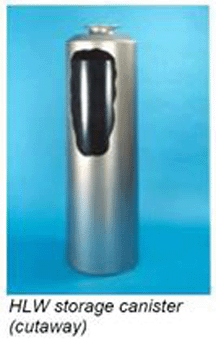
Fight To Stop Nuclear Waste Dump In Flinders Ranges, 6 Feb 17, Inside the massively shielded “intermediate level waste container that returned to Australia from France” are multiple stainless steel containers of vitrified reprocessed waste (pictured) – and this would be called “High Level Waste” (HLW) in France, USA, Canada, Japan and the UK.
Accepting the first container of this HLW anywhere into South Australia opens the door to South Australia becoming the vitrified HLW dump for Sellafield and France. https://www.facebook.com/groups/344452605899556/
February 6, 2017
Posted by Christina Macpherson |
Federal nuclear waste dump, South Australia |
Leave a comment
The State Government has agreed to fund the reburial of the skeletal remains of the child — which a respected Aboriginal elder says died following the Maralinga atomic testing more than 50 years ago.
Coroner Mark Johns has ordered a comprehensive report from police, which will likely determine if an inquest will be held.
Traditional owners of the APY Lands, who are devastated that the remains were disturbed, have engaged a barrister to push for the inquiry and to seek changes to state and federal legislation to ensure such sites are better protected.
Aboriginal Affairs Minister Kyam Maher has also written to police and Coroner Mark Johns, asking both to ensure “appropriate policies are in place and followed’’ to avoid future incidents……..
The bizarre case has created tensions within the APY community, with traditional owners and elders upset the remains were removed from the burial cave, near Mimili, in the Sandy Bore indigenous Protected Area.
Traditional owner Rex Tjami, who is also a director of APY corporation, has engaged barrister Rosanne McInnes, a former magistrate, to seek further protection for burial sites from such action………
Mr Tjami’s affidavit states when he went to the cave region near Sandy Bore — after being alerted to the discovery — he recognised the area and recalled the story his mother had told him about the burial cave.
“The child and the parents of the child died a long time ago. They were related to my mother and my uncle and other families. They came from the area where there was nuclear testing,’’ he states.
“My mother and my uncle told me the parents were staying in the large cave. They and the child became sick. The child died. The parents cut their hair, wrapped it around the child and wrapped the child in special plants. They put the child’s body in a smaller cave opening into the wall of the large cave to protect it. They used sticks from a special plant to fence out predators. After they buried the child, the parents left the cave. Before they died, the parents told their relatives — our family — about the cave in the hill where the child was buried.’’……….
“We want protection for our heritage. Not people from Adelaide digging up old graves and taking away the bodies of our people without telling us.’’
February 6, 2017
Posted by Christina Macpherson |
aboriginal issues, South Australia, weapons and war |
Leave a comment
Paul Waldon Fight To Stop Nuclear Waste Dump In Flinders Ranges SA, 5 Feb 17 The governments sluggish piecemeal approach to nuclear responsibilities that betrays all South Australians safety, needs to be addressed. Also I would like the issues of classification of high grade waste dealt with promptly, as this could open the door to Frances high grade waste being dumped in SA under the guise of intermediate waste.
I believe that the French delegate are here to feather their own nest. A professional, when brokering a deal will kick ass out of the price of their second option knowing it will be rejected, then move in on their intended target, “Their first option.”
With the agenda of a nuclear waste abandonment program I believe Kimba to be their first option. Can anyone tell me with previous such programs, was there more than one site proposed per sortie, or is this a new strategy that may pay dividends to the French? https://www.facebook.com/groups/344452605899556/
February 6, 2017
Posted by Christina Macpherson |
Federal nuclear waste dump, South Australia |
Leave a comment


 , NT News
 Antinuclear