 Tim Bickmore , Fight to stop Nuclear Waste Dump in South Australia February 18 There is also another elephant in the room which is yet to rate a mention. At Lucas heights there are 2 reactors – OPAL & HIFAR. OPAL is the working reactor, whilst HIFAR is the old one now undergoing de-commissioning – which includes dealing with more radioactive waste. Is the HIFAR waste
  (= old reactor parts) also destined for the dump? Considering the decommission schedule, this seems highly probable & where else would it go……
“HIFAR is currently being decommissioned and will be totally decommissioned by 2018.” HTTPS://WWW.FACEBOOK.COM/GROUPS/344452605899556/
February 20, 2017
Posted by Christina Macpherson |
Federal nuclear waste dump, New South Wales, South Australia |
Leave a comment
Artists paint the truth of SA nuclear la la land https://www.eurekastreet.com.au/article.aspx?aeid=50616#.WKpGiNJ97Gg Michele Madigan | 12 February 2017
‘It will be your artists: the poets, painters, actors, dancers, musicians, orators — they will be the ones to lead the changes.’ It was one of the many international invited guests, a Maori woman speaker, who made this prediction to the huge 40,000 strong crowd; to the 30,000 First Nations people from across the nation and 10,000 of us non-Aboriginal supporters who had joined them enroute to Hyde Park, Sydney, on 26 January 1988.
In South Australia almost 30 years later, this prophecy continues to unfold in the ongoing high-stakes battle for country that surrounds the proposed nuclear waste dump.
The orators have been long leading the way. ‘We can’t sell that country — we can’t sell it. Just like selling your own kid, own grandmother, own grandfather,’ said Arabunna Elder Kevin Buzzacott at the 1998 Global Survival and Indigenous Rights Conference in Melbourne 1998.
Tjunmutja Myra Watson told the Olympic Games international media, Botany Bay, 2000: ‘We already lost everything at Maralinga’ — the site of the 1950s and 1960s British nuclear tests.
‘We thought that Maralinga would be the last one … We love our land … We got the Dreaming, we got the songs and we got the culture. We’re going to fight to keep it. Let’s keep it, let’s keep the country, not this man coming in and digging up our spirit and our land and all our songs. They’re spoiling it when they put the poison in. They’re taking everything and they did it before.’
They are joined in the struggle by other artists: painters Eileen Wani Wingfield and Eileen Unkari Crombie; dancers Eileen Kampakuta Brown, Edie Nyimpula King and other Kupa Piti Kungka Tjuta, dancing for protection of country in the bush; singers like Ivy Makinti Stewart, whose astonishing voice filled the Adelaide Town Hall with the lament of the Seven Sisters: Irati Wanti — the poison — leave it! Continue reading →
February 20, 2017
Posted by Christina Macpherson |
art and culture, South Australia |
Leave a comment
 It is extraordinary that some French wine producers are accompanying the Australian and French nuclear promoters spruiking the benefits of nuclear waste dumping to the community in the Barndioota region of South Australia. Not only are many vital questions unanswered as ENuFF SA (Everyone for a Nuclear Free Future SA) has shown, but this propaganda campaign completely ignores both the opposition to nuclear waste dumping, in France and the radioactive danger to France’s Champagne vineyards
“The Champagne producers are facing two nuclear timebombs – one already leaking at Soulaine, and one planned at Bure. The wine producers in the Rhone region stood up to the nuclear state in France and won. The Champagne region needs to act fast before it’s too late,” said Fred Marillier of Greenpeace France. “The French Government must stop this madness. The new facility must not accept any more waste, and an immediate investigation launched into how to stop further contamination of ground water.”
Radioactive waste leaking into Champagne Water Supply, Levels set to rise warns Greenpeace, Greenpeace 30 May, 2006 Greenpeace today revealed that France’s iconic sparkling wine, Champagne, is threatened by radioactive contamination leaking from a nuclear waste dumpsite in the region. Low levels of radioactivity have already been found in underground water less than 10 km from the famous Champagne vineyards.
Problems at the dumpsite, including water migration leading to fissures in the storage cells have been reported to French nuclear safety agency in recent weeks (1). Greenpeace has written to the Comita des Producteur de Champagne to warn them that their production risks contamination, as experienced by dairy farmers in la Hague, Normandy.
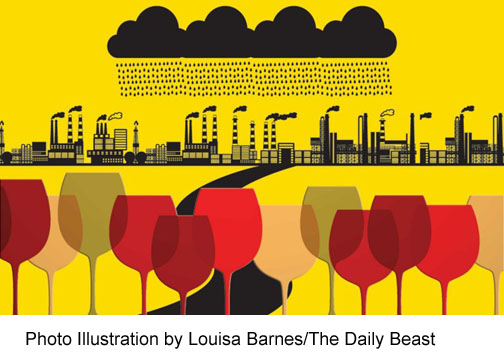
The waste dump, Centre Stockage l’Aube (CSA) in Soulaine eastern France, contains mostly waste from Electricite de France (EdF) and AREVA, but also includes foreign nuclear waste disposed of illegally under French law (2). Every week nuclear waste is trucked across France to the Champagne site. Once full, the dumpsite will be one of the world’s largest with over 1 million cubic meters of waste, including plutonium and other radionuclides.
ANDRA, the national nuclear waste agency operating the site, stated that it would not release any radioactivity into the environment when given permission for the dumpsite in the late 1980’s. Greenpeace research released last week showed levels of radioactivity leaking from another dumpsite run by ANDRA in Normandy were up to 90 times above European safety limits in underground water used by farmers, and that the contamination was spreading into the countryside Continue reading →
February 10, 2017
Posted by Christina Macpherson |
Federal nuclear waste dump, South Australia |
Leave a comment
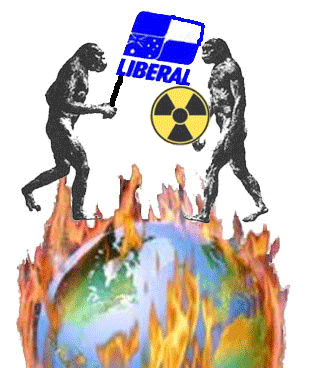 SA power cuts: Nuclear energy should be considered as solution, state Liberals say, ABC News 9 Feb 17 Despite opposing a high-level nuclear waste dump in South Australia, state Liberal leader Steven Marshall is now proposing nuclear power as a potential solution to the state’s energy reliability issues….
A citizens’ jury rejected high-level nuclear waste storage in November, prompting Mr Marshall to declare plans of “turning South Australia into a nuclear waste dump” were “now dead”. But today he said that did not mean he or his party were against the production of high-level nuclear waste in South Australia, via nuclear energy generation.
“We’ve never ruled out the nuclear opportunity for energy. We made it very clear that we were not in the slightest bit interested in continuing to pour money into the hopeless case which was a nuclear repository in South Australia,” he said.
“The royal commissioner ruled out nuclear energy in South Australia but there will be a time when it may become viable, and desperate times call for desperate solutions, and we are in a desperate situation.”
Mr Marshall denied the policy was hypocritical, but did not offer an explanation as to what would become of the highly radioactive spent fuel rods if a nuclear reactor was built in South Australia….. http://www.abc.net.au/news/2017-02-09/sa-power-cuts-could-be-solved-by-nuclear-energy-say-liberals/8256814
February 10, 2017
Posted by Christina Macpherson |
politics, South Australia |
Leave a comment
“If the same sequence of events happened today the system black would not occur,” Marxsen told the audience, according to one source.
This is an important concession from AEMO. It suggests that South Australia, even with around 40 per cent wind energy and a further 6 per cent from rooftop solar, is not at risk of a system-wide shut-down that affected the state late last year.
 AEMO says wind farm changes mean SA blackout won’t be repeated http://reneweconomy.com.au/aemo-says-wind-farm-changes-mean-sa-blackout-wont-repeated-43631/ By Giles Parkinson on 6 February 2017
The Australian Energy Market Operator says it is confident that adjustments made to wind farm software means there is no risk of the South Australia blackout being repeated in the future.
AEMO chairman Tony Marxsen told more than 100 energy experts at a presentation under the auspices of the Electrical Energy Society of Australia last week that the “system black” event in South Australia in September – which has set off a huge debate about renewable energy across the country – would not be repeated. Continue reading →
February 8, 2017
Posted by Christina Macpherson |
South Australia, wind |
Leave a comment
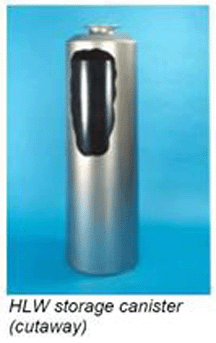
Fight To Stop Nuclear Waste Dump In Flinders Ranges, 6 Feb 17, Inside the massively shielded “intermediate level waste container that returned to Australia from France” are multiple stainless steel containers of vitrified reprocessed waste (pictured) – and this would be called “High Level Waste” (HLW) in France, USA, Canada, Japan and the UK.
Accepting the first container of this HLW anywhere into South Australia opens the door to South Australia becoming the vitrified HLW dump for Sellafield and France. https://www.facebook.com/groups/344452605899556/
February 6, 2017
Posted by Christina Macpherson |
Federal nuclear waste dump, South Australia |
Leave a comment
The State Government has agreed to fund the reburial of the skeletal remains of the child — which a respected Aboriginal elder says died following the Maralinga atomic testing more than 50 years ago.
Coroner Mark Johns has ordered a comprehensive report from police, which will likely determine if an inquest will be held.
Traditional owners of the APY Lands, who are devastated that the remains were disturbed, have engaged a barrister to push for the inquiry and to seek changes to state and federal legislation to ensure such sites are better protected.
Aboriginal Affairs Minister Kyam Maher has also written to police and Coroner Mark Johns, asking both to ensure “appropriate policies are in place and followed’’ to avoid future incidents……..
The bizarre case has created tensions within the APY community, with traditional owners and elders upset the remains were removed from the burial cave, near Mimili, in the Sandy Bore indigenous Protected Area.
Traditional owner Rex Tjami, who is also a director of APY corporation, has engaged barrister Rosanne McInnes, a former magistrate, to seek further protection for burial sites from such action………
Mr Tjami’s affidavit states when he went to the cave region near Sandy Bore — after being alerted to the discovery — he recognised the area and recalled the story his mother had told him about the burial cave.
“The child and the parents of the child died a long time ago. They were related to my mother and my uncle and other families. They came from the area where there was nuclear testing,’’ he states.
“My mother and my uncle told me the parents were staying in the large cave. They and the child became sick. The child died. The parents cut their hair, wrapped it around the child and wrapped the child in special plants. They put the child’s body in a smaller cave opening into the wall of the large cave to protect it. They used sticks from a special plant to fence out predators. After they buried the child, the parents left the cave. Before they died, the parents told their relatives — our family — about the cave in the hill where the child was buried.’’……….
“We want protection for our heritage. Not people from Adelaide digging up old graves and taking away the bodies of our people without telling us.’’
February 6, 2017
Posted by Christina Macpherson |
aboriginal issues, South Australia, weapons and war |
Leave a comment
Paul Waldon Fight To Stop Nuclear Waste Dump In Flinders Ranges SA, 5 Feb 17 The governments sluggish piecemeal approach to nuclear responsibilities that betrays all South Australians safety, needs to be addressed. Also I would like the issues of classification of high grade waste dealt with promptly, as this could open the door to Frances high grade waste being dumped in SA under the guise of intermediate waste.
I believe that the French delegate are here to feather their own nest. A professional, when brokering a deal will kick ass out of the price of their second option knowing it will be rejected, then move in on their intended target, “Their first option.”
With the agenda of a nuclear waste abandonment program I believe Kimba to be their first option. Can anyone tell me with previous such programs, was there more than one site proposed per sortie, or is this a new strategy that may pay dividends to the French? https://www.facebook.com/groups/344452605899556/
February 6, 2017
Posted by Christina Macpherson |
Federal nuclear waste dump, South Australia |
Leave a comment
Fading Eyre Peninsula town looks to nuclear waste dump for a future http://www.theaustralian.com.au/news/nation/fading-eyre-peninsula-town-looks-to-nuclear-waste-dump-for-a-future/news-story/d02dd60bc73cab2b8ee3a3f5efb3bdc3 The Australian February 6, 2017 VERITY EDWARDS Reporter Adelaide Jeff Baldock, a third-generation farmer at Kimba, watches the Eyre Peninsula town 460km west of Adelaide declining as families move for work and schooling, but believes that if his land was chosen for an intermediate-level nuclear waste dump it would mean economic salvation.
“It would basically guarantee Kimba’s future, it’s a 300-year program the federal government will be here for,” Mr Baldock said.
“If we don’t do something, I’m worried the school won’t be going to Year 12 by the time my grandchildren get there, and the hospital might be closed by the time we need it. We’ve only just secured a doctor; we don’t want to lose any more services.”
The federal government earmarked a cattle station at Barndioota in the Flinders Ranges as its preferred site last April, but Bruce Wilson, the head of the Industry Department’s resources division, said other sites would be considered until a final decision, which could be made late this year. Construction of the facility is likely to be completed in the early 2020s.
A second Kimba farmer also put his property forward last week, and both submitted formal applications ahead of a French delegation visiting Kimba and Barndioota from Wednesday.
Among the delegation will be two mayors whose towns are near the Aube Disposal Facility in Champagne, the facility’s director and a representative of the French national radioactive waste agency. They will discuss safety concerns with residents, who have not previously supported the proposal.
“The facility we are proposing is for Australian low- and intermediate-level waste only, [REALLY?] and we will answer as many questions from as many perspectives as we can at these sessions,” Mr Wilson said.
Mr Baldock, whose family farms three properties, suggested a different site last year but neighbours were opposed. This time, all the adjacent property owners are supportive.
Mr Baldock said selecting a Kimba property would mean the federal government injected at least $10 million into the community and created 30 fulltime jobs. His own payment would be equivalent to a year’s worth of fertiliser costs, with the community benefiting more than his family.
Local funding could be used to boost services for the community’s ageing population, fix the pool which has been closed this year because of disrepair, and create jobs, agricultural research projects and economic opportunities.
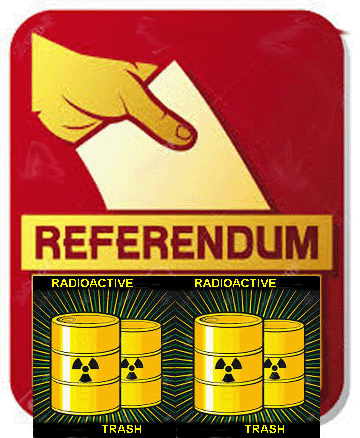
Kimba Mayor Dean Johnson said there had been some opposition to hosting a dump last year, but an information campaign on the low risk involved was turning the tide. His council would also ask the Australian Electoral Commission to run a referendum for the 700 voters after a 60-day community consultation period ended.
“Certainly there is a group that is solidly opposed and that hasn’t changed, but the important thing to remember is this is a chance to get more information about the benefits to the community,” Mr Johnson said.
February 6, 2017
Posted by Christina Macpherson |
Federal nuclear waste dump, South Australia |
Leave a comment
 Derek Abbott No High Level International Nuclear Waste Dump in South Australia, 4 Feb 17, Here’s the American DOE report on repositories. Notice it’s much more truthful than our Royal Commission report. For starters it:
(a) compares the disadvantages of different types of rock for a repository and there are many openly listed, and
(b) it openly mentions the tens of $billions needed in repackaging costs for the fuel. Our Royal Commission totally side stepped these points. https://www.energy.gov/sites/prod/files/2014/04/f15/DOE%20DispOptions%20R1%20Volume1%20Apr15.pdf
the repackaging and even the technical details about the casks was missing from the RC report. Wonder what they were hiding
February 6, 2017
Posted by Christina Macpherson |
NUCLEAR ROYAL COMMISSION 2016, wastes |
Leave a comment
 The only way to avoid gambling hundreds of millions or billions of SA taxpayers’ dollars would be in the wildly improbable scenario that potential client countries would take that gamble.
Taipower clearly states that it would not consider sending waste to another country unless and until that country has developed a repository. Yet the economic case developed by Jacobs and MCM collapses if revenue (and waste) is not received before construction of a repository.
Finally, Mr Heard’s promotion of fast breeder reactors is beyond stupid….. Most of the countries that invested in fast breeder reactors have given up, deciding not to throw good money after bad. Last year, Japan decided to give up on the Monju fast breeder reactor, a fiasco that will cost Japanese taxpayers A$17.3 billion in construction, operation and decommissioning costs despite the fact that the reactor rarely operated.
The Royal Commission completely rejected proposals advanced by Heard and others for ‘advanced fast reactors’, noting in its final report that such reactors are unlikely to be feasible or viable in the foreseeable future; that the development of such a first-of-a-kind project would have high commercial and technical risk
Friends of the Earth Australia has today written to all Members of the SA House of Assembly and Legislative Council, and SA political representatives in the Federal Parliament, responding to the latest round of misinformation from those proposing to turn SA into the world’s high-level nuclear waste dump.
——————————————————————————–
To: Members of the SA House of Assembly and Legislative Council
From: Jim Green
National nuclear campaigner
Friends of the Earth, Australia Feb. 3, 2017
EXPOSING THE LATEST MISINFORMATION FROM THE NUCLEAR WASTE DUMP LOBBY
Dear Members of the SA House of Assembly and Legislative Council,
 The Advertiser has today run an article including false claims from nuclear lobbyist / uranium industry consultant / PhD student Ben Heard that Jay Weatherill’s plan to turn SA into the world’s high-level nuclear waste dump could be pursued without the need to gamble hundreds of millions or billions of dollars with no guarantee of any return on the investment.
Mr Heard is quoted saying that the “notion of high upfront cost to South Australia is a persistent and deliberate lie first peddled by deceitful environmental groups and now, sadly, taken up by the Liberal Party.”
In fact, the necessity of gambling hundreds of millions or billions of dollars ‒ without the slightest guarantee of any return on the investment ‒ is clearly spelt out by Jacobs, the economics consulting firm commissioned by the Nuclear Fuel Cycle Royal Commission.
Jacobs Project Manager / Consultant Tim Johnson told the SA Joint Select Committee that “total expenditure prior to the decision to proceed” is likely to be from around A$300 million to in excess of A$600 million, depending on the timing of the decision to proceed. (Letter to Joint Standing Committee, 5 July 2016.)
Dr Johnson told the Joint Select Committee that the project entails very significant economic risks: “It isn’t a risk-free process to go into this. There is a very significant risk.” Yet the nuclear waste dump lobby persist with the fabrication that the project can be pursued without economic risks. Continue reading →
February 4, 2017
Posted by Christina Macpherson |
AUSTRALIA - NATIONAL, South Australia, spinbuster, wastes |
3 Comments
 Flinders Local Action Group ( FLAG ) Community Survey Results Do You Want a National Radioactive Waste Management Facility established at Wallerberdina Station / Barndioota ? December 2016
A survey of residents living within a 50km radius of the proposed National Radioactive Waste Management Facility of Barndioota, and the remainder of the Flinders Ranges Council Area, South Australia……….
Conclusion FLAG employed two separate survey methodologies to gauge community support for the proposed waste facility.
The first opportunistically sampled interested &/or concerned community members attending the Quorn Town Hall Meeting of 21st September 2016 and the Quorn Agricultural Show on 25th September 2016. Respondents elected to fill out a questionnaire at the FLAG booth.
Whilst there is a possibility of some response bias the method does offer a measure of community support or opposition to the development.
The second mail out/postal survey represents a more systematic attempt to survey the entire towns of Quorn, Hawker and Craddock. Although there is still the possibility of some response bias (as in any survey), these methods provide an improved estimate of regional community sentiment.
Both surveys indicate considerable community opposition to the waste facility and when taken together demonstrate that Department of Industry, Innovation & Science does not have the majority community support it requires.
In both surveys, a clear majority voted “no” to the establishment of a National Radioactive Waste Management Facility in the area, with 92% voting against it in Survey 1 and 79% in Survey 2.
In the Hawker/Cradock region, which is closer to the proposed site, the support for the proposal was slightly higher, presumably due to the perceived economic benefits. Further away in Quorn, support for the proposal was lower, as the benefits would be minimal and outweighed by loss to other industries such as tourism.
Both surveys indicate majority disapproval for the proposal.
February 4, 2017
Posted by Christina Macpherson |
Federal nuclear waste dump, opposition to nuclear, South Australia |
Leave a comment

Kimba wants to take nuke waste, Peter Jean, The Advertiser. p.6 of print version. “…….Kimba mayor Dean Johnson said a referendum of residents should be held before a final decision was made to build a waste dump in the district ….”
February 3, 2017
Posted by Christina Macpherson |
South Australia, wastes |
Leave a comment
 SA landowners offer up two more properties as sites for federal nuclear dump http://www.abc.net.au/news/2017-02-02/new-properties-nominated-as-nuclear-dump-sites/8236894 Another two properties near Kimba in South Australia have been put forward as potential sites for the nation’s first nuclear waste dump.
Six sites around Australia, including two others near Kimba, were previously shortlisted by the federal government to store low- and intermediate-level waste.
Wallerberdina station near Barndioota in the Flinders Ranges was the only one to reach a formal consultation phase, which remains ongoing.
The nomination of the previous sites caused significant divisions within the Kimba community, but two other local landowners have since offered up their properties, called Napandee and Lyndhurst.
Bruce Wilson from the federal resources department said Industry Minister Matt Canavan had not decided on whether to take the proposals forward. “By no means has there been any decision to accept the nominations at this point,” Mr Wilson said. “We are hopeful that in the next few weeks there will be a decision made.”
Mr Wilson said a French nuclear delegation would visit the region, as well as the Flinders Ranges, next week to discuss storage of radioactive waste with locals.
“The French delegation has been invited by the Kimba Council to come down,” he said.”It’s an opportunity for them to ask questions about the issues they’re concerned about.”
Napandee is about 25 kilometres west of Kimba, while Lyndhurst is about 20km north-east of the town.
Kimba mayor Dean Johnson said he was not surprised other local landowners had nominated their properties for nuclear waste storage, and welcomed the chance to meet with the delegation.
“The more information we can get the better, so hopefully this will provide some real answers,” he said.
“The entire question remains around community consent.”
The Federal Government’s selection of Wallerberdina station for further consideration has proved highly controversial and generated a backlash within the local community.
February 3, 2017
Posted by Christina Macpherson |
Federal nuclear waste dump, South Australia |
Leave a comment
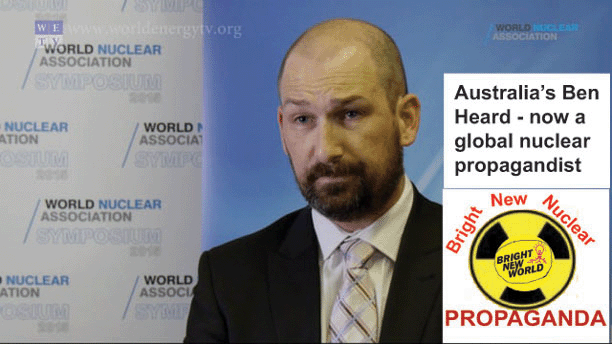
In his latest pro nuclear spiel, on his front group “Bright New World” Ben Heard attacks South Australia’s Liberal Party. He attacks them for ignoring the evidence of (so-called) “Independent” experts.
Those experts are in fact, highly biased pro nuclear lobbyists. Dr Tim Johnson of Jacob Consulting, a leading advocate for underground nuclear storage in S.A. Jim Voss the ex-MD of Pangea Resources – a failed joint venture attempt to bring High Level nuclear waste to Australia in the late 1990s. Voss has global links in the nuclear industry at the highest level. Through UCL he lectured South Australians on the glories of nuclear.
February 3, 2017
Posted by Christina Macpherson |
South Australia, spinbuster |
Leave a comment
 , NT News