Clinton Pryor’s Walk for Justice comes through Port Augusta http://www.transcontinental.com.au/story/4516323/big-crowd-for-justice-walk/Matt Carcich@MattCarcich8 Mar 2017 The Joy Baluch Bridge and parts of Port Augusta were shaking under the loud voice of Clinton Pryor’s Walk for Justice on Wednesday March 8. Starting outside the Standpipe Motel at 10am, the walk went up the Augusta Highway and across the Joy Baluch Bridge. The group then travelled down Mackay and Young Street, before finalising with speeches and a community barbecue on the Port Augusta foreshore.
The crowd included kids under 10 to retirees, all of whom were supportive of achieving justice for Aboriginal people. Chants heard during the walk included, ‘When your rights are under attack, stand up, fight back!’ and ‘Always was, and always will be Aboriginal land!’.
It left Clinton speechless, and thankful for all the help and support he’s received from Port AugustIt was amazing to see the community backing me up in this walk I did over the bridge– Aboriginal Activist Clinton Pryor“It was unbelievable and I’m really proud of Port Augusta and seeing everyone together in one group is really good,” he said.
In September 2016, Clinton left from Matargarup, near Perth, to Uluru, Coober Pedy, on his way to Canberra.Along the way he’s spent time in Aboriginal communities; meeting with elders, hearing their stories, talking with school kids and community groups.
The walk centres around holding governments to account over their treatment of Aboriginal communities around Australia and bringing justice for non-Aboriginal Australians too. Port Augusta Barngarla man Stephen Atkinson was part of the walk across the bridge and said he, and many others in Port Augusta, are proud of Clinton’s efforts. “Hopefully we’re all equally proud of walking across the bridge with Clinton as you should be, we should be really proud of ourselves,” he said. “Port Augusta, we all know is the crossroads of the country, we got that many different mobs here, and 30 odd different languages spoken in this town.
“We’re all different tribes, we’re all different language groups, we’re from all different parts of the country, but when something like this is on we all come together and we’re one people.”
For more information and photos taken during Clinton’s Walk for Justice, make sure to visit his website, www.clintonswalkforjustice.org.
Battery-makers on Turnbull’s Tesla chat: ‘Give Australian companies a fair go’
Industry wants more support from federal government now prime minister has ‘taken interest in the tweets of an American billionaire’, Guardian, Melissa Davey, 13 Mar 17, Malcolm Turnbull should encourage Australia’s battery energy storage industry now he has “taken interest in the tweets of an American billionaire”, Zen Energy chairman Ross Garnaut says.
Garnaut was referring to Elon Musk, the billionaire co-founder of electric car giant Tesla, who tweeted that Tesla could solve the power shortage issue causing price spikes and blackouts in South Australia within 100 days by installing 100-300 megawatt hours of battery storage.
Turnbull subsequently tweeted that he had phoned Musk and enjoyed a “great, in-depth” conversation.
But Australian companies had been working on large battery projects for years, Garnaut said, including one by Zen Energy in the upper gulf of South Australia which it had discussed with the market. Continue reading →
Greens say Elon Musk’s plan is a game changer Australian Greens Senator for South Australia Sarah Hanson-Young says Elon Musk’s proposal to solve South Australia’s energy crisis with battery storage is the game changer our state needs to switch back on.
“We live in the perfect state for wind and solar. Battery technology allows us to make hay while the sun shines, storing the power so we can use it when we want and need. While chairing a senate inquiry into battery storage, I’ve heard evidence that if 20,000 homes with solar panels had a battery as well, the load shedding that cut off the air conditioning when we needed it most last month wouldn’t have happened.
“This is the innovation Malcolm Turnbull promised when he declared he would be the ‘Innovation Prime Minister’
Elon Musk says his Tesla battery company could solve South Australia’s energy crisis in 100 daysLuke Griffiths, Lauren Novak, The Advertiser March 11, 2017 TECH billionaire Elon Musk on Saturday confirmed he’s spoken personally with Jay Weatherill to discuss his company’s plans to build a battery farm to help SA solve its power woes – amid support from the Australian Greens, who say his plan to build a batter farm could be “game changer”.
Michio Kaku – Musk & Game Changing Tesla Powerwall Battery
Mr has weighed into South Australia’s energy crisis, boldly claiming he can fix the problem for $33 million and in under 100 days.
Elon Musk on Friday said his US-based company, Tesla, could build a 100MWh battery farm less than four months after a contract being signed.
Such a system, he said, would go a long way to preventing a repeat of recent blackouts due to load-shedding. Tesla recently launched a similar, but smaller, system in California.
Today billionaire Mr Musk revealed he had spoken by phone with Premier Jay Weatherill, describing the State Government as “clearly committed to a smart, quick solution” to the state’s power woes. Continue reading →
Tesla’s offer: How SA’s power network could benefit from energy storage, ABC News, By Michael Collett 11 Mar 17 South Australia’s energy network has been struggling of late — there were forced blackouts for tens of thousands of homes during a heatwave last month because there wasn’t enough power to meet demand.
But Tesla thinks it has a solution. The company’s billionaire boss Elon Musk says he could install a battery farm capable of fixing the system within 100 days of signing a contract.
It’s a suggestion that the Grattan Institute’s energy expert Tony Wood says should be taken seriously, but it’s not the only electricity storage option that’s available.
What’s the advantage of electricity storage? The idea is that energy storage technologies can take power during off-peak hours and put it back into the grid when it’s needed.
As well, wind and solar are intermittent sources of electricity generation, so this power needs to be stored if the grid is to rely entirely on renewables. (Keep in mind that South Australia already gets about 50 per cent of its energy from renewables, mostly wind and solar.)
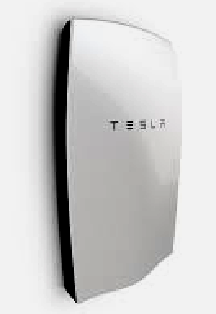
One storage technology that’s getting a lot of press is Tesla’s Powerpack.
Tesla says this battery is “infinitely scalable” — that means a business could buy a single Powerpack so that it still has power during a blackout, while a city, state or country could install hundreds, thousands or even millions of them in order to support an entire grid.
In 2015, Musk said you’d be able to transition the United States to renewable energy with 160 million of them, and the entire world with 900 million……
INSTALLATION of solar panels have surged in the wake of SA’s statewide blackout, despite a cutback in customer tariffs, as homes and businesses take power security into their own hands.
Figures released by Solar Citizens shows SA spent about $23 million on panels in the final quarter of last year, a more-than 17 per cent jump compared with the same period in 2015.
In the second half of 2016, after an incident in July when volatile prices almost forced the temporary closure of some of SA’s biggest employers, 6424 solar systems were installed in the state.
That lifted the overall number of solar systems in SA to a huge 205,068.
At the same time, diesel generator sellers are reporting a huge surge in interest.
Solar Citizens SA campaigner Dan Spencer said households were clearly looking to panels as a technology that could bring down prices as well as add some backup to the grid.
“While politicians attacked SA’s clean energy leadership, South Australians took action at home,” he said. “With solar and storage becoming cheaper and more affordable every day it’s no surprise that ordinary South Australians have looked to clean energy.”
The top five suburbs for solar installation since the blackout were located in regional or outer suburban areas with incomes below the SA average. The regional suburb of Waitpinga led the way and was followed by Smithfield Plains, Salisbury North, Angas Plains and Morphett Vale.
Fight To Stop Nuclear Waste Dump In Flinders Ranges , 11 Mar 17SA Response of the office of South Australian State Liberal leader Steven Marshall, to query about Liberal opinion on the plan to import nuclear waste.
The State Liberal Team is united in its decision not to proceed with a nuclear waste dump.We have carefully considered the Royal Commission Report. We have taken note of the outcomes of the community consultation. We have actively participated in the parliamentary committee process. We have visited Finland, France and the United States to consider the technical aspects and financial risks.
It is clear that Premier Jay Weatherill’s plan to make South Australia the world’s nuclear dumping ground exposes taxpayers to unacceptable financial risks without knowing whether the project will even proceed.
For 70 years the State Liberal Party has demonstrated its commitment to creating realistic opportunities in the nuclear industry with the establishment of the Radium Hill mine and later the Olympic Dam Mine under Liberal Premiers Playford and Tonkin respectively……
The Premier, lacking support from his own Cabinet, had to establish a Citizen’s Jury at taxpayers’ expense, to progress his own agenda and with access to a wide range of advice, two-thirds of that jury has determined that this venture should not be pursued ‘under any circumstances’.
Appointed by the Premier, Royal Commissioner Kevin Scarce has acknowledged that it could take up to 10 years to secure vital public support and another 28 years to establish such a facility.
The advice to State Parliament shows it will cost taxpayers $600 million to continue the consultation and select a site without any guarantee of eventually securing investors or customers for the facility……The Weatherill Labor government is playing poker with your money and our state will be forced to place a blind bet of $600 million just to stay in the game…..
Nuclear Waste storage is a responsibility for those nations using nuclear power. It is not the instant fix for the South Australian economy as promised by the Premier. https://www.facebook.com/groups/344452605899556/
Energy executives say gas market – not windfarms – to blame for South Australia’s woes
Main problem afflicting country’s grid is the lack of clear policy direction from Canberra, witnesses tell Senate inquiry, Guardian, Katherine Murphy, 7 Mar 17, Senior executives from AGL Energy have given evidence that the main issue causing problems with reliable energy supply in South Australia is “dysfunction” in the gas market – not too many windfarms making the grid unreliable.Executives from AGL told a Senate inquiry in Melbourne on Tuesday they would like to build a new gas-fired power station in South Australia to increase base load capacity in the state, but gas supply was chronically unreliable in the eastern states.
Richard Wrightson, AGL’s general manager of wholesale markets, told Tuesday’s hearing the problem was so dire the company was contemplating building its own LNG hub in Queensland to help secure reliable supply downstream.
“Dysfunction in the gas market is causing most of the systemic problems we are seeing in South Australia,” Wrightson told the Senate select committee into resilience of electricity infrastructure in a warming world.
“We would love to be able to contract more in that marketplace but the main restriction on being able to do that is access to flexible gas contracts that we are able to trade in an out of.”
The Turnbull government has argued that ambitious state-based renewable energy targets are driving too large a share of low-emissions technologies, such as wind power, into the grid, and that is a significant factor behind the unreliable conditions in South Australia.
But a number of witnesses appearing before the Senate committee on Tuesday said the main problem afflicting Australia’s energy grid was not proliferating renewables, but a lack of a clear policy direction from Canberra. The policy vacuum had created a damaging investment strike in new assets at a time when old coal-fired power generators had reached their natural age of retirement.
Ross Garnaut, the economics professor who led the climate change policy review for the Rudd government and was the independent expert adviser to the multi-party climate change committee that developed the carbon pricing scheme subsequently repealed by Tony Abbott, said the political debate about climate and energy policy in Australia was “incoherent”……
The chief scientist, Alan Finkel – the official leading the energy review – has already provided implicit support for an emissions intensity scheme in his preliminary report to the government, saying it would integrate best “with the electricity market’s pricing and risk management framework” and “had the lowest economic costs and the lowest impact on electricity prices”.
SA power: Taxpayers should buy gas-fired electricity generator, top economic advisor says, ABC News 8 Mar 17 By political reporter Nick Harmsen The South Australian Government should consider buying or leasing a gas-fired electricity generator to help stabilise the state’s expensive and unreliable power supply, South Australia’s influential Economic Development Board says.
The recommendation was made to the Government late last month, according to evidence given to the SA Parliament’s Statutory Authorities Review Committee.
Board member Goran Roos told the committee in the absence of progress on energy policy at a national level, South Australia should consider going it alone.
“In the medium term, which is one to two years, the South Australian Government should consider direct control of electrical generation facilities either through acquisition or leasing arrangements coupled with long-term back-to-back take-or-pay contracts with end users,” Professor Roos told the committee.
“A suitable facility could be the second … Pelican Point gas turbine.”
The second unit at Pelican Point was mothballed in 2013, and was seldom used until the second half of last year.
“ENGIE has argued that the second Pelican Point gas turbine cannot compete with cheaper wind energy and it is commercially unviable to occasionally switch on the gas-fired power plant to meet requirements for a few high-demand days across the year,” Professor Roos said.
“As such, the acquisition costs or lease costs for the second gas turbine should be minimal on an NPD basis, should the Government choose to acquire or lease this facility.
Advertiser reporter Paul Starick apparently wrote this. But pro nuclear lobbyist Ben Heard claimed credit for it tweeting:
“New push for nuclear industry in South Australia: This effort was brought to you by Bright New World “
New push for high-level international nuclear waste dump in South Australia Paul Starick, Chief Reporter, The Advertiser March 2, 2017 FORMER Port Adelaide Football Club chief Brian Cunningham and Economic Development Board chairman Raymond Spencer are among prominent South Australians launching a fresh push to progress a proposed $257 billion international nuclear waste repository.
In a new open letter to state MPs, 42 influential people demand the State Government commits to completing first-stage investigations of the proposed high-level repository.
The group, which also includes Adelaide Football Club chairman Rob Chapman and renowned brewer Tim Cooper, urges modest expenditure to investigate the proposal’s viability.
This would include assessing whether other countries were willing to participate and contribute financially, analysing potential competitors and developing a clear exit strategy……..
Many of the signatories were behind a similar open letter in December last year, which demanded political leaders not block study of the proposed repository, which would involve a purpose-built waste storage and disposal facility for international used nuclear fuel…….
After all the negative comments from State and Federal politicians and the media about renewable energy not providing synchronous generation I find it ironic that this “event” was 99% related to synchronous thermal (coal and gas) electricity generators. Ill-informed comment from politicians and journalists exposes the subjective ideological underpinning of these commentators.
Dennis Matthews 1 Mar 17, INTRODUCTION The AEMO report (, 1 DECEMBER 2016) is shockingly (!) written.
It’s full of jargon and acronyms with no easy way of finding what the acronyms mean. We could be forgiven for thinking that AEMO publications are intended to be read only by industry experts rather than concerned consumers.
Its charts are frequently unreadable, with minute characters used to label the axes, the axes overcrowded with labels, and five figure labels such as 200.00 where 200 would have sufficed.
The continual use of the words “incident” and “event” are reminiscent of the nuclear industry’s description of its many serious accidents and failures.
AEMO has uncovered gross inadequate performance by the electricity industry from electricity transmission to fossil fuel electricity generation to systems needed to maintain the integrity of the overall generation-distribution-transmission system. At no stage is there even a hint that severe penalties should be incurred by those responsible. I suspect, even if there were penalties that these would be recovered through increased prices. Competition is almost totally lacking in the industry.
At no stage was the cause of the “separation event” (failure of the Heywood interconnector from Victoria to SA) the fault of wind or solar electricity generators, quite the opposite. Wind powered electricity generators contributed 6% to power supply and the interconnector failure led to the shutdown of 2 wind farms in Victoria.
The following discussion uses the same section notation as the AEMO report.
Treaty: South Australian Government enters historic discussions with Aboriginal nations, The World Today By Caroline Winter15 Dec 2016 South Australia is making history, with the State Government entering treaty discussions with Aboriginal nations to help address past injustices.
The Government has set aside $4.4 million over five years to support the treaty process and the appointment of an independent commissioner for treaty. At this stage it is unclear what the treaties will cover or whether compensation will be included, but South Australian Indigenous leaders said the process would set a positive course for the future.
Major Sumner, a Ngarrindjeri man at the Murray mouth, said the word treaty alone has important meaning. “Even just with a mention of treaty, that opens up a different world for us to talk and put things in place, do all sorts of negotiations around how we structure our lives,” he said.
Mr Sumner joined other Aboriginal elders at the start of historic negotiations between the State Government and Indigenous communities. The chairman of Narungga nations on the Yorke Peninsula, Tauto Sansbury, wants an open, transparent process about everything that has affected Aboriginal people. “I think it’s going to mean the satisfaction of acknowledging that Australia was basically invaded,” he said.
“And that the process of sitting down and negotiating a final outcome for us — because we’ve been totally dispossessed of everything — and coming up with a good solution that could move our community, children and families forward.”
The South Australia Government said negotiations would be open-ended, but what form any treaty would take or whether compensation would be included, is not yet clear.
The State’s Aboriginal Affairs Minister, Kyam Maher, said it was hoped a treaty would be signed off on by the end of next year. Continue reading →
“If a project of this scale, a pumped hydro project of this scale, had been available recently in South Australia, there wouldn’t have needed to been the load shedding that occurred there,” Mr Turnbull said.
Power is generated by releasing sea water from a top dam, through a turbine, into a lower dam
During times of plentiful energy on the network, seawater is pumped up into the top dam, like charging a battery
The top dam would hold about eight hours of power which can be switch on at short notice
Backed by federal funding, the company and its partners will investigate the proposal further, with hopes it could be operational by the end of the decade.
“What’s required is to find a site, obviously being pumped hydro, that has water, but we also look for a site that has the right geography and topography … elevation, but also a site that has proximity to transmission,” Ms Tanna said.
Using $450,000 received from the Australian Renewable Energy Agency, the company will look at whether it is feasible to put a 100 to 200-megawatt power station close to Port Augusta and Whyalla. Continue reading →
EnergyAustralia managing director Catherine Tanna, along with the company’s executive for energy, Mark Collette, were in Sydney on Tuesday updating the Cabinet Energy Committee on the progress they have made, along with their research partners Melbourne Energy Institute and Arup Group, investigating the viability of a pumped hydro energy storage plant using seawater.
In a statement on Tuesday, Arup Group said that the proposed South Australia project would have the capacity to produce around 100MW of electricity with six-to-eight hours of storage – the equivalent of 60,000 home battery systems, EnergyAustralia says, but at “one-third of the cost.”
Pumped hydro, one of the oldest and most basic and low-cost forms of energy storage, converts electrical energy into potential energy by pumping water up to the top of a hill, storing it there in a reservoir, and then using it when needed to generate electricity at very high efficiency.
Most recently in Australia, it has been linked with a ground-breaking project being developed by Genex Power, which proposes to convert an old gold mine into a 330MWh pumped hydro storage project, to go alongside a 150MW solar PV array.
But its potential for Australia has come into sharper focus in recent months, as governments and electricity market operators grapple with the problem of how to support the smooth transition of electricity networks to renewable energy generation. Continue reading →
SA power bills rose less in past decade than coal states, REneweconomy By Sophie Vorrath on 21 February 2017 A new report charting Australia’s rising power prices over the past decade has undermined claims that South Australia’s high electricity prices have been driven by the state’s uptake wind and solar, showing that its rises have been less than in coal dependent states.
The argument that South Australia’s high electricity prices are a result of its pursuit of wind and solar is an argument prosecuted by conservative media and politicians alike, but the new report from the Australian National University underlines the fact that its prices have always been high, but have moderated since its investment in renewable energy.
The ANU report, commissioned by News Limited, but available here, shows that average household electricity bills have increased less in the renewables-rich state of South Australia over the past 10 years than they have in Australia’s eastern states, which are predominantly powered by coal and gas-fired generation…….. http://reneweconomy.com.au/sa-power-bills-rose-less-past-decade-coal-states-95588/
Solar power battery storage would solve SA’s electricity problems, company says, ABC News, By Claire Campbell, 21 Feb 17, The company behind a $100-million solar plant with battery storage says its project could solve South Australia’s energy woes as the Federal Government announces a $445,000 investment into a pumped hydro-station for the state.
South Australia’s power supply has been scrutinised since the state was plunged into darkness last September, and was forced to “load shed” during a recent heatwave.
Chairman Professor Ross Garnaut said the battery would “solve most” of the state’s energy problems and if increased by a further 50MW it would solve “all” energy issues.
“The blackouts of the past year would not have happened if this was in place,” he said.