Tax-payer funding goes to South Australian nuclear propaganda event Nov 15-16
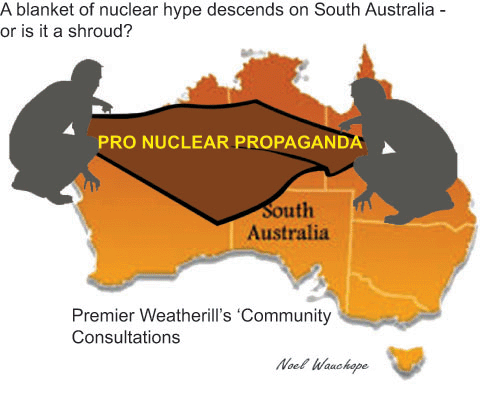
The Weatherill government continues to break South Australia’s law against tax-payer funding of promotion of nuclear waste importing. Of course, they’ve been doing this for nearly two years now, with close to $10 million on the Nuclear Fuel Chain Royal Commission, the Nuclear Citizens’ Juries and on the blanket of pro nuclear propaganda across the State.
The latest is A new conference called “Australian Nuclear Fuel Cycle ’16 – Managing Radioactive Waste & Spent Nuclear Fuel” , being held in Adelaide on November 15-16 to discuss nuclear waste storage prospects.
Sponsors include the University of South Australia (a public university), ANSTO (a Federal gov’t agency) and UCL (whose Australian campus was publicly supported financially).
Nuclear Waste Importing: latest comments for Citizens Jury on Your Say site
 The South Australian government set up this site for comments on the plan. Comments close at 5 pm today (30 October). I wonder if the Citizens Jury members will have managed to see them – the vast majority of comments were very negative about the plan Here are some of the most recent:
Claudio Pompili 28 Oct 2016
“Your Say” comment on Safety of Nuclear Waste Importing
Noel Wauchope 30 Oct 2016 I trust that the Nuclear Citizens’ jury has noted the fact that there are  only two situations under which any commercial nuclear reactor could ever be built.
The first is the situation for democracies , such as the United States. They set the pattern by passing the Price Anderson Act, ensuring that the tax-payer would cover the monumental costs of any serious accident.
The second is for totalitarian states such as China and Russia. Here the taxpayer pays for the whole lot, from nuclear construction to waste disposal.
If South Australia is foolish enough to set up a waste import and disposal industry, South Australia will be following the Russian and Chinese examples. Not being a private enterprise job, I guess they won’t need a Price Anderson Act. I do hope that the Citizens’ Jury members are aware of this.
“Your Say” comment on Trust in South Australia’s Nuclear Royal Commission
Trust – hmmm How can anyone trust a process that began with the charade of the Nuclear Fuel Chain Royal Commission South Australia?
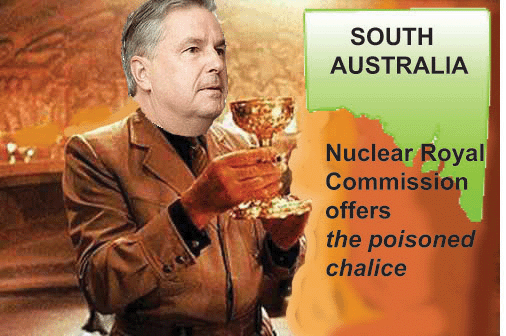 For a start – what a strange topic for a Royal Commission (RC) . RCs are called when there is an urgent problem, ?scandal to address.- child abuse, Aboriginal deaths in custody, detention of juveniles. I know of no other RC called to study a commercial enterprise. RCs are up until now, chaired by persons of legal knowledge and a legal background, generally retired judges. They are not chaired by military men. In this case, the Royal Commissioner Kevin Scarce is a person of defence industry background and clearly a previous promoter of the nuclear industry – clearly biased choice for a clearly unsuitable topic for a Royal Commission.
The Weatherill government then set up a State wide blanket of promotion, (despite the law prohibiting such spending taxpayers money on such a nuclear promnotion. Then set up the Citizens’ Jury process – designed to delay decision, and get some sort of claim to community support. The Citizens’ juries were given loaded questions, designed to prevent any verdict, and to produce a veneer of support. Some of the witnesses were poorly informed and biased, especially in the First Jury sessions, on the subject of ionising radiation and health.
At the very worst, the Juries are expected to produce a report that says “Further discussion is needed” and certainly, by the wording of their questions – not able to produce a “NO to Nuclear Dumping” answer.
The surprising factor in all this, is – as far as I can see, the Weatherill government, the nuclear lobby, and the shonky Nuclear RC have underestimated the intelligence of the jury members. The took it seriously, and asked inconvenient questions.
Your Say comment on Consent to Nuclear Waste Importing
 Noel Wauchope 30 Oct 2016 How on earth can consent be given to the plan to import and store and dispose of nuclear wastes when nobody knows where they will be put? Do we have the majority of South Australians, and of course the majority of Australians, too.l consenting too have nuclear wastes dumped on the land where only a minority live?
The only way that I can imagine consent ever being given for this is if that happens – and the minority is outvoted. Or perhaps the Aboriginal people can be expected to accept massive financial bribes? We all know damn well that if it’s to put not exactly on Aboriginal land, it will be put next door to Aboriginal land – with all the risks to land, groundwater, sacred sites involved in the transport of wastes etc. Well, bribing the Aborigines has been tried for over 20 years, for radioactive trash dumping on their land. It has never worked, and won’t work this time.
“Your Say” comment on Economics of Nuclear Waste Importing
 John Collins 30 Oct 2016
While, for me, the risks of irretrievable environmental disaster are paramount, the purported ‘economics’ are also relevant.
Firstly the RC Report states: “There is no existing market to ascertain the price a customer may be willing to pay for the permanent disposal of used fuel.” (p.93)
It goes on, “the baseline scenario assumes that 50 per cent of the accessible quantities of used fuel and intermediate level waste will be stored and disposed of in South Australian facilities” (p.292 – see also p.98 and p.298)
To assume that a start-up venture for what is made out to be a highly profitable, low-risk undertaking will be able to capture a 50% market share seems most unlikely noting that the report itself acknowledges; “(i)t should be underscored that there is significant potential for other countries to develop a domestic solution …” (p.97)
The RC Report states: “The modelling assumed the establishment of a reserve fund to provide for the costs of decommissioning, remediation of surface facilities, closure, back fill of underground facilities and the ongoing, post-closure monitoring phase.” (p.301) The report also acknowledges that; “(t)he consequences of human error and ‘normal’ accidents must be anticipated, expected and planned for in system design and operation.” (p.91) It appears that the costing for these eventualities (noting the life of the dump is “at least 10 000 years and up to a million years” (p.85) has not been taking into account.
It seems to me that at very best the figures are ‘rubbery’.
And again I would ask the basic test question, ‘if importing high level waste is so straightforward, safe and so very, very profitable why are no other countries (or Australian States or Territories) doing so already?’ Noting that ‘other countries’ that could consider such a project are entrepreneurial, technically advanced, and, most importantly, experienced in handling nuclear waste (unlike SA). Such countries include, China, USA, Russia and the Scandinavian and EU countries.
Another “Your Say” comment on Economics of Nuclear Waste Importing
It’s a pity that this radioactive trash import plan has not been knocked out on grounds of risks to health, damage to environment, disrespect of Aboriginal people, and importantly – on its real purpose – to save and promote the global nuclear industry.
At least the Nuclear Fuel Chain Royal Commission South Australia had to admit that there is no argument for nuclear waste importing actually benefiting the Nation’ or the State’s health, environment, or indigenous people.
 The Nuclear Fuel Chain Royal Commission had only one argument for the plan – that it would be an economic bonanza for South Australia. I could list the economic analysts who have destroyed that argument. But the well known Blind Freddie could see the economic flaws. South Australia is supposed to set up “interim” waste storage before the famous underground dump is built, – sort of using the money that will be paid for the dump to finance it – or some plan like that. South Australia has to spend $millions on the plan, for years before it gets any revenue. The planned revenue is entirely speculative, as there is no market for nuclear waste importing. If it goes ahead – any financial benefit will be decades away, yet South Australia needs economic development now, not decades later. If it were to go ahead, it could grind to a halt at any time – with changes in governments overseas, collapse of nuclear companies or untoward events, such as a disaster in the transport of the wastes. South Australia could well be left with expensive, dangerous, and useless Stranded Radioactive Trash.
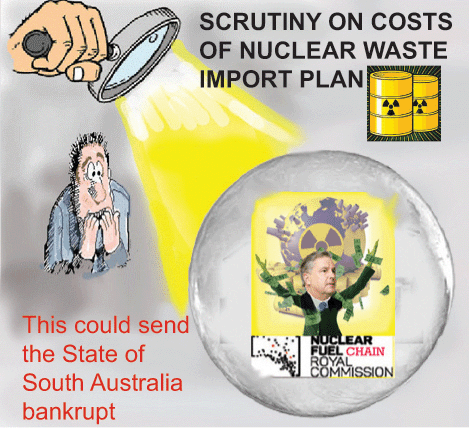
Meanwhile, other clean, and quicker alternatives – in renewable energy, energy efficient design for example, have been neglected while South Australia pursues this toxic dream – which has the very real potential to bankrupt the state.
Labor Party dithers in vote over nuclear waste dumping in South Australia
 Nuclear waste dump: Labor votes at SA convention to delay decision on proposal, ABC News By Daniel Keane, 29 Oct 16, “……Inside the conference, Mr Weatherill defended the decision to explore the nuclear option, but Labor MP Steph Key told the gathering of ministers, MPs and party members her constituents strongly opposed the idea.
“People in Ashford don’t favour a high-level nuclear waste dump,” she said.
“We think there needs to be a special convention so that we can talk about these issues in detail within the party, and see whether or not there is a social licence within the Labor Party first of all for such a thing.”
Frontbencher Peter Malinauskas used his speech to mock the demonstrators.
“We’re all here past lunchtime, unlike the protesters,” he said.
“The difference between us and them, of course, is that we take very seriously our obligation to make sure that our ideology is underpinned by evidence.”
But Labor voted to delay a decision on whether to pursue a nuclear dump until it holds a special convention, in line with Ms Key’s suggestion, at the end of the community consultation process.
Citizens’ jury hears from expert witnesses The party conference coincides with a royal commission citizens’ jury at the Adelaide Convention Centre, where about 350 randomly selected people are meeting this weekend to discuss the state’s possible involvement in the nuclear fuel cycle.
Mr Weatherill has previously been confronted by protesters over the issue, and was heckled on his way into a previous citizens’ jury. “I don’t know where this debate is ultimately going to end, either in the community or in this party,” he told the convention…..
The citizens’ jury is hearing from more than 30 experts witnesses over two days. A report prepared after the citizens’ jury meetings will be presented to Mr Weatherill next month.http://www.abc.net.au/news/2016-10-29/sa-nuclear-dump-decision-delayed-at-labor-state-conference/7977670
South Australian Premier Weatherill heckled by anti nuclear protestors
 Adam Langenberg, Political reporter, The Advertiser October 29, 2016 PREMIER Jay Weatherill and ALP colleagues were heckled by anti-nuclear protesters as he headed into the Labor State Convention in Adelaide today.
The Premier and Senator Penny Wong entered the venue amid cries of “nuclear waste, what a disgrace”, with a number of senior party ministers including Police Minister Peter Malinauskas also lobbied by protesters.
Eleven separate motions about a proposal to establish a nuclear waste dump in the state will be heard at the conference this afternoon, with many calling on Labor to immediately rule out establishing a dump.
……….More than 130 motions will be debated at the convention. http://www.adelaidenow.com.au/news/south-australia/jay-weatherill-colleagues-heckled-by-antinuclear-protesters-at-labor-state-convention-in-adelaide/news-story/93593b17164cba17c78cbaf6d856bb63
Delaying tactics on the nuclear waste agenda at South Australia’s Labor party Conference
 Treasurer defends SA dump debate Read more at http://www.9news.com.au/national/2016/10/28/12/18/treasurer-defends-sa-dump-debate#rpdClBGbUpWJ4umI.99 October 28, 2016 The Labor party is no different to a football club or a family barbecue when it comes to debating the merits of establishing a nuclear waste dump in South Australia, Treasurer Tom Koutsantonis says.
The issue will come under discussion at the party’s state convention on Saturday, with a number of motions to be debated, some calling for any plans for a dump to be scrapped and others buying the state government some time before having to make a decision. Mr Koutsantonis says the party is rightly engaged in the same discussion that mums and dads are having across South Australia, weighing up the pros and cons of taking high-level waste from overseas.
“People are just talking about what do we do next? Do we do this or don’t we do this? What are the risks, what are the rewards.
“So absolutely we should have this debate.”
Among motions to be debated at the convention, one calls for the government to hold a state referendum on the issue of a dump, others call for the government to delay any decision until after the issue is discussed at the next national ALP conference and one calls for a special state convention to be called.
There is also one that calls for the state government to “cease and desist” any further action to consider nuclear waste dumps of any kind.
Mr Koutsantonis acknowledged there were strong feelings within the party on the question of nuclear waste. “Our view, very simply is, we want to continue the debate,” he said. “The party is allowed to express its views, individuals are allowed to express their views.”
Also this weekend the second citizen’s jury will continue to deliberate on the dump proposal, which was raised as possibility by a royal commission conducted into SA’s future involvement in the nuclear fuel cycle.
The 350 people making up the jury will present their final report to Premier Jay Weatherill on Sunday.
The No Dump Alliance, which plans to stage a protest outside the convention on Saturday, said the ALP should “close the door on this deeply flawed and reckless plan”.
“Despite a huge amount of taxpayer-funded promotion, opposition to an international nuclear dump is growing within the Labor Party and the wider community,” spokesman Craig Wilkins said.

Will Australia become the global nuclear toilet? Events in Adelaide 29 October

Will Australia become the global nuclear toilet?, [corrected version] Noel Wauchope, 29 Oct 16 It’s not obvious to the rest of the nation, but this question is about to be advocated in two South Australian events, that will have repercussions for the whole of Australia. These are the second Nuclear Citizens’ Jury in Adelaide on October 29 and the South
Australian Labor Party Conference, also on October 29. The ALP conference is really the most important one, as Premier Weatherill will surely need the backing of his own party as he moves to the process of overturning South Australia’s law against nuclear waste importing.
Indeed, the Nuclear Citizens’ Jury is really irrelevant. Whatever decision it makes, is in no way binding on the government. And anyway, this so-called “Jury” of 350 persons cannot make a convincing decision. The brief given to them is worded, in terms that come straight from the Nuclear Fuel Cycle Royal Commission South Australia’s (NFCRC) report that advocated nuclear waste importing:
Under what circumstances, if any, could South Australia pursue the opportunity to store and dispose of nuclear waste from other countries?
I understand that some jurors wanted a change from this question, but no change was allowed.
The previous Citizens’ Jury had some very dubious witness presentations, particularly on the health effects of ionising radiation. This was not entirely the fault of the organisers, DemocracyCo, as the 50 jury members themselves selected the witnesses to be invited.
One might expect this second Citizens’ jury to be better served by witnesses, but the new witness list is a curiously mixed bag. Of the 31 names, 16 are likely to be supporters of nuclear waste importing, 11 opposing it, and 4 appear to be neutral.
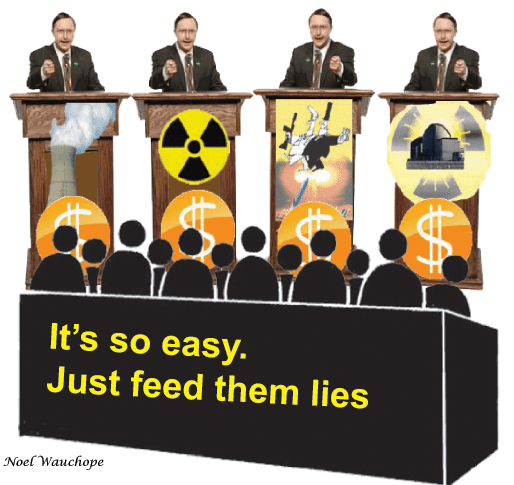 The most worrying section in this Citizens’ Jury is the session on SAFETY, dealing with general safety, siting and transport. For this session, there are 7 witnesses. Of these, only one witness, Dean Summers , appears to be anti nuclear, and one a neutral expert. This is Professor Sandy Steacy who knows all about earthquakes.
The witnesses are:
- Professor David Giles, of Minerals & Resources Engineering Future Industries Institute has all too strong a background in the mining industry.
- Dr John Loy: his theme is all about medical waste(an almost negligible component of Australia’s own Lucas Heights nuclear waste), and over-confidence on the safety of nuclear waste facilities. He has a background in promoting nuclear power to United Arab Emirates.
- Frank Boulton, General Manager WMC (Olympic Dam Marketing) Pty Ltd
- Dr AndrewHerczeg, formerly of the International Atomic Energy Agency
- Ian Hore-Lacy formerly of the Uranium Institute in Australia-he now works for the World Nuclear Association. Mr Hore-Lacy is unusual: he sees support for nuclear power as areligious and moral duty (He is also very critical of Pope Francis’ ideas on environment)
These pro nuclear experts have had much to say on storage of nuclear wastes. But none seems to have taken much interest in the issues around transporting highly radioactive wastes over thousands of kilometres across oceans and land. With the increasing volatility of weather events, as climate change progresses, and with the also growing concerns about terrorism, this omission is one of the greatest weaknesses of the case for importing nuclear wastes. The subject just glossed over in a few brief paragraphs in the NFCRC Report.
On the subject of SAFETY, focussing on the aspect of human health, one witness, Tony Hooker is a bit of a worry. He worked with Professor Pamela Sykes on her mouse studies, at Flinders University? Funded by America’s Department of Energy, Syke’s research purported to show that low dose radiation is actually good for you.
The 6 witnesss for this section are not evenly matched, with Dr Margaret Beavis and Dr Robert Hall opposing nuclear waste importing, and Dr Paul Degman, Dr Sami Hautakangas , Dr Stephan Bayer and Dr Tony Hooker likely to support it.
The vital section could well turn out to be ECONOMICS. And here, there IS a surprise, with an apparent bias towards the negative camp. Speakers Adjunct Professor Richard Blandy,Richard Dennis, Professor Barbara Pocock and Assoc. Professor Mark Diesendorf (via Skype) all have views opposing waste importation. The remaining speaker, Tim Johnson, from Jacobs, is supportive of the plan, but only cautiously so.
If economics were the only consideration, the waste import plan might conceivably die a quiet death, following this Citizens’ Jury, and a possibly negative report from a Parliamentary Inquiry. However, there are other considerations, such as underlying connections with the defence industry.
The South Australian Labor government, led by Premier Jay Weatherill, is enthusiastically backing the nuclear lobby’s campaign for setting up South Australia as the first place in the world to invite in the world’s nuclear waste, as a profit-making enterprise.
In practical terms, you can forget this government’s extravagant public relations promotion of the nuclear industry, culminating in these “Citizens’ Juries”. They really matter very little, in comparison with the actual steps to be taken for the pro nuclear campaign to succeed.
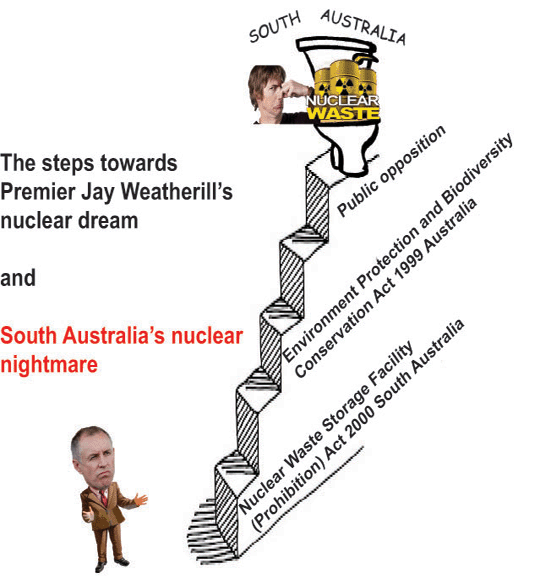 Step One is to overturn a South Australian law – the NuclearWaste Storage Facility (Prohibition) Act 2000. It includes:
8 Prohibition against construction or operation of nuclear waste storage facility
9 Prohibition against importation or transportation of nuclear waste for delivery to nuclear waste storage facility (The Act does have exemptions for the nuclear waste generated within Australia, e.g from Australia’s research reactor at Lucas Heights).
The government has already weakened this Act (In April 2016) by amending this provision:
13—No public money to be used to encourage or finance construction or operation of nuclear waste storage facility
(1) Despite any other Act or law to the contrary, no public money may be appropriated, expended or advanced to any person for the purpose of encouraging or financing any activity associated with the construction or operation of a nuclear waste storage facility in this State.
They had to change it quickly – to allow for financing community consultation or debate on the desirability or otherwise of constructing or operating a nuclear waste storage facility in this State. – seeing that they had already spent $7.2 million promoting nuclear waste storage, in the NFCRC
Anyway, prior to overturning this Act, Premier Weatherill is surely going to need to have the Labor Party onside. At last year’s ALP Conference, He and State Labor president Peter Malinauskas made a big push for South Australia going nuclear As the national ALP policy remains clearly opposed to all nuclear industry further development, we can expect that Weatherill will meet with some opposition to his nuclear plan from Labor members at the conference.
Perhaps the nuclear lobby, their captive South Australian Premier, and subservient national media, will not be able to press on with their plan without an unpleasant fracas.
Nuclear showdown for South Australia’s Labor Party Conference – perhaps
Steve Dale , Nuclear Fuel Watch South Australia Watch out, there is also a group trying to delay decision making about the dump for a few months. They say they are anti-dump but the agenda is probably to defuse maritime/transport/fire/.. unions anger over this crazy plan. These unions who will have to handle this poisonous muck are rightfully angry. They should kill this plan off on Saturday unless they want their workers killed by this cancer causing poison years later.https://www.facebook.com/groups/1021186047913052/permalink/1342858522412468/?comment_id=1342893619075625
 http://www.adelaidenow.com.au/news/south-australia/labor-readies-for-tense-nuclear-showdown-amid-opposition-at-state-meeting/news-story/94b465193620d74f489a1f0cd3fc6e40 Political Reporter Sheradyn Holderhead, The Advertiser October 27 2016
PREMIER Jay Weatherill faces a tense showdown over his Government’s nuclear strategy at a state Labor meeting this weekend.
Three motions have been listed for a vote that essentially call on the Government to abandon the proposed nuclear waste dump while others call for further consultation or a referendum. A joint motion from the Maritime and Rail, Tram and Bus unions demands the State Government “immediately cease and desist any further action or consideration” of any type of nuclear dump.
Among its concerns are a weak economic case, high upfront cost, political damage to Labor, safety risks to workers and the public, and ignoring the rights of Aboriginal people.
The moves make good on threats of a heated fight from powerful union figures who have publicly backed anti-dump campaigners. The Advertiser revealed last month that some within Labor were talking about a repeat of the union campaign against Mike Rann, which boiled over in 2010 when he needed a police escort through protesters at Labor’s state convention.
Anti-dump protesters are expected at the West Adelaide Football Club, which is the venue for Saturday’s meeting. Mr Weatherill declined to comment on the meeting.
The Government is pinning its hopes on an alternative motion that would buy time on a vote to overturn the longstanding party policy to oppose nuclear reactors and imported waste storage.
It instead calls for a Special State ALP Convention on the matter to be held at the conclusion of community consultation but before a decision was made on whether to develop a dump.
 Labor MP Tom Kenyon said he hoped the convention would show there was support within the party to continue investigating the $445 billion project, which he called a “tremendous opportunity” for SA.
Mr Kenyon, also a member of a parliamentary committee considering the project, said making it easier for other countries to have nuclear power could potentially do more to address climate change than efforts toward renewables.
He said while the party always “finds something to be excited about” at conventions this issue was unique.
“This is unusual because since the ‘70s, the Labor Party has had a very strong anti-nuclear position. It’s almost an article of faith,” Mr Kenyon said.
“At some point the party will have to grapple with this deeply and consider its position at the state and federal level.”
Health Services Union state secretary Jorge Navas, who also put forward a motion to reaffirm the existing policy of opposition to a dump said safety risks remained a significant concern.
He likened pursuit of the nuclear industry to asbestos.
“It was profitable but the consequences are devastating,” he said.
Port Augusta is attracting solar energy developers
Solar energy developers attracted to Port Augusta after power station’s closure, ABC, The World Today 25 Oct 16 By Khama Reid Solar energy developers are honing their attention on the South Australian city of Port Augusta after the community’s economy took a hit when its largest employer, Alinta Energy, closed its coal-fired power station.
For the past five years, the community has been pushing for a transition from coal to renewable energy, which is now steps closer to becoming reality.
Residents and those in the neighbouring city of Whyalla brag the region gets “300 days of sunshine” a year.
Port Augusta Mayor Sam Johnson said the tagline had become more than just a tourism slogan with solar companies getting serious about development in the region.
“Reach Solar have made an application to the State Government as recent as only a few weeks ago for a very real project here at Port Augusta using solar PV [photovoltaic],” Mr Johnson said.
“We know there’s Solastor and Solar Reserve both looking at large scale solar thermal technology, both in the vicinity of $1 billion projects.”
Mr Johnson said one of the further progressed proposals was for the DP Energy Renewable Energy Park to the south of the city.
“DP Energy actually has planning approval and will be the largest wind and solar PV farm in Australia and actually the first to have not just wind but solar PV technology as well.”
Queensland and SA ‘real hot markets’ for solar
Renew Economy editor Giles Parkinson said the spike in interest was not surprising. “There’s two real hot markets for solar at the moment, that’s Queensland and South Australia and in South Australia around the Port Augusta/Whyalla area and that comes from two things,” Mr Parkinson said.
“One is the excellent sunshine, but also the high wholesale electricity prices.
“They rely so much on gas to set the price of generation, and the price of gas has gone up, so the wholesale price has gone up as well.”
Mr Parkinson said solar was becoming a more affordable investment option.
“I guess the overwhelming driver is the reduction in costs of solar PV, it’s actually falling to a point where it can actually compete with wind energy.”
He said the Australian Renewable Energy Agency (ARENA) previously funded wind farm developments, but in its latest round awarded more than $91 million to solar photovoltaic projects across the country……http://www.abc.net.au/news/2016-10-25/solar-energy-developers-flock-to-port-augusta/7962306
Could there EVER be an ethical argument for Australia to import nuclear wastes?
If indeed, the waste importing idea were conditional on a Japanese plan to close down the industry, and help Japan overcome its very serious dilemma, this could be one big move towards halting the global nuclear industry juggernaut, with its undoubted connection to nuclear weapons. Japan could pay a reasonable amount to the waste host country, without being ripped off, without that country expecting to become mega wealthy. That would be one circumstance in which it would be an ethical choice for South Australia to import and dispose of nuclear waste.
“Pie in the sky!” I hear your cry.
Yes, sadly so. Is there any chance that such an ethical decision would ever be made? I doubt it. The Nuclear Citizens’ Jury is left with the question of whether or not to support the NFCRC’s plan for a nuclear waste bonanza, or to risk possible State bankruptcy in the event of it all going wrong. http://www.onlineopinion.com.au/view.asp?article=18603
Nuclear Citizens’ Jury: an ethical case for importing nuclear wastes, Online Opinion, Noel Wauchope, 25 Oct 16 The South Australian government will call another Nuclear Citizens’ Jury, on October 29 – 30. This time the jury must answer this question:
Under what circumstances, if any, could South Australia pursue the opportunity to store and dispose of nuclear waste from other countries?
That set me thinking. The main “circumstance” for recommending this “opportunity” is the State Government’s plan to eventually bring in a pot of gold for the State. There really is no other argument for this project in the Report. In the 320 page report any arguments about Aboriginal issues, safety, environment, health, are aimed at rebutting criticism of the plan. They provide no argument on the plan actually improving health or environment, and are in fact quite defensive about Aboriginal impacts. Continue reading
Confusion in the wording of the South Australia Nuclear Citizens’ Jury question
 The question has been worded in two different ways in the Juror’s materials. The two versions were:
(1) Under what circumstances, if any, should SA pursue the storage and disposal of high level nuclear waste from other countries?
(2) Under what circumstances, if any, should South Australia pursue the opportunity to store and dispose of nuclear waste from other countries?
Differences are (1) inclusion of the word “opportunity” in second version and (2) removal of the words “high level” in the second version.
1 This month.
20 September –National Day of Action in Melbourne on the International Day of Peace


Help Aunty Sue Protect Her Land and Sacred Sites From Destructive Rocket Testing.
.

Australians deserve the truth
about
AUKUS – https://aukuspublicinquiry.com/


PETITION – To: Prime Minister Anthony Albanese and the Australian Labor Government

of the week – Australians for War Powers Reform (AWPR)
To see nuclear-related stories in greater depth and intensity
 Antinuclear
I was shocked to read in 26 October’s InDaily:
Jay spruiks nuclear expansion as an agent of economic change
Jay Weatherill has told a nuclear industry forum in Adelaide he is personally convinced of the potential for an expansion of South Australia’s role in the fuel cycle, framing the push as part of his ambition to forge a “new economy”.
It appears that Premiere Weatherill has at last come out and played his pro-nuke card. So much for his publicly-avowed position that he would make up his mind when the whole process of the RC has been undertaken. It’s patently clear that he’s been captured by the nuclear industry and foisted an expensive sham of a royal commission onto the SA public, which overwhelmingly has repeatedly been opposed to expansion of nuclear in this state.
The Royal Commission process and the biased ‘findings’ of its subsequent Report are deeply flawed on a range of issues from the dubious economics right through to the non-existent risk assessment. No project of this magnitude, scope, cost and risks into the far-distant future, should be entertained without a comprehensive Risk Assessment Plan. The Report does not meet the criterion in the Terms of Reference to present “the risks and opportunities associated with establishing and operating those facilities” It does present the supposed opportunities but dismisses the risks and assures us that risk assessments will be done in due course. Continue reading →