
 Some comments on Weatherill’s article .( Jay Weatherill: South Australia can learn valuable lessons from nuclear waste facility at Eurajoki, Finland)
Brett Stokes calls out South Australian govt on its illegal promotion of nuclear waste importation
Brett Burnard Stokes shared Your Say Nuclear‘s photo.
We have laws, good laws, that are being subverted.
These laws are the embodiment of the will of the people.
I have asked many times why this propaganda exercise is omitting the facts about South Australian law and the prohibition of nuclear waste importation into South Australia.
I have pointed out the deception involved in pretending to be objective while omitting the facts about current law and the penalties per offence of ten years jail and huge fines.
I ask again for an end to this waste of time and money.
I call again for investigation and prosecution of the perpetrators.
(copy of my comment at Your Say Nuclear facebook page run by Dept Premier and Cabinet)
politicians blame renewable energy for blackout – though none can say HOW!
 Politicians blame wind power for taking out electrical grid in South Australia, Mashable, BY ANDREW FREEDMAN , 30 Sep 16 In the wake of an unprecedented blackout that cut off an entire Australian state from electricity on Wednesday into Thursday, some politicians are vilifying renewable power sources, particularly wind turbines.
Considering the rapid rise in renewables around the world, including the U.S., the political fight that has broken out in Australia is not an issue limited to one nation. In fact, it could foreshadow future fights if blackouts occur in the U.S. or Europe, two areas where renewable energy use has increased recently……..
However, ElectraNet, which owns transmission lines in South Australia, said the severe storm — which included powerful winds and tens of thousands of cloud-to-ground lightning strikes, damaged three out of the four transmission lines that connect Adelaide with northern parts of South Australia.
None of the politicians have proposed an explaination for how wind turbines could’ve caused such a widespread outage, a first in Australia’s history, whereas ElectraNet has done so.…….
Prime Minister Malcolm Turnbull told reporters that the state’s aggressive push into renewables may have contributed to the unprecedented statewide blackout.
A federal inquiry is likely to be launched into the cause of the more than 24-hour blackout, which may settle some of the debate going on now. Officials in states with a high reliance on wind power, such as Texas, will be closely watching the developments Down Under. http://mashable.com/2016/09/29/south-australia-blackout-wind-power/#KFHs2CKfmiqG
South Australia’s nuclear dump plan – fool’s gold? – senior Liberal MP
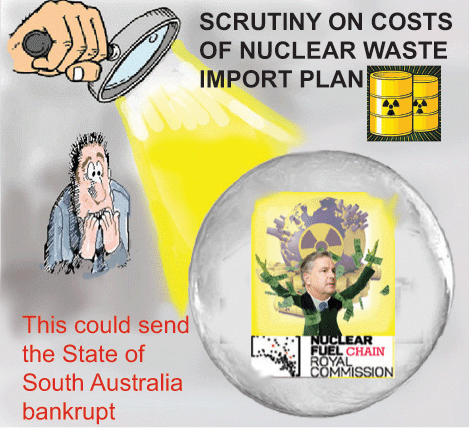 SA nuclear dump dreams just fool’s gold: senior Lib, The Australian, September 29, 2016, byMichael Owen http://www.theaustralian.com.au/national-affairs/state-politics/sa-nuclear-dump-dreams-just-fools-gold-senior-lib/news-story/a595649777c14703159a462c5d9cb34f
A senior Liberal has broken ranks in what had been a bipartisan approach to inquire into the potential for South Australia to host a repository for the world’s high-level nuclear waste, warning that taxpayers risked wasting money “on fool’s gold”.
Rob Lucas, a former state treasurer and the opposition’s Treasury spokesman, told parliament that intense political pressures would make it near impossible for there to be the required bipartisan support at both federal and state level for the necessary legislative changes to allow such a facility.
Mr Lucas, a member of parliament’s joint committee on the findings of the Nuclear Fuel Cycle Royal Commission, also cast doubt on the potential economic benefits, warning it was not possible to verify “some of the financial estimates in terms of what the state might earn from this facility”.
The Scarce royal commission’s final report, delivered in May, found that building a nuclear waste dump in South Australia could bring in an extra $100 billion over 120 years.
South Australian Premier Jay Weatherill — who faces resistance from federal Labor and his own Left faction — has said cabinet would make a decision in November as to whether to progress the proposal, after extensive community consultation. Latest opinion polls show South Australians almost equally divided on the issue.
Last night, Mr Weatherill, who returned this week from touring the world’s first permanent nuclear waste storage facility in Finland, told The Australian he understood the complexities. “I do agree that this issue poses challenges, not the least for my party, but I feel duty bound to act in South Australia’s and the national interest in progressing this debate,” he said.
Mr Lucas said it would be a “courageous Liberal candidate or member in a federal campaign who would be out there campaigning hard to support Premier Weatherill on a nuclear waste dump or facility’’ in his state.
“At an upcoming federal election … (there will be) federal Labor candidates campaigning in South Australia against a nuclear waste facility in South Australia and potentially candidates from the Greens and the Nick Xenophon Team campaigning against a nuclear waste dump or facility (there). If there is not going to be the support of the federal Labor Party, then we, the taxpayers of South Australia, will be spending tens and maybe hundreds of millions of dollars on fool’s gold — fool’s uranium, fool’s nuclear waste dumps.”
South Australia’s electricity blackout was caused by extreme weather, not by renewables – energy experts
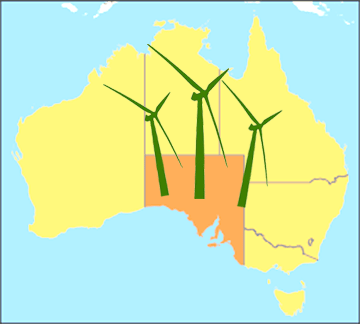 SA weather: No link between blackout and renewable energy, experts say, ABC News, 29 Sep 16 By political reporter Matthew Doran Linking the statewide blackout in South Australia with the state’s heavy reliance on renewable energy is unfounded, energy industry experts say.
Key points:
- South Australia has the highest rate of renewable energy in Australia
- The ‘one in a 50 year’ weather event ‘couldn’t have been prevented or foreseen’
- SA to be an example for other states and territories when planning for significant weather events
A severe storm caused the entire state to go dark yesterday afternoon, following serious damage to more than 20 transmission lines.
That infrastructure failure put extra strain on the interconnector system that links the South Australian electricity grid with the east coast — and tripped safeguards which shut down the power supply to the state………
Mr Frydenberg highlighted the underlying cause of the blackout was the weather.
South Australia has the highest rate of renewable energy in the country, with a fraction over 40 per cent of the state’s power supply generated from sources such as wind and solar farms.
Earlier this week, the Grattan Institute released a report detailing the pressure high uptake in renewables had put on the state’s wholesale power prices, and how it was being viewed as a test case for the rest of the nation. But the report’s author, Tony Wood, said the blackout was as a result of a particularly violent storm and it was usual for a system to shut down to protect itself from further damage. “My understanding, at least at the moment, is there’s no evidence to suggest these two issues are related,” Mr Wood said.
“There’s no evidence to suggest this was caused by too much wind power, or the dependence on wind power, or anything else, or would’ve been any different if any of the power stations that had been shut down earlier this year had still been operating.
“If you’ve got a wind farm or a coal-fired power station at the end of a transmission line, and that system either is taken out by a storm or is forced to shut down to protect itself from a storm, it doesn’t matter what the energy source is.”
There are two interconnector power lines between South Australia and the eastern states, but Mr Wood said there was no indication having more links would have prevented the issue.
“When this event has occurred, it’s created a fault in the system which has caused the generation to trip offline,” the Clean Energy Council’s Tom Butler said.
“It’s separate to the interconnector entirely.
“This is a one-in-a-50 year, almost-unprecedented event for the state that couldn’t have been prevented or foreseen.”
Mr Butler said the Snowtown wind farm, north of Adelaide, was actually helping to prop up the state’s power supply ahead of gas power stations as the network was gradually brought back online.
Labor’s assistant spokesman for climate change, Pat Conroy, told AM it was premature to link the blackout to renewables.
“The South Australian Government has made the point that even if the coal-fired power station that was recently closed down was still operating, it would not have been able to supply power to the state,” he said.“This was a failure of the transmission network, and it didn’t matter what sort of fuel was feeding into the grid, power was not able to flow……..http://www.abc.net.au/news/2016-09-29/sa-weather:-no-link-between-blackout-and-renewables-expert-says/7887052
Should Australia invest in importing nuclear waste, with nuclear industry in decline?
 In summary, the branding of nuclear as ‘green’ is fallacious
To invest in an industry that is in global decline, does not appear to be as rational as investing in a growth area such as renewable energy. Renewable energy is a business space where Australia has a multitude of trained engineers, existing infrastructure, and an abundance of sunshine. Building intentional renewable overcapacity in Australia will potentially be a wise investment, as that surplus can then be used to generate hydrogen or other fuels that can be liquefied and traded on overseas markets.
Nuclear power – Game over – Derek Abbott, October 2016, “……..Renewables vs. nuclear While nuclear power plants experience economic decline, renewables are rapidly growing and penetrating the market on an exponential curve. The global annual increase in renewable generation for 2015 alone was 50 GW for solar panels, 63 GW for wind power, and 28 GW for hydropower.26
Nuclear power is large and centralised, with enormous entry and exit costs. By contrast, renewables are made up of small modular units that yield a faster return on investment. The revolution we are witnessing is akin to the extinction of big powerful dinosaurs versus resilient swarms of small ants working in cooperation.
Nuclear power is sinking under the weight of its complexity, costs, and the headache of its waste issue. On the other hand solar power is brought to us via free sunshine exposing the promises of nuclear as mere moonshine………
What really matters is rate of carbon footprint reduction Continue reading
Long delay for money in for South Australia’s Temporary Nuclear Waste Storage facility
David Salomon, Nuclear Fuel Cycle Watch South Australia, 30 Sept 16
Did you know: This calls for $2.4b up front investment for infrastructure, ie port and temporary storage facilities, electricity supply etc. Yes, the plan includes temporary storage facility with first receipts after 8 years on the “aggressive” time line, 11 years on the baseline scenario. A long time and a lot can happen.
At any election during this time approval for the project could be overturned by either state or federal governments as happened with the Yucca Mountain Repository in the USA after being approved in 2002 and funding withdrawn in 2011. Were there to be another Chernobyl or Fukushima that leads to shut down of existing nuclear power stations the demand for the waste facility would be restricted to existing not projected waste. The business plan fall apart.
The fact that the only new reactors are planned by non market economy countries. Business seems not to be interested in building new power plants without massive public subsidy. In the UK this means guaranteeing double the market price for the power supplied. You need very deep pockets to be engaged in the nuclear industry. Could it be that South Australia is in danger of exhausting itself financially and politically on going for the one big prise on the horizon that is actually a mirage when you get closer. We do have a history of doing that in the past. Would it not make better business sense to invest in renewables and ride that wave for the next 25 years or so, or is it that we can see what is right in front of us. We are already at 40% renewables, a manufacturing workforce itching for something to do and in need of greater independence in power supply.
I know that there are people who think about renewables like Bill Gates did in the early days of the internet when he said, “the internet was a novelty that would give way to something better”, though I do believe this sentiment does apply to the waste dump proposal. (BTW I don’t know if Bill likes renewables or what his attitude to Nuclear fuel is, just that people of high status can say some dumb things.)
Check out the outgoings references in this report: https://antinuclear.net/2016/05/06/major-financial-risks-for-south-australia-are-ignored-by-nuclear-fuel-cycle-royal-commission/
I think you’ll find the financial analysis in the Royal Commission somewhat lacking. https://www.facebook.com/groups/1021186047913052/
A new political low: Politicians use S.A. blackout to attack renewable eneregy
 Is this a new low: politicians using a natural disaster to push a fact-free agenda?, Guardian, Matt Grudnoff, 29 Sept 16
Unburdened by evidence, anti-wind campaigners used the South Australian blackout to kick off a debate about renewables while others waited for facts Normally natural disasters are off limits to politicking, at least in the period straight after the event. So it was pretty awful watching politicians and commentators pushing their anti-renewables message on the back of aonce in 50 year storm that hit South Australia and knocked out the electricity grid.
These baseless claims led bulletins despite energy industry experts, upon actual analysis of the situation, reporting that there was no evidence that renewables are in any way linked to the power outage.
The outage is more likely to have something to do with the 80,000 lightning strikes and the winds that knocked over 22 transmission poles. Who knew violent storms could knock the power out?
It’s hard to imagine how coal fired power would have remained on without a grid for the electricity to flow through.
Just before the grid shut down, renewables were not offline. Wind energy was busy producing almost 1,000 Megawatts of electricity. The problem was not a lack of renewable power but a storm-ravaged grid that couldn’t get it to the consumers…….
Resilient renewables
The real irony is that an electricity system that has decentralised renewable energy with battery storage would be more resilient to these kinds of storms. Houses and businesses with their own batteries could have kept the lights on even when the grid went down.
In the past, renewables were more expensive – but those days are over.Renewable energy has fallen in price and battery storage is close behind. Change in how we produce electricity is coming and an anti-renewables campaign will only slow it and make the transition more difficult.
Rather than attack renewables, the government should be putting in place policies that help with the transition. The economics of renewable energy and the reality of climate change mean that it is inevitable that we will leave fossil fuel electricity generation behind. The question is how can we move to the new energy future in the smoothest way possible?
Renewable energy targets, system changes that make it easier to install battery storage, and a moratorium on new coal mines will all help.
Attacking renewables in the wake of a massive storm might help some people’s political agenda but it will do nothing to help South Australians build a reliable and resilient energy system.
Matt Grudnoff is the Senior Economist for The Australia Institute. https://www.theguardian.com/commentisfree/2016/sep/29/is-this-a-new-low-politicians-using-a-natural-disaster-to-push-a-fact-free-agenda?CMP=soc_568
Premier Weatherill either dishonest or ignorant, about Finland’s nuclear waste dump plan
Finland’s false hope for Australia’s nuclear future Independent Australia, 26 September 2016 Premier Weatherill is using Finland’s nuclear waste dump model as a benchmark for Australia but they are not comparable, says Noel Wauchope.
SOUTH AUSTRALIAN PREMIERJay Weatherill has gone to Finland to study their nuclear waste storage project.
With the premier are three stalwarts of the mining and nuclear lobbies: marketing man Bill Muirhead, chief executive of the Nuclear Fuel Cycle Consultation and Response Agency (CARA) Advisory Board Madeleine Richardson and chair of CARA John Mansfield.
Unsurprisingly, they all seemed to have no anxieties about nuclear waste disposal.
 Premier Weatherill waxed lyrical in The Advertiser about the Finland waste disposal site, describing it in operation:
There, spent nuclear fuel is placed in eight metre long iron canisters, encased in copper tubes … Inside the underground tunnels, the canisters are placed in deep holes.
Reading this, you would think that is actually happening in Finland. But no — that’s just the plan. The facility, in fact, has no nuclear wastes yet disposed of there. In fact, no wastes will be placed there until 2020, at the earliest.
Weatherill’s comments imply that the Finland project and the South Australian plan are pretty much the same kind of thing. Well, apart from some rather obvious differences in climate, which might matter, the whole plan is different.
South Australia’s nuclear waste import plan would need a dump substiantially larger than Finland’s waste dump:……..
Just for high level nuclear waste alone, it will require a waste dump 14 to 28 times the size of Onkalo (69,000 high level nuclear waste canisters). And for decades, half of the high level nuclear waste will be stored above ground in a temporary facility.
A perhaps even bigger deception is in Weatherill’s main theme, praising Finland for its transparency and community consent, since that is a subject of considerable dispute. ……
Sweden has the Swedish NGO Office for Nuclear Waste Review. It is a coalition comprising five NGOs working with nuclear and radiation safety issues, advising the Government and informing the public. The coalition is financed by the Government’s Swedish Nuclear Waste Fund.
Finland has no such agency. That might account for the relative ease with which the Finnish nuclear industry gained public acceptance for the plan with no substantial criticism from the public. In Sweden, the nuclear waste burial project has not gone ahead, as there is much debate and opposition from some scientists and from a well-informed public.
Representatives from municipalities near the Finland repository construction site, Johanna Huhtala and Raija Lehtorinne, explained:
‘ … the locals trust the nuclear industry completely.’
I guess that the Finnish model for community consent is more to Weatherill’s liking than the Swedish one. I can’t see him setting up a South Australian NGO office for nuclear waste review. https://independentaustralia.net/politics/politics-display/finlands-false-hope-for-australias-nuclear-future,9518
Premier Weatherill in Finland; predicts nuclear waste as an election issue for South Australia in 2018
Weatherill hints at following suit on nuclear waste, MICHAEL OWEN, THE AUSTRALIAN September 20, 2016
Talks with countries looking to export their nuclear waste to Australia for permanent storage will begin next year if the South Australian Labor government decides to proceed with a bold plan to build a dump in the state to house high-level spent nuclear fuel.
Premier Jay Weatherill yesterday toured the site of the world’s first permanent disposal facility for nuclear waste in the Eurajoki region of southern Finland and gave every indication South Australia’s government would give the green light to follow suit…….
Under Finnish law, all nuclear waste the country generates must be handled and permanently stored in Finland.
However, its parliament has ruled out taking waste from other countries.
Mr Weatherill acknowledged Finland’s facility was a direct response to the problem of its own high-level waste, a problem his state did not have. However, he said, there was an economic opportunity for South Australia, which could safely store the world’s most toxic nuclear waste deep underground……..
“One thing that is really clear is that this is a long journey and that there will be a series of steps that the community will have to take before any final decision is taken,” Mr Weatherill said, noting it could be at least 10 to 20 years before construction started on a facility.
- Mr Weatherill said Posiva was prepared to license its expertise to countries such as Australia…
The state government is conducting a final round of community consultation before cabinet decides in November if to move forward with plans for a facility.
Mr Weatherill indicated a facility for high-level international nuclear waste would be an election issue in March 2018.
“It needs bipartisan support and a state government that is prepared to advance it,” he said. http://www.theaustralian.com.au/national-affairs/state-politics/weatherill-hints-at-following-suit-on-nuclear-waste/news-story/05a36a8bb24610eec0e4ec0c2138b222?from=public_rss
Risky plan for thousands of shiploads of radioactive trash to South Australia
Derek Abbott, No High Level Nuclear Waste Dump in South Australia, 27 Sept 16, To fulfil the economic analysis of the Royal Commission report, SA’s dump will have to receive a shipload of
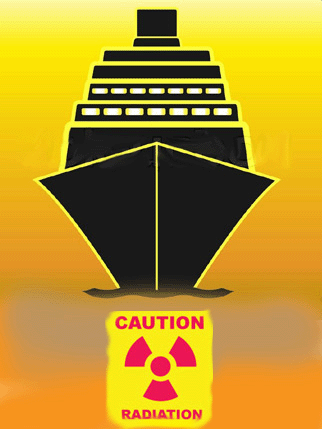 waste once every THREE weeks for the life time of the dump.
Hmmmm…..
I think the Commission hasn’t thought through how unrealistic that workflow will be to manage and how many double hulled ships will have to be purpose built for this. They haven’t thought through how many contract guarantees they are going to need to get that kind of volume. They haven’t thought through the tendency of the nuclear industry to defer costs, and possibly renege on those contracts.
When they don’t even have the sniff of even one contract yet, this is all highly risky. https://www.facebook.com/groups/1314655315214929/
Canberra travellers learn of South Australian Aboriginals’ fight against nuclear waste dumping
MAGALI MCDUFFIE http://www.magalimcduffie.com/travels/2016/9/26/south-australia-no-nuclear-dump Over two years ago, my partner Alexander Hayes met Bruce Hammond, of the Tanganekald & Western Arrente people, South Australia, who brought to his awareness the ongoing struggles and challenges that his people and other Aboriginal communities face, particularly in light of the South Australian proposal for a nuclear waste dump in the Flinders Ranges. With over three months of logistics and planning, and at Bruce’s invitation, Alex and myself will be travelling through many different communities in South Australia, listening to the voices of people on country, who have not been consulted by the government in an appropriate manner.
So on September 24th we started our journey from Canberra to South Australia.
Our road trip took us through Wagga-Wagga, the Hay Plains, Benanee Lake, Balranald, Mildura, finally arriving in Adelaide on the morning of the 26th. On 26 September, 2016 we had the pleasure of meeting  and interviewing Karina Lester, Co-Manager and Aboriginal Language Worker at Mobile-Language Team, at the University of Adelaide. Karina is the daughter of well-known Yankunytjatjara Elder and Activist Yami Lester, who was blinded by the ‘black mist’ from the first Atomic Test Bomb at Emu Junction, South Australia.
Karina told us that the idea of a nuclear waste dump in South Australia is not new – her grand-mother and her family successfully fought against it back in the 1990s. But now it is on the agenda again, and Aboriginal communities whose land the nuclear dump would be built on are not being properly consulted. Even though the South Australian government is sending representatives to a hundred different communities, under the guise of consultation (Get to Know Nuclear), they are not engaging language experts and interpreters to communicate directly and effectively with these communities. Aboriginal people are therefore not getting all the information on the nuclear waste project, thereby contravening the United Nations Declaration on the Rights of Indigenous Peoples on Free, Prior and Informed Consent. Continue reading
South Australian government’s barrage of pro nuclear advertising – making the unthinkable “normal”
“Perhaps the barrage of pro-nuclear forces/strategies explains why there’s no explosion of outrage either in South Australian society or in church and faith groups against this extraordinarily destructive scheme.”
 The normalisation of destruction in SA nuclear plan, Eureka Street. Michele Madigan | 22 September 2016 On Friday 26 August in Adelaide, Yankunyjatjara Elder Edie Nyimpula King was awarded the 2016 Perpetual Trophy of the prestigious Gladys Elphick Awards for her decades of work ‘in standing up for culture, country and community’.
On Saturday 3 September, in Port Augusta, Edie was keeping up the struggle, singing again the Seven Sisters inma, strong in its demands for a clean country and protection for the future generations.
Unable then to stop the flow of tears, she paid tribute to her former companions’ heroic struggles. ‘Ivy Makinti Stewart, Kampakuta — Eileen Brown, Eileen Unkari Crombie’ amid all the other heroes — the brave fighters for country and the future generations against the nuclear industry and its proponents in South Australia; women who had immortalised that inma in the same obedient re-enactment of the Seven Sisters and their demands to care for country.
Its cry: Irati Wanti — leave the poison! Have nothing to do with it! No radioactive waste dump in our country!
But why is such responsibility for country and the health of its people — forever — so hard? And ongoing! Why is the destruction of country — its lands and waters and huge risks to the future generations — forever allowed to be normalised?
Indeed how to explain the current normalisation of the new threat — of importing high-level radioactive waste across the Southern Hemisphere oceans and its dumping onto the lands of South Australia. And this with the seemingly full permission of a government and perhaps a peoples, both of whom will be long gone in the ‘hundreds of thousands of years’ which the nuclear royal commission itself admits such material must be isolated.
Poll results during the third week of September revealed that 50 per cent of those polled agree to welcome such waste with 35 per cent against and 15 per cent undecided.
Of course the full throttled media campaign must take credit for much of this.
Recently the Adelaide Advertiser had a front page story entitled ‘Nuke fear for kids’. The heading would surely lead one to believe that (surprisingly) SA’s only daily paper had a front page article about the substantial risk that the proposed importation of international high-level radioactive waste will be for the present and future generations of South Australian children.
But no — further reading made clear that the ‘fear’ was the effect ‘noisy protestors’ would have on the 150 high school children who had been chosen to meet with the former nuclear Royal Commissioner Scarce. Hence the venue was to be secret.
There seems little expense spared either at the importation of experts like Geraldine Thomas, who spoke  at the Hawke Institute at the University of South Australia on 16 September on the risks of radiation. Were many of her audience relieved to hear that, well, no, there is actually little risk? In that jolly English way reminiscent of one of the English experts in the government ‘consultations’ also being conducted across the state, she explained that the problems of the people of Fukushima were mainly psychological.
Proposed is a forever risk-laden project of ships travelling to a yet unnamed Australian port every 24 to 30 days with the world’s highest level nuclear waste. Then dumping/storing the casks perhaps five or ten kilometres away for some decades until funds are available to build a ‘safe’ depository — something that has not yet been possible anywhere in the world including countries with decades of nuclear expertise.
Perhaps the barrage of pro-nuclear forces/strategies explains why there’s no explosion of outrage either in South Australian society or in church and faith groups against this extraordinarily destructive scheme. Much less in Australian society in general.
Or perhaps theologian Brendan Lovettt names it.
‘If there is a typically bourgeois virtue it must be the cult of moderation. The extreme is to be abhorred; it is a matter of unseemly exaggeration. We cannot bear too much reality. the world is to be thought of as a place where comfortable mediocrity rules, where everything is under control and there is nothing to be horrified about, either in ourselves or in the world. This is our necessary lie. What we deny under our veneer of a smoothly reasonable world are the real dimensions of life and history. Understandably we project a God who will be compatible with this comforting view of life and history.’
What we are resisting, he concludes, is our own responsibility for the world.
On 3 September, the 25 year old Kumana Karen Crombie, now herself mother of two, danced with veterans, Betty Ngangala Muffler and Dianne Pinku Edwards, to Edie Nyimpula’s singing, to herald the new generation taking up responsibility for country and its peoples.
What will it take for the rest of us to take up our own responsibility.
Michele Madigan is a Sister of St Joseph who has spent the past 38 years working with Aboriginal people in remote areas of South Australia and in Adelaide. Her work has included advocacy and support for senior Aboriginal women of Coober Pedy in their campaign against the proposed national radioactive dump. https://www.eurekastreet.com.au/article.aspx?aeid=49962#.V-9UG4h97Gg
Adelaide Advertiser’s nauseous sycophantic account of Premier Weatherill’s nuclear jaunt to Finland
 I knew that The Advertiser was the mouthpiece of the nuclear lobby, anyway, but their latest effort was really sick-making. A rave which portrays Premier Weatherill as some kind of democratic champion, and which is pushing the soft sell that the decision on nuclear waste importing will not happen soon, but be dragged on for years. (They don’t say this, but in the interim, the nuke lobby has time to get secret arrangements made – and money lent to South Australia, so that ultimately, it might all be just too committed to turn back.)
A Premier with any spine might make a decision, a soon decision, and a wise one, to say no to the whole noxious scheme, – send home the business lobbyists and the propaganda spruikers like Geraldine Thomas, put the lid on the shonky Nuclear Royal Commission’s biased report, stop the silly nuke spinning Forums, and get on with running South Australia properly. Such an opportunity that State has, as a world leader in renewable energy!
Lack of trust more toxic than nuclear dump notion: Daniel Wills, The Advertiser September 23, 2016 “South Australia is still at the stage where it needs reassurance about the science, as well as the competency and motivations of a government that would oversee its administration.
No site has been selected to house the world’s high-level international waste for profit, should the state choose to build one, nor any explanation of how one would be picked. The State Government is yet to overturn laws that ban public money being spent on investigating the establishment of a nuclear dump or even to pick up the phone to ask places like Japan what they would pay…….
 The Finnish operators say they would jump at the chance to form an alliance with SA to build a dump here…..
Mr Weatherill is likely to confirm before Christmas that the Government will begin the serious work of developing a robust business case…….
Expect the Government to seek money from overseas to undertake a major geological survey that rules out places too unsafe for disposal to occur. At a cost of up to $1 billion, this is too expensive for SA to fund itself, but could have the benefit of doubling as a discovery tool for new mining deposits.
From there, it is likely the offer will be thrown open to communities to show an interest, and estimates made of what they could receive. Even on the most extremely rapid timeline, that point is unlikely to have been reached by the time voters head to the polls in March 2018.
This project is multi-generational, with a point of no return years away. But it is a doubtful and open question as to whether our politics are up to the job…….Mr Weatherill has framed this as a great test of our democracy’s ability to consider difficult questions and come to wise solutions. … http://www.adelaidenow.com.au/news/opinion/lack-of-trust-more-toxic-than-nuclear-dump-notion-daniel-wills/news-story/e927e455e6f244f35a8b6743bc791adb
We shouldn’t be the world’s nuclear dump, says Councillor Lynton Vomow
We shouldn’t be the world’s nuclear dump, Adelaide Hills Herald News. By Councillor Lynton Vomow, Lobethal 23 Sep 16, You may have recently had a say at one of the Nuclear Waste Dump forums being held around the state. My biggest concern, however, being the prevention of an accident at sea and the loss of highly radioactive nuclear waste into the ocean, was not satisfactorily explained .
Indeed the attendant basically said that we could not guarantee against such a disastrous event, it could be impossible to retrieve every container of waste and modelling is showing it wouldn’t actually be that bad! Fish and all creatures of the ocean for hundreds of miles around the lost radioactive waste material would be devastatingly affected.
Did you know that medium or high level (depending on whether it’s France or Australia describing it) nuclear rubbish was brought to Australia, in December just last year, in a rust bucket that had failed three safety inspections in five years?
Can you imagine what could happen if we were to receive dozens of shipments? Can we be guaranteed the waste will make it here safely, every single time?
Some are saying that low level waste is non hazardous, so then why not store it near its source i.e Sydney, and save the fuel costs of transporting it?
Basically a low level waste dump would be coming here to soften us up for a high level dump.
There is a need to have safe repositories for the waste, somewhere, but it will have to be near its usage location.
Countries ought to be looking at phasing out nuclear power so that there is as little waste as possible.
How long does nuclear waste last anyway? Can you imagine two hundred years? Ten times that then takes us back to the birth of Christ. Ten times all of that now takes us back to just before the last ice age, 20,000 years ago. Then ten times 20,000 years? 200,000 years. That’s when only about half of the atoms in high level nuclear waste will have decayed to less harmful atoms. It is going to be a long wait for this deadly waste to become harmless, to care for our generation’s nuclear waste.
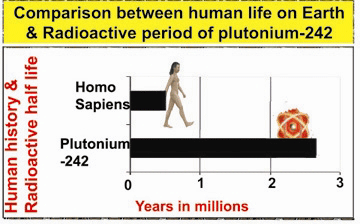
Are we going to be beggars or choosers? We are not so desperate that we have to take the world’s most toxic waste and prevent it from damaging anything for hundreds of thousands of years.
South Australia continues to have huge potential for growing the renewable energy industry instead.
The risk to the world’s environment of transporting high level nuclear waste across the oceans to to the furthest point on the planet, ie, South Australia, just doesn’t make sense.
And people, (including of course the Adnyamathanha Indigenous people of the Flinders Ranges) do not want it.
Adelaide Advertiser readers not all taken in by Premier Weatherill’s dishonest spiel about nuclear waste
Some comments on Weatherill’s article .( Jay Weatherill: South Australia can learn valuable lessons from nuclear waste facility at Eurajoki, Finland)
It is not a good legacy to leave behind, Jay. 100,000 years is a long time for something to go wrong and you’ll be remembered for it, if it does.
@Michael well, actually the Fins haven’t. Not any radioactive waste at all. But they hope too! Probably some time next decade, unless things go wrong. But they are c̶e̶r̶t̶a̶i̶n̶ c̶o̶n̶f̶i̶d̶e̶n̶t̶ hopeful that it will be fine, that is why they want to sell it to us. Not for money, because it has cost them so much more than they expected and taken so much longer. No for altruistic reasons, sortof.
Finland currently have two different types of operating reactors and the different fuel rods mean canisters are different for the two types of reactors they have. It also means that they drill different depth holes.
But Australia won’t be so lucky if SA imports high level waste from different countries because there will be all sorts of different reactors with many, many different fuel rod length and array dimensions. Lucky eh?
Well, that is if we stick to Finland’s quality KBS-3V system, and not try to sacrifice safety for price by using cheap steel and concrete vessels. When has safety ever been sacrificed for cost in SA? n̶R̶A̶H̶, R̶a̶i̶l̶ ̶u̶p̶g̶r̶a̶d̶e̶, s̶o̶u̶t̶h̶ ̶r̶o̶a̶d̶ ̶s̶u̶p̶e̶r̶w̶a̶y̶, a̶m̶b̶u̶l̶a̶n̶c̶e̶ ̶r̶a̶m̶p̶i̶n̶g̶…..
Pfffft! mere details, it only has to work without failure for 100,000 years!, http://www.adelaidenow.com.au/news/opinion/jay-weatherill-south-australia-can-learn-valuable-lessons-from-nuclear-waste-facility-at-eurajoki-finland/news-story/b8e2250210f4f2a3b0c6a60d9a8037d5
1 This month
7 April – WEBINAR – Australia and the Doomsday Clock – Preventing nuclear war through NoFirstUse and other policies
Online | Tuesday April 7, 4:00-5:30pm, Australian Eastern Time / 8:00-9:30am Central Europe Time
– Access the registration link
15 April – Zoom –Nuclear Power is Not the Solution
Apr 15, 2026 01:00 AM in Canberra, Melbourne, Sydney

Join the International Physicians for the Prevention of Nuclear War (IPPNW) on Tuesday, April 14th for a timely webinar exploring the risks associated with nuclear power and challenging the myth that it offers a simple, safe, carbon-free solution to the climate crisis

21 April Webinar: No Nuclear Weapons in Australia
Start: 2026-04-21 18:00:00 UTC Canberra, Melbourne, Sydney (GMT+10:00)
End: 2026-04-21 19:30:00 UTC Canberra, Melbourne, Sydney (GMT+10:00)
Event Type: Virtual
A virtual link will be communicated before the event.
Host Contact Info: australia@icanw.org

of the week – Australians for War Powers Reform (AWPR)
To see nuclear-related stories in greater depth and intensity
 Antinuclear