The protest was held on the 63rd anniversary of the first bomb going off Maralinga in the Woomera Prohibited Area, as part of a national day of action against nuclear dumps.
Royal Commission silent on dangers of nuclear transport and security required
 Peter Mahoney, Your Say site 17 Oct 2016 The Royal Commission report appears to be silent on the details of how these radioactive materials would be transported to South Australia, and what sort of defence force support would be required to ensure that they are not the subject of terrorist attack. Who would be responsible for ensuring that they are correctly and securely sealed in their containers in the country of origin, say India or Pakistan? How would an SA facility ensure that proper standards are being followed at every step. The consequences of undetected, small or slow leaks would be enormous if they occur all the way from the country of origin, across the oceans and then across the land to SA.
Plan for nuclear above-ground waste facility, before contracts, and with no lndependent Nuclear Regulator
 Malgo Schmidt, from Your Say site 16 Oct 2016 “……..There is no independent Nuclear Regulator in Australia and SA has a conflict of interest
The nuclear dump plan proposes sitting a Nuclear port and an above ground high level nuclear waste storage facility in Project Year 5 – before potential nuclear waste contracts in Year 6′ This depends on assessment and approval by an lndependent Nuclear Regulator- that does not exist in Australia’
The current Federal nuclear regulator would requiré legislative amendments before it could claim to ‘regulate’ lnternational nuclear wastes. SA is disqualified from doing so by clear conflict of interest’
This senate can block any nuclear dump legislation up to the next Federal Election ALP, Greens and the Xenophon team can together block any pro-dump legislation in the senate
Four key themes in community concern over international nuclear waste dumping:
It is quite clear that there are 4 key concerns that have to be dealt with collectively. Failure to pass any of these tests should stop further consideration of a Nuclear Dump. They are:
1. safety of workers and community throughout the nuclear waste supply chain.
2. Flawed Economic assumptions
3. Aboriginal veto
4. Environmental and inter-generational concerns, risks and impacts
The current Federal nuclear regulator would requiré legislative amendments before it could claim to ‘regulate’ lnternational nuclear wastes. SA is disqualified from doing so by clear conflict of interest’
This senate can block any nuclear dump legislation up to the next Federal Election ALP, Greens and the Xenophon team can together block any pro-dump legislation in the senate
Four key themes in community concern over international nuclear waste dumping:
It is quite clear that there are 4 key concerns that have to be dealt with collectively. Failure to pass any of these tests should stop further consideration of a Nuclear Dump. They are:
1. safety of workers and community throughout the nuclear waste supply chain.
2. Flawed Economic assumptions
3. Aboriginal veto
4. Environmental and inter-generational concerns, risks and impacts
Safety is compromised by import of nuclear waste long before any disposal capacity
The Nuclear Commission proposed import of nuclear waste in Project Year 11′ four years ahead of an agreed licensed disposal site and some 16 years ahead of any potential waste disposal capacity
SA faces the threat of a Nuclear port receiving nuclear waste ships every month for decades
Reality check analysis shows there is No Profit in Nuclear waste
South Australians are being misled by inflated revenue claims, untenable assumptions including globally unprecedented scale of dump plans and under reported nuclear waste costs & liabilities’
Nuclear dump plans are prone to fail- like Yucca Mountain in the USA, and end in debt not profit.
Future generations – importing international nuclear waste is an irrevocable decision
The nuclear waste would be here forever and remain dangerous for hundreds of thousands of years’ our children will have no say in this decision hgt be left with this liability into the future ‘
The Campaign needs to mobilise mainstream community to oppose nuclear waste dumps
Countering the Premier’s nuclear waste agenda requires mobilising SA community’ working through the steps in who? when? where? and How? to engage groups across society on these issues’
We can all contribute to protect SA from nuclear dumping and build strength in our community’ For further info see: www.foe.org.au/import-waste & http://www.nodumpalliance.org.au/
South Australia’s Sundrop Farms – desert solar powered agriculture
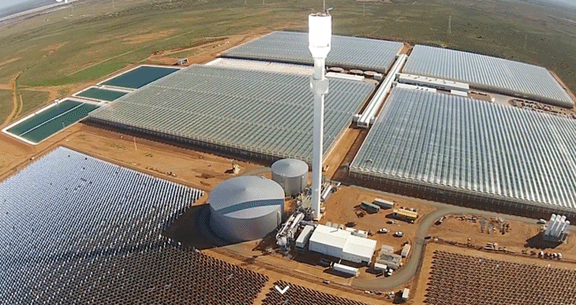
Desert farm grows 180,000 tomato plants using only sun and seawater http://www.mnn.com/your-home/organic-farming-gardening/stories/desert-farm-grows-180000-tomato-plants-using-only-sun-and-seawater
Farms that grow food in arid deserts, without groundwater or fossil fuels, could be the future of agriculture. BRYAN NELSON October 10, 2016, No soil, no pesticides, no fossil fuels, and no groundwater. And yet, a thriving farm in the heart of the arid Australian desert. How is this possible?
An international team of scientists has spent the last six years fine-tuning a system that pipes seawater in from the ocean and desalinates it using a state-of-the-art concentrated solar energy plant. The water is then used to irrigate 180,000 tomato plants grown in coconut husks instead of soil, kept in a network of greenhouses.
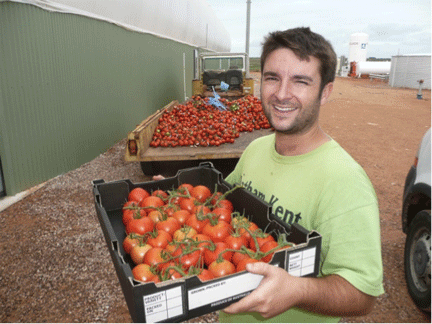 The result is Sundrop Farms, a commercial-scale facility located just off the Spencer Gulf in South Australia that began construction in 2014. Today it’s producing an estimated 17,000 tons of tomatoes per year to be sold in Australian supermarkets.
Given the increasing demand for fresh water around the world — a problem that’s particularly apparent in the sunburned landscape of South Australia — this might just represent future of large-scale farming, especially in coastal desert regions that have previously been non-arable.
The heart of the farm is the 23,000 mirrors that reflect sunlight towards a 115-meter high receiver tower. All of that concentrated sunlight produces an immense amount of power, up to 39 megawatts. That’s more than enough to cover the desalination needs of the farm and supply all the electricity needs of the greenhouses.
The seawater, too, has other purposes besides just irrigation. During scorching hot summers, seawater-soaked cardboard lines the greenhouses to help keep the plants at optimal temperature. Seawater also has the remarkable effect of sterilizing the air, meaning that chemical pesticides are unnecessary.
All in all, the facility cost around 200 million dollars to get up and running. That might sound excessive, but in the long run the facility should save money compared to the costs of conventional greenhouses that require fossil fuels for power. It’s a self-sustaining, cost-efficient design so long as the initial investment can be provided. Facilities similar to the Australian one are already being planned for Portugal and the U.S., as well as another in Australia. Desert areas like those seen in Oman, Qatar and the United Arab Emirates could be next in line.
“These closed production systems are very clever,” said Robert Park of the University of Sydney, Australia, to New Scientist. “I believe that systems using renewable energy sources will become better and better and increase in the future, contributing even more of some of our foods.”
South Australia’s home solar batteries- electricity provided throughout recent blackout
Market for solar storage batteries growing and competitive http://www.adelaidenow.com.au/news/south-australia/market-for-solar-storage-batteries-growing-and-competitive/news-story/cae6fc767743e6b38c5165145a9bb893 Craig Cook, The Advertiser October 16, 2016
http://www.adelaidenow.com.au/news/south-australia/market-for-solar-storage-batteries-growing-and-competitive/news-story/cae6fc767743e6b38c5165145a9bb893 Craig Cook, The Advertiser October 16, 2016 THE hi-tech home energy storage battery revolution, allowing households to better manage solar rooftop power, has been promised for more than a decade and now it could finally arrive in South Australia.
Battery installers in Australia have reported more than 100,000 customer inquires this year, although sales of the systems – which are adaptable, stylish, and small compared to the ugly lead acid batteries of the past – number less than 5000 units.
World leaders in battery production include Elon Musk’s Tesla company that produces the popular bar fridge sized ‘Powerwall’ unit, and German firms Sonnen and BMZ.
 Leading players offering home battery solutions include ZEN Energy, based at Clovelly Park in Adelaide, with Professor Ross Garnaut as chairman, and Redflow, based in Brisbane, led by SA-based innovator Simon Hackett, as chairman, chief executive and majority shareholder.”
But the biggest indicator that this is a growing, competitive and lucrative market is that major energy providers, AGL and Origin, now offer their own storage battery solutions.
ZEN Founder and Director of Innovation, Richard Turner, said while South Australia was plunged into darkness last week, its customers were completely uninterrupted.
“They were using their electric ovens, watching television, and going about their night like nothing had happened,” Mr Turner said.
“These systems are designed to generate and store ample solar energy during the day to meet their home’s power needs at night and provide backup power during blackouts.”
Mr Turner said while luxury homeowners were among the first adopters of solar energy storage, solutions were now affordable and within everyone’s reach. Continue reading
Aboriginal landowners joined by thousands in South Australian protest against nuclear waste dumping
Nuclear waste dump protesters bring the fight from outback South Australia to the city, By Lauren Waldhuter http://www.abc.net.au/news/2016-10-15/nuclear-waste-dump-protesters-bring-the-fight-to-adelaide/7935954
Traditional landowners from South Australia’s outback have brought their fight against proposed nuclear storage facilities to the steps of Parliament House.
About 3,000 people rallied against proposed nuclear waste dumps, with Aboriginal families affected by nuclear testing at Maralinga among the crowd.
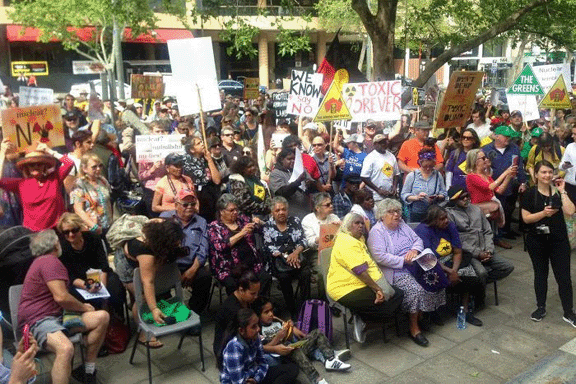
The State Government is considering whether it should store the world’s high-grade nuclear waste at a site somewhere in South Australia.
At the same time, the Federal Government is considering building its first storage facility for Australia’s low-grade radioactive waste, having short-listed Wallerberdina station, near Hawker in the Flinders Ranges, as a preferred site.
Traditional landowner Karina Lester said many people did not want to see either proposal go ahead.
“We are starting to unite and we are starting to really think about how we’re going to fight this, because it concerns us and we have a cultural responsibility,” she said.
“People travelled from the Mid North [and] from Ceduna as well to be part of this event and it was so important that they gathered here today to say ‘enough is enough’.
“Having Yalata crew, having Ceduna crew, the Yappala crew being involved is so strong for us as Aboriginal people.”
Renowned film director Scott Hicks lent his voice to the cause, with particular concern about the high-grade dump.
“To me it’s an idea that doesn’t make sense on any level I can look at it,” he said.
“It doesn’t make economic sense. We can’t even predict the price of coal a month from now. How can we predict the price of nuclear waste 100 years from now?
“Why would we want to leave a legacy for our children’s, children’s children and beyond 100,000 years, that can never be taken away?”
What is being proposed?
Federal
- Low-to-intermediate level radioactive waste generated in Australia stored in a purpose-built facility
- It would include materials such as nuclear medicine by-products
- This waste is currently stored in more than 100 sites across Australia, in metropolitan areas, regional towns and cities
- The project promises at least 15 ongoing jobs and $10 million in funding for the host community once the facility is operational
South Australia
- The Nuclear Fuel Cycle Royal Commission found SA could store the world’s high-grade nuclear waste
- Sealed waste would be stored 500 metres underground in a purpose-built facility
- The facility could create up to 5,000 jobs during construction and 600 ongoing jobs
- It is tipped to generate $5.6 billion of annual revenue for SA once established
The Advertiser (Under)Reports huge anti nuclear waste rally in Adelaide
 I have received several reports from those who attended the rally in Adelaide – estimates of attendance numbers range from 100o to 3000.
A smaller rally was held in Melbourne, and in Alice Springs. At this stage, I have no reports on the rally held in Sydney.
Hundreds march against nuclear dumping in South Australia http://www.9news.com.au/national/2016/10/15/12/51/hundreds-march-against-nuclear-dumping-in-south-australia Hundreds of land owners have converged in Adelaide’s city centre to resist the South Australian government’s plans for two nuclear waste dumps in the state’s north.
Groups opposing the government’s plans to store high-level waste from other countries have flooded the steps of Parliament House in Adelaide’s CBD.
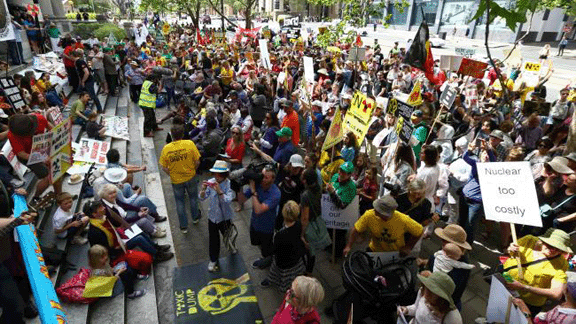
Many have come bearing flags and signs protesting the dumps, which were proposed in July. Traffic in the local area has been restricted to one lane as a steady stream of protesters continue to arrive. Motorists are advised to avoid the area.
Karina Lester, from the No Dump Alliance, said people need to send a strong message of opposition to the state and federal governments.
“All traditional owner groups need to unite and fight this as we all know the international waste storage facility is not going to be Norwood or Unley (in Adelaide), it will be in the far north of the state,” Ms Lester said.
Aboriginal Congress SA chairman Tauto Sansbury said people need to understand what building nuclear waste dumps means for future generations.
“We are talking about the importance of country and the preservation of culture and safety of our peoples,” Mr Sansbury said.
Conservation SA chief executive Craig Wilkins believes today’s rally is “another opportunity for all South Australian to express their concerns over the dump proposals”.
The rally also marks the 63rd anniversary of the first British atomic bomb test at Emu Field, in SA’s far northwest, in 1953.
Could the nuclear waste issue be the finish for South Australia’s Premier Jay Weatherill?
 Power to the people may mean pulling plug on Jay Premier Jay Weatherill must pull off complex balancing act on SA’s energy infrastructure Daniel Wills, The Advertiser,October 14, 2016 PREMIER Jay Weatherill is strangely now both a hero and villain of the environmental movement.
Jobs have long been the biggest issue in SA politics, and will undeniably dominate the campaign in 18 months’ time. It’s a sign of how desperate the situation in SA has become that beating Tasmania back into last place on the unemployment ladder is now a cause for muted celebration.
We also wait to see what future, if any, Whyalla has and the full impact of Holden’s closure.
But leaping up into the top strata of vote-changing issues, which includes the State Government’s overhaul of the health system, are two divisive topics that evoke powerful emotions……….
An Advertiser-Galaxy poll on the blackout published on Monday showed only 16 per cent of people supported dialling back renewables in favour of coal and gas generation……..Voters seem to want something existing technologies don’t offer – carbon-free renewable energy that is cheap and reliable……..
In two Saturdays’ time, Mr Weatherill will head to a Labor Party state convention where the prospect of the state taking high-level nuclear waste for cash will be a flashpoint.
Already, Labor MP Steph Key is speaking out against any change to the party platform. Stakeholders such as SA Unions are expressing grave doubts about the business model…….
The numerical dominance of Labor’s Right faction, plus hesitant support in elements of Mr Weatherill’s Left, makes it likely his nuclear position will survive………
The same people cheering speech lines about wind farms may roll their eyes at nuclear. And vice-versa. This is the core and complex balancing act Mr Weatherill must pull off in the bid for a fifth term – holding a coalition of diverse and often opposed interests to win the day.
It’s not about being all things to all people. It’s about being just enough to just enough.http://www.adelaidenow.com.au/news/opinion/daniel-wills-premier-jay-weatherill-must-pull-off-complex-balancing-act-on-sas-energy-infrastructure/news-story/69403007930c182f4d0f679491a3eee9
Witnesses recommended for the next Citizens’ Jury on Nuclear Waste Importing, South Australia
This is a full list of witnesses chosen by the Nuclear Citizens’ Jury on October 9th and invited to be witnesses for the next Nuclear Citizens’ Jury on 29 October.
Here I have endeavoured to shed light on the likely evidence of each, according to the following code :
GREEN = Anti-nuclear waste dumping , Yellow – doubtful on waste importing. ORANGE=Neutral – Uncertain, about waste dumping, BLACK = I don’t know, PINK = probably pro waste dumping , RED = Pro nuclear waste dumping
- I ran into a spot of bother with the many Aboriginals recommended. As far as I can tell, they are all opposed to importing nuclear waste, except Parry Agius . Some of the most prominent Aboriginal persons are: Kevin Buzzacott, Karina Lester, Rose Lester, Vivienne McKenzie, Enice Marsh.
- Some pro nuclear people might be opposed to the dump plan, so I put those in pink.
 Nuclear Citizens Jury Two: Witness work
WITNESSES CHOSEN BY JURY AND INVITED FOR THE 29th
No List Ref Name Votes Theme
1 123 Richard Dennis 96 Economics
2 121 Professor Richard Blandy 54 Economics
3 128 Professor Barbara Pocock 45 Economics
4 179 Professor Brian Cox 45 Safety
5 166 Hon Nick Xenophon 44 Trust
6 56 Paddy Crumlin 34 Safety
7 1 Timo Aikas 34 Safety
8 4 Professor Rodney Ewing 31 Safety
9 168 Dr Karl Kruszelnicki 30 Safety
10 116 Dr Simon Longstaff 29 Trust
11 5 Robert J Halstead 27 Safety
12 19 Dr Jim Green 25 Safety
13 9 Dr Carl Magnus‐Larsson 25 Safety
14 162 Ian Hore‐Lacy 22 Economics
15 49 Professor Tilman Ruff, AM 22 Safety
16 53 Frank Boulton 21 Safety
17 188 Someone from the Attorney Generals Department to provide advice on the legislation that will be required to be developed/changed. DemocracyCo seeking advice on who. Trust
18 124 Assoc. Professor Mark Diesendorf 20 Economics
19 7 Dr Andrew Herczeg 20 Safety
20 42 Dr Ian Fairlie 19 Safety
21 137 Hon Mark Parnell, MLC 18 Economics
22 39 Dr Margaret Beavis 18 Safety
23 119 Assoc. Professor Haydon Manning 17 Trust
24 122 John Carlson AM 16 Economics
25 200 Dr Benito Cao 16 Economics
26 18 Professor David Giles 16 Safety
27 115 Steven McIntosh 16 Trust
28 2 Dr Ian Chessell 14 Safety
29 34 Professor Sandy Steacy 14 Safety
30 69 Gill McFadyen 11 Consent
31 74 Dave Sweeney 10 Consent
32 104 Bob Watts 9 Consent
33 76 Ross Womersley 8 Consent
34 72 Dr Gerald Ouzounian 7 Consent
35 73 Dan Spencer 6 Consent
36 126 Tim Johnson 7 Economics Invited to provide info on the Royal Commission economic modelling after 20+ requests on Information Gap Cards Dotmocracy Results ‐ 25 plus a few extras to allow for availability Top 6 from Consent ‐ as Gill is unavailable.
Nuclear Citizens Jury Two: Witness work
ABORIGINAL WITNESSES ALREADY INVITED ON THE 29TH Continue reading
People power against nuclear waste dumping – protest at proposed dump site
 Nuclear waste protest http://www.transcontinental.com.au/story/4210032/people-power-on-display-in-the-flinders/ 10 Oct 2016, People power was in full force over the weekend, and it was directed against the federal government’s proposed nuclear waste facility.
‘Yanakanai Ngarpala Yarta – Come Here to Our Country’, saw 70 people travel to the proposed national nuclear waste dump site at Wallerberdina in the Flinders Ranges.
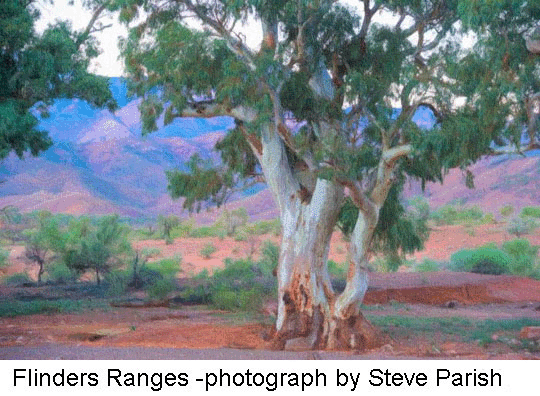
It was at the invitation of Adnyamathanha Traditional Owner and neighbour to the proposed site,Regina McKenzie,
Ms McKenzie made her opposition to the proposal clear.
“We don’t own the land, the land owns us. If you poison the land, you poison us,” she said.
At the three day camp, from October 7-9, Regina McKenzie shared her knowledge of the land and its cultural significance, including Australia’s first registered song-line, which runs from Hawker to Lake Torrens.
Supporters were taken to one of the world’s richest archaeological sites, and the sacred Hookina Springs.
More than 150 people gathered on Sunday and marched from the Blue Burt Memorial Park to the main intersection of Hawker, chanting “don’t waste the Flinders, dump the dump now!”
The rally was addressed by Traditional Owners, local pastoralists and members of the Flinders Local Action Group.
Hawker GP Dr Susan Andersson remains critical of the proposal.
“The continued availability of nuclear medicine services does not depend on a permanent waste repository. Less than one percent of the low level waste is medical waste,” she said.
Supporters across Australia will hold protests, film screenings and meetings for a national day of action against the nuclear waste dumps targeted for South Australia on October 15.
Solar power needed, to bring energy security and jobs to Port Augusta, South Australia
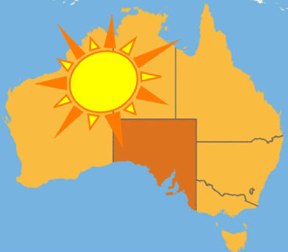 Sam Johnson: Solar power must be provided to regional centres such as Port Augusta to provide electricity security – and jobs
 http://www.adelaidenow.com.au/news/opinion/sam-johnson-solar-power-must-be-provided-to-regional-centres-such-as-port-augusta-to-provide-electricity-security/news-story/4ffcdfeb9fc35ef3f8cbfe0eea1c9bdc October 10, 2016 THE political hoo-ha over renewable energy in South Australia over recent weeks has revealed a serious lack of leadership when South Australian towns like Port Augusta need it most.
Will South Australia’s Nuclear Citizens’ jury be fed lies and half-truths?
 Nuclear waste storage plan prompts more citizens’ jury debate in South Australia, ABC 7
Oct 16, Greens leader Mark Parnell is worried members of the South Australian Government’s citizens’ jury are not getting all the facts as they consider whether the state should pursue a nuclear future.
The Government is considering a royal commission’s recommendation that SA store high-to-intermediate-grade nuclear waste, most likely in the outback.
A citizens’ jury of more than 300 people is meeting in Adelaide this weekend to hear a range of expert views, the second such process after a first jury pondered the business case at a weekend forum back in July.
Mr Parnell said he was worried the citizens were not getting the best information, especially as the Government pointed out other countries with nuclear waste storage facilities.
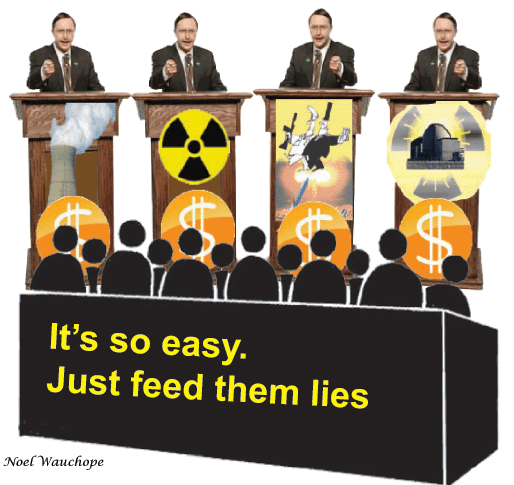
“The Government seems keen on promoting this idea that Finland have got all the answers,” he said. “The Finland facility isn’t finished, it’s been 30 years in the making, it’s at least six or eight years away from taking any nuclear waste.
“What’s proposed for South Australia is 20 times bigger.”……..
SA senator Nick Xenophon said citizens’ juries might have a role, but could not replace taking the nuclear issue to the wider community.
“The ultimate citizens’ jury to decide an issue so big, so momentous for SA has to be 1.2 million South Australian voters at a referendum,” he said…….
[Mark Parnell said] “I’m worried that the [current] parliamentary committee won’t have finished its work, and the most important bit of work that is needed I think is a second and third economic opinion.”………http://www.abc.net.au/news/2016-10-08/nuclear-waste-storage-south-australia-citizens-jury-debate/7915292
More safety problems in canisters for storing nuclear wastes
Premature failure of U.S. spent nuclear fuel storage canisters, San Onofre Safety.org, “……Stainless Steel Dry Canister Problems Darrell Dunn, an NRC materials engineer, stated stainless steel dry storage canisters are vulnerable to failure within about 25 – 42 years. If any of the fuel cladding in the canister fails, there is no protective barrier and we could have a serious radiation release.
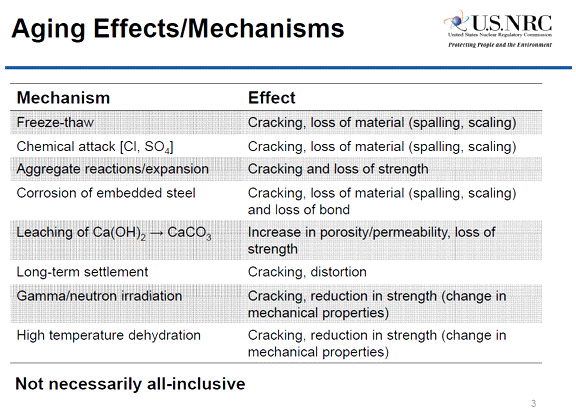
The NRC said they have no current mitigation plan for that consequence. They suggested we MIGHT be able to put the fuel back in the spent fuel pool. However, Edison plans to destroy the spent fuel and transfer pools. And there is no technology to repair the canisters. The NRC said they HOPE there will be a solution for mitigation in the future. Even an NRC May 2nd High Burnup Fuel letter admits there are mitigation problems.
No Inspections of Stainless Steel Canisters EPRI 2012 presentation To make matters worse, these stainless steel canisters are not inspected after they are loaded into the unsealed concrete overpacks (Areva NUHOMS) or concrete casks (Holtec and NAC Magnastor). The NRC proposed having each nuclear plant inspect the outside of only ONE stainless steel canister before they receive a license renewal and then do that once every 5 years. The industry balked at having to even check one canister at every plant. The problem with the stainless steel canisters is they do not protect against gamma rays; so it’s not a simple task to remove a canister from the concrete overpack/cask to examine the exterior for corrosion or other degradation. And since welded canisters do not have monitoring for helium leaks, we may not have any warning of an impending radiation release.
Concrete Overpack Corrosion Problems Darrell Dunn discussed serious corrosion problems with the concrete overpacks/casks, especially in coastal environments…….. https://sanonofresafety.org/2014/08/21/premature-failure-of-u-s-spent-nuclear-fuel-storage-canisters/

Citizens’ Jury members not allowed to change the wording of their set question.
9 Oct 16 Tim Bickmore Some of the Jury Members requested that the form of the question be changed to adjust the term ‘circumstances’ into better context ie the question should be along the lines of …. whether or not to pursue the HLW dump, & if so, under what circumstances…..
They were informed that there would be no change to the question. This calls into question any claims that the Jury is in Charge of the process.
The set question is “Under what circumstances, if any, could South Australia pursue the opportunity to store and dispose of nuclear waste from other countries?”
Monitoring South Australia’s Nuclear Citizens’ Jury
 I have not been watching today’s Citizens’ Jury Two Livestreaming and Video. However, these sessions are available for viewing. I saw at the agenda – See the agenda here – that the gathering was to be opened by Premier Jay Weatherill, and Kevin Scarce, former chief of the Nuclear Fuel Chain Royal Commission.
Unlike may other critics of the nuclear industry, I have some faith in the process. I did think that DemocracyCo ran the first Citizens’ Jury meetings well, and the jury members asked intelligent questions. The problems were:
- The whole premise was not really a jury situation in any sense. The jury were told that they were not to make a decision (the essential brief of any real jury). They were told to produce a ‘Summary of the Nuclear Fuel cycle Royal Commission’s Report.
- The witnesses were not always well informed, and some were both ignorant and biased. They were chosen at an early stage by the jury members, who clearly did not then have access to impartial and well informed experts.
- Members of the Nuclear Fuel Chain Royal Commission were far too prominently present and vocal. Greg War and Chad Jacobi made sure to dazzle all with their pro nuclear knowledge, whenever it looked as if criticism of the nuclear industry was coming up.
This new Citizens’ Jury has been given a loaded question to consider:
“Under what circumstances, if any, could South Australia pursue the opportunity to store and dispose of nuclear waste from other countries?”
So – much as I admire DemocracyCo’s the group management efforts, and real attempts at fairness, I am not optimistic about the outcome of this Citizens’ Jury 2. I think it will boil down to another delaying tactic by the Weatherill government, to keep the State guessing – while behind the scenes, the nuclear lobby gets on with its preparations for nuclear waste importing to south Australia.
1 This month


Help Aunty Sue Protect Her Land and Sacred Sites From Destructive Rocket Testing.
.

Australians deserve the truth
about
AUKUS – https://aukuspublicinquiry.com/

PETITION – To: Prime Minister Anthony Albanese and the Australian Labor Government

of the week – Australians for War Powers Reform (AWPR)
To see nuclear-related stories in greater depth and intensity

