Taxpayers up for huge costs in South Australia – just for the PLANNING for nuclear waste importing
 Political Reporter Sheradyn Holderhead, The Advertiser September 11, 2016 THE State Government will need to find up to $600 million to plan a nuclear waste dump even if the project never gets off the ground, a consultant working on the Royal Commission has revealed.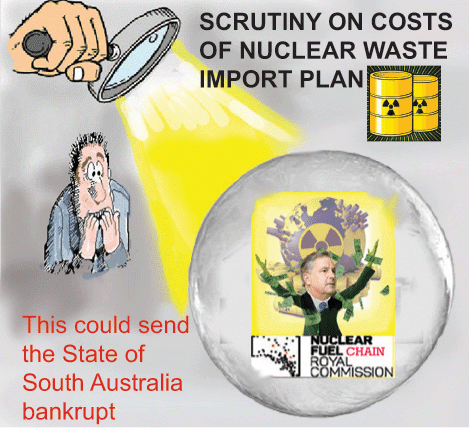
Jacobs Engineering Group project manager Tim Johnson told a parliamentary committee investigating the project that the total cost prior to the decision to proceed and sign contracts with client countries would likely be $300 million to $600 million.
Premier Jay Weatherill said precommitment from participating countries could reduce the risk for taxpayers.
But Dr Johnson questioned the likelihood of doing that earlier than year six of the project, at which time up to $600 million would already have been spent.
Late last week, the committee visited a dump site in Nevada where more than $10 billion has been spent by US government. The project has stalled for years as the state and federal governments fight over approvals.
Liberal MLC and committee member Rob Lucas said the large costs were “a potential deal breaker”.
“I don’t speak for the committee or my party at this stage. Personally, I would find it very hard to support any proposal which meant we could spend $600 million and then decide we wouldn’t proceed with the project,” he said.
“That would simply mean taxpayers had wasted $600 million for nothing.” Continue reading
South Australia, Australia’s most secretive state
 Daniel Wills: Welcome to South Australia, the nation’s most secretive state
IT crept up with such stealth that few people noticed it was even happening, but South Australia can now make fair claim to being the most secretive state in the country.
The Advertiser revealed two stories this week that should deeply concern lovers of open debate and informed democracy, and leave them demanding big changes.
After a period of welcome sunlight as court suppression orders sank to relative lows, they’ve spiked in the past two years and are running at their highest rate in a decade.
On top of that, a Monash University study admonished our Freedom of Information laws as the worst in the country and found the system was “designed to block, delay and obfuscate”.
But this viscous culture of secrecy isn’t isolated to those two important areas.
It seeped so far into the foundations of our Independent Commission Against Corruption that even the man running it has complained to lawmakers that the public is shielded from important information………
SA also trails other states in the protections offered to whistleblowers and any journalists they contact in an honest bid to get important stories of public interest into the light of day. This has a chilling affect on political debate, and makes it more likely that bad practices will survive.There are a few decent theories that help explain why SA stands out so darkly in the crowd………
When the ICAC legislation was drawn up the balance fell on the side of minimising the risk that people of standing would have their reputations unfairly smeared, rather than a bias towards ensuring the public had maximum access to information about what they were up to………. http://www.adelaidenow.com.au/news/opinion/daniel-wills/news-story/10735e85a9e26eeea142501aa6985f25
Hawker in the middle of the earthquake hazard zone south Australia
 Greg Wurn to Nuclear Fuel Cycle Watch South Australia Earthquake Hazard Zones of South Australia. Hawker in the middle of the earthquake hazard zone, well the proposed nuclear fuel waste dump is just a little to the west of Hawker at a place called Wallerberdina, a station near Barndioota, this property just happens to be under a long term lease to ex SA liberal senator Grant Chapman, he also while in politics served on several Senate Select Committees to do with uranium mining and milling, and another on the Lucas Heights Reactor.I will never know if he acquired that property with some sort of insider knowledge, but I do know the land is not geologicaly stable, and it also appears to drain into lake Torrens, which seams to drain south towards Port August and the Spencer Gulf.
David Noonan bad siting for national waste dump and shows that proposed Inter waste dump will be sited somewhere west of Port Augusta… https://www.facebook.com/groups/1021186047913052/
South Australian govt makes a change- to purchase 75 per cent of its long-term electricity needs
 SA Government to purchase 75 per cent of its long-term electricity needs, ABC News, 7 Sept 16 By Nick Harmsen and staff The South Australian Government says it will launch a tender to buy 75 per cent of its long-term electricity needs in an effort to increase competition.
SA has been hit hard by spiralling electricity costs over recent years and the Government wants to introduce a new competitor to the market.
Premier Jay Weatherill said current rules allowed private electricity companies to drive “prices higher by withholding supply”. “A small number of energy suppliers in South Australia have too much power,” he said. “If we increase competition, we will put the power back into the hands of consumers.”
South Australia’s electricity provider, the Electricity Trust of South Australia, was privatised in 1999.It changed its name to SA Power Networks in 2012……..
Carbon emissions scheme on the cards The SA Government also wants to “explore” an Emissions Intensity Scheme (EIS) that would trade credits between energy companies at a national level…….
“[This] means no coal-fired power generation and the only way you’re going to do that is through an emissions trading scheme or an emissions intensity scheme,” he said.
Independent senator for SA Nick Xenophon said an EIS was a “breakthrough” that would increase power reliability, reduce costs and bring about good environmental outcomes. He said that under an EIS, “dirty generators” that emit above a baseline emission rate would have to pay for the pollution while those below it would be credited.
Senator Xenophon said he proposed it at a federal level with the then opposition leader Malcolm Turnbull in 2009. “It seems that after seven long years of skyrocketing power prices that the ‘mongrel scheme’ that I proposed with Malcolm Turnbull has now become the ‘top dog’,” he said.
Yesterday, Port Augusta residents lobbied Mr Weatherill to commit to purchase the power from a proposed solar thermal project in the state’s north.
Mr Weatherill said the tender would not specify which power plant technology should be used…….http://www.abc.net.au/news/2016-09-08/sa-government-to-purchase-75pc-of-electricity-needs/7825852
Confusion about the two South Australian nuclear waste dump plans
 Are these 2 proposals really so separate, or is the Federal dump choice of South Australia planned so as to soften up South Australians and Australia at large, to view South Australia as a suitable radioactive trash toilet? South Australian Liberals, and the Federal Liberal and Labor are all staying quiet about the Scarce Nuclear Commission plan – but are they secretly in support of it?
Two nuclear proposals ‘confusing discussion’ about potential waste dumps in South Australia, ABC News 2 Sept 16 By Lauren Waldhuter Two separate proposals for storing nuclear waste in South Australia have caused widespread confusion in communities and the Premier has conceded public consultation was badly timed.
The State Government has launched a state-wide public consultation program on royal commission recommendations to store the world’s high-grade nuclear waste in SA.
But at the same time the Federal Government hasshort-listed Wallerberdina station, near Hawker in the Flinders Ranges, as a preferred site for Australia’s first storage facility for low-to-intermediate level radioactive waste.
Hawker Community Development Board chairperson Janice McInnis said SA’s public consultation was clouding discussion about the federal plan.
“I’ve had phone calls from friends in Adelaide who said, ‘what’s this about a waste dump at Hawker?’, thinking it was the state one and they hadn’t heard about the federal one at all,” she said.
| March 2015 | Nuclear Fuel Cycle Royal Commission established. |
May 2015 |
Landholder nominations to host Australia’s Radioactive Waste Management Facility close. |
| May 2015 |
Royal commission releases four issues papers. Public consultation period begins. |
November 2015 |
Six sites around Australia identified for further assessment, including three in SA. Consultation period begins. |
| February 2016 |
Royal commission releases tentative findings. It suggests SA builds a dump for the world’s high-level nuclear waste. |
April 2016 |
Federal Government announces Wallerberdina station as its preferred site. |
| May 2016 | Final report released and consultation continues. | Present | Consultation continues until next year. |
Premier Jay Weatherill admitted the timing could have been better.
“Certainly we would’ve preferred if the federal process had have waited until our process had been underway,” he said.
“There’s no doubt there’s been confusion between the federal process and the South Australian Government process.
“We’ve detected that as we’ve gone out and spoken to people.
“I think the Commonwealth support the approach that we’ve taken but we’re going to have to find a way to bring those two decision-making processes together.”……..
Two sets of conversations ‘insulting’ Despite disagreeing with both government plans to pursue a nuclear future for SA, environmental groups agree the issue has become too confusing.
The Conservation Council of SA held an expo in Port Augusta on Friday to highlight concerns about both proposals as well as their differences.
“It’s actually insulting to have two sets of governments having two sets of conversations on two different proposals at the same time,” chief executive Craig Wilkins said.
“No wonder the community is confused. “It’s incredibly important that these two plans are kept separate because the impacts are very, very different.” http://www.abc.net.au/news/2016-09-04/nuclear-proposals-confusing-discussion-in-sa/7812646?pfmredir=sm
South Australia’s Premier Weatherill is proud that his nuclear waste import plan is RISKY!
 Voters will reward my courage, Weatherill insists, INDaily, 1 Sept 16 Tom Richardson
 Tom Richardson “……….the Premier believes the South Australian public will reward his own Government at the 2018 election for courting “political risk” with contentious changes to the state’s healthcare system and a royal commission into the nuclear fuel cycle………
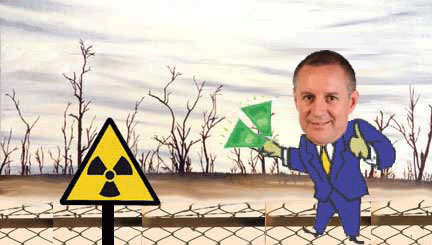
I think ultimately people will give credit to people that are taking on the big decisions,” he insisted.
“There will always be complaints around the edges, but in their heart of hearts they understand somebody’s got to tackle these big questions.”……
On the nuclear issue, acting Liberal leader, Vickie Chapman said: “Weatherill scans the world and tries to find an idea, then thinks, ‘I’ll be bold and brash about this’ – but he’s years late, so it just becomes a sideshow.”……http://indaily.com.au/news/politics/2016/09/01/voters-will-reward-my-courage-weatherill-insists/
Geothermal energy – not necessarily renewable, nor environmentally benign.
Dennis Matthews, 3 Sept 16 It’s important to understand that what companies such as Geodynamics, and organisations like the SA Centre for Geothermal Energy Research at Adelaide Uni have been trying to do is a special sort of geothermal energy, commonly known as “Hot Rocks”. This type of geothermal energy is not renewable in the normal sense of the word, and it is not environmentally benign.
Hot Rocks geothermal requires the expenditure of large amounts of energy to drill 5km underground and to pump liquid under pressure in order to fracture rocks (fracking) 5 km underground. for which it uses a large amount of water to do this.
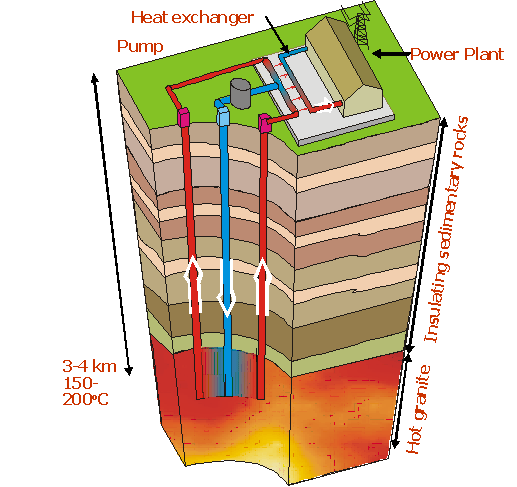
In SA, where most of the hot rocks projects were being pursued, the eventual market for the electricity would have been mining companies especially uranium mines such as Roxby Downs and Beverley. This is no coincidence. The rocks are hot, not because of heat from the earths interior, but because they are radioactive.
By fracking the radioactive rocks and pumping water through them, radioactive radon gas is released and the water becomes radioactive through a host of radioactive isotopes that have built up over millions of years. In principle, during operation the water is not released to the environment but this is the ideal scenario. Accidents and maintenance work is highly likely to rel;lease radioactive water. The water used in fracking is not recycled. I assume it is put into tailings dams and allowed to evaporate leaving behind a concentrated radioactive waste. Often this occurs in areas, such as near the Cooper, which are subject to flash flooding.
Each hot rocks site has a very limited life (approx 20 years), because the rate of heat replacement is much less than the rate of extraction. This means that the project has to constantly move from one set of 5km holes and the exhausted holes will not be viable for “many hundreds of years”. This is not renewable energy. Growing trees for biomass is quicker. Solar is instantaneous in the sense that the sun is essentially an infinite source of energy; using solar energy in no way diminishes the amount available.
Despite several attempts, I was never able to get an answer on the energy payback time, or on greenhouse gas emissions and payback time, or water consumption. For the last 20 years these projects have been powered by govt subsidised diesel and have received very generous Govt funding, both State and Federal, including for the Centre for Geothermal Energy Research. Up to April 2010, public funding totalled approx $300 million.
When these projects were first proposed with backing from the SA mines and energy dept I publicly stated that they were economically and environmentally risky. I see no reason to now change that position.
Unions ready to oppose South Australian Premier Jay Weatherill on nuclear waste dump plans
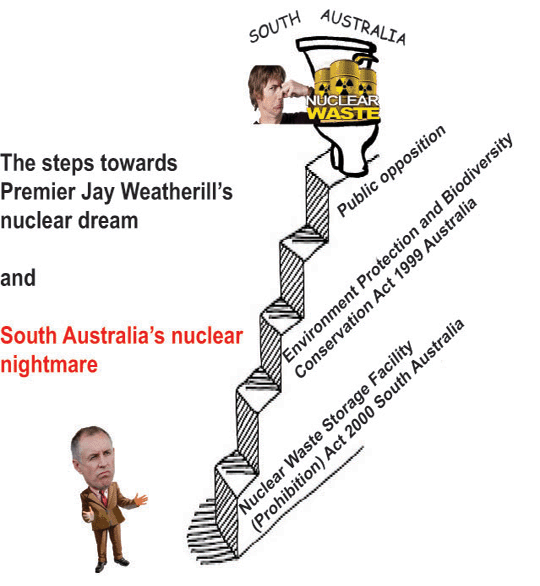 Unions ready to dump on Jay Off the Record: SA’s home of political, business and legal gossip http://www.adelaidenow.com.au/news/opinion/off-the-record-sas-home-of-political-business-and-legal-gossip/news-story/d4d7206f85a8cf5ff5a628158157ef66The Advertiser September 2, 2016 POWERFUL forces within the Labor movement are bracing for an intense union campaign against Premier Jay Weatherill if he goes ahead with plans for a high-level nuclear waste dump.
Off the Record can reveal some are talking about a repeat of the union campaign against Mike Rann, which boiled over in 2010 when he needed a police escort through protesters at Labor’s state conference.
Labor figures have drawn our attention to Maritime Union of Australia state secretary Jamie Newlyn’s public backing of the No Dump Alliance, a broad coalition of environmentalists, indigenous groups and academics.
Newlyn, also SA Unions president, says on the group’s website that the MUA has “a long history of opposing expansion of the nuclear industry including nuclear waste dumps”.
“We fear that the economic assumptions pale in insignificance to the unknown safety and environmental implications of such plans,” says Newlyn.
Wharfies clearly would be required to unload any imported high-level waste, so the union’s support would be critical.
SA Unions vice-president (women) and nurses’ union state secretary Elizabeth Dabars also is backing the anti-dump campaigners, ambiguously declaring her union is pleased “to join the No Dump Alliance to actively participate in community debate on this very important issue for the South Australian community”.
Rann discovered, to his peril, the risks of putting off-side powerful union leaders, such as Australian Workers’ Union state secretary (now president)Wayne Hanson. The AWU, however, is said to be more onside with the dump, because of the potential for jobs and investment.
Perhaps Weatherill will have to worry about his hitherto smooth relations with the union movement being disrupted when he delivers, by the end of the year, the government’s response to the nuclear royal commission.
Carbon neutral plan for Adelaide transport would supply 20,000 jobs
 20,000 jobs tipped if Adelaide spends big on tram network, plug-in hybrid cars to be carbon-neutral city
 http://www.adelaidenow.com.au/news/south-australia/20000-jobs-tipped-if-adelaide-spends-big-on-tram-network-plugin-hybrid-cars-to-be-carbonneutral-city/news-story/0a9e113ba2c052a5167ab24a9b6d1c49 September 2, 2016 A RADICAL plan to make Adelaide the world’s first carbon-neutral city could create more than 20,000 jobs, a State Government-commissioned report says.Engineering company Siemens has presented a range of options that could help Adelaide reduce its net carbon emissions to zero by 2025, including heavy investment in public transport to reduce private car use.
The report, released on Friday, says spending $4.9 billion on public transport infrastructure, including six new tram lines, could create 21,000 full-time equivalent jobs and reduce car use as a share of annual passenger kilometres by 20 per cent.
A less expensive option would be to create incentives for more drivers to use low-emission vehicles, including plug-in hybrid cars.
A $1.4 billion outlay would create 5600 full-time equivalent jobs but would provide a greater return on investment, reducing Adelaide’s transport-related emissions by up to 47 per cent.
“From a 50-50 split in 2015, emissions in the building sector will drop to 33 per cent, with 67 per cent of emissions accruing from transportation,” the report says. “The city will increasingly need to tackle its transport emissions to meet its targets.”
Incentives to encourage greater use of electric cars could include free public parking, exemptions from one-off purchase fees and the freedom to use dedicated bus lanes, all of which have been implemented in Norway. Electric car owners could also receive grants and streamlined permits to install their own charging stations or a reimbursement of energy recharging costs.
Premier Jay Weatherill said the report would add to the debate on ways to reduce emissions, adding that previous efforts to green the state had not constrained economic growth. “We’ve demonstrated that you can cut your emissions and at the same time grow your economy,” he told a Committee for Economic Development of Australia briefing. “These two things are not mutually exclusive.”
Secret forum – for the Nuclear Royal Commission to indoctrinate kids?
The South Australian government is going to a lot of trouble to set up a forum for 160 students and 60 teachers to hear a presentation from the former Nuclear Royal commissioner, Kevin Scarce, and the Chief Executive of the Nuclear Consultation and Response Agency, to tell them all about the plan for South Australia to import foreign nuclear waste.
Walk Against Nuclear Waste Importation protestors speak out at Willunga, Adelaide
 Fleurieu protesters stand against nuclear storage | VIDEO, The Times On The Coast, 30 Aug 16 “Nuclear waste, what a disgrace,” was chanted loud and clear by more than 100 participants in the Walk Against Nuclear Waste Importation as they gathered on the steps of the Willunga Hub on August 24.
Inside was a consultation team who welcomed the walkers with feedback forms and Know Nuclear information packs, taking an opportunity to inform the community about what the Nuclear Fuel Cycle Royal Commission recommendation on storing international radioactive waste meant.
“The proposal before us is an economic one: $5.5 billion per annum, $445 billion over the life of the facility,” said John Phalen, Director, Engagement, Nuclear Fuel Cycle Royal Commission Consultation and Response Agency.
“What we are asking people to do is examine the opportunity,” he said……..
Willinga, Strathalbyn and Victor Harbor among the 100 selected sites for Know Nuclear representatives to talk to local communities.
“I don’t think nuclear dumping is good for our environment or our future,” said Jeffrey Simmons. “Especially when we take it from other parts of the world.”
Sherilee Williams agreed. She said she had a deep respect for the land and its traditional owners since walking from central Australia’s Dingo Fence to Mount Compass a few years ago. “They (the state government) are thinking South Australia’s desert is a wasteland but it’s a sacred place; it’s a place of healing,” she said………
Community consultation runs until October. Feedback forms are available atnuclear.yoursay.sa.gov.au
Living in a radioactive environment Boris Sopotsko from Hallett Cove grew up in St Petersburg, Russia, 40 kilometres from a nuclear power plant and remembers as a child being taught where to run, where to hide, and what to eat after an explosion or leak.
“I hate the idea so much,” he said, referring to an international nuclear waste storage facility proposed for South Australia. “It makes me feel ill. “I remember our school had a gas mask for every single student and an under ground shelter; a nuclear bomb shelter. “The walls had posters showing us how to check which way the wind was blowing and what to do to avoid contaminated rains. “We were well trained, but that doesn’t mean we’d survive.”
Mr Sopotsko feared for the state’s future and said he actively opposed the importing, storing and burying of international nuclear waste in South Australia.
“Nuclear waste from all over the world is clearly a concern, especially when shipping in high seas,” he said. He said transporting the material on roads and rail posed a safety risk: “you freeze with dread at the sight,” he remembers.
Storing the waste above ground was also a concern. “We live in a time when the West has enemies,” he said. “This would be an easy target.”
Underground storage poses a contamination risk to soil and water. “Germany’s waste deposit in Lower Saxony has experienced an underground radioactive leak and people’s resistance against further storage is very strong……..http://www.victorharbortimes.com.au/story/4130203/fleurieu-protesters-stand-against-nuclear-storage-video/
Geothermal power project closes in SA as technology deemed not financially viable
ABC News, 30 Aug 16 By Tom Fedorowytsch A potential energy source in Australia is set to remain untapped, with a geothermal power project in the far north of South Australia now closed.
Energy company Geodynamics closed and remediated the sites of several test wells and generation plants in the Cooper Basin after deciding they were not financially viable.
Before the closure, the company had managed to extract super-heated water from five kilometres below the earth’s surface and use it to generate small amounts of electricity.
“The technology worked but unfortunately the cost of implementing the technology and also the cost of delivering the electricity that was produced to a market was just greater than the revenue stream that we could create,” Geodynamics chief executive Chris Murray said…….http://www.abc.net.au/news/2016-08-30/geothermal-power-plant-closes-deemed-not-financially-viable/7798962
Surface nuclear waste spurs community concern
Community concern is mounting about plans to store high level radioactive waste above ground for years before building a proposed nuclear waste dump, warns Conservation SA CEO Craig Wilkins.
“From our public consultation, most people think this proposed dump is an ‘out of sight, out of mind’ idea, where we bury the waste deep in the outback and that’s it,” he said. “The reality is very different.
“The Nuclear Fuel Cycle Royal Commission was very candid: The project only stacks up financially if we import and stockpile 50,000 tonnes of nuclear waste above ground for as long as 17 years before we can deposit it in an underground disposal site. Indeed, that ‘interim’ surface site will store tens of thousands of tonnes above ground for the next 100 years.

“So, we acquire the risk and responsibility for this nuclear waste before we know if we can actually build and operate the ultimate repository – let alone obtain community consent for it.
“Before we get there, ships containing that high-level waste enter South Australian waters through problem areas such as the South China Sea, then traverse our prawn and tuna fisheries, aquaculture zones and tourism hotspots every month for 70 years. That is a huge amount of risk.
“The plan would require a purpose-built nuclear port and rail line with nuclear waste being stored at five different locations across the state. While these facts are publicly accessible, they’ve been obscured by the promise of eye-popping windfall profits from this proposal.”
However, community concern has grown as South Australian citizens identify problems with the financial viability, environmental impact and community effects of the proposed nuclear waste dump.
In Port Augusta, a two-day community forum, called Exposure 2016, will run this weekend, from September 2-4, at the city’s Institute Theatre, starting on Friday night with ‘Talking Straight Out’. This exhibition showcases the famous Irati Wanti campaign when senior Aboriginal women from Coober Pedy, the Kupa Piti Kungka Tjuta, defeated Federal Government plans to dump radioactive waste on their land.
The free event will also include sessions on the SA Government’s international nuclear waste dumping plans; current Federal Government plans to dump waste in the Flinders Ranges; traditional owners’ voices and rights; impacts of radiation on people and the environment; impacts on industries including tourism, farming and recreation and the track record of radioactive waste management / mismanagement in South Australia and globally.
For many South Australians, the proposed nuclear waste dump in the State’s outback invokes memories of Maralinga and Emu Fields, the South Australian sites of nine British secret nuclear tests between 1953 and 1963. The tests exposed local Aboriginal communities to radiation that caused cancers, blindness and ongoing genetic damage. British and Australian servicemen were also exposed and radioactivity was detected in SA, NT, NSW and Queensland.
South Australian singer Mike Roberts also communicates concern about the nuclear waste dump in his new song Welcome to the Nuclear State. Listen at http://www.cdbaby.com/cd/mikeroberts23#. For community concerns about the SA nuclear waste dump, visit http://www.nodumpalliance.org.au/.
Climate Change Adaptation – South Australia in the lead
National Climate Adaptation Conference 2016, Day Three – Sean Kidney
SOUTH AUSTRALIA: LEADING ON CLIMATE CHANGE ADAPTATION The Climate group, August 2016. Sandy Pitcher, Chief Executive of South Australia’s Department of Environment, Water and Natural Resources, reflects on the achievements of Australia’s preeminent climate change forum, the Climate Adaptation 2016 conference, which took place in Adelaide in July.
The Climate Adaptation 2016 conference provided an unprecedented opportunity for South Australia to highlight the important progress being made on climate change adaptation in our state, and learn from others in Australia and around the world.
The conference was presented by the National Climate Change Adaptation Research Facility and the Commonwealth Scientific and Industrial Research Organisation, with the South Australian Government – a member of The Climate Group’s States & Regions Alliance, the platinum sponsor. It attracted around 490 policy makers, researchers and practitioners and the debate focused on the challenges and opportunities presented by climate change adaptation.
The innovation that we’re seeing mainly happens at the local level, and can be shared at conferences like this. It is a crucial way, for us in South Australia and beyond, to share ideas, catalyze local action, and bring key influencers together.
ADAPTATION IS A VERY KEY TENANT TO ANY FUTURE STRATEGY – THERE ARE MANY PEOPLE WHO ARE GOING TO BE IMPACTED BY A CHANGING CLIMATE
South Australia has long been recognized as a global leader on climate action, and our work in climate change adaptation is central to our efforts.
Our award-winning adaptation framework is based on a collaborative, regional approach involving partnerships between local government, regional development committees and natural resources management boards, who are working together to develop well-informed adaptation solutions for their communities.
Currently, in each of the State’s regions, five climate adaptation plans have been completed with the remainder due to be finalized by the end of the year….https://www.theclimategroup.org/news/south-australia-leading-climate-change-adaptation
South Australia’s nuclear waste dump plan not economically viable? The nuclear lobby doesn’t care
The global nuclear lobby surely does not care about whether or not the South Australian nuclear waste importing scheme is economically viable. Their fairly desperate need is to sell nuclear reactors to those countries that don’t already have them. In particular, the ‘small nuclear” lobby sees an urgency now, with ‘big nuclear’ failing, to get their industry happening.
A commitment by an Australian State to take in nuclear waste could do the trick for them – as Oscar Archer put it – by unblocking the back end of the nuclear fuel cycle.
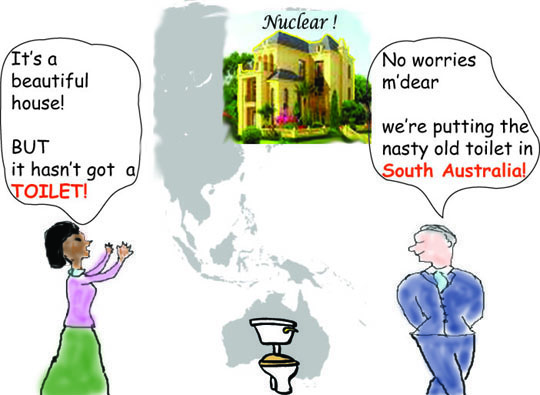
Mixed motives in South Australia’s nuclear waste import plan. Online Opinion, Noel Wauchope, 23 Aug 16 In South Australia the continued nuclear push focusses solely on a nuclear waste importing industry. Yet that might not be economically viable. Behind the scenes, another agenda is being pursued – that of developing new generation nuclear reactors.
First, let’s look at the message. The message from the Nuclear Fuel Cycle Royal Commission (NFCRC) is clearly a plan to make South Australia rich, by importing foreign nuclear wastes. …..This theme has been repeated ad nauseam by the NFCRC’s publicity, by politicians, and the mainstream media.…..
Whereas other countries are compelled to develop nuclear waste facilities, to deal with their waste production from civil and military reactors,that is not a necessity for Australia, (with the exception of relatively tiny amounts derived from the Lucas Heights research reactor).
So, the only reason for South Australia to develop a massive nuclear waste management business is to make money.
If it’s not profitable, then it shouldn’t be done.
Or so it would seem.
There is another, quieter, message. When you read the Royal Commission’s reports, you find that, while the major aim is for a nuclear waste business, in fact, the door is kept open for other parts of the nuclear fuel chain……… Continue reading
1 This month


Help Aunty Sue Protect Her Land and Sacred Sites From Destructive Rocket Testing.
.

Australians deserve the truth
about
AUKUS – https://aukuspublicinquiry.com/

PETITION – To: Prime Minister Anthony Albanese and the Australian Labor Government

of the week – Australians for War Powers Reform (AWPR)
To see nuclear-related stories in greater depth and intensity

