Our Sceptical Observer scrutinises the South Australian govt’s Know Nuclear roadshow
 As of last week there were one million, one hundred and thirty five thousand and seven hundred and eighty one voters on SA roll.
Day one of Roadshow coincided with the publication the day before of The Advertiser 24 p “Nuclear Dossier” hugely pro-nuclear using much of the info as used in roadshow and much much more.Token short pieces by Ian Lowe, Craig Wilkins,Mark Parnell. Free Copies of this available in the cafe area of Know Nuclear booth.
Cover-up of Australia’s Hiroshima -like story – Maralinga
This March, documents obtained exclusively by news.com.au revealed that hundreds of children and grandchildren of veterans exposed to radiation were born with shocking illnesses including tumours, Down syndrome, cleft palates, cerebral palsy, autism, missing bones and heart disease.
Other veterans posted to the Maralinga nuclear test site blamed the British Nuclear Test for an unusually high number of stillbirths and miscarriages among the group.
“The rest of the Aboriginal people in this country need to know the story as well,” “This one’s been kept very quiet.”
Nuclear will be on show at the National Aboriginal Cultural Institute in Adelaide, South Australia from 17 September to 12 November.
 The secret destruction of Australia’s Hiroshima, http://www.news.com.au/lifestyle/real-life/news-life/the-secret-destruction-of-australias-hiroshima/news-story/9eabf722dbe2f87e03a297c2a348a8e1 news.com.au, SEPTEMBER 17, 2016 WHEN nuclear explosions tore through Australia’s vast, arid centre, some people living there didn’t even know it was coming.
It devastated the country for miles around, annihilating every bird, tree and animal in its path.
Even today, the effects of our very own Hiroshima are still felt by the families it ripped apart, and those suffering horrific health problems as a result.
The British military detonated seven nuclear bombs in remote Maralinga, around 800km north-west of Adelaide, plus two at Emu Fields and three off the coast near Karratha, Western Australia.
They also staged hundreds of minor trials investigating the impact of non-nuclear explosions on atomic weapons, involving tanks, gun, mannequins in uniforms and even tethered goats. In many ways, these smaller tests were equally dangerous, spraying plutonium in all directions.
Yet most Australians know very little about the blasts that shattered communities, and the dramatic story now buried under layers of dust. Continue reading
Unpleasant consequences for Australia in setting up international nuclear waste dump?
Paul Richards No High Level International Nuclear Waste Dump in South Australia 17 Sept 16
 What are the probabilities this futurist scenario will unfold via TPP international treaties, setting up a nuclear industry here in Australia controlled by the United States?
1) Strip out State & Federal legislation prohibiting a nuclear industry
2) Legislate to allow US & foreign nuclear submarines to port
3) French Sf/Barracuda sub diesels drive swapped out for reactors
4) Stakeholders in sub reactors to train nuclear engineers
5) Sovereign Capital to fund waste repository and enrichment plant
6) Enrichment plant built next to waste storage [for the world’s unspent fuel including plutonium & weapons grade nuclear material]
7) Commission environmental reports for deployment of reactors
8) Fund reprocessing of unused fuel to fire experimental reactors
Be mindful, defunding of cheap alternative energy systems has already started, as the Federal Government has reduced the ARENA budget; while maintaining carbon energy subsidies and encouraging the nuclear industry sales executives to promote their product
A scenario where the acquisition of nuclear weapons is an obvious long-term objective of our government. Where Australia becomes a platform for not our own Foreign Policy or our sovereign interests, but US sovereign interests, deferring to US Foreign Policy
In doing so, becoming the 52 State of the United States of America by proxy for the Southern Hemisphere
Be aware, the UN Security Council P5; China, France, Russia, United Kingdom, United States and the International Atomic Energy Agency – IAEA police all international nuclear treaties on weapons & reactors
The IAEA answers nuclear weapons, energy and health issues only to the UN Security Council P5.
The World Health Organisation-WHO, sit’s below this chain of command. Since it’s inception in 1946 the WHO, has always sat outside the then WWII Allied “Big Four”; China, Soviet Union, the UK, the and the US hierarchical structure.
This information is on public record easily found scanning the United Nations Portal https://www.facebook.com/groups/1314655315214929/
South Australian Premier off to Finland to visit unfinished and costly nuclear waste facility
 SA premier in Finland to see nuclear dump SEPTEMBER 17, 2016 news.com.au Australian Associated Press South Australian Premier Jay Weatherill has left for Finland to visit the world’s first deep disposal facility for used nuclear fuel as his government continues to grapple with the idea of establishing its own nuclear waste dump.
The facility at Eurajoki is still under construction and is due to open in the early 2020s……..
Mr Weatherill has pledged to outline the government’s final position on the proposal by the end of the year.
Greens MP Mark Parnell said as the premier visits the Finnish facility he should note that it is already nine years behind schedule and 300 per cent over budget.
“Having already wasted $10 million of taxpayers’ money on this folly, the premier needs to seriously consider at what point he allows economic reality rather than fanciful dreaming to enter this debate,” Mr Parnell said. http://www.news.com.au/national/breaking-news/sa-premier-in-finland-to-see-nuclear-dump/news-story/2d96fb49559906a7a162ca58f8710b55
Jay Weatherill dithering on when to make a decision about nuclear waste importing for South Australia
Daniel Wills: Final decision on nuclear waste repository in South Australia could be years away, Daniel Wills, The Advertiser, September 16, 2016 “………A year and a half ago, Mr Weatherill stunned the state and turned decades of Labor orthodoxy on its head by calling the Nuclear Fuel Cycle Royal Commission.
Four months ago, it delivered a final report that concluded an almost unimaginable amount of wealth could be bestowed on SA if it chose to take high-level nuclear waste from around the world and store it for all time.
If a decision to proceed is eventually taken, it would stand as second only to the arrival of whites on this land 180 years ago as the most dramatic moment in SA’s living history.
The first key date will be December this year, because Mr Weatherill has said the Government will reveal a position to State Parliament before the Christmas break. This week, some flesh was put on the bone about what that will be. Likely, a decision to keep talking, if everyone agrees. Continue reading
Your Say – comments on the diseconomics of the nuclear waste dump plan
Paul Laris 31 Aug 2016 I am very concerned that SA may be placed at environmental and/or financial risk if the nuclear waste storage project goes ahead. The business case rests on the assumption of continuing demand for storage over several decades. This cannot be assured. If, over that period there is another nuclear power station catastrophe, or the cost of other renewable sources of baseline power falls significantly, then demand for storage, and income, will shrivel. These are both highly plausible scenarios. I note that Germany is committed to closing all nuclear power stations by 2022.
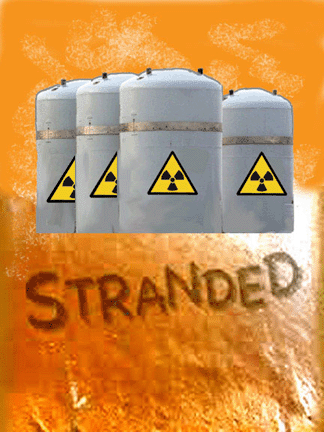 The business case involves temporary surface storage until there is a sufficient accumulation of income to build the very costly underground infrastructure required for safe millenial storage. If demand and income faulters during the next 30 years or so, there is a major risk that we will be left with a large amount of inadequately surface-stored waste – a stranded liability. To leave it that way will be environmentally iresponsible. To store it safely will be financially crippling.
Due dilligence demands we do not proceed to burden our children and suceeding generations with such high levels of risk.
Claire Catt 08 Aug 2016 There is a simple principal question, one needs to ask how a venture relaying on a once off payment of an uncertain amount could be viable when costs are unknown but certainly lasting for thousands of years. How could that ever add up.
I would speculate the money won’t last to actually pay for any underground storage many years hence.
There is certainly no precedent of any Government ever being able to manage a large amount of money responsibly so far into the future. And most certainly not this Government.
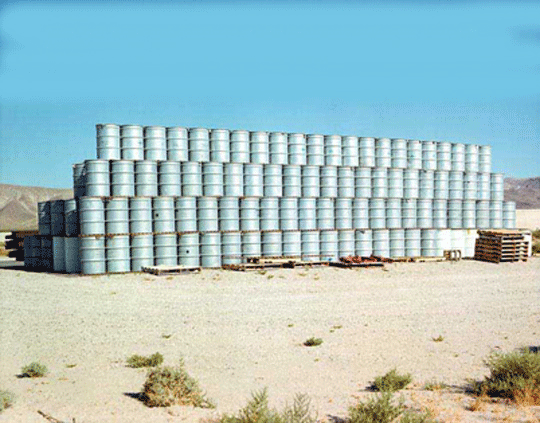 So even to the average person, the economics look shonky. The risks however are crystal clear! Several above ground ‘temporary’ storage sites all over our state for a very very long time to be guarded and somehow kept from all forms of life for thousands of years.
Really, it’s unbelievable our own Government is even thinking about it. Money, even if it was there, doesn’t come into it. The nuclear industry needs to get out of this country and stop spreading their horrendous problems all over this world.
Claire Catt 14 Aug 2016 It is utterly unpredictable what the longterm maintenance and security costs of such a large and dangerous dump would be. All figures in the Royal Commission’ Report are speculative and untested. The optimistic promises of riches reek of bias and manipulation.
There is far more opportunity in South Australia in a clean and green future with a healthy, involved and participating population. We don’t want a dirty secretive industry here which will endanger the longterm well being of us all.
Mary-Ann Lovejoy 29 Aug 2016 The economics of this proposal IMO seem highly speculative. I understand they have not even been costed by someone reputable and independent of ANY bias (pro or con.)
 I understand not even Treasury have been permitted to examine the figures – perhaps Belinda could answer that question definitively? Or tell us if that will happen, before we go any further in the debate of economics?
Nick Xenophon responded to my query on his nuclear position – he replied he did not support this proposal as the “alleged” benefits were outweighed by the potential risk. Given it’s such an important topic for his/our state, I’m sure he will have examined the figures well, prior to his statement of position.
What runs often through my mind, in discussion of nuclear, is the Deepwater Horizon oil disaster off the USA coast, where the technology that was stated to be beyond reproach caused a huge disaster. The costs, (environmental, economic and social) were devastating, and the company responsible did its best to avoid liability for the cleanup. That frightens me, as not only would our state be devastated by such an event (nuclear waste accident, terrorist attack, human error, equipment failure, whatever the cause) , but how could it be cleaned up? Is it even possible to do so? And what of the resultant cost? Surely it would bankrupt our state?
Like Xenophon, I think the benefits are speculative, and the potential risks too great.
I demand a vote of all citizens before this proceeds any further, to test community consent. If there’s not initial consent, how on earth can there be “on-going consent”? important.http://nuclear.yoursay.sa.gov.au/get-invol…/statewide-survey
Your Say. Nuclear Commissioner Kevin Scarce biased: supporter of nuclear waste dumping
Your Say: Nuclear waste deal – stealthy plan to get nuclear submarines?
 Steve Charles 13 Sep 2016 I suggest the real reason behind turning SA into a high level nuclear waste dump is that the SA Government knows that the submarines to be built in Adelaide are already a nuclear design and will need to be converted to diesel, but this is difficult and costly. Perhaps they are wanting to get nuclear submarines by stealth, but will need somewhere to dump the spent fuel. We cannot trust this government. See: http://www.abc.net.au/news/2016-09-13/dick-smith-questions-submarines-project-over-nuclear-power/7837946 important.
http://nuclear.yoursay.sa.gov.au/get-invol…/statewide-survey
Your Say: brand South Australia to be irrevocably smirched by nuclear waste dump
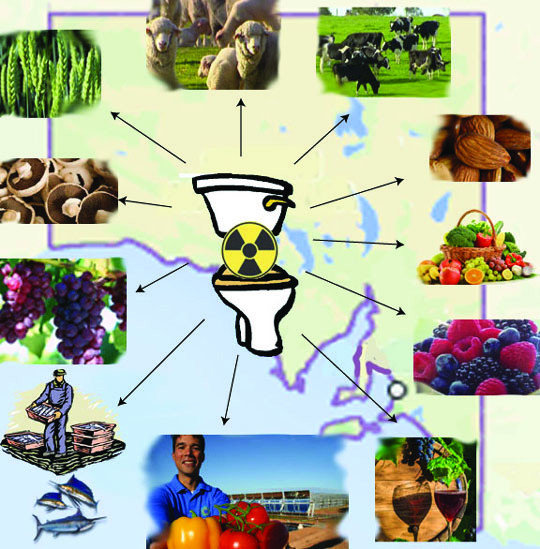 adrian hill 04 Sep 2016 Safety isnt what we should be worrying about
Our brand is more at risk. We want to be known for our great food and wine. While there is not risk at all the waste will reach anywhere near our food chain, we know the how the media can paint a city. I’m concerned that SA will be rebranded as the waste dump state which could affect our tourism. It wouldnt bother me if we could redraw the boarders so the area is not our state. Could it be an independant state like canberra? Or do we name a town where the dumping will occur and push the name of that town rather than associate with SA….google ‘snowtown important.
http://nuclear.yoursay.sa.gov.au/get-invol…/statewide-survey
Your Say: Comments on safety in importing nuclear wastes
 Lachlan Childs 14 Sep 2016 We are not a rich country, we don’t have money to just throw in the air. A Nuclear waste dump would not only harm the environment, and radiate the land for future generations, but it would put the country into bankruptcy. The nuclear waste dump may in fact cost millions of dollars just to set up and manufacture. I understand that the government will then say “Oh! but if we go forward with the Nuclear Waste Dump, a total of $279 billion dollars with be made,” Yea but at the risk of thousands being affected by radiation and if the shipping makes a mistake which could possibly happen, Australia would become another wasteland.
Marisol Da Silva 12 Sept 16 People predicted the Fukushima accident could happen years before it did happen. Chernobyl had it’s disaster because of human error. Because, as humans we do get it wrong. Years after both of these major catastrophes it is still costing money to maintain, clean up, not to mention the health issues of the people and children left behind to live with nuclear devastation. To this date there has been no real solution on how to store nuclear waste. It has been proven that it costs way to to much to plan, build, maintain now and far into the future as this stuff is going to stick around for what is essentially a forever (far beyond several human lifespans and our imaginations into the future). With all the information out there on radiation sickness and the unpredictability of natural disasters occurring, how can anyone hold a straight face and claim nuclear waste, power, mining, bombs are safe? Because ultimately all these things are linked. If you feel you have forgotten then ask the children of Chernobyl and the former USSR, Fukushima, the Marshall Islands, the survivors of the atomic bomb, British Maralinga SA tests, the tribals in Jagugoda Jharkhand India, and the list goes on. We don’t learn. Why don’t we learn from their stories? Why do you think South Australia suddenly will solve what no one has solved? Do you think future children are ever going to thank you for even entertaining this idea? It is a shame that a few greedy people can ruin the earth for the rest of us. We can’t let this happen. We wont let this happen here.
Craig Gordon 01 Sep 2016 I have a question relating to sea transport and geology.
When I stopped at a “Know Nuclear” stand recently the person I spoke to mentioned that with 10km’s of the coast lost cargo would be retrievable.. but past that it wouldn’t be accessible/safe/whatever to bring the waste back to the surface.
She wasn’t quite sure how to answer my follow up question though.. (her expertise was physics, not geology).
My (limited) understanding is that unlike continental crust, which is stable, oceanic crust is constantly being subducted into the core of the earth into the mantle… I understand the rate of this is slow.. but I was wondering how that process might relate to any high level waste that was lost at sea?
http://nuclear.yoursay.sa.gov.au/get-invol…/statewide-survey
With careful planning, Kangaroo Island could be independent with renewable energy
A balanced local electricity supply solution and a transition to 100% renewable power could deliver a range of economic development and other benefits to the local community.
 Kangaroo Island’s choice: a new cable to the mainland, or renewable power, The Conversation, Chris Dunstan September 16, 2016 South Australia’s iconic Kangaroo Island, the site of Australia’s first free settled colony, could pioneer a new age of renewable energy, according to our new research.
The first hardy settlers in 1836 had to decide whether to go it alone with a settlement on the island or revert to the mainland. Today, the 4,400 or so people who call the island home face a similarly stark choice: energy independence, or continued reliance on the mainland.
On one hand, the ageing existing cable could simply be replaced, at a cost of between A$22 million and A$50 million. This is the “preferred network option” proposed by the local electricity distribution network, SA Power Networks (SAPN).
On the other hand, SAPN is also currently considering an alternative mix of local wind, solar and biomass generation, complemented by diesel generation, battery storage and demand management. Continue reading
Your Say: Immoral and illegal for Jay Weatherill to spend taxpayer money to promote nuclear waste dump
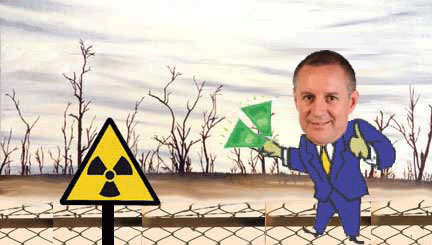 Peter Lazic 12 Sep 2016 What consent does Jay Weatherill have to spend $600 million dollars of taxpayer money to plan a nuclear waste dump, when the proposed dump may never get approved. This and the money spent to date on the Royal Commission, the road show, now TV advertisements, etc, is obscene and immoral
Ed note : Especially as the SA Law says:
13—No public money to be used to encourage or finance construction or
operation of nuclear waste storage facility Nuclear Waste Storage Facility (Prohibition) Act 2000https://www.legislation.sa.gov.au/LZ/C/A/NUCLEAR%20WASTE%20STORAGE%20FACILITY%20(PROHIBITION)%20ACT%202000/CURRENT/2000.68.UN.PDF
http://nuclear.yoursay.sa.gov.au/get-invol…/statewide-survey
When will Premier Weatherill admit that the nuclear bonanza is a really bad idea.
an illusion http://www.adelaidenow.com.au/news/opinion/margaret-beavis-claims-south-australia-will-make-a-fortune-out-of-nuclear-waste-are-just-an-illusion/news-story/de432ce34d9deac7cfbfab406ec32c71 Margaret Beavis, The Advertiser September 13, 2016 THE acclaim around the pot of gold to be made importing nuclear waste into South Australia increasingly feels more like an illusion.There are so many invisible parts making up this story, it is probably only a matter of time before Premier Jay Weatherill finds the courage to say the nuclear bonanza is a really bad idea.
So what are these invisible items?
Firstly, there are no high level nuclear waste facilities anywhere in the world. None. Anywhere.
Both Germany’s efforts have leaked radiation into the water table, and they are currently spending billions pulling the waste out again.
 In Nevada, the US government has spent over US$10 billion building a site, only to find multiple problems including deliberately falsified data about the water table, and massive community opposition. It will never open. The Waste Isolation Pilot Plant in New Mexico closed two years ago after a fire and later an explosion exposed 22 workers and contaminated the whole site. Official investigation found cost cutting, corner cutting and human error was to blame, with a “loss of safety culture”.
The high level nuclear sites in Sweden and Finland were described by the recent Nuclear Fuel Cycle Royal Commission in South Australia as “successful”.
These locations have been researched for 40 years, and will not even start taking waste for at least another six years and, in the Swedish case, well over a decade. It is easy to succeed when there is no radioactive stuff to actually deal with.
 For the last forty years we have counselled pregnant women to avoid X-rays as we know their babies have much higher rates of leukemia.
Evidence from Hiroshima and Nagasaki, from vast human trials literally involving hundreds of thousands of nuclear workers to research about Cat scans and nuclear heart scans, all point to significant harms with additional radiation.
There is no evidence of a safe lower dose; the higher the exposure the higher the risk.
And recent large research trial found rates of stroke and heart attack are also increased.
There is a good reason why countries want so badly to be rid of this material, which is toxic for over 100,000 years.
Thirdly, we have nowhere to put it.
The plan is to import it, and then find some poor remote community to take it.
The problem with that theory is that for almost twenty years the government has been looking for a site for Australia’s own intermediate level waste, without success.
 Aboriginal communities have been disproportionately targeted. We clearly already have more nuclear waste than we know what to do with.
Finally the promised billions, so pivotal to the whole proposal, are risky.
They have been modelled by a firm that works in this area and has potentially a strong vested interest in this venture going ahead
They have not allowed for potential competition, which would massively reduce the prices paid. They have included countries like Ukraine as clients, when Ukraine is looking into building its own facility at Chernobyl.
They have included countries like Bangladesh, which does not even have a reactor yet.
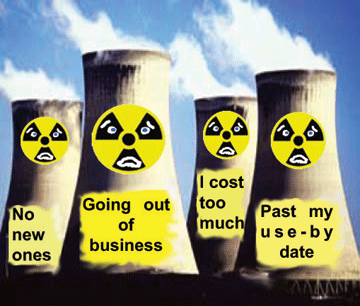 And it has made assumptions about the viability of the nuclear power industry, when plants in places like the US are closing down as they cannot compete financially.
Nuclear waste facilities are very expensive to build, and historically costs inevitably blow out. For example, in the current French waste construction project costs have doubled in the last decade.
There has been no independent financial modelling done by the government, which is extraordinary given the enormous financial risks and the extraordinary time frames.
And the income to cover the clean up — decommissioning and other costs — does not start until 2042.
In essence, this proposal is startling in its optimism.
The likely outcome if it goes ahead is a whole lot of highly toxic radioactive waste lasting for 100,000 years in South Australia, and billions of taxpayers’ money spent trying to find a way that works to get rid of it.
If it is such a financial bonanza, many countries would be racing to do it.
The reality is that a royal commission, lots of clever marketing, 100 consultation sites and a couple of citizens’ juries still don’t make this a smart idea.
Margaret Beavis is president of the Medical Association for Prevention of War
South Australian govrenment sucked in by the Small Modular Nuclear Reactor lobby?
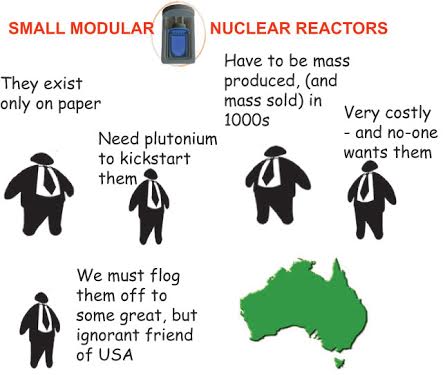 The SA Government’s “Energy Market Transition Plan”, obtained by Freedom of Information request, has revealed that prospects for small modular nuclear reactor deployment in South Australia have been explored.
SA government probes nuclear option as Premier Jay Weatherill promises cheaper power https://au.news.yahoo.com/video/watch/32558838/sa-government-probes-nuclear-option-as-premier-jay-weatherill-promises-cheaper-power/#page2
7News Adelaide September 7th, 7 News can reveal a top level report clearly indicates small scale nuclear reactors have been on the short term radar. Mike Smithson reports
An expert witness to the Nuclear Citizens Jury – sceptical of the “economic bonanza”
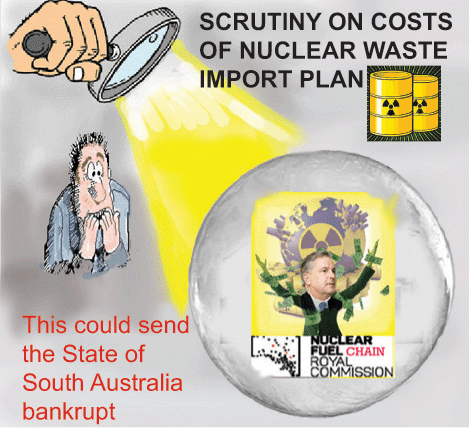 The price is a guess; there is no market price for accepting dumped waste at the present time.
The cost of shipping the waste to South Australia seems also to be a notional allowance in Appendix J ($0.20m/tonne heavy metal). Where this comes from is not obvious.
far from being a financial bonanza, as proposed by the Royal Commission, the project could make minimal returns, and be a real distraction from alternative paths to the economic future of the state
The SA economy, the nuclear waste dump and democracy Richard Blandy INDaily, 12 Sept 16 ANALYSIS As TV messages encourage South Australians to become informed about a proposed nuclear waste dump, Richard Blandy argues the project could prove a distraction from exploring alternative solutions to the state’s economic challenges.
Several times in recent days I have seen a brief message on our TV in which a South Australian mother advises her small daughter that everyone must become informed about the proposed high-level nuclear waste dump in the state. Her daughter looks suitably mystified.
No doubt this is part of the exercise in citizens’ democracy that is currently underway to determine whether there is a “social licence” to proceed with such a dump. Other elements in this process include two meetings of citizens’ juries (one of which has already been held), as well as citizens’ information meetings.
The TV message could have come from the satirical 1970 movie The Rise and Rise of Michael Rimmer, in which conman Rimmer (Peter Cook) eventually becomes British Prime Minister. …….
my experience of the first citizens’ jury, which I attended as an expert witness on July 9, was very positive. I was invited principally as a result of my InDaily articles opposing the dump.
There was one other expert economics witness present questioning the economics of the dump: Rod Campbell, research director of the Australia Institute in Canberra.
Several of the expert witnesses present who supported the economics of the dump had been involved in undertaking the economic/financial analysis for the Nuclear Fuel Cycle Royal Commission.
The citizens’ jury operated as a free-flowing discussion rather than with set pieces presented by the witnesses followed by questions from the jurors. The issues are difficult and technical, but the jurors were great. They made me think that if I am ever in deep trouble with the law, I will always opt for trial by jury.
The 54 South Australian citizens on the jury were sensible, common-sense people who asked pertinent questions. They quite properly insisted that the business case for the dump should be made watertight – or the dump abandoned. Continue reading
1 This month


Help Aunty Sue Protect Her Land and Sacred Sites From Destructive Rocket Testing.
.

Australians deserve the truth
about
AUKUS – https://aukuspublicinquiry.com/

PETITION – To: Prime Minister Anthony Albanese and the Australian Labor Government

of the week – Australians for War Powers Reform (AWPR)
To see nuclear-related stories in greater depth and intensity

