Questions about Senator Sean Edwards’ nuclear waste proposal
 Nuclear Fuel Cycle Watch, Andrew Allison July 21 Rumour has it that once of the anonymous countries that Sean Edwards will not name is South Korea. One might speculate about where the money for Sean Edwards’ very glossy submission to the NFCRC came from? ….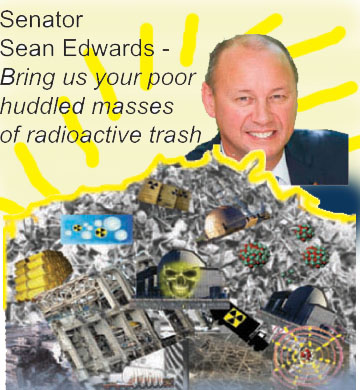
I have many reservations about Sean Edwards’ proposal, but two obvious questions come to mind:
1/ If the deep-underground storage of nuclear waste is a “solved” problem and South Australia can supposedly acquire and implement the technology at low cost (leading to high profits…) then why can’t South Korea do that?
2/ If the generation IV reactors are going to solve the waste storage problem then why can’t an advanced technological country like South Korea do that? https://www.facebook.com/groups/1021186047913052/
Nick XenophonTeam backs 40pc renewables
Xenophon party backs renewables but wants Senate electricity inquiry The Australian July 25, 2016
NXT federal MP Rebekha Sharkie, who won the Adelaide Hills seat of Mayo from Liberal Jamie Briggs, said the party was committed to the renewables target, but NXT wanted a Senate inquiry into electricity prices “so we can get the arguments on the table and look to a solution”.
Ms Sharkie believed a second interconnector between South Australia and the eastern states could help the situation, though it had been discussed for 15 years without action…….http://www.theaustralian.com.au/news/nation/xenophon-party-backs-renewables-but-wants-senate-electricity-inquiry/news-story/3a2920c0274a22994f377395acb6b5bc
Will Australia’s new Resources Minister Matt Canavan really listen to Aboriginal people?
 Matt Canavan has now the opportunity to correct these mistakes and engage in a truly inclusive and transparent process which actually listens to the concerns of the community and other stakeholders. Although a nuclear proponent, he should ensure that this process is not dealt with light-heartedly and pays attention to all aspects involved.
This would best be achieved through an independent inquiry into Australia’s nuclear waste and options for managing it.
Aboriginal communities all across Australia have sustainably managed the land for thousands of years, longer than any other group of people can claim. Their knowledge and concerns are valuable. Let’s hope they will be listened to.
3rd Minister in two years to handle Australia’s nuclear waste dump http://www.onlineopinion.com.au/view.asp?article=18394&page=0 Anica Niepraschk – , 22 July 2016 The recent federal election has once more seen a bit of a reshuffle in PM Turnbull’s cabinet and thereby thrown the portfolio for Australia’s national radioactive waste dump in the hands of another Minister for the third time in less than two years.
After 20 years of failed siting processes for the proposed dump, then Industry and Science Minister Ian MacFarlane only announced a new attempt in November 2014. The first half of last year saw a voluntary nomination process happen where landowners across Australia could propose their property to host Australia’s low and intermediate level nuclear waste. Out of the 28 sites nominated, six were shortlisted for further consultation and investigation last November. All six site nominations were highly contested by the local communities.
Although the government, with its new ‘voluntary’ approach promised to not impose a nuclear waste dump on any community and therefore rely on voluntary nominations and community consultation, one of these six sites, Wallerbidina/ Barndioota in the Flinders Ranges, SA, made it to the next stage of the process, despite the strong opposition of the local Adnyamathanha community at Yappala station, just kilometres away from the site.
Not only chose the government to once again, after pursuing Coober Pedy from 1998 to 2004 and Muckaty in the NT from 2005 to 2014, to target an Aboginial community but it also chose a culturally highly significant site. The proposed property, nominated by former Liberal Senator Grant Chapman, is part of a songline and hosts many cultural sites, including the beautiful Hookina springs, a sacred women’s site for the Adnyamathanha. The local community remains actively connected to the maintenance and preservation of the land and is documenting and preserving their culture and history through recording traditional heritage sites and artefacts and mapping storylines in the area. Continue reading
South Australia: Resuscitating a Nuclear Waste Nightmare
The project to bury the world’s nuclear poison in the heart of the Australian desert has not sprung out of a void. It is an idea that has been insidiously festering for two decades in a variety of incarnations.
The first stirrings of the hellish project to turn Australia into the world’s nuclear dumping ground emerged in the late 1990s when Pangea Resources, a U.K. based company promoted the construction of a commercially-operated international waste repository in Western Australia. The project was supported by a $40 million budget, 80% of which came from British Nuclear Fuels Limited (wholly owned by the U.K. government), with the remaining 20% from two nuclear waste management companies.
Australia’s Overflowing Nuclear Waste Dumps
One of the more disturbing elements of the Royal Commission report is its explicit endorsement of the progressive nuclearisation of the planet over the course of the next century. But given the make-up of the Royal Commission, this comes as no surprise.
Poison In The Heart: The Nuclear Wasting Of South Australia Counter Currents by Vincent Di Stefano — July 22, 2016 “……..It is a curious thing to observe the confidence with which the recent Nuclear Fuel Cycle Royal Commission has embraced the promotion of South Australia as the ideal destination for over one third of the world’s accumulated stores of spent nuclear fuel. This spent fuel, together with the 400,000 cubic metres of intermediate-level nuclear waste that the Royal Commission recommends be transported to South Australia, represents a problem that nations with decades-long histories of nuclear energy production have failed to resolve. The entrancement induced by a whiff of billions of dollars of new revenue presently has a closed circle of nuclear advocates and politicians straining to persuade the people of South Australia to obligingly make their way as latter-day lemmings towards a dangerous and uncharted nuclear abyss.
In the short term, the Commission calls for the transportation of vast tonnages of highly radioactive materials from around the planet for decades-long storage in above-ground facilities. In the longer term, it proposes the construction of a deep underground repository for the “permanent” burial of the most dangerous wastes produced by a destructive and senescent civilisation. Continue reading
How much is the South Australian government spending on its pro nuclear extravaganza?
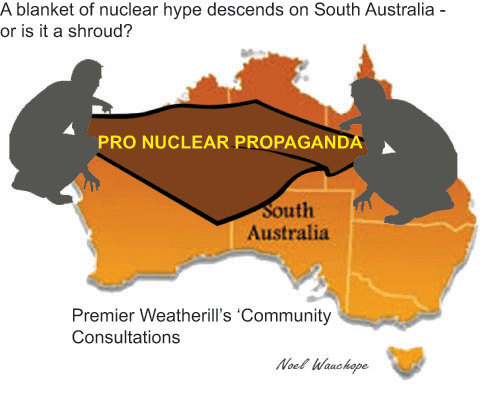
 What I’m worried about is the amount of tax-payers’ money that is going into this State-wide nuclear brainwash. Is Premier Jay Weatherill squandering so much of the State’s coffers on this fool’s enterprise that he and the rest of the politicians will feel that they MUST go on and complete the damn thing – commit to an international nuclear waste dump? Current estimate is $13 million. But will it be more?
From July 29 to October 20 they will be sending teams of nuclear spruikers all over the State of South Australia.
Teams from Nuclear Fuel Cycle Royal Commission Consultation and Response Agency will be there to spread the jolly word of the biased Nuclear Fuel Chain Royal Commission. Who’s on this Agency anyway? Can we expect to hear, yet again, from Greg Ward and Chad Jacobi giving their polished pro nuclear spiel? Will there be deceptive and trivialised presentations on the healthiness of ionising radiation – as there were at the recent Citizens’ Jury hearings?
Adelaide: the next steps in South Australia’s nuclear brainwash
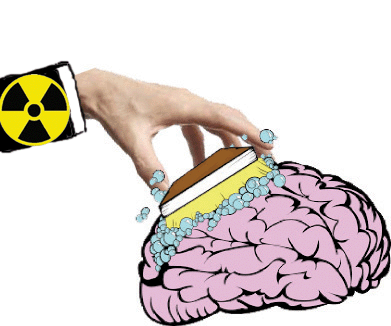
The next step in the international nuclear waste dump campaign from the government is “community consultation” and they are visiting 100 sites around SA. People’s opinions will be used to gauge whether there is community consent or not.
South Australia to get world’s biggest solar + storage project
 World’s biggest solar + storage projects planned for Australia http://reneweconomy.com.au/2016/worlds-biggest-solar-storage-projects-planned-australia-95528 By Giles Parkinson on 19 July 2016 Australian infrastructure investor Lyon Group says it plans to build the world’s biggest solar plus storage project in South Australia in the next two years, and sees a huge future for combined solar and battery storage plants..
Lyon Group’s David Green – which worked on developing a soon-to-be built 30MW solar plant and 1.4MW/5.3MWh lithium battery storage facility near Cooktown, in far north Queensland, before selling it to German-based company Conergy – plans a series of other projects and claims a pipeline of more than 300MW of solar and up to 60MW of battery storage.
The first new project is planned for South Australia, with a 100MW solar PV plant to be combined with a battery storage array of up to 40MW, Green says the plant could be in operation near Roxby Downs by early 2018, and there are plans for other similar projects around the country.

The first stage of what is known as the Kingfisher project – 20MW of solar PV plus a minimum 2MW battery storage – is expected to be running late next year.
The project is one of the finalists in the Australian Renewable Energy Agency funding round for large scale solar, which is expected to allocate monies to 10 or more projects when decisions are announced next month.
Green says the company – which has previously invested in coal, gas and wind projects, but is now specialising in solar and storage – is looking to be a global industry leader in solar plus storage.
“The genie is out of the bottle. There will be a burst of activity now in large scale solar + battery projects. This is the real battery storage story coming out of Australia – batteries used to convert large scale solar to effectively baseload, or peaking plant.”
The combination of solar and storage means the facilities can compete on two levels – providing clean energy and dispatchable power, either to household or large energy users, and also re-enforcing the edge the grid, in some cases avoiding the costs of grid upgrades. Continue reading
Nick Xenophon wants inquiry in South Australia’s renewable energy issues
Nick Xenophon blames SA energy woes on ‘bad’ renewables rules, AFR, by Angela Macdonald-Smith, 20 July 16 South Australian Senator Nick Xenophon says the state’s energy problems are due to “bad decisions” in the design of the renewable energy target legislation that failed to take into account the impact of more intermittent generation on wholesale prices……..
Mr Xenophon said he would raise the suggestion of a Senate inquiry into renewable energy to consider issues as to whether some types of energy should attract a higher weighting in renewable energy certificates if they produced more reliable power, and to consider potential incentives for battery storage.
SA Treasurer Tom Koutsantonis says those blaming the state’s energy woes on its push into renewables have “completely misunderstood” the situation and insists the fault lies in the lack of a real national electricity market.
South Australia’s coming renewable energy revolution- Craig Wilkins at Parliamentary Inquiry

83-Percent Of south Australia’s Electricity From Wind last weekend
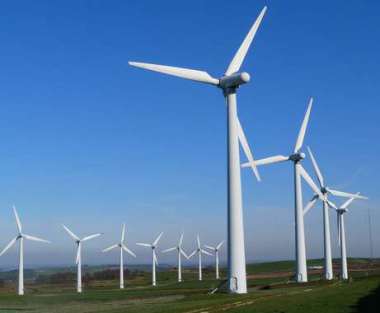 South Australia Just Produced 83-Percent Of Its Electricity From Wind Energy HTTP://WWW.HEXAPOLIS.COM/2016/07/16/ BY: SUKANYA MUKHERJEE JULY 16, 2016
Thanks to a particularly windy weekend, South Australia recently saw nearly 83-percent of its total electricity coming solely from eco-friendly wind energy. Although the harsh weather conditions led to power outages in some of the places, its advantages far outweigh the temporary inconvenience. According to officials, wind turbines installed in the area captured much of the ambient energy, which was used to meet more than two-thirds of the region’s total electricity demands last Monday.
When it comes to renewable power, South Australia is one of the front runners, boasting both solar and wind energy. Investments of up $6 billion have resulted in the installation of as many as 638 wind turbines in the area. According to Alicia Webb of Australia-based Clean Energy Council, an organization dedicated to improving renewables and conversion efficiency, the industry has also generated “hundreds” of jobs. Given the current trend, the region will soon see wind and solar power overtaking conventional fossil fuels. Webb said:
Southern Australia…is in the midst of a remarkable transformation, with more than 40 percent of its power needs coming from renewable energy last year. It is clear that modern economies can run on increasingly higher levels of renewable energy, and it is clear from South Australia’s example that other mainland states can go much further with no loss of reliability.
With oil and volatile gas prices skyrocketing in recent years, wind turbines in South Australia actually help produce electricity at lower costs, especially during windy weather. As pointed out by Webb, the area’s total “installed solar capacity” will likely reach five gigawatts in the coming months. These steps are part of the government’s efforts to meet the targets declared in the Paris agreement. In addition to renewables, researchers in South Australia are coming up with new, innovative technologies that could in turn help reduce environmental pollution. Via: CleanTechnica
South Australian Liberals keen to obstruct wind energy projects?
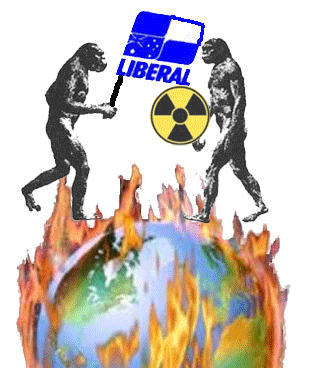 Libs pushing for wind farm changes
ALL new wind farm projects would have to undergo an assessment to see how they would affect the electricity market before being approved, if changes proposed by the Opposition were adopted…. (subscribers only )
http://www.adelaidenow.com.au/news/south-australia/sa-liberals-pushing-for-all-new-wind-farms-to-be-assessed-for-their-impact-on-the-electricty-market/news-story/c52442ad2d7640d9b23ee4372b75eb6a
South Australia’s Premier Jay Weatherill and his Citizens’ Jury Nuclear Deception
 Weatherill trumps up Citizens’ Jury Report in push for SA nuke waste dump, Independent Australia 15 July 2016, Noel Wauchope, who has been covering the Nuclear Fuel Cycle Royal Commission for IA, calls SA Premier Jay Weatherill out over a sleight of hand following the Nuclear Citizen’s Report this week.
SA Premier Jay Weatherill received the Nuclear Citizen’s Jury Report on 10 July. He said that it was a “commonsense” report and that:
“they [the jury] are asking us to also change the legislation to undertake that work”
(i.e: the work of investigating overseas markets for sending nuclear wastes to South Australia)
Here’s where the sleight of hand comes in. That call to change legislation did not come from the Citizens’ Jury. It came from the pro-nuclear Nuclear Fuel Cycle Royal Commission (NFCRC), and the jury was merely doing its appointed task — which was to paraphrase the NFCRC’s recommendations. Throughout the jury process, the jury members were reminded that they had no brief to make any decisions or recommendations and they conscientiously stuck to that rule.
Now I think we know why Weatherill was so adamant that this group be called a “jury”. A later group of 350 members, will also be called a “jury”. There is some possibility that this number 350 could be taken as an adequate sample of the South Australian population of 1.712 million. So again, by regurgitating the NFCRC’s recommendations, this might conceivably be portrayed as the “verdict”of the people. That’s a lot safer than a referendum. …….
NFCRC is over, and finished, but hey — not so! The next move is a massive public advertising process and this kicked off with the recent Citizens’ Jury, which, while being organised by the South Australian firm DemocracyCo, was master-minded and controlled by NFCRC personnel. The witnesses were predominantly pro-nuclear, speakers from NFCRC were prominent and NFCRC staff were present at many, if not all, sessions.
Several times, during hearings, and Q and A sessions, the jury was reminded of the necessity to change State and Federal legislation.
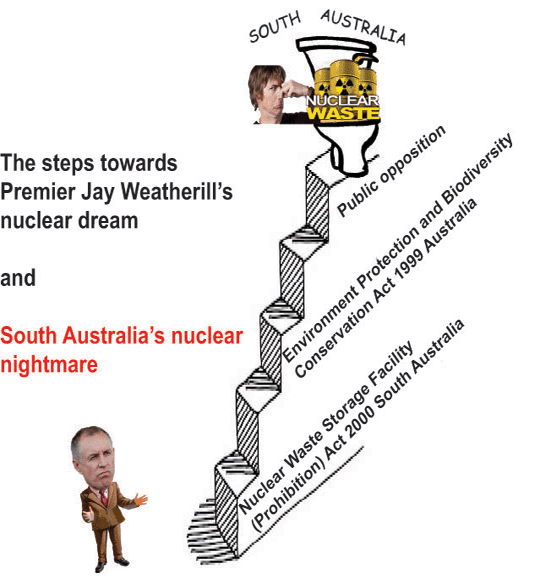
This process had, in fact, already begun, with legislative change that had to be made retrospective, seeing that the government had already spent $7.2 million on the Royal Commission. It is rare for legislation to be made retrospective. As the Greens’ Mark Parnell commented:
‘The retrospective clause is basically saying that if anyone did anything illegal we now legalise it.’
The South Australia Nuclear Waste Storage Facility (Prohibition) Act 2000 used to say:
13 — No public money to be used to encourage or finance construction or operation of nuclear waste storage facility
(1) Despite any other Act or law to the contrary, no public money may be appropriated, expended or advanced to any person for the purpose of encouraging or financing any activity associated with the construction or operation of a nuclear waste storage facility in this State
This section was amended in May 2016. The government wanted to remove Section 13, altogether. However, after several efforts on this, (Greens’ Mark Parnell objecting), Section 13 was amended, to include a new provision:
‘(2) Subsection (1) does not prohibit the appropriation, expenditure or advancement to a person of public money for the purpose of encouraging or financing community consultation or debate on the desirability or otherwise of constructing or operating a nuclear waste storage facility in this State.’
That was a small step forward for the nuclear cause.
Now for a bigger step. The government needs to drastically amend the South Australia Nuclear Waste Storage Facility (Prohibition) Act 2000. Later on, they need to get changes made to the national legislation — The Environment Protection and Biodiversity Conservation Act 1999 (the EPBC Act). They’d probably like these national powers to be removed and have these topics placed under State laws.
In building their argument for changing the law, the Weatherill Government needs to gather persuasive evidence about the proposed economic bonanza to come from importing foreign nuclear wastes. That means another round of expensive trips overseas, and a lot of advertising and promotional meetings in South Australia.
All this can now be justified, because, according to the government, the Citizens’ Jury called for more information, especially on economics, and even more importantly, called for changing the law on importing nuclear waste.
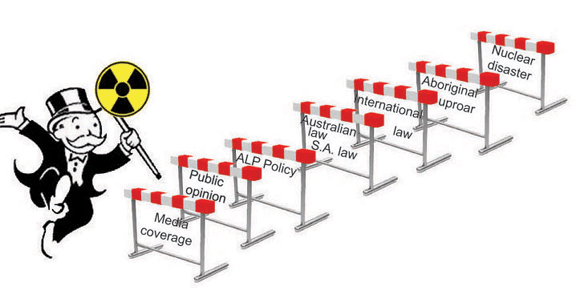
The fact that this jury group diligently summarised the Royal Commission report, without themselves making any recommendations, will almost certainly get lost in the onslaught of pro-nuclear hype that is about to descend upon the South Australian population. https://independentaustralia.net/environment/environment-display/weatherill-trumps-up-citizens-jury-report-in-push-for-sa-nuke-waste-dump,9237
Craig Wilkins, Conservation Council of South Australia, at parliamentary Nuclear Inquiry
Citizens Jury Panel 1: Craig Wilkins
 TRANSCRIPT OF EVIDENCE TO SOUTH AUSTRALIAN PARLIAMENTARY
  COMMITTEE, 15 July 16
 No Profit in Nuclear waste
- A minimal safety margin requires that high level waste not be imported before an agreed licensed geological disposal site…
- High level nuclear waste disposal costs can double in a decade…..
- Dubious claim that disposal of nuclear waste in SA costs one quarter less than in experienced countries….
- SA faces a $60 billion debt in costs across 37 years of ongoing nuclear waste storage operations and nuclear facility decommissioning after the last receipt of overseas revenues for waste imports….
- Nuclear contingency costs are unfunded…
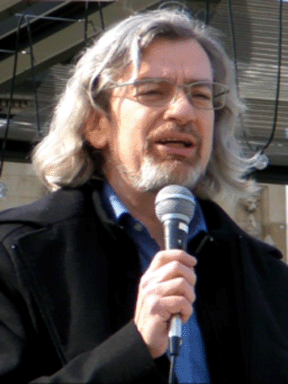 Brief (July 2016) by David Noonan, Independent Environment Campaigner
South Australians are being misled by inflated revenue claims, untenable assumptions and under-reported nuclear waste costs. Reality check analysis shows there is no profit in nuclear waste.
Nuclear waste costs are fast rising and unrelenting for decades after the last recite of waste imports regardless of whether or not claimed revenues and fixed prices over time prove to be realistic or illusory.
The Nuclear Royal Commission Final Report Ch.5 “Management, storage and disposal of nuclear waste” and the Nuclear Commission Tentative Findings Report (p.16-20) present a nuclear waste baseline business case that is near solely reliant on a consultancy “Radioactive waste storage and disposal facilities in SA” (Feb 2016) by Jacobs MCM, summarised in Final Report Appendix J.
There is no market based evidence for the Final Report revenue assumptions and claimed income.
Claimed revenues are a tonnage based multiplier: inflated tonnage equals misleading revenues.
Claimed revenues are doubled by an assumption SA can take twice the waste the US failed to achieve. Continue reading
David Noonan at Parliamentary Nuclear Committee- “waste plan is based on misleading assumptions”
JOINT COMMITTEE ON THE FINDINGS OF THE NUCLEAR FUEL CYCLE ROYAL COMMISSION
If I could make a key point of guidance for the committee’s consideration and due deliberations and any recommendations that you would make, I draw your attention to the objects of the Nuclear Waste Storage Facility (Prohibition) Act 2000 which states:
…”to protect the health, safety and welfare of the people of South Australia and to protect the environment in which they live”…
The act then goes on to prohibit certain classes of nuclear waste storage and disposal facilities. I think that recommendation, those objects to protect the health, safety and welfare of the people of South Australia and the environment in which they live, should be the overriding guidance that this committee considers in how you address the findings of the nuclear royal commission and the business case as presented by the Jacobs Consultancy which is I think the primary matter that lies behind the nuclear commission’s findings and final report.
In my opinion, the nuclear commission, the findings and the final report, and the Jacobs Consultancy on which it is heavily reliant, present a number of assumptions which effectively mislead the public.
The project is projected to be at an inflated scale which has significant consequences both for the reality of the project but also for the claimed revenues. The revenues in this matter are a tonnage-based revenue multiplier. By Jacobs proposing that the world’s largest ever nuclear waste project in the world—the Yucca Mountain project in the USA, a project which failed and was cancelled by President Obama in 2009—could be doubled in scale has a significant question as to whether that is remotely reasonable, realistic, and whether that is a matter that effectively doubles the claimed revenues for the project. If this project had started with a proposal to equal the world’s largest ever proposed nuclear waste project, then the revenues would be half what they are presented in the report—half the numbers that are presented in the report—just on that step alone, that reality test of not exceeding what has ever been envisaged before in terms of scale of nuclear waste projects around the world. The project essentially also maximises aboveground storage, and I believe that compromises safety and it is an unnecessary step.
I believe that in a more realistic scenario, in more realistic time lines where this national matter—a matter that has no mandate to proceed—a matter that would not just realise bipartisan political support at state and federal level, it also needs to realise independent oversight and federal regulation. I believe it would have to be federal regulation and not state regulation. The state could be seen to have a significant conflict of interest in attempting to regulate this matter. Overseas players, whether it is the IAEA, client countries, and the public expectations in those countries, would reasonably expect as do the international conventions that such matters of highlevel nuclear waste be managed by a federal government and a federal authority, not by state.
I think that it is reasonable to project that that independent oversight would require a number of key steps and different time lines and different decision point assumptions than what are presented in the Jacobs report and the nuclear commission findings. The key one of those, I think, is that as an absolute minimum independent oversight would require that Australia not accept high-level nuclear waste prior to having an agreed licensed site for the potential geological disposal of that waste. That is a really key fundamental step that I believe public confidence, public consent, political support and independent oversight would rely on, not just in Australia but overseas through all the levels from consent of the state at a national and international level.
That one step alone—and I would consider that a four-year safety margin in the project that proposed imports could not be envisaged to be credible prior to what the project says is year 15 where they might first realise an agreed licensed site. That four-year safety margin actually realises a 40 per cent reduction in the claimed net present value of the project. A very small step, a very small initial step, in change of time line takes off 40 per cent of the claimed net present value the project is supposed to realise for South Australia………See: http://www.parliament.sa.gov.au/Committees/Pages/Committees.aspx?CTId=2&CId=333
1 This month

of the week – Australians for War Powers Reform (AWPR)
To see nuclear-related stories in greater depth and intensity
 Antinuclear