Nick Xenophon wants inquiry in South Australia’s renewable energy issues
Nick Xenophon blames SA energy woes on ‘bad’ renewables rules, AFR, by Angela Macdonald-Smith, 20 July 16 South Australian Senator Nick Xenophon says the state’s energy problems are due to “bad decisions” in the design of the renewable energy target legislation that failed to take into account the impact of more intermittent generation on wholesale prices……..
Mr Xenophon said he would raise the suggestion of a Senate inquiry into renewable energy to consider issues as to whether some types of energy should attract a higher weighting in renewable energy certificates if they produced more reliable power, and to consider potential incentives for battery storage.
SA Treasurer Tom Koutsantonis says those blaming the state’s energy woes on its push into renewables have “completely misunderstood” the situation and insists the fault lies in the lack of a real national electricity market.
South Australia’s coming renewable energy revolution- Craig Wilkins at Parliamentary Inquiry

83-Percent Of south Australia’s Electricity From Wind last weekend
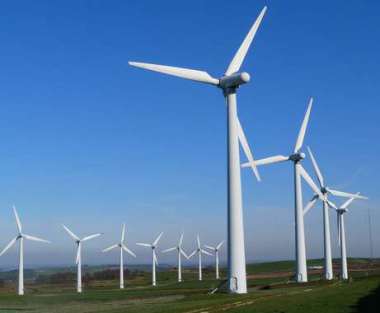 South Australia Just Produced 83-Percent Of Its Electricity From Wind Energy HTTP://WWW.HEXAPOLIS.COM/2016/07/16/ BY: SUKANYA MUKHERJEE JULY 16, 2016
Thanks to a particularly windy weekend, South Australia recently saw nearly 83-percent of its total electricity coming solely from eco-friendly wind energy. Although the harsh weather conditions led to power outages in some of the places, its advantages far outweigh the temporary inconvenience. According to officials, wind turbines installed in the area captured much of the ambient energy, which was used to meet more than two-thirds of the region’s total electricity demands last Monday.
When it comes to renewable power, South Australia is one of the front runners, boasting both solar and wind energy. Investments of up $6 billion have resulted in the installation of as many as 638 wind turbines in the area. According to Alicia Webb of Australia-based Clean Energy Council, an organization dedicated to improving renewables and conversion efficiency, the industry has also generated “hundreds” of jobs. Given the current trend, the region will soon see wind and solar power overtaking conventional fossil fuels. Webb said:
Southern Australia…is in the midst of a remarkable transformation, with more than 40 percent of its power needs coming from renewable energy last year. It is clear that modern economies can run on increasingly higher levels of renewable energy, and it is clear from South Australia’s example that other mainland states can go much further with no loss of reliability.
With oil and volatile gas prices skyrocketing in recent years, wind turbines in South Australia actually help produce electricity at lower costs, especially during windy weather. As pointed out by Webb, the area’s total “installed solar capacity” will likely reach five gigawatts in the coming months. These steps are part of the government’s efforts to meet the targets declared in the Paris agreement. In addition to renewables, researchers in South Australia are coming up with new, innovative technologies that could in turn help reduce environmental pollution. Via: CleanTechnica
South Australian Liberals keen to obstruct wind energy projects?
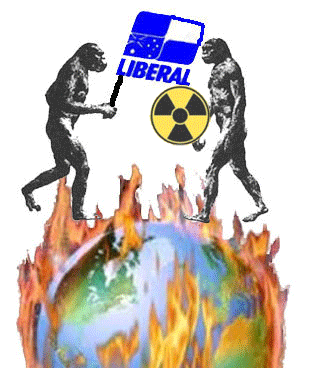 Libs pushing for wind farm changes
ALL new wind farm projects would have to undergo an assessment to see how they would affect the electricity market before being approved, if changes proposed by the Opposition were adopted…. (subscribers only )
http://www.adelaidenow.com.au/news/south-australia/sa-liberals-pushing-for-all-new-wind-farms-to-be-assessed-for-their-impact-on-the-electricty-market/news-story/c52442ad2d7640d9b23ee4372b75eb6a
South Australia’s Premier Jay Weatherill and his Citizens’ Jury Nuclear Deception
 Weatherill trumps up Citizens’ Jury Report in push for SA nuke waste dump, Independent Australia 15 July 2016, Noel Wauchope, who has been covering the Nuclear Fuel Cycle Royal Commission for IA, calls SA Premier Jay Weatherill out over a sleight of hand following the Nuclear Citizen’s Report this week.
SA Premier Jay Weatherill received the Nuclear Citizen’s Jury Report on 10 July. He said that it was a “commonsense” report and that:
“they [the jury] are asking us to also change the legislation to undertake that work”
(i.e: the work of investigating overseas markets for sending nuclear wastes to South Australia)
Here’s where the sleight of hand comes in. That call to change legislation did not come from the Citizens’ Jury. It came from the pro-nuclear Nuclear Fuel Cycle Royal Commission (NFCRC), and the jury was merely doing its appointed task — which was to paraphrase the NFCRC’s recommendations. Throughout the jury process, the jury members were reminded that they had no brief to make any decisions or recommendations and they conscientiously stuck to that rule.
Now I think we know why Weatherill was so adamant that this group be called a “jury”. A later group of 350 members, will also be called a “jury”. There is some possibility that this number 350 could be taken as an adequate sample of the South Australian population of 1.712 million. So again, by regurgitating the NFCRC’s recommendations, this might conceivably be portrayed as the “verdict”of the people. That’s a lot safer than a referendum. …….
NFCRC is over, and finished, but hey — not so! The next move is a massive public advertising process and this kicked off with the recent Citizens’ Jury, which, while being organised by the South Australian firm DemocracyCo, was master-minded and controlled by NFCRC personnel. The witnesses were predominantly pro-nuclear, speakers from NFCRC were prominent and NFCRC staff were present at many, if not all, sessions.
Several times, during hearings, and Q and A sessions, the jury was reminded of the necessity to change State and Federal legislation.
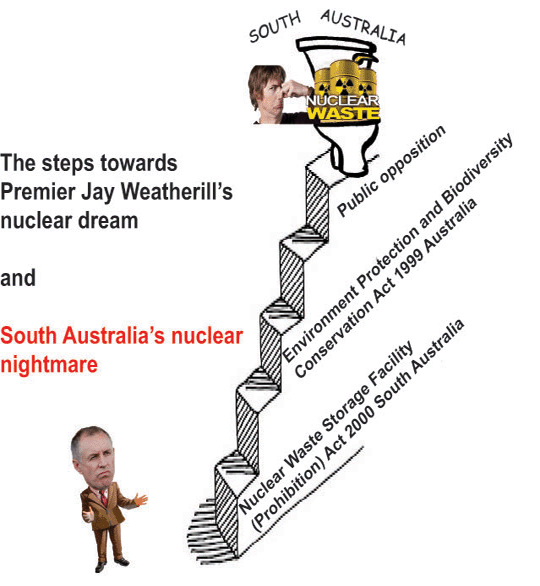
This process had, in fact, already begun, with legislative change that had to be made retrospective, seeing that the government had already spent $7.2 million on the Royal Commission. It is rare for legislation to be made retrospective. As the Greens’ Mark Parnell commented:
‘The retrospective clause is basically saying that if anyone did anything illegal we now legalise it.’
The South Australia Nuclear Waste Storage Facility (Prohibition) Act 2000 used to say:
13 — No public money to be used to encourage or finance construction or operation of nuclear waste storage facility
(1) Despite any other Act or law to the contrary, no public money may be appropriated, expended or advanced to any person for the purpose of encouraging or financing any activity associated with the construction or operation of a nuclear waste storage facility in this State
This section was amended in May 2016. The government wanted to remove Section 13, altogether. However, after several efforts on this, (Greens’ Mark Parnell objecting), Section 13 was amended, to include a new provision:
‘(2) Subsection (1) does not prohibit the appropriation, expenditure or advancement to a person of public money for the purpose of encouraging or financing community consultation or debate on the desirability or otherwise of constructing or operating a nuclear waste storage facility in this State.’
That was a small step forward for the nuclear cause.
Now for a bigger step. The government needs to drastically amend the South Australia Nuclear Waste Storage Facility (Prohibition) Act 2000. Later on, they need to get changes made to the national legislation — The Environment Protection and Biodiversity Conservation Act 1999 (the EPBC Act). They’d probably like these national powers to be removed and have these topics placed under State laws.
In building their argument for changing the law, the Weatherill Government needs to gather persuasive evidence about the proposed economic bonanza to come from importing foreign nuclear wastes. That means another round of expensive trips overseas, and a lot of advertising and promotional meetings in South Australia.
All this can now be justified, because, according to the government, the Citizens’ Jury called for more information, especially on economics, and even more importantly, called for changing the law on importing nuclear waste.
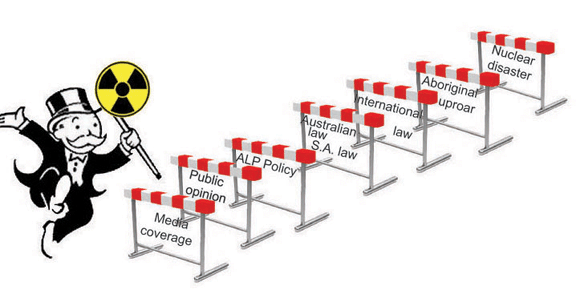
The fact that this jury group diligently summarised the Royal Commission report, without themselves making any recommendations, will almost certainly get lost in the onslaught of pro-nuclear hype that is about to descend upon the South Australian population. https://independentaustralia.net/environment/environment-display/weatherill-trumps-up-citizens-jury-report-in-push-for-sa-nuke-waste-dump,9237
Craig Wilkins, Conservation Council of South Australia, at parliamentary Nuclear Inquiry
Citizens Jury Panel 1: Craig Wilkins
 TRANSCRIPT OF EVIDENCE TO SOUTH AUSTRALIAN PARLIAMENTARY
  COMMITTEE, 15 July 16
 No Profit in Nuclear waste
- A minimal safety margin requires that high level waste not be imported before an agreed licensed geological disposal site…
- High level nuclear waste disposal costs can double in a decade…..
- Dubious claim that disposal of nuclear waste in SA costs one quarter less than in experienced countries….
- SA faces a $60 billion debt in costs across 37 years of ongoing nuclear waste storage operations and nuclear facility decommissioning after the last receipt of overseas revenues for waste imports….
- Nuclear contingency costs are unfunded…
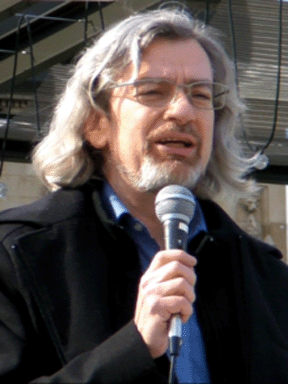 Brief (July 2016) by David Noonan, Independent Environment Campaigner
South Australians are being misled by inflated revenue claims, untenable assumptions and under-reported nuclear waste costs. Reality check analysis shows there is no profit in nuclear waste.
Nuclear waste costs are fast rising and unrelenting for decades after the last recite of waste imports regardless of whether or not claimed revenues and fixed prices over time prove to be realistic or illusory.
The Nuclear Royal Commission Final Report Ch.5 “Management, storage and disposal of nuclear waste” and the Nuclear Commission Tentative Findings Report (p.16-20) present a nuclear waste baseline business case that is near solely reliant on a consultancy “Radioactive waste storage and disposal facilities in SA” (Feb 2016) by Jacobs MCM, summarised in Final Report Appendix J.
There is no market based evidence for the Final Report revenue assumptions and claimed income.
Claimed revenues are a tonnage based multiplier: inflated tonnage equals misleading revenues.
Claimed revenues are doubled by an assumption SA can take twice the waste the US failed to achieve. Continue reading
David Noonan at Parliamentary Nuclear Committee- “waste plan is based on misleading assumptions”
JOINT COMMITTEE ON THE FINDINGS OF THE NUCLEAR FUEL CYCLE ROYAL COMMISSION
If I could make a key point of guidance for the committee’s consideration and due deliberations and any recommendations that you would make, I draw your attention to the objects of the Nuclear Waste Storage Facility (Prohibition) Act 2000 which states:
…”to protect the health, safety and welfare of the people of South Australia and to protect the environment in which they live”…
The act then goes on to prohibit certain classes of nuclear waste storage and disposal facilities. I think that recommendation, those objects to protect the health, safety and welfare of the people of South Australia and the environment in which they live, should be the overriding guidance that this committee considers in how you address the findings of the nuclear royal commission and the business case as presented by the Jacobs Consultancy which is I think the primary matter that lies behind the nuclear commission’s findings and final report.
In my opinion, the nuclear commission, the findings and the final report, and the Jacobs Consultancy on which it is heavily reliant, present a number of assumptions which effectively mislead the public.
The project is projected to be at an inflated scale which has significant consequences both for the reality of the project but also for the claimed revenues. The revenues in this matter are a tonnage-based revenue multiplier. By Jacobs proposing that the world’s largest ever nuclear waste project in the world—the Yucca Mountain project in the USA, a project which failed and was cancelled by President Obama in 2009—could be doubled in scale has a significant question as to whether that is remotely reasonable, realistic, and whether that is a matter that effectively doubles the claimed revenues for the project. If this project had started with a proposal to equal the world’s largest ever proposed nuclear waste project, then the revenues would be half what they are presented in the report—half the numbers that are presented in the report—just on that step alone, that reality test of not exceeding what has ever been envisaged before in terms of scale of nuclear waste projects around the world. The project essentially also maximises aboveground storage, and I believe that compromises safety and it is an unnecessary step.
I believe that in a more realistic scenario, in more realistic time lines where this national matter—a matter that has no mandate to proceed—a matter that would not just realise bipartisan political support at state and federal level, it also needs to realise independent oversight and federal regulation. I believe it would have to be federal regulation and not state regulation. The state could be seen to have a significant conflict of interest in attempting to regulate this matter. Overseas players, whether it is the IAEA, client countries, and the public expectations in those countries, would reasonably expect as do the international conventions that such matters of highlevel nuclear waste be managed by a federal government and a federal authority, not by state.
I think that it is reasonable to project that that independent oversight would require a number of key steps and different time lines and different decision point assumptions than what are presented in the Jacobs report and the nuclear commission findings. The key one of those, I think, is that as an absolute minimum independent oversight would require that Australia not accept high-level nuclear waste prior to having an agreed licensed site for the potential geological disposal of that waste. That is a really key fundamental step that I believe public confidence, public consent, political support and independent oversight would rely on, not just in Australia but overseas through all the levels from consent of the state at a national and international level.
That one step alone—and I would consider that a four-year safety margin in the project that proposed imports could not be envisaged to be credible prior to what the project says is year 15 where they might first realise an agreed licensed site. That four-year safety margin actually realises a 40 per cent reduction in the claimed net present value of the project. A very small step, a very small initial step, in change of time line takes off 40 per cent of the claimed net present value the project is supposed to realise for South Australia………See: http://www.parliament.sa.gov.au/Committees/Pages/Committees.aspx?CTId=2&CId=333
Indigenous opposition to the international waste dump plan
 Nuclear waste dump case unravels, World News Report, 13 July 16 , Green Left By Renfrey Clarke “……..Yankunytjatjara Native Title Aboriginal Corporation chairperson Karina Lester told a packed venue at a June 16 meeting: “The overwhelming majority of traditional owners … continue to speak out against establishing an international waste dump.”
Indigenous spokespeople have condemned the project since it was first mooted. In May last year, soon after the royal commission on South Australian involvement in the nuclear cycle began its work, representatives of 12 Aboriginal peoples met in Port Augusta.
 The gathering issued a statement that said: “South Australian Traditional Owners say NO! We oppose plans for uranium mining, nuclear reactors and nuclear waste dumps on our lands.
“We call on the Australian population to support us in our campaign to prevent dirty and dangerous nuclear projects being imposed on our lands and our lives and future generations.”
The prime site for the long-term waste repository is on the lands of the Kokatha people, near the towns of Woomera and Roxby Downs.
The Transcontinental Railway crosses the region and, as the Australian explained on June 27, the ancient rocks of the underlying Stuart Shelf are “considered by experts to have the best geological conditions for a nuclear dump”.
Early this year Dr Tim Johnson of the nuclear industry consulting firm Jacobs MCM told the royal commission his company envisaged a new port being built on the South Australian coastline to service the project. An interim storage facility nearby would hold newly-arrived wastes above ground for some decades, until they had cooled sufficiently to be transported by rail to the permanent dumpsite.
The only practical location for the port and above-ground repository would be on the western shore of Spencer Gulf, south of the city of Whyalla. Spencer Gulf is a shallow, confined inlet whose waters mix only slowly with those of the Southern Ocean. Any accident that released substantial quantities of radioactive material into the gulf would be catastrophic for the marine environment. Profitable fishing, fish-farming and oyster-growing industries would be wiped out, and the recreational fishing that is a favourite pastime of local residents would become impossible.
To connect the above-ground repository to the rail network, a new line would need to be built from the present railhead at Whyalla. Taking wastes north for permanent storage, trains would pass by the outskirts of Whyalla and Port Augusta.
Initially, the materials transported would be large quantities of low and intermediate-level waste, also planned for importation and burial. But after several decades, transport of high-level wastes would begin and would continue for another 70 years.
Awareness is growing in the Spencer Gulf region of the dangers posed by the nuclear industry. On June 24 in Port Augusta about 80 people took part in a protest against the federal plans to site a separate dump, for Australian-derived low-level radioactive wastes, near the Flinders Ranges’ tourist area………..https://world.einnews.com/article/334731841/OM4SBscz5Dp42697
South Australia Nuclear Energy Systems in talks with govt on a different nuclear waste import plan
 Mr Hundertmark said his firm’s plans were quite advanced and had already included talks with state and federal governments.
Push for high-level nuclear waste storage at Maralinga, former British atom bomb test site PAUL STARICK, CHIEF REPORTER, The Advertiser February 16, 2016 DUMPING imported high-level nuclear waste at Maralinga after shipping it through a deepwater port south of Whyalla is being pushed by a high-powered company.
In a multibillion-dollar plan similar to that recommended by the Nuclear Fuel Cycle Royal Commission, radioactive waste would be taken by rail to the former British atomic bomb test site.
SA Nuclear Energy Systems is proposing to bury the waste in giant pits, where soil and equipment contaminated during the British tests was stored in the 1990s, while the Royal Commission recommends underground storage.
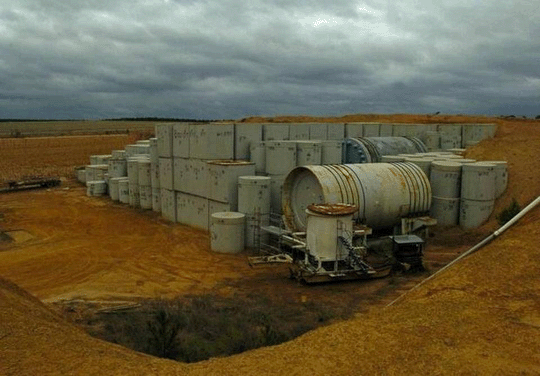
But the site criteria, such as its arid location free from seismic activity, is similar to that proposed by the Royal Commission, as is a dedicated port.
Where could a site go?
The company’s board includes former Premier’s Department chief Ian Kowalick, two Adelaide  University scientists and a former US nuclear industry executive. It is chaired by businessman Bruce Hundertmark……..In a submission to the Nuclear Fuel Cycle Royal Commission, Mr Hundertmark also highlights the fully operational air strip at Maralinga which is capable of receiving the heaviest transport aircraft……
Mr Hundertmark said his firm’s plans were quite advanced and had already included talks with state and federal governments, along with the area’s Aboriginal people, but would require state and federal legislative change.
He said his company’s plan could start far sooner than the late 2020s, because of the existing infrastructure, but did not specify a precise time frame…….http://www.couriermail.com.au/news/national/push-for-highlevel-nuclear-waste-storage-at-maralinga-former-british-atom-bomb-test-site/news-story/65d14a0d7c2f0daf90d7a5ef89da5e9f
South Australian Labor’s push for nuclear waste importing is unravelling already
The case presented by the nuclear dumpsters is dissolving. Outspoken opposition from traditional owners is exposing, as a racist charade, the government’s attempts to manufacture “consent”.
The people of the upper Spencer Gulf cities will not be reconciled to having trainloads of lethal wastes rumbling past their doors for the next century. And the economic case for the dump scheme would merit an “F” in any respectable business course.
 Nuclear waste dump case unravels, World News Report, 13 July 16 , Green Left By Renfrey Clarke Armed with the findings of the Nuclear Fuel Cycle Royal Commission, South Australian Labor Premier Jay Weatherill is pressing ahead with plans to import as much as a third of the world’s high-level nuclear reactor waste and store it in the state’s outback.
There are compelling reasons to reject it. The project, it now emerges, could go ahead only over resistance from Indigenous traditional landowners, some of whom took part in the Lizard Bites Back convergence in early July.
There are serious environmental dangers in unloading the wastes, maintaining them above ground for decades while they cool and transporting them for final burial. Tens of thousands of people would be at risk.
Several devastating critiques have also shown that the economic case for the scheme is largely guesswork. Conceivably, the project would run at a loss — while burdening South Australians with the costs and dangers of tending to the world’s greatest single radiation hazard, effectively forever…….
Consultation?
Another element of the pro-nuclear “educational process” is to be the work of a “Nuclear Consultation and Response Agency” that will visit “all major regional centres, more than 50 remote towns and all Aboriginal communities” in a “dedicated program to ensure all South Australians can have their say about the state’s future involvement in the nuclear industry”.
There is no guarantee, however, that the massaging will work. For all the loot promised by the Advertiser, public opinion for and against the waste dump plan seems evenly split and active resistance is growing.
In mid-May Indigenous, health, union, faith and conservation groups joined in setting up a No Dump Alliance. On June 25, some 80 protestors heckled Weatherill as he arrived to address the opening session of his first “citizens’ jury”.
A 200-strong July protest at Roxby Downs, Lizard Bites Back, also condemned the government’s plan for a nuclear waste dump on Indigenous land. Spokesperson Nectaria Calan said the convergence was focused on the connections between uranium mining and nuclear waste. “A responsible approach to managing nuclear waste would begin with stopping its production”, she said.
The case presented by the nuclear dumpsters is dissolving. Outspoken opposition from traditional owners is exposing, as a racist charade, the government’s attempts to manufacture “consent”.
The people of the upper Spencer Gulf cities will not be reconciled to having trainloads of lethal wastes rumbling past their doors for the next century. And the economic case for the dump scheme would merit an “F” in any respectable business course. https://world.einnews.com/article/334731841/OM4SBscz5Dp42697
Enice Marsh at the Nuclear Citizens’ Jury – about the Federal nuclear waste dump
 “……..JUROR: Enice, you are representing all of the Adnyamathanha people.
Nuclear Waste Business Plan from Hell – South Australia

Blandy conveyed his objections to the royal commission — which substantially ignored them. Instead, the commission continued putting its trust in Jacobs MCM, which it had engaged to perform its financial modelling.
Jacobs, The Australia Institute notes, “consult extensively to the nuclear industry and have an interest in its expansion and continuation”
Nuclear waste dump case unravels, World News Report, 13 July 16 , Green Left By Renfrey Clarke “…….That the environmental and health risks posed by the international waste scheme are alarming and the economics could well be prohibitive are being ignored by the scheme’s supporters.
In its February “tentative findings” and in its May 9 final report, the state government’s royal commission set the hucksters drooling with its view that a high-level waste dump “could generate more than $100 billion income in excess of expenditure over the 120-year life of the project”.
Even this sum was too modest for the Murdoch-owned Adelaide Advertiser as it sought to herd public opinion behind the government’s plans. Working only from revenues and ignoring costs, the newspaper declared on February 17 that “a gigantic $445 billion would be pumped into the state’s finances over at least 70 years”.
The truth is that the economic case for the project rests on such wild assumptions that any competent entrepreneur would view it as a business plan from hell.
Hopes of a monster pay-out were savaged during March when The Australia Institute published a detailed analysis of the waste dump scheme.
Retired professor of economics Richard Blandy, the economic commentator for the Independent Daily, exploded the royal commission’s guesswork still more definitively on June 7.
The figure for net income of $100 billion, Blandy explained, was based on a completely fanciful estimate of the price that South Australia could expect to obtain for storing spent reactor fuel.
To obtain this estimate, of $1.75 million per tonne of heavy metal, the commission had assumed that the South Australian authorities of the future would have perfect knowledge of the maximum price that potential customers were willing to pay and that the state would face no competitors in the waste storage market-place.
The reality, as Blandy pointed out, is that India and China — to name just two countries — have extensive nuclear power industries and are highly likely to create their own waste repositories.
For these countries to add extra capacity to accommodate international customers would be relatively cheap — and much cheaper than could be managed by an Australian dump relying exclusively on imported waste.
The “$100 billion” figure also reflected an estimate that 37 countries that now have nuclear power industries — or that might someday set them up — would contract with South Australia to store 50% of their reactor waste.
But what if this estimate was grossly inflated?
If South Australia’s dump attracted only a quarter of the wastes targeted, Blandy calculated, and if the price received equalled the costs of building storage capacity in Sweden or Finland (costs, we must assume, that would be high compared to those in India or China) then the South Australian dump would lose money.
Blandy conveyed his objections to the royal commission — which substantially ignored them. Instead, the commission continued putting its trust in Jacobs MCM, which it had engaged to perform its financial modelling.
Jacobs, The Australia Institute notes, “consult extensively to the nuclear industry and have an interest in its expansion and continuation”…… plans.https://world.einnews.com/article/334731841/OM4SBscz5Dp42697
Big Business and right-wing Labor are backing nuclear waste project, despite its dodgy economics
 Nuclear waste dump case unravels, World News Report, 13 July 16 , Green Left By Renfrey Clarke “……….Business backing The waste dump project may not have good arguments, but it certainly has powerful friends. “We’re absolute advocates,” Nigel McBride, CEO of the industry and commerce peak body Business SA told the Independent Dailyon June 17. “We’re now absolutely saying this is not only feasible but absolutely viable.
“I can tell you Business SA is overtly advocating for a high-level nuclear waste facility in SA, subject to an educational process that will get social consent.”
If this typifies the business skills of South Australia’s moneyed elite, then the state’s economic woes are no mystery.
The Weatherill government has made no formal commitment to the waste dump project, and will not do so before a process of “consultation” with South Australians ends in November.
But few people take the premier’s claim of open-mindedness seriously. Influential figures within the state Labor Party’s dominant right faction are on record as enthusiasts for the waste scheme and big business is cracking the whip.
Weatherill made his views clear when he defied the anti-nuclear thrust of federal Labor policy to set up the royal commission and named the conservative-technocratic retired rear-admiral and former state governor Kevin Scarce as commissioner.
More recently, the government has funded two “citizens’ juries” to hear the testimony of (mainly) pro-nuclear figures and to deliver reports that can be claimed as indicating popular agreement to the nuclear-waste plans……..https://world.einnews.com/article/334731841/OM4SBscz5Dp42697
South Australian Premier Jay Weatherill’s deception about the Nuclear Citizens’ Jury
The Citizens’ Jury has delivered exactly what Jay Weatherill wanted- a summary of the Royal  Commission recommendations, with enough uncertainty to justify the nuclear lobby’s next step.
(I’m correcting a previous version of this post, here) The South Australian government already rushed through legislation that overturned South Australia’s legislation against spending money on nuclear industry development, (making this retrospective of course – to cover the $millions already spent)
The next step is to overturn the whole Act, or at least those parts of it which prohibit importing a nd storing foreign wastes.
Weatherill is quoted in THE AUSTRALIAN today as saying ”
“they (the Citizens’ Jury) are asking us to also change the legislation to undertake that work”.
That is a lie. The jury was merely repeating what the Nuclear Royal Commission said. The jury kept to their brief – no decisions or recommendations – just regurgitate what the Commission said.
1 This month


Help Aunty Sue Protect Her Land and Sacred Sites From Destructive Rocket Testing.
.

Australians deserve the truth
about
AUKUS – https://aukuspublicinquiry.com/

PETITION – To: Prime Minister Anthony Albanese and the Australian Labor Government

of the week – Australians for War Powers Reform (AWPR)
To see nuclear-related stories in greater depth and intensity

