Renewables not to blame for South Australia’s electricity papers – says Energy Minister Josh Frydenberg
 Frydenberg says renewables not to blame for South Australia energy “crisis”, REneweconomy By Giles Parkinson on 28 July 2016 Josh Frydenberg, the minister newly elevated to the combined energy and environment portfolio, says that renewable energy was not to blame for the recent energy “crisis” in South Australia, although he did deliver some mixed messages about how the government proposes to move forward.
Frydenberg delivered a series of interviews on Wednesday, the first since he was appointed to the new position in a reshuffle by the re-elected Turnbull government, and this included a “chat” with ABC personality Annabel Crabb at a dinner function at the Clean Energy Summit.
Asked about the recent electricity spikes in South Australia, Frydenberg said it was a “complex picture” that included a reduced capacity on the inter-connector, a cold snap that spiked demand, a big shift in gas prices, and the “intermittency issue about wind and solar.”
But he also noted that in 2008, as RenewEconomy has reported, the price of wholesale electricity in South Australia peaked above $5,000/MWh more than 50 times. That was before wind and solar were in that state, he said, and noted there had only been three such peaks so far this year.
“People have to understand that this volatility is not a new thing. It was back there in 2008 …. so to say that (this price spike) is the fault of renewables is not an accurate assessment,” Frydenberg said, to the applause of the audience of around 400 people.
This, however, was not how The Australian interpreted events, who attributed Frydenberg’s comments about the crises in South Australia and Tasmania as a “wake-up” call about the problems created by wind and solar.
Tasmania, it should be remembered, suffered the highest wholesale prices in Australia last financial year because its electricity supply was restricted by the loss of the Basslink cable and much of its hydro capacity due to drought. Most analysts say it was its lack of investment in wind and solar that forced it to rely heavily on expensive back-up gas and diesel…….
Frydenberg appeared well briefed, non-confrontational, and recognised the growing role of technologies such as wind, solar and battery storage whose costs had fallen quickly and would continue to do so. He also appeared to be listening, people said.
The role of coal, Frydenberg accepted, is declining, and the transition to clean energy is inevitable. But he was reluctant to put any time frames on the inevitable move to zero emissions technology, apart from saying that a shift to 100 per cent renewable energy was not going to happen overnight.
But while his comments were soothing for an industry just regaining its confidence after being battered and bruised by the first term of the Abbott-Turnbull government and the key policy decisions of Frydenberg’s good friend, the previous environment minister Greg Hunt, his next moves will be scrutinised intensely.
There is great concern about a push by the incumbent energy industry, such as the Energy Supply Council to force state governments to abandon their individual state targets, a move that will be strongly resisted by South Australia, Victoria, Queensland and the ACT……..http://reneweconomy.com.au/2016/frydenberg-says-renewables-not-to-blame-for-south-australia-energy-crisis-75546
Wind and solar are NOT responsible for the doubling of wholesale energy prices in South Australia
South Australia’s ‘absurd’ electricity prices: renewables are not to blame, Guardian
Tristan Edis, 28 July 16
Wind and solar are not responsible for the doubling of wholesale energy prices in SA – that’s just part of the spin that says renewables are expensive. Reading many of the newspapers over the past few weeks you’d think South Australia had become a horrible case study in the dangers of too much renewable energy……
Politicians are now responding, with Liberal Senator Chris Back calling for a ban on new wind farms until after a review by the Productivity Commission. Meanwhile Senator Nick Xenophon’s party are backing a Senate inquiry.
Yet everyone has missed the main cause of a doubling in SA power price rises – a doubling in gas prices.
What makes it all especially worrying is the blame attributed to renewable energy appears to have originated from a public relations campaign initiated by the lobby group for the big power generators………
wholesale market data suggests renewable energy has actually been depressing power prices, not increasing them. In the months before and after the Northern Coal Power Station was taken off-line, South Australia’s wind farms, without exception, bid their entire available output into the market for a price less than a single dollar. Meanwhile rooftop solar doesn’t even bid into the market, with its output just reducing the demand for generators that do bid into the wholesale market.
This is not to suggest renewable energy imposes no costs. It is certainly true that wind and solar require a subsidy, but its cost is distributed equally across all electricity consumption around the nation via the federal RenewableEnergy Target scheme. It isn’t allocated to states depending on how many wind farms or solar panels they have installed.
The idea that renewables are to blame for the doubling in South Australian wholesale prices is an idea the Australian Energy Council, which represents big power companies, have been pushing since late last year. This campaign has sought to paint South Australia as an “accidental experiment” in the dangers of too much renewable energy.
If you scratch the surface they actually acknowledge renewable energy is depressing wholesale power prices. But they claim it pushes prices so low that, rather strangely, it is apparently increasing prices……..
It was only with the addition of wind and solar to the existing mix of coal plus the interconnector that gas could be driven down to less than a third of the electricity market. This acted to substantially shield SA from power price rises, not induce them.
So it is LNG plants, not wind and solar, that are responsible for South Australia’s “absurd” electricity prices. https://www.theguardian.com/commentisfree/2016/jul/27/south-australias-absurd-electricity-prices-renewables-are-not-to-blame
What chance for truth at the South Australian Nuclear Parliamentary Inquiry?
 Well, not a whole lot, because out of the six members of this Inquiry, only one, Mark Parnell, has an antinuclear position. the other five all belong to political parties that, to put it mildly, are friendly to the nuclear industry:
Hon Tom Kenyon MP Labor’s “ true believer in SA’s nuclear potential”
Mrs Annabel Digance MP – Labor party. well, we all know how Labor MPs toe the party line, no matter what the evidence.
South Australian Nuclear Royal Commission Did Not Give The Citizens’ Jury The Full Picture
 Submission to JOINT COMMITTEE ON FINDINGS OF THE NUCLEAR FUEL CYCLE ROYAL COMMISSION Makes the case that Australians are being denied the bigger picture, and the NFCRC was deliberately or negligently selective in their assessment of evidence received. https://www.academia.edu/27087058/Submission_to_Joint_Committee_on_Findings_of_the_Nuclear_Fuel_Cycle_Royal_Commission
“………I believe that the South Australian people have a right to know about the implications of all relevant nuclear materials handling processes and their consequences for human health and the environment in advance of making or influencing any government decision to accept or reject spent nuclear fuel.
I am concerned that the Citizens’ Jury currently tasked with simplifying the Nuclear Fuel Cycle Royal Commission may not comprehend the full extent of the Commission’s recommendations- that is, that they are seeking to enable currently prohibited industrial activities across the whole nuclear fuel cycle.[1] Nuclear Fuel Cycle Royal Commission, Government of South Australia, ‘Nuclear Fuel Cycle Royal Commission Report’, 2016: pg. XV. http://yoursay.sa.gov.au/system/NFCRC_Final_Report_Web.pdf . Accessed 2016-07-01……..
3. the question arises: how selective or otherwise was the process of assembling its Final Report and recommendations? Why was certain information received not included in the Commission’s final report?
4. the first Citizens’ Jury did not hear from a presenter who was appropriately knowledgeable on matters of radio-biology and the pathways and effects of exposure to nuclear materials in environmental or occupational contexts (with respect to uranium and nuclear fuel). The only medical professional to address the jurors for any significant length of time was Associate Professor Michael Penniment.
It is my opinion that by not providing fundamental information about the connection between radiationexposure and the development of cancers and leukaemia, the Department of the Premier andCabinet is preventing the jurors from being able to adequately consider risks, which being bombarded by the opportunity of waste storage, and the numerous mechanical processes which would need to occur to enable it………
CHERNOBYL In his presentation to the jurors, Penniment went on to describe the consequences of Chernobyl incorrectly, stating that only 28 people died as a result of the incident, and that those were the first responder clean-up workers. This misinformation conflicts with all recent accounts of the disaster, including those published in the Nuclear Fuel Cycle Royal Commission’s own Final Report. No-one present in the room was able to correct him……
5 I supplied evidence to the Commission for its consideration demonstrating the different approaches taken to measuring and estimating the human health consequences of Chernobyl in my submission to the Tentative Findings. I had hoped that the Commission would compare these with its own references to UNSCEAR and the WHO. No such comparisons were reflected in the Final Report…….
FUKUSHIMA In the case of the 2011 Fukushima disaster, the Commission’s final report fails to reflect the gravity, extent of harm and technical complexities related to the incident and the response thus far……
6. [On the health effects on nuclear workers]
The Commissioner’s response to my question and correction demonstrate that the Commissioner was at that time unaware of the problematic nature of the elevated risk of cancers and leukemias experiencedby nuclear industry workers, despite my submissions. This also confirmed that the evidence I provided to the Commission was ignored, either wilfully or negligently. I reach this conclusion with confidence, given Chad Jacobi’s recent admission that all submissions were read by the Commission, and by him personally.[11]
I have received further confirmation from the Royal Commission’s Chief of Staff, Greg Ward that Chad Jacobi was the chief author of the final report. If Jacobi read all of my submissions, what cause did he have to ignore the evidence that I provided?
NUCLEAR FACILITY EFFLUENT & EMISSIONS In my submissions to the Commission, I drew attention to several studies which identified or analyses clusters of leukemias in close proximity to nuclear facilities…….. The Commission chose not to include this controversial subject in its final report, despite a preliminary search revealing a substantial number of peer-reviewed medical research papers exploring this topic……..
NUCLEAR FUEL LEASING The Final Report refers to the prospect of establishing a nuclear fuel leasing scheme in South Australia, contingent on the establishment of a permanent storage facility for spent nuclear fuel. The report then goes on to say that such a program could provide a competitive advantage capable of improving prospects for the development of additional uranium processing activities in South Australia……..This process of gradual expansion into enrichment and fuel processing is summarised….
By my assessment, these statements reveal the broader intent of the Commission’s recommendations, yet this information is buried deep inside the body of the Final Report. The Commission suggests that South Australia work with established nuclear industrial players to add value to the currently exported product: uranium oxide concentrate.
RECOMMENDATIONS
South Australian govt spruiking nuclear waste dump to TAFE students
SA govt’s Nuclear Consultation and Response Agency (CARA)TAFE SA will host a Video Conference (VC) for students on Thursday 28thJuly between12-1pm. Mr John Phelan, CARA’s Director of Engagement, will provide information during this session.
TAFE SA Video Conference (VC) Campus Locations – Thursday 28th July 12pm – 1pm
South Australian Greens prevented law that would give full rein to taxpayer funded nuclear promotion
 Nuclear waste dump ‘spruiking’ with taxpayers’ money stopped by Greens http://www.abc.net.au/news/2016-04-14/nuclear-waste-dump-‘spruiking’-with-taxpayers’-money-stopped/7325076 14 Apr 2016 An attempt to change the law in South Australia to allow public money to be spent on promoting a nuclear waste dump has been stopped with the Greens claiming a victory.
A law passed in 2000 to stop public funds from being used in any activity associated with a nuclear waste facility.
The State Government had tried to amend the law to allow consultation with the community on the results of the Nuclear Fuel Cycle Royal Commission. Greens MLC Mark Parnell said the proposed change was too wide ranging and the Upper House had stepped in to protect taxpayers.
“The Greens do accept that we do need to have a public debate,” he said.”We’re confident we know what the result will be but nevertheless the Government says they only want to consult, they don’t want to spruik and they don’t want to plan for a nuclear waste dump.”
He said the Government had attempted to “overreach”.”The law now says that the Government can use public money to consult the community but they’re not to use public money for promoting or designing or even buying land for a nuclear waste dump.”
Global nuclear industry promoters influencing SA nuclear waste plan
 27 July 2016 The Australian Conservation Foundation will today table to a South Australian Parliamentary committee information showing a key adviser to the state’s recent nuclear Royal Commission is a nuclear ‘true believer’ who was behind a failed attempt to open a global radioactive waste dump in Australia in the 1990s.
Charles McCombie, who was technical manager of Pangea Resources – a consortium that tried to advance a waste dump in Australia during the 1990s – is a foundation partner of MCM, a Swiss based firm contracted by the Royal Commission to model economic and technical information and analyse potential customer demand and economics.
MCM’s report strongly influenced the Commission’s enthusiastic pro-dump recommendations. Mr McCombie is also President of ARIUS, the Association for Regional & International Underground Storage. MCM and ARIUS both aim to advance global radioactive waste disposal, raising questions about the independence and objectivity of the advice provided.
MCM has stated that a positive state government response to the Royal Commission report would ‘change the worldwide paradigm of radioactive waste management’.
“In the late 1990s public outrage forced Pangea to abandon its dumping plan”, said ACF campaigner Dave Sweeney. “Today a pro-nuclear Royal Commission is using public funds so Pangea’s inheritors can re-write the proposal. South Australians deserve better.
“Understandably there is concern about commercial interests pushing a plan to ship, store and bury the largest amount of the world’s worst nuclear waste in South Australia.
“The permanent risk of nuclear waste demands the highest level of scrutiny and transparency, not limited disclosure and insiders promoting a pre-determined agenda.
“Radioactive waste management is complex, contaminating and costly – and it lasts far longer than any politician or headline. It needs real analysis, not industry assumptions.
“ACF urges Premier Jay Weatherill to seek an independent review of the Royal Commission’s research and recommendations and not to further advance this high risk plan based on a report that is compromised, deeply deficient and unfit for purpose.”
South Australia is targeted for five nuclear dumps and high level waste processing
 SA is targeted for five nuclear dumps and high level waste processing
Brief by David Noonan, Independent Environment Campaigner
The Nuclear Royal Commission recommended SA pursue nuclear waste storage and disposal “as soon as possible” – requiring five waste dumps and a high level nuclear waste encapsulation processing facility.
The Final Report Ch.5 “nuclear waste” and the Findings Report (p.16-20) are reliant on a consultancy “Radioactive waste storage and disposal facilities in SA” by Jacobs MCM, summarised in Appendix J.
SA is targeted for above ground high level nuclear waste storage, without a capacity to dispose of wastes, exposing our society to the risk of profound adverse impacts, potential terrorism and ongoing liabilities.
The State government is in denial on the importance of nuclear waste dump siting by claiming social consent could be granted before we know what’s involved in siting up to five nuclear dumps across SA.
Affected regions and waste transport routes are fundamental pre-requisites to transparency and to an informed public debate on potential consent to take any further steps in this nuclear waste agenda.
First: a dedicated new deep sea Nuclear port is to receive waste ships every 24 to 30 days for decades, to store high level waste on site following each shipment, and to operate for up to 70 years.
The coastal region south of Whyalla and north of Tumby Bay is the likely location for this Nuclear port.
South Australia is targeted for a globally unprecedented scale of high level nuclear waste shipments. Some 400 waste shipments totalling 90 000 tonnes of high level waste and requiring 9 000 transport casks are to be brought into SA in the first 30 year period of proposed Nuclear port operations.
This is in excess of the global total of 80 000 tonnes of high level nuclear waste shipped around the world in the 45 year period from 1971 to 2015, according to the World Nuclear Association report “Transport of Radioactive Materials” (Sept 2015) and the Jacobs MCM consultancy (Feb 2016, p.152).
Second: an above ground nuclear waste Storage facility is to take on approx. 50 000 tonnes high level waste before a Disposal facility could first start to operate in Project Year 28 (Jacobs p.5 Fig.3).
SA is proposed to import high level waste at 3 000 tonnes a year, twice the claimed rate of waste disposal (Jacobs p.114), with storage to increase to 70 000 tonnes. The Store is to operate for up to 100 years.
The Nuclear Commission budgeted to locate the waste Storage facility 5 to 10 km from the Nuclear port.
The Nuclear port and above ground waste Storage facility are to be approved in Project Year 5, ahead of pre-commitment contracts for 15 500 tonnes high level waste in Year 6 and waste imports in Year 11.
South Australia needs to know the proposed region for siting the Nuclear port AND whether the nuclear waste Store is to be adjacent to the port (likely on Eyre Peninsula) or sited in the north of SA.
Third: a Low Level Waste Repository for burial of radioactive wastes derived from all operations including final decommissioning of all nuclear facilities is proposed to be located in north SA. This Repository has a nominal waste burial capacity of 80 000 m3 of radioactive wastes (Jacobs p.144). This is some eight times the total scale of the proposed National Radioactive Waste Repository.
Questions about Senator Sean Edwards’ nuclear waste proposal
 Nuclear Fuel Cycle Watch, Andrew Allison July 21 Rumour has it that once of the anonymous countries that Sean Edwards will not name is South Korea. One might speculate about where the money for Sean Edwards’ very glossy submission to the NFCRC came from? ….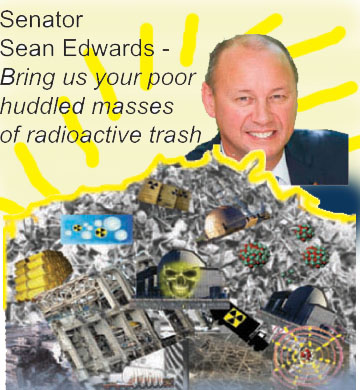
I have many reservations about Sean Edwards’ proposal, but two obvious questions come to mind:
1/ If the deep-underground storage of nuclear waste is a “solved” problem and South Australia can supposedly acquire and implement the technology at low cost (leading to high profits…) then why can’t South Korea do that?
2/ If the generation IV reactors are going to solve the waste storage problem then why can’t an advanced technological country like South Korea do that? https://www.facebook.com/groups/1021186047913052/
Nick XenophonTeam backs 40pc renewables
Xenophon party backs renewables but wants Senate electricity inquiry The Australian July 25, 2016
NXT federal MP Rebekha Sharkie, who won the Adelaide Hills seat of Mayo from Liberal Jamie Briggs, said the party was committed to the renewables target, but NXT wanted a Senate inquiry into electricity prices “so we can get the arguments on the table and look to a solution”.
Ms Sharkie believed a second interconnector between South Australia and the eastern states could help the situation, though it had been discussed for 15 years without action…….http://www.theaustralian.com.au/news/nation/xenophon-party-backs-renewables-but-wants-senate-electricity-inquiry/news-story/3a2920c0274a22994f377395acb6b5bc
Will Australia’s new Resources Minister Matt Canavan really listen to Aboriginal people?
 Matt Canavan has now the opportunity to correct these mistakes and engage in a truly inclusive and transparent process which actually listens to the concerns of the community and other stakeholders. Although a nuclear proponent, he should ensure that this process is not dealt with light-heartedly and pays attention to all aspects involved.
This would best be achieved through an independent inquiry into Australia’s nuclear waste and options for managing it.
Aboriginal communities all across Australia have sustainably managed the land for thousands of years, longer than any other group of people can claim. Their knowledge and concerns are valuable. Let’s hope they will be listened to.
3rd Minister in two years to handle Australia’s nuclear waste dump http://www.onlineopinion.com.au/view.asp?article=18394&page=0 Anica Niepraschk – , 22 July 2016 The recent federal election has once more seen a bit of a reshuffle in PM Turnbull’s cabinet and thereby thrown the portfolio for Australia’s national radioactive waste dump in the hands of another Minister for the third time in less than two years.
After 20 years of failed siting processes for the proposed dump, then Industry and Science Minister Ian MacFarlane only announced a new attempt in November 2014. The first half of last year saw a voluntary nomination process happen where landowners across Australia could propose their property to host Australia’s low and intermediate level nuclear waste. Out of the 28 sites nominated, six were shortlisted for further consultation and investigation last November. All six site nominations were highly contested by the local communities.
Although the government, with its new ‘voluntary’ approach promised to not impose a nuclear waste dump on any community and therefore rely on voluntary nominations and community consultation, one of these six sites, Wallerbidina/ Barndioota in the Flinders Ranges, SA, made it to the next stage of the process, despite the strong opposition of the local Adnyamathanha community at Yappala station, just kilometres away from the site.
Not only chose the government to once again, after pursuing Coober Pedy from 1998 to 2004 and Muckaty in the NT from 2005 to 2014, to target an Aboginial community but it also chose a culturally highly significant site. The proposed property, nominated by former Liberal Senator Grant Chapman, is part of a songline and hosts many cultural sites, including the beautiful Hookina springs, a sacred women’s site for the Adnyamathanha. The local community remains actively connected to the maintenance and preservation of the land and is documenting and preserving their culture and history through recording traditional heritage sites and artefacts and mapping storylines in the area. Continue reading
South Australia: Resuscitating a Nuclear Waste Nightmare
The project to bury the world’s nuclear poison in the heart of the Australian desert has not sprung out of a void. It is an idea that has been insidiously festering for two decades in a variety of incarnations.
The first stirrings of the hellish project to turn Australia into the world’s nuclear dumping ground emerged in the late 1990s when Pangea Resources, a U.K. based company promoted the construction of a commercially-operated international waste repository in Western Australia. The project was supported by a $40 million budget, 80% of which came from British Nuclear Fuels Limited (wholly owned by the U.K. government), with the remaining 20% from two nuclear waste management companies.
Australia’s Overflowing Nuclear Waste Dumps
One of the more disturbing elements of the Royal Commission report is its explicit endorsement of the progressive nuclearisation of the planet over the course of the next century. But given the make-up of the Royal Commission, this comes as no surprise.
Poison In The Heart: The Nuclear Wasting Of South Australia Counter Currents by Vincent Di Stefano — July 22, 2016 “……..It is a curious thing to observe the confidence with which the recent Nuclear Fuel Cycle Royal Commission has embraced the promotion of South Australia as the ideal destination for over one third of the world’s accumulated stores of spent nuclear fuel. This spent fuel, together with the 400,000 cubic metres of intermediate-level nuclear waste that the Royal Commission recommends be transported to South Australia, represents a problem that nations with decades-long histories of nuclear energy production have failed to resolve. The entrancement induced by a whiff of billions of dollars of new revenue presently has a closed circle of nuclear advocates and politicians straining to persuade the people of South Australia to obligingly make their way as latter-day lemmings towards a dangerous and uncharted nuclear abyss.
In the short term, the Commission calls for the transportation of vast tonnages of highly radioactive materials from around the planet for decades-long storage in above-ground facilities. In the longer term, it proposes the construction of a deep underground repository for the “permanent” burial of the most dangerous wastes produced by a destructive and senescent civilisation. Continue reading
How much is the South Australian government spending on its pro nuclear extravaganza?
 What I’m worried about is the amount of tax-payers’ money that is going into this State-wide nuclear brainwash. Is Premier Jay Weatherill squandering so much of the State’s coffers on this fool’s enterprise that he and the rest of the politicians will feel that they MUST go on and complete the damn thing – commit to an international nuclear waste dump? Current estimate is $13 million. But will it be more?
From July 29 to October 20 they will be sending teams of nuclear spruikers all over the State of South Australia.
Teams from Nuclear Fuel Cycle Royal Commission Consultation and Response Agency will be there to spread the jolly word of the biased Nuclear Fuel Chain Royal Commission. Who’s on this Agency anyway? Can we expect to hear, yet again, from Greg Ward and Chad Jacobi giving their polished pro nuclear spiel? Will there be deceptive and trivialised presentations on the healthiness of ionising radiation – as there were at the recent Citizens’ Jury hearings?
Adelaide: the next steps in South Australia’s nuclear brainwash
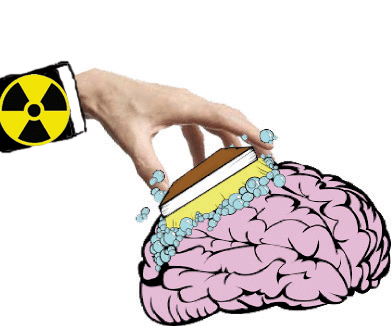
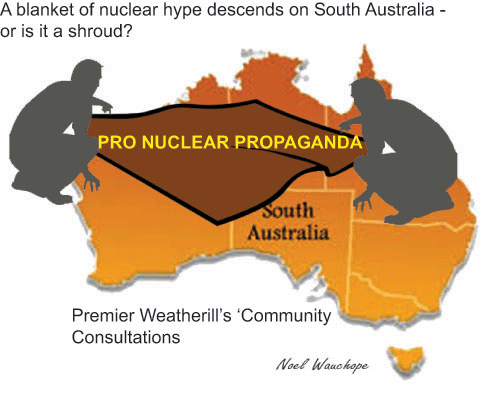
The next step in the international nuclear waste dump campaign from the government is “community consultation” and they are visiting 100 sites around SA. People’s opinions will be used to gauge whether there is community consent or not.
South Australia to get world’s biggest solar + storage project
World’s biggest solar + storage projects planned for Australia http://reneweconomy.com.au/2016/worlds-biggest-solar-storage-projects-planned-australia-95528 By Giles Parkinson on 19 July 2016 Australian infrastructure investor Lyon Group says it plans to build the world’s biggest solar plus storage project in South Australia in the next two years, and sees a huge future for combined solar and battery storage plants..
Lyon Group’s David Green – which worked on developing a soon-to-be built 30MW solar plant and 1.4MW/5.3MWh lithium battery storage facility near Cooktown, in far north Queensland, before selling it to German-based company Conergy – plans a series of other projects and claims a pipeline of more than 300MW of solar and up to 60MW of battery storage.
The first new project is planned for South Australia, with a 100MW solar PV plant to be combined with a battery storage array of up to 40MW, Green says the plant could be in operation near Roxby Downs by early 2018, and there are plans for other similar projects around the country.

The first stage of what is known as the Kingfisher project – 20MW of solar PV plus a minimum 2MW battery storage – is expected to be running late next year.
The project is one of the finalists in the Australian Renewable Energy Agency funding round for large scale solar, which is expected to allocate monies to 10 or more projects when decisions are announced next month.
Green says the company – which has previously invested in coal, gas and wind projects, but is now specialising in solar and storage – is looking to be a global industry leader in solar plus storage.
“The genie is out of the bottle. There will be a burst of activity now in large scale solar + battery projects. This is the real battery storage story coming out of Australia – batteries used to convert large scale solar to effectively baseload, or peaking plant.”
The combination of solar and storage means the facilities can compete on two levels – providing clean energy and dispatchable power, either to household or large energy users, and also re-enforcing the edge the grid, in some cases avoiding the costs of grid upgrades. Continue reading
1 This month


Help Aunty Sue Protect Her Land and Sacred Sites From Destructive Rocket Testing.
.

Australians deserve the truth
about
AUKUS – https://aukuspublicinquiry.com/

PETITION – To: Prime Minister Anthony Albanese and the Australian Labor Government

of the week – Australians for War Powers Reform (AWPR)
To see nuclear-related stories in greater depth and intensity

