Once again, Australian government wages nuclear war on Aboriginal people
The plan to turn South Australia into the world’s nuclear waste dump has been met with near-unanimous opposition from Aboriginal people.
The Royal Commission acknowledged strong Aboriginal opposition to its nuclear waste proposal in its final report – but it treats that opposition not as a red light but as an obstacle to be circumvented.
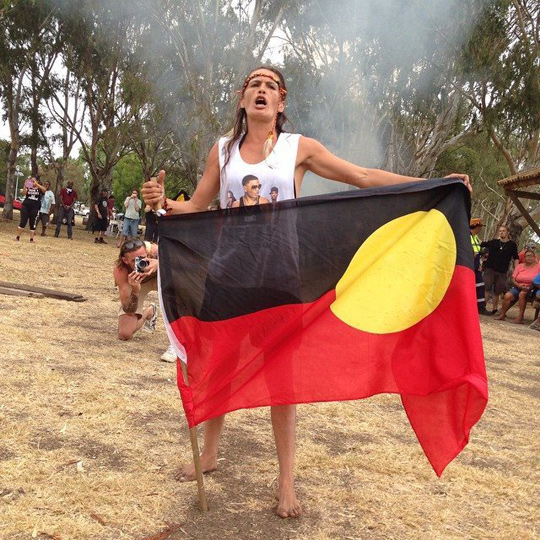

 Radioactive waste and the nuclear war on Australia’s Aboriginal people, Ecologist Jim Green 1st July 2016
Australia’s nuclear industry has a shameful history of ‘radioactive racism’ that dates from the British bomb tests in the 1950s, writes Jim Green. The same attitudes persist today with plans to dump over half a million tonnes of high and intermediate level nuclear waste on Aboriginal land, and open new uranium mines. But now Aboriginal peoples and traditional land owners are fighting back!
Then the government tried to impose a dump on Aboriginal land in the Northern Territory, but that also failed.
Now the government has embarked on its third attempt and once again it is trying to impose a dump on Aboriginal land despite clear opposition from Traditional Owners. The latest proposal is for a dump in the spectacular Flinders Ranges, 400 km north of Adelaide in South Australia, on the land of the Adnyamathanha Traditional Owners.
The government says that no group will have a right of veto, which is coded racism: it means that the dump may go ahead despite the government’s acknowledgement that “almost all Indigenous community members surveyed are strongly opposed to the site continuing.”
The proposed dump site was nominated by former Liberal Party politician Grant Chapman but he has precious little connection to the land. Conversely, the land has been precious to Adnyamathanha Traditional Owners for millennia.
It was like somebody ripped my heart out’
The site is adjacent to the Yappala Indigenous Protected Area (IPA). “The IPA is right on the fence – there’s a waterhole that is shared by both properties”, said Yappala Station resident and Adnyamathanha Traditional Owner Regina McKenzie.
The waterhole – a traditional women’s site and healing place – is one of many archeological and culturally significant sites in the area that Traditional Owners have registered with the South Australian government over the past six years. Two Adnyamathanha associations – Viliwarinha Aboriginal Corporation and the Anggumathanha Camp Law Mob – wrote in November 2015 statement:
“Adnyamathanha land in the Flinders Ranges has been short-listed for a national nuclear waste dump. The land was nominated by former Liberal Party Senator Grant Chapman. Adnyamathanha Traditional Owners weren’t consulted. Even Traditional Owners who live next to the proposed dump site at Yappala Station weren’t consulted. This is an insult.
“The whole area is Adnyamathanha land. It is Arngurla Yarta (spiritual land). The proposed dump site has springs. It also has ancient mound springs. It has countless thousands of Aboriginal artefects. Our ancestors are buried there.
“Hookina creek that runs along the nominated site is a significant women’s site. It is a registered heritage site and must be preserved and protected. We are responsible for this area, the land and animals.
“We don’t want a nuclear waste dump here on our country and worry that if the waste comes here it will harm our environment and muda (our lore, our creation, our everything). We call on the federal government to withdraw the nomination of the site and to show more respect in future.”
Regina McKenzie describes getting the news that the Flinders Ranges site had been chosen from a short-list of six sites across Australia: “We were devastated, it was like somebody had rang us up and told us somebody had passed away. My niece rang me crying … it was like somebody ripped my heart out.”
McKenzie said on ABC television: “Almost every waste dump is near an Aboriginal community. It’s like, yeah, they’re only a bunch of blacks, they’re only a bunch of Abos, so we’ll put it there. Don’t you think that’s a little bit confronting for us when it happens to us all the time? Can’t they just leave my people alone?”
Adnyamathanha Traditional Owner Dr Jillian Marsh said in an April 2016 statement:
“The First Nations people of Australia have been bullied and pushed around, forcibly removed from their families and their country, denied access and the right to care for their own land for over 200 years. Our health and wellbeing compares with third world countries, our people crowd the jails. Nobody wants toxic waste in their back yard, this is true the world over. We stand in solidarity with people across this country and across the globe who want sustainable futures for communities, we will not be moved.”
The battle over the proposed dump site in the Flinders Ranges will probably be resolved over the next 12 months. If the government fails in its third attempt to impose a dump against the wishes of Aboriginal Traditional Owners, we can only assume on past form that a fourth attempt will ensue……
Now Aboriginal people in South Australia face the imposition of a national nuclear waste dump as well as a plan to import 138,000 tonnes of high-level nuclear waste and 390,000 cubic metres of intermediate level waste for storage and disposal as a commercial venture.
The plan is being driven by the South Australian government, which last year established a Royal Commission to provide a fig-leaf of independent supporting advice. The Royal Commissioner is a nuclear advocate and the majority of the members of the Expert Advisory Committee are strident nuclear advocates.
Indeed it seems as if the Royal Commissioner sought out the dopiest nuclear advocates he could find to put on the Expert Advisory Committee: one thinks nuclear power is safer than solar, another thinks that nuclear power doesn’t pose a weapons proliferation risk, and a third was insisting that there was no credible risk of a serious accident at Fukushima even as nuclear meltdown was in full swing.
Announcing the establishment of the Royal Commission in March 2015, South Australian Premier Jay Weatherill said: “We have a specific mandate to consult with Aboriginal communities and there are great sensitivities here. I mean we’ve had the use and abuse of the lands of the Maralinga Tjarutja people by the British when they tested their atomic weapons.”
Yet the South Australian government’s handling of the Royal Commission process systematically disenfranchised Aboriginal people. The truncated timeline for providing feedback on draft Terms of Reference disadvantaged people in remote regions, people with little or no access to email and internet, and people for whom English is a second language. There was no translation of the draft Terms of Reference, and a regional communications and engagement strategy was not developed or implemented.
Aboriginal people repeatedly expressed frustration with the Royal Commission process. One example (of many) is the submission of the Anggumathanha Camp Law Mob (who are also fighting against the plan for a national nuclear waste dump on their land):
“Why we are not satisfied with the way this Royal Commission has been conducted:
Yaiinidlha Udnyu ngawarla wanggaanggu, wanhanga Yura Ngawarla wanggaanggu? – always in English, where’s the Yura Ngawarla (our first language)?
“The issues of engagement are many. To date we have found the process of engagement used by the Royal Commission to be very off putting as it’s been run in a real Udnyu (whitefella) way. Timelines are short, information is hard to access, there is no interpreter service available, and the meetings have been very poorly advertised. …
“A closed and secretive approach makes engagement difficult for the average person on the street, and near impossible for Aboriginal people to participate.”
The plan to turn South Australia into the world’s nuclear waste dump has been met with near-unanimous opposition from Aboriginal people. The Aboriginal Congress of South Australia, comprising people from many Aboriginal groups across the state, endorsed the following resolution at an August 2015 meeting:
“We, as native title representatives of lands and waters of South Australia, stand firmly in opposition to nuclear developments on our country, including all plans to expand uranium mining, and implement nuclear reactors and nuclear waste dumps on our land. … Many of us suffer to this day the devastating effects of the nuclear industry and continue to be subject to it through extensive uranium mining on our lands and country that has been contaminated.
“We view any further expansion of industry as an imposition on our country, our people, our environment, our culture and our history. We also view it as a blatant disregard for our rights under various legislative instruments, including the founding principles of this state.”
The Royal Commission acknowledged strong Aboriginal opposition to its nuclear waste proposal in its final report – but it treats that opposition not as a red light but as an obstacle to be circumvented.http://www.theecologist.org/News/news_analysis/2987853/radioactive_waste_and_the_nuclear_war_on_australias_aboriginal_people.html
Attempts to dump nuclear waste on South Australia 1998-2004
The Kungkas wrote in an open letter: “People said that you can’t win against the Government. Just a few women. We just kept talking and telling them to get their ears out of their pockets and listen. We never said we were going to give up. Government has big money to buy their way out but we never gave up.”
Radioactive waste and the nuclear war on Australia’s Aboriginal people, Ecologist Jim Green 1st July 2016 “………Dumping on South Australia, 1998-2004
This isn’t the first time that Aboriginal people in South Australia have faced the imposition of a national nuclear waste dump. In 1998, the federal government announced its intention to build a dump near the rocket and missile testing range at Woomera.
The proposed dump generated such controversy in South Australia that the federal government hired a public relations company. Correspondence between the company and the government was released under Freedom of Information laws. Continue reading
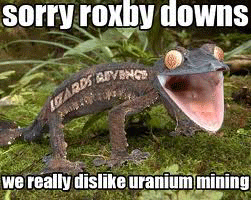
The anti nuclear lizard is biting back at Olympic Damn Uranium Mine
 Zombies, giant sea god join large anti-nuclear protest at Olympic Dam
 http://www.adelaidenow.com.au/news/south-australia/zombies-giant-sea-god-join-large-antinuclear-protest-at-olympic-dam/news-story/df927542a3dc6d8b7a18b4868eb47fe7 Erin Jones, Roxby Downs, The Advertiser, July 1, 2016
MORE than 100 anti-uranium protesters from across the nation dressed as zombies and marched to the “gates of hell” outside Olympic Dam on Friday. It marked the start of a three-day protest by the Desert Liberation Front outside the BHP mine at Roxby Downs, bringing with them a heavy police presence.
STAR Group officers, sniffer dogs, mounted police, dirt bike patrols, a helicopter and a drone were all visible at the mine site during the event’s first day.
About half of the 200 protesters, including children, walked 2km to the mine’s front gates chanting “leave it in the ground, Roxby’s going down”. Some protesters shook the gates, but vowed to keep the event peaceful.
Arabunna elder Kevin Buzzacott has also called on the police “to do right” by them and issued an open invitation to officers to attend their camp. “It’s always a peaceful protest even though others might say it’s not, but we always like to do the right thing,” Mr Buzzacott said.
“We got pulled up by the police and they questioned everyone like we’re terrorists, checking licenses and cars being defected. “So we would also like the other people to do the right thing and come and talk to us and have a cup of tea.”
Mr Buzzacott said the group only wanted to raise awareness on the dangers of uranium and called on BHP to close the mine within two years.
Police Assistant Commissioner Bronwyn Killmier said there had been no arrests on the event’s first day and people had protested peacefully. Ms Killmier said officers were not wearing weapons as protesters were acting peacefully and respectfully. The event follows a similar protest in 2012 which lasted longer than a week and resulted in 18 people being arrested.
Among the colourful characters was a giant 2.5m Tongan sea god named Lumi. Its creator, Nick Wilson, took time off from his job as a puppeteer and travelled from Melbourne to give Lumi a first-hand look at a uranium site he said was poisoning his ocean. “Lumi is the Pacific Island god of ocean and death and he seemed too perfect not to bring,” Mr Wilson, 31, said.
Last night protesters were setting up a roadkill barbecue at their solar-powered camp, on Olympic Way, which included a communal kitchen, music stage and children’s activity tent.
The majority of events by the protesters have been kept under wraps, but marches to the gates are expected throughout the weekend.
The Advertiser understands truck deliveries to the mine were halted Thursday night and will resume Monday evening to minimise any disturbance caused by the protest. BHP Olympic Dam head of corporate affairs Simon Corrigan said they were working closely with police to ensure safe transport of mine workers to and from the site. “We have a great team of people at Olympic Dam who are focused on working safely every day,” Mr Corrigan said.
Indigenous elder Dr Jillian Marsh – Greens candidate for Grey, South Australia
 Nuclear personal and political for Dr Jillian Marsh http://www.portpirierecorder.com.au/story/3987452/nuclear-issue-personal-and-political-for-marsh/ Politicians more often than not stick religiously to the party line when it
  comes to key policy issues.
But for The Greens’ candidate for Grey, Dr Jillian Marsh, the issue of a proposed nuclear industry in South Australia is not just political – it is personal, too. Dr Marsh is a traditional owner and elder of the Adnyamathanha people.
She endorses The Greens’ nuclear and uranium policy which outlines a future without uranium or nuclear energy production. But she said that her Aboriginal heritage motivated her to take the role as candidate for Grey and fight against the proposed nuclear dump.
“I know this is something I have as an obligation as an Adnyamathanha traditional owner,” Dr Marsh said. “I am required to step up to the mark … to take this on board for the sake of future generations.”
One of the proposed sites for a low to intermediate-level nuclear waste dump at The Wallerberdina station, near Barndioota in the Flinders Ranges, sits on Adnyamathanha land.
Dr Marsh was involved in anti-nuclear protest marches through Port Pirie and Port Augusta recently.She felt the the responsibility as a traditional owner and elder of the Adnyamathanha people to speak out about the federal and state government plans.
“Traditional owners, the Aboriginal people, have really had a gutful of this type of approach to community consultation,” she said. “They are always facing the prospect of their culture and country being damaged, destroyed, abused once again.”
Dr Marsh said that the consultation processes and uncertainty put a lot of pressure on aboriginal communities. “It creates a lot of ill-feeling in the community,” she said. “This type of uncertainty and angst is one of the things contributing to the shorter lifespans faced by our people.”
The translation of Adnyamathanha is “people of the rock” or “people of the rocky country” and Dr Marsh said this sacred cultural connection is under threat. “Our connection to the land is constantly being ransacked by ill-informed policies,” she said.
China as market for agriculture, could be finished if nuclear waste dump goes ahead
Kristen Jelk, Your Say Last month I was in China promoting an Australian product that comes from SA which is pitched as a clean, green, environment. The full potential of the market in China for South Australian produce is immeasurable. From a Chinese consumers point of view, the environmental conditions where the product is sourced or grown, is pivotal to the choices made when purchasing.
Chinese consumers will pay top prices for products that are considered SAFE – produced where the source is known to be an unpolluted clean environment. Perception is everything, and if a consumer becomes aware that SA had developed a nuclear waste dump, then that perception of a safe environment will be shattered. It will not matter that the dump is in a desert, nor will it matter if the dump is considerable distance from prime agricultural land, nor will it matter if experts assure of safety standards.

The perception that would prevail is that SA will be a dumping ground for nuclear waste. If this is a discussion over commercial viability verses environmental risks long term, then I would argue that the real cost of the dump being located in SA is the loss in the perception that SA is a “clean, green” state. Questions would be raised over validity of the safety of the states produce.
Science does not dispel the pervading distrust of nuclear waste storage. Impassioned long standing anti-nuclear supporters cannot be placated and therefore ongoing discourse over the proposed dump will just shine a brighter light on the discussion world wide. The long term impact on the revenue of export sales will, without doubt be affected.
To risk the potential of long term growth in export sales due to a short term vision on job creation,( which is questionable ) is not good economics. SA has the potential to be a renewable energy ambassador with exciting projects already in development. We have to think globally, not locally if we are to sustain economic growth based on the real tangible asset that we have, which is our environment. http://yoursay.sa.gov.au/discussions/nuclear-community-conversation-comment-on-the-specific-recommendations-in-the-final-report
Nigel Carney analyses intrinsic flaws in the Nuclear Royal Commission
SA NUCLEAR BRIEFING Nigel Carney, June 16, 2016 Coober Pedy Regional Times “…… the issue South Australians are currently facing in the low level waste site selection process has always been a state and federal alliance, no mere coincidence of need…….
The Commission has been criticized widely as being a political stunt, not an independent Commission but rather a rubber stamp. The findings of the Commission released in May 2016 tend to support this view. The report itself presents evidence against its own findings. We are reminded that the Radium Hill mine and Port Pirie treatment plant remain as unresolved radioactive sites. The Commission finds:
‘The failure to consider the environment in the planning, operating and decommissioning of these facilities has resulted in ongoing management challenges….Although subsequent assessments of both sites show they do not pose a serious radiological risk to the health of visitors to the sites the state government is required to continue to monitor and manage potential environmental contamination’ (Nuclear Fuel Cycle Royal Commission Findings May 2016)
Why then, the public may ask, would a Commission which acknowledges the failure of government to manage the legacy of the nuclear fuel cycle suggest the state has the capability of managing the world’s nuclear waste? Continue reading
Politics and the Nuclear Waste Importing Plan
Risks, ethics and consent: Australia shouldn’t become the world’s nuclear wasteland, The Conversation, Mark Diesendorf, Associate Professor, Interdisciplinary Environmental Studies, UNSW Australia, June 28, 2016
In a country that is divided about nuclear power and where the annual economic value of uranium exports is a modest A$622 million (roughly equal to Australia’s cheese exports), the origin of the nuclear waste proposal is puzzling and inevitably involves speculation.
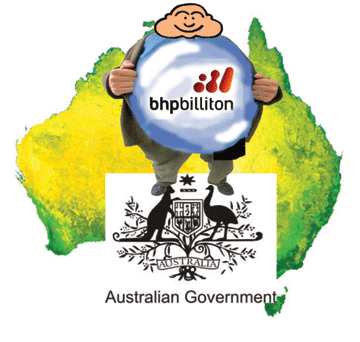 However, one could suggest the political influence of BHP-Billiton, owner of Olympic Dam in South Australia, Australia’s largest uranium mine and the second-largest in the world, and Rio Tinto, owner of the Ranger uranium mine in the Northern Territory.
A global nuclear waste site would lock future generations of Australians into an industry that is dangerous and very expensive. It’s unlikely to gain social consent from Indigenous Australians, or indeed the majority of all Australians. Given the risks, it would be wise not to proceed. https://theconversation.com/risks-ethics-and-consent-australia-shouldnt-become-the-worlds-nuclear-wasteland-61380
The (anti-nuclear) Lizard dances in Adelaide
Zombie dance protest against nuclear industry, in Adelaide’s Rundle Mall http://www.abc.net.au/news/2016-06-28/zombie-dance-protest-rundle-mall/7551626 By Claire Campbell Anti-nuclear campaigners dressed as “zombie mine workers” have taken their message to shoppers in Adelaide’s busy Rundle Mall.
Dancing to the song Radioactive by Imagine Dragons, they rallied against nuclear energy use in Australia and a planned expansion of the outback Olympic Dam uranium mine near Roxby Downs.
Protestor Izzy Brown said South Australia needed to reject proposals that it expand its role in the nuclear fuel cycle. “We’re trying to raise awareness about the dangers of radiation, especially as South Australia is facing an expansion of the nuclear industry,” she said.
“There’s a threat of a national and international waste dump, Roxby wants to expand its uranium mining as well. “So we wanted to get out on the streets of Adelaide. The flash mob is just one small piece of a very big artistic theatrical theme.”
The protest group, the Desert Liberation Front, has dubbed its latest campaign, The Lizard Bites Back. An earlier protest at Olympic Dam four years ago saw police and protesters clash as some broke through a perimeter fence of the mine.
The Risky Economics of South Australia’s Nuclear Waste Importing Plan
 Risks, ethics and consent: Australia shouldn’t become the world’s nuclear wasteland, The Conversation, Mark Diesendorf, Associate Professor, Interdisciplinary Environmental Studies, UNSW Australia, June 28, 2016 Last month the South Australian Nuclear Fuel Cycle Royal Commission recommended that the state government develop a business venture to store a large fraction of the world’s high- and intermediate-level nuclear power station wastes in South Australia. It proposes to do this by first building an interim above-ground store, to be followed by permanent underground repository.
But the commission’s recommendation is based on several debatable assumptions, including:
- an economic analysis that purports to show huge profits with negligible commercial risk
- the notion that social consent could be gained by “careful, considered and detailed technical work”
- the argument that Australia, as a net exporter of energy, has an ethical responsibility to help other countries lower their carbon emissions by means of nuclear power.
I have analysed critically these and other assumptions of the royal commission in a scholarly paper published in the international journal Energy Research and Social Science.
Risky economics
The commission’s economic analysis rests on the heroic assumption that customers would, upon delivery of their nuclear wastes to South Australia, pay up-front for both interim above-ground storage andpermanent underground storage. This would be up to 17 years before the underground repository has actually been built. The estimated total payment would be about A$1.75 million per tonne of heavy metal (tHM) for storing possibly 138,000 tHM in total.
However, this ignores the huge financial risk to the government and taxpayers in the following scenario: the SA government builds the initial facilities – port, underground research and an interim above-ground storage – at a cost of about A$3 billion. Commencing in year 11, customers deliver their nuclear wastes in dry casks, but pay initially only for the costs of interim storage of the casks, declining to pay for geological storage until the underground repository has been built and becomes operational in year 28.
Despite the royal commission’s claim that the government would not develop the project under these conditions, the government could be influenced to accept the wastes by pressure, both positive and negative, from overseas governments, multinational corporations and/or internal politics.
Then, after a large quantity of nuclear waste has been placed into interim storage in SA, the government might not proceed with the geological storage, costing an extra A$38 billion, for technical, political or financial reasons.
A similar situation occurred in the United States with the termination of funding for the Yucca Mountain repository after US$13.5 billion had already been spent.
In this scenario, SA would be locked into managing a large number of dry casks, designed only for interim storage and located above ground, which will gradually erode and leak their dangerous contents over several decades. The physical hazards and the corresponding financial burden on future generations of all Australians would be substantial.
In this scenario, it would also be risky for customers who relied upon it and so failed to provide their own domestic geological repository……… https://theconversation.com/risks-ethics-and-consent-australia-shouldnt-become-the-worlds-nuclear-wasteland-61380
Social Consent and South Australia’s Nuclear Waste Import Plan
Risks, ethics and consent: Australia shouldn’t become the world’s nuclear wasteland, The Conversation, Mark Diesendorf, Associate Professor, Interdisciplinary Environmental Studies, UNSW Australia, June 28, 2016
“…….Aware that Australians are divided on the nuclear industry, the royal commission acknowledges that gaining “social consent warrants much greater attention than the technical issues during planning and development”.
Then, on the same page of its report, it postulates that community support could be gained by “careful, considered and detailed technical work”. It thus creates the false impression that all social and ethical concerns can be reduced to technical issues.
Ultimately, gaining social consent is a socio-political struggle that draws only slightly on research and education on science, technology and economics. This is demonstrated by current debate in Australia on climate science, in which citizens are influenced by a print media that in many cases is biased towards denial, and a Coalition government that contains several vocal climate sceptics
Indigenous Australians have successfully opposed for 20 years an above-ground dump for low-level national nuclear waste on their land at Muckaty in the Northern Territory. Indigenous communities are already mobilising, together with environmentalists, to resist very strongly any development of intermediate- and high-level repositories in South Australia. The social impacts of a low-level waste dump are bad enough, but would be dwarfed by the social, physical and financial impacts of a high-level waste repository…….” https://theconversation.com/risks-ethics-and-consent-australia-shouldnt-become-the-worlds-nuclear-wasteland-61380
Citizens Jury: the ever climbing costs of Jay Weatherill’s nuclear waste dream
 $7k each for Jay Weatherill’s nuclear citizen jury http://www.theaustralian.com.au/news/briefs-nation/7k-each-for-jay-weatherills-nuclear-citizen-jury/news-story/c363f8aac22374ef76e470b9c71d33e8 JUNE 27, 2016 Rebecca Puddy Reporter Adelaide The South Australian government has set aside $350,000 for 50 randomly chosen people to meet over four days to discuss the establishment of a nuclear waste dump, equating to $7000 a person.
The first two days of consultations of the citizens’ jury were held at the weekend, with Premier Jay Weatherill picketed by anti-nuclear activists on his way to open the deliberations over whether the state should have a high-level nuclear waste repository.
It is understood a budget of $350,000 has been set aside for the four days, including recruitment and management, accommodation and transport, event facilitation over the two weekends, live streaming and transcription services, catering, venue hire and security.
In announcing the citizens’ jury, Mr Weatherill last month said less than a $1 million had been budgeted for his nuclear consultation process, but more would likely be assigned in the state budget on July 7.
Blow to South Australian govt: BHP categorically rejects any role in nuclear waste importing
 In another potential blow to the South Australian government, which had pinned the state’s economic future on the original expansion plan, Olympic Dam asset president Jacqui McGill categorically rejected siting a high-level international nuclear waste repository on any land covered by its indenture agreement.
We’re not a waste repository company, so that’s not in our business model and it’s not in our plans,” she said. BHP had no moral responsibility to manage waste
BHP: Fukushima set uranium industry back for years THE AUSTRALIAN JUNE 27, 2016 Michael Owen SA Bureau Chief Adelaide A key reason for BHP Billiton’s decision four years ago to indefinitely mothball a $30 billion plan to turn Olympic Dam into the world’s biggest uranium mine was the Fukushima nuclear plant explosion rather than cost concerns, it has been revealed. Continue reading
1 – 3 July – Lizard Bites Back festival at Olympic Damn Uranium Mine
The Lizards Bites Back music and arts festival and protest camp will take place at the gates of the Olympic Dam uranium mine (or close by) from the 1st – 3rd of July this year. The “protestival” will include a variety of musicians and artists from around the country, mobile artworks, workshops on nuclear issues, non-violent direct action, and the message that there is strong community opposition to uranium mining and any expansion of the nuclear fuel chain in South Australia, from BHP Billiton’s planned heap leach demonstration plant to current proposals for South Australia to host a nuclear waste dump. The event will run entirely on solar and wind power.
The entire nuclear fuel chain from mining to nuclear waste dumps poses unique health and environmental risks that span generations. With South Australia currently facing two proposals for nuclear waste dumps The Lizard Bites Back will re-focus on the source of the problem, highlighting an absurd global situation where we continue to mine a mineral that we cannot dispose of safely, whilst proposals are again being made to force nuclear waste dumps on communities that do not want them. The Olympic Dam mine itself will also eventually become a dump – in the sense that once it is closed, it will leave millions of tonnes of radioactive tailings on the surface of the land forever.
Uranium mining is the beginning of the nuclear fuel chain, and the problem of the long term storage of radioactive waste remains unresolved. Until the industry and governments stop creating nuclear waste by mining uranium, operating nuclear reactors and making nuclear weapons, why should any community bear the health and environmental risks associated with a nuclear waste dump? The government’s current approach mops up the bathroom floor whilst the tap is still running.
A responsible approach to managing nuclear waste would begin with stopping its production. An environmentally and socially just approach would stop targeting Aboriginal lands as sacrifice zones.
The Lizard Bites Back follows on from the Lizards Revenge in July 2012, which mobilised 500 people against the proposed expansion of the mine. Since then, that proposal has been shelved and the company has been investigating heap leach mining as part of a cheaper expansion plan. BHP is projected to begin a heap leach trial on the current mining lease by late this year. Even though this technique is not currently used on-site, Federal approval of the trial did not require environmental assessment.
Please see below for a summary of the issues. Continue reading
Port Augusta protest against federal government’s plan for dumping Lucas Heights nuclear wastes at Barndioota
Doctor Margaret Beavis, a Melbourne-based GP, joined the protest today and  says the community needs help addressing this issue.
“I think it’s important to realise that most of this waste doesn’t come from the use of medicine,” Dr Beavis said.
Nuclear waste protest gives people voice http://www.transcontinental.com.au/story/3990175/nuclear-waste-protest-gives-people-voice/ Matt Carcich @MattCarcich June 24, 2016,Around 150 people made their voices heard in a protest against the federal government’s plan for a national nuclear storage facility in the Flinders Ranges at the Barndioota site near Hawker.
The march started at the Port Augusta foreshore, before stopping out the front of State MP Dan van Holst Pellekaan’s office.
The rally continued down the main street, stopping at every major intersection and Woolworths, before heading to the Port Augusta Regional Council building and finishing at Gladstone Square.
People travelled from Port Pirie, Whyalla, Hawker, Quorn and Adelaide for the event.
Upon arrival at Mr van Holst Pellekaan’s office, the state MP for Stuart and protesters discussed about multiple facets of the proposal.
Australian Greens candidate for Grey Dr Jillian Marsh, who is a Adnyamathanha Traditional Owner, accompanied the march and made an impassioned speech.
Dr Marsh said it’s important for people to have their voices heard and reinforced the Australian Greens’ stance against the proposal. Continue reading
Protest outside South Australia’s Nuclear Citizens Jury
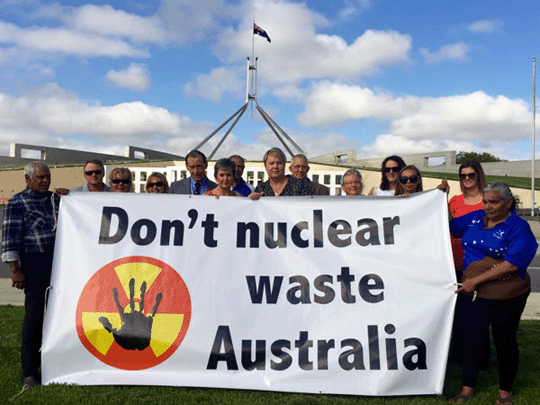 Nuclear royal commission: Protesters voice opposition to SA waste dump outside citizens’ jury, ABC News, 25 June 16 Anti-nuclear protesters have confronted SA Premier Jay Weatherill on his way into a citizens’ jury which is meeting to consider a controversial proposal to build a nuclear waste dump in the state.
The event at the South Australian Health and Medical Research Institute (SAHMRI) was prompted by the Nuclear Fuel Cycle Royal Commission, which handed down its findings earlier this year.
The final report by commissioner Kevin Scarce delivered to the SA Government in May made 12 recommendations, including the creation of waste storage sites and the relaxation of federal restrictions on nuclear power.
Tentative findings released in February also urged the creation of a dump with capacity for 138,000 tonnesof spent fuel from the world’s nuclear reactors.
Dozens of protesters gathered outside SAHMRI in Adelaide this morning, shouting out their concerns when the Premier arrived.
Gypsy-Rose Entriken from the Barossa Valley said she was worried about the dangers of transporting nuclear waste. “I’m really worried about what the implications of this long-term dump are going to be, and how it’s going to affect us for the rest of our lives and for generations,” she said.
“How are they going to get it here? There’s so many things that can go wrong.”
The citizens’ jury is made up of 50 people selected from about 1,100 registrations by research organisation newDemocracy Foundation, and is part of a public relations exercise organised by the State Government.
Its job is to decide which elements of the royal commission’s recommendations need to be discussed in more detail…….http://www.abc.net.au/news/2016-06-25/citizens-jury-to-consider-nuclear-dump-proposal/7543314
1 This month


Help Aunty Sue Protect Her Land and Sacred Sites From Destructive Rocket Testing.
.

Australians deserve the truth
about
AUKUS – https://aukuspublicinquiry.com/

PETITION – To: Prime Minister Anthony Albanese and the Australian Labor Government

of the week – Australians for War Powers Reform (AWPR)
To see nuclear-related stories in greater depth and intensity

