Gems from Nuclear Citizens Jury – South Australia today
Morning Session
DemocracyCo advises on streaming of Nuclear Citizens Jury hearings in Adelaide
Emily from democracyCo here.
 The Lifestream sessions will be up tomorrow on this website. http://yoursay.sa.gov.au/decisions/yoursay-engagements-nuclear-community-conversation/about First session will be from 9.20am. We are also transcribing all presentation & Q&A sessions with the Jury – we can’t transcribe workshop sessions though, too tricky! On Facebook & Twitter you will also be able to find updates throughout the day.
******************************************
 For any credibility, the hearings with witnesses would need to be available on video and audio, and preferably televised. I fear that NewDemocracyCo is being played by the Nuclear Royal Commission and the Weatherill government.
National Labor opposes nuclear waste importing: an obstacle to South Australia’s plan

 Labor’s national policy against nuclear could create issues for SA’s waste dump proposal http://www.abc.net.au/news/2016-06-24/alp-policy-could-create-issues-for-sa-nuclear-vision/7539166?utm_source=dlvr.it&utm_medium=twitter By Leah Maclennan Labor may oppose a high-level nuclear waste dump, even if the South Australian Government decides to build one, a federal Labor MP says.
The State Labor Government is consulting on the proposal following the recommendations of the Nuclear Fuel Cycle Royal Commission.
But Labor MP Nick Champion told a forum in Adelaide that he is against it, and would not want one in his electorate, which covers the northern suburbs and the Barossa Valley.
“I think the transport of it. I think the actual construction of it, the fact that nobody in the world has done it,” Mr Champion said. “Canada hasn’t done it. I think the Fins have only just established one, I think there is a lot more thinking that would have to go into it before we embarked on such a route.”
Mr Champion also raised the issue of the Labor Party’s policies, saying it has a national position in opposition to a high-level nuclear waste dump.
“There’d be some interesting debates at the national conference as there has been for the last three decades on nuclear issues,” he said
“But at the moment our platform opposes a high-level nuclear waste dump and so I suspect that’s the way the policy will be.”
Liberal senator Simon Birmingham told the forum it was the strongest opposition he has heard from a Labor MP.
“I’ve heard Bill Shorten and Penny Wong and Anthony Albanese express reservations about a nuclear waste dump before but I think Nick has put the party platform and position more clearly today than I’ve actually heard from a lot of others,” he said.
“For South Australians who think there is a good opportunity for our economy here, and [Premier] Jay Weatherill appears to be one of them, that’s a concerning proposition that you’ve put that it would seem to be very hard to get cooperation from a federal Labor government if SA is to go down this pathway.”
The federal Liberal Government has said it would work cooperatively with the South Australian Government if it decides to go ahead with the plan.
S Australia’s Nuclear Citizens Jury – dubious panel, dubious public accessability
omigawd I can’t believe that they are classing nuclear business lobbyists Nigel NcBride  and Jason Kuchel as “experts” on nuclear science.
This Citizens jury panel is worse than I expected it to be. As for the link to “streaming” – it does not lead you there. It leads you to the Nuclear Royal Commission’s page where you’re invited to “register for discussion”. So much for public access to the hearings. This is a charade of the Citizens Jury Process.
To have any credibility a Citizens Jury on this nationally important matter should be televised, or at very least available as video, audio and transcript.
South Australia’s Nuclear Citizens Jury to have a ?scientific panel
A businessman, an environmentalist and an oncologist walked into a citizens’ jury…http://indaily.com.au/news/local/2016/06/23/a-businessman-and-environmentalist-and-an-oncologist-walked-into-a-citizens-jury/ Passionate advocates and fierce opponents of a state-based high-level nuclear waste dump will confront the first Citizens’ Jury debating the issue over the weekend.
Business SA chief Nigel McBride, who last week confirmed his organisation was now “advocating actively and positively for a high-level waste repository” will join a panel of prominent figures to debate the issues and field questions from the 50 jurors on Sunday.
McBride will butt heads with the likes of Conservation Council SA chief Craig Wilkins, who has strongly argued against increasing SA’s involvement in the nuclear fuel cycle.
They will join SA’s chief scientist Dr Leanna Read, SA Native Title Services CEO Keith Thomas and ethicist Simon Longstaff on the panel, along with mining lobbyist Jason Kuchel, Kelly-Anne Saffin from the Northern and Yorke Regional Development Australia and Michael Penniment, Director of Radiation Oncology at the Royal Adelaide Hospital.
Nuclear Fuel Cycle Royal Commission Consultation and Response Agency chief executive Madeline Richardson said in a statement the panel was “a dynamic way of exploring some of the big issues in an open and informative way”, with the discussion to be livestreamed to the public.
“It is about letting everyday South Australians frame what the community should focus on, rather than the Government, politicians or lobby groups setting the agenda,” she said.
The jury will meet for four days across two weekends to identify key issues that require further debate.
Jury convenor Emily Jenke, from DemocracyCo, said the panel discussion was “designed to stretch the jurors’ thinking, spark ideas and explore issues through presentations by speakers who can elevate the conversation”.
“We know jurors want to hear from people who have strong opinions, and also people who have specific expertise,” she said.
“The group is made up of a range of people – leaders, experts and people with a specific interest – and that’s the balance we are looking for.”
Topics such as health, Aboriginal heritage, environment, industry, ethics, community, business and potential reputational damage will be canvassed.
Taxpayers $100,000,000 to be spent up front BEFORE any decision on South Australia nuclear waste importing
 Valdis Dunis Nuclear Fuel Cycle Watch South Australia 24 June 16
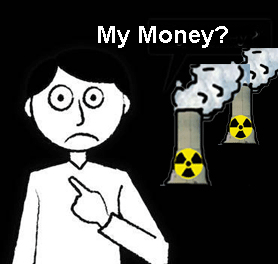
Last night on Adelaide ABC TV News, The Royal Commission’s Jacob Engineering Manager Tim Johnson was interviewed after his submission to SA Parliament yesterday. He stated for the government to be certain that a waste dump would be feasible technically and financially would – like any large technical engineering program – require detailed analysis, and given the complexity Jacob’s estimate is about A$100M that the State Government would have to spent upfront BEFORE we could confirm a yes/no to make sure it will work and make money for us.
Should we spend $100M on more nuclear analysis, or spend the money instead on renewables and other services in our state?
http://nuclearrc.sa.gov.au/…/2016/02/JOHNSON-Tim-489-496.pdf
http://www.abc.net.au/news/sa/
Nuclear Citizens Jury South Australia Saturday, June 25 and Sunday, June 26
The first Jury of 50 South Australians has now been randomly selected with representatives from far and wide across the state ranging in age from 18 to over 65. The jurors will meet for the first time in Adelaide next Saturday, June 25 and Sunday, June 26 for a weekend of deliberations.
South Australians will have the chance to sit in and watch first-hand the deliberations and workings of a Citizens’ Jury. Ten randomly selected people will be able to attend selected sessions of over both upcoming Jury weekends.
To register for your chance to be offered an observer place at one of the Jury sessions, you must first be logged in or registered on the YourSAy Nuclear website, before filling out the application form.
The observers will be able to sit in during a morning or afternoon session. Each day there are between three and four sessions available. All open sessions will be streamed live on the YourSAy Nuclear website
Registration for the first two days of the Citizens’ Jury (Saturday 25 June and Sunday 26 June) will close at 5pm Wednesday 22 June, 2016.
Registrations for the last two days (Saturday 9 July and Sunday 10 July) will close at 5pm on Wednesday 6th July. All applicants’ names will be sorted into a random stratification process which will be
facilitated independently by newDemocracy Foundation. To allocate seats, a random number draw will be conducted.
Does the South Australian plan meet the BASIC REQUIREMENTS FOR CITIZENS’ JURY ?
BASIC REQUIREMENTS FOR CITIZENS’ JURY - Assurance that the participants are randomly selected from as wide a range as possible.
- Honorarium payment, crèche facilities, and easy-access jury locations, etc, every effort made not to exclude any person because of their situation.
- The selection of a truly neutral Advisory body, with equal representation from pro and anti nuclear witnesses.
- Moderators for the hearings also selected to be neutral.
- Questions well selected so as not to influence the response (this was one of the major failings of the Royal Commission)
- Complete video and audio of the hearings available to the public, (though not the private discussions of the participants)
The public availability of complete audio or video recordings of all jury hearings, (though not of “jury room” deliberations if participants would prefer privacy) is an important aid to transparency. Multiple sources of funding help to ensure that the jury’s organisers are not seen as having a financial interest in producing a verdict that supports the interests of a single funding body. To maximise the scrutiny they provide, the two or more funders should have somewhat opposing interests regarding the subject likely to be under discussion.
The moment in a citizens jury that is most important for its participants is the point at which they deliver their recommendations to those in power. A jury in which jurors are not only allowed to present their conclusions themselves at a press conference, but also undertake work towards ensuring that some of their conclusions are implemented, is a far more empowering process than one in which their verdict is merely extracted by researchers and written up without further input from the jurors. http://sru.soc.surrey.ac.uk/SRU37.html
| Iain Walker <iain.walker@newdemocracy.com.au |
but sub-contracted out to South Australia’s DemocracyCo
- – CEOs are Emma Lawson and Emily Jenke.
Principal Advisor is Ilka Walkley
- CONTACTS:
- 0421 098 355
- 0427 834 062
- Ilka Walkley
- 0409 961 902
- Vivienne Lambert
- 0417 084 475
- Note how the poisoned chalice is always given to women. They can then be blamed when it all stuffs up
David Noonan’s Nuclear waste security brief, in brief
 Nuclear waste security brief by David Noonan, Independent Environment Campaigner, June 16
“Proposed International nuclear waste storage exposes Australia to risks of terrorism”
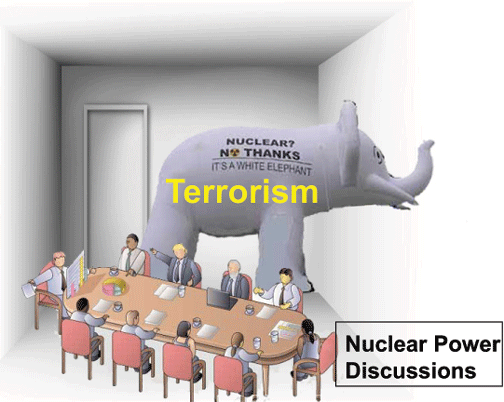
An International nuclear waste storage agenda exposes Australia to a range of potential profound adverse impacts through nuclear insecurity as a target for terrorism.
Claims by the Nuclear Commission Findings Report (Feb 2016, p.16-20) that SA “offers a safe long term capability” for the storage and disposal of high level nuclear waste are contradicted by the fact that Australia will be exposed to significant and developing threats in terrorism over decades of proposed Nuclear port and above-ground waste storage operations.
The UK Nuclear Free Local Authorities are concerned a determined terrorist group could be able to pierce nuclear waste transport and storage casks in use around the world and states that transport of nuclear materials should be limited as much as practical, with safe on-site storage facilities developed instead.
The Nuclear Commission’s nuclear waste transport and storage plans face fast emerging and unexpected nuclear security threats as lethal technology gets ever more destructive. Rocket propelled grenades, demolition charges and innovative available technology like the use of small drones by non-state actors are of increasing concern.
Attacks could seriously compromise operations of a nuclear port or an above-ground nuclear waste storage facility and the extent of impacts could conceivably require the site to be abandoned.
Security dangers in Nuclear Royal Commission’s plan
Nuclear Waste Brief (June 2016) by David Noonan, Independent Environment Campaigner
 Proposed International nuclear waste storage exposes Australia to risks of terrorism “In the event of a major nuclear accident, adverse impacts on the tourism, agriculture and property sectors could potentially be profound.” Nuclear Royal Commission Finding 155 Feb 2016, Impacts on other Sectors p.28
An International nuclear waste storage agenda exposes Australia to a range of potential profound adverse impacts in major nuclear accidents and in nuclear insecurity as a target for terrorism.
The SA Nuclear Royal Commission Final Report (9 May 2016, 16 Mb) flagged risks in proposed high level nuclear waste transport and storage and concluded that terrorist attack scenarios are conceivable and rocket attack has the greatest potential to cause a release of radiation from impacted waste transport and storage casks (Appendix L – Transport risk analysis p.312).
In an age of terrorism following the devastating September 11th 2001 attacks there is no room for denial on the real security risks society faces in nuclear and radiological terrorism. Continue reading
Why a referendum is needed on South Australian govt’s nuclear waste import plan
john jasson, Your Say 17 June 16 Chapter 6 page 122 [Nuclear Fuel Chain Royal Commission Recommendations] states:
“Because of these shifts, a public vote on a proposal is not a reliable indicator of ongoing social consent: A vote for or against a proposal one day may not result in the same level of social consent one month later. ”
The two paragraphs that precede this unsubstantiated opinion as declared by the commission are in my view irrelevant because they relate to changes in public consent for matters of technological change that are easily reversible and have risk profiles that are minimal by comparison to a nuclear storage or transportation accident.
For this reason I have no trust in this process as I believe this to be a blatant attempt to circumvent the people of SA having a true say in this matter. A referendum is the only acceptable way to achieve public consent on a matter that has such significant commercial, safety and social implications for the public of SA. http://yoursay.sa.gov.au/discussions/nuclear-community-conversation-comment-on-the-specific-recommendations-in-the-final-report
View South Australia Nuclear Citizens Juries Saturday 25 June and Sunday 26 June
Citizens’ Jury Viewing Your Say Nuclear Register to be an “Observer” for the first upcoming nuclear Citizens’ Jury
There are a number of sessions in which 10 randomly selected South Australians will be able to sit in and watch proceedings, hear what the Jury hears and observe how democracy works in this important discussion.
While sessions will be broadcast publicly via media organisations and live streaming on the YourSAy website, at any time the jury reserves the right to deliberate privately and can ask for the jury room to be cleared.
Please note that photographers will be present to take photographs and capture film at this event. This material will be published in both printed and electronic (including Internet-based) media used by the South Australian Government to promote the consultation process on the Nuclear Fuel Cycle Royal Commission report. In some cases, the media in which this material is published may be administered by a third party……
Registration for the first two days of the Citizens’ Jury (Saturday 25 June and Sunday 26 June) will close at 5pm Wednesday 22 June, 2016. Registrations for the last two days (Saturday 9 July and Sunday 10 July) will close at 5pm on Wednesday 6th July. All applicants’ names will be sorted into a random stratification process which will be facilitated independently by newDemocracy Foundation. To allocate seats, a random number draw will be conducted.
Successfully drawn applicants for the first weekend of the Citizens’ Jury will be notified by telephone or email on Thursday 23 June. Successfully drawn applicants for the second weekend will be notified by telephone on Thursday 7 July.
Senator Nick Xenophon not keen on nuclear waste importing
 Xenophon “can’t see benefits” of nuke dump, InDaily, Tom Richardson, 17 June 16 Influential senator Nick Xenophon has come down against the establishment of an international nuclear repository in South Australia, arguing “I can’t see the benefits are there that outweigh the risks”.
It comes as the state’s chamber of commerce, Business SA, nailed its own colours firmly to the mast, with chief Nigel McBride saying the organisation was now “advocating actively and positively for a high-level waste repository here in SA”.
InDaily revealed in March that McBride would be joining a business delegation organised by the  Committee for Adelaide to tour nuclear sites in Europe, but at the time he insisted he was there to observe and learn, not to advocate…… with a public information campaign gearing up in the wake of the Scarce Royal Commission’s bullish final report, McBride says he is now prepared to take a lead in pushing for the repository to become a reality.
He said “thought leaders” in the community, rather than politicians, should step up to play a prominent role in the debate.
“We’re absolute advocates,” he said of Business SA…….
Business SA is overtly advocating for a high-level nuclear waste facility in SA, subject to an educational process that will get social consent.”
But the influential lobby group’s enthusiasm was not reciprocated by Xenophon at an election forum, co-hosted last night by a range of interest groups including the Wilderness Society and Conservation SA in the marginal electorate of Hindmarsh.
In a packed Glenelg Football clubroom, Karina Lester from the Yankunytjatjara Native Title Aboriginal Corporation pressed Xenophon on where his fledgling party stood on high-level nuclear waste imports.
“Would your party listen to us and support the overwhelming majority of traditional owners who continue to speak out against establishing an international nuclear waste dump?” Lester asked.
Xenophon said: “The short answer is yes, I don’t support importation of high-level waste.”
He has previously endorsed a referendum on the issue, explaining last night that “it seems to me you might get a consensus between the two major parties here in SA and it might be seen as a a done deal [so] it’s important to get the consent of the community”.
However, he added, “if a referendum were held tomorrow I can’t see myself supporting it”.
“I can’t see the benefits are there that outweigh the risks,” he said.
The debate is set to dominate the state political scene in the latter half of the year, with two Citizens’ Juries headlining a broader community consultation………http://indaily.com.au/news/local/2016/06/17/xenophon-cant-see-benefits-of-nuke-dump/
Australian Greens plan for a solar South Australia
 Australian Greens announce plan to fund solar panels for 48,000 SA homes
 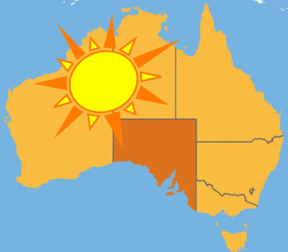 June 16, 2016 http://www.adelaidenow.com.au/news/national/federal-election/australian-greens-announce-plan-to-fund-solar-panels-for-48000-sa-homes/news-story/fd62f39d9131861e539f9a674 Political Editor Tory Shepherd, Advertiser MORE than 48,000 South Australian homes would get solar panels and energy efficient measures under an Australian Greens plan to reduce electricity costs and reduce emissions.
Deputy Leader Larissa Waters and SA Senator Robert Simms has announced in Adelaide today a plan to spend $2000 on each public and community housing home, which they say could save renters as much as $1075 a year.
The plan would cost $60 million a year, and would not be finished until 2030. By that point homes would be retrofitted with energy-saving and water efficient devices, with solar on every roof.
Senator Simms said it would also boost jobs, employing thousands of South Australians.
“This initiative would not only provide South Australians with more jobs in the renewable energy and green housing sector, but it would save the average household $780 per year in electricity bills from installing solar alone,” he said.
Senator Waters said nationally it would help about 800,000 people. More than 2400 deaths a year are associated with cold weather, she said.
“We have an unequal system where our lowest earners are paying the highest price for power, many in ageing houses that are inefficient to run, hot in summer and freezing in winter,” she said.
The Greens will not be able to form Government but they may share the balance of power in the Senate after the July 2 election, which could give them leverage over the major parties.
One response to the recommendations of the South Australian Nuclear Fuel Chain Royal Commission
john jasson 09 Jun 2016Recommendations 1, …. Strongly disagree with removal of State powers on these matters. This is contrary to the interests of South Australians
Recommendations 2,3,4…….Agree with these recommendations as they apply to mining generally.
Recommendation 5 is an absolute nonsense and I strongly disagree as it is not practical and realistically enforceable. This appears to me be a hollow and deceptive assurance to gain support for recommendations 8 through 12. The recommendation overlooks the appalling history of contamination in this State that has already occurred and can not be economically remediated.
Recommendation 7 Agree subject to this activity NOT contravening the original intent and purpose of this facility. Priority should at all times support the fundamental purpose for which this facility was created.
Recommendation 8 Strongly disagree.
Recommendation 9 Agree with the intent of this recommendation but subject to the removal of Nuclear.
Recommendations 10, 11, 12 Strongly disagree. http://yoursay.sa.gov.au/discussions/nuclear-community-conversation-comment-on-the-specific-recommendations-in-the-final-report
1 This month


Help Aunty Sue Protect Her Land and Sacred Sites From Destructive Rocket Testing.
.

Australians deserve the truth
about
AUKUS – https://aukuspublicinquiry.com/

PETITION – To: Prime Minister Anthony Albanese and the Australian Labor Government

of the week – Australians for War Powers Reform (AWPR)
To see nuclear-related stories in greater depth and intensity

