Nuclear port in Australia to receive and store High level Nuclear Wastes
 The first high level nuclear waste shipment imposes untenable & unfunded liabilities on Australia, without a disposal capacity or even a site, and facing proposed decades of above ground storage.
David Noonan, 3 June 16 Nuclear port in Australia to store High level Nuclear wastes and receive waste ships every 24 to 30 days for decades:
The SA Nuclear Royal Commission Final Report (9 May 2016, 16 Mb) recommends a deep sea Nuclear port in Australia to receive an average 3 000 tonnes of high level Spent Nuclear Fuel (SNF) waste per year throughout the first three decades of proposed operations.
“In summary, the report recommends: Management, storage and disposal of waste, Recommendation: Pursue a purpose-built waste storage and disposal facility for used nuclear fuel. … The Commission’s firm conclusion is that this opportunity should be actively pursued, and as soon as possible.” (Nuclear Commission, Report Delivered, 9 May)
The Nuclear Commission report is based on a desk top nuclear waste consultancy “Radioactive waste storage and disposal facilities in SA” (Feb 2016) by Jacobs MCM, stating baseline requirements for:
the proposed Nuclear port is to take a total of 138 000 tonnes of high level nuclear waste (equivalent to 1/3 of total global SNF waste) over some 70 years from Project Year 11;
a “dedicated port facility specifically developed to transfer the canisters from the delivery ship to rail for transportation to the facility site” stating a “greenfield port is proposed”, with an allowance of A$100 million in baseline costs for the development of the port.
(Jacobs MCM, Enabling infrastructure, Port facilities, p.136);
“…estimated receivals of 3,000 tonne of SNF per year. With typical capacity per cask of 10 tonnes , this translates as 300 casks per year, requiring 12-15 sailings (nuclear waste shipments) per annum, meaning one ship each 24-30 days on average.” At 200 – 250 tonnes SNF waste per ship.(Jacobs MCM, Immediate port receival laydown area, p.170);
the proposed Nuclear port is to store high level nuclear waste on site, with a “minimum immediate port storage capacity for casks unloaded from ships suggested as 28 waste casks” required a storage capacity of some 280 tonnes of high level SNF waste, at an average timeline of 10-12 days to clear a shipment of 20 waste casks from the port (p.170). A loaded high level nuclear waste transport cask weighs in range of 100 to 140 tonnes (by type);
In addition, the proposed Nuclear port is required to receive some 390 000 cubic metres of intermediate level nuclear wastes. At a rate of 10 000 m3 per year for the first 28 years of operations (equating to circa 600 x OSO shipping containers per year) stepping down to circa 4 000 m3 per year over the following proposed 24 years of port operations (p.161 and 172).
The proposed Nuclear port is itself to become a high level nuclear waste dump holding SNF wastes (280 tonnes) equivalent to some 14 years operations of a nuclear power reactor. “A typical nuclear power plant in a year generates 20 metric tons of used nuclear fuel” (US Nuclear Energy Institute).
The first high level nuclear waste shipment imposes untenable & unfunded liabilities on Australia, without a disposal capacity or even a site, and facing proposed decades of above ground storage.
South Australian Premier Jay Weatherill launches nuclear propaganda campaign
 Premier Jay Weatherill Sunday, May 29, 2016 Consultation on nuclear future to extend across all of South Australia http://assets.yoursay.sa.gov.au/production/2016/05/29/01/29/06/0cee3e94-ed82-4dfa-992e-a44d25cec636/nuclearconsult.pdf
Coober Pedy headed for 70% renewable energy
 Local jobs out of Hydro Tasmania project in Coober Pedy http://www.examiner.com.au/story/3934449/local-jobs-out-of-hydro-project/ Toli Papadopoulos 29 May 16.
A new project will inject millions into the Tasmanian economy and create local jobs, according to Hydro Tasmania CEO Steve Davy.
Mr Davy said the new project will use local manufacturing suppliers, and aims to turn South Australia’s Coober Pedy into a renewable township.
Hydro Tasmania’s manager off-grid solutions Simon Gamble said a number of Tasmanian companies would be involved in the project, including Doric engineering and Southern Prospect out in Wynyard.
He said the containerised systems and electrical equipment would be designed and tested in Tasmania.
Hydro said it was engaged by project developer Energy Developments Limited to develop technologies previously used in King Island.
They said Energy Developments Limited received a grant of $18.4 million by the Australian Renewable Energy Agency for the project.
“This is second project using this containerised modular system, the first was Flinders Island, but this one is by far the largest project we’ve done,” Mr Gamble said.
Mr Gamble said Hydro had already invested in projects in South-East Asia and the Pacific, and this was really just the beginning.
Hydro said 70 per cent of the town’s energy will be drawn from renewable sources once the technology is in place, with a goal of eventually making Coober Pedy completely renewable.
Doubts about the integrity of South Australia’s “Citizens’ Jury” nuclear waste plan
 I am in fact, in favour of the Citizens’ Jury Idea. Instead of us being ‘talked down to’ by experts, (who are likely to have a vested interest in the nuclear waste import plan), ordinary non experts hear all the evidence and opposing opinions, discuss these, and come up with a sensible verdict.
After all, that is what we expect in a criminal trial. We do not trust the verdict to “experts” although we do expect their opinions to be heard.
My problem with the South Australia’s Citizens’ Jury on nuclear waste importing is that it doesn’t seem to be given a truly jury role.
The letter sent to potential jury participants says that their task will be to produce an independent guide to help every South Australian understand the recommendations raised by the Royal Commission’s report.
No mention of a verdict on whether or not the jury thinks that the nuclear waste import plan should go ahead.
The organisation running the process, newDemocracy, is using a trademarked definition of ‘Citizens’ Jury’ That trademark belongs to the Jefferson Center. They define the term;
The Citizens Jury convenes diverse groups of citizens to study an issue deeply, discuss different perspectives on the issue, and recommend a course of action or craft their own solutions to address the issue at hand.
I would like to give newDemocracy the benefit of the doubt. Their all too brief notes on this plan do end with this statement:
The first stage of the project will run from May through November 2016, and results in a gateway decision as to whether or not there is broad social consent to continue to pursue opportunities related to the Nuclear Fuel Cycle.
Will the Citizens’ jury be able to say NO to nuclear waste importing for South Australia?
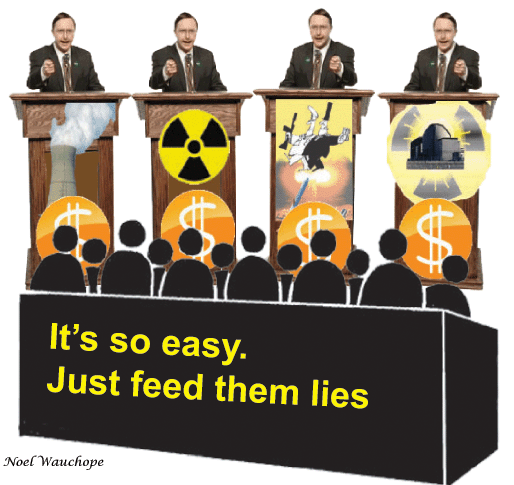 Just how strictly controlled the process is becomes obvious when it emerges that the task of those 50, during two weekend meetings in June and July, will be to produce ‘a short independent guide to help every South Australian understand the recommendations raised’ by the report.
ABC news dubbed this whole process the Premier’s ‘public relations exercise’, and surely they’re not wrong.
The Premier is urging all South Australians to remain ‘open’ about the proposal. But are they, including the Citizens’ Jury, allowed to be open to refusal?
SA Premier coopts democracy for nuclear nefariousness http://www.eurekastreet.com.au/article.aspx?aeid=48345#.V0eKYTV97Gg Michele Madigan | 25 May 2016
 I was trying to think what the invitation reminded me of. It took me a moment, but then I had it: the Project for the New American Century, the neo-conservative think tank and ‘educational’ organisation that went on to play a key role in shaping the foreign policy of the George W. Bush administration.
It’s a different time and different circumstances, but there was something about this invitation — a joint missive from the Premier of South Australia and the newDemocracy Foundation — that seemed to resonate with that ominous American institution; a sense that democratic ideas such as consultation and partnership were being co-opted for nefarious ends. In the address section of the envelope, in beautiful script, the partnership was emphasised: ‘An Invitation from the Premier and the newDemocracy Foundation’.
The gold and black lettered document was an invitation ‘to take part in the Citizens’ Jury of the Nuclear Fuel Cycle Royal Commission’s report’. This Citizens’ Jury will take place now that Royal Commissioner Kevin Scarce has handed down his final report, with the primary extraordinary recommendation that South Australia invite high-level radioactive waste from overseas. Continue reading
Xenophon wants nuclear waste referendum, but only AFTER a dump site is selected
Independent Senator Nick Xenophon might vote against company tax cuts, seeks referendum on nuclear waste dump, The Advertiser May 26, 2016 Political Reporter Peter Jean INDEPENDENT Senator Nick Xenophon wants a referendum to decide whether South Australia should be home to a nuclear waste dump……
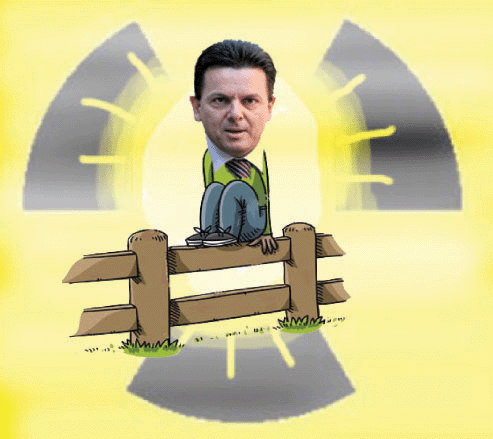 After a South Australian Press Club election debate on Thursday, he told The Advertiser that a waste dump referendum should happen once a location was decided.
“The people of SA should have a direct say on it,” he said. If the state referendum passed, it is likely the federal Parliament would pass the legislation needed at that level…..http://www.adelaidenow.com.au/news/south-australia/independent-senator-nick-xenophon-might-vote-against-company-tax-cuts-in-senate/news-story/0207bb0fe9c9fd5761d2ab8b474942
Federal Liberal and Labor support nuclear waste import: Xenophon suggests referendum
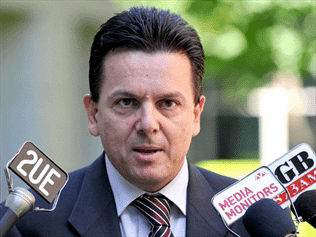 Xenophon calls for SA nuclear referendum http://www.9news.com.au/national/2016/05/26/15/09/sa-needs-nuclear-referendum-xenophon South Australia should hold a referendum on whether to host a high-level nuclear waste dump, independent senator Nick Xenophon says.
The decision to host the dump would have far-reaching consequences, Senator Xenophon told an SA Press Club debate on Thursday.
“If we had a high-level dump it will be around for tens of thousands of years,” he said.
Premier Jay Weatherill has consistently rejected the idea of a referendum, saying the government will instead pursue “qualitative” consultation.
The government will receive feedback from two citizen juries and a bipartisan parliamentary committee.
A decision to host a high-level dump appears likely to be supported at a federal level regardless of who wins the July election.
Education Minister Simon Birmingham said the Turnbull government would change laws to facilitate a dump if the state government wanted to host one.
 Labor Senator Penny Wong expressed misgivings about a nuclear dump but praised the state government’s public consultation.
“I share some of the concerns which have been raised in the community about this,” she told the debate.
“I think the process Jay and the government are going through and the way in which they’re approaching it is the right one. That process itself will yield the outcome. It will have community support or it won’t.”
The Greens remained strongly opposed to a nuclear dump, South Australian senator Sarah Hanson-Young said. http://www.9news.com.au/national/2016/05/26/15/09/sa-needs-nuclear-referendum-xenophon#lR58JolbQ0ZlvYfC.996/15/09/sa-needs-nuclear-referendum-xenophon#lR58JolbQ0ZlvYfC.99
Indigenous owners put Minister Frydenberg on the spot about nuclear waste dump
 Indigenous owners appeal to Minister’s ‘human side’ to shelve proposed nuclear waste site, ABC News By Alex Mann, 27 May 16
Wallerberdina Station part-owner Grant Chapman did not consult the neighbouring Adnyamathahna community before nominating his land as a nuclear waste site. Opposition to the Federal Government’s proposed nuclear waste facility in the Flinders Ranges is heating up, with traditional owners travelling to meet with Federal Resources Minister Josh Frydenberg to demand the Government shelve its plans.
Traditional owner Regina McKenzie said she hoped travelling the more than 1,000 kilometres to Melbourne would appeal to the Minister’s “human side” and get him to change his mind.
“It’s always, every waste dump is near an Aboriginal community,” she told 7.30.
“Don’t you think that’s a bit confronting for us? When it happens to us all the time?”
Ms McKenzie is also a member of Viliwarina Yura, the corporation that was granted the land neighbouring the proposed waste site in 2000. Now she has teamed up with veteran anti-nuclear campaigner Dave Sweeney to take her message across the country.
Mr Sweeney told 7.30 that as the national anti-nuclear campaigner for the Australian Conservation Foundation, and with more than 20 years experience in nuclear issues, he would use his connections, contacts and ability to amplify the story.
“It just feels disturbingly familiar, and disturbingly like we’re replicating past mistakes,” he said.
Mr Frydenberg declined 7.30’s request for an interview but acknowledged in a statement that “legitimate issues have been raised about the Indigenous heritage in the broader area”. As a result, he said the Government would undertake a “comprehensive and independent heritage assessment and further consult with key stakeholders before any final decisions are made”.
But the traditional owners maintain that nowhere would be acceptable.
Local Indigenous owners not consulted
This is just the latest front in a battle around nuclear waste that has raged for decades…….http://www.abc.net.au/news/2016-05-26/local-indigenous-owners-protest-hawker-nuclear-dump/7449124
Business South Australia’s Nigel McBride touts nuclear waste importing plan
 Homer Simpson and nuclear politics as France shows the way for SA, Fin Rev 23 May 16 by Simon Evans Nigel McBride, the chief executive of Business SA, the organisation that oversees the interests of more than 46,000 businesses in South Australia, has just returned from Finland and France, where he researched the nuclear waste industry.
He is convinced there would be no detrimental impact to the image of prime wine regions such as the Barossa Valley, McLaren Vale, Clare Valley and the Coonawarra from having an underground storage facility elsewhere in the state.
“We’re not going to have any overt signs anywhere,” Mr McBride told reporters in Adelaide on Monday………
Mitchell Taylor, the managing director of Taylors Wines, which has operations in the Clare Valley, Adelaide Hills, McLaren Vale and the Coonawarra, said the most sensible thing would be to locate any future nuclear waste storage facility in arid lands hundreds of kilometres away from agricultural land.
“You wouldn’t put it close to agricultural land,” he said…….
From an overseas marketing viewpoint, Mr Taylor said he didn’t think it would have any impact on the image of South Australian wines and premium food, provided the two were kept separate.
“You’ve got to get politics out of it,” he said.
Mr McBride said the regulatory model in Finland was a good benchmark, and there had been too much simplistic criticism of a nuclear industry based on what he termed “The Simpson’s model” taken from the popular cartoon series where a hapless Homer Simpson works at the Springfield nuclear power plant.
A final report by royal commissioner Kevin Scarce in early May recommended the state set up a nuclear waste storage facility to generate $100 billion in profits over the project’s forecast 120-year life, with Mr Weatherill saying he would make a decision by the end of the year after an extensive community consultation process, on whether to proceed. http://www.afr.com/it-pro/homer-simpson-and-nuclear-politics-as-france-shows-the-way-for-sa-20160522-gp1851
More worrying aspects of the Nuclear Royal Commission’s Final Recommendations
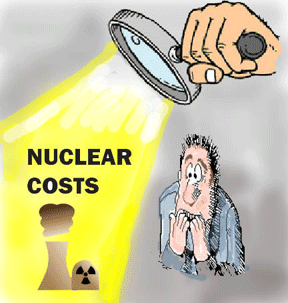 There is no existing market to ascertain the price that a customer may be willing to pay for the permanent disposal of used fuel.(CH 5 p 93)
The Commission is very vague on the nature of the public- private partnership that will pay for the capital costs of AS 41$billion (Ch 5 p.100)
The revenue would be paid on delivery of wastes to a South Australian port. That will be after the 20 – 30 years it will take to construct the facility, plus 10 years after the project begins operation.-
“a pre-commitment before project commencement would provide added assurance that capital costs are fully covered before construction began” (But after a commitment 40 years before, a foreign nuclear company could have gone bankrupt” (Ch 5 p. 100 -102) Finland.http://yoursay.sa.gov.au/system/NFCRC_Final_Report_Web.pdf
Worrying financial aspects of the Nuclear Royal Commission Final Recommendations.
 It looks as if the customers for the nuclear waste import business could be dodgy Asian and Middle Easter ones, with unstable politics. The Commission does not name any countries as potential customers, but DOES RULE OUT countries that will NOT be – i.e. United States, France, the United Kingdom and Canada, and countries which have national laws that prohibit their export of waste, such as Sweden and Finland.http://yoursay.sa.gov.au/system/NFCRC_Final_Report_Web.pdf CH 5 p.93.
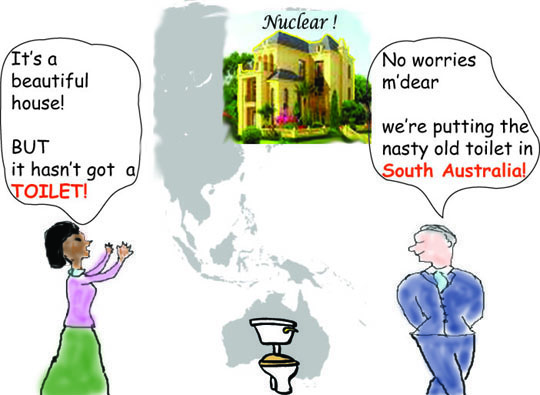
Dr Andrew Allison assesses the FINAL RECOMMENDATIONS of South Australia’s Nuclear Fuel Chain Royal Commission
 Andrew Allison 23 May 16 Here is my assessment of “NUCLEAR FUEL CYCLE ROYAL COMMISSION – FINAL RECOMMENDATIONS Copied from Pg. 169 of the Commission’s final report, and republished here for the purpose of discussion.
Based on the findings set out in this report, the Commission recommends that the South Australian Government:
1. pursue the simplification of state and federal mining approval requirements for radioactive ores, to deliver a single assessment and approvals process
AA: The devil is in the detail for this one. The word “simplification” could be code for reducing environmental standards, or allowing corporations to avoid the consequences of their actions. I am suspicious.
2. further enhance the integration and public availability of pre-competitive geophysical data in South Australia
AA: It depends who owns the data. If a corporation has collected the data then it is part of the intellectual property of that corporation. It is difficult to see how they could be forced to share it, by a state government. If the data were collected by the state government then one would have to ask why she state government is investing in prospecting for nuclear materials. This is in an era where state governments supposedly cannot operate water utilities, banks, gas companies, public transport etc etc…. Why are they breaking their own laws to prospect for nuclear materials?
3. undertake further geophysical surveys in priority areas, where mineral prospectivity is high and available data is limited
AA: This is a matter for the corporations, subject to regulatory approval.
http://www.theaustralian.com.au/…/story-e6frg6n6…
AA: Readers may remember that Marathon resources breached environmental guidelines in The Flinders Ranges in 2012. We cannot allow this. I don’t see why the resources of the state should be spent prospecting on behalf of mining companies.
4. commit to increased, long-term and counter-cyclical investment in programs such as the Plan for Accelerating Exploration (PACE) to encourage and support industry investment in the exploration of greenfield locations
AA: Once again, this is a purely commercial matter. I don’t see why the state government should be investing money in this. There are much more efficient ways of carrying out counter-cyclical Keynesian investment, than exploring for nuclear materials. We could invest in schools, and hospitals and public transport infrastructure, for example.
5. ensure the full costs of decommissioning and remediation with respect to radioactive ore mining projects are secured in advance from miners through associated guarantees
AA: This seems to be very sensible to me. I ask the question: aren’t we already doing this? See the reference to marathon resources, above.
6. remove at the state level, and pursue removal of at the federal level, existing prohibitions on the licensing of further processing activities, to enable commercial development of multilateral facilities as part of nuclear fuel leasing arrangements
AA: In my view, the existing laws are in place to protect public safety and no good case has been made to overturn them. There is currently a glut of Uranium on the world market. The prices are low. To increase the supply of Uranium at this time would only depress the price further and affect the viability of existing producers.
7. promote and actively support commercialisation strategies for the increased and more efficient use of the cyclotron at the South Australian Health and Medical Research Institute (SAHMRI)
AA: The limited and controlled use of nuclear technology in medicine has been shown to be beneficial. I don’t see any logic in expanding the program, unless there is a demonstrated need that is currently not being met in South Australia.
AA: The use of cyclotrons should be carefully regulated, since they can be used to enrich fuel, leading to weapons proliferation:
http://nuclearweaponarchive.org/Iraq/Calutron.html
8. pursue removal at the federal level of existing prohibitions on nuclear power generation to allow it to contribute to a low-carbon electricity system, if required
AA: It is very doubtful that nuclear energy is “low carbon”, if one considers the entire fuel cycle.
9. promote and collaborate on the development of a comprehensive national energy policy that enables all technologies, including nuclear, to contribute to a reliable, low-carbon electricity network at the lowest possible system cost
AA: Of course, a centralized government energy policy that was oriented towards the needs of the people would be sensible. Unfortunately state governments were in a rush to privatize their energy assets (or to lease out monopolies on a long-term basis) so the control of the system has been relinquished to corporations, for the time being. The Royal Commission has admitted that there is no commercial basis for nuclear power, in Australia, for the foreseeable future.
10. collaborate with the Australian Government to commission expert monitoring and reporting on the commercialisation of new nuclear reactor designs that may offer economic value for nuclear power generation
AA: I will believe in “Generation IV” nuclear power stations when I see one actually operating. In the mean time, we do have to consider the opportunity cost associated with investing Australia’s limited research dollars on a technology that Australia does not even use, and will not use for the foreseeable future.
11. pursue the opportunity to establish used nuclear fuel and intermediate level waste storage and disposal facilities in South Australia consistent with the process and principles outlined in Chapter 10 of this report
AA: I am very curious to know why the Royal Commission is in such a hurry for South Australia to commit to a facility that may not even work, and will not actually hold any nuclear waste for over eighty years. I think that it would be much more prudent for South Australia to watch technological developments elsewhere in the world before committing to such a great an irreversible development as a nuclear waste dump. We should note that no country has yet completely solved the nuclear waste storage problem, not even the former nuclear superpowers, the USA and Russia.
12. remove the legislative constraint in section 13 of the Nuclear Waste Storage Facility (Prohibition) Act 2000 that would preclude an orderly, detailed and thorough analysis and discussion of the opportunity to establish such facilities in South Australia.”
AA: I argue that this legislation serves an important public safety purpose. A convincing case has not yet been made to remove this important piece of safety legislation. The “economic” analysis of the Royal commission is mostly based on the opinion of one consultant, in the Jacobs report. The assumptions that were made in this report are very generous to the pro-dump case.
Aboriginal group to take their protest against nuclear waste dump to Resources Minister Josh Frydenberg
 Fears nuclear dump will end their story, MEREDITH BOOTH, THE AUSTRALIAN,MAY 23, 2016 Australia’s first registered Adnyamathanha storyline runs 70km from Hawker to Cotebina Spring through pastoral and indigenous lands between Lake Frome and South Australia’s picturesque northern Flinders Ranges, where it is emerging as a battleline between anti-nuclear activists and the federal government.
Its landmarks, 440km north of Adelaide, tell the origin of Pungka Pudanha spring, where it is said tears falling from a grieving husband merged with the birth waters of his buried pregnant wife — a story that teaches children about family relationships and provides the basis for deeper women’s business.
Custodian and elder Regina McKenzie, a descendant of the king of five clans known as the Adnyamathanha or “people of the rock”, said Pungka Pudanha was the first storyline in Australia to be registered with Aboriginal heritage authorities, in 2012.
But it was now at risk of destruction since pastoral neighbour Wallerberdina Station was named last month as the preferred site for the federal government’s low and intermediate-level nuclear waste dump.
If further technical and environmental testing proves the site suitable, five million litres, or two Olympic-sized swimming pools’ worth, of low radioactive waste will be stored in a warehouse and underground facility.
Ms McKenzie’s worry is mostly for the 25 tonnes of intermediate waste, spent fuel from Sydney’s Lucas Heights reactor returned from reprocessing in France and which requires handlers to wear protective clothing.
She said the Adnyamathanha didn’t want the risk of contamination of groundwaters that fed mound springs on the floodplain where Ms McKenzie brought groups to camp, drink from the spring, and hunt and cook kangaroo in traditional ground ovens and share stories.
“We want to share the culture so we can promote this region to the world,’’ she said.
“Nobody takes the Aboriginal belief systems seriously — it’s our belief system. I just wish that non-Aboriginal people will look and see the richness in our culture.’’
Ms McKenzie and her sister Vivienne, two of 13 children in the McKenzie clan and part of a wider 200 indigenous people in the area, will take their protest, supported by conservation groups, to federal Resources Minister Josh Frydenberg in Melbourne on Wednesday to stop a dump at Wallerberdina………http://www.theaustralian.com.au/national-affairs/indigenous/fears-nuclear-dump-will-end-their-story/news-story/0bf29b3b919547bad0c797ac1b9a4631
Adelaide prize contest for new green businesses
ADELAIDE COULD BE FIRST ZERO-CARBON CITY IN WORLD WITH SOUTH AUSTRALIA’S NEW ENTREPRENEUR CONTEST http://www.theclimategroup.org/what-we-do/news-and-blogs/adelaide-could-be-first-zero-carbon-city-in-world-with-south-australias-new-entrepreneur-contest/?platform=hootsuite 15 MARCH 2016
LONDON: Adelaide has launched a low carbon contest with an AU$250,000 (~US$187,000) prize, which is open to innovative entrepreneurs who can help the South Australian capital become the world’s first carbon neutral city.
South Australia’s Low Carbon Entrepreneur Prize will transform groundbreaking ideas from around the world into real projects, and is the first initiative of the ‘Adelaide to Zero Carbon Challenge’ which aims to reduce greenhouse gas emissions while stimulating opportunities for pioneering green businesses. Continue reading
First impressions of South Australian government’s “Citizens’ Jury”
 Well, they will provide to the jury members meals, $500 compensation, travel assistance and accommodation if needed. This is all fair enough. If the jury members were not compensated in this way, we’d be likely to end up with a bunch of volunteered pro nuclear shills.
They apparently don’t assist with child care – probably eliminating young mothers from the jury.
The jury is asked to produce an independent guide to help every South Australian understand the recommendations raised by the Royal Commission’s report.
1 This month


Help Aunty Sue Protect Her Land and Sacred Sites From Destructive Rocket Testing.
.

Australians deserve the truth
about
AUKUS – https://aukuspublicinquiry.com/

PETITION – To: Prime Minister Anthony Albanese and the Australian Labor Government

of the week – Australians for War Powers Reform (AWPR)
To see nuclear-related stories in greater depth and intensity

