South Australia runs over 50% on renewable energy
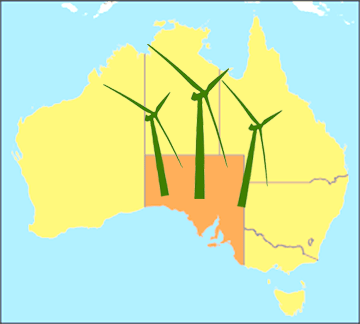 South Australia runs mainly on renewable energy following coal
 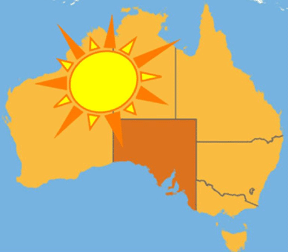 plant closure, The Independent, Gabriel Samuels 12 May 16 Majority of energy comes from solar and wind but the transition has been fraught with difficulties South Australia now gets the bulk of its electricity from wind and solar power, following the closure of its last coal-fired power station.
The state, which includes the city of Adelaide, exclusively has gas generators, solar panels and wind turbines serving a population of 1.7 million.
More than 50% of the region’s electricity stems from wind and solar with the remainder coming from energy efficient combined cycle gas plants.
The final coal station still in operation in Port Augusta closed down on May 9 after operating for 31 years. It generated 520 megawatts of power from coal but failed to compete with the falling price of clean renewable energy. Its closure produced a brief faltering in wholesale energy prices across the state.
The RenewablesSA transition initiative was established by the state govenment in late 2009 with a promise of $10 billion invested in low carbon generation by 2025…….
The state plans to become Australia’s wind and solar capital and is working towards complete reliance on natural sources
The state’s leading electricity provider, SA Power Networks, yesterday announced it will undertake Australia’s largest trial of storage batteries in solar homes in a bid to defer a $3 million network upgrade.
Meanwhile, last week Portugal ran entirely on renewable energy for four consecutive days between Saturday and Wednesday, in a bid to become completely reliant on natural resources.
The Independent has contacted RenewablesSA for comment. http://www.independent.co.uk/news/world/australasia/south-australia-runs-entirely-renewable-energy-following-coal-plant-closure-a7037646.html
Parry Agius – founding member of Uranium lobby group – should not be on “independent” Nuclear Advisory Board.
The South Australian government will make the decision on whether or not to make that State become the world’s nuclear toilet.
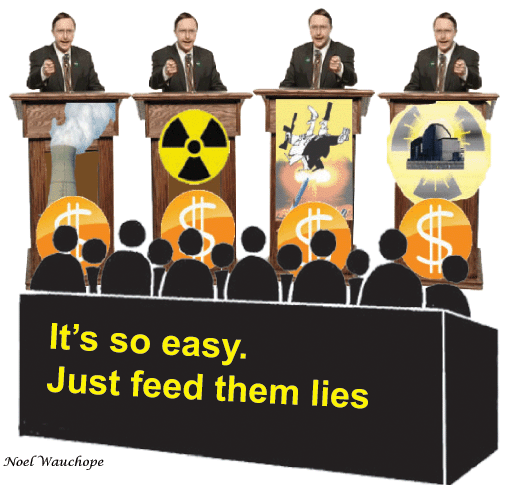 However, they’ll still go through a process of informing and consulting the community, beforehand. That will be the job of the new Nuclear Fuel Cycle Royal Commission Consultation and Response Agency :-
It will “draw upon existing government expertise and expertise from the Royal Commission itself to to increase awareness of the Royal Commission’s report and facilitate the community consultation process.”
The other one, Nuclear Fuel Cycle Royal Commission Consultation and Response Advisory Board, will oversee the Agency throughout the consultation process. That’s the one chaired by John Mansfield, and with Adjunct Professor Daniela Stehlik, Rebecca Huntley, Professor Deb White, and Parry Agius.
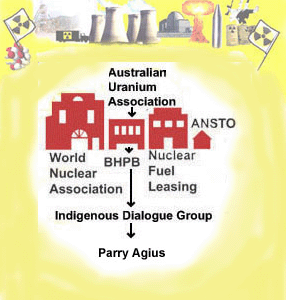
I don’t think that Parry Agius should be on this supposedly independent Board. He is a founding member of the Australian Uranium Association’s Indigenous Dialogue Group. He’s also been a member of the Resources Industry Development Board in South Australia.
South Australian Premier creates two new Nuclear Advisory Agencies
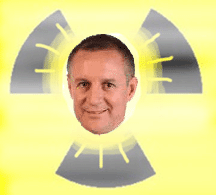 Premier Jay Weatherill, 17 May 16 Cabinet has approved the establishment of the Nuclear Fuel Cycle Royal Commission Consultation and Response Agency and the appointments to the Nuclear Fuel Cycle Royal Commission Consultation and Response Advisory Board…
Last week I announced that the Government would establish these two bodies, and today I confirm that Cabinet has approved the establishment of the Nuclear Fuel Cycle Royal Commission Consultation and Response Agency and the appointments to the Nuclear Fuel Cycle Royal Commission Consultation and Response Advisory Board.
The purpose of the new agency, which will draw upon existing government expertise and expertise from the Royal Commission itself, will be to increase awareness of the Royal Commission’s report and facilitate the community consultation process.
The independent Advisory Board will oversee the Agency throughout the consultation process.
The Board will be chaired by the Honourable John Mansfield, Member of the Order of Australia and retiring Justice of the Federal Court of Australia, who will commence the role immediately after his retirement from the Federal Court.
The other members of the board will be:
- Parry Agius, former Chief Executive Officer of the South Australian Native Title Service; – 3 –
• Adjunct Professor Daniela Stehlik, Griffith University, is one of Australia’s leading social scientists in the fields of sustainability, human services and social cohesion with a particular focus on families and communities.
• Rebecca Huntley, Social researcher and former Director of The Mind & Mood Report, Australia’s longest running social trends report;
• Professor Deb White, Director of Cancer Research at the South Australian Health and Medical Research Institute (SAHMRI)
The outcomes of this community engagement process will help inform the government’s response to the Report, which I intend to deliver to the Parliament by the end of this year…. http://www.premier.sa.gov.au/images/speeches/NuclearFuelCycleRoyalCommission.pdf
South Australia sets up parliamentary inquiry on proposed nuclear waste importing
 SA to set up inquiry into nuclear dump https://au.news.yahoo.com/sa/a/31626088/sa-to-set-up-inquiry-into-nuclear-dump/ AAP on May 17, 2016, The South Australian government will set up a parliamentary inquiry into whether the state should host a nuclear waste dump.
Premier Jay Weatherill says a joint select committee will help inform the government’s response to the nuclear fuel cycle royal commission, which recommended the state pursue building such a facility.
A citizen jury will also be selected by an independent panel to identify key questions about the issue, while a second jury will be asked to produce a report outlining community views.
Jay Weatherill could now be in a dither over nuclear waste dump proposal
Jay Weatherill: Nuclear waste and citizens’ juries, Independent Australia 17 May 2016 Jay Weatherill has announced the establishment of “citizens’ juries” to debate the Royal Commission’s recommendation in favour of a nuclear waste dump for SA— and angered both sides of politics in the process. Noel Wauchope reports.
NEITHER the Left nor the Right is happy with the South Australian Premier’s plan for “citizens’ juries” on the question of importing nuclear waste.
Jay Weatherill will surely be remembered as the quintessential flip flop Premier. In past years, Weatherill was a Labor Left faction opponent of the nuclear fuel cycle and a strong supporter of renewable energy. In the face of the collapse of the car industry in SA and the uncertainty around the shipbuilding and submarine contracts, he was enticed by the nuclear lobby to do an about turn on the nuclear industry.
He went off to the Paris climate summit, preaching about “low carbon electricity” — which is nuclear lobby code for nuclear energy, not “renewable” energy. However, he had earlier described nuclear power as not being viable.
Weatherill went on to set up the Nuclear Fuel Cycle Royal Commission, led by pro-nuclear Kevin Scarce and with a team in which nuclear power experts predominated. It produced – no surprises here – the recommendation for South Australia to set up a nuclear waste importing industry, in thewords of Kevin Scarce, ‘as soon as possible’.
So, the hasty programme for nuclear waste importing is underway. The first step is to be citizens’ juries. In a process run by New Democracy, 2,500 invitations are being mailed this week to potential participants — 50 will be selected for the first meeting in a month’s time and 350 for the next one in October. There are other initiatives too. The Government is launching an advertising campaign entitled, NuClear, with advertisements to be run on radio, television, print and social media. They also have a consultation website, YourSAy. All very good for the nuclear waste import plan.
But now, the plan does seem to be running into a bit of trouble.
The Advertiser ran a poll early last week was a negative result for the nuclear waste cause….
There must be sufficient anxiety in the South Australian Government and the Liberal Opposition to warrant consideration of a referendum on the subject:……..Previously, a referendum was not considered an option. …..
Meanwhile, the immediate trouble lies with this citizens’ jury plan.
Spruiking about citizens’ juries, Jay Weatherill sounds like an old style Liberal:…….In his press release about the nuclear waste plan, Weatherill said:
‘This first Citizens’ Jury will guide the debate by identifying the key issues that need to be considered during the state-wide consultation phase.’
This is not to the liking of today’sLiberals, nor today’s pro-nuclear Laborites, nor even the anti-nuclear camp.
The pro-nuke response was best expressed by Chris Kenny, in Adelaide Now:
‘Forget the citizens jury, Mr Weatherill — just make a decision. That’s what you were voted in to do!’
Liberal Opposition Leader Steven Marshall fumed:
‘This is the largest decision in the history of the state, and Jay Weatherill’s plan is to outsource it to 50 randomly selected individuals. It’s just outrageous.’…….
….. Meanwhile, on Facebook pages, and in some comments on other sites, the anti-nuclear people were up in arms, certain that the process would be stacked with pro-nuclear experts and participants would be brain-washed with nuclear advertising.
It looks as if Jay Weatherill started out on all this in socialist mode — with political and technical experts running the show. Then he aberrated into old “wet” style Liberal mode, towards participatory democracy. In the process, he seems to have pleased nobody…..https://independentaustralia.net/politics/politics-display/jay-weatherill-nuclear-waste-and-citizens-juries1,8998
Global nuclear waste dump for South Australia is opposed by women and Labor voters
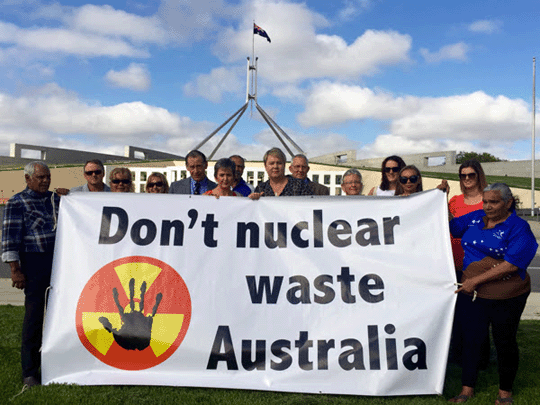 Women and Labor voters opposed to international nuclear waste dump in South Australia, poll finds, Adelaide Now, March 21, 2016 PETER JEAN, POLITICAL REPORTER The Advertiser PREMIER Jay Weatherill will need to win the support of women and his own Labor voters if the State Government decides to back the construction of an international nuclear waste storage facility in South Australia.
The results of a new opinion poll show almost 60 per cent of women and most Labor voters are opposed to a global nuclear waste facility being located in the state.
The ReachTEL Poll of 1077 SA residents conducted on March 10 found that 37 per cent of voters supported of voters supported an international nuclear waste dump, 48.5 per cent were opposed and 14 per cent were undecided….
Australia Institute executive director Ben Oquist said South Australians were increasingly aware of the risks posed by the project, including the damage it could do to the state’s reputation.
“I think people are increasingly wise to the projects that are jobs-rich, versus those that are expensive, likely to involve a large upfront government subsidy and won’t produce long-term jobs,’’ Mr Oquist said.
“Those industries that are jobs-intensive are potentially put at risk by South Australia’s brand being threatened by a global nuclear waste dump.’’….. http://www.adelaidenow.com.au/news/south-australia/women-and-labor-voters-opposed-to-international-nuclear-waste-dump-in-south-australia-poll-finds/news-story/35d4ad38cadbaae4798ca89e91c74f5f
Nuclear waste dumping in South Australia – an act of cultural genocide
 Nuclear dump protesters warn of ‘cultural genocide’ in South Australia, ABC , 17 May 16 By Claire Campbell Building a nuclear waste dump in South Australia would be “cultural genocide”, an Indigenous Australian says, as a campaign against a potential facility in South Australia ramps up.
Flinders Ranges Adnyamathanha woman Candace Champion was among unions, community groups and traditional landowners who today launched an alliance to protest the dump if it goes ahead.
Nuclear Fuel Cycle Royal Commissioner Kevin Scarce made a recommendation earlier this month that SA build a used-nuclear fuel and intermediate level waste storage facility as an economic opportunity.The State Government has not committed to building a dump and said community engagement would be pivotal before a proposal was considered.
But the alliance believes going ahead with such a facility would ignore Aboriginal rights and put public health, the environment and the state’s finances at risk. It includes the Australian Nursing Midwifery Federation, Conservation Council, Maritime Union of Australia and the Uniting Church.
“This proposal and the proposals of nuclear dumps right around Australia is a threat to Aboriginal culture and society and it is cultural genocide,” Ms Champion said.
“As a young Adnyamathanha woman, I can tell you that my family will be affected by this nuclear dump. It is bringing back a lot of anxiety, a lot of anxiousness and a lot of mental health issues within my family and my community.”
Premier Jay Weatherill in February said it was important that everybody was “afforded an opportunity to have their say” and believed an emotion-charged debate was required.
“In a sense, this is a test of our democracy,” Mr Weatherill said……..http://www.abc.net.au/news/2016-05-16/nuclear-dump-protesters-warn-of-cultural-genocide-in-sa/7419406
South Australia – “base load” power from wind and solar – Giles Parkinson
 Wind and solar become new “base load” power for South Australia http://reneweconomy.com.au/2016/wind-and-solar-become-new-base-load-power-for-south-australia-99364 [good graphs] By Giles Parkinson on 16 May 2016
This is expected to be the pattern of the future, as energy systems with high renewable energy penetration rely first on variable energy providers such as wind and solar, and then on “flexible” or “dispatchable” energy from the likes of gas, but ultimately hydro, solar towers with storage, and emerging technologies such as geothermal and ocean energy and battery and other energy storage. Continue reading
No Dump Alliance – anti-nuclear advocacy group launched

Advocacy group protests against high-level nuclear waste dump in SA, saying it poses great health, environment and financial risks http://www.abc.net.au/news/2016-05-16/nuclear-dump-protesters-warn-of-cultural-genocide-in-sa/7419406 May 16, 2016 Erin Jones The Advertiser
A NEW advocacy group will lobby against a high-level nuclear waste dump being built in SA.
The No Dump Alliance group launched on Monday and already has the support of several groups, including the Australian Nursing & Midwifery Federation, the Maritime Union of Australia and SA Aboriginal Congress.
The group formed after the Nuclear Fuel Cycle Royal Commission earlier this month recommended the state urgently pursue the opportunity of a nuclear dump.
The No Dump Alliance believes the proposal shows a lack of respect for traditional owners, who opposed the dump and said it could pose significant health, environment and financial risks.
Candice Champion is a Adnyamathanha woman from the Flinders Ranges who said a nuclear storage facility could pose many risks to her community.
“As a young Adnyamathanha woman my family will be affected by this nuclear dump, which is bringing about a lot of anxiety and mental health issues to my family and community,” Ms Champion said.
“These places are of quality and significance to me and people continue to discount the Adnyamathanha voice which is frustrating and disheartening.
“We want to be able to invest in our future generations and be able to pass something over that is important and pristine, not something posing any risks.”
SA Aboriginal Congress chairman Tauto Sansbury said the group must have a united front and it was not just an “Aboriginal fight” to protect the land.
“This will be a united front to protect SA and make sure it continues to grow from other opportunities, apart from being the international dumping ground,” Mr Sansbury said.
“I believe we’re going to win this because this is not just about an Aboriginal fight … it’s everyone’s fight.”
The State Government will use a jury of 350 randomly selected South Australians to make recommendations to it in November on whether to proceed with the plan for a nuclear waste dump.
The jury was part of a six-step process to unfold over the next seven months, culminating in a firm Government position being outlined to State Parliament.
Premier Jay Weatherill has previously stressed the project could not proceed without broad political and community support.
Nuclear “Citizens’ Juries” and new South Australian campaign “Nu-Clear”
( an unfortunate title for the nuclear lobby – “Nu-Clear” – all too close to the UK’s incisive anti-nuclear publication NuClear News )
Citizens’ juries to consider SA’s nuclear future, The Mandarin, Citizens’ juries show potential as a way for governments to take the heat out of contentious issues, with evidence-informed consideration of contentious policy by regular people having the ability to reshape often staid debates.
So as South Australia is tossing up whether to create a nuclear waste dump to take spent fuel from around the world, the state government has decided to convene two citizens’ juries to consider the future of the nuclear fuel cycle in the state…….
Premier Jay Weatherill says the citizens’ jury deliberations will help South Australians have an “informed discussion” about the nuclear fuel cycle, based on the body of evidence presented in the royal commission report.
The work of the citizens’ juries and other consultation processes “will play a key role in informing the decisions we make”, he stated yesterday:
“I know that some people are worried about safety and the environment whilst others see the economic opportunities. This is why before the government decides, we want South Australians to understand the choices and to be able to put their perspective on this issue.”
Deliberations will begin next month, when a group of about 50 South Australians will be asked to identify the key questions that need to be considered during the debate.
Invitations will be sent this week to 25,000 randomly selected citizens seeking an expression of interest for their participation in the jury, with members selected by an independent, non-political organisation.
Later, in October, a second citizens’ jury of about 350 people will be convened to evaluate the feedback from the state-wide consultation and weigh up the choices and options on the important issues raised by the royal commission.
In November, this second jury will produce a report summarising the community’s position for the government to consider in its response to the royal commission’s report by the end of the year.
New agency to ‘facilitate’ debate
The government will introduce a range of other consultative measures to help it come to a decision.
An independent advisory board to guide the consultation process will soon be appointed, and a state government nuclear fuel cycle agency established to help facilitate the discussion.
A campaign titled “Nu-Clear” was launched on Tuesday to promote discussion and encourage people to explore the facts on the nuclear fuel cycle, with advertisements to be run on radio, television, print and social media.
Citizens are able to comment on the royal commission report on the state’s YourSAy consultation website.
The key questions identified by the citizens’ jury will guide a number of community consultation activities from July, which will include meetings held across the state, as well as social media engagement, information centres and a free call 1800 service.
A specific program of Aboriginal engagement will also be undertaken across SA with the guidance of Aboriginal community leaders. http://www.themandarin.com.au/64738-64738/
South Australian Premier Jay Weatherill sounding like an old style Liberal!
 Jay Weatherill: governments lost the art of talking to people, The Mandarin by
David Donaldson 18.02.2016 Democracies get into trouble when the judgement of experts supplants listening to the people it is supposed to represent, says South Australian Premier Jay Weatherill.
In an op-ed for DemocracyRenewal, Weatherill says the use of experts — “scientists, specialists in particular fields of knowledge and bureaucrats who come up with ‘rational’ answers to issues that they decide are the problem the community should think about” — is important, but if overzealous can disenfranchise people and create distrust in government……..
“Rather than being a threat to established institutions and reform, our Citizens’ Juries have demonstrated that the involvement of citizens in public decisions enables change and helps to restore faith in the political process. Independent evaluation has shown that the cynicism and suspicion people had felt towards government decreased as a result of being involved in the citizen jury process, with a strong interest in participating again.” http://www.themandarin.com.au/56739-jay-weatherill-governments-lost-art-talking-people/
Alinytjara Wilurara Natural Resources Management Board – response to Nuclear Royal Commission
 The Alinytjara Wilurara Natural Resources Management Board – reponse to Tentaive Findings of Nuclear Fuel Cycle Royal Commission
A referendum might be held to decide on nuclear waste import plan
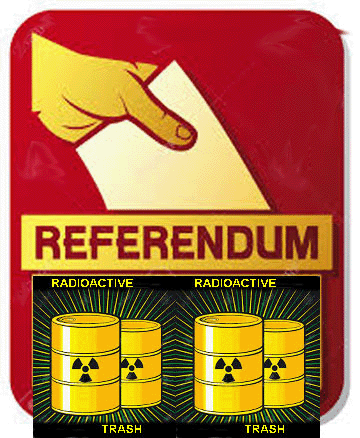 Daniel Wills: Voters’ nuclear reaction can avoid meltdowns in future May 13, 2016 The Advertiser
EVERY South Australian has been assured they can join a grand debate over a high-level nuclear waste dump for the state, but it’s no certainty that voters will get to directly decide.
The Nuclear Fuel Cycle Royal Commission’s final report this week included a strong call for the state to urgently pursue the opportunity and usher in a golden era of new wealth for SA.
Premier Jay Weatherill is holding fire until the end of the year. The State Government’s formal position is that its mind is not made up, and a combination of statewide consultation and two citizens’ juries made up of average people will help chart the course to be taken from here.
But ultimately, he’s indicated the final decision will be taken by the Cabinet, Government and 69 members of State Parliament who are put in place to make decisions on behalf of all.
The prospect of a referendum, which could be held concurrently with the 2018 state election and would effectively offer every South Australian a direct say on what would be an irreversible decision, is not being ruled out at the highest levels either major party.
If it were to occur, the electoral dynamics in two years’ time would be dramatically altered………
if a simple change to an Act of Parliament is all that’s required for a future government in coming decades and centuries to shift course, South Australians have reason to be wary.
A business case penned by Jacobs & MCM for the commission shows the state would be swimming in cash for 75 years, and then serious bills would start rolling in for the next 50……..
It’s easy to imagine a future where short-term politics triumphs over today’s best intentions…..
The next six months — with two citizens’ juries and a statewide consultation process — will shake out some of these questions and may even formally recommend a nuclear referendum…… http://www.adelaidenow.com.au/news/opinion/daniel-wills-voters-nuclear-reaction-can-avoid-meltdowns-in-future/news-story/fae428aedd70a823c06302bf15b92289
Electoral suicide for Labor? The nuclear waste dump plan.
from “Sanity” “Mr Weatherill is understood to be favouring a political decision taken without the delay and additional hassle of a referendum.” Sorry Jay, but it is reasonable to go to the “hassle of a referendum” when the the decision has such a significant impact upon our state and citizens.
Tom Koutsantonis threatened the Liberal party with a referendum on the issue (a nuclear waste dump in SA) so it would be beyond hyporitical (even for a politician) for him not to require one now.
Daniel, could you publish the results of the ‘Advertiser -Galaxy’ poll here too?
Earlier this week a survey of ‘AdelaideNow’ readers gave the following results:
Are you in favour of a nuclear waste dump in SA?
No: 61.04% (1,648 votes)
Yes: 35.63% (962 votes)
Undecided: 3.33% (90 votes)
Which indicates certain electoral suicide for any party that allows SA to become a nuclear dump.
Citizens’ Juries can be a valuable guide in nuclear decision-making
 The role of Citizens’ Juries in decision-making on nuclear waste importation, Online opinion, By Noel Wauchope 13 May 2016 On May 10th South Australian Premier Jay Weatherill announced the process by which the state will decide whether or not to host a global nuclear waste import industry, as recommended by the Nuclear Fuel Cycle Royal Commission.
The first step will be to set up a “Citizens’ Jury” of 50 participants randomly selected from 25,000 invitees statewide, to be followed later by another one of 350 participants.
I think that Weatherill might have mistaken his terms here, as a Citizens’ Jury, by definition, means a group of 10 to 12 participants. The Weatherill plan sounds more like a “Deliberative Poll”, which involves a much larger group.
A properly constituted Citizens’ Jury can be a valuable process in participatory democracy. The group of 10 or 12 people serves as microcosm of the public. …… The process depends on having the oversight of a neutral but well informed advisory panel. Questions need to be framed in a way that does not risk influencing the response. Transparency is important, and complete audio or video recordings of all jury hearings should be publicly available, although the actual jury room deliberations should be private.
The citizen jury process can be an empowering one for the participants, and, as long as it is perceived to be fair and transparent, can be a valuable democratic option for assessing public opinion. It also has the advantage of being cost-effective.
The “Deliberative Poll” method is potentially another very useful form of participatory democracy. It is a lot more expensive, and more complicated. The biggest disadvantage of the Deliberative Poll method is probably its cost. Wikipedia notes:
“Imagine how much money is needed to pay for the trips, the hotel and the food for each participant, hiring the research crew and moderators, booking a venue, etc. Additional costs can include paying for participants’ compensation so that people that are randomly selected can put aside their duties to attend the events (i.e. hiring someone to milk a participant’s cow and providing child care”
Some critics insist that funding for either of these processes should not come from on single body.
“Multiple sources of funding help to ensure that the jury’s organisers are not seen as having a financial interest in producing a verdict that supports the interests of a single funding body. To maximise the scrutiny they provide, the two or more funders should have somewhat opposing interests regarding the subject likely to be under discussion.”……
In Japan, in 2012, a Deliberative Poll formed the guide to government decision-making. The Japanese government used the Center for Deliberative Democracy’s Deliberative Polling method to both inform participants and allow them to influence policymakers about the public’s will with regard to energy production issues. As a direct result of the deliberative polling process, Japan’s national government pledged to have zero percent dependency on nuclear energy after 2030. (This decision was overturned by a later government).
The South Australian government’s decision to start with a participatory democracy process is a welcome one, provided that it is done fairly and properly. Neither a Citizens Jury nor a Deliberative Poll can be a substitute for a fully democratic process like a referendum, but either could be a valuable contributor to a wider process of decision making. http://www.onlineopinion.com.au/view.asp?article=18230
1 This month


Help Aunty Sue Protect Her Land and Sacred Sites From Destructive Rocket Testing.
.

Australians deserve the truth
about
AUKUS – https://aukuspublicinquiry.com/

PETITION – To: Prime Minister Anthony Albanese and the Australian Labor Government

of the week – Australians for War Powers Reform (AWPR)
To see nuclear-related stories in greater depth and intensity

