Adnyamathanha Traditional Owners will fight nuclear waste dump plan
 29 Apr 16, The federal government has announced that the Flinders Ranges has been selected as the preferred site for a national nuclear waste dump. The land was nominated by former Liberal Party Senator Grant Chapman and his nomination has been endorsed by the Liberal government in Canberra.
Adnyamathanha Traditional Owner Regina McKenzie, who lives at Yappala Station near the proposed dump site and is a member of Viliwarinha Yura Aboriginal Corporation, said:
“Adnyamathanha Traditional Owners weren’t consulted about the nomination. Even Traditional Owners who live next to the proposed dump site at Yappala Station weren’t consulted. The proposed dump site is adjacent to the Yappala Indigenous Protected Area. On the land with the proposed dump site, we have been working for many years to register heritage sites with the SA government. The area is Adnyamathanha land. It is Arngurla Yarta (spiritual land). The proposed dump site has countless thousands of Aboriginal artifacts. Our ancestors are buried there. The nominated site is a significant women’s site. Throughout the area are registered cultural heritage sites and places of huge importance to our people.
“There are frequent yarta ngurra-ngurrandha (earthquakes and tremors). At least half a dozen times each year, we see and feel the ground move. It is flood land. The water comes from the hills and floods the plains, including the proposed dump site. Sometimes there are massive floods, the last one in 2006.
“We don’t want a nuclear waste dump here on our country and worry that if the waste comes here it will harm our environment and muda (our lore, our creation). We call on the federal government to withdraw the nomination of the site and to show more respect in future. We call on all South Australians − all Australians − to support us in our struggle. Adnyamathanha Traditional Owners and Viliwarinha Yura Aboriginal Corporation will fight the proposal for a nuclear waste dump on our land for as long as it takes to stop it.
“Last year I was awarded the SA Premier’s Natural Resource Management Award in the category of ‘Aboriginal Leadership − Female’ for working to protect land that is now being threatened with a nuclear waste dump. But Premier Jay Weatherill has been silent since the announcement of six short-listed dump sites last year. Now the Flinders Ranges has been chosen as the preferred site and Mr Weatherill must speak up. The Premier can either support us or he can support the federal government’s attack on us by maintaining his silence. He can’t sit on the fence.”
Adnyamathanha Traditional Owner Enice Marsh said:
“Vulnerable communities are suffering from lack of vision from our government and industry ‘leaders’ and should not be the government’s target for toxic waste dumps. This predatory behaviour is unethical and is an abuse of human rights. An Indigenous Protected Area is a Federal Government initiative, but it seems that in the case of Yappala this means nothing to the government. We ask you to honour this commitment to protect, not pollute and damage our land. This facility will cause immeasurable damage to the whole area which is covered with thousands of artefacts, home to people, animals, birds and reptiles. The building of this facility will cause widespread damage. It will scar the area and break the spiritual song-lines like never before in the 60000+ years of human occupation. We don’t want this waste in our country, it’s too toxic and long lived.”
Adnyamathanha Traditional Owner Jillian Marsh said:
“The First Nations people of Australia have been bullied and pushed around, forcibly removed from their families and their country, denied access and the right to care for their own land for over 200 years. Our health and wellbeing compares with third world countries, our people crowd the jails. Nobody wants toxic waste in their back yard, this is true the world over. We stand in solidarity with people across this country and across the globe who want sustainable futures for communities, we will not be moved. We challenge Minister Josh Frydenberg on his claim that this waste is just “gloves, goggles and test tubes” – the intermediate-level waste is much more toxic so why not talk about it? What about the damage to the area that construction of this site will cause? You can’t compensate the loss of people’s ancient culture with a few dollars.”
Nice little bonanza for former SA Liberal Senator Grant Chapman in choice of nuclear waste dump site
 Mr Frydenberg said Barndioota, owned by former SA Liberal Senator Grant Chapman, had been chosen ahead of others because of broad community support
If Barndioota is chosen, Mr Chapman and his business partner would get four times the land value for the 100ha excised for the repository from the 6357ha section of their station which has been nominated.
National low-level nuclear waste dump earmarked for Barndioota, near Wilpena Pound April 29, 2016 The Advertiser
A CATTLE station west of Wilpena Pound has been earmarked as the site for a national radioactive dump for medical and laboratory waste. In a surprise pre-election move, federal Resources Minister Josh Frydenberg will on Friday reveal that South Australia’s Barndioota has been pinpointed for the dump ahead of five other voluntarily nominated sites.
Mr Frydenberg emphasised that the short-listing was not a final decision to put the national facility at Barndioota, 35km northwest of Hawker, but it now represents the only option.
In a significant development, Treasurer Tom Koutsantonis said the State Government was supportive of the site’s short-listing and he called the process rigorous.
Overwhelming state and community opposition in 2004 forced the-then prime minister John Howard to abandon plans for a similar national radioactive waste dump near Woomera.
Mr Frydenberg, who will face voters at a July 2 double dissolution election, said he would make a final decision on the site within a year — after design, safety, technical, environmental and indigenous heritage assessment at Barndioota. He had previously been expected to nominate two SA sites — one near Kimba and Barndioota — on a shortlist of two or three ahead of a final decision later this year.
Traditional land owners say the site, near the Flinders Ranges and the famed Wilpena Pound, is home to countless sacred sites and culturally important landmarks that would be destroyed by a radioactive waste dump……. Continue reading
South Australia’s Nuclear Royal Commission was a nuclear lobby set-up from the beginning
There is no logical reason to believe that the SA government would perform any better than the U.S. government. On the contrary, there are good reasons to believe that nuclear waste management would be more difficult here given that the U.S. has vastly more nuclear waste management expertise and experience than Australia.
 SA nuclear Royal Commission is a snow job Jim Green, 29 April 2016 http://reneweconomy.com.au/2016/sa-nuclear-royal-commission-is-a-snow-job-18368
The South Australian Nuclear Fuel Cycle Royal Commission (RC) will release its final report on May 6. It was established to investigate opportunities for SA to expand its role in the nuclear industry beyond uranium mining.
Before his appointment as the Royal Commissioner, Rear Admiral Kevin Scarce said little about nuclear issues but what he did say should have excluded him from consideration. Speaking in November 2014 at a Flinders University guest lecture, Scarce acknowledged being an “an advocate for a nuclear industry”. Just four months later, after his appointment as the Royal Commissioner, he said the exact opposite: “I have not been an advocate and never have been an advocate of the nuclear industry.”
Other than generalisations, and his acknowledgement that he is a nuclear advocate, Scarce’s only comment of substance on nuclear issues in his 2014 lecture was to claim that work is “well underway” on a compact fusion reactor “small enough to fit in a truck”, that it “may be less than a decade away” and could produce power “without the risk of Fukushima-style meltdowns.” Had he done just a little research, Scarce would have learnt that Lockheed Martin’s claims about its proposed compact fusion reactor were met with universal scepticism and ridicule by scientists and even by nuclear industry bodies.
So the SA government appointed Scarce as Royal Commissioner despite knowing that he is a nuclear advocate who has uncritically promoted discredited claims by the nuclear industry. Scarce appointed an Expert Advisory Committee. Despite claiming that he was conducting a “balanced” RC, he appointed three nuclear advocates to the Committee and just one critic. The bias is all too apparent and Scarce’s claim to be conducting a balanced inquiry is demonstrably false.
Given the make-up of the RC, it came as no surprise that numerous questionable claims by the nuclear industry were repeated in the RC’sinterim report released in February. A detailed critique of the interim report is available online, as is a critique of the RC process.
The RC’s interim report was actually quite downbeat about the economic prospects for a nuclear industry in SA. It notes that the market for uranium conversion and enrichment services is oversupplied and that a spent fuel reprocessing plant would not be commercially viable. The interim report also states that “it would not be commercially viable to generate electricity from a nuclear power plant in South Australia in the foreseeable future.”
In a nutshell, the RC rejected proposals for SA to play any role in the nuclear fuel cycle beyond uranium mining. But that still leaves the option of SA offering to store and dispose of foreign high-level nuclear waste (HLW) and the RC strongly promotes a plan to import 138,000 tonnes of HLW for storage and deep underground disposal.
SA as the world’s nuclear waste dump The RC insists that a nuclear waste storage and dumping business could be carried out safely. But would it be carried out safely? The RC ought to have considered evidence that can be drawn upon to help answer the question, especially since Kevin Scarce has repeatedly insisted that he is running an evidence-based inquiry.
So what sort of evidence might be considered? The experience of the world’s one and only deep underground nuclear waste dump ‒ the Waste Isolation Pilot Plan (WIPP) in the U.S. ‒ is clearly relevant. And Australia’s past experience with nuclear waste management is clearly relevant, with the clean-up of nuclear waste at the Maralinga nuclear test site in SA being an important case study.
But the RC completely ignores all this evidence in its interim report. We can only assume that the evidence is ignored because it raises serious doubts about the environmental and public health risks associated with the proposal to import, store and dispose of HLW. Continue reading
First site chosen for nuclear waste dump – a former Liberal Senator’s property
Former Lib senator’s property first pick for nuclear dump, Fin Rev, by Fleur Anderson Simon Evans 29 Apr 16 A remote South Australian outpost on a cattle station part-owned by former Liberal senator Grant Chapman has been short-listed as the possible site for Australia’s first nuclear waste dump.
Barndioota station, one of six short-listed properties for the dump which would store nuclear waste from hospitals, universities and other locations, will be announced on Friday as the leading contender and there will now be further consultation for the site’s technical suitability and Indigenous heritage.

The Barndioota community, listed as having a population of three people, will receive up to $2 million for local projects that create lasting economic or social benefits and “in recognition of any short-term disruption that this detailed assessment may involve”, Resources and Energy Minister Josh Frydenberg said.
Mr Chapman is one of the owners of the long-term lease over a large 25,000 hectare outback pastoral property near Barndioota, which is about 45km north-west of the town of Hawker in the lower Flinders Ranges.
He chaired a Senate-select committee studying radioactive waste dangers and in 1996 proposed a national repository.
The site which Mr Chapman put forward is understood to only be about 100ha of the pastoral property at the northern end. The site is on dry, arid land where only saltbush grows and is about 440km north of Adelaide, and close to a railway line…….
The nuclear dump process is separate to the Nuclear Royal Commission headed by Royal Commissioner Kevin Scarce who is due to hand down his final report on May 6, but in preliminary findings in February outlined the economic benefits of SA becoming involved in nuclear storage.
The current federal Liberal Member for Grey, Rowan Ramsey, whose electorate covers a vast area on the Eyre Peninsula, in the initial stages of the process had nominated his own property as a potential site but later withdrew from the process because of perceptions of a conflict of interest……http://www.afr.com/news/politics/former-lib-senators-property-first-pick-for-nuclear-dump-20160428-gohggc
#NuclearCommissionSAust sets up a pro nuclear Committee for Adelaide overseas junket
Business SA chief Nigel McBride, who will join the tour, told InDaily the delegation would examine “what most people regard as a state-of-the-art piece of engineering [in terms of a] high-level waste repository”. “We don’t want to see people rely on fear and oozing-green Simpsons-cartoon-like imagery”
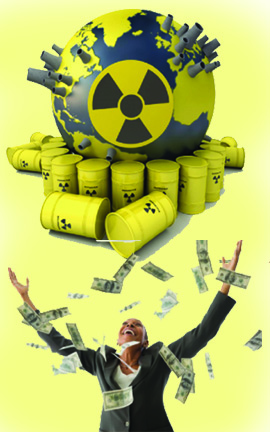 SA leaders to tour key nuclear sites, Committee for Adelaide, 25 Apr 15 A high-powered delegation of South Australian business leaders and parliamentarians will jet off to Europe next month to visit key nuclear sites in a bid to facilitate a community debate on the merits of expanding the state’s role in the nuclear fuel cycle.
The trip was organised after consultation with Kevin Scarce’s Royal Commission, which last month handed down tentative findings outlining a multi-billion-dollar economic boon if SA established a high-level nuclear waste dump.
The delegation – to be capped at 10, plus prospective MPs and their staff – was organised by the Committee for Adelaide, an independent think-tank of community leaders, and will likely include representatives from environmental business consultants Golders, property group Knight Frank, engineering consultancy Mott MacDonald and Business SA, among others.
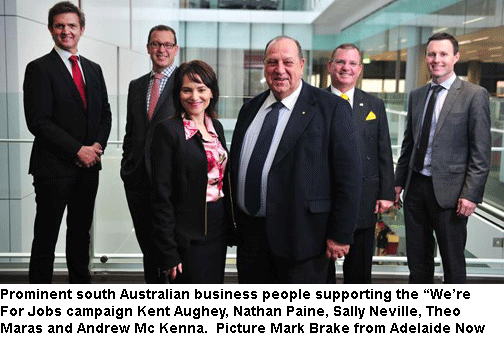
Committee for Adelaide general manager Matt Clemow told InDaily the tour would take in France, Finland, the UK and possibly Sweden, and was designed “to understand the issues and opportunities involved in the nuclear fuel cycle with specific focus on safety, alignment with agriculture and tourism, and associated industry regulations”.
The tour also aims “to create a cohort of SA people who have experienced the operations of the nuclear fuel cycle and will be able to contribute to the public discourse”.
The delegation – whose members will pay their own way – departs in late April, returning the day before Scarce hands down his final recommendations on May 6……
Secrecy on health information about uranium workers – Submission to #NuclearCommissionSAust
 NUCLEAR FUEL CYCLE ROYAL COMMISSION TENTATIVE FINDINGS RESPONSE March 2016 Dan Monceaux – Documentary filmmaker & South Australian citizen
EXPLORATION, EXTRACTION & MILLING “………I have previously expressed my criticism that this, and indeed all Royal Commissions conducted in South Australia are exempt from the Freedom of Information Act 1991. This is fundamentally undemocratic, and contradicts claims made by the Commissioner on many occasions of his commitment to openness and transparency.

Returning to the subject of exploration drilling, I would suggest that there is another factor confounding the efficacy of exploration drilling regulation in South Australia- namely regulatory capture. This is accompanied by a tendency to withhold information regarding non-compliance and regulatory failure. The resulting impression can be one of false assurance. For example, by citing Marathon Resources Rectification Plan 2008 in its Tentative Findings, while neglecting to list the Eyre Iron compliance audit report which it also received, the Commission is misleading the reader. A reader would be forgiven for assuming that Marathon’s non-compliance was an isolated example, when clearly, this is not the case. The compliance audit report is found as Appendix A attached to my submission below. http://nuclearrc.sa.gov.au/app/uploads/2016/03/Dan-Monceaux-10-08-2015.pdf
The Government of South Australia has on its own record admissions of its institutional knowledge of lung cancer risk to uranium workers in underground mines. The evidence base dates back to the early experiences of miners at Joachimstahl in Czechoslovakia, from whose high incidence of lung cancer the first precautionary safety standards were subsequently set in other jurisdictions. The risk was understood in the 1920s as evidenced by publications of the South Australian Department of Mines from the mid 1950s, namely: Possible health hazards in uranium mining – Armstrong, A.T., Department of Mines (1955) https://sarigbasis.pir.sa.gov.au/WebtopEw/ws/samref/sarig1/image/DDD/RB00429.pdf The health consequences of workers in the uranium industry – Dr. B. S. Hanson (1956) https://sarigbasis.pir.sa.gov.au/WebtopEw/ws/samref/sarig1/image/DDD/RB4200080.pdf
They are found in the results of Radium Hill worker cohort studies published in peer-reviewed medical journals. The epidemiological studies of the 1980s, published circa 1990 proved, with epidemiological evidence of elevated cancer incidence, that confidence expressed in the safety of working conditions at the Radium Hill mine in the 1950s and 1960s was ill-founded.
Radon daughter exposures at the Radium Hill uranium mine and lung cancer rates among former workers, 1952-1987 – Alistair Woodward, David Roder, Anthony J. McMichael, Philip Crouch and Arul Mylvaganam (1991) http://www.jstor.org/stable/3553403………
the Olympic Dam mine’s radiological safety measures and records remain protected by special secrecy provisions established under the Roxby Downs (Indenture Ratification) Act 1982. Secrecy during the time of the Radium Hill mine was a matter of protecting Commonwealth secrets during the Cold War. The secrecy provisions of the Roxby Downs Indenture (Ratification) Act 1982, were according to Ian Gilfillan of the Australian Democrats, at least in part to protect the project from attack by environmental groups. The Indenture Act was revised in 2011, and forfeited the ideal opportunity to repeal Cold War-style exemptions as a sign of good faith to the people of South Australia and movement towards open government………… https://www.academia.edu/23544163/Nuclear_Fuel_Cycle_Royal_Commission_Tentative_Findings_Submission_-_March_2016
The health of uranium and nuclear workers. Response to #NuclearCommissionSAust’s ‘Tentative Findings’
It is extraordinary that the South Australian Nuclear Fuel Chain Royal Commission is not publishing Responses to its “Tentative Findings” before it makes its final announcement on May 6th.
Meanwhile, here is part of at least one very clear and informative response.
NUCLEAR FUEL CYCLE ROYAL COMMISSION TENTATIVE FINDINGS RESPONSE March 2016 Dan Monceaux – Documentary filmmaker & South Australian citizen.
“…… I sincerely hope that the health and wellbeing of South Australia’s workforce, its citizenry and its environment are considered sufficiently important topics for this Commission to elaborate on the matters raised here ahead of its final report to Parliament in May.
………The Commission’s opening tentative finding states that “South Australia can safely increase its participation in nuclear activities, and by doing so, significantly improve the economic welfare of the South Australian community.”
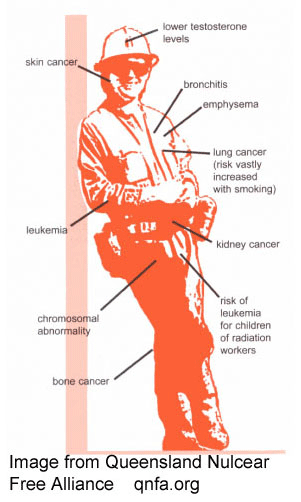
The evidence base for adopting such a confident and conclusive statement is questionable. In the case of nuclear industrial activities which have established links with health conditions including cancer and associated heart, lung and liver conditions and potential genetic harm, the safety or otherwise of an activity or regulatory regime can only be proven by epidemiological studies spanning a timeframe of decades. For example, little is known about the fates of worker cohorts from existing and past uranium mining and milling activity in South Australia………. The Commission has had time to consider this matter, but appears to have not deemed it sufficiently important. ……
I wish to make a case for the prioritisation of epidemiological studies of past and present South Australian uranium worker cohorts as a matter of the utmost importance. The results of such studies could provide an empirical basis for future commentary regarding the safety or otherwise of the industry as it has existed until now…….
The Commission states that “policies must be based on evidence, not opinion or emotion.” The same rule should apply to statements made by the Commission. To be considered credible, they must be supported by material evidence. The absence of evidence is not evidence of absence. Harm can neither be proven, nor safety assured without relevant epidemiological studies. This was known to South Australia’s Department of Mines in 1956, when Dr. B. S. Hanson wrote in The Health of Workers in the Uranium Industry (pg. 16): “It is only by long-term health examinations that the validity of our present speculative exposure limits may be tested.” This document is currently available on SARIG, the South Australian government’s resources industry geoserver: https://sarigbasis.pir.sa.gov.au/WebtopEw/ws/samref/sarig1/image/DDD/RB4200080.pdf…….
The available evidence suggests that contemporary publications of South Australian Government departments fail to adequately communicate occupational exposure risk to their readers. The perfect example of this is the Uranium fact sheet published by the Department of State Development in 2015, during the proceedings of this Commission. The “Fact Sheet” poses the question “Is uranium safe?” then neglects to answer the question. Instead, it provides the graphic reproduced from http://www.statedevelopment.sa.gov.au/upload/uranium/uranium%C2%ADthe-facts-final.pdf? t=1458534521755
Compare this to Hanson and Armstrongs statement from 1956, in documents held by the same South Australian government, written 60 years earlier:
 “Hazards associated with uranium ore are of two kinds, those due to radioactivity, including 6 external radiation as well as internal radiation; and those due to uranium metal poisoning. Radon gas and its solid daughter products would appear to offer the greatest potential danger. They can be inhaled and the solid products so lodged in the body.” (Armstrong, pg. 18)
“The individual employed in a mine or mill risks damage by external or internal radiation, and as to the latter the radioactive particles which form a danger are either ingested or inhaled.” (Hanson pg. 7)
“The daughter products are insoluble, but together with the dust to which they adhere some are engulfed by the reticulo-endothelial cells of the lung surface and there theoretically give a high intensity of alpha radiation to those very surface cells which form the type seen in the usual cancer of the lung.” (Hanson pg. 9)
“The inhalation of active deposit on dust particles, is so much the most important one that most of our [Department of Mines’] effort should be directed towards overcoming it.” (Hanson pg.10)
“In my opinion, dusty clothes inevitably mean an inhalation risk as well as an ingestion risk.” (Hanson pg.14)
“Almost without exception this report deals with the real or probable dangers of radioactivity.” (Hanson pg. 19)
The disparity between the messages of 1955 and 1956 (Department of Mines) and 2015 (Department of State Development) is alarming and deeply concerning…… https://www.academia.edu/23544163/Nuclear_Fuel_Cycle_Royal_Commission_Tentative_Findings_Submission_-_March_2016
Breakfast with the Toffs, after May 6th Nuclear Royal Commission announces wonderful waste import plan
 Spin all over the place about Australia’s so wonderful opportunities in the uranium/nuclear industry! It’s all part of the leadup to the shonky Nuclear Fuel Commission’s unsurprising recommendation that South Australia should import radioactive trash.
I guess they had a good time with the charade of the Royal Commission, jaunts overseas for the nuclear shills, and the spurious business of taking submissions – of course, as Kev says, the antinuke ones were mostly “emotional, so they don’t count anyway.
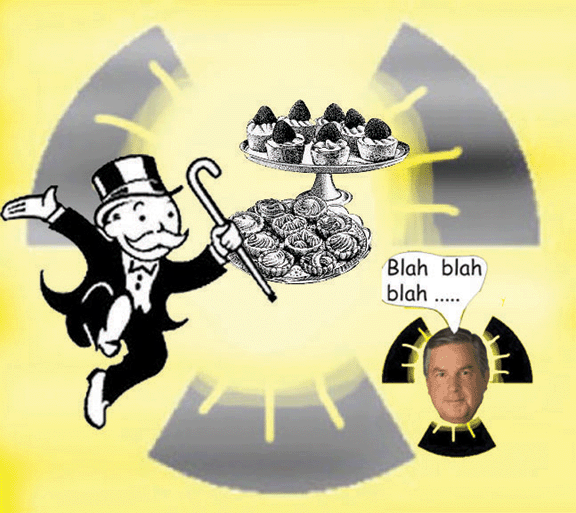
Let’s begin with good old reliable nuclear stooge Kevin Scarce. For just the measly $67.50 , you can have brekky with him – a sit-down hot breakfast, layered berry yoghurt muesli shot, seasonal fruit, brewed coffee, T Bar teas and fresh juice.
Meanwhile, Kev will tell you how you beaut it will be when South Australia goes full steam ahead with importing radioactive trash and expanding the nuclear fuel chain. See more at Action Australia.
Anyway, it’s a suitable breakfast price. We do want to keep the great unwashed out, after all .
Meanwhile, back at the struggling, barely surviving uranium mining industry, they are putting on a bold face, too.
The Minerals Council of Australia’s Uranium Forum has today released a range of material that purports to demonstrate the potential benefits of further developing Australia’s uranium industry. ‘Uranium: Untapped Potential’ includes a poster, a series of videos featuring industry experts and voices, and social media material highlighting the untapped potential further growth of the uranium industry offers Australia. They’r on Facebook, Twitter, Youtube. linked in, as well as the usual mainstream media.
Just where does South Australia’s Senator Nick Xenophon stand on nuclear waste importing?
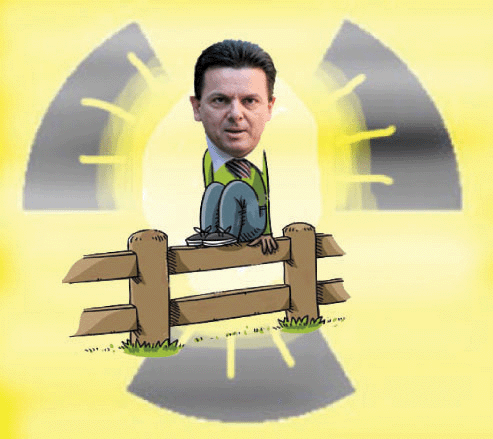
 Nuclear caution vital, Port Lincoln Times, 18 Apr 16 ROAD funding, nuclear waste and drilling in the Great Australian Bight are among the issues on the agenda for recently announced candidate for Grey, Andrea Broadfoot.
Ms Broadfoot was last week announced as the Nick Xenophon Team’s candidate for the seat of Grey and said she hoped to make the safe Liberal seat marginal to attract the resources the region needed.
“We’re very committed in the community about getting out and talking to people and finding out what their issues are.”
Speaking in Port Lincoln on Thursday, Senator Nick Xenophon said Ms Broadfoot would give current member for Grey, Liberal Rowan Ramsey, a “run for his money”…….
Ms Broadfoot said the potential for a nuclear waste storage facility at one of three sites in South Australia was another issue she was concerned about.
She said the region needed to look at the long term impact on the perception of the region rather than the short term monetary gains that may be made.
“We need to be really cautious and careful about the decisions we make,” Ms Broadfoot said……..
She said the community was divided on the issue, with even the former Liberal member for Grey Barry Wakelin publicly coming out and saying Kimba was not the place for nuclear waste.
Mr Xenophon said it did not make sense to have a nuclear waste storage facility in a premium agriculture region……http://www.portlincolntimes.com.au/story/3855319/nuclear-caution-vital/?cs=1500
South Australia could save water by adopting India’s brilliant solar energy plan
Today’s story from India – about setting up solar panels over water channels – set me thinking about South Australia. I think South Australia is the most beautiful State, and with a proud and interesting history.
It is also, arguably, the nation’s most water stressed State.
It is so frustrating that the politics and economics of beautiful South Australia are in the hands of ignorant neanderthals. That want to damage the country, and extract even more water than BHP Billiton now does at Olympic Dam uranium mine, – by expanding the water intensive nuclear industry. And all this with the risk of radioactively polluting the precious groundwater.
India’s solar panels over water channels not only provide electricity. They also reduce evaporation. What a boon for a hot climate! South Australia’s SunDrop Farms have also made use of the water-saving abilities of solar panels.
South Australia has the expertise to lead the world in clean energy and water management.
What a pity it is run by deadheads!
Greens manage to put some brakes on South Australian govt’s pro nuclear promotion
 Nuclear waste dump ‘spruiking’ with taxpayers’ money stopped by Greens http://www.abc.net.au/news/2016-04-14/nuclear-waste-dump-‘spruiking’-with-taxpayers’-money-stopped/7325076 An attempt to change the law in South Australia to allow public money to be spent on promoting a nuclear waste dump has been stopped with the Greens claiming a victory.
A law passed in 2000 to stop public funds from being used in any activity associated with a nuclear waste facility.
The State Government had tried to amend the law to allow consultation with the community on the results of the Nuclear Fuel Cycle Royal Commission.
Greens MLC Mark Parnell said the proposed change was too wide ranging and the Upper House had stepped in to protect taxpayers.
“The Greens do accept that we do need to have a public debate,” he said.
“We’re confident we know what the result will be but nevertheless the Government says they only want to consult, they don’t want to spruik and they don’t want to plan for a nuclear waste dump.”
He said the Government had attempted to “overreach”.
“The law now says that the Government can use public money to consult the community but they’re not to use public money for promoting or designing or even buying land for a nuclear waste dump.”
As CSIRO slashes jobs, water science in South Australia a big loser
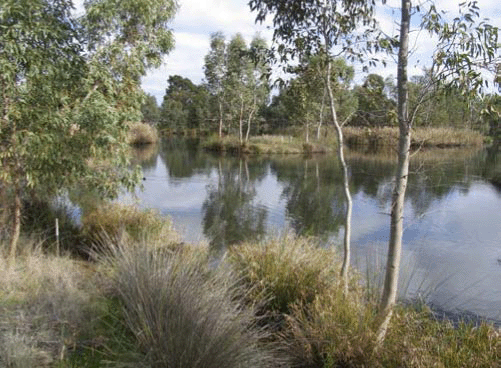
Water science in South Australia could evaporate as CSIRO looks to slash 350 jobs across the country April 12, 2016 CLARE PEDDIE SCIENCE REPORTER The Advertiser SOUTH Australian water science at the CSIRO is in the firing line as the national research organisation prepares to cut 350 staff across the country in the next two years.
Staff in SA have been told job losses are inevitable with “reductions in headcount” at CSIRO Land and Water, which has 103 people at its Urrbrae base.
Other research areas could also be impacted………
Former CSIRO scientist Dr Peter Dillon said the anticipated job cuts were “economic nonsense”. He said 35 of 50 staff were set to go from the CSIRO’s urban water research area, while rural research was also thought to be on the chopping block.
“Just like building submarines, in research it takes years to develop world-leading teams and shutting down a productive area can’t be quickly reversed,” he said.
CSIRO Staff Association deputy president and Waite Campus staff representative Sonia Grocke said staff felt strongly about the fundamental change to the type of work the CSIRO had done on water, agriculture and the environment.
“We think the current round of cuts and particularly the areas of science that are being targeted will severely impact CSIRO’s ability to address major environmental events as they impact South Australia,” she said. “The Murray-Darling Basin is a good example of that.”…….http://www.adelaidenow.com.au/news/south-australia/water-science-in-south-australia-could-evaporate-as-csiro-looks-to-slash-350-jobs-across-the-country/news-story/647fd6fdbfebfca28d4c683c4166336e
Michele Madigan remembers Bob Ellis and that other nuclear royal commission
In July 2004, a six-year anti-nuclear campaign spearheaded by Aboriginal women, who themselves had suffered in the British nuclear tests, was successfully concluded with the federal government’s announcement: ‘No national radioactive dump for SA.’
who could have imagined that just 11 years later, a new and far more dangerous plan would be launched by another royal commission, perhaps the first royal commission to plan a future scheme rather than examine one past?
Since this royal commission’s ‘tentative findings’ in February for South Australia to import international high-level nuclear waste, which it actually names as radioactive for ‘many hundreds of thousands of years’, the scepticism among South Australians is growing.
Bob Ellis and the other nuclear royal commission http://wwweurekastreet.com.au/article.aspx? aeid=47194#.VwrLvtR97Gg Michele Madigan | 07 April 2016
The passing of Bob Ellis recalls his faithful accompanying of the 1984–1985 royal commission into the British nuclear tests conducted in South Australia in the 1950s and 1960s. He went ‘to England and back’ and, as he described it, ‘to each black polis’ of the royal commission hearings.
Ellis’ article on the Wallatina hearings (The National Times, 3–9 May 1985), described what he named as the commission’s ‘worst story of all’ — Edie Milpudie’s telling of herself and her family camping, in May 1957, on the Marcoo bomb crater.
She told of being ‘captured by men in white uniforms … forcibly and obscenely washed down, miscarrying twice and losing her husband who to prove to the soldiers he knew English, sang, “Jesus loves me, this I know. For the Bible tells me so.”
‘And how the soldiers shot their beloved irradiated dogs.’
‘The bad parts of the story,’ Ellis went on, ‘the miscarriage and afterward, were communicated to Jim (Commissioner McClelland) in secret session, in the distance in the bush, with Edie’s women friends giving her comfort, and prompting with giggles and nudges her reminiscence of a story they knew by heart, already an old legend.
‘Jim called these women the best in the world, unstinting comforters, inextinguishable friends”
Five years later I had the privilege myself of meeting Edie Milpudie at her Oak Valley camp in the SA Maralinga lands. Many of the Yalata elders had prepared me in a way with the constant mantra: ‘Milpudie — she went through the bomb.’ Continue reading
South Australia’s Nuclear Fuel Chain Royal Commission virtually ignored dangers of transporting radioactive trash
As the days get a bit closer to #NuclearCommissionSAust’s announcement of its (predetermined) findings, we need to remember that the Commission’s “Issues Papers” almost completely ignored the question of the dangers of transporting highly radioactive trash across land and sea.
Paul Langley, in his fine response to the Commission’s “Tentative Findings” raised this very important matter – in the extract below
Response to the Tentative Findings of the SA Nuclear Fuel Cycle Royal Commission A Submission by Paul Langley Nuclear Exhaust 16 Mar 16 “……Transport of HLNW from around the world to a SA HLNW geologic repository
 The Royal Commission apparently assumes that the movements of many hundreds of thousands of tonnes of spent nuclear fuel from many countries around the world to the Gawler Craton will be low risk, no problems and perfectly safe. As contradictory as those stances are. I do not accept that position of default safety. Further I do not accept that the unloading of the HLNW will be perfectly safe. I do not accept that road transport from port to repository site will be perfectly safe, even on a dedicated purpose built road.
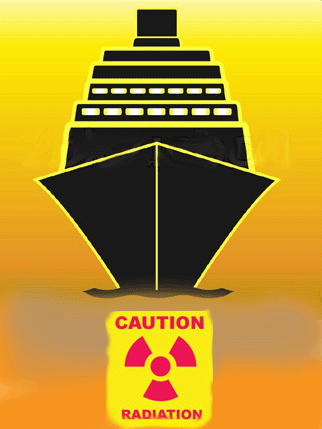 I would recommend that Super Freighters laden with the contents of countless reactor cores not sail down the Somali coast nor in the waters to the south of Thailand for fear of pirates. They should avoid man made Islands in the South China Sea. I suppose the ships will be guarded by 6 English policemen each with two revolvers between them. Rather than half the Pacific Fleet they would actually warrant. If they ever get to leave their home ports. What is the Somali coast going to be like in 40 years? Peaceful or short of rad weapons?…….” https://nuclearexhaust.wordpress.com/2016/03/15/response-to-the-tentative-findings-of-the-sa-nuclear-fuel-cycle-royal-commission/
6 April – 6 May : Assessing the Nuclear Fuel Chain Royal Commission before its results are released on 6 May
 It’s one month until the South Australian Nuclear Fuel Chain Royal Commission will announce its findings. And everyone knows what they will be – “nuclear waste importing will be a bonanza for South Australia”
This is the first of the significant posts that will appear on this site each day, ,until 6th May.
Kevin Scarce has dismissed opposition to the plan as largely “emotional”, not “factual” . I suspect that will be the way in which the Commission will deal with the opposing Submissions. Here’s today’s:
The Greens SA’s submission to the Nuclear Royal Commission’s Tentative Findings rejects the suggestion that an economic bonanza awaits our State if South Australians would only resign ourselves to becoming the world’s nuclear garbage bin.
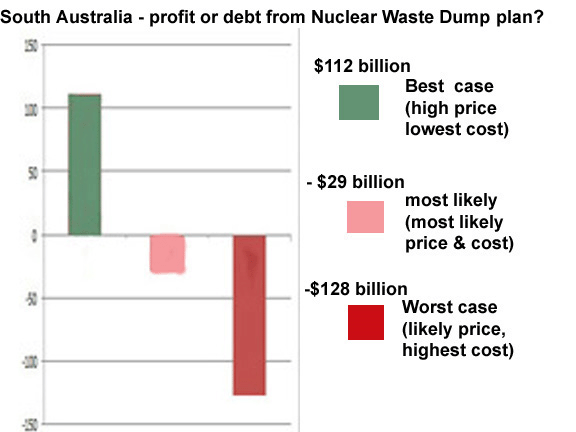
“The Royal Commission has been blinded by imaginary wealth and sucked into believing that a project that has never succeeded anywhere else in the World is South Australia’s for the taking”, said Greens SA Parliamentary Leader, Mark Parnell MLC.
“The most obvious question is being ignored: If this is such a great deal, how come no other country has grabbed it before now?
“The Greens are urging the Royal Commission to “get real” and critically examine the supposed economic benefits alongside the ongoing economic, social, environmental and reputational costs.
“Washing your hands of responsibility for a toxic legacy left to future generations is just immoral.
“The solution to South Australia’s current unemployment problems won’t be solved with mythical jobs that are decades into the future with the creation of toxic liabilities that last hundreds of thousands of year.
On releasing the “Tentative Findings” Report to the media on 15th February 2016, Commissioner Kevin Scarce stated, “The community needs to understand the risks and the benefits.” The Royal Commission’s “Tentative Findings” highlights many purported benefits but is scant on detail when it comes to the profound risks.
According to the Greens’ submission, the “Tentative Findings” suffer from:
1.Unrealistic expectations of the magnitude of the project;
2.Failure to appreciate 6 decades of international failure to solve the nuclear waste problem;
3.Missing costs, unfunded liabilities, missing contingencies and failure to recognise inevitable cost blow-outs
4.Heroic assumptions of other countries’ willingness to pay for SA to take their nuclear waste;
5.Lack of recognition of the potential for irrecoverable sunk costs and unlimited future liabilities;
6.Failure to address reputational damage and impact on other sectors of the economy; and
7.Naïve expectations that South Australia would get to keep all the profits from a nuclear waste dump in our State, without having to share them with other States.
“The Commission’s final report due on 6th May should recommend that the folly of South Australia’s increased involvement in the nuclear industry be abandoned.
“In relation to the other Terms of Reference, increased uranium mining, uranium processing or nuclear power were never really an option for SA and the Royal Commission was an expensive way to tell us what we already knew”, concluded Mark Parnell.
1 This month


Help Aunty Sue Protect Her Land and Sacred Sites From Destructive Rocket Testing.
.

Australians deserve the truth
about
AUKUS – https://aukuspublicinquiry.com/

PETITION – To: Prime Minister Anthony Albanese and the Australian Labor Government

of the week – Australians for War Powers Reform (AWPR)
To see nuclear-related stories in greater depth and intensity

