Aboriginal cultural heritage threatened by plan for nuclear waste dump in Flinders Ranges
 Flinders Ranges communities divided over whether to host Australia’s planned nuclear waste dump , ABC News, By Nicola Gage 23 Feb 16 Communities in South Australia’s Flinders Ranges remain deeply divided over whether the nation’s nuclear waste should be stored locally.
Wallerberdina Station, north-west of Hawker, is one of six locations being considered by the Federal Government to house low-level waste…… Meetings have been held in the region recently and Flinders Ranges Council Mayor Peter Slattery said there were mixed feelings in the community…….
Traditional owners vow to fight against waste dump For the Adnyamathanya people of the Flinders Ranges, their land is filled with songlines and sacred sites.
Traditional owner Regina McKenzie said she wanted to send a strong message to the Federal Government that her people did not want a dump built locally. “We’re just hoping that it’s not going to be here,” she said. “The amount of archaeology and the amount of heritage that’s in this area is way, way too high. “It’s actually the site of our first storyline that runs 70 kilometres from Hawker right down to Lake Torrens, so it’s a very significant place for us.”
Adnyamathanya man Tony Clark helped successfully fight against a nuclear dump being built at Woomera a decade ago.
He said he would fight with the same vigour against any proposal to store nuclear waste in the Flinders Ranges.
“This is a pristine area and represents a dreaming story that we want to preserve,” Mr Clark said.“The white man preserves ancient things in museums, this part of our land is our museum.“So our great-grandchildren can come along with their great-grandchildren and show people.”
The Federal Government is expected to make a final decision on a site by the end of the year. http://www.abc.net.au/news/2016-02-24/flinders-ranges-communities-divided-over-nuclear-waste-dump/7194592
South Australia”destined to be locked in to nuclear industry” – Adelaide Advertiser
The Adelaide Advertiser – mouthpiece of the nuclear lobby advises that we should all just give up – “see the light’ and let South Australia just roll over like a tame dog, and let the nuclear juggernaut roll over it.

we hosted the British nuclear bomb tests at Maralinga in the 1950s, and we have the world’s largest uranium mine at Olympic Dam.
So we are destined to be locked in to the nuclear fuel industry for decades to come. – Chris Kenny, The Advertiser 21 Feb 16
Julie Bishop, Christopher Pyne, Bill Shorten do their bit for the pro nuclear dance

Opposition Leader Bill Shorten has indicated he is open to the idea as long as there is community support, an economic benefit, and reassurance of environmental protection….
Overall Ms Bishop is optimistic that public opinion is in favour of more engagement with the nuclear fuel cycle………http://www.adelaidenow.com.au/news/south-australia/australia-the-ideal-location-for-nuclear-waste-dump-says-julie-bishop/news-story/c2655249dd4f655d05bf809d6d1795c8
Nuclear waste dump plan for Kimba – govt ignores relevant standards and codes
 Jim Green 21 Feb 16 Some comments on the 18 Feb 2016 government ‘information session’ in Kimba regarding plans for a radioactive waste repository and above-ground ‘interim’ store for long-lived intermediate-level waste.
 1. The government ignores and breaches relevant standards and codes when it suits.
As a Kimba resident noted at the meeting, the National Health and Medical Research Council’s (NH&MRC) ‘Code of Practice for Near-Surface Disposal of Radioactive Waste in Australia (1992)’ states that “the site for the facility should be located in a region which has no known significant natural resources, including potentially valuable mineral deposits, and which has little or no potential for agriculture or outdoor recreational use”.
So the government has breached the NH&MRC Code of Practice by short-listing the Kimba sites.
Following the so-called clean-up of the Maralinga nuclear test site in the late 1990s, nuclear engineer Alan Parkinson wrote: “The Department has claimed that burial is a safe disposal method consistent with “the [NH&MRC] Code.” This was the first time that the Code had been mentioned in relation to the Maralinga project. When three of the five authors said that it was not applicable (the other two were Commonwealth public servants and would not comment), the Department claimed that it did not have to follow the Code but had chosen to do so. It made this statement despite the fact that not a single requirement of that Code was satisfied.”
(Alan Parkinson, “The Maralinga Rehabilitation Project: Final Report”,
http://www.ippnw.org/pdf/mgs/7-2-parkinson.pdf)
So the government ignores relevant standards and codes when it suits, and the government breaches relevant standards and codes when it suits. Why would anyone trust the government to safely operate a radioactive waste facility in the Kimba region in those circumstances?
Alan Parkinson summarises the problem (keep in mind that he is pro-nuclear and a nuclear engineer): “The disposal of radioactive waste in Australia is ill-considered and irresponsible. Whether it is short-lived waste from Commonwealth facilities, long-lived plutonium waste from an atomic bomb test site on Aboriginal land, or reactor waste from Lucas Heights. The government applies double standards to suit its own agenda; there is no consistency, and little evidence of logic.”
(Alan Parkinson, 2002, ‘Double standards with radioactive waste’, Australasian Science, www.foe.org.au/anti-nuclear/issues/oz/britbombs/clean-up)
Next steps in the push for South Australia as world’s nuclear toilet
 Friends of the Earth 20 Feb 16 The ‘Tentative Findings’ report is posted at: http://nuclearrc.sa.gov.au/tentative-findings/
The deadline for written submissions responding to the interim report is March 18 (see the Royal Commission website for details).
The final report will be published in May 2016. http://www.foe.org.au/royal-commission
9 News 19 Feb 16 The report is due on May 6 and the state government will not make any decisions before the end of the year.
That could include putting the issue to a referendum at the next state election, due in 2018
Nuclear Semioticians (sign experts): how to warn future generations of the wastes danger
they established the field of nuclear semiotics……. an “atomic priesthood”
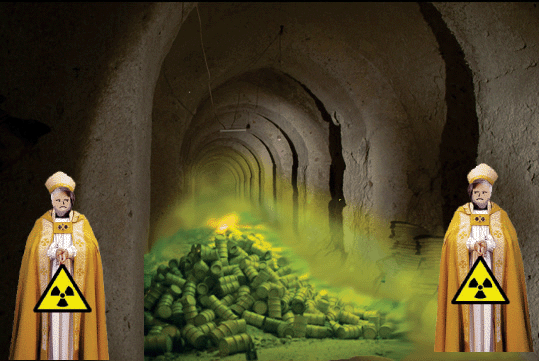
The message walls would have the faces as well as simple messages
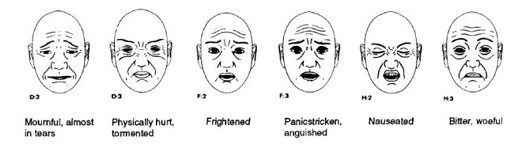
Temple of Doom: How do we warn the future about nuclear waste?, Triple J Hack, by James Purtill, 19 Feb 16 This week the South Australian Royal Commission released “tentative findings” recommending the state take more than 100 tonnes of high-level radioactive waste and store it in the desert for hundreds of thousands of years.
……..If the facility goes ahead, the designers may consider a problem that has baffled linguists and semioticians (sign experts): how to tell the distant future don’t dig up the dump?
Atomic priesthoods and ‘ray cats’
In 1991, the Department of Environment hired linguists, scientists and anthropologists at a cost of about $1 million to answer what is basically a conundrum of labelling. How do you warn far-off civilisations or scattered bands of post-apocalyptic survivors that invisible beams of energy emanating from the earth could kill them, and this was not a trick, there’s no buried treasure?
The report runs to 351 pages and has the (rather dry) title: Expert Judgement on Markers to Deter Inadvertent Human Intrusion into the Wasteland Isolation Pilot Plant.
Here’s some of the problems they identified:
- Languages evolve too fast to communicate with the future: Few English speakers understand Old English, which was spoken about 1000 years ago.
- The meanings of symbols is too ambiguous: For example, the physicist Carl Sagan was invited to join the researchers, couldn’t make it, and wrote to suggest they simply use the skull-and-crossbones symbol to signify danger. But this symbol has only been current for a few hundred years, has meant ‘poison’ for the last 100, and is no longer very threatening. It’s on ‘pirate theme’ drink bottles.
- Even if they understand the warnings, future trespassers might not believe them. Curses associated with the burial sites of the Egyptian Pharaohs did not deter grave robbers.
Maralinga tipped for the site of Premier Jay Weatherill’s nuclear waste site fantasy
 Planning 500 years ahead makes nuclear storage a difficult road, AFR, Simon Evans 20 Feb 16, It’s the first 500 years that bring the biggest worries about radioactivity when it comes to spent nuclear fuel rods.
After that, most of the radioactive elements have decayed, but they still need to be isolated from the environment in a deep underground nuclear storage facility for many hundreds of thousands of years. Everything in the nuclear waste industry has an enormously long outlook, including the promise of a $257 billion pay-day for South Australia . Correct, billion. That is if it’s able to traverse a difficult political road and build a sophisticated nuclear waste facility 500 metres below ground to operate over a projected 120-year commercial life……….
DEEP-BELOW-GROUND STORAGE
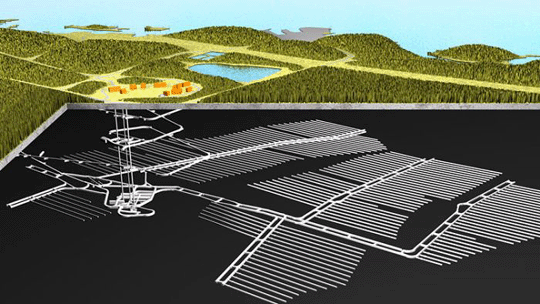
political considerations collide with the economics of the proposed plant. He says the $33 billion cost of the underground facility is so vast it would need to be shared between the state and federal government, which also needs to change legislation to allow it to proceed. Federal Resources and Energy Minister Josh Frydenberg gave cautious support to the plan if a political and community consensus can be developed……..
One submission to the royal commission by a private company called SA Nuclear Energy Systems has proposed the Maralinga atomic bomb test sites about 850km north-west of Adelaide as a good spot for an underground facility. Maralinga was used by Britain to test atomic bombs in the late 1950s, with the site later becoming embroiled in controversy because of the long-term health effects on the Aboriginal owners of the land and on military personnel who had been present. http://www.afr.com/business/energy/nuclear-energy/planning-500-years-ahead-makes-nuclear-storage-a-difficult-road-20160216-gmvchl#ixzz40e9J9qEw
What does the #NuclearCommissionSAust report say?
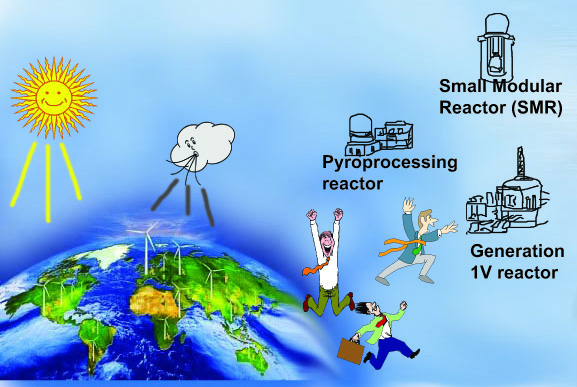
the waste-to-fuel fantasies of Senator Edwards and Ben Heard are dead and buried.
 [Wastes storage] timeframes – 150 years in the U.S. report and 120 years in the Royal Commission study – are nothing compared to the lifespan of nuclear waste. It takes 300,000 years for high level waste to decay to the level of the original uranium ore. The Royal Commission report notes that spent nuclear fuel (high level nuclear waste) “requires isolation from the environment for many hundreds of thousands of years.”
 the Waste Isolation Pilot Plant (WIPP) in the U.S. state of New Mexico. WIPP was closed in 2014 because of a chemical explosion which ruptured a nuclear waste barrel and resulted in 23 workers being exposed to radiation. Before WIPP opened, the government estimated one radiation release accident every 200,000 years. But there has been one radiation release accident in the first 15 years of operation of WIPP.
 The Royal Commission’s report is silent about WIPP. It is silent about the Asse repository in Germany, where massive water infiltration has led to the decision to exhume 126,000 barrels of radioactive waste. The report is silent about the fire at a radioactive waste repository in the U.S. state of Nevada last year. And the report is silent about many other problems with the nuclear industry that it should have squarely addressed
Summary of ‘Tentative Findings’ of SA Nuclear Fuel Cycle Royal Commission Friends of the Earth Australia, by Jim Green, national nuclear campaigner, Friends of the Earth 20 Feb 16 What does the report say?
In a nutshell, the Royal Commission is negative about almost all of the proposals it is asked to consider – but positive about the proposal to import high-level nuclear waste from nuclear power plants for disposal in South Australia. Continue reading
No country has a nuclear waste repository that will last long enough
Temple of Doom: How do we warn the future about nuclear waste?, Triple J Hack, by James Purtill, 19 Feb 16 “…….This week the South Australian Royal Commission released “tentative findings” recommending the state take more than 100 tonnes of high-level radioactive waste and store it in the desert for hundreds of thousands of years…….
This is true, but it’s worth pointing out none of these already built repositories are for the final disposal of nuclear fuel. They are either for low to intermediate level waste, which needs to be isolated for several hundred years, or they are temporary, interim solutions to the problem of finding a final resting place that will isolate waste for tens of thousands of years.
Finland is building the world’s first deep underground repository for high level nuclear waste and Sweden is close behind. The Finnish site is scheduled for completion in 2023.
A better example of the kind of repository proposed for South Australian is the United States’ Waste Isolation Pilot Plant (WIPP), deep in the New Mexico desert. It’s the only working long-lived nuclear waste repository in the world. It holds barrels of gloves and masks and machines and bomb parts contaminated by nuclear testing. The site is designed to last for 10,000 years.
WIPP is scheduled to close in the 2040s. It will be sealed up and left alone. Centuries will pass and become millennia. On the surface, civilisations will rise and fall.
China, the world’s oldest continuous civilisation, stretches back about 5,000 years. The world’s oldest inscribed clay tablets date from about the same time.
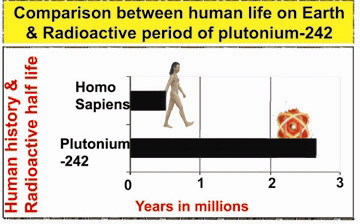 The half-life of plutonium-239, which can produce fatal radiation doses during short periods of direct exposure, is 24,000 years – the time it takes to decay to half its level of radioactivity. In 10 times that period, or 240,000 years, it decays to uranium-234, which is fairly harmless.
Homo sapiens began to evolve about 200,000 years ago………..http://www.abc.net.au/triplej/programs/hack/temple-of-doom-how-do-we-warn-the-future-about-nuclear-waste/7181278
#NuclearCommissionSAust ignores the long term problem of storing radioactive trash
South Australia ponders nuclear waste options MAX OPRAY, The Saturday Paper, 20 Feb 16 The initial findings of a royal commission into the merits of South Australia becoming a hub for uranium mining and waste storage raised as many questions as they answered.”…… Scarce put forward a premise even more audacious than his necktie – that South Australia’s seemingly hopeless descent into economic oblivion could be reversed by importing 138,000 tonnes of high-level nuclear waste from all over the world, reaping $445 billion in profits over 120 years. ……
The royal commission’s brief was to examine the feasibility of South Australia mining more uranium, processing it, using it for nuclear energy and then storing the waste – turning the state into a value-adding, vertically integrated hub of radioactivity.
The initial findings, based on interviews with 128 witnesses and more than 250 submissions, will be out for public comment for a five-week period before informing a final report due on May 6……….
Scarce urged attendees in Adelaide to contemplate the state’s future, but when question time arrived, the locals appeared to be thinking further ahead than he had in mind.
There was Lorraine Brady, who described herself as being from a group of mothers concerned about jobs for their children and future generations, but “not at any price”.
Brady asked: “How can you guarantee the safe containment of toxic, high-level nuclear waste for thousands of years to come?”
To speak of millennia is not hyperbole – by the royal commission’s own admission, some of the waste in question will remain hazardous for hundreds of thousands of years.
Craig Wilkins, chief executive of Conservation Council SA, an organisation that has actively questioned the impartiality of the royal commission, said the overall time frame needed to be taken into account not just in an environmental sense but an economic one.
“The commission acknowledges that nuclear waste needs to be isolated from the environment for ‘many hundreds of thousands of years’ yet there is no attempt to cost the management of waste over those time frames,” he said.
“If there’s one thing we know, the nuclear industry is expert at overstating the benefits and radically understating the costs and risks.”……..
there is the actual journey – the transportation of waste internationally across oceans, and then through ports and populated areas, before arriving at a temporary above-ground dump site, where it will have to remain until enough funds have been accrued from such imports to invest in a large-scale underground facility.
As the attendees noted, communities all along the route would need to offer consent, along with anyone living near the final destination………..https://www.thesaturdaypaper.com.au/news/politics/2016/02/20/south-australia-ponders-nuclear-waste-options/14558868002910
World’s most expensive and toxic “stranded asset” – Nuclear Waste Dump For South Australia
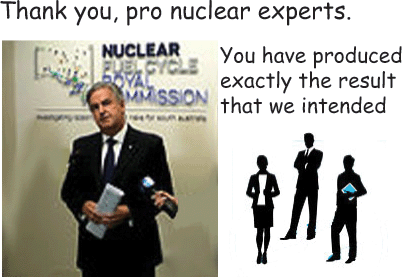 Nuclear Royal Commission: What’s Scarce in Kevin’s Report, Independent Australia
17 February 2016,The Scarce Report recommends South Australia being storing the world’s nuclear waste, opening the door for nuclear power generation in Australia in the future, writes Noel Wauchope.
Kevin Scarce’s Report on the “tentative findings” of the South Australian Nuclear Fuel Chain (I mean Cycle) Royal Commission runs to 42 pages. Still, he manages to leave a few questions unanswered and, indeed, a few questions not even asked, as well as leaving a few grey areas to be brushed over in a suitably vague manner.
MONEY
The major recommendation of the Report is for South Australia to make billions by importing, managing, storing and disposing of nuclear waste.
Who pays up first?
An interesting question – and grey area – is exactly who would be responsible for paying for the building of the nuclear waste facilities; for the construction of the dedicated port facility, airport and rail freight line; and the maintenance of all the infrastructure?
Well, that question is not answered clearly at all by the Report. However, as it states that ‘the facilities would need to be controlled and owned by government’, we can assume that the tax-payer will be responsible for the costs, now unto eternity, as eternity is about how long that high level radioactive wastes have to be contained and kept secure .
The Commission’s financial advice from Jacobs MCM makes this clear:
‘Capital and operating costs are assumed to be met from revenue. In the first few years of the model costs are assumed to be incurred before revenue is received.’
The payments for taking in spent fuel (high level wastes) from other countries would start only ‘at the moment of transfer from ship to shore in South Australia’, which would happen 15 years after the waste storage facility was built
Now how could they sell that idea to the public? Well, there’s the possibility of other countries paying for some of it, sort of:
‘…the potential to negotiate advance reservation fees with some prospective client countries to offset at least a portion of this cost.’
How much will it all cost?
Scarce reports the underground disposal facility as costing $33 billion. The Jacob report does not make all of the costs clear. It does not reveal the costs of the surface storage facilities and of maintaining high level wastes for many decades in dry storage casks.
The Jacobs MCM financial advisory report to the Commission has a tone of optimism and yet its 214 pages contain many “ifs” and “buts”.
Some of these include:
- Disposal of spent fuel (SF) will account for 93% of the costs. No country except UK has actually priced this cost, and estimates for these costs vary wildly from country to country.
- Countries with established nuclear experience – USA, UK, France, Sweden, Finland, Russia, China and India – will not be exporting nuclear waste to Australia, which leaves potential markets to a number of nuclear-inexperienced countries in Asia and Middle East — some with unstable regimes. Japan is committed to reprocessing its nuclear wastes, with no plan to export them……….
How come Australia is the only country to jump at this opportunity? Continue reading
Barry Brook, Pinchy Lobster and Clive Palmer: Three ‘Outstanding Scientists/Intellectuals’
 Jim Green, 19 Feb 16 Tas Uni academic Barry Brook’s university webpage says that in 2005 he was listed as one of the “2000 Outstanding Scientists of the 21st Century” by the International Biographical Centre (IBC). But the IBC is a zero-credibility money making operation.
The WA Government’s Dept of Commerce ‘ScamNet’ website states: “The material promoting the International Biographical Centre creates a false impression about the credentials of the organisation. It also wrongly implies that the receiver of the letter has been picked through a special research process considering their work and qualifications.”
If there was any doubt about the IBC’s illegitimacy, one of Brook’s academic colleagues nominated a squeaky toy lobster and Prof. Lobster was accepted for inclusion as one of the ‘2000 Outstanding Scientists of the 21st Century’. And the IBC has accepted a nomination for Clive Palmer to be listed as one of the ‘2000 Outstanding Intellectuals of the 21st Century’. A ‘Medal of Intellect’ will be sent to Palmer on payment of a $240 fee.
Feel free to test the IBC’s credibility yourself … you’ll have no trouble getting the Wiggles or the Bananas in Pyjamas or Thomas the Tank Engine accepted as Outstanding Scientists or Outstanding Intellectuals.
Given that the illegitimacy of the IBC is beyond doubt, why does the IBC accolade remain on Brook’s university webpage?
Sources:
- Brook’s Tas Uni website (see the Career tab, under “Awards and Prizes”): https://secure.utas.edu.au/profiles/staff/plant-science/barry-brook
- IBC: www.internationalbiographicalcentre.com/2000_outstanding_scientists_of_the_21st_c.php
- WA Government ‘scamnet’ website: http://www.scamnet.wa.gov.au/scamnet/Scam_Types-Directory_Listings_and_registry_schemes-International_Biographical_Centre.htm
- Wikipedia IBC entry: https://en.wikipedia.org/wiki/International_Biographical_Centre
- Critique of Brook’s nuclear propaganda: www.foe.org.au/anti-nuclear/issues/oz/barry-brook-bravenewclimate
Barry Brook, Pinchy Lobster and Clive Palmer: Three ‘Outstanding Scientists/Intellectuals
Jim Green, 19 Feb 16 Tas Uni academic Barry Brook’s university webpage says that in 2005 he was listed as one of the “2000 Outstanding Scientists of the 21st Century” by the International Biographical Centre (IBC). But the IBC is a zero-credibility money making operation.
The WA Government’s Dept of Commerce ‘ScamNet’ website states: “The material promoting the International Biographical Centre creates a false impression about the credentials of the organisation. It also wrongly implies that the receiver of the letter has been picked through a special research process considering their work and qualifications.”
If there was any doubt about the IBC’s illegitimacy, one of Brook’s academic colleagues nominated a squeaky toy lobster and Prof. Lobster was accepted for inclusion as one of the ‘2000 Outstanding Scientists of the 21st Century’. And the IBC has accepted a nomination for Clive Palmer to be listed as one of the ‘2000 Outstanding Intellectuals of the 21st Century’. A ‘Medal of Intellect’ will be sent to Palmer on payment of a $240 fee.
Feel free to test the IBC’s credibility yourself … you’ll have no trouble getting the Wiggles or the Bananas in Pyjamas or Thomas the Tank Engine accepted as Outstanding Scientists or Outstanding Intellectuals.
Given that the illegitimacy of the IBC is beyond doubt, why does the IBC accolade remain on Brook’s university webpage?
Sources:
- Brook’s Tas Uni website (see the Career tab, under “Awards and Prizes”): https://secure.utas.edu.au/profiles/staff/plant-science/barry-brook
- IBC: www.internationalbiographicalcentre.com/2000_outstanding_scientists_of_the_21st_c.php
- WA Government ‘scamnet’ website: http://www.scamnet.wa.gov.au/scamnet/Scam_Types-Directory_Listings_and_registry_schemes-International_Biographical_Centre.htm
- Wikipedia IBC entry: https://en.wikipedia.org/wiki/International_Biographical_Centre
- Critique of Brook’s nuclear propaganda: www.foe.org.au/anti-nuclear/issues/oz/barry-brook-bravenewclimate
Nuclear waste dump for South Australia: an unacceptably bad option
The endeavours of our scientists and engineers are needed in dealing with the many facets of climate challenge, including the transition to renewable energy, and they should be focused on this.
 Nuclear waste dump just another bad option — what about renewable energy? http://www.adelaidenow.com.au/news/opinion/nuclear-waste-dump-just-another-bad-option–what-about-renewable-energy/news-story/92f494cdde1dcae41481a45e5ac4f4ac February 18, 2016 John Willoughby The Advertiser SOUTH Australia’s Nuclear Fuel Cycle Royal Commission, in its tentative findings, has recommended avoiding some bad options: no nuclear power generation and no reprocessing or fuel leasing in the foreseeable future.
However, a bad option it found acceptable is allowing a proportion of the world’s most dangerous high-level nuclear waste to be transported to SA for long-term disposal. Continue reading
Proposal for nuclear waste dump splits South Australian Kimba community
 Support for proposed nuclear storage facility at Kimba difficult to determine
ABC Rural 18 Feb 16 The South Australian town of Kimba is divided over the benefits or otherwise of a low level nuclear storage facility in the area.
The Federal Government has released a shortlist of six sites nominated to store low-to-intermediate nuclear waste, with three of them located in South Australia.
The three South Australian sites are Cortlinye and Pinkawillinie near Kimba on the Eyre Peninsula, and Barndioota near Hawker, north of Port Augusta.
The prospect of Kimba region being selected has caused deep divisions in the community of Kimba.
The ABC has been told some people are boycotting local businesses in town due to their opposing views  on the issue but the Federal Member for Grey,Rowan Ramsey believes as the debate continues more people are coming around to the idea.
“That’s very concerning, I had not anticipated that people would go to those lengths. All I have ever wanted was a calm rational debate,” Mr Ramsey said…….
Mr Ramsey has been a key player in the debate even offering up his own property as a possible site to host the facility before it was deemed a conflict of interest……
Andrew Baldock and his father Graeme nominated 100 hectares of cropping country at Cortlynie outside Kimba to host the nuclear site……
Melanie Woolford who runs Merinos and prime lambs with her husband, kilometres from the proposed site at Pinkawilinie does not share that view. Ms Woolford is concerned the risk of jeopardising the regions clean, green image does not justify the proposed benefits of having a nuclear waste facility in the region.
“It scares me to think what could happen to our kids or our grandchildren, I think we have a right to say no. “It’s good farming land and I don’t understand why you’d want to put it (a nuclear storage facility) in the middle of farming land,” Ms Woolford said.
“I’ve been here for 13 years and I don’t enjoy coming to Kimba anymore, it’s horrible.” http://www.abc.net.au/news/2016-02-18/nuclear-dump-support-at-kimba-diifficult-to-determine/7181410
1 This month
15 April – Zoom –Nuclear Power is Not the Solution
Apr 15, 2026 01:00 AM in Canberra, Melbourne, Sydney

Join the International Physicians for the Prevention of Nuclear War (IPPNW) on Tuesday, April 14th for a timely webinar exploring the risks associated with nuclear power and challenging the myth that it offers a simple, safe, carbon-free solution to the climate crisis

21 April Webinar: No Nuclear Weapons in Australia
Start: 2026-04-21 18:00:00 UTC Canberra, Melbourne, Sydney (GMT+10:00)
End: 2026-04-21 19:30:00 UTC Canberra, Melbourne, Sydney (GMT+10:00)
Event Type: Virtual
A virtual link will be communicated before the event.
Host Contact Info: australia@icanw.org

of the week – Australians for War Powers Reform (AWPR)
To see nuclear-related stories in greater depth and intensity
 Antinuclear