Port Augusta community keenly concerned about renewable energy versus nuclear industry developments
Key points:
- Regional job losses and nuclear royal commission findings have some locals worried
- Government minister Geoff Brock says no nuclear decisions have been taken
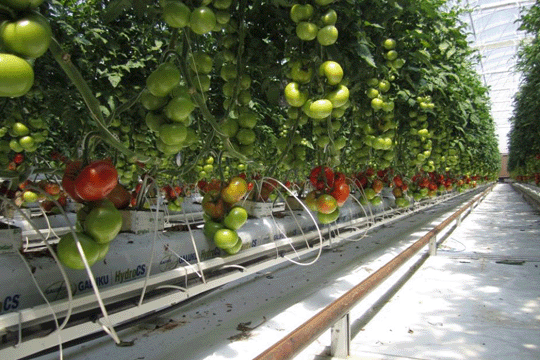
- Tomato greenhouses using desalinated water are praised for creating local jobs
Hundreds of residents are expected at Port Augusta’s Central Oval complex to quiz visiting Government ministers on a range of issues including jobs.
The regional city is gearing for an imminent closure of Alinta’s Port Augusta power stations.
 Mayor Sam Johnson expressed hope a range of options including hydroponic farming and renewable energy projects would create a secure future for the Port Augusta region.
“There is an area around Port Augusta which is clearly one of the world’s best sites when it comes to wind … also [ideal for] solar virtually from just south of Port Augusta right up to Roxby Downs,” he said.”As you go over towards Whyalla and Cowell, [that area] has been identified for anyone that wants to invest in wave technology.”
Government ministers are expected to tour Sundrop Farms’ vast tomato greenhouses at Port Augusta, which use desalinated sea water for crop production in the arid region. State Regional Development Minister Geoff Brock praised such ventures at a time of job losses elsewhere. “They will have around 200 people working there full-time and the good thing about this [is] Sundrop have just won an innovative award in Germany on an international scale,” he said.
“They’re going to have the research and development [functions] located at Port Augusta, so this is state of the art.”
Radioactive nuclear waste worries for northern SA residents Nuclear concerns will also be high on the agenda for the public forum and for Cabinet as it meets in the far north region. The Port Augusta Mayor said there was significant local concern about the future prospect of radioactive waste being transported through the northern region.
Mr Johnson said talk of a possible nuclear waste facility for the state’s north was a hot topic among residents. He said if any high-level waste was ever shipped in via Whyalla or Port Pirie, it would also be likely to be transported through Port Augusta.
 “The only way to go … is through Port Augusta, which has a two-lane bridge which has been in need of a little bit of work,” he said.
“There’s effectively no alternative detour access route and should there be an incident that occurs on that bridge then that has significant impacts not just for Port Augusta but also potentially the eco or marine environment.”…….http://www.abc.net.au/news/2016-02-28/jobs-nuclear-waste-port-augusta-forum-country-cabinet/7205842
Will the Australian govt impose a Lucas Heights nuclear waste dump on a South Australian community?
 We will soon see how much in a rush the government is with the issue. Will it try to find a site by any means, even if this implies imposing it on a community or will it take its commitment not to do so seriously and maybe take the steps necessary to find a long-lived solution to a long-lived problem?
| By Anica Niepraschk , 29 February 2016 The federal government – once again – is looking for a place to dump its nuclear waste. All attempts over the last twenty years have failed – and so might this one, at least if the government is sticking to the promises it made in its new approach.The process is to be voluntary and no dump is to be located anywhere without community consent. These are the words at least. 28 sites across Australia had been nominated by landowners last year and were reduced to a shortlist of six by the Department for Resources.
The six sites are in Hale (NT), not far from Alice Springs, Hill End in NSW, Oman Ama in Queensland and three sites in South Australia: two in the Kimba region (Cortlinye and Pinkawillinie) and Wallerbidina/ Barndioota, outside Hawker. The South Australian shortlisted sites also get increasingly entangled in a debate as to whether the state might offer itself up as the world’s nuclear waste dump, accepting high-level nuclear waste from power reactors around the world. This was the key prospect outlined in the tentative findings of the Royal Commission into the Nuclear Fuel Cycle, released last week. All six sites are so far highly contested by the local communities, Continue reading |
South Australia a great State not a Waste State – communities visit Federal Parliament
 Flinders Ranges and Kimba residents voicing nuclear concerns to Federal Parliament http://www.transcontinental.com.au/story/3753842/local-voice-on-nuclear-goes-national/?cs=1538 28 Feb 16
FLINDERS Ranges and Kimba representatives will travel to Parliament House in Canberra next week, with delegates from three other sites across Australia targeted for a national radioactive waste dump joining them.
South Australia has three nominated sites – two at Kimba and one just north of Hawker in the Flinders Ranges. The visit comes a week before the closure of public comment on the National Radioactive Waste Management Project on March 11.
Meetings have been requested with the key decision maker federal Resources Minister Josh Frydenberg and other ministers to discuss community concerns ahead of the submission deadline.
Toni Scott and her family neighbour in Kimba a part of a group of locals within affected areas.She has been in regular contact and feels taking their message directly to Canberra will be an important way to step up campaigning efforts to ensure community concerns are recognised and reflected. “We are going to Canberra because our concerns must be heard,” Ms Scott said.
“Communities deserve to be treated better than what this process has delivered thus far and we want to get our message across face to face.”
Regina McKenzie has regularly spoken against the planned proposal near Hawker.“Its important that we get the message through to the government – no means no,” Ms McKenzie said.”We don’t want to live next to a radioactive waste dump. “SA is a great state not a waste state.”
Exposing the vested interests of pro nuclear publicists like Oscar Archer
 Dennis Matthews, 26 Feb 16 The Advertiser newspaper has been printing lots of Letters to the Editor on the nuclear issue.
Two pro-nuclear letters caught my attention.
One was by a writer (Oscar Archer) who is regular contributor to a pro-nuclear website, and who prides himself on having a PhD in Chemistry. The PhD, however, is in an area of chemistry not evenly faintly related to nuclear issues and is no basis for claiming any special insight. What is highly relevant however is that the supervisor of his thesis was Stephen Lincoln who, as a member of the board of SA Nuclear Energy Systems, has a vested interest in promoting the nuclear industry.
Another letter was written by a geologist (Sean Kennedy) who was one of the people acknowledged by Senator Edwards as contributing to his submission calling for an integrated nuclear industry in SA.
Noel Wauchope – Oscar Archer is a star publicist for the nuclear lobby. And – he really gave the game away in a talk on ABC Radio National “Ockham’s Razor” – in which he elaborated the plan of USA nuclear industry “new nukes” – their idea to set up a suite of experimental SMRs -Small Modular Reactors in Australia at their own expense. All Australia has to do to get these is to invite in the world’s radioactive trash. They don’t mention that SMRs need plutonium or enriched uranium to start the reaction – so Australia would have to import those, to get these reactors working.
Interesting that they just call them “SMRs” – leaving out that unpopular word “Nuclear”. As USA govt has difficult safety regulations for setting up new nuclear reactors, why not have Australia be the guinea pig?
Adelaide Advertiser poll – nearly all supporters of nuclear waste import had vested interests!
 Dennis Matthews, It was heartening to see that in a survey stacked with vested interests (The Advertiser, 23/2/16), of those who had no apparent vested financial or professional interest only two people supported the importation of high-level nuclear waste into South Australia and one of those had imprecise information about Finland.
Stacking inquiries and surveys is a trade mark of the nuclear lobby.
I look forward to the day when we can trust the business community, media and politicians to be honest with the people of South Australia and to stop treating us as like idiots.
Naively, I thought this would have happened after the State Bank fiasco in 1991. Consecutive South Australian Premiers have clearly demonstrated that they have learnt nothing from past indiscretions.
It is now up to ordinary South Australians to keep South Australia free from exploitation by vested interests and incompetent politicians.
#NuclearCommissionSAust ‘s plan – not necessarily an Eldorado for South Australia
 SA’s Nuclear Waste Boom: A Hot Story Requires Cool Heads http://adelaidereview.com.au/opinion/business-finance-opinion/nuclear-waste-boom-a-hot-story-requires-cool-heads/ John Spoehr Director of the Australian Industrial Transformation Institute at Flinders University February 26, 2016
As the alluring prospect of a nuclear waste storage boom fades a little in our minds, attention needs to turn to the risks associated with large–scale radioactive waste storage…….
I think the Commission’s estimates might prove to be over-optimistic. If the proposition is as attractive as the modeling provided by the Commission suggests, then you would expect a range of players to enter the market at the same time as Australia does……
We cannot rely on a radioactive storage facility to deliver short-term benefit. ‑The lead times on a project like this are long and will be complicated by the need for very thorough and accurate geological, environmental, social and economic impact assessment. Community attitudes will be shaped by this as it unfolds.
In the meantime, we must guard against seeing the Commission’s findings as the foundation for some kind of nuclear Eldorado. The prospect of great riches and jobs flowing from being a storehouse for radioactive material is seductive at a time when job losses in the automotive, mining and steel industries loom large. We must be convinced rather than seduced by the case for a storage facility in South Australia. Future generations will not forgive us if we get this one wrong.
#NuclearCommissionSAust willing to pass huge costs on to future generations
we are bequeathing a stream of costs to our successor generations. They will be poorer as a result, and will have reason to curse their forebears for selfishly making themselves better off at their expense.
Nuclear waste dump confounds cost-benefit analysis, In Daily, 23 Feb 16 The proposal for a South Australian high level nuclear waste dump places too much risk on future generations, argues economist Richard Blandy.
The Nuclear Fuel Cycle Royal Commission delivered its tentative findings on 15 February. It is seeking responses to these findings up until 18 March. I intend to submit this article to the commission for its consideration.
The only aspect of the nuclear fuel cycle that received the Royal Commission’s support in its tentative findings was the storage and disposal of used nuclear fuel, entirely from overseas, obviously. The Royal Commission described such an integrated storage and disposal facility as “likely to deliver substantial economic benefits to the South Australian community”.
I believe that the Royal Commission has got this wrong and that South Australia should not use part of its land mass as a dump for highly radioactive used fuel from overseas nuclear reactors (called “high level waste”) which, in the Royal Commission’s own words, “requires isolation from the environment for many hundreds of thousands of years”.
The reason why South Australia should not allow a nuclear dump within its borders goes to the heart of cost-benefit analysis involving many generations of people, literally tens of thousands of generations, in this case. Cost-benefit analysis works well when the costs are up front and the benefits accrue into the future. But it falls apart when the benefits are up front and the costs accrue into the future.
This is the case with the proposed high level nuclear waste dump. We are promised an up-front bonanza, after 30 years of construction of the facility, with a net present value of “more than $51 billion (at the intergenerational discount rate of 4 per cent)”. Continue reading
Aboriginal landowners shocked at plan for nuclear waste dump close to sacred site
 Traditional owners in the Flinders Ranges say nuclear waste dump threatens cultural heritage ABC NORTH AND WEST MICHAEL DULANEY Traditional owners in the Flinders Ranges say a Federal Government nuclear waste dump could destroy significant cultural heritage and countless sacred sites around a permanent spring. The lush vegetation and birdlife along Hookina Creek, 30 kilometres north of Hawker in South Australia, stands out even among the imposing space and scale of the central Flinders Ranges. Its permanent waters are fed by aquifers that bubble up to feed ‘an oasis’ of reeds and large eucalypts bursting from the dry heat and dust of the pastoral landscape.
It is an area integral to the lives of the Adnyamathanha people for generations and whose presence has left a rich cultural and archaeological record along the creek.
These waters are also just a few kilometres from Wallerberdina, a cattle station near Barndioota partly-owned by former Liberal senator Grant Chapman.
It is also one of six sites nominated to host Australia’s first nuclear waste dump.The Adnyamathanha people, who manage the Yappala Indigenous Protected Area which shares a boundary with Barndioota, said they were “shocked” by the prospect of storing Australia’s low and intermediate level nuclear waste so close to a significant cultural site.
Traditional owner Regina McKenzie said the facility would jeopardise their links to a place important for the present — a place where her children have learnt to swim and the family comes to camp — as well as the past, as seen in the tools, paintings and storylines that mark the area.
“The emotional stress we’re feeling is off the charts,” Ms McKenzie said. “We’re still the custodians here; we’ve always looked at it that way.”
The Adnyamathanha people are also worried about the risk from large floods known to hit the area, and elder Enice Marsh pointed out damage around the creek caused by the last flood a decade ago.
Ms Marsh said she feared the loss of her people’s heritage in the region if rising flood waters mixed with radioactive waste. “If we’re going to have that poison stuff here, even if it’s a low-level situation, it’s just absolute madness to put something like this near somewhere that’s so special,” she said.
“It’s everything; it’s a type of importance that you would never be able to describe. “The connection to this land for Adnyamathanha people is their culture, their customs; it’s their identity.”…….
With a final decision from the Government due by the end of the year, Ms McKenzie said the Adnyamathanha people would continue to oppose the expansion of the nuclear industry into their traditional lands.
“We’re feeling as though we’re being forced to do something we don’t want to do,” she said. http://www.abc.net.au/news/2016-02-24/traditional-owners-flinders-ranges-fears-on-nuclear-waste-dump/7195030
Aboriginal cultural heritage threatened by plan for nuclear waste dump in Flinders Ranges
Flinders Ranges communities divided over whether to host Australia’s planned nuclear waste dump , ABC News, By Nicola Gage 23 Feb 16 Communities in South Australia’s Flinders Ranges remain deeply divided over whether the nation’s nuclear waste should be stored locally.
Wallerberdina Station, north-west of Hawker, is one of six locations being considered by the Federal Government to house low-level waste…… Meetings have been held in the region recently and Flinders Ranges Council Mayor Peter Slattery said there were mixed feelings in the community…….
Traditional owners vow to fight against waste dump For the Adnyamathanya people of the Flinders Ranges, their land is filled with songlines and sacred sites.
Traditional owner Regina McKenzie said she wanted to send a strong message to the Federal Government that her people did not want a dump built locally. “We’re just hoping that it’s not going to be here,” she said. “The amount of archaeology and the amount of heritage that’s in this area is way, way too high. “It’s actually the site of our first storyline that runs 70 kilometres from Hawker right down to Lake Torrens, so it’s a very significant place for us.”
Adnyamathanya man Tony Clark helped successfully fight against a nuclear dump being built at Woomera a decade ago.
He said he would fight with the same vigour against any proposal to store nuclear waste in the Flinders Ranges.
“This is a pristine area and represents a dreaming story that we want to preserve,” Mr Clark said.“The white man preserves ancient things in museums, this part of our land is our museum.“So our great-grandchildren can come along with their great-grandchildren and show people.”
The Federal Government is expected to make a final decision on a site by the end of the year. http://www.abc.net.au/news/2016-02-24/flinders-ranges-communities-divided-over-nuclear-waste-dump/7194592
South Australia”destined to be locked in to nuclear industry” – Adelaide Advertiser
The Adelaide Advertiser – mouthpiece of the nuclear lobby advises that we should all just give up – “see the light’ and let South Australia just roll over like a tame dog, and let the nuclear juggernaut roll over it.

we hosted the British nuclear bomb tests at Maralinga in the 1950s, and we have the world’s largest uranium mine at Olympic Dam.
So we are destined to be locked in to the nuclear fuel industry for decades to come. – Chris Kenny, The Advertiser 21 Feb 16
Julie Bishop, Christopher Pyne, Bill Shorten do their bit for the pro nuclear dance

Opposition Leader Bill Shorten has indicated he is open to the idea as long as there is community support, an economic benefit, and reassurance of environmental protection….
Overall Ms Bishop is optimistic that public opinion is in favour of more engagement with the nuclear fuel cycle………http://www.adelaidenow.com.au/news/south-australia/australia-the-ideal-location-for-nuclear-waste-dump-says-julie-bishop/news-story/c2655249dd4f655d05bf809d6d1795c8
Nuclear waste dump plan for Kimba – govt ignores relevant standards and codes
 Jim Green 21 Feb 16 Some comments on the 18 Feb 2016 government ‘information session’ in Kimba regarding plans for a radioactive waste repository and above-ground ‘interim’ store for long-lived intermediate-level waste.
 1. The government ignores and breaches relevant standards and codes when it suits.
As a Kimba resident noted at the meeting, the National Health and Medical Research Council’s (NH&MRC) ‘Code of Practice for Near-Surface Disposal of Radioactive Waste in Australia (1992)’ states that “the site for the facility should be located in a region which has no known significant natural resources, including potentially valuable mineral deposits, and which has little or no potential for agriculture or outdoor recreational use”.
So the government has breached the NH&MRC Code of Practice by short-listing the Kimba sites.
Following the so-called clean-up of the Maralinga nuclear test site in the late 1990s, nuclear engineer Alan Parkinson wrote: “The Department has claimed that burial is a safe disposal method consistent with “the [NH&MRC] Code.” This was the first time that the Code had been mentioned in relation to the Maralinga project. When three of the five authors said that it was not applicable (the other two were Commonwealth public servants and would not comment), the Department claimed that it did not have to follow the Code but had chosen to do so. It made this statement despite the fact that not a single requirement of that Code was satisfied.”
(Alan Parkinson, “The Maralinga Rehabilitation Project: Final Report”,
http://www.ippnw.org/pdf/mgs/7-2-parkinson.pdf)
So the government ignores relevant standards and codes when it suits, and the government breaches relevant standards and codes when it suits. Why would anyone trust the government to safely operate a radioactive waste facility in the Kimba region in those circumstances?
Alan Parkinson summarises the problem (keep in mind that he is pro-nuclear and a nuclear engineer): “The disposal of radioactive waste in Australia is ill-considered and irresponsible. Whether it is short-lived waste from Commonwealth facilities, long-lived plutonium waste from an atomic bomb test site on Aboriginal land, or reactor waste from Lucas Heights. The government applies double standards to suit its own agenda; there is no consistency, and little evidence of logic.”
(Alan Parkinson, 2002, ‘Double standards with radioactive waste’, Australasian Science, www.foe.org.au/anti-nuclear/issues/oz/britbombs/clean-up)
Next steps in the push for South Australia as world’s nuclear toilet
 Friends of the Earth 20 Feb 16 The ‘Tentative Findings’ report is posted at: http://nuclearrc.sa.gov.au/tentative-findings/
The deadline for written submissions responding to the interim report is March 18 (see the Royal Commission website for details).
The final report will be published in May 2016. http://www.foe.org.au/royal-commission
9 News 19 Feb 16 The report is due on May 6 and the state government will not make any decisions before the end of the year.
That could include putting the issue to a referendum at the next state election, due in 2018
Nuclear Semioticians (sign experts): how to warn future generations of the wastes danger
they established the field of nuclear semiotics……. an “atomic priesthood”
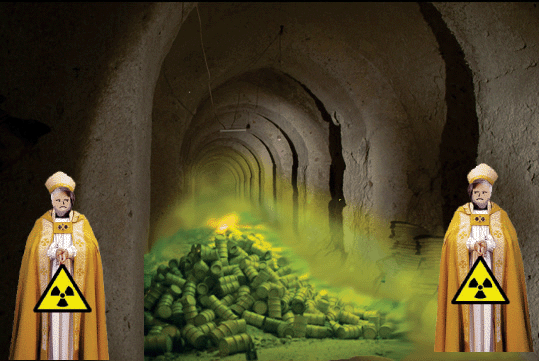
The message walls would have the faces as well as simple messages
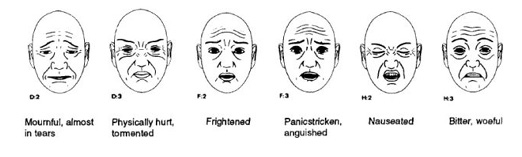
Temple of Doom: How do we warn the future about nuclear waste?, Triple J Hack, by James Purtill, 19 Feb 16 This week the South Australian Royal Commission released “tentative findings” recommending the state take more than 100 tonnes of high-level radioactive waste and store it in the desert for hundreds of thousands of years.
……..If the facility goes ahead, the designers may consider a problem that has baffled linguists and semioticians (sign experts): how to tell the distant future don’t dig up the dump?
Atomic priesthoods and ‘ray cats’
In 1991, the Department of Environment hired linguists, scientists and anthropologists at a cost of about $1 million to answer what is basically a conundrum of labelling. How do you warn far-off civilisations or scattered bands of post-apocalyptic survivors that invisible beams of energy emanating from the earth could kill them, and this was not a trick, there’s no buried treasure?
The report runs to 351 pages and has the (rather dry) title: Expert Judgement on Markers to Deter Inadvertent Human Intrusion into the Wasteland Isolation Pilot Plant.
Here’s some of the problems they identified:
- Languages evolve too fast to communicate with the future: Few English speakers understand Old English, which was spoken about 1000 years ago.
- The meanings of symbols is too ambiguous: For example, the physicist Carl Sagan was invited to join the researchers, couldn’t make it, and wrote to suggest they simply use the skull-and-crossbones symbol to signify danger. But this symbol has only been current for a few hundred years, has meant ‘poison’ for the last 100, and is no longer very threatening. It’s on ‘pirate theme’ drink bottles.
- Even if they understand the warnings, future trespassers might not believe them. Curses associated with the burial sites of the Egyptian Pharaohs did not deter grave robbers.
Maralinga tipped for the site of Premier Jay Weatherill’s nuclear waste site fantasy
 Planning 500 years ahead makes nuclear storage a difficult road, AFR, Simon Evans 20 Feb 16, It’s the first 500 years that bring the biggest worries about radioactivity when it comes to spent nuclear fuel rods.
After that, most of the radioactive elements have decayed, but they still need to be isolated from the environment in a deep underground nuclear storage facility for many hundreds of thousands of years. Everything in the nuclear waste industry has an enormously long outlook, including the promise of a $257 billion pay-day for South Australia . Correct, billion. That is if it’s able to traverse a difficult political road and build a sophisticated nuclear waste facility 500 metres below ground to operate over a projected 120-year commercial life……….
DEEP-BELOW-GROUND STORAGE
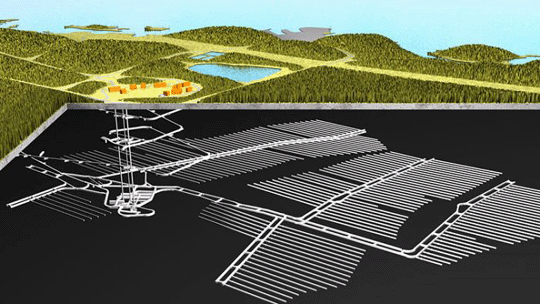
political considerations collide with the economics of the proposed plant. He says the $33 billion cost of the underground facility is so vast it would need to be shared between the state and federal government, which also needs to change legislation to allow it to proceed. Federal Resources and Energy Minister Josh Frydenberg gave cautious support to the plan if a political and community consensus can be developed……..
One submission to the royal commission by a private company called SA Nuclear Energy Systems has proposed the Maralinga atomic bomb test sites about 850km north-west of Adelaide as a good spot for an underground facility. Maralinga was used by Britain to test atomic bombs in the late 1950s, with the site later becoming embroiled in controversy because of the long-term health effects on the Aboriginal owners of the land and on military personnel who had been present. http://www.afr.com/business/energy/nuclear-energy/planning-500-years-ahead-makes-nuclear-storage-a-difficult-road-20160216-gmvchl#ixzz40e9J9qEw
1 This month


Help Aunty Sue Protect Her Land and Sacred Sites From Destructive Rocket Testing.
.

Australians deserve the truth
about
AUKUS – https://aukuspublicinquiry.com/

PETITION – To: Prime Minister Anthony Albanese and the Australian Labor Government

of the week – Australians for War Powers Reform (AWPR)
To see nuclear-related stories in greater depth and intensity

