Greens ready for #NuclearCommissionSAust report “all about waste dumping”
 “It’s all about the dump”: Greens gear up for nuclear war, IN Daily, 12 Feb 16 The South Australian Greens are preparing for a sustained public relations assault from next week, in the assumption that the Royal Commission into the state’s nuclear fuel cycle will recommend the viability of a nuclear waste dump. The commission, headed by former Governor Kevin Scarce, will detail its “tentative findings” on Monday morning, preceding another round on consultation.
Greens MLC Mark Parnell told InDaily the party had prepared a variety of options for leaflets and online material, with staff “putting out a call to Greens members for volunteers to hand out flyers”.
“What we’re doing is trying to anticipate what the Royal Commission might come up with, so there will be no surprises that the waste dump is front and foremost in our thinking,” Parnell said.
“That’s on the basis that nuclear power is incredibly expensive and slow [so] they might recommend it but I always thought that was less likely. The processing and value-adding stuff – my understanding is economically it doesn’t stack up [and] of all the different things they’re looking at, it keeps coming back to the dump.”
He said insiders he had spoken to insist “it’s all about the dump”.
“That’s the impression that we’ve had since about a week after the Royal Commission was announced, once the terms of reference were announced… but we’re preparing for a few different scenarios so we can respond on Monday,” he said.
“We have several different versions ready to go.”
He said his party’s position on nuclear waste storage “hasn’t really changed over the past many years”, and suggested Labor should maintain the position it took in 2004, when it went to the High Court to kill off a federal proposal to establish a repository at Woomera. Continue reading
Traditional Owners vow to fight nuclear proposals ahead of the Royal Commission’s draft report

Ahead of Monday’s release of the draft report of the Nuclear Fuel Cycle Royal Commission, SA Traditional Owners are once again voicing strong opposition to proposals for expanded uranium mining and proposals for nuclear waste dumps and other nuclear projects.
Sue Coleman-Haseldine, co-chair of the Aboriginal-led Australian Nuclear Free Alliance, is a Kokatha-Mula woman from Ceduna and winner of the 2007 Premier’s Award for excellence for indigenous leadership in natural resource management. Ms Coleman-Haseldine said: “I was born on Koonibba Aboriginal Mission in 1951. Atomic bomb tests began in the desert areas north of my birthplace in 1953 when I was two years old. First at Emu Fields and then Maralinga. I grew up under the Maralinga nuclear cloud. Do I want to see my state known worldwide as a nuclear waste dump? No. Do I have the right to subject our future generations to a life of nuclear fear? No. Accidents happen, be it at a uranium mine or on a nuclear freeway or at a nuclear reactor or a dump site.”
Kevin Buzzacott, Arabunna elder and President of the Australian Nuclear Free Alliance said: “We will fight this industry across the country, whether it be the expansion of uranium mining or a nuclear waste dump. It is our cultural obligation and responsibility to care for our land. It’s time the government and nuclear industry acknowledge and listen to us. There are and have been so many sick people as a result of this industry. Why has there not been a Royal Commission into the intergenerational health impacts of this industry? How will this Royal Commission measure the risks and impacts on culture and country? You cannot put a number on these things.”
Copied below is a statement from SA Traditional Owners.
 South Australian Traditional Owners say NO!
Statement from a community meeting held in Port Augusta on Saturday 16 May, 2015 to discuss the Royal Commission into the Nuclear Fuel Cycle.
We oppose plans for uranium mining, nuclear reactors and nuclear waste dumps on our land.
We call on the SA Royal Commission to recommend against any uranium mining and nuclear projects on our lands.
We call on the Australian population to support us in our campaign to prevent dirty and dangerous nuclear projects being imposed on our lands and our lives and future generations.
Endorsed by members from the following groups, Kokatha, Kokatha-Mirning, Arabunna, Adnyamathanha, Yankunytjatjara-Pitjanjatjara, Antikirinya-Yunkunytjatjara, Kuyani, Aranda, Western Aranda, Dieri, Larrakia, Wiradjuri
Senator Edwards’ fantasy of free nuclear electricity for South Australia
Free nuclear power is a fantasy: Report http://www.tai.org.au/content/free-nuclear-power-fantasy-report# A new report from The Australia Institute shows that a proposal to establish a global nuclear waste industry in South Australia would fail to secure 90% of the imported waste, leaving an expensive and risky legacy for the state.
The report was commissioned by the Conservation Council of South Australia to analyse the submission to the South Australian Nuclear Fuel Cycle Royal Commission by Liberal Senator Sean Edwards. The Royal Commission is due to release tentative results next week.
“The Edwards plan is deeply flawed. It is a plan funded by taking thousands of tonnes of nuclear waste, but would fail to process over 90% of that waste, leaving it to future generations to deal with,” said report author, The Australia Institute’s Dan Gilchrist.
Senator Edwards is proposing that South Australia imports 60,000 tonnes of spent nuclear fuel from other countries, and then leaves most of it, 56,000 tonnes, in dry cask storage which is designed for temporary use.
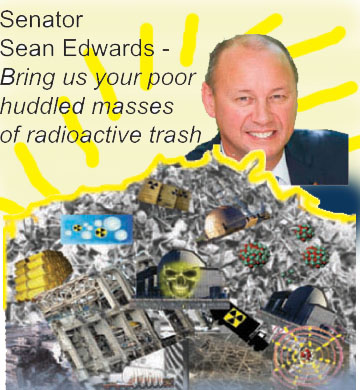
Report: The impossible dream: Free electricity sounds too good to be true. It is.
“The plan relies on technology that has never been deployed commercially – not with all the expertise in France or Germany or Japan or the United States.
“Indeed, logically, if a viable solution emerges, other countries will no longer pay Australia billions to hand over the waste.
“The plan fails to consider a basic economic principle: if Australia can generate free electricity – why wouldn’t other countries?
“Nothing in the plan explains what our great-great grandchildren are meant to do with this legacy. Indeed, the plan never mentions the leftover waste, as if it was not worth worrying about. Worse, all the money is spent in the first 50-60 years. Nothing is left to deal with the leftover waste.
“In many ways it is like a vastly complex loan. Australia will ‘borrow’ many billions of dollars, spend the lot, and leave it to future generations to pay it back. Indeed, a loan would be better, since it would not require South Australia to store tens of thousands of tonnes of radioactive material in the meantime.
“It is no wonder that Senator Edwards has been able to promise free electricity and reduced taxes. He is spending someone else’s money. Eventually, however, the piper must be paid.”
Sean Edwards proposal for nuclear pot of gold – a myth, says South Australia’s Conservation Council
Nuclear Pot of Gold is a Myth Conservation Council of South Australia, 11 Feb 16 The state’s peak environment body has welcomed today’s release of a new report that questions grandiose claims of an economic bonanza arising from the creation of a global nuclear industry in South Australia.
The report The impossible dream. Free electricity sounds too good to be true – it is was prepared by leading economic think-tank The Australia Institute. The Conservation Council of South Australia commissioned The Australia Institute to analyse the submission of Senator Sean Edwards to the SA Nuclear Royal Commission.
Conservation SA Chief Executive Craig Wilkins said the analysis presented a much-needed dose of reality.
“There’s been a lot of grandiose claims made about a nuclear waste-led economic boom for our state, including free power and the scrapping of all state taxes,” Mr Wilkins said.
“The reality is there is no magic pot of gold.
“The Edwards proposal manages to ignore basic economic laws of supply and demand while leaving tens of thousands of tonnes of highly radioactive nuclear waste for future generations to deal with.
“Either way you look at it the Edwards proposal contains high risk and fuzzy logic.
“Either South Australia solves the problem of long-term safe storage of toxic nuclear waste – a problem that no other country has yet been able to fix despite decades of research and failed proposals – in which case other countries will simply follow our lead and we quickly lose our monopoly position that underpins the economic case Senator Edwards is making, or we don’t solve it and are left with a social, economic and environmental nightmare for our state.
“This is not a legacy we should be leaving for our children.”
The Royal Commission is due to release tentative results Monday morning at 11am.
The Australia Institute Report can be found here and attached below. The Edwards submission can be found here. The Conservation SA submission to the Royal Commission can be found here. A critique of the Royal Commission can be found here.
Adani going for solar energy project in Australia
Adani pursuing solar energy project February 10, 2016 Indian mining giant Adani is pursuing a solar power project in Australia after years of delays in building a mega coalmine in central Queensland.
The company has confirmed it is chasing investment opportunities in Australia’s solar generation sector, saying it is focusing on potential opportunities in Queensland and South Australia……. http://www.brisbanetimes.com.au/queensland/adani-pursuing-solar-energy-project-20160210-gmqj19.html#ixzz3ztbMquoa
The Lizard is biting back at Olympic Dam uranium mine
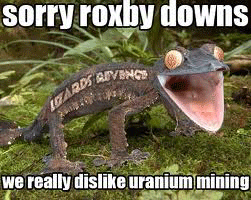 Lizard’ bites back with new message http://www.themonitor.com.au/news-articles/160210-lizard-bites-back-with-new-message– 10-Feb-2016 Patrick Glover Hundreds of protestors are set to descend on Olympic Dam for a three-day festival in July.
The Desert Liberation Front previously visited the area in 2012 with its Lizard’s Revenge event.
This year’s gathering, which will run from July 1-3, is being called The Lizard Bites Back.
“The first time, we were very focused on the expansion with the announcement having only been made a few months prior to our visit,” said event co-organiser Nectaria Calan.
“The mine is still there, and it’s four years later now, so we thought it was time to go back to the source.
“The mine is always an issue. It was not just when the expansion was going ahead – it is one of the largest uranium mines in the world, so for us it is already having an impact.
“Now there is the Royal Commission (into nuclear energy) on”
Ms Calan said the event was still in the early planning stages and no activities had been planned yet.
However, she said the group was hoping to hold educational workshops and other activities as part of the ‘protestival’.
The group is also aiming to reach out to more locals this time around. It is inviting anyone interested to visit the campsite during the event.
Ms Calan said she was hoping for a similar attendance to the previous festival’s crowd of hundreds.
Senior Sergeant Terry Boylan said South Australia Police (SAPOL) was well under way with planning for this year’s protest, as extra officers may need to be called in.
A BHP Billiton spokesperson told The Monitor the company wished to make no comment regarding the protestors’ visit at this point in time.
Environmental Defenders Office (SA) outlines critical issues in proposal for nuclear waste facility
 Possibility of a high level nuclear waste facility in SA Environmental Defenders Office (SA) Inc. The environment’s legal team since 1992 – protecting the public interest – evening the odds 10 Feb 16
As our nuclear industry, insofar as it exists is principally focused on mining and not on the generation of electricity there would have to be a large amount of new legislation that would have to be enacted in order to establish a high level nuclear waste facility in SA. There are issues regarding environmental impacts, workplace safety, the imposition on aboriginal land, the impact on future generations, the potential for technological changes and security concerns.
Some of the major issues.
Continue reading
South Australia – decision on nuclear expansion at end of 2016
 SA govt to hold off on nuclear call http://www.9news.com.au/national/2016/02/09/16/44/sa-govt-to-hold-off-on-nuclear-call South Australia’s government won’t decide whether to expand its nuclear industry until the end of the year, despite a royal commission preparing to release tentative findings.
Former governor Kevin Scarce will on Monday reveal his initial response to whether SA should play a bigger role in the mining, enrichment, energy and storage aspects of the nuclear fuel cycle before releasing his final report on May 6.
Premier Jay Weatherill told parliament on Tuesday that the government will consult with the community and the Commonwealth and provide its response before the end of the sitting year in December.
South Australian Premier Jay Weatherill’s Statement to Parliament on Nuclear Fuel Cycle Royal Commission
 Premier Jay Weatherill tabled a Statement (9/02/16) outlining the progress and next steps for the South Australian Nuclear Fuel Chain (sorry, they call it “Cycle”) Royal Commission.
Following the release on February 15, of its “tentative findings“, the Commission will hold a five week “comment period”, during which public meetings will be held in:
Adelaide, Port Pirie, Port Augusta, Whyalla, Port Lincoln, Mt Gambier, Ceduna, Renmark, and Aboriginal communities in the Far North and West Coast.
On 6 May, the Commission will present its final report.
Next – community discussion between May and August.
“Once we have the findings, I would anticipate some engagement with the Commonwealth Government about the final report”
Then “a period of decision making where Government will need to assess the evidence gathered by the Commission, and the feedback from the community before outlining its full response to the Royal Commission
I expect to provide a full response to the Royal Commission to the Parliament before the end of sitting this year.”
South Australia Riverland farmers get new crop – harvesting the sun
 Solar venture in SA Riverland aims to make abandoned crop land productive again, ABC News, 10 Feb 16 By Isabel Dayman Solar energy might be a saviour for some South Australian Riverland fruit growers who abandoned their crops and land during severe drought late last decade.
Key points:
- Solar test site has 800 panels on the roof of an old storage depot
- Proponent Mark Yates says all profits would stay in the local community
- Many fruit blocks were abandoned at the end of last decade due to severe drought
A test site with 800 solar panels on the roof of an old storage depot at Renmark has been set up by Yates Electrical Services director Mark Yates to show what might be possible.
“We wanted to use this as a test case to see what the viability of the small-scale generation plants could be and whether they could be implemented in a community,” he said.
“We’d like to get 12 months of full data — that way we can draw a really clear picture and be really transparent to show people what the costs are and what the returns are.”
Mr Yates said the owners of vacant fruit blocks might be able to generate a profit from the abandoned land, which he said would be preferable to letting big investors set up large-scale solar operations and take any profits elsewhere.
“With our small-scale solar farms, 100 per cent of the profits that the system generates can be retained by the local community,” he said.
“Traditional methods of generating income are always going to [be there], but I suppose this is just a way we can introduce a completely new market to the area.”…….. The Renmark solar test site is expected to start generating power from the region’s abundant sunshine by the end of this month, and it is planned to be sold into the electricity grid. http://www.abc.net.au/news/2016-02-08/solar-plan-a-ray-of-hope-for-riverland’s-former-fruit-growers/7149150
Port Augusta Council to consider DP Energy’s big solar/wind project
 DP Energy seeks approval for big solar/wind project near Port Augusta as public urged to have say ABC News2 Feb 16 Port Augusta’s council is encouraging the public to share their views on a renewable energy park proposed to the south of the city, along the Augusta Highway.
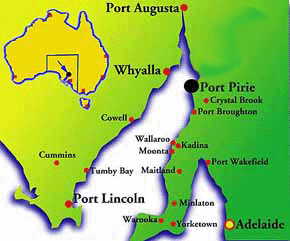 DP Energy has submitted an application to the state Development Assessment Committee for the project, which contains up to 59 wind turbines and 1.6 million solar panels, to be built in stages south of Port Augusta.
Port Augusta Mayor Sam Johnson said the project fits in well in the region, which aims to be a centre for renewable energy.
“It’s been demonstrated in Port Augusta through Sundrop Farms using the technology which they’re using, in this case yes we know that wind turbines do exist around the world and around the countryside and in South Australia as well as solar PV [photovoltaic], but this one is the first of its kind in linking the two together,” he said.
The proposal is now out for public consultation and councillor Johnson is encouraging people to have a say……..http://www.abc.net.au/news/2016-02-02/dp-energy-seeks-nod-for-solar-wind-project-near-port-augusta/7133076
AUSTRALIAN NUCLEAR ASSOCIATION wants nuclear reactors on Spencer Gulf
THE AUSTRALIAN NUCLEAR ASSOCIATION (ANA) put in a submission to #NuclearCommissionSAust devoted only to promoting NUCLEAR ELECTRICITY GENERATION. Of course, they made no attempt to consider renewable energy generation, let alone compare the costs. Heaven forfend, as that would have blown their argument right out of the water!
Anyway, they selected recommending Upper Spencer Gulf Area as the site for South Australia to get nuclear reactors:
“The sites are · Site 1 – Fleurieu Peninsula · Site 2 – Upper Spencer Gulf Crag Point · Site 3 – Kadina site, Spencer’s Gulf east coast”
ANA went to great lengths comparing the different types of nuclear reactors – large, small and medium reactor types.
They were hesitant about Generation IV (new nukes) stating that emerging technologies would be available too late to be effective against global warming.
As for Small Modular Nuclear Reactors, ANA sees hurdles, and is not enthusiastic:
“their deployment is highly dependent on: 1. An order book which matches factory scale manufacture to ensure their economic competitiveness 2. A new regulatory regime which enables operations and security personnel to be deployed in reduced numbers to match the scale of power output”
So, ANA wants to put existing types of nuclear reactors on Spencer Gulf coast:
“the Westinghouse AP1000, the Russian VVER1000 and the Enhanced Candu 6”
Their conclusion?
“nuclear power is a realistic option to connect the grid in SA provided the interconnector to Victoria is upgraded.” (Nary a word about how there’s have to be a nuclear waste dump site set up first. )
South Australian community in Kimba alarmed: nuclear waste site “at Minister’s discretion”
Community shortlisted for nuclear waste site says consultation is driving community apart ABC Radio PM 1 Feb 16 “……..NATALIE WHITING: Three of the six sites shortlisted for Australia’s nuclear waste dump are in the federal seat of Grey in South Australia.
Two of those are in the small farming community of Kimba. Local farmer Peter Woolford says consultation about the proposal is taking its toll.
PETER WOOLFORD: The stress that’s there is quite evident, and the community is fractured…….
PETER WOOLFORD: They meet with groups, they meet with individuals, so to me it’s a pretty divisive thing doing it separately, and in small groups, but you know, that’s what they have to do. They say they’re trying to get word to everybody, and I guess that’s the consultation process.
NATALIE WHITING: The Federal Government has said the shortlist will be whittled down further in March. But across the border in New South Wales, a shortlisted community has already been told they won’t be getting the dump.
The Federal Member for Calare, John Cobb, assured a packed community meeting in Hill End on the weekend that it wouldn’t be the site. He said he had already spoken with the Minister, and it would be ruled out because of community opposition. That’s frustrated some people in Kimba……..
NATALIE WHITING: The Commonwealth process has been running alongside South Australia’s Royal Commission into the Nuclear Cycle.
The country’s chief scientist Alan Finkel told Radio National he looks forward to advising the Commonwealth when it responds to the findings.
ALAN FINKEL: The primary focus I anticipate from the report will be on storage: is there an opportunity for Australia, in particular South Australia, to have a role in a global nuclear fuel cycle by taking the role of long term storage.
NATALIE WHITING: That goes well beyond the waste plans currently being discussed by the Government……..http://www.abc.net.au/pm/content/2015/s4398054.htm
Peter Burn, Australian Industry Group’s Submission to #NuclearCommissionSAust – is weakly pro nuclear
This is one of those pro nuclear Submissions that carefully hedges its bets, while coming out as weakly pro nuclear.
It comments on – “future world demand for nuclear fuels. We recognise that this is highly uncertain”
It even warns on the effect on Australia’s uranium industry, if nuclear reprocessing were to be adopted: “would alter the dynamics of the world market for nuclear fuels and potentially reduce the prospects for expanded uranium mining”
Peter Burn’s Submission comes up with that interesting bit of ?logic that I keep meeting. Acknowledging that currently there is a poor market for nuclear electricity, then his argument goes that we’d better get cracking on setting up a nuclear industry in case there’s a big demand later!
“these facts and uncertainties mean that any investment commitments are likely to be many years away – and that now is a good time to start preparing our energy options, including a potential nuclear generation sector.”
Like all the pro nuclear proponents, this AIG Submission calls for “review of the legal context of these developments” – i.e change Australia’s Environmental Laws.
This is not a very enthusiastically pro nuclear Submission. It lists 7 recommendations, all of which come straight from Australia’s pro nuclear front group “Think Climate Consulting”, headed by Barry Brook.
The two major ones are a “cost benefit” study of South Australia importing nuclear waste, and of setting up nuclear recycling. Left to Barry Brook’s nuclear lobby group, we can guess what the outcome of that study would be.
Charles Waite’s Submission to #NuclearCommissionSAust wants tax-payer to buy Small Modular Nuclear Reactors
Energy.Proj.AU presents: C. M. Waite’s CONSOLIDATED PAPER A Submission to SA’s Nuclear Fuel Cycle Royal Commission C. M. Waite, M Sc, B Sc Ed .
Charles Waite’s Submission to the South Australian Nuclear Fuel Chain Royal Commission is a hymn of praise to new nuclear technology.
“South Australia has before it a great opportunity to PIVOT into Nuclear Energy”
“SA Government announced its $20 Billion plan to PIVOT the State to a Nuclear Energy economy”
“Molten Salt Reactors have been proven safe, viable & reliable”
And also a hymn to to those new nuclear companies, – Bill Gates’ Terra Power, Terrestrial Energy, Transatomic Power etc
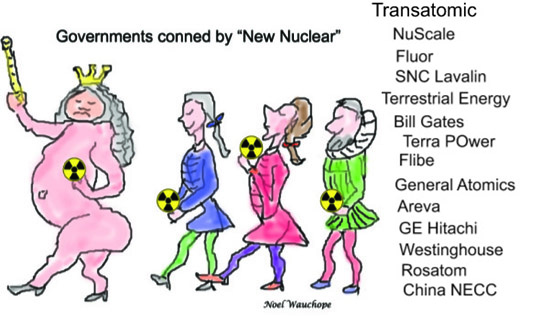
Interestingly, he does not recommend GE-Hitachi’s IFR PRISM reactor as too expensive.
Waite wants the South Australian government, i.e: the taxpayer to buy “new nukes”
“It seems to me “best” for SA to own+run some WAMSR’s, so that it has at least some customers for its processed Fuel Rods.”
“SA should consider owning some MSRs, ie, rather than being dependent on the whims of a private generator; since SA Govt’s announcement of a plan to PIVOT the State to a Nuclear Energy economy”
Waite’s chosen location for these new, untested Molten salt Nuclear Reactors? – near South Australia’s desalination plant ?(Port Stanvac)
1 This month


Help Aunty Sue Protect Her Land and Sacred Sites From Destructive Rocket Testing.
.

Australians deserve the truth
about
AUKUS – https://aukuspublicinquiry.com/

PETITION – To: Prime Minister Anthony Albanese and the Australian Labor Government

of the week – Australians for War Powers Reform (AWPR)
To see nuclear-related stories in greater depth and intensity

