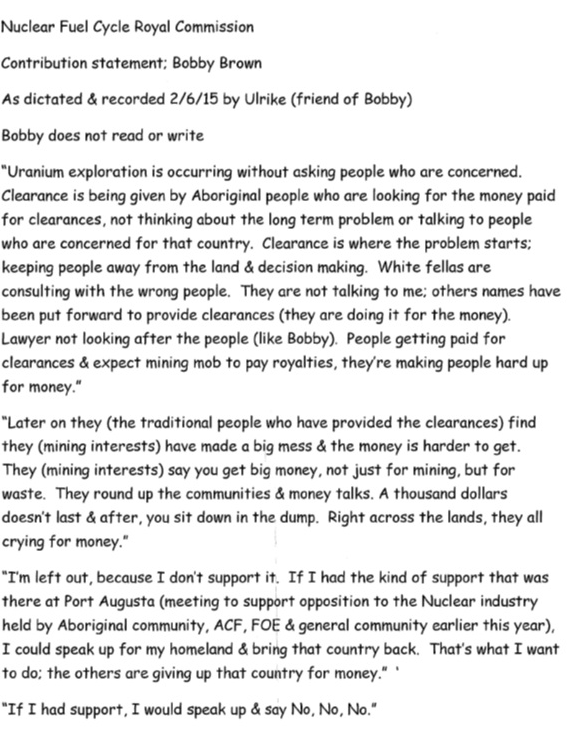
How much is the #NuclearCommissionSAust farce costing the taxpayer?
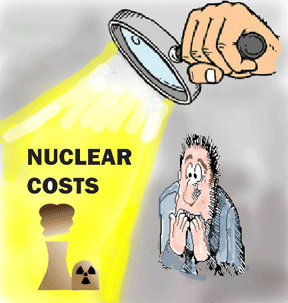 How much has the South Australian tax-payer already spent on the Nuclear Fuel Chain Royal Commission? The public should be informed – how much are they paying Kevin Scarce and his overwhelmingly pro nuclear merry men for all their ‘hearings’ and ‘information sessions’ and junkets to rural Australa, and to Japan, France, Canada, South Korea etc?
Blind Freddy could tell that the purpose is now, and always has been , to set up an international nuclear waste importing business – aimed at enriching a very few South Australians – and bugger the costs to the State’s children their children their chilred and beyond.
A whole heap of blah has gone on about nuclear power stations – which, everybody knows, is not an option, due to their astronomic expense. Then Kevin Scarce presumably will look good when he rules that one out, and just goes for the waste dump.
Anyway, it’s about time we all knew how much this whole sorry farce is costing.
ABC News reported thuis week that an extra $3 million will be pumped into the Nuclear Fuel Chain Royal Commission
Film “Containment” timely, as #NuclearCommissionSAust blocks environmental and Aboriginal voices

It would certainly be beyond their comprehension that any community, any government, would actually volunteer to take other countries’ nuclear waste, which remains radioactive for thousands of years. Yet in Australia, this is what nuclear proponents, the SA premier, and now the prime minister are backing.
South Australia’s Royal Commission has refused Australian environmental movement experts ACF and Friends of the Earth permission to appear. On 8 December Rose Lester, a second-generation Yankunyjatjara nuclear survivor, found her own plea blocked by Commissioner Scarce.
Fears and fictions in SA’s nuclear waste tussle, Eureka Street, Michele Madigan | 10 December 2015 The long anticipated arrival of reprocessed nuclear fuel rods in the first week of December has thrown the spotlight again on Australia’s nuclear industry. Greenpeace’s highlighting of the deficiencies of transport gives little hope that government plans will fit with the usual assurances of ‘world’s best practice’ in this, the world’s most dangerous industry…….
At a screening last month of his film Containment, Harvard Professor Robb Moss agreed with me regarding the ‘providence’ of its timely showing to Australian audiences. Five years in the making, Containment shows, among other sequences, how the US is attempting to tackle the massive problem of dealing with their own high level radioactive waste.
It includes interviews with government officials and regulator personnel amid their attempts to contain the radioactivity for the expected 10,000 years — a time frame that will embrace ‘people who will not share our language, our nation and even our civilisation’. It’s unsurprising that the oft repeated phrase from those from the nuclear industry was that ‘the hardest thing is to get the community onside’. Continue reading
#NuclearCommissionSA moves on to phase about overturning Australia’s federal law on waste dumping
 Scarce to meet pro-nuke chief scientist as conclusions emerge. IN
  Daily, Tom Richardson 10 Dec 15 “…….Nuclear royal commissioner Kevin Scarce has indicated that some of his inquiry’s terms of reference may not be viable, as the commission prepares to wrap up its major phase of evidence-gathering.
Scarce will next week meet Australia’s new chief scientist Dr Alan Finkel, a nuclear power advocate.
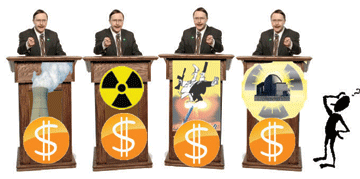
“He’s got considerable experience in the industry, (so) we’re going across to talk with him about nuclear issues from a national perspective,” Scarce said.
“I think it’s important that we’re starting to see a national debate of the issue … because there’s federal legislation that needs to be changed as well as state legislation, were we to proceed.”
South Australia Nuclear Fuel Chain Royal Commission quietly spinning to rural SA
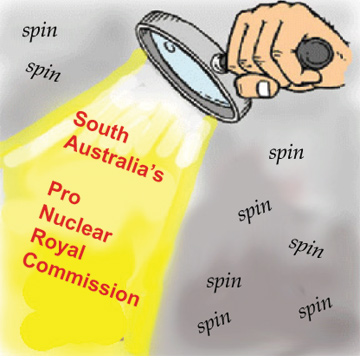 It’s hard to keep up with developments in the South Australian Nuclear Fuel Chain Royal Commission.
On the one hand, as Kevin Scarce has recently revealed, the first move for the nuclear lobby is to get rid of Australia’s national legislation against setting up a nuclear waste dump. (There is special legislation allowing only the Lucas Height reprocessed nuclear wastes to be deposited)
On the other hand, the Royal Commission is keeping a very low profile, nationally.
Do they think that rural South Australia is stupid? Quietly quietly, the Royal Commission is doing its propaganda bit in rural centres – at Port Pirie Yacht club (3/12), at Port Lincoln and Whyalla this week.
Former Santos CEO warns on the diseconomics of nuclear operations in Australia
 x-Santos CEO says megaprojects tough in Aust and nuclear needs upfront revenue December 10, 2015, SMH, Simon Evans An Australian nuclear industry would have to overcome very high construction costs and would only be built if there is certainty beforehand that it can generate secure revenue over a long period, former Santos chief executive David Knox said.
Mr Knox said that assuming the construction costs of overseas megaprojects can be directly translated to be similar in Australia is fraught with danger. That’s because the logistics, large distances, higher labour costs and finding the right skilled workers makes it more challenging.
“This can be a trap, of course,” Mr Knox told South Australia’s royal commission into the nuclear industry on Thursday.
“The whole logistics exercise of doing a megaproject in Australia does make it more challenging.”
He said the large geographic distances from specialist manufacturers of equipment offshore, the need to import certain levels of specialist expertise and skills, and the higher costs of labour are influencing factors. He gave the example of an Australian worker costing an overall $100 an hour, compared with $50 an hour for a Gulf of Mexico project in the northern hemisphere.
He emphasised that Santos had no wish to enter the nuclear industry, but he was giving evidence on the broad issue of building large infrastructure projects and the potential pitfalls……
A nuclear project would need to demonstrate at the start that it could generate revenue for a long time, similar to the LNG contracts that Santos had signed, which lasted for 20 years……..
The head of the nuclear royal commission, Kevin Scarce, is due to hand down preliminary findings in February, ahead of a final report in May 2016, on whether South Australia should expand into nuclear waste storage, enrichment and power generation……. http://www.smh.com.au/business/exsantos-ceo-says-megaprojects-tough-in-aust-and-nuclear-needs-upfront-revenue-20151209-gljwl0.html#ixzz3twyrGFxv
South Australia headed for 100% renewable energy, and away from nuclear
It is also supporting its capital city, Adelaide, in its push to become the first large carbon neutral city in the world – a target it hopes to achieve within a decade. Both the state government and the city council have pushed new incentives to encourage battery storage in homes and businesses. Weatherill has also called for tenders to ensure that his government’s own electricity demand is met entirely by renewable energy.
South Australia is also hosting a royal commission into the nuclear fuel cycle, but since the release of a new report late last month predicting that nuclear technology will cost more than twice as much as wind and solar in the next decades, the chance of nuclear power being built in South Australia, or even Australia, appears negligible.
 South Australia to set path towards 100% renewable energy, REneweconomy By Giles Parkinson on 8 December 2015 South Australia is expected to pass its 50 per cent renewable energy target next year – nearly a decade ahead of schedule – and the Labor government will now aim to get the state as close to 100 per cent renewable energy as possible.
Premier Jay Weatherill said in Paris on Monday that the state was leading the world in the incorporation of variable renewable energy sources such as wind and solar, and hoped the knowledge gained would create a massive economic opportunity for a state struggling with the decline of long-term industries such as car manufacturing.
“We are running a big international experiment right now,” Weatherill said at the launch in Paris of the Compact of States and Regions, an initiative that will see 44 states and regions reduce their emissions by 12.4 tonnes by 2030.
“We have got a long, skinny transmission system and we will soon have 50 per cent renewable energy, including a lot of wind and some solar.
“We need technology breakthroughs for large-scale storage, such as pumped hydro or batteries, but these are massive technological challenges that are exciting opportunities for the state.”
South Australia does find itself at the cutting edge of the transition from a fossil-fuel based economy to an energy system dominated by technologies such as wind, solar and storage. Its last coal fired power generator is due to close in March next year.
The 50 per cent renewable energy target was formally announced last year, but was always going to be met well ahead of time – the addition of the Snowton 2 wind farm, the construction of the Hornsdale wind farm, and the growth in rooftop solar PV will take the state over that threshold in 2016.
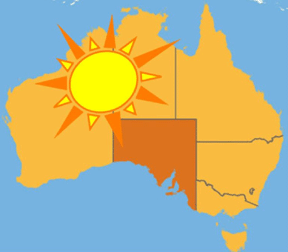
Indeed, the Australian Energy Market Operator has forecast that all of the state’s daytime demand may on occasions be met by rooftop solar alone within the next decade. Continue reading
Nuclear Royal Commission blocks lessons learned from Maralinga
 The carefully engineered terms of reference for the Royal Commission into the Nuclear Fuel Cycle in South Australia are being used to block a thorough investigation of the ongoing effects of radiation from the fallout of the Maralinga bomb test on Indigenous communities across South Australia. This is the latest example of Kevin Scarce and the Royal Commission ignoring and disrespecting Aboriginal people. He can expect fierce resistance from Aboriginal people in the firing line from plans to dump high-level nuclear waste in South Australia and other plans to expand the state’s role in the nuclear industry.
Ms Rosemary Lester, a second generation survivor of the Maralinga atomic tests, met with Commissioner Scarce today, and asked him whether he would be making comment on the effects of radiation on Indigenous communities from the Maralinga bomb tests. The Commissioner said, ‘I’ll be reporting only on the effects on the entire community from the nuclear fuel cycle’. He stated that the history and effects of the Maralinga tests were outside the scope of the Commission’s terms of reference saying; ‘Issues of Maralinga are not linked to the terms of reference that I have’.
However, it is argued by Ms Lester, that a closer examination of the terms of reference require that the Commission enquires into the risks and opportunities associated with processing, management, storage and disposal of waste and that it includes an inquiry into the full impact of these on the South Australian community (incorporating regional, remote and Aboriginal communities) including potential impacts on health and safety. Moreover, the terms of reference clearly state that “consideration should be given, as appropriate, to their future impact…” Ms Lester argues that the Inquiry must investigate and consider Maralinga as a major incident of radiation exposure in South Australia that affected all Australians, especially remote Indigenous communities living across the Maralinga Tjarutja region, and that irreversible contamination continues to degrade the environment.
Leaving aside semantic interpretations of the terms of reference, there is unfinished business from Maralinga. It is a disgrace that Commissioner Scarce refuses to investigate these issues and it is a disgrace that the SA Government wants to increase radiological risks – risks that impact disproportionately on Aboriginal communities – when the health and environmental issues from Maralinga remain unresolved.
When pressed about the effects on Indigenous communities of the Ranger Uranium Mine in Northern Territory as a result of leaks and mismanagement of the waste storage, his response was that “The situation in Ranger is very different to other sites in South Australia”. Ms Lester says, “Irrespective of where these catastrophic incidents occurred, it is critically important that the universal lessons from such incidents are recognised and should form a central focus of the Commission’s work. It is clear that the dangers inherent in uranium and its use are well within this Commission’s terms of reference. It seems curious that the Commissioner has gone to great lengths to travel and inquire into nuclear sites across the world, including Fukushima and Scandinavia, and yet will not acknowledge the critical relevance of the Ranger experience.”
Rose Lester continues:
“The very narrow and selective interpretations of the Commission’s terms of reference are at best disingenuous and at worst another example of nuclear racism. This interpretation ignores the critical issues of the mismanagement and inability to safely dispose of radioactive waste. By adopting a legalistic approach to the terms of reference the Commissioner ignores the spirit that underpins the Inquiry. It is critical, and within the Commission’s scope, to focus on the risks associated with the management, storage and disposal of nuclear waste.”
#NuclearCommissionSAust: expert recommends medical nuclear waste to be stored at LOCAL level, not centralised dump
 Nuclear waste best stored locally, SA royal commission to be told by medical researcher, ABC News 3 Dec 15 By Nicola Gage Local disposal of nuclear waste in South Australia would be the best option for medical facilities and research, a radiation oncology researcher says.
Key points:
- Radiation researcher says medical waste should be stored locally
- Sending SA nuclear waste to Lucas Heights NSW is expensive, she says
- SA researchers could make use of some waste stored locally at a central facility
Professor Eva Bezak from the University of South Australia will give her evidence today to the state’s royal commission into the nuclear fuel cycle…..
Professor Bezak said South Australia’s nuclear waste currently was stored at the state’s hospitals and universities. She said it was expensive to send waste to New South Wales for storage at a facility at Lucas Heights.
“If we want to get rid of the waste in South Australia at the moment, we basically have to pay other companies for services to remove the waste and store it elsewhere,” she said…….
Professor Bezak said she hoped there would be a measured community response to the royal commission’s findings, with its final report due next May. “We should be applying science, common sense, we should be looking at the needs of the society,” she said.”We should be looking at what is the best way to safely produce the isotopes and to safely store any radioactive waste.”
The royal commission’s public access sessions will continue until the middle of this month and some early findings are expected to be released in February.
A fourth round of regional community meetings is currently being held by the royal commission, at Renmark, Berri and Port Pirie. http://www.abc.net.au/news/2015-12-03/nuclear-medical-waste-best-stored-locally-sa-researcher-says/6996626
Uranium enrichment a severe nuclear weapons proliferation risk
Uranium enrichment akin to “bomb starter kits”: IN Daily 3 Dec 15 A former federal Foreign Minister has warned South Australia’s nuclear royal commission against pursuing domestic enrichment, saying the technology was akin to “bomb starter kits”. Gareth Evans, who was Labor’s Foreign Minister in the 1980s and ‘90s and later Deputy Leader of the party, told a public hearing of the commission today there was “no good reason at all for Australia to go down the enrichment path”, arguing instead that to “actively foreswear that path … would be a positive contribution”.
He said there were “very obvious proliferation risks associated with allowing any state to develop its own enrichment capability, because of the obvious reality that the technology required is … exactly the same technology that’s involved in enriching up to weapons grade”.
“Once you get into that game, you are in the business of having bomb starter kits,” he said, observing that “a world that’s anxious to avoid proliferation … ought to be anxious to avoid further spread of bomb starter kits”.
He also questioned the commercial viability of enrichment without a significant number of domestic reactors.http://indaily.com.au/news/local/2015/12/02/uranium-enrichment-akin-to-bomb-starter-kits-gareth-evans/
Royal Commission hears that nuclear is a poor solution to Climate Change
 SA NUCLEAR FUEL CYCLE ROYAL COMMISSION PROFESSOR HENRY SOKOLSKI, The Nonproliferation Policy Education Centre TRANSCRIPT OF PROCEEDINGS ADELAIDE, 25 NOVEMBER 2015 DAY 27
excerpt:
COMMISSIONER: We had it put to us that nuclear power generation might be the saviour in terms of climate change. Would you add that to your economic analysis of light-water reactors in terms of accepting their development?
PROFESSOR SOKOLSKI: I think I would not, and I’ll tell you why. This is a topic which has been debated very extensively here in the States and as a result, the folks promoting nuclear power and the folks who are against nuclear power have gotten focused on very, very detailed analytical models. The best, or I should say the one used the most, is put out by an auditing firm called McKenzie. This model has been used by Greenpeace analysts and the largest 25 merchant utility utilising nuclear power, Epsilon, and they both use this model and they both agree that it’s a good model, and this model tells you that you should do about ten other things first if you’re serious about reducing carbon before you buy a new power reactor. That strikes me as very, very interesting and as positive.
More recently, I think you can read an article that was put out by Chris Buckley in the New York Times, and he makes the case that others do, that China must go with nuclear to reduce its carbon footprint. But he repeats the claim by the government of China that at most by 2030 if every one of the 35 reactors they built was built on time, which will be a remarkable achievement, they will only have 10 per cent of their electricity generation supplied by nuclear. The rest will likely be fossil fuels. I think this tells you how far you can go with nuclear. First, not very and second, there are quicker ways to reduce carbon that are cheaper.
Mostly it has to do with management of consumption which is a fancy word or phrase for turning the lights off more regularly and the second thing is doing natural gas substitutions for coal. Those are your quickest, cheapest ways to most dramatically reduce carbon and that is the project probably of the next 45 three decades. That is where you will make your advances. Also grid……to me http://nuclearrc.sa.gov.au/app/uploads/mp/files/videos/files/151125-topic-16-day-3-transcript.v1.pdf
#NuclearCommissionSAust on HIGH LEVEL WASTE STORAGE AND DISPOSAL
HIGH LEVEL WASTE STORAGE AND DISPOSAL
SA NUCLEAR FUEL CYCLE ROYAL COMMISSION SPEAKERS: DR MARK NUTT Argonne National Laborator WEDNESDAY, 25 NOVEMBER 2015 DAY 27 – excerpts from transcript
“……COMMISSIONER: can you tell us where the current US plans are for a high-level waste facility?
DR NUTT: As of right now, I would say they’re a little bit uncertain……So right now it’s really doing groundwork activity, open storage and disposal, to essentially be ready for when a decision is made to proceed with national policy towards disposal and storage. [ed: USA doesn’t know what to do with the wastes]
….DR NUTT: In terms of low-level waste generation it is probably – it is the biggest contributor. We have 100 – roughly 100 operating reactors that – the maintenance of the reactors, the clean up of the cooling systems all generate low-level waste that has to be disposed of. There are smaller contributions 45 from medical, industrial applications of radioactive materials that then become .SA Nuclear 25.11.15 P-1460 Spark and Cannon low-level waste. So by far in terms of volume it’s the nuclear industry that dominates the low-level waste disposal….. [ed: mdical wastes are not the problem, as ANSTO pretends]
…….it’s this inter-generational equity that people of today are gathering the benefits from nuclear electricity or nuclear energy and should deal with the problems of today and not pass the problems down…..[nuclear industry pretend to care about future generations, but no thought of stopping producing radioactive trash]
…there is a general consensus that it’s indeed temporary, that the ultimate 35 solution should be disposition of it in a geologic repository. There may be – there is countries that are considering fuel cycles where you might reprocess and recycle materials back to the reactor but either way you are going to generate high-level waste that would need to be disposed of. [ed: so new reactors that supposedly ‘eat wastes’ still produce wastes]
….We’ve gone towards interim dry storage at the reactor sites because all of the spent fuel pools for the US fleet are essentially full….[ waste pools full BUT THEY STILL KEEP MAKING THE STUFF!]
COMMISSIONER: Can I just pick up on the dry storage Dr Nutt? What sort of studies have been conducted in the US to look at the longevity of these dry storage casks and is there a view about – conservative view about how long they will last? S
R NUTT: I don’t – no one has done a study to put a – what I’ll call a line in the sand for how long they can last. Our regulatory framework allows storage up to 60 years, dry storage. We have studies underway within the Department of Energy’s programme, the Electric Power Research Institute which is our utilities research arm. It’s also investigating various aspects associated with 15 extended storage. The Electric Power Research Institute runs a group called the Extend Storage Collaboration Project which is involved in – a number of countries are involved with it that are dealing with the same issues that we are. So there is a lot of work going on looking at extended storage and what it entails. There has been several gap analyses done to identify what the key 20 issues are and the R&D’s under way to try to resolve those, so that there is confidence in extended storage. (there seems no reason for this confidence: sound like blind faith]
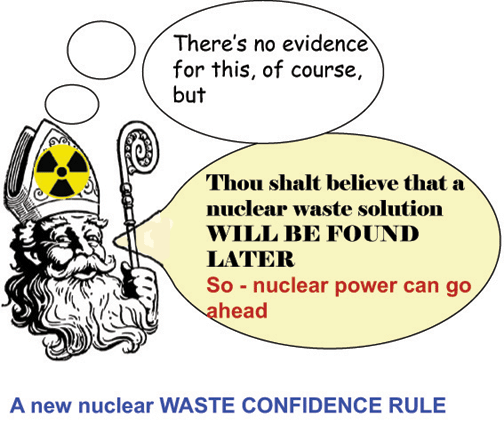
… When you get in to disposals, where I believe things get a little bit different because you are 20 dealing with long timeframes, you’re dealing with geologic systems, you are a large – sometimes large areas or footprints for the disposal facility and it leads to a little different type of safety case that one needs to consider to help build confidence in the safety of – the long term safety of the facility……[means they’ve got to convince the public somehow?]
DR NUTT: I’ll say it’s not possible to validate the long-term disposal models in the traditional sense. In that you can’t do an experiment and then run the 30 model and validate the experiment for the repository itself. You can do a variety of techniques to again demonstrate your confidence in the models and their ability to reasonably predict or estimate exposures out in the future…[ that doesn’t make ME feel confident]
Low Carbon Economy Expert Panel report – boost renewables, No to nuclear
Low Carbon Economy Expert Panel report recommends South Australia move quickly to 100 per cent green energy production, Sheradyn Holderhead Political Reporter The Advertiser November 25, 2015 SOUTH Australia should produce 100 per cent green energy “relatively quickly” using a mix of solar, wind and other sources but not a nuclear power station, a report recommends.
On releasing the Low Carbon Economy Expert Panel report today, Premier Jay Weatherill said the State Government would adopt a target of zero net carbon emissions by 2050.
But Mr Weatherill is yet to map out exactly how the state will reach that target, as the Government is still to respond to more detailed recommendations in the report.
They include:
SET a goal of 100 per cent renewable electricity within, a timeframe to be decided, that could be done relatively quickly, capitalising on the abundance of solar, wind, oceanic, geothermal and bioenergy resources.
EXPAND the state’s renewable energy generation to the point where a significant amount is exported interstate.
DEVELOP and manufacture cost-effective energy storage technology, which is critical for a stable renewable electricity supply and could also become a new industry for the state.
SIGN the Under 2 memorandum of understanding, making SA a part of the growing group of sub-national governments making a commitment to contribute to limiting global warming to 2°C.
CONSIDER implementing a state-based emissions trading scheme linked to California’s ETS, which could be politically and economically attractive to California and provide significant benefits for SA.
INTEGRATE curriculum in schools, universities and TAFE colleges about carbon pollution, green energy and related technologies.
The report also noted that nuclear power stations generally need to be of a certain size to be cost effective and should not be considered for use in smaller states such as SA.
Former Federal Liberal leader John Hewson headed the panel, which also included Anna Skarbek of ClimateWorks and Australian National University’s Frank Jotzo……http://www.adelaidenow.com.au/news/south-australia/low-carbon-economy-expert-panel-report-recommends-south-australia-move-quickly-to-100-per-cent-green-energy-production/story-fni6uo1m-1227622467473
South Australian govt has already ruled out nuclear power
 from “Adelaide Arclight”, 25 Nov 15 , There is barely a mention of nuclear power in the 53 page Panel’s final report from the South Australia Low Carbon Economy Experts Panel. You have to hunt to find:
on page 22:
“In the high-level analysis for South Australia undertaken for the Panel, the CCS and nuclear scenarios were not considered, and all data was derived from the 100% renewable scenario.”
“Given South Australia’s abundance of wind and high solar rating (DNI), South Australia has the capacity to move to 100% renewable energy more quickly than other States and has already made significant progress in decarbonising its electricity supply utilising these advantages.”
On page 24 it states:
“The modelling for the Panel did not include consideration of whether the nuclear and carbon capture and storage scenarios modelled at the national level are a cost-effective means to move to low carbon electricity for South Australia. The Deep Decarbonisation Pathways modelling found that nuclear power stations generally need to be of a certain size to be cost effective and thus precluded their consideration for use in smaller States such as South Australia.”
Can we take it from this that the nuclear scenario is already off the table entirely? The Premier’s and Minister Hunter’s joint press release is vague talking about “zero net emissions” and “low carbon economy”, but in context their endorsement of the report would seem to undercut any push for nuclear energy, leaving the Nuclear Fuel Cycle Royal Commission with just an expansion of uranium mining and nuclear waste dumps to consider.
Given that the Nuclear Fuel Cycle Royal Commission is in progress and that one of the report’s authors gave evidence at a public hearing, it can hardly be an oversight that nuclear was not considered.
Renewable energy is the star – throughout the report:
“…….South Australia can greatly expand its renewable energy generation, to the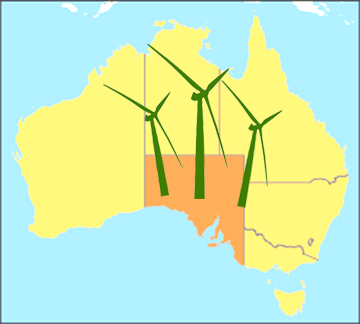 point where on balance over the year all of the State’s electricity comes from renewables and a significant amount is exported interstate. According to the Panel’s preliminary analysis, this could occur relatively quickly. South Australia can therefore set an indicative goal of 100% renewable electricity with the timeframe to be decided. The timeframe will depend on expansion of interconnectors, costs of renewables and extent of support for renewable energy federally. The share of renewables in South Australia is expected to be double that in the National Electricity Market at any point in time up to 100%. Action….”
SOUTH AUSTRALIA’S LOW CARBON ECONOMY EXPERTS PANEL Findings and recommendations
2015 http://www.environment.sa.gov.au/Science/Science_research/climate-change/climate-change-initiatives-in-south-australia/sa-low-carbon-economy-experts-panel November 2015 With an economy in transition, changes in the national and international policy environment, and key strengths in renewable energy, South Australia has the opportunity to transition to a low carbon economy.
To maximise this opportunity, the South Australian Government appointed a panel of experts to provide independent advice about climate change targets and objectives for the State to 2050. The Panel was also asked to recommend key strategies to meet these objectives and ensure that the SA economy is best placed to adjust to a carbon constrained future. The Panel members were Dr John Hewson, Anna Skarbek and Frank Jotzo.
The Panel’s final report was released on 25 November 2015. The Panel found that it is feasible for South Australia to achieve a target of net zero emissions by 2050 and that a commitment to this target will position South Australia well in a low carbon world.
1 This month
Chernobyl: The Lost Tapes – A good documentary on Chernobyl on SBS available On Demand for the next 3 weeks– https://www.sbs.com.au/ondemand/tv-program/chernobyl-the-lost-tapes/2352741955560
15 April – Zoom –Nuclear Power is Not the Solution
Apr 15, 2026 01:00 AM in Canberra, Melbourne, Sydney

Join the International Physicians for the Prevention of Nuclear War (IPPNW) on Tuesday, April 14th for a timely webinar exploring the risks associated with nuclear power and challenging the myth that it offers a simple, safe, carbon-free solution to the climate crisis

21 April Webinar: No Nuclear Weapons in Australia
Start: 2026-04-21 18:00:00 UTC Canberra, Melbourne, Sydney (GMT+10:00)
End: 2026-04-21 19:30:00 UTC Canberra, Melbourne, Sydney (GMT+10:00)
Event Type: Virtual
A virtual link will be communicated before the event.
Host Contact Info: australia@icanw.org

of the week – Australians for War Powers Reform (AWPR)
To see nuclear-related stories in greater depth and intensity
 Antinuclear