Nuclear Royal Commission blocks lessons learned from Maralinga
 The carefully engineered terms of reference for the Royal
  Commission into the Nuclear Fuel Cycle in South Australia are being used to block a thorough investigation of the ongoing effects of radiation from the fallout of the Maralinga bomb test on Indigenous communities across South Australia. This is the latest example of Kevin Scarce and the Royal Commission ignoring and disrespecting Aboriginal people. He can expect fierce resistance from Aboriginal people in the firing line from plans to dump high-level nuclear waste in South Australia and other plans to expand the state’s role in the nuclear industry.
Ms Rosemary Lester, a second generation survivor of the Maralinga atomic tests, met with Commissioner Scarce today, and asked him whether he would be making comment on the effects of radiation on Indigenous communities from the Maralinga bomb tests. The Commissioner said, ‘I’ll be reporting only on the effects on the entire community from the nuclear fuel cycle’. He stated that the history and effects of the Maralinga tests were outside the scope of the Commission’s terms of reference saying; ‘Issues of Maralinga are not linked to the terms of reference that I have’.
However, it is argued by Ms Lester, that a closer examination of the terms of reference require that the Commission enquires into the risks and opportunities associated with processing, management, storage and disposal of waste and that it includes an inquiry into the full impact of these on the South Australian community (incorporating regional, remote and Aboriginal communities) including potential impacts on health and safety. Moreover, the terms of reference clearly state that “consideration should be given, as appropriate, to their future impact…” Ms Lester argues that the Inquiry must investigate and consider Maralinga as a major incident of radiation exposure in South Australia that affected all Australians, especially remote Indigenous communities living across the Maralinga Tjarutja region, and that irreversible contamination continues to degrade the environment.
Leaving aside semantic interpretations of the terms of reference, there is unfinished business from Maralinga. It is a disgrace that Commissioner Scarce refuses to investigate these issues and it is a disgrace that the SA Government wants to increase radiological risks – risks that impact disproportionately on Aboriginal communities – when the health and environmental issues from Maralinga remain unresolved.
When pressed about the effects on Indigenous communities of the Ranger Uranium Mine in Northern Territory as a result of leaks and mismanagement of the waste storage, his response was that “The situation in Ranger is very different to other sites in South Australia”. Ms Lester says, “Irrespective of where these catastrophic incidents occurred, it is critically important that the universal lessons from such incidents are recognised and should form a central focus of the Commission’s work. It is clear that the dangers inherent in uranium and its use are well within this Commission’s terms of reference. It seems curious that the Commissioner has gone to great lengths to travel and inquire into nuclear sites across the world, including Fukushima and Scandinavia, and yet will not acknowledge the critical relevance of the Ranger experience.”
Rose Lester continues:
“The very narrow and selective interpretations of the Commission’s terms of reference are at best disingenuous and at worst another example of nuclear racism. This interpretation ignores the critical issues of the mismanagement and inability to safely dispose of radioactive waste. By adopting a legalistic approach to the terms of reference the Commissioner ignores the spirit that underpins the Inquiry. It is critical, and within the Commission’s scope, to focus on the risks associated with the management, storage and disposal of nuclear waste.”
#NuclearCommissionSAust: expert recommends medical nuclear waste to be stored at LOCAL level, not centralised dump
 Nuclear waste best stored locally, SA royal commission to be told by medical researcher, ABC News 3 Dec 15 By Nicola Gage Local disposal of nuclear waste in South Australia would be the best option for medical facilities and research, a radiation oncology researcher says.
Key points:
- Radiation researcher says medical waste should be stored locally
- Sending SA nuclear waste to Lucas Heights NSW is expensive, she says
- SA researchers could make use of some waste stored locally at a central facility
Professor Eva Bezak from the University of South Australia will give her evidence today to the state’s royal commission into the nuclear fuel cycle…..
Professor Bezak said South Australia’s nuclear waste currently was stored at the state’s hospitals and universities. She said it was expensive to send waste to New South Wales for storage at a facility at Lucas Heights.
“If we want to get rid of the waste in South Australia at the moment, we basically have to pay other companies for services to remove the waste and store it elsewhere,” she said…….
Professor Bezak said she hoped there would be a measured community response to the royal commission’s findings, with its final report due next May. “We should be applying science, common sense, we should be looking at the needs of the society,” she said.”We should be looking at what is the best way to safely produce the isotopes and to safely store any radioactive waste.”
The royal commission’s public access sessions will continue until the middle of this month and some early findings are expected to be released in February.
A fourth round of regional community meetings is currently being held by the royal commission, at Renmark, Berri and Port Pirie. http://www.abc.net.au/news/2015-12-03/nuclear-medical-waste-best-stored-locally-sa-researcher-says/6996626
Uranium enrichment a severe nuclear weapons proliferation risk
Uranium enrichment akin to “bomb starter kits”: IN Daily 3 Dec 15 A former federal Foreign Minister has warned South Australia’s nuclear royal commission against pursuing domestic enrichment, saying the technology was akin to “bomb starter kits”. Gareth Evans, who was Labor’s Foreign Minister in the 1980s and ‘90s and later Deputy Leader of the party, told a public hearing of the commission today there was “no good reason at all for Australia to go down the enrichment path”, arguing instead that to “actively foreswear that path … would be a positive contribution”.
He said there were “very obvious proliferation risks associated with allowing any state to develop its own enrichment capability, because of the obvious reality that the technology required is … exactly the same technology that’s involved in enriching up to weapons grade”.
“Once you get into that game, you are in the business of having bomb starter kits,” he said, observing that “a world that’s anxious to avoid proliferation … ought to be anxious to avoid further spread of bomb starter kits”.
He also questioned the commercial viability of enrichment without a significant number of domestic reactors.http://indaily.com.au/news/local/2015/12/02/uranium-enrichment-akin-to-bomb-starter-kits-gareth-evans/
Royal Commission hears that nuclear is a poor solution to Climate Change
 SA NUCLEAR FUEL CYCLE ROYAL COMMISSION PROFESSOR HENRY SOKOLSKI, The Nonproliferation Policy Education Centre TRANSCRIPT OF PROCEEDINGS ADELAIDE, 25 NOVEMBER 2015 DAY 27
excerpt:
COMMISSIONER: We had it put to us that nuclear power generation might be the saviour in terms of climate change. Would you add that to your economic analysis of light-water reactors in terms of accepting their development?
PROFESSOR SOKOLSKI: I think I would not, and I’ll tell you why. This is a topic which has been debated very extensively here in the States and as a result, the folks promoting nuclear power and the folks who are against nuclear power have gotten focused on very, very detailed analytical models. The best, or I should say the one used the most, is put out by an auditing firm called McKenzie. This model has been used by Greenpeace analysts and the largest 25 merchant utility utilising nuclear power, Epsilon, and they both use this model and they both agree that it’s a good model, and this model tells you that you should do about ten other things first if you’re serious about reducing carbon before you buy a new power reactor. That strikes me as very, very interesting and as positive.
More recently, I think you can read an article that was put out by Chris Buckley in the New York Times, and he makes the case that others do, that China must go with nuclear to reduce its carbon footprint. But he repeats the claim by the government of China that at most by 2030 if every one of the 35 reactors they built was built on time, which will be a remarkable achievement, they will only have 10 per cent of their electricity generation supplied by nuclear. The rest will likely be fossil fuels. I think this tells you how far you can go with nuclear. First, not very and second, there are quicker ways to reduce carbon that are cheaper.
Mostly it has to do with management of consumption which is a fancy word or phrase for turning the lights off more regularly and the second thing is doing natural gas substitutions for coal. Those are your quickest, cheapest ways to most dramatically reduce carbon and that is the project probably of the next 45 three decades. That is where you will make your advances. Also grid……to me http://nuclearrc.sa.gov.au/app/uploads/mp/files/videos/files/151125-topic-16-day-3-transcript.v1.pdf
#NuclearCommissionSAust on HIGH LEVEL WASTE STORAGE AND DISPOSAL
HIGH LEVEL WASTE STORAGE AND DISPOSAL
SA NUCLEAR FUEL CYCLE ROYAL COMMISSION SPEAKERS: DR MARK NUTT Argonne National Laborator WEDNESDAY, 25 NOVEMBER 2015 DAY 27 – excerpts from transcript
“……COMMISSIONER: can you tell us where the current US plans are for a high-level waste facility?
DR NUTT: As of right now, I would say they’re a little bit uncertain……So right now it’s really doing groundwork activity, open storage and disposal, to essentially be ready for when a decision is made to proceed with national policy towards disposal and storage. [ed: USA doesn’t know what to do with the wastes]
….DR NUTT: In terms of low-level waste generation it is probably – it is the biggest contributor. We have 100 – roughly 100 operating reactors that – the maintenance of the reactors, the clean up of the cooling systems all generate low-level waste that has to be disposed of. There are smaller contributions 45 from medical, industrial applications of radioactive materials that then become .SA Nuclear 25.11.15 P-1460 Spark and Cannon low-level waste. So by far in terms of volume it’s the nuclear industry that dominates the low-level waste disposal….. [ed: mdical wastes are not the problem, as ANSTO pretends]
…….it’s this inter-generational equity that people of today are gathering the benefits from nuclear electricity or nuclear energy and should deal with the problems of today and not pass the problems down…..[nuclear industry pretend to care about future generations, but no thought of stopping producing radioactive trash]
…there is a general consensus that it’s indeed temporary, that the ultimate 35 solution should be disposition of it in a geologic repository. There may be – there is countries that are considering fuel cycles where you might reprocess and recycle materials back to the reactor but either way you are going to generate high-level waste that would need to be disposed of. [ed: so new reactors that supposedly ‘eat wastes’ still produce wastes]
….We’ve gone towards interim dry storage at the reactor sites because all of the spent fuel pools for the US fleet are essentially full….[ waste pools full BUT THEY STILL KEEP MAKING THE STUFF!]
COMMISSIONER: Can I just pick up on the dry storage Dr Nutt? What sort of studies have been conducted in the US to look at the longevity of these dry storage casks and is there a view about – conservative view about how long they will last? S
R NUTT: I don’t – no one has done a study to put a – what I’ll call a line in the sand for how long they can last. Our regulatory framework allows storage up to 60 years, dry storage. We have studies underway within the Department of Energy’s programme, the Electric Power Research Institute which is our utilities research arm. It’s also investigating various aspects associated with 15 extended storage. The Electric Power Research Institute runs a group called the Extend Storage Collaboration Project which is involved in – a number of countries are involved with it that are dealing with the same issues that we are. So there is a lot of work going on looking at extended storage and what it entails. There has been several gap analyses done to identify what the key 20 issues are and the R&D’s under way to try to resolve those, so that there is confidence in extended storage. (there seems no reason for this confidence: sound like blind faith]
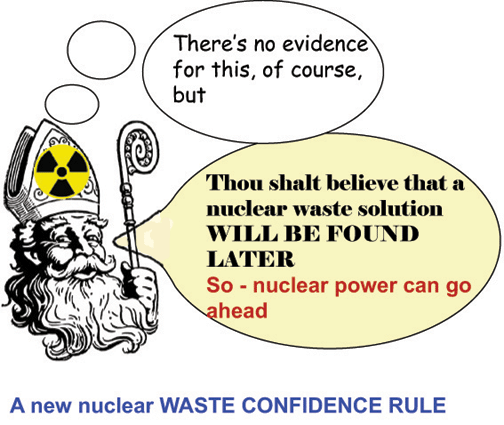
… When you get in to disposals, where I believe things get a little bit different because you are 20 dealing with long timeframes, you’re dealing with geologic systems, you are a large – sometimes large areas or footprints for the disposal facility and it leads to a little different type of safety case that one needs to consider to help build confidence in the safety of – the long term safety of the facility……[means they’ve got to convince the public somehow?]
DR NUTT: I’ll say it’s not possible to validate the long-term disposal models in the traditional sense. In that you can’t do an experiment and then run the 30 model and validate the experiment for the repository itself. You can do a variety of techniques to again demonstrate your confidence in the models and their ability to reasonably predict or estimate exposures out in the future…[ that doesn’t make ME feel confident]
Low Carbon Economy Expert Panel report – boost renewables, No to nuclear
 Low Carbon Economy Expert Panel report recommends South Australia move quickly to 100 per cent green energy production, Sheradyn Holderhead Political Reporter The Advertiser November 25, 2015 SOUTH Australia should produce 100 per cent green energy “relatively quickly” using a mix of solar, wind and other sources but not a nuclear power station, a report recommends.
On releasing the Low Carbon Economy Expert Panel report today, Premier Jay Weatherill said the State Government would adopt a target of zero net carbon emissions by 2050.
But Mr Weatherill is yet to map out exactly how the state will reach that target, as the Government is still to respond to more detailed recommendations in the report.
They include:
SET a goal of 100 per cent renewable electricity within, a timeframe to be decided, that could be done relatively quickly, capitalising on the abundance of solar, wind, oceanic, geothermal and bioenergy resources.
EXPAND the state’s renewable energy generation to the point where a significant amount is exported interstate.
DEVELOP and manufacture cost-effective energy storage technology, which is critical for a stable renewable electricity supply and could also become a new industry for the state.
SIGN the Under 2 memorandum of understanding, making SA a part of the growing group of sub-national governments making a commitment to contribute to limiting global warming to 2°C.
CONSIDER implementing a state-based emissions trading scheme linked to California’s ETS, which could be politically and economically attractive to California and provide significant benefits for SA.
INTEGRATE curriculum in schools, universities and TAFE colleges about carbon pollution, green energy and related technologies.
The report also noted that nuclear power stations generally need to be of a certain size to be cost effective and should not be considered for use in smaller states such as SA.
Former Federal Liberal leader John Hewson headed the panel, which also included Anna Skarbek of ClimateWorks and Australian National University’s Frank Jotzo……http://www.adelaidenow.com.au/news/south-australia/low-carbon-economy-expert-panel-report-recommends-south-australia-move-quickly-to-100-per-cent-green-energy-production/story-fni6uo1m-1227622467473
South Australian govt has already ruled out nuclear power
 from “Adelaide Arclight”, 25 Nov 15 , There is barely a mention of nuclear power in the 53 page Panel’s final report from the South Australia Low Carbon Economy Experts Panel. You have to hunt to find:
on page 22:
“In the high-level analysis for South Australia undertaken for the Panel, the CCS and nuclear scenarios were not considered, and all data was derived from the 100% renewable scenario.”
“Given South Australia’s abundance of wind and high solar rating (DNI), South Australia has the capacity to move to 100% renewable energy more quickly than other States and has already made significant progress in decarbonising its electricity supply utilising these advantages.”
On page 24 it states:
“The modelling for the Panel did not include consideration of whether the nuclear and carbon capture and storage scenarios modelled at the national level are a cost-effective means to move to low carbon electricity for South Australia. The Deep Decarbonisation Pathways modelling found that nuclear power stations generally need to be of a certain size to be cost effective and thus precluded their consideration for use in smaller States such as South Australia.”
Can we take it from this that the nuclear scenario is already off the table entirely? The Premier’s and Minister Hunter’s joint press release is vague talking about “zero net emissions” and “low carbon economy”, but in context their endorsement of the report would seem to undercut any push for nuclear energy, leaving the Nuclear Fuel Cycle Royal Commission with just an expansion of uranium mining and nuclear waste dumps to consider.
Given that the Nuclear Fuel Cycle Royal Commission is in progress and that one of the report’s authors gave evidence at a public hearing, it can hardly be an oversight that nuclear was not considered.
Renewable energy is the star – throughout the report:
“…….South Australia can greatly expand its renewable energy generation, to the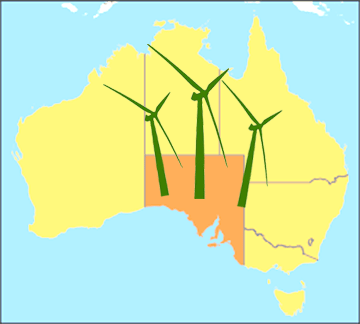 point where on balance over the year all of the State’s electricity comes from renewables and a significant amount is exported interstate. According to the Panel’s preliminary analysis, this could occur relatively quickly. South Australia can therefore set an indicative goal of 100% renewable electricity with the timeframe to be decided. The timeframe will depend on expansion of interconnectors, costs of renewables and extent of support for renewable energy federally. The share of renewables in South Australia is expected to be double that in the National Electricity Market at any point in time up to 100%. Action….”
SOUTH AUSTRALIA’S LOW CARBON ECONOMY EXPERTS PANEL Findings and recommendations
2015 http://www.environment.sa.gov.au/Science/Science_research/climate-change/climate-change-initiatives-in-south-australia/sa-low-carbon-economy-experts-panel November 2015 With an economy in transition, changes in the national and international policy environment, and key strengths in renewable energy, South Australia has the opportunity to transition to a low carbon economy.
To maximise this opportunity, the South Australian Government appointed a panel of experts to provide independent advice about climate change targets and objectives for the State to 2050. The Panel was also asked to recommend key strategies to meet these objectives and ensure that the SA economy is best placed to adjust to a carbon constrained future. The Panel members were Dr John Hewson, Anna Skarbek and Frank Jotzo.
The Panel’s final report was released on 25 November 2015. The Panel found that it is feasible for South Australia to achieve a target of net zero emissions by 2050 and that a commitment to this target will position South Australia well in a low carbon world.
South Australia to aim for zero emissions by 2050
 Premier Jay Weatherill Minister Ian Hunter Minister for Climate Change , 24 November, 2015
South Australia will adopt a target of zero net emissions by 2050, as recommended in a report by the Low Carbon Economy Expert Panel released today. The Panel consisting of John Hewson, Anna Skarbek of ClimateWorks and Frank Jotzo of the Australian National University recommends that South Australia:
SIGNALS the transition to a zero net emissions economy by 2050
SUPPORTS the community and industry to transition to a zero net emissions economy
IMPLEMENTS the transition by taking action now
PremierJay Weatherill said being the first to signal this intention to Australian and overseas investors will give South Australia a competitive advantage. “As we head towards the Paris Climate Change Conference, South Australia has an opportunity to place itself at the forefront as a leader in transitioning to a low carbon economy,” Mr Weatherill said. “The Expert Panel’s report is a roadmap for our State to reduce emissions in a way that supports job growth in new and emerging green technologies. “
One example is the potential for South Australia to be a low carbon electricity powerhouse and a net exporter of renewable energy. “The state’s abundant renewable electricity combined with its rich resource base and existing manufacturing expertise mean that the state could be a natural base for energy intensive mining and manufacturing industries in a low carbon world.”
Minister for Climate Change Ian Hunter said the Expert Panel also identified the state’s strengths in education and the potential for these to be applied to developing the skills and workforce for a carbon constrained future. “This means providing assistance for workers moving from industries in decline into new opportunities is critical as is support for communities affected by rapid change,” Mr Hunter said.
“There are also significant innovative market opportunities for energy storage solutions from the state’s high penetration of solar PV, with the potential to attract and develop technology suppliers and expertise in the state.” Minister Hunter said the Government would not seek to implement a State based emissions trading scheme – favouring a national scheme
“Consensus for global action on climate change should be a trigger for the Federal Government to revisit the important issue of a nationwide ETS,” Mr Hunter said. “We believe this is the most practical approach to this question and will not seek to implement an ETS at the State level.” Further details of South Australia’s efforts to tackle climate change, including responses to the other recommendations, will be detailed in the soon to be released new Climate Change Strategy for the State. The South Australian Low Carbon Experts Panel report is available at www.environment.sa.gov.au
Civil Contractors Federation SA want to save town Leigh Creek by hosting nuclear dump
 Call to store nuclear waste at Leigh Creek http://www.9news.com.au/national/2015/11/24/10/29/call-to-store-nuclear-waste-at-leigh-creek A nuclear waste dump should be built at Leigh Creek in the South Australian outback before it becomes a ghost town, the state’s peak civil construction body says.
The federal government has short-listed six sites – two on the Eyre Peninsula and another in SA’s mid-north – for Australia’s first permanent nuclear waste dump for low-level and intermediate domestic waste.
The Civil Contractors Federation SA says putting a nuclear waste dump near Leigh Creek would be a “no brainer” and guarantee its survival after Alinta Energy last week shut down the town’s coal mine, shedding about 200 workers.
Chief executive Phil Sutherland says the facility could also be used to store and convert other industrial waste into energy and fuel.
The proposal bypasses the commonwealth in favour of the state government, which is holding a Nuclear Fuel Cycle Royal Commission.
“All the SA government needs to do is simply show some mettle and bite the bullet to give Leigh Creek a purpose before the township transitions into a ghost town,” Mr Sutherland said.
Dr Edwin Lyman: Direct nuclear waste disposal is best: pyroreprocessing has dangers
 In the second part of his evidence to South Australia’s Nuclear Royal Commission, Dr Lyman explains that direct disposal is the safest and the most prudent approach for nuclear power. In recycling, as in pyroreprocessing, the risks outweigh the benefits.
Dr Lyman has studied pyroreprocessing in great detail. The fact that its products are highly radioactive does not act to deter thieves, especially those aiming to use these products for weapons proliferation.
Also, “the IEA is still struggling to provide even technical approaches for how you would get weapons grade accountancy in pyroprocessing, and that’s a great concern”……”Many minor actinides that would be in the pyroprocessing product are also weapons useable “… “It’s also easy, if that combination were to be stolen, to separate out plutonium from the minor actinides”.
Lyman describes the pyroreprocessing process as an “unmanageable enterprise”. The United States decided not to pursue re-processing and fast reactors in the 1970s, for these very same risks of terrorism and weapons proliferation.
SA NUCLEAR FUEL CYCLE ROYAL COMMISSION DR EDWIN LYMAN, Union of Concerned Scientists TRANSCRIPT OF PROCEEDINGS ADELAIDE 7.30 AM, TUESDAY, 17 NOVEMBER 2015 DAY 23
The Commission’s first witness today, Dr Edwin Lyman, is a senior scientist in the global security program at the Union of Concerned Scientists in the United States. His areas of interests include nuclear proliferation, terrorism and nuclear power safety and security, and he’s published articles in a number of 5 journals and magazines on these topics. Dr Lyman is a member of the Institute of Nuclear Materials Management and has given evidence before the US Congress and Nuclear Regulatory Commission, the NRC, on multiple occasions. 10 Prior to joining the Union of Concerned Scientists, Dr Lyman was president of the Nuclear Control Institute, the CI, in Washington, an organisation concerned with nuclear proliferation. The Commission calls Dr Edwin Lyman……..
The transcript of Dr Lyman’s interview can be read at http://nuclearrc.sa.gov.au/app/uploads/mp/files/videos/files/151117-topic-14-day-1-transcript-full.v5.pdf
Dr Edwin Lyman at Nuclear Royal Commission, speaks on waste transport problems.
Dr Lyman’s evidence can be pretty heavy going for the non technical reader. First, he explained safety problems in standards for transportation casks for land or sea shipment of spent fuel, high-level radioactive waste and specially with materials like plutonium or plutonium oxide. These standards have not been updated over many decades, and the USA Nuclear Regulatory Commission (NRC) has not yet carried out tests intended to address this problem.
If a transport package of radioactive material is lost in the ocean, it could lead to significant long term contamination, if the package is not retrieved.
With increased transport, and speed of transport, of radioactive wastes, the risk of such accidents is increased, and the NRC would have confidence in the current standard for transporting wastes.
Apart from accidents, the other big danger is terrorism.
SA NUCLEAR FUEL CYCLE ROYAL COMMISSION DR EDWIN LYMAN, Union of Concerned Scientists TRANSCRIPT OF PROCEEDINGS ADELAIDE 7.30 AM, TUESDAY, 17 NOVEMBER 2015 DAY 23
The Commission’s first witness today, Dr Edwin Lyman, is a senior scientist in the global security program at the Union of Concerned Scientists in the United States. His areas of interests include nuclear proliferation, terrorism and nuclear power safety and security, and he’s published articles in a number of 5 journals and magazines on these topics. Dr Lyman is a member of the Institute of Nuclear Materials Management and has given evidence before the US Congress and Nuclear Regulatory Commission, the NRC, on multiple occasions. 10 Prior to joining the Union of Concerned Scientists, Dr Lyman was president of the Nuclear Control Institute, the CI, in Washington, an organisation concerned with nuclear proliferation. The Commission calls Dr Edwin Lyman……..
The transcript of Dr Lyman’s interview can be read at http://nuclearrc.sa.gov.au/app/uploads/mp/files/videos/files/151117-topic-14-day-1-transcript-full.v5.pdf
ANSTO, Geoscience, Dept of Science to visit Kimba, South Australian site on shortlist for nuclear trash dump
 Nuclear delegations to visit Kimba after release of toxic dump short list, ABC News 23 Nov 15 Two separate delegations are to visit Kimba on SA’s Eyre Peninsula, the tiny town shortlisted by the Federal Government to be the site of a nuclear waste dump.
Earlier this month the Government released a shortlist of six sites nominated to store low and intermediate level nuclear waste…….One delegation, including Geoscience Australia, the Australian Nuclear Science and Technology Organisation, and the Department of Science, will visit councillors and landowners who have nominated their properties.
Greens MP Mark Parnell will also tour the community which has been divided by the issue.
He said there was no need for a new dump because waste could be stored at existing sites.
“When it comes to nuclear waste we have a responsibility to manage it properly, and safely,” Mr Parnell said.
“The waste has been stored at Lucas Heights for many years and can be safely continue to be stored there. There’s waste that’s in hospital basements that’s got people worried, but they’re still going to have to operate.”
He said local residents had good reason to be alarmed, especially in light of an accident last year at a New Mexico waste facility.
“The operators put organic kitty litter into the drums of nuclear waste rather than inorganic kitty litter. As a result, the chemical reaction burst the drum open and radiation spread throughout the facility,” he said.
“There were 22 workers who were contaminated, and the facility is likely to be closed for four years.” http://www.abc.net.au/news/2015-11-23/nuclear-delegations-to-visit-kimba-after-dump-shortlisting/6962598
3 South Australian sites picked for nuclear trash toilet, but locals resist
The indigenous group Adnyamathanha Camp Law Mob says while the property is governed by a perpetual lease, meaning no native title claim can be lodged over the area, Aboriginal heritage legislation does apply.
“We demand that the Federal Resources Minister Josh Frydenberg publicly declare who he has consulted regarding these nominations, and who has the authority to nominate these sites,” spokeswoman Jillian Marsh said in a statement.
Cortlinye and Pinkawillinie KIMBA is known as “the Gateway to the Gawler Ranges”. But some residents fear the township would become known as “the Gateway to the National Nuclear Waste Facility” should it be selected as the future site to store radioactive waste. Local farmers Toni Scott, Sue Woolford, Helen Harris and their families have vowed to fight any move to build the facility in their district.
“They’re saying this is a voluntary process but how is this voluntary?,” Mrs Scott said.
“We’re not volunteering, we don’t want any money and we don’t want to live next to it.’’
The group vowed to be vocal during the Federal Government’s consultation in Kimba next week
Nuclear waste repository in SA: What do the locals think? The Advertiser, 22 Nov 2015 BRYAN LITTLELY, PAUL STARICK and MEAGAN DILLON PICKING a site for a nuclear dump is as contentious a decision as you will find. Whichever of the six Australia-wide candidates that is chosen to be the nation’s nuclear repository will acquire a degree of notoriety.
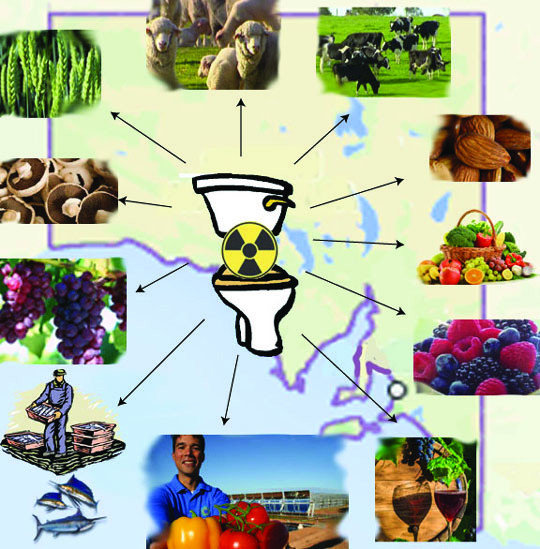
South Australia is home to three potential dump locations. Continue reading
Nuclear lobby hosts 5 Kimba officials in tour of Lucas Heights nuclear recator
Kimba officials take nuclear fact-finding mission to Lucas Heights after toxic dump short listing, ABC Radio 20 Nov 15 The World Today By Tom Fedorowytsch Officials from Kimba, the tiny town home to two possible sites for a radioactive waste dump in South Australia, have visited Australia’s only nuclear reactor in Sydney.
Mayor Dean Johnson was among the small group of five people to be shown the reactor and waste facility at Lucas Heights, southwest of Sydney’s centre.
“We feel the tour has provided us now with a much more thorough overview and an understanding of what a repository would look like, and probably some of the keys to properly and safely handling and storing that waste,” the mayor said.
Two of the Federal Government’s six proposed sites — Pinkiwilinie and Cortlinye — fall within the Kimba council region. Other sites making up the Government’s shortlist include Barndioota in South Australia, Hale in the Northern Territory, Sallys Flat in New South Wales and Oman Ama in Queensland.
A $10 million sweetener for infrastructure and community development will be given to the local area that accepts the waste.
……..’Everyone has right to say no’: farmer While Cr Johnson and the council weigh up whether to support a nuclear waste dump, some residents of Kimba — especially farmers — are deeply opposed to the idea.
As a farmer, the perception and stigma attached to a nuclear waste dump, could have ramifications on this clean and green reputation we have in agriculture.
Farmer Peter Woolford
“To be quite frank I think it’s totally irresponsible to be putting one of these in a food producing area,” Peter Woolford, a farmer who works land next door to one of the sites, said. “We obviously have the safety issue, but you know, we have things like land values,” he said.
“Who’s going to buy a property alongside a nuclear waste dump? I think we have to be real about that.”
Mr Woolford said he would not consider taking a tour of Lucas Heights.
“Well I don’t think I need to, at the end of the day surely everyone has the right to say no, and that’s what we’re doing. This has been forced upon us,” he said. “As a farmer, the perception and stigma attached to a nuclear waste dump, could have ramifications on this clean and green reputation we have in agriculture.”
Formal consultation will ramp up in Kimba in the next few weeks, and a decision to proceed will be made next year.http://www.abc.net.au/news/2015-11-20/kimba-officials-take-nuclear-fact-finding-mission/6958734
1 This month


Help Aunty Sue Protect Her Land and Sacred Sites From Destructive Rocket Testing.
.

Australians deserve the truth
about
AUKUS – https://aukuspublicinquiry.com/

PETITION – To: Prime Minister Anthony Albanese and the Australian Labor Government

of the week – Australians for War Powers Reform (AWPR)
To see nuclear-related stories in greater depth and intensity

