South Australian launch for Aboriginal owned solar energy storage system
The products are being launched at Tandanya Aboriginal Cultural centre in Adelaide on Wednesday 2 September. Ms Oberon said Adelaide was chosen for the launch because of the council’s Sustainable City Incentive Scheme, which provides up to $5000 towards the cost in installing solar PV storage across the residential, business, education and community sectors. Funding for the program also has financial support from the South Australian government.
“We felt it was important to acknowledge the South Australian government and the City of Adelaide for such a forward-looking and innovative scheme,” Ms Oberon said.
The company is also hoping other state governments and councils will be encouraged to take up the idea of supporting the uptake of renewable energy storage.
The company’s core mission is based on the fundamental Aboriginal approach of stewardship of the earth and its resources. This means needing to shift out of high-emissions fossil-fuel derived energy.
Aboriginal-owned energy company one-upping Tesla By Willow Aliento, The Fifth Estate Friday 8 January 2016 The renewable energy storage game is about to be disrupted, with Australian Aboriginal-owned company AllGrid Energy announcing the launch of WattGrid, a new 10kWh solar energy storage system it says is around 30 per cent cheaper than the Tesla Powerwall.
Customers also don’t have to wait until 2016. Spokeswoman for AllGrid, Deborah Oberon, said the company expected to be making its first deliveries in the next two to three months.

The $11,999 WattGrid unit comprises an aluminium cabinet containing tubular lead acid gel batteries, and a hybrid 5kW solar inverter with battery management system that has load share capability with the grid and uninterrupted power supply capability.
The unit is also accompanied by a software app, WattsHappening, that allows users to view real-time information and interface with the system.
Beta testing has shown the unit can help solar owners maintain an energy supply profile that can be matched to the demand profile, potentially rendering drawing grid power unnecessary.
The Queensland-based company is also releasing another product it has developed, the PortaGrid. This is an independent unit comprising solar panels, storage, UPS, inverter and outlets that is suitable for remote and off-grid locations, as well as emergency situations.
The units can be supplied with an inbuilt weather station that will automatically close up the panels in the event of a severe weather hazard such as a cyclone. Continue reading
South Australian towns could become nuclear terrorism targets
 Nuclear a terrorist risk, Whyalla News Dec. 28, 2015, Local towns such as Whyalla could be made terror targets if South Australia does become part of the nuclear fuel cycle.
This risk was outlined as part of a Nuclear Royal Commission public session held at the Whyalla public library in front of a small group of locals earlier this month.
Regional engagement officer Jon Bok said that an increased threat of terrorism was one of the several risks the commission were taking into account.
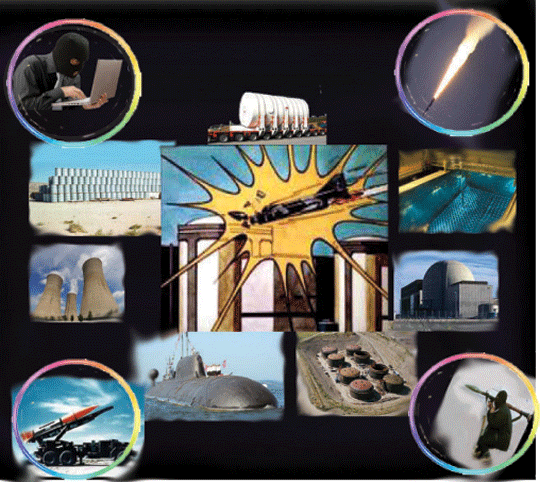
“At the moment we are looking into several issues, with terrorism being one of them,” Mr Bok said.
Mr Bok declined to comment on what counter-measures could be taken to prevent a terrorist attack…… http://www.whyallanewsonline.com.au/story/3617682/nuclear-a-terrorist-risk/
Record low price for wind energy achieved in ACT deal with South Australia
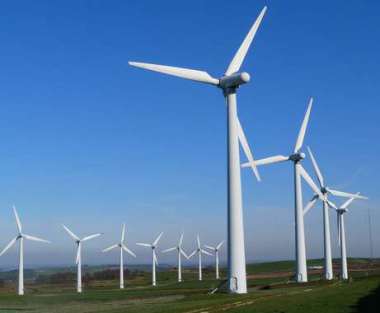 Record price for renewable energy achieved in new wind farm deal, ACT Government says http://www.abc.net.au/news/2015-12-21/record-price-for-renewale-energy-achieved-in-new-wind-farm-deal/7045414
A record low in pricing for renewable energy has been set as part of a deal to buy power from a South Australian wind farm, the ACT Environment Minister says.
The French-developed Hornsdale wind farm has been selected to supply power to the ACT, at a cost of $77 per megawatt hour.
Located just north of Jamestown in South Australia, the wind farm will eventually power 56,000 Canberra houses, providing 13 per cent of the ACT’s projected electricity demand by 2020. Continue reading
Australian media ignored the indigenous achievements in opposing a nuclear South Australia
Dennis Matthews 24 Dec 15 In response to Dave Sweeney’s “good nuclear news” – on the leadership of indigenous Australians in opposing the nuclear industry and nuclear waste dumping in South Australia
 It’s correct, in December Karina and Rose Lester shared the Conservation Council of SA (Conservation SA) 2015, $1000, Jill Hudson Award for environmental protection for their opposition to the nuclear industry, but, apart from a small column in The Advertiser which didn’t mention the nuclear industry I’ve seen no mention of this important event.
I looked for a media release on the Conservation SA website but couldn’t find anything.
Perhaps someone could put the media release on this website?
PS. The first winners of the Jill Hudson award were Adnyamathanha activist Dr Jillian Marsh and ABC journalist Rose Crane. I understand that Jillian is involved in fighting attempts to put the proposed national nuclear waste dump on Adnyamathanha land.
South Australia power networks cannot impose tariff on solar homes
Federal Court rejects SA Power Networks’ proposed charge on solar-powered households http://www.abc.net.au/news/2015-12-23/federal-court-rejects-solar-household-charge/7050600 The Federal Court has dismissed an appeal by SA Power Networks to charge a tariff on homes with solar panels.
The electricity distributor wanted it to approve a tariff of about $100 a year.
It argued that solar-powered houses have different energy consumption patterns and are effectively subsidised by houses without panels.
SA Power Networks took the matter to court when the Australian Energy Regulator rejected the proposed charge.
The distributor said that it was “disappointed by the appeal decision” and maintained that its application was about “fair and equitable cost-sharing among customers”.
“This was not about additional revenue,” SA Power networks said in a statement.
Bill Fisher spells it out on nuclear waste – Submission to #NuclearCommissionSAust
 Bill Fisher Nuclear Fuel Cycle Royal Commission – Submission – All Issues
Introduction I frequently make submissions to parliamentary enquiries on matters nuclear: most recently the Enquiry into Nuclear Non-proliferation and Disarmament and the Enquiry into expansion of the Roxby mine. My submission is usually among the large majority (about 90%) opposed to uranium mining and export. The usual 90% majority is usually ignored! The 10% who are listened to are uranium industry representatives, governments and government departments, and a few scientists who are on the payroll of the uranium industry or the government. While this is a significant problem in the case of federal governments, it is far worse in South Australia, where the Roxby Downs Indenture Act is designed to override virtually all other legislation, and government departments which are supposed to monitor mining and export also act as promoters and protectors of the industry…..
Biased South Australia Nuclear Royal Commission
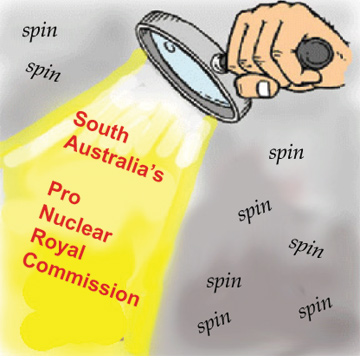 Royal Commission vs Community Permission: Environment groups assess performance of SA nuclear Royal Commission
National and state environment groups have today released an assessment of the state Royal Commission into the nuclear industry in SA. The report – commissioned by Conservation SA, the Australian Conservation Foundation and Friends of the Earth Australia – looks at the Commission’s progress since its surprise unveiling by Premier Jay Weatherill ten months ago.
The report raises serious concerns about the Royal Commission, from the unrepresentative and unbalanced composition of the Expert Advisory Committee, conflicts of interest, the Royal Commission’s unwillingness to correct factual errors, to a repeated pattern of pro-nuclear claims being uncritically accepted and promoted.
“The nuclear industry embodies unique, complex and long lasting safety, security, environmental and public health challenges,” said Conservation SA Chief Executive Craig Wilkins. “The sector lacks a secure social license and it is imperative that any consideration of an expansion of the industry is predicated on the highest standards of evidence, rigour, transparency and inclusion. Sadly this report shows these standards are not being reflected in the current Royal Commission.”
The Royal Commission has been criticised by civil society groups including environmental, public health and Aboriginal organisations for its restricted processes and limited information flows.
“Unlike most Royal Commissions this one was not a response to a pressing public issue, but rather it is a calculated political initiative with a pro-nuclear agenda,” said ACF nuclear campaigner Dave Sweeney. “As a result the Commission looks less like an objective risk-benefit analysis and more an industry feasibility study. Environment groups and others will continue to closely track this deficient process.”
The Royal Commission is set to make an interim report in February 2016 with a final report due no later than 6 May 2016.
“We are concerned about skewed and inaccurate information and assumptions, especially in relation to nuclear growth and reactor longevity and so-called small modular reactors,” said Friends of the Earth Australia’s Dr Jim Green, a co-author of the report. “The Royal Commission praises the United Arab Emirates for the speed of its nuclear power program without making any mention of the elephant in the room: undemocratic countries can build reactors more quickly than democratic countries. Statements by the Royal Commission regarding the impact of the Chernobyl and Fukushima nuclear disasters are incorrect – and the list goes on.”
The groups have called for an expanded Advisory Committee, increased Aboriginal access to information and decision points and dedicated studies into the potential for growth in SA’s renewable energy sector as important steps to bring some much needed balance into the Commission’s deliberations.
The report is posted at: http://www.foe.org.au/rc-critique
Direct download: http://www.foe.org.au/sites/default/files/RC-critique-16Dec2015-final.pdf
__._,_.___
Yandruwandha Yawarrawarrka people granted Native Title
Native title granted by Federal Court for Yandruwandha Yawarrawarrka people, ABC News, 17 Dec 15 By Nicola Gage Descendants of Aboriginal families who helped Burke and Wills on their ill-fated expedition through central Australia have won native title over their outback land.
Hundreds of Yandruwandha Yawarrawarrka people have gathered near Innamincka in South Australia for a bush hearing of the Federal Court.
It determined the group to be the rightful native title holders of 40,000 square kilometres of the outback. The area stretches across seven pastoral leases and includes Coongie Lakes National Park, Innamincka Regional Reserve and Strzelecki Regional Reserve.
Lawyer Michael Pagsanjan said the Yandruwandha Yawarrawarrka people fought for decades for recognition, after filing their original claim in 1998.
“The Yandruwandha Yawarrawarrka people will have the right to hunt, the right to camp, the right to fish and the right to look after special places,” he said.
“Today is a really momentous occasion where they can sit back, take a deep breath, a sigh of relief.
“This day isn’t just important for them, it’s important for their ancestors who have passed away.”……..
Historical past where two cultures met
The remote region includes places of significance to the Burke and Wills expedition, including the old “dig tree” under which food was buried.
The Yandruwandha Yawarrawarrka people helped the explorers, giving them food and shelter, and sharing knowledge about the land.
“For those explorers who were willing to accept their help, they luckily survived,” Mr Pagsanjan said.
“But unfortunately for those explorers who denied or rejected that help, they perished.”
Mr Pagsanjan said the native title determination marked a new chapter in South Australia.
“This is the last of the larger, far northern claims that’s been resolved,” he said.
“Now we’ve got close to about 60 per cent of the state which is capable of being determined.
“We’ve got a goal that soon we’ll hopefully have resolved the vast majority of claims in the state.” http://www.abc.net.au/news/2015-12-16/native-title-claim-acknowledged-at-sa-bush-hearing/7033858
How much is the #NuclearCommissionSAust farce costing the taxpayer?
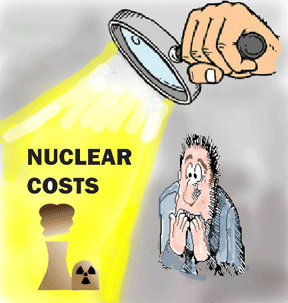 How much has the South Australian tax-payer already spent on the Nuclear Fuel Chain Royal Commission? The public should be informed – how much are they paying Kevin Scarce and his overwhelmingly pro nuclear merry men for all their ‘hearings’ and ‘information sessions’ and junkets to rural Australa, and to Japan, France, Canada, South Korea etc?
Blind Freddy could tell that the purpose is now, and always has been , to set up an international nuclear waste importing business – aimed at enriching a very few South Australians – and bugger the costs to the State’s children their children their chilred and beyond.
A whole heap of blah has gone on about nuclear power stations – which, everybody knows, is not an option, due to their astronomic expense. Then Kevin Scarce presumably will look good when he rules that one out, and just goes for the waste dump.
Anyway, it’s about time we all knew how much this whole sorry farce is costing.
ABC News reported thuis week that an extra $3 million will be pumped into the Nuclear Fuel Chain Royal Commission
Film “Containment” timely, as #NuclearCommissionSAust blocks environmental and Aboriginal voices

It would certainly be beyond their comprehension that any community, any government, would actually volunteer to take other countries’ nuclear waste, which remains radioactive for thousands of years. Yet in Australia, this is what nuclear proponents, the SA premier, and now the prime minister are backing.
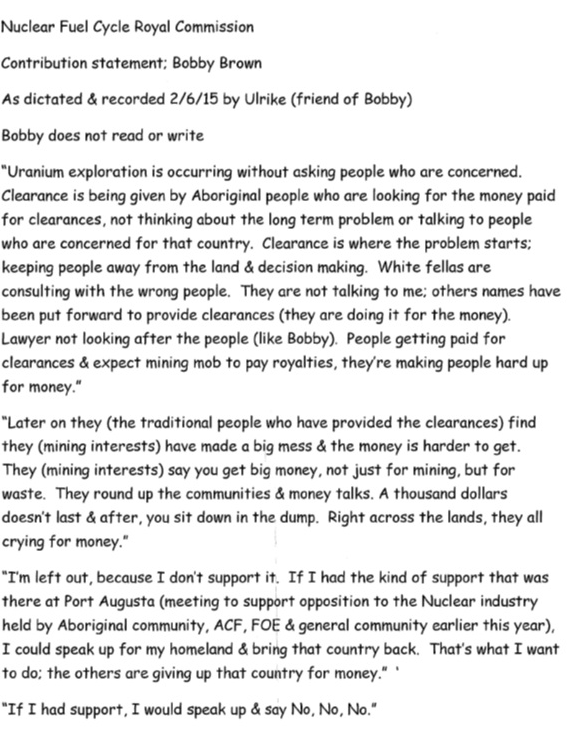
South Australia’s Royal Commission has refused Australian environmental movement experts ACF and Friends of the Earth permission to appear. On 8 December Rose Lester, a second-generation Yankunyjatjara nuclear survivor, found her own plea blocked by Commissioner Scarce.
Fears and fictions in SA’s nuclear waste tussle, Eureka Street, Michele Madigan | 10 December 2015 The long anticipated arrival of reprocessed nuclear fuel rods in the first week of December has thrown the spotlight again on Australia’s nuclear industry. Greenpeace’s highlighting of the deficiencies of transport gives little hope that government plans will fit with the usual assurances of ‘world’s best practice’ in this, the world’s most dangerous industry…….
At a screening last month of his film Containment, Harvard Professor Robb Moss agreed with me regarding the ‘providence’ of its timely showing to Australian audiences. Five years in the making, Containment shows, among other sequences, how the US is attempting to tackle the massive problem of dealing with their own high level radioactive waste.
It includes interviews with government officials and regulator personnel amid their attempts to contain the radioactivity for the expected 10,000 years — a time frame that will embrace ‘people who will not share our language, our nation and even our civilisation’. It’s unsurprising that the oft repeated phrase from those from the nuclear industry was that ‘the hardest thing is to get the community onside’. Continue reading
#NuclearCommissionSA moves on to phase about overturning Australia’s federal law on waste dumping
 Scarce to meet pro-nuke chief scientist as conclusions emerge. IN Daily, Tom Richardson 10 Dec 15 “…….Nuclear royal commissioner Kevin Scarce has indicated that some of his inquiry’s terms of reference may not be viable, as the commission prepares to wrap up its major phase of evidence-gathering.
Scarce will next week meet Australia’s new chief scientist Dr Alan Finkel, a nuclear power advocate.
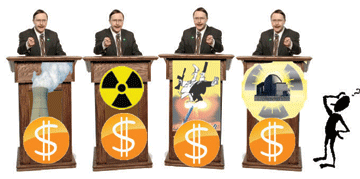
“He’s got considerable experience in the industry, (so) we’re going across to talk with him about nuclear issues from a national perspective,” Scarce said.
“I think it’s important that we’re starting to see a national debate of the issue … because there’s federal legislation that needs to be changed as well as state legislation, were we to proceed.”
South Australia Nuclear Fuel Chain Royal Commission quietly spinning to rural SA
It’s hard to keep up with developments in the South Australian Nuclear Fuel Chain Royal Commission.
On the one hand, as Kevin Scarce has recently revealed, the first move for the nuclear lobby is to get rid of Australia’s national legislation against setting up a nuclear waste dump. (There is special legislation allowing only the Lucas Height reprocessed nuclear wastes to be deposited)
On the other hand, the Royal Commission is keeping a very low profile, nationally.
Do they think that rural South Australia is stupid? Quietly quietly, the Royal Commission is doing its propaganda bit in rural centres – at Port Pirie Yacht club (3/12), at Port Lincoln and Whyalla this week.
Former Santos CEO warns on the diseconomics of nuclear operations in Australia
 x-Santos CEO says megaprojects tough in Aust and nuclear needs upfront revenue December 10, 2015, SMH, Simon Evans An Australian nuclear industry would have to overcome very high construction costs and would only be built if there is certainty beforehand that it can generate secure revenue over a long period, former Santos chief executive David Knox said.
Mr Knox said that assuming the construction costs of overseas megaprojects can be directly translated to be similar in Australia is fraught with danger. That’s because the logistics, large distances, higher labour costs and finding the right skilled workers makes it more challenging.
“This can be a trap, of course,” Mr Knox told South Australia’s royal commission into the nuclear industry on Thursday.
“The whole logistics exercise of doing a megaproject in Australia does make it more challenging.”
He said the large geographic distances from specialist manufacturers of equipment offshore, the need to import certain levels of specialist expertise and skills, and the higher costs of labour are influencing factors. He gave the example of an Australian worker costing an overall $100 an hour, compared with $50 an hour for a Gulf of Mexico project in the northern hemisphere.
He emphasised that Santos had no wish to enter the nuclear industry, but he was giving evidence on the broad issue of building large infrastructure projects and the potential pitfalls……
A nuclear project would need to demonstrate at the start that it could generate revenue for a long time, similar to the LNG contracts that Santos had signed, which lasted for 20 years……..
The head of the nuclear royal commission, Kevin Scarce, is due to hand down preliminary findings in February, ahead of a final report in May 2016, on whether South Australia should expand into nuclear waste storage, enrichment and power generation……. http://www.smh.com.au/business/exsantos-ceo-says-megaprojects-tough-in-aust-and-nuclear-needs-upfront-revenue-20151209-gljwl0.html#ixzz3twyrGFxv
South Australia headed for 100% renewable energy, and away from nuclear
It is also supporting its capital city, Adelaide, in its push to become the first large carbon neutral city in the world – a target it hopes to achieve within a decade. Both the state government and the city council have pushed new incentives to encourage battery storage in homes and businesses. Weatherill has also called for tenders to ensure that his government’s own electricity demand is met entirely by renewable energy.
South Australia is also hosting a royal commission into the nuclear fuel cycle, but since the release of a new report late last month predicting that nuclear technology will cost more than twice as much as wind and solar in the next decades, the chance of nuclear power being built in South Australia, or even Australia, appears negligible.
 South Australia to set path towards 100% renewable energy, REneweconomy By Giles Parkinson on 8 December 2015 South Australia is expected to pass its 50 per cent renewable energy target next year – nearly a decade ahead of schedule – and the Labor government will now aim to get the state as close to 100 per cent renewable energy as possible.
Premier Jay Weatherill said in Paris on Monday that the state was leading the world in the incorporation of variable renewable energy sources such as wind and solar, and hoped the knowledge gained would create a massive economic opportunity for a state struggling with the decline of long-term industries such as car manufacturing.
“We are running a big international experiment right now,” Weatherill said at the launch in Paris of the Compact of States and Regions, an initiative that will see 44 states and regions reduce their emissions by 12.4 tonnes by 2030.
“We have got a long, skinny transmission system and we will soon have 50 per cent renewable energy, including a lot of wind and some solar.
“We need technology breakthroughs for large-scale storage, such as pumped hydro or batteries, but these are massive technological challenges that are exciting opportunities for the state.”
South Australia does find itself at the cutting edge of the transition from a fossil-fuel based economy to an energy system dominated by technologies such as wind, solar and storage. Its last coal fired power generator is due to close in March next year.
The 50 per cent renewable energy target was formally announced last year, but was always going to be met well ahead of time – the addition of the Snowton 2 wind farm, the construction of the Hornsdale wind farm, and the growth in rooftop solar PV will take the state over that threshold in 2016.
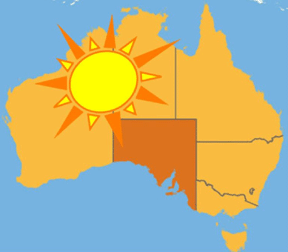
Indeed, the Australian Energy Market Operator has forecast that all of the state’s daytime demand may on occasions be met by rooftop solar alone within the next decade. Continue reading
1 This month


Help Aunty Sue Protect Her Land and Sacred Sites From Destructive Rocket Testing.
.

Australians deserve the truth
about
AUKUS – https://aukuspublicinquiry.com/

PETITION – To: Prime Minister Anthony Albanese and the Australian Labor Government

of the week – Australians for War Powers Reform (AWPR)
To see nuclear-related stories in greater depth and intensity

