Karoonda Council, South Australia, considering floating solar plant
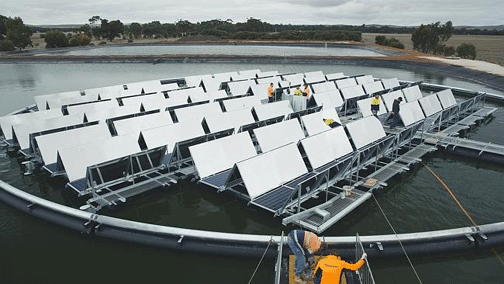 Floating solar power plant mooted for Karoonda to power waste management pump station http://www.abc.net.au/news/2015-10-30/floating-solar-power-plant-mooted-for-karoonda/6899436 The District Council of Karoonda-East Murray says it will look into the possibility of a floating solar power plant at Karoonda in South Australia’s Murray-Mallee region.
Council CEO Peter Smithson said the floating solar plant would provide power for the waste management pump station next to the stormwater dam.
A similar plant is already operating at Jamestown in the state’s mid-north.
Mr Smithson said the council had committed to undertake further due diligence about the green power opportunity.
“We’ve been approached by a company about the possibility of a solar generating power plant at Karoonda which would provide power to our CWMS [Community Wastewater Management System] pumps,” he said.
“We’ve gone and looked at Jamestown.
“There’s quite a long resolution because it really details the fact that there’s no capital outlay by council and it really looks at the fact that we’ve done due diligence and we’ve asked the company to come and address the next council meeting.
NoNukes South Australia comments on the South Australian media
 The News’ media in South Australia are daily and nightly having a nuclear field day in what they say promoting human nuclear as saviour of the planet.
It is easy to see who and what this Mr Jacobi and his mob are about.
The human nuclear mob have been intensively above and behind the scenes of the human nuclear movement since early the past century.
IT IS IMPORTANT TO POINT OUT THAT THE DEBATE REGARDING HUMAN NUCLEAR WAS ALREADY DONE – ALREADY COMPLETED – IN THE 1970’s IN AUSTRALIA
THE VERDICT OBTAINED BY ALL EXPERTS ASSEMBLED AT THE TIME FROM NEAR AND FAR WAS
vvvvvvvvvvvvvvvvvvvvvvvvvvvvvvvvvvvv
NO HUMAN NUCLEAR.IN AUSTRALIA
^^^^^^^^^^^^^^^^^^^^^^^^^^^^^^^^^^^^^^
and especially since there is an extreme pristine clean perpetual abundance of Sunshine and Natural Gas in over and all around Australia that could last almost forever in a conservative frugal austere sustainable society, such as the People Society who has a record of over 50,000 years of natural pre-Invasion habitation.
Regarding the sudden re-appearance of the erroneous need for human Nuclear evaluation and approval:, the same words of wisdom apply as they did for the mass falsetto of the South Australia State Bank Debt crisis (deliberately engineered by human world finance in the 1980’s) and also the pre-emptive dumping of the Libya-like Gough Whitlam government earlier in the 1970’s
“The World is governed by very different personages from what is imagined by those who are not behind the scenes.”
Benjamin Disraeli – British Statesman
NEVER TRUST NEWS
NEVER TRUST HUMAN NUCLEAR
Fed up with the #NuclearCommissionSAust
 Yes, I am fed up with the charade of this Royal Commission – its pro nuclear bias is apparent from the very start – with nuclear enthusiasts strongly represented, starting from Commissioner Kevin Scarce.
Today I looked for the transcript of the hearing with Dr Helen Caldicott on 27 October. Well, it’s hard to find. When you go to the appropriate page on the Commission’s website – not a mention of Dr Caldicott, though she was the first speaker that day.
The one that they do mention is Professor Geraldine Thomas, Imperial College London. Prof Thomas is a very well known pro nuclear speaker. She appeared prominently on the nuclear dragon thing soft sell series on SBS. Thomas has spruiked about radioactive iodine, but conveniently has ignored other radioactive isotopes. (I’ve not read her latest spruik to the RC, but you can bet your boots that she is lobbying away there for the nuclear cause. Sadly Imperial College is becoming notorious for this.)
I have been reading through the transcript of Dr Caldicott’s speech, or more correctly, interrogation. by the redoubtable Mr Jacobi.
I am amazed at the aggressive questioning of Dr Caldicott – it seems to me to be aimed at discreditiing her.
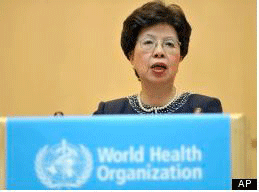 Not long ago, Dr Margaret Chan of the World Health Organisation stated “There is no safe low level of radiation”
Yet when Dr Caldicott said that same thing, she was subjected to aggressive questioning and demand for exact sources.
I wonder whether Mr Jacobi would have subjected the head of the WHO to the same insulting inqusition.
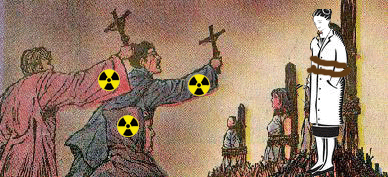
Opportunity for Port Augusta to be repowered with solar thermal energy
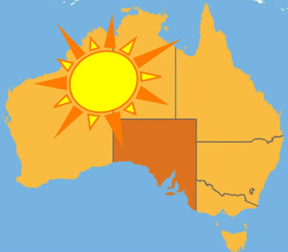 Repower Port Augusta, 30 Oct 15 In incredibly exciting news, after returning from a visit to a massive solar thermal plant in the United States, the federal local member for Port Augusta Rowan Ramsey has revealed to The Transcontinental that US solar thermal giant SolarReserve have made a bid to build solar thermal with storage in Port Augusta!
After a long running community campaign, numerous studies and actions from people like you this revelation is a huge step forward in the community driven push to Repower Port Augusta with solar thermal.
So, what does this mean?
The ACT Government are using a policy called a reverse auction to help them meet their 100% renewable energy target by 2025. This is a policy where they effectively bid for projects to buy renewable power from and early this year they called for bids from projects across the country from solar with stoage.
This is the policy we called on the SA Government to adopt in our submission to the state government that many of you signed onto.
We are still waiting on the result of the bid, but we know the bid for solar thermal from Port Augusta is one of thirty from across the country.
It’s a huge step forward and a testament to the community campaign backed by people across the country that SolarReserve are ready to build solar thermal in Port Augusta.
Conflict of interest in nuclear authorities: Dr Gordon Edwards explains
 Dr Gordon Edwards at SA NUCLEAR FUEL CYCLE ROYAL COMMISSION hearing, 21 October 15
Dr Edwards gave a wonderful explanation of the danger of nuclear technology, focussing on explaining radioactivity.
He also spoke of his concerns about the independence of nuclear regulators, and of safety measures needed for population near nuclear facilities, for example, how Canada supplies potassium iodate pills to communities.
Extract DR EDWARDS: The complexity of the technology means that a lot of people 45 are mystified by it, including decision-makers, and politicians, for example, .SA Nuclear 21.10.15 P-742 Spark and Cannon generally don’t necessarily have a background in nuclear science. One of the only ones I know, I think, was Jimmy Carter, he was actually a nuclear engineer in the American nuclear navy. But outside of him, I don’t think of any major politician who has a background in nuclear science.
So that the technology is sufficiently complicated that people tend to be mystified by it and therefore feel a little bit – they find it difficult to judge, other than by trusting the experts in the industry itself. The difficulty with trusting the people in the industry itself, is that there is either consciously or unconsciously a kind of a conflict of interest there because they are devoted to the industry 10 and they want the industry to succeed and of course they try to reassure the public that it’s safe and they try their best to make it safe but there is this problem of – well, what if they weren’t so devoted to the industry and had the same knowledge, would they make the same judgment? Would they perhaps see it as being unsafe? And one of the difficulties with dangerous technologies 15 is that people who work on the technology feel conflicted and it’s difficult to blow the whistle on a technology that you truly believe in. So this is an inherent problem.
Similarly when you have a regulator, although independence is the goal, it’s 20 difficult to maintain that independence. The people in the regulatory body are often drawn from the very industry that they are regulating because they are experienced in that field and consequently you need people with understanding and expertise, so how do you kind of keep regulatory independent when in fact there is this constant interaction between the people in the regulatory body and 25 the people in the industry. They tend to come to see themselves as colleagues and if I might draw an analogy, you might think of the regulator as drifting towards being more of a coach than a referee…….So this problem of independence is not an easy one to deal with…….
Another thing that I think would be very helpful in my own opinion would be regulators, as the industry itself, they tend to be very top heavy with engineers and physical scientists, geologists and such like, 5 chemists, the so-called hard scientists and they tend to be extremely thin on biomedical expertise. I think it’s very helpful to have some biomedical expertise in the regulatory body because they have a different perspective. They have a different approach and also if and when things do go wrong, the biomedical team can be very helpful in advising the public and the workers and 10 everybody, as to what kind of precautions to take in terms of protecting yourself. What kind of foods should be avoided? What kind of measures should be taken? I think it would be very reassuring to the public to have such people on board.
Moreover, if you had a health department, which we do not have in our regulator, if you had a health department staffed with competent and independent biomedical people, they could also help to educate workers and the public as to why we are so careful with this technology. Why we must invest in all these safety precautions because they could make it clear what the dangers are. Continue reading
100% renewable energy electricity company launched in South Australia
South Australian company to launch country’s first 100 per cent renewable energy utility provider, ABC News By Alex Mann, 26 Oct 15 A South Australian company will launch the country’s first 100 per cent renewable energy utility company, with the author of the 2008 Climate Change Review signalling his support.
Professor Ross Garnaut has been appointed chairman of Zen Energy and said the company’s launch would be a game changer.
“I’ve been disappointed that the established energy companies have not taken the opportunity that’s there,” he said.
The company will use a combination of solar power generation, battery storage, and localised energy grids to create self-sustained communities that will buy back the power they generate.
For years, Zen Energy has been putting battery units in people’s homes.
Now its chief executive Richard Turner plans to take entire communities off the grid — from social housing stock, to apartment buildings and regional communities.
He said he will generate the power, then sell it back to users at a fraction of the current costs.
“We’re looking at a spot in the market very soon where we’re going to be almost half the cost of the grid,” he said.
It could be the end of the power grid as we know it
It is just the latest disruption in an energy revolution sweeping across Australia which could spell the end of the power grid as we know it……….http://www.abc.net.au/news/2015-10-26/sa-company-launch-renewable-energy-utility-company/6886578
Tourism industry at Maralinga – but how safe is Maralinga nuclear bomb site?
from THE AUSTRALIAN, 26 Oct 15 …… Robin Matthews, the weathered caretaker of Maralinga nuclear test site, welcomes his visitors with some soothing words: the endless expanse of red gibber plain is safe — just as long as you do not dig.
Concealed under the rusty soil lies 60-year-old secrets of the British Empire, where seven nuclear bombs were detonated and hundreds of minor trials using plutonium and other radioactive materials contaminated kilometres of land.

But look close enough and the remnants of the tests are there — from the salt bush that refuses to grow any taller than 30cm and marks out a wide circle in the blast zones to scattered shrapnel and dark-green glass scattered across ground zero at the Breakaway nuclear test site, created by the heat of the explosion……
Most of the land was handed back to the Maralinga Tjarutja Aboriginal people in 2009 after rehabilitation work was finished, but Defence held on to the weapons-testing range in the Woomera Prohibited Area. In November last year, the 1782sq km site was officially handed back to the Aboriginal people.
Government papers released in 2011 show the site had required further remediation, with the topsoil over the massive Taranaki trench — four football fields wide and three storeys deep and now the burial site for contaminated topsoil and machinery — eroding over time.
Maralinga-Tjarutja general manager Richard Preece said the traditional owners of the land still did not want anything to do with the area, which they described as mamu (devil) country…..
Mr Preece said Maralinga was not only a legacy for Aboriginal people, but also for all Australians who had to remediate the site and were now left with buried radioactive material.
“I find it incredible that somehow it was all right for the British government on foreign soil to create a radioactive mess that was completely left to Australia,” he said.
#NuclearCommissionSAust plans for radioactive trash dumping on Aboriginal land: a confusing issue
SA Royal Commission: Nuke waste dump on Aboriginal land? Really?, Independent Australia Noel Wauchope 23 October 2015 THIS IS clearly a terribly important question that needs discussion. When and if theNuclear Fuel Cycle Royal Commission (RC) ultimately results in establishing a nuclear waste import business in South Australia, it is a certain bet that it will be on Aboriginal land.
There are relatively few published submissions from Aboriginal people and organisations. However, these cannot be easily lumped into pro or anti nuclear boxes. There are some passionately anti nuclear ones. There are no passionately pro nuclear ones, but there’s more than a hint of support in the two submissions that take an apparently neutral stance. The RC has allowed Aboriginal people to choose whether or not their submissions are published.
A pro nuclear submission might evoke condemnation from environmentalists and other Aboriginal groups. This fact is recognised in the submission by Maralinga Tjarutja and Yalata Community Incorporated: …..
Nuclear lobby plans to further override South Australia’s Aboriginal Heritage Act
IN the mire of technical jargon at the hearings of the Nuclear Fuel Chain Royal Commission South Australia, sometimes a little gem emerges on what they really want to happen.
Ploughing through the pitch of James Voss for importing radioactive trash, at the 15th October hearing, Philip White alerted me to this little gem, from Voss:
“There clearly has to be a siting undertaking – siting of facility for storage. Within that, there has to be a broad set of agreements with the host – with South Australia…. This might be an equivalency to the indenture agreement between Olympic Dam and the state.”
Sounds inoccuous, doesn’t it? But as Philip White says: “The indenture agreement precedent might sound great for them, but we need to expose the racism of that approach.”
Nectaria Calan comments – “That’s really interesting and corroborates our suspicions that the indenture is indeed a dangerous precedent for the nuclear industry in SA. Imagine a waste dump exempt from parts of the Radiation Protection Act.” Calan has previously written on this Act:
“exemptions from the Environmental Protection Act (1993) are of particular concern. The exclusion of this Act means that the Olympic Dam mine is not subject to the same environmental regulatory framework as other industrial projects in South Australia, and the Environmental Protection Authority (EPA), which administers the Act, is excluded from its monitoring role. BHP’s environmental performance is instead the responsibility of the Minister for Mineral Resources Development, who, based on BHP’s own reports, has full discretion to approve or reject programmes for the management and rehabilitation of the environment, without any obligation to consult with other agencies.”
The Josephite SA Reconciliation Circle are well aware of the real effect of Roxby Downs (Indenture Ratification) Act , amended 2011. In their submission to the Royal Commission they state:
“Aboriginal Heritage Act
Our Members are particularly concerned that the Royal Commission is actually circulating
information that claims that the mining of uranium in SA is controlled by various legislative
safeguards including any protection afforded to Aboriginal Traditional Owners by the SA
Aboriginal Heritage Act.
Our members’ collective memory is very clear that the reverse is the actual truth. The 1982 SA
Roxby Downs Indenture Act initially for the original joint venturers, BP and Western Mining,
and later Western Mining and then BHP Billiton, EXEMPTED each operator from the
Aboriginal Heritage Act.
The Aboriginal Heritage Act needs to be
• reinstated as a genuine safeguard containing rules to be followed, and
• restored to its original strength
If this is not sufficient then Traditional Owners in our democracy need to be given the power
to refuse to have facilities on their lands – whether under native title or land rights legislation- that will imperil the health of their country, groundwater and the health of the
community members now and for future generations.”
Aboriginal women will fight on against nuclear waste dumping in South Australia
Aboriginal women reaffirm fight against nuclear waste dump in South Australia ABC Radio National, The World Today By Natalie Whiting 16 Oct 15 The first shipment of Australia’s nuclear waste to be returned from re-processing in France has now left a French port, and will arrive on our shores by the end of the year. The return of the 25 tonnes of nuclear waste is putting renewed pressure on the Federal Government to find a location for a permanent waste dump.
The shipment began its journey just a day after senior Aboriginal women gathered in Adelaide to mark their fight against a proposed dump in South Australia in the 1990s.
The women say they will fight against any new move to put the waste on their land…..
SA Aboriginal women remember waste dump victory A Federal Government plan to build a  nuclear waste dump in the South Australian outback in 1998 attracted fierce opposition, especially among local Aboriginal people.
An event in Adelaide last night celebrated the work of a group of women called kupa piti kungka tjuta, who campaigned against the dump. Emily Austin from Coober Pedy was one of them. (centre in picture)
The women campaigned for six years until a Federal Court challenge from the South Australian government put an end to the dump. Ms Austin said she could remember the day the court found in South Australia’s favour.
“I was out in the bush hunting and I heard it on the radio in the Toyota. We were all screaming, ‘We won’.
“All the kungkas (women) were happy.”
While the Federal Government is in the midst of a voluntary process for finding a site for a dump, South Australia’s outback is still seen as an ideal location.
The South Australian Government’s attitude to the industry has been shifting.
It has launched a royal commission to investigate possible further involvement in the nuclear fuel cycle.The royal commission is looking at everything from mining uranium, processing, waste storage and nuclear power.
The organiser of last night’s event, Karina Lester, is the granddaughter of one of the women who campaigned and her father was blinded by the British nuclear tests at Maralinga half a century ago.
She said the Aboriginal people in South Australia’s north have a long and tortured history with the nuclear industry. “Maralinga’s had a huge impact because people speak from first-hand experience,” she said.
“People like the amazing kupa piti kungka tjuta, many of those old women who are no longer with us today, they were there the day the ground shook and the black mist rolled.
“It’s an industry that doesn’t sit comfortably with Anungu community.”
Ms Lester said it was good to see the royal commission consulting with people before a decision is made.”Credit to the royal commission that they’ve made an effort to engage with a broader community of Aboriginal communities,” she said.
“But how many of those Anangu are really understanding he technicality of this royal commission and what industry really means?” Ms Austin said she was ready to fight any future attempts to set up a waste dump in the region.
“Oh yeah, I’ve still got fight yet. They might stop yet, they might listen, I dunno,” she said. http://www.abc.net.au/news/2015-10-16/aboriginal-women-fight-against-nuclear-waste-dump-in-sa/6861012
Small Nuclear Reactors lobby turns to Australia, as safety rules too strong in USA
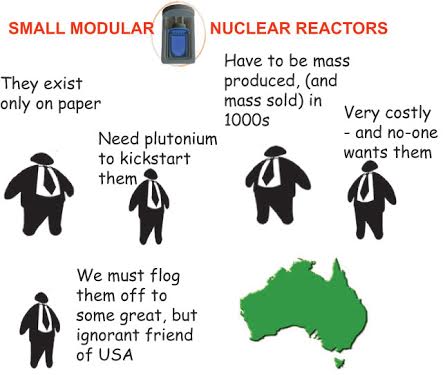 Why Australia is important to the Small Nuclear lobby. Independent Australia
the nuclear lobby’s spiel to Australia is something different, and very original. No dispute — because the argument is that small reactors would further the large reactor industry.
First articulated by Oscar Archer on ABC RN, March 2015, the idea is that Australia, in setting up small nuclear reactors, would enable the conventional nuclear industry and uranium mining to flourish:….. As Archer says, Australia would indeed be the pioneer for the new technology.
And that’s what the USA “new nuclear” lobby desperately needs. They need this, because they’re finding it impossible to go ahead in America. Why? Well it’s those pesky safety regulations imposed by the Nuclear Regulatory Commission.
What the “Small Nuclear” lobby needs is a “nuclear friendly” country – one with less stringent safety
 regulations – to set up their nuclear reactors on a test site. Hence the enthusiasm of those lobbyists for the South Australia Nuclear Fuel Chain Royal Commission, as shown, for example, in a recent Royal Commission hearing speech by Thomas Marcille of Holtec International nuclear company.
……… the Nuclear Regulatory Commission(NRC) has proved to be real nuisance since it tightened regulations for the licensing process after the Fukushima nuclear disaster. The new nuclear marketers have had to go overseas, first to China, then perhaps to Australia?…. https://independentaustralia.net/environment/environment-display/why-australia-is-important-to-the-small-nuclear-lobby,8263
South Australia: subsidy for large-scale solar photovoltaic (PV) projects
 Rooftop solar subsidies for SA business http://www.heraldsun.com.au/news/breaking-news/rooftop-solar-subsidies-for-sa-business/story-fni0xqi4-1227569000315
CLIMATE Change Minister Ian Hunter says the subsidy for large-scale photovoltaic (PV) projects, between 10 and 50 megawatts, will help businesses take advantage of a $100 million commonwealth funding pool aimed at increasing the uptake of solar panels.
“This is a great opportunity for potential developers to bring the cost of solar PV down to a price comparable to wind energy,” Climate Change Minister Ian Hunter said on Wednesday.
Eloquent Submission to #NuclearCommissionSAust – an Aboriginal Perspective
 Submission to: Nuclear Fuel Cycle Royal Commission South Australia Prepared by Breony Carbines on behalf of West Mallee Protection
“West Mallee Protection are a conservation group made up of Aboriginal and non-Aboriginalmembers based in Ceduna on the west coast of South Australia. Our On country work includes cultural maintenance of water rock holes and monitoring of biodiversity in the last stretch of intact stunted mallee country. WMP also works to ensure that this area is protected now and well into the future.”
I found it very hard to select an extract from this submission, because I didn’t want to exclude any of it. This submission is expressed with clear and forceful logic: it contains excellent references and recommendations.
Here’s what they had to say about the Commission’s question onsetting up a nuclear waste dump:
#NuclearCommissionSAust’s plan to bring radioactive trash to Australia – by Leasing
Next Thursday’s (Oct 15) Adelaide public hearing at the Nuclear Fuel Chain Royal Commission (NFCRC) could be an interesting one.
It will be about the concept of leasing uranium – the idea that Australia continues to “own” uranium , so contracts to take back all radioactive trash.
It’s not a new idea – pushed for decades by Dr John White

and by the former Global Nuclear Energy Partnership (GNEP) and the current International Framework for Nuclear Energy Cooperation (IFNEC)

Topics to be addressed at this public session: Concept of nuclear fuel leasing and potential demand for those services. The international and commercial arrangements necessary to establish a fuel leasing operation
Dr Caldicott’s submission concerning radiation #NuclearCommissionSAust
Dr Helen Caldicott Submission to the Nuclear Fuel Chain Royal Commission http://www.helencaldicott.com/submission-to-the-nuclear-fuel-cycle-royal-commission/
Excerpt – Types of ionizing radiation
- X-rays are electromagnetic, and cause mutations the instant they pass through the body.
- Similarly, gamma radiation is also electromagnetic, being emitted by radioactive materials generated in nuclear reactors and from some naturally occurring radioactive elements in the soil.
- Alpha radiation is particulate and is composed of two protons and two neutrons emitted from uranium atoms and other dangerous elements generated in reactors (such as plutonium, americium, curium, einsteinium, etc – all which are known as alpha emitters and have an atomic weight greater than uranium). Alpha particles travel a very short distance in the human body. They cannot penetrate the layers of dead skin in the epidermis to damage living skin cells. But when these radioactive elements enter the lung, liver, bone or other organs, they transfer a large dose of radiation over a long period of time to a very small volume of cells. Most of these cells are killed; however, some on the edge of the radiation field remain viable to be mutated, and cancer may later develop. Alpha emitters are among the most carcinogenic materials known.
- Beta radiation, like alpha radiation, is also particulate. It is a charged electron emitted from radioactive elements such as strontium 90, cesium 137 and iodine 131. The beta particle is light in mass, travels further than an alpha particle and is also mutagenic.
- Neutron radiation is released during the fission process in a reactor or a bomb. Reactor 1 at Fukushima has been periodically emitting neutron radiation as sections of the molten core become intermittently critical. Neutrons are large radioactive particles that travel many kilometers, and they pass through everything including concrete and steel. There is no way to hide from them and they are extremely mutagenic.
So, let’s describe just five of the radioactive elements that are continually being released into the air and water at Fukushima. Remember, though, there are over 200 such elements each with its own half-life, biological characteristic and pathway in the food chain and the human body. Most have never had their biological pathways examined. They are invisible, tasteless and odourless. When the cancer manifests it is impossible to determine its aetiology, but there is a large body of literature proving that radiation causes cancer, including the data from Hiroshima and Nagasaki. Continue reading
1 This month

of the week – Australians for War Powers Reform (AWPR)
To see nuclear-related stories in greater depth and intensity
 Antinuclear