South Australia bushfires: crazy to suggest nuclear waste dump there!
Bushfires threaten South Australia. After the hottest October on record, in what will be the hottest year on record, South Australia already faces an extraordinarily dangerous fire season.
 Is it sane for the South Australian government and its Nuclear Fuel Chain Royal Commission to be contemplating setting up this State as the world’s radioactive trash dump?
Are they not aware of the agonies that went on in Ukraine over the forest fires threatening Chernobyl region. and radioactive waste sites in California?
It is simply crazy, in view of climate change and increasingly hot, dry , long bushfire seasons to suggest placing dangerous radioactive trash in South Australia
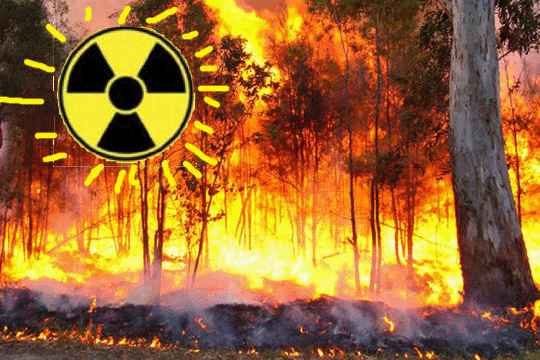
Catastrophic fire danger warning as SA faces extreme heat http://www.abc.net.au/news/2015-11-18/hot-weather-forecast-sa-change-later/6952632 Another day of extreme heat has been forecast across South Australia for Thursday and total fire bans have been imposed for 10 districts, with catastrophic ratings in four of them.
Adelaide is expecting a high of 35 degrees Celsius, after the mercury peaked above 40C on Wednesday….. The Education Department said catastrophic fire danger ratings meant it would close some state schools and preschools in bushfire-prone areas of the Riverland, mid-north, Flinders and North-West Pastoral regions on Thursday.
Some national parks and reserves would remain closed on Thursday, the Environment Department said, on eastern Eyre Peninsula, in the far north, and through the mid-north, Flinders Ranges, Riverland and Murraylands.
Firefighters will be on high alert and crews are still at a blaze south of Adelaide, which first broke out on Tuesday.
The Country Fire Service said the scrub fire at Yundi on the Fleurieu Peninsula was yet to be controlled.
Country Fire Service crews continue to tackle fires as South Australia goes on full alert for 2015 bushfire season, Advertiser, 18 Nov 15 POLICE are patrolling bushfire-prone areas and aerial bombers remain on standby as extreme fire conditions are forecast across the state just days into the fire-danger season.
Operation Nomad patrols and other police will target known firebugs and ask that anyone who notices suspicious activity or people in fire danger areas to contact the police assistance line on 131 444.
“Landowners are also asked to adhere to local harvest codes of practice which are available from your local council,’’ a police spokeswoman said.
Total fire bans are in place across most of the state as the temperature is tipped to soar into the 40s in the north and west of the state……. Continue reading
Australia’s really big radioactive waste dump is at Roxby Downs
Dennis Matthews, 19 Nov 15, In the 1980’s we were repeatedly told not to worry about uranium mining at Roxby, that Roxby was a copper mine and that uranium was incidental. Now we are being told that Roxby has the world’s largest deposit of uranium.
Despite strong public opposition, mining at Roxby got the nod from politicians. Soon radioactive water started leaking through the un-sealed base of the tailings dam, and now BHP is building an ever-expanding man-made stockpile of radioactive waste.
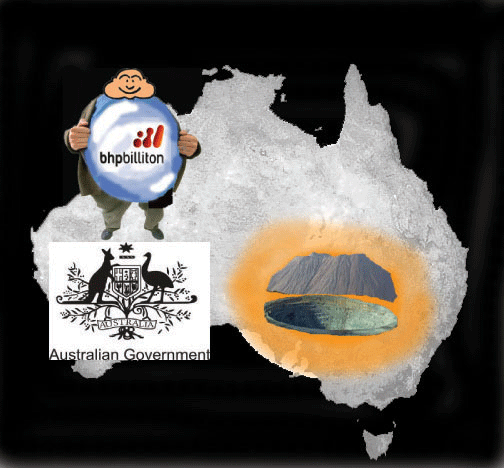
Paul Starick (The Advertiser, 13/11/15) downplays the fact that we have a nuclear reactor, stating that Australia has no nuclear power reactor, a distinction that has little to do with the issue. Using the “nuclear medicine” mantra, Starick downplays the main role of a nuclear waste dump, namely to deal with highly radioactive waste from Australia’s nuclear reactor, which will open the door to international waste.
The small amounts of relatively benign low-level waste being safely stored in institutions around Australia is trivial compared to BHP’s massive stockpiles of waste at Roxby and Australia’s nuclear reactor waste.
What are the radioactive risk of nuclear waste dump to a farming community?
Jim Green Friends of the Earth, 18 Nov 15 Responding to these questions: “So what are irradiation cans, ion exchange resins and aluminium ends of fuel rods and what dangers do they present to those living in a farming community? Is anyone able to inform me or direct me to where I can find such information please?”
They are harmless metals (irradiation cans + aluminium ends of fuel rods) and resins/polymers … but hazardous because of contamination with radioactive substances. For the contaminated metals they are likely contaminated with long-lived alpha-emitting radionuclides and would likely be classified as long-lived intermediate-level waste (LLILW) and would therefore be sitting in an above-ground shed at Kimba for an ‘interim’ period likely to last for many decades since absolutely no effort is being made to find a disposal site for LLILW (it is destined for deep underground disposal).
The risks …. pretty much anything you can imagine has happened at one or another radioactive waste repository around the world: fires, leaks, water infiltration and corrosion of waste drums, a chemical explosion, etc.
Fire would be a particular concern at Kimba, all the more so since the most hazardous waste (LLILW) would be stored above ground. Articles about recent fires at U.S. repositories are posted at: http://www.foe.org.au/fire
Water infiltration and corrosion is a difficult dilemma. Continue reading
South Australia’s radioactive threat: it’s not “medical” waste – it’s nuclear waste from used fuel rods
Freydenberg said the facility would ‘only’ house low and intermediate level waste. Perhaps he is unaware of the toxicity of this LLILW. Dr Green again: ‘When the spent fuel is removed from the reactor, it is high-level nuclear waste. After some months it cools down and falls below the heat criterion so is reclassified as LLILW.’
The farmer opponents of the Kimba sites are right to be concerned. The spent fuel reprocessing waste will be hazardous for thousands of years.
 South Australia’s nuclear threat continues http://www.eurekastreet.com.au/article.aspx?aeid=45708#.VkuCE9IrLGh Michele Madigan | 17 November 2015
Last Friday 13 November, the federal government released the shortlisted sites of the proposed national radioactive waste facility. No surprise that three are in South Australia, the ‘expendable state‘: Cortlinye and Pinkawillinie near Kimba on Eyre Peninsula, and Barndioota near Hawker, north of Port Augusta.
I wonder if South Australians aren’t beginning to feel like nuclear particles themselves, bombarded on all sides by the nuclear industry. This announcement from the federal government about its nuclear repository plans comes as the state government continues to consider, through its Royal Commission, whether, when and where South Australia will offer to host the world’s high-level nuclear waste.
The six names on the federal government shortlist (the remaining three being Sallys Flat in NSW, Hale in the Northern Territory and Oman Ama in Queensland) are taken from an original list of 28 properties that were offered by their landowners. It’s disturbing to find that the owner of the Cortilinye site, at least, has been misinformed,believing ‘It’s basically only a medical waste facility.’
In reality, only 10–20 per cent of the radioactive waste is medical in origin. And nuclear medicine is in no way affected by the lack of a national repository.
Resources and energy minister Josh Freydenberg’s Friday announcement included a masterly sentence of understatement: ‘Low level waste is those gloves or those goggles or the paper or the plastic that comes into contact with nuclear medicine, and intermediate waste could be, for example, those steel rods that are used in the reactor to actually create these particular products.’
It’s interesting to notice what’s different and what stays the same from the 1998–2004 ‘dump’ campaign in SA. Continue reading
Indigenous Australians fight Liberal bigwig Grant Chapman’s plan for radioactive trash dump
 Indigenous groups to fight plan for Flinders Ranges nuclear dump THE AUSTRALIAN NOVEMBER 18, 2015 Michael Owen Aborigines in the northern Flinders Ranges of South Australia are vowing to fight any move to make a site owned by a former senator the home of a national nuclear waste dump.
A group representing the Adnyamathanha people yesterday said it was fiercely opposed to any expansion of the nuclear industry. The group was shocked that Barndioota, along the Leigh Creek railway to Port Augusta, was one of six sites, including three in South Australia, being considered by the federal government to store low and intermediate-level nuclear waste.
Former senator and state Liberal Party president Grant Chapman jointly owns the long-term lease to
Wallerberdina, a station near Barndioota in the Flinders Ranges. If the site were chosen, it would house a storage facility over about 100ha in the northern section of the 25,000ha property.
Adnyamathanha Camp Law Mob spokeswoman Jillian Marsh yesterday said there was no support for the “imposition of a radioactive waste dump on Adnyamathanha country”.
“We are shocked that one of the three nominated sites in South Australia … is 377 Wallerberdina Road, Barndioota,” Ms Marsh said. “We understand that ex-Liberal senator Grant Chapman is the current owner of the nominated site that is a perpetual lease property and therefore no native title claim can be lodged.”
Total Environment Centre’s legal challenge to South Australia solar tariff proposal
Solar penalty tariff proposal for SA households subject of Federal Court challenge, ABC News By Candice Marcus, 16 Nov 15, An environment group wants the Federal Court to uphold the energy regulator’s decision to reject a penalty tariff on South Australian households with solar power.
The Total Environment Centre has intervened in a court case in which SA Power Networks is challenging the Australian Energy Regulator.
The regulator rejected a pricing proposal for households to face a solar tariff and a social tariff, which SA Power Networks said would have been directed toward helping low-income earners facing hardship in paying their bills.
It was estimated the solar tariff could cost the average solar-powered household about $100 annually.
The Total Environment Centre lodged submissions with the Federal Court urging it uphold the regulator’s rejection of the penalty pricing proposal.
Extra tariffs would be solar ‘disincentive’
Mark Byrne from the environment group said imposing additional tariffs would be a disincentive for people to install and use solar power.
“We’ve got half a million people living under solar roofs in South Australia already though and it’s going to negatively impact on them as well as making it less advantageous for new customers to install solar,” he said.
“Obviously in the long run we want to see more solar because it helps reduce greenhouse emissions as well as household electricity bills.”
He said SA Power Networks had a flawed argument.
“Their argument effectively is that solar customers should be paying more because they use less energy and the network is entitled to a fixed amount of revenue,” he said.
“The unfortunate thing about that is it discriminates against solar customers and will result in them paying about another $100 a year.
“What the network should be doing is introducing a tariff that affects everyone equally and recovers more of their revenue during those peaks, when they’re worried about the impact on prices because they have to build more to meet peak demand.”……..http://www.abc.net.au/news/2015-11-16/court-hears-challenge-on-sa-solar-penalty-tariff-proposal/6944870
Indigenous Adnyamathanha Camp Law Mob shocked at selection of South Australian site for radioactive trash dump
Response from the Adnyamathanha Camp Law Mob regarding the Federal Resources Minister’s announcement of 3 sites nominated for a nuclear waste dump in South Australia.
The Adnyamathanha Camp Law Mob are a group of Adnyamathna people who meet regularly to discuss issues relating to our land and culture.
The Camp Law mob share this message on behalf of all Adnyamathanha people and other South Australians who are opposed to any further expansion of the nuclear industry. We have taken part in the SA Nuclear Fuel Cycle Royal Commission, and our views along with many others are clearly stated in our submission that we do not support any expansion of a nuclear industry this includes the imposition of a radioactive waste dump on Adnyamathana country at Barndioota.
We are shocked to hear on Friday 13th November 2015 that one of the 3 nominated sites in South Australia for a national nuclear waste dump is 377 Wallerberdina Road, Barndioota. We understand that ex-Liberal Senator Grant Chapman is the current owner of the nominated site that is a Perpetual Lease property and therefore no native title claim can be lodged over this area. It must still be governed according to the requirements of the Aboriginal Heritage legislation.
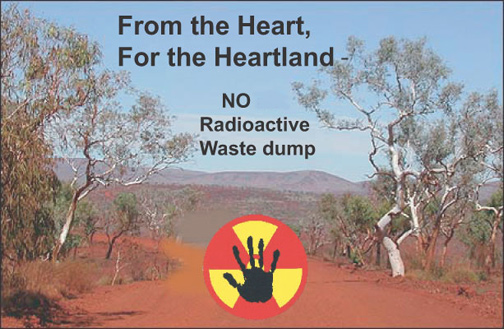
We demand that the Federal Resources Minister Josh Frydenberg publicly declare who he has consulted regarding these nomination, and who has the authority to nominate these sites.
We want to know who are the experts with local knowledge that took part in the advisory panel prior to these sites being nominated as waste sites? Who are the Traditional Owners that took part in this process? What Traditional knowledge from thousands of years of occupation has been incorporated into the decision-making?
Our involvement is this industry is nothing new. We were concerned by the government agreeing to uranium mining activities that have now permanently contaminated our land and our groundwater. We want no further expansion of the nuclear industry and we will continue to fight for our rights as Traditional Owners in respect of the wisdom of our old people that came before us.
That’s what Traditional Owners do. We care for our country. We only wish governments and industries would do the same. Stop playing with our future and care for our country.
Former Liberal Party presidnt and Senator Grant Chapman offers Grant Chapman land for high level nuclear waste dump
Proposed Flinders Ranges nuclear site identified as pastoral property belonging to former Liberal senator Grant Chapman, ABC News, By Daniel Keane, 16 Nov 15 A former South Australian senator and Liberal Party president who jointly owns one of several proposed sites for a nuclear dump in the state said he would be willing to allow high-level waste to be stored on the property in the future.
Grant Chapman owns the long-term lease to Wallerberdina, a station near Barndioota in the Flinders Ranges about 40 kilometres north-west of Hawker, which is currently used to graze cattle.
It is one of six sites across the nation, including three in SA, being considered by the Federal Government to store low- and intermediate-level nuclear waste.
News of its potential future use has alarmed some neighbours, who are opposed to a nuclear dump and said they had not been consulted.
Mr Chapman said if approved, a proposed nuclear storage facility would eventually occupy 100 hectares in the northern section of the 25,000-hectare property.
He said he nominated the site several months ago…….Mr Chapman was a strong supporter of storing nuclear waste in Australia during his time as a senator, chairing a Senate committee into the subject.
“If it was shown to be safe for that high level waste to be eventually transformed into a form that was safe to store in that situation then certainly the property would be a potential site for that,” he said…..
Neighbour angered and concerned by location
Artist Regina McKenzie, who lives on neighbouring Yappala Station, which shares a boundary with Wallerberdina, said she and her family were angry and frustrated they had not been consulted.
Ms McKenzie said she had heard rumours Wallerberdina was being considered but was shocked when that was confirmed by the Federal Government.
She said Aboriginal people have suffered greatly as a result of the Maralinga nuclear tests and she feared history would repeat itself.
“The water here that we use, the aquifers that are under the earth, what if they get contaminated by some leakages or something?” she said.
“I don’t care how safe they say it is. If it’s so safe, why don’t they take it back and put it in their own back yards. If it’s so safe, have it in Canberra there where all the pollies sit.”
Ms McKenzie said the area was culturally significant to the Adnyamathanha people.
We don’t want [waste] in the area. We didn’t want them to take it out of the ground in the first place, it’s against our culture, and now they’re sending it back to the country,” she said.
“It’s not right. If they take it, they should keep it. It’s poison. We don’t want the poison back.
“I’m a little bit scared about it. My grandchildren are going to come back here and visit as well.
“I just don’t want anything coming back on our communities.”………http://www.abc.net.au/news/2015-11-16/proposed-nuclear-site-identified-as-wallerberdina-station/6944636?section=sa
Adelaide branch of University College London (UCL) to close (and good riddance)
 With UK import Tim Stone, and Prof Stefaan Simons leading the charge, this UCL branch has been a useful propaganda piece for the global nuclear lobby. South Australia has enough nuclear shills without UCL. It will be good to see it gone.
UCL Australia ‘to wind down by 2017’ https://www.timeshighereducation.com/news/ucl-australia-to-wind-down-by- 2017/2018581.article#comment-5146
Future of branch campus in Adelaide under review as funds dry up and London focuses on partnerships
February 19, 2015University College London is set to close its Australia branch within two years as part of a wider review of its overseas campuses.
UCL’s Adelaide campus is likely to be wound up in 2017 on the completion of research deals with energy and mining companies Santos and BHP Billiton worth about A$20 million (£10 million).
Support from South Australia’s regional government is also due to expire that year, which led the university to carry out a review of UCL Australia’s long-term sustainability.
It is now undertaking a consultation process with its staff about a “move away from a stand-alone presence in Adelaide”, although it says this is “not a fait accompli”. Continue reading
Nov 16 Royal Commission public hearing with Maralinga Tjarutja & Yalata Community Incorporated
 In all the drama about nuclear waste returning from France, we need to be mindful that this has nothing to do with the Royal Commission proposal to import the world’s radioactive trash to Australia.
On 16 November the RC’s public hearing topic will be COMMUNITY ENGAGEMENT & NUCLEAR FACILITIES – ENGAGEMENT WITH ABORIGINAL COMMUNITIES. TThe speakers will include two representing the Maralinga Tjarutja & Yalata Community Incorporated – a group whose Submission to the RC was not negative.
Strong objections to nuclear waste dump sites
Why is it that THE AUSTRALIAN and most media go on about medical wastes, but don’t mention the REAL problem – Lucas Heights nuclear reactor wastes returning from France?
Nuclear waste dump goes against the grain, THE AUSTRALIAN, REBECCA PUDDY ANDREW BURRELL, 14 Nov 15, Grain farmer Cameron Scott is no green activist, but he promises to fight any move to build the nation’s first nuclear waste dump on his doorstep in South Australia’s wheatbelt.
Mr Scott is a key member of a coalition of neighbours in the town of Kimba, almost 500km northwest of Adelaide, who are strongly opposed to the region hosting a facility to store the nation’s low-level and mediumlevel radioactive waste.
“The first thing that hit me was safety — we’ve got kids, we’ve been here for three generations and we want to look after their future,” Mr Scott said yesterday, as he acknowledged deep tensions in his local community over the issue.
“What will this do for our price of land, who wants to buy land next to a radioactive waste dump and what will happen to the price of our grain?”
Kimba is ground zero in the deeply personal battle over the location of the dump, with two of the six shortlisted sites across Australia — all of which were voluntarily nominated by landholders — located in the district……… Continue reading
Yami Lester, victim of nuclear testing urges communities to fight nuclear waste dumping
SA Government ‘open’ to nuclear waste dump proposal despite previous opposition: Weatherill, ABC News, 13 Nov 15, “…… Greens MP Mark Parnell said he wanted to see more detail on the proposal, but was suspicious of the agenda from Canberra. He was concerned accepting a site in South Australia could lead to the storage of high level radioactive waste.
“It’s no surprise that the Federal Government has its eyes on South Australia for its nuclear waste dump,” Mr Parnell said. “But what will worry people in this state is whether this is a precursor to a high level radioactive waste dump.”…
 Indigenous man Yami Lester, from Mintabie in the APY Lands, said the state and federal governments should not mine uranium, let alone store it.
Mr Lester was blinded from a radiation fallout in 1953 when the British and Australian governments conducted uranium testing near his community, west of Coober Pedy.
“It was terrible. Some older people died, I went blind and my cousin went blind, skin rash, diarrhoea and all that sickness,” he said.
“We had no treatment at all, the hospital nearest the clinic was 160 kilometres [away] at Ernabella, and we were sitting here, no doctor nothing.
“That’s why I’m scared of the government mining uranium. Better to leave it under the ground. Don’t touch it.”
Mr Lester urged the communities close to the proposed waste sites to fight against the dumps.
He said the state and federal government should learn from past mistakes.
“I don’t agree with [experts] at all. The Australian Government and the South Australian Government, people haven’t learnt from the mistakes that happened overseas, in Germany, Japan they haven’t learned from that,” he said…..http://www.abc.net.au/news/2015-11-13/sa-govt-consider-nuclear-waste-proposal-royal-commission/6937530
NATIONAL NUCLEAR WASTE DUMP IN SA: TROJAN HORSE FOR AN INTERNATIONAL NUCLEAR WASTE DUMP?
13 Nov 15 The Federal Government has released the shortlist of six sites for the location of a national radioactive waste dump. Three of these sites are in South Australia.
Friends of the Earth Adelaide is cautious about the Federal Governments genuine commitment to a voluntary site nomination and selection process.
“The test will be how the government handles community opposition, how inclusive and transparent the site selection process will be, and how it will handle the issue of existing South Australian legislation banning the establishment of a nuclear waste dump,” said Nectaria Calan of Friends of the Earth Adelaide.
The National Radioactive Waste Management Act 2012, the Act governing the site selection process, over-rides existing state legislation prohibiting the establishment of a nuclear waste dump.
“Will the Federal Government impose a nuclear waste dump on states that have legislated against it, or communities that do not want it?” asked Ms Calan.
“The location of a waste dump cannot simply be decided through individual nominations,” said Ms Calan. “It affects the wider community, particularly those in close proximity to the site. Radioactive contamination knows no property boundaries. The principle of voluntarism extends beyond the individual where an action has wider ramifications,” continued Ms Calan.
“There is yet to be an independent inquiry into all our radioactive waste management options, so the nominations process is premature,” said Ms Calan.
Additionally, here in South Australia the Royal Commission into the Nuclear Fuel Cycle is considering the feasibility of an international nuclear waste dump. “Will a national nuclear waste repository in SA be the trojan horse for an international high level nuclear waste dump down the track?” asked Ms Calan.
“Rather than considering existing nuclear waste in Australia as an intractable problem, the SA government and some proponents of the nuclear industry seem to consider radioactive waste a business opportunity and want to import it, astounding given that so far globally there has been no success in establishing even one facility for the long term storage of high level waste.”
“ The one deep underground repository for intermediate level waste that does exist, the Waste Isolation Pilot Plant (WIPP) in New Mexico, saw an incident in February last year where a waste barrel exploded, leading to an aboveground release of airborne radiation, after only 15 years in operation,” said Ms Calan. “According to the US Department of Energy, twenty-two workers tested positive to low-level radiation exposure.”
Friends of the Earth Adelaide has serious concerns regarding the regulatory framework that may be applied to a nuclear waste dump in South Australia, whether national or international.
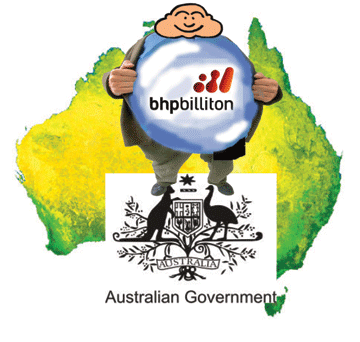 “BHP Billiton, operator of the Olympic dam mine, is exempt from key regulating legislation in SA, including the Freedom of Information Act, and parts of the Radiation Protection and Control Act and the Environmental Protection Act. With such a precedent here in SA for the regulation of the nuclear industry, where is the guarantee that other nuclear projects such as a nuclear waste dump would not also be exempt from laws regulating radiation, environmental protection, and transparency?” asked Ms. Calan.
UCL Australia – key player/driver in South Australia nuclear push
“University College London’s International Energy Policy Institute (IEPI), based at its Australia campus in Adelaide, undertakes economic, regulatory and policy research on how Australia could develop a nuclear energy industry and manage its externalities, including decommissioning and waste.”
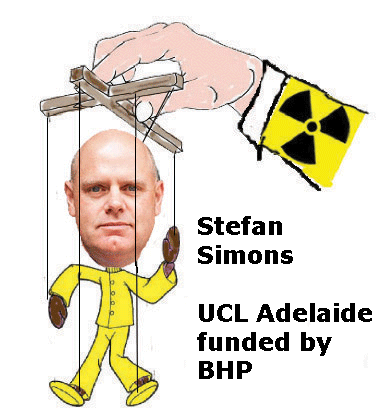
UCL Australia https://en.wikipedia.org/wiki/UCL_Australia 10 Nov 2015
UCL Australia is an international campus of the University College London, located on Victoria Square in Adelaide, South Australia.
Industry partnerships
UCL Australia has key corporate partnerships with two major resource and energy companies operating in South Australia: Santos and BHP Billiton. Santos’ South Australian interests include onshore and offshore oil and gas developments while BHP Billiton’s interest is concentrated on the expansion of the Olympic Dam mine- the world’s largest known deposit of uranium.
International Energy Policy Institute
The International Energy Policy Institute (IEPI) is housed on the Adelaide campus of University College London, Australia. In 2011, UCL signed a five-year $10 million partnership with BHP Billiton to establish the International Energy Policy Institute in Adelaide and an Institute for Sustainable Resources in London. Continue reading
Nuclear fuel leasing – not economically viable for Australia
 When nuclear reactors shut (as they are doing in USA) – where is the income stream to pay Australia for having all that radioactive trash?
 Proponents are talking up the billions that might be made by swallowing our pride and making Australia the world’s nuclear waste dump. But they have been silent about the costs.
And the waste would need to be monitored and problems addressed for millenia
Wasting Australia’s Future: Why We Shouldn’t Become The World’s Nuclear Waste Dump, New Matilda, By Dr Jim Green on November 9, 2015 There are many good reasons why Australia should not set its sights on becoming a dumping ground for nuclear waste. Dr Jim Green takes up the case.
While sceptical about the prospects for nuclear power in Australia, Prime Minister Malcolm Turnbull has given cautious support to the idea of a nuclear fuel leasing industry in Australia. Such an industry would involve uranium mining, conversion (to uranium hexafluouride), enrichment (increasing the ratio of uranium-235 to uranium-238), fuel fabrication, and disposal of the high-level nuclear waste produced by the use of nuclear fuel in power reactors overseas.
In the Prime Minister’s words: “We have got the uranium, we mine it, why don’t we process it, turn it into the fuel rods, lease it to people overseas, when they are done, we bring them back and we have got stable, very stable geology in remote locations and a stable political environment.”
Regardless of its merits, a nuclear leasing industry is an economic non-starter. That much is clear from the data provided in the latest edition of the International Atomic Energy Agency’s Nuclear Technology Review. Uranium miners could be compelled to participate in an Australian nuclear leasing industry. But try telling that to BHP Billiton. The company bluntly stated in its submission to the 2006 Switkowski Review: “BHP Billiton believes that there is neither a commercial nor a non-proliferation case for it to become involved in front-end processing or for mandating the development of fuel leasing services in Australia.”
And there’s no point appealing to the patriotic fervour of Australia’s uranium miners: they are majority foreign-owned. Continue reading
1 This month


Help Aunty Sue Protect Her Land and Sacred Sites From Destructive Rocket Testing.
.

Australians deserve the truth
about
AUKUS – https://aukuspublicinquiry.com/

PETITION – To: Prime Minister Anthony Albanese and the Australian Labor Government

of the week – Australians for War Powers Reform (AWPR)
To see nuclear-related stories in greater depth and intensity

