Costs of new nuclear, high, higher and astronomic
 You’ll never guess how much this Australian nuclear power plant will cost, http://www.bizjournals.com/pittsburgh/blog/energy/2015/11/youll-never-guess-how-much-this-australian-nuclear.html Matt Stroud, energy reporter for the Pittsburgh Business Times. Nov 6, 2015 A nuclear power plant has never been built in Australia before, but Westinghouse is putting a price tag on a new one they’re hoping to build there.
The price? About $12.3 billion.
 Australian state of South Australia should build the nation’s first nuclear power plant — Westinghouse executive Rita Bowser said that price was all inclusive, according to The Advertiser in Adelaide, South Australia. It would include land, environmental safeguards and construction.
Australia has zero nuclear power plants — and is known for being extremely averse to nuclear energy; it won’t even allow nuclear ships into its ports.
 The historical aversion won’t affect the price much, apparently; the company’s guesstimate is in line with its current Vogtle project in Georgia, which has been plagued by cost overruns. It’s less than a comparable Chinese project, set to cost $24 billion. And it’s cheap in comparison to a project proposed in Johannesburg that could cost $100 billion.
The South Australia project’s future is fluid at the moment: the Nuclear Royal Commission hasn’t even decided whether it wants to recommend a nuclear facility.
That decision is set to come in May 2016. Tokyo-based Toshiba Corp. (TYO: 6502) owns 87 percent of the Cranberry-based Westinghouse Electric Co.
Adelaide’s January heatwave attributed to climate change
The findings are reported in the fourth issue of the American Meteorological Society’s report into extreme weather. The report looked at 33 extreme weather events around the world and analysed which could be attributed to human activity and which were the result of natural variability in weather patterns.

As David Mark reports, detecting the human hand in climate change is a developing area of climate science.
Continue reading
Forget climate change spin: Nuclear lobby’s aim is South Australia as radioactive trash dump
But the main game according to recent statements by Turnbull is to establish South Australia as a permanent waste dump for the world’s 350,000 tonnes of spent fuel containing more than 100 isotopes including plutonium-239 which lasts 250,000 years – one millionth of a gram is carcinogenic, americium, more toxic than plutonium and strontium-90 and caesium-137 lasting 300 years .

Increased uranium mining and more radioactive waste would be bad news for Australia http://www.theage.com.au/comment/increased-uranium-mining-and-more- radioactive-waste-would-be-bad-news-for-australia-20151103-gkpyp3.html November 4, 2015 Helen Caldicott
The nuclear industry may advocate in Paris that nuclear power is the answer to global warming. When Malcolm Turnbull mooted the question about storing radioactive waste in Australia, I felt that I finally understood the aim of the Nuclear Fuel Cycle Royal Commission being conducted in South Australia. Then I wondered whether the nuclear industry is going to propose in Paris that nuclear power as the answer to global warming.
A curious situation is developing in South Australia that will have serious health ramifications, especially for Aboriginal communities, and will also severely impair the state’s reputation for its superb wine and food. Continue reading
Fact-checking Senator Sean Edwards’s claim on future nuclear bonanza
 FREE ENERGY – WITH NUCLEAR? http://www.factsfightback.org.au/free-energy-with-nuclear/ November 4, 2015
The claim
Senator Sean Edwards claimed that an expansion of the nuclear fuel 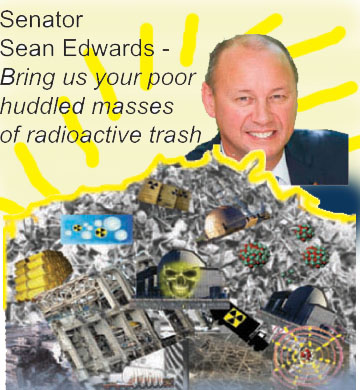 cycle in South Australia could provide low or even no cost electricity, create a generation of high-paying jobs and do so without any subsidies from government. His plan is to take spent fuel from older nuclear power plants from around the world, and reprocess them for use in fourth generation reactors here in Australia. We could be paid to take waste which we then turn into fuel, providing free electricity.
The facts
So called fourth generation reactors are not yet commercially available but are predicted to become available sometime in the 2030s. If these reactors become commercially available they will be able to take spent fuel rods(currently treated as nuclear waste) from older nuclear reactors and use them to generate electricity. This effectively turns a waste source into a valuable commodity.
The claim that low or no cost electricity can be produced comes from the idea that other countries would pay South Australia to take their nuclear waste. This would mean that not only will South Australia pay nothing for its fuel costs but it would generate an additional revenue source from taking other countries waste and turning it into a commodity.
We will address his argument as three linked claims:
- Other countries will pay Australia to take nuclear waste for storage.
- Australia can build fourth generation reactors to use this spent fuel to generate electricity.
- This will result in free electricity, and perhaps even earn sufficient profit for the state that it will allow a reduction in taxes.
Claim 1
The expert advice to the South Australian Royal Commission into expanding the nuclear fuel cycle gave a time-frame of 25 years to complete a long term waste storage facility. The Generation IV International Forum expects fourth generation reactors – capable of using existing waste stockpiles as fuel – to be commercially deployed in 2030-2040. This means that any waste storage facility that South Australia develops is likely to be completed at about the same time as fourth generation reactors become commercially available. It is likely that South Australia’s own waste storage business would need to compete with other countries’ fourth generation reactors. Spent fuel will cease to be waste, and will become a commodity. Why would anyone pay South Australia to take a commodity?
Claim 2
The circular reasoning is clear. If fourth generation reactors work as hoped, no-one will pay South Australia to take their spent fuel. Further, if fourth generation technology proves to be expensive and difficult to maintain, South Australia would have locked itself into expensive electricity generation, having set up a waste import industry. In either case, countries with existing stockpiles of spent fuel have a clear competitive advantage over South Australia. It makes more financial sense for them to build fourth generation reactors next to existing stockpiles than it does to transport it half-way around the world. There is no good outcome for South Australia.
Claim 3
According to the US Energy Information Administration, fuel represents less than 15% of the cost of generating electricity with advanced nuclear power plants. Most of the cost is in the initial capital expense and maintenance of the reactor. Even if Australia received “free” fuel – a wildly optimistic hope – the cost of building reactors is still great. Wind and solar have no fuel costs, but no one thinks renewable electricity is free. Furthermore, the cost of setting up an international waste storage component would be extreme large. The Pangea proposal which looked at setting up a nuclear waste disposal facility in the late 1990’s included port facilities and a fleet of specialised ships. It showed that any waste facility would be very expensive.
The first ton of waste that Australia received would require a gamble of many billions of dollars.The findings
Perhaps the cheapest way to take a gamble on nuclear power might be to create temporary storage facilities now, use this brief window before fourth generation reactors are deployed commercially to get paid to take waste, and be among the first in the world to build the reactors which can use our newly acquired waste for fuel.
However, the risks are obvious. If fourth generation reactors turn out to have high costs of operation, we would be locked into expensive electricity. If they can’t be made to work commercially at all, we would have given ourselves a high-level waste problem for tens of thousands of years, a problem that may not have a solution. And if they are cheap and effective, most countries could build their own and bid for the fuel we are so generously taking for a fee. If we can plan ahead for fourth generation technology, so can everyone else.
Even at best, if everything goes just as hoped, the payoff for our gamble is paltry. A 15% reduction in energy costs from nuclear reactors, which already have a higher cost per unit of energy than new wind and solar generators, is far from “free” electricity. A waste industry, costing billions to set up, which will see its revenues killed off – in as little as ten years – by the very technologies we hope to champion, can hardly be said to provide “generations” of high-paying jobs. And we will inherit a nuclear waste storage problem that must be solved for at least hundreds, and perhaps thousands, of years.
The most risk for the least reward is not a smart business plan. Free electricity is no more than a pleasant dream.
#NuclearCommissionSAust THE APPEARANCE OF BIAS – NOT A GOOD LOOK
THE ROYAL COMMISSION INTO THE NUCLEAR FUEL CYCLE: Thursday 5th November, 2015
Today the Royal Commission into the Nuclear Fuel Cycle will be hearing oral evidence from London based insurance company Nuclear Risk Insurers, on the subject of insuring against a nuclear accident. On October 2015, Dr Timothy Stone, member of the Royal Commission’s Executive Advisory Committee, was appointed director of this company.
“How critically will evidence given by this company be treated, when a member of the Executive Advisory Committee is also one of its directors?” asked Nectaria Calan of Friends of the Earth Adelaide.
On Friday 30th October GE Hitachi gave oral evidence to the Royal Commission on their new PRISM reactor design. GE Hitachi is a global nuclear alliance between General Electric (US) and Hitachi (Japan). Hitachi is the parent company of Horizon Nuclear Power, a UK energy company developing new nuclear power stations, of which Dr Stone is also a director.
“Dr Stone’s connections with these companies highlights the broader issue here, which is his direct involvement in the nuclear industry, regardless of whether companies he’s employed by are giving evidence. He also owns Alpha-n Infrastructure, an elusive company with a partially built website which promotes nuclear power. This interest has not been disclosed by the Royal Commission on its website,” said Ms Calan.
Dr Stone is not the only Royal Commission member directly involved in the nuclear industry. Julian Kelly, its Technical Research Team Leader, is currently the Chief Technology Officer of Thor Energy, a Norwegian company focusing on the use of Thorium in nuclear reactors.
“If you’re directly involved in the very industry the Royal Commission is considering expanding, you potentially stand to gain something if a recommendation is made that this industry expand. At the very least there is an appearance of bias here that will undermine the credibility of the Royal Commissions findings,” said Ms Calan.
Don’t let strident pro nuclear voices drown out alternative voices
Gone Nuclear Fishing, The Adelaide Review, 2 Nov 15 John Spoehr With the nuclear Royal Commission, the South Australian Government has unexpectedly opened up a debate about our role in the nuclear fuel cycle. ……My own position at the outset is that it is not possible to examine the nuclear fuel cycle, and all that the nuclear industry entails, without detailed comparisons with the range of alternatives that are available to us in tackling climate change and building an energy industry for the future. Fair comparisons need to be commissioned and sought from a wide range of experts and subject to peer assessment. A citizens’ jury could be presented with the evidence to form another step in the advisory chain.
I am willing to listen to all sides of the debate while maintaining the highest levels of scepticism along the way. I need to be convinced, however, that Australia’s deeper participation in the nuclear fuel cycle is a superior journey to the alternatives available to us – particularly advanced solar thermal and energy storage technologies. Safety concerns and proliferation risks need to be honestly addressed. Other parts of the world might require other energy mixes, dictated by local realities and natural advantages but our position need not be dictated by what might be best applied in other nations to bring about sustainable reductions in greenhouse gases……
we need to ensure that the loudest and most well-resourced voices don’t drown out a robust debate about the alternatives available to us. http://adelaidereview.com.au/opinion/gone-nuclear-fishing/
#NuclearCommissionSA chief dismisses ‘overheated’ worries about #nuclear industry
 Nuclear inquiry head says objections to uranium ‘overheated’ http://www.afr.com/news/nuclear-inquiry-head-says-objections-to-uranium-overheated-20151030-gkn2mo
by Simon Evans The former admiral overseeing South Australia’s nuclear inquiry says he is trying to be as straight as possible on what can be a divisive issue, but some concerns about the nuclear industry go too far.
Kevin Scarce, who was appointed by South Australian Premier Jay Weatherill this year to investigate if South Australia should go into nuclear enrichment, storage of waste and power generation, says he is on target to deliver preliminary findings by February before a final report by May. He says he is focused on objective evidence and tapping into global expertise, and accepts that many people have passionate views about the nuclear industry.
“Some of those concerns are overheated,” he told AFR Weekend. “I think it’s really important that we investigate all the issues and rely on fact-based evidence.”
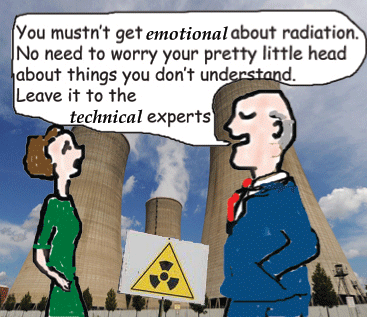
Mr Scarce, who was governor of South Australia for seven years until mid-2014, has taken evidence from more than 60 witnesses. The latest on Friday was Eric Loewen, the chief consulting engineer at United States firm GE Hitachi Nuclear Energy.
Dr Loewen is an expert in the development of the company’s new generation of small, modular nuclear reactors designed to recycle spent nuclear fuel.
He was asked about the approximate costs of the new generation PRISM reactor, and said a United States Department of Energy report had estimated it at about $6 billion.
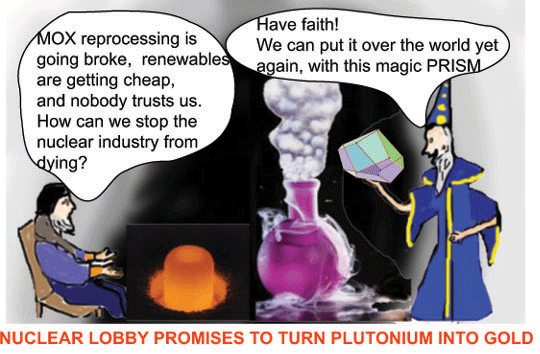
“We would describe that cost as very reasonable,” Dr Loewen said. Continue reading
Senator Sean Edwards wants the whole toxic nuclear chain here, as well as the radioactive trash dump
Edwards pushing forward on nuclear, Sky News, 30 October 2015 A government senator is upping the ante on the nuclear debate, saying a revamp of the industry could help deliver free energy to his fellow South Australians and reduce state taxes.
Unlike Prime Minister Malcolm Turnbull, who is open to a discussion on exporting fuel rods, Sean Edwards wants to see spent ones recycled here and generators installed.
‘We are looking for an energy that week can generate at low cost so we can foster industry and foster jobs and ensure we are not destroying the planet at the same time,’ Edwards told Sky News on Friday, spruiking the economic benefits of having a local industry……. http://www.skynews.com.au/news/politics/national/2015/10/30/edwards-pushing-forward-on-nuclear-3.html#sthash.Okmc5vyv.dpuf– See more at: http://www.skynews.com.au/news/politics/national/2015/10/30/edwards-pushing-forward-on-nuclear-3.html#sthash.Okmc5vyv.dpuf
Karoonda Council, South Australia, considering floating solar plant
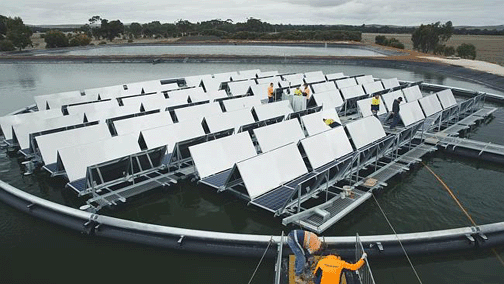 Floating solar power plant mooted for Karoonda to power waste management pump station http://www.abc.net.au/news/2015-10-30/floating-solar-power-plant-mooted-for-karoonda/6899436 The District Council of Karoonda-East Murray says it will look into the possibility of a floating solar power plant at Karoonda in South Australia’s Murray-Mallee region.
Council CEO Peter Smithson said the floating solar plant would provide power for the waste management pump station next to the stormwater dam.
A similar plant is already operating at Jamestown in the state’s mid-north.
Mr Smithson said the council had committed to undertake further due diligence about the green power opportunity.
“We’ve been approached by a company about the possibility of a solar generating power plant at Karoonda which would provide power to our CWMS [Community Wastewater Management System] pumps,” he said.
“We’ve gone and looked at Jamestown.
“There’s quite a long resolution because it really details the fact that there’s no capital outlay by council and it really looks at the fact that we’ve done due diligence and we’ve asked the company to come and address the next council meeting.
NoNukes South Australia comments on the South Australian media
 The News’ media in South Australia are daily and nightly having a nuclear field day in what they say promoting human nuclear as saviour of the planet.
It is easy to see who and what this Mr Jacobi and his mob are about.
The human nuclear mob have been intensively above and behind the scenes of the human nuclear movement since early the past century.
IT IS IMPORTANT TO POINT OUT THAT THE DEBATE REGARDING HUMAN NUCLEAR WAS ALREADY DONE – ALREADY COMPLETED – IN THE 1970’s IN AUSTRALIA
THE VERDICT OBTAINED BY ALL EXPERTS ASSEMBLED AT THE TIME FROM NEAR AND FAR WAS
vvvvvvvvvvvvvvvvvvvvvvvvvvvvvvvvvvvv
NO HUMAN NUCLEAR.IN AUSTRALIA
^^^^^^^^^^^^^^^^^^^^^^^^^^^^^^^^^^^^^^
and especially since there is an extreme pristine clean perpetual abundance of Sunshine and Natural Gas in over and all around Australia that could last almost forever in a conservative frugal austere sustainable society, such as the People Society who has a record of over 50,000 years of natural pre-Invasion habitation.
Regarding the sudden re-appearance of the erroneous need for human Nuclear evaluation and approval:, the same words of wisdom apply as they did for the mass falsetto of the South Australia State Bank Debt crisis (deliberately engineered by human world finance in the 1980’s) and also the pre-emptive dumping of the Libya-like Gough Whitlam government earlier in the 1970’s
“The World is governed by very different personages from what is imagined by those who are not behind the scenes.”
Benjamin Disraeli – British Statesman
NEVER TRUST NEWS
NEVER TRUST HUMAN NUCLEAR
Fed up with the #NuclearCommissionSAust
 Yes, I am fed up with the charade of this Royal Commission – its pro nuclear bias is apparent from the very start – with nuclear enthusiasts strongly represented, starting from Commissioner Kevin Scarce.
Today I looked for the transcript of the hearing with Dr Helen Caldicott on 27 October. Well, it’s hard to find. When you go to the appropriate page on the Commission’s website – not a mention of Dr Caldicott, though she was the first speaker that day.
The one that they do mention is Professor Geraldine Thomas, Imperial College London. Prof Thomas is a very well known pro nuclear speaker. She appeared prominently on the nuclear dragon thing soft sell series on SBS. Thomas has spruiked about radioactive iodine, but conveniently has ignored other radioactive isotopes. (I’ve not read her latest spruik to the RC, but you can bet your boots that she is lobbying away there for the nuclear cause. Sadly Imperial College is becoming notorious for this.)
I have been reading through the transcript of Dr Caldicott’s speech, or more correctly, interrogation. by the redoubtable Mr Jacobi.
I am amazed at the aggressive questioning of Dr Caldicott – it seems to me to be aimed at discreditiing her.
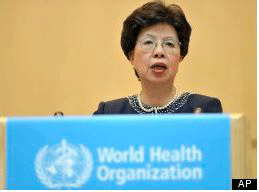 Not long ago, Dr Margaret Chan of the World Health Organisation stated “There is no safe low level of radiation”
Yet when Dr Caldicott said that same thing, she was subjected to aggressive questioning and demand for exact sources.
I wonder whether Mr Jacobi would have subjected the head of the WHO to the same insulting inqusition.
Opportunity for Port Augusta to be repowered with solar thermal energy
 Repower Port Augusta, 30 Oct 15 In incredibly exciting news, after returning from a visit to a massive solar thermal plant in the United States, the federal local member for Port Augusta Rowan Ramsey has revealed to The Transcontinental that US solar thermal giant SolarReserve have made a bid to build solar thermal with storage in Port Augusta!
After a long running community campaign, numerous studies and actions from people like you this revelation is a huge step forward in the community driven push to Repower Port Augusta with solar thermal.
So, what does this mean?
The ACT Government are using a policy called a reverse auction to help them meet their 100% renewable energy target by 2025. This is a policy where they effectively bid for projects to buy renewable power from and early this year they called for bids from projects across the country from solar with stoage.
This is the policy we called on the SA Government to adopt in our submission to the state government that many of you signed onto.
We are still waiting on the result of the bid, but we know the bid for solar thermal from Port Augusta is one of thirty from across the country.
It’s a huge step forward and a testament to the community campaign backed by people across the country that SolarReserve are ready to build solar thermal in Port Augusta.
Conflict of interest in nuclear authorities: Dr Gordon Edwards explains
Dr Gordon Edwards at SA NUCLEAR FUEL CYCLE ROYAL COMMISSION hearing, 21 October 15
Dr Edwards gave a wonderful explanation of the danger of nuclear technology, focussing on explaining radioactivity.
He also spoke of his concerns about the independence of nuclear regulators, and of safety measures needed for population near nuclear facilities, for example, how Canada supplies potassium iodate pills to communities.
Extract DR EDWARDS: The complexity of the technology means that a lot of people 45 are mystified by it, including decision-makers, and politicians, for example, .SA Nuclear 21.10.15 P-742 Spark and Cannon generally don’t necessarily have a background in nuclear science. One of the only ones I know, I think, was Jimmy Carter, he was actually a nuclear engineer in the American nuclear navy. But outside of him, I don’t think of any major politician who has a background in nuclear science.
So that the technology is sufficiently complicated that people tend to be mystified by it and therefore feel a little bit – they find it difficult to judge, other than by trusting the experts in the industry itself. The difficulty with trusting the people in the industry itself, is that there is either consciously or unconsciously a kind of a conflict of interest there because they are devoted to the industry 10 and they want the industry to succeed and of course they try to reassure the public that it’s safe and they try their best to make it safe but there is this problem of – well, what if they weren’t so devoted to the industry and had the same knowledge, would they make the same judgment? Would they perhaps see it as being unsafe? And one of the difficulties with dangerous technologies 15 is that people who work on the technology feel conflicted and it’s difficult to blow the whistle on a technology that you truly believe in. So this is an inherent problem.
Similarly when you have a regulator, although independence is the goal, it’s 20 difficult to maintain that independence. The people in the regulatory body are often drawn from the very industry that they are regulating because they are experienced in that field and consequently you need people with understanding and expertise, so how do you kind of keep regulatory independent when in fact there is this constant interaction between the people in the regulatory body and 25 the people in the industry. They tend to come to see themselves as colleagues and if I might draw an analogy, you might think of the regulator as drifting towards being more of a coach than a referee…….So this problem of independence is not an easy one to deal with…….
Another thing that I think would be very helpful in my own opinion would be regulators, as the industry itself, they tend to be very top heavy with engineers and physical scientists, geologists and such like, 5 chemists, the so-called hard scientists and they tend to be extremely thin on biomedical expertise. I think it’s very helpful to have some biomedical expertise in the regulatory body because they have a different perspective. They have a different approach and also if and when things do go wrong, the biomedical team can be very helpful in advising the public and the workers and 10 everybody, as to what kind of precautions to take in terms of protecting yourself. What kind of foods should be avoided? What kind of measures should be taken? I think it would be very reassuring to the public to have such people on board.
Moreover, if you had a health department, which we do not have in our regulator, if you had a health department staffed with competent and independent biomedical people, they could also help to educate workers and the public as to why we are so careful with this technology. Why we must invest in all these safety precautions because they could make it clear what the dangers are. Continue reading
100% renewable energy electricity company launched in South Australia
South Australian company to launch country’s first 100 per cent renewable energy utility provider, ABC News By Alex Mann, 26 Oct 15 A South Australian company will launch the country’s first 100 per cent renewable energy utility company, with the author of the 2008 Climate Change Review signalling his support.
Professor Ross Garnaut has been appointed chairman of Zen Energy and said the company’s launch would be a game changer.
“I’ve been disappointed that the established energy companies have not taken the opportunity that’s there,” he said.
The company will use a combination of solar power generation, battery storage, and localised energy grids to create self-sustained communities that will buy back the power they generate.
For years, Zen Energy has been putting battery units in people’s homes.
Now its chief executive Richard Turner plans to take entire communities off the grid — from social housing stock, to apartment buildings and regional communities.
He said he will generate the power, then sell it back to users at a fraction of the current costs.
“We’re looking at a spot in the market very soon where we’re going to be almost half the cost of the grid,” he said.
It could be the end of the power grid as we know it
It is just the latest disruption in an energy revolution sweeping across Australia which could spell the end of the power grid as we know it……….http://www.abc.net.au/news/2015-10-26/sa-company-launch-renewable-energy-utility-company/6886578
Tourism industry at Maralinga – but how safe is Maralinga nuclear bomb site?
from THE AUSTRALIAN, 26 Oct 15 …… Robin Matthews, the weathered caretaker of Maralinga nuclear test site, welcomes his visitors with some soothing words: the endless expanse of red gibber plain is safe — just as long as you do not dig.
Concealed under the rusty soil lies 60-year-old secrets of the British Empire, where seven nuclear bombs were detonated and hundreds of minor trials using plutonium and other radioactive materials contaminated kilometres of land.

But look close enough and the remnants of the tests are there — from the salt bush that refuses to grow any taller than 30cm and marks out a wide circle in the blast zones to scattered shrapnel and dark-green glass scattered across ground zero at the Breakaway nuclear test site, created by the heat of the explosion……
Most of the land was handed back to the Maralinga Tjarutja Aboriginal people in 2009 after rehabilitation work was finished, but Defence held on to the weapons-testing range in the Woomera Prohibited Area. In November last year, the 1782sq km site was officially handed back to the Aboriginal people.
Government papers released in 2011 show the site had required further remediation, with the topsoil over the massive Taranaki trench — four football fields wide and three storeys deep and now the burial site for contaminated topsoil and machinery — eroding over time.
Maralinga-Tjarutja general manager Richard Preece said the traditional owners of the land still did not want anything to do with the area, which they described as mamu (devil) country…..
Mr Preece said Maralinga was not only a legacy for Aboriginal people, but also for all Australians who had to remediate the site and were now left with buried radioactive material.
“I find it incredible that somehow it was all right for the British government on foreign soil to create a radioactive mess that was completely left to Australia,” he said.
1 This month


Help Aunty Sue Protect Her Land and Sacred Sites From Destructive Rocket Testing.
.

Australians deserve the truth
about
AUKUS – https://aukuspublicinquiry.com/

PETITION – To: Prime Minister Anthony Albanese and the Australian Labor Government

of the week – Australians for War Powers Reform (AWPR)
To see nuclear-related stories in greater depth and intensity

