New nuclear energy is an expensive fantasy – Dr Mark Diesendorf
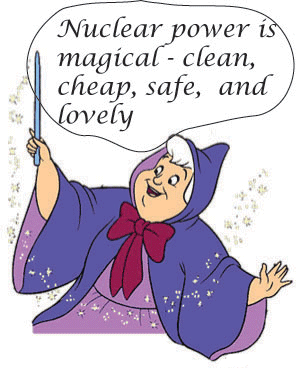 The fantasy of cheap, safe nuclear energy http://indaily.com.au/opinion/2015/09/28/the-fantasy-of-cheap-safe-nuclear-energy/ Back in the 1970s and 80s, solar and wind energy were expensive and their supporters were criticised by the nuclear industry for dreaming of a renewable energy future.
Nowadays the situation is reversed. Several countries are well on their way to their targets of 80-100 per cent renewable electricity while global nuclear energy generation ceased growing nine years ago.
In northern Europe and the USA wind energy is about half the price of nuclear. In South America contracts to deliver electricity from big solar photovoltaic (PV) power stations are being signed at 8 US cents per kilowatt-hour, already less expensive than nuclear, and the price of solar PV is still declining. In many places, including mainland Australia, rooftop solar is much less expensive than retail electricity from the grid.
The current fantasy is that nuclear energy is cheap, safe, CO2-free and necessary, and that South Australia could make a profit storing the world’s nuclear wastes. All of these claims by enthusiasts for the nuclear fuel cycle, made in submissions to the current Nuclear Fuel Cycle Royal Commission, are poorly based.
In theory, the geologically stable regions of South Australia could provide a location for storing high-level nuclear wastes. But as yet there are no permanent repositories operating anywhere in the world. It would be crazy for Australia to attempt build one when the USA has failed.
Apparently recognising this, South Australian Liberal Senator Sean Edwards has proposed an even greater fantasy: that South Australia could earn huge revenue from storing the world’s high-level wastes temporarily in dry casks. He claims that the revenue would be sufficient to fund a nuclear power station.
Unfortunately, this scheme fails under basic economics. Why would a nuclear power country pay the additional costs of shipping and storing high-level waste in Australia when it can store its own wastes temporarily in dry casks? Indeed, several nuclear power countries are already doing this.
Senator Edwards’ fantasy is that Australia could convert the long-lived component of the nuclear wastes into nuclear fuel in an Integral Fast Reactor. However, this technology is not commercially available. It has only ever existed as a pilot plant in the USA. Proposing that SA buy unproven technology at huge expense is a poor prescription for the economy.
Australia could not convert the contents of the dry casks to nuclear fuel. We would be stuck with managing them while they corrode and release their deadly contents. It’s far better to leave the source countries to handle the huge costs and risks of managing their nuclear wastes for 100,000 years or more.
Turning to nuclear power stations, both the Australian Energy Market Operator and our own research group at UNSW have shown independently that the National Electricity Market, which includes South Australia, could be operated reliably and affordably on 100 per cent renewable energy. The UNSW research uses only scaled-up commercially available renewable energy technologies. The results of the computer simulations, now spanning eight years of hourly data, are supported by practical experience in South Australia where at times renewable energy provides up to three-quarters of electricity.
Nuclear power is very inflexible in operation, unable to follow the variations in wind and solar PV output. It would be an inadequate partner for a SA electricity supply system that will soon be predominantly renewable. Instead, flexible peak-load plants are required: biofuelled gas turbines, concentrated solar power with thermal storage, and, in appropriate locations, pumped hydro.
Furthermore, under current market rules, wind and solar, with their tiny operating costs, would have priority in supplying base-load demand. Nuclear power would be displaced from operating as base-load power, just as coal is currently being displaced in SA. Then, nuclear energy would have even greater difficulties in repaying its already exorbitant capital costs.
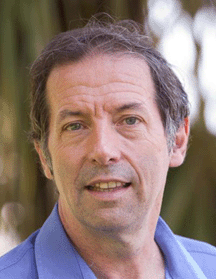
Dr Mark Diesendorf is Associate Professor in Interdisciplinary Environmental Studies at UNSW. He gave evidence to a hearing of the Nuclear Fuel Cycle Royal Commission on 14 September.
Professor John Quiggin dismisses the CANDU nuclear reactor at the #NuclearCommissionSAust
 SA NUCLEAR FUEL CYCLE ROYAL COMMISSION PROCEEDINGS, WEDNESDAY, 23 SEPTEMBER 2015, Excerpts from the transcript
Prof Quiggan: “……..I think we’ll go back to carbon pricing and we’ll go down essentially a renewable (indistinct) perhaps already well-established industry. With popular acceptance – there’s obviously a little bit of objection to wind but broad 40 popular acceptance and essentially all we need is the price signal and some policy certainty and that’s the path we’ll take……..
Coober Pedy gets another visit from #NuclearCommissionSAust
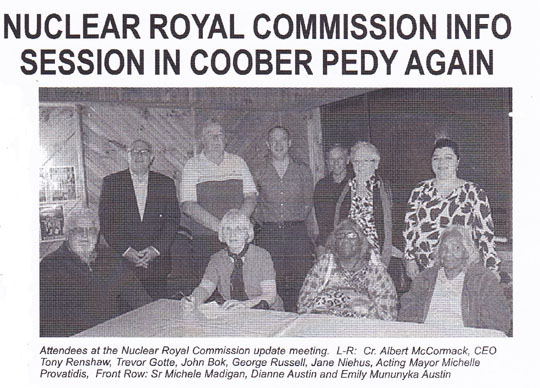
https://cooberpedyregionaltimes.files.wordpress.com/2014/05/coober-pedy-regional-times-24-09-2015.pdf , Noel WauchopeThe South Australian Nuclear Fuel Chain Royal Commission went to Coober Pedy again, on September 18th. John Bok, Regional Engagement Manager for the Commission was there to make a presentation about the Royal Commission. Bok stressed that he was there only to provide information about the Commission’s processes, and also that the Commission’s findings would be evidence based..
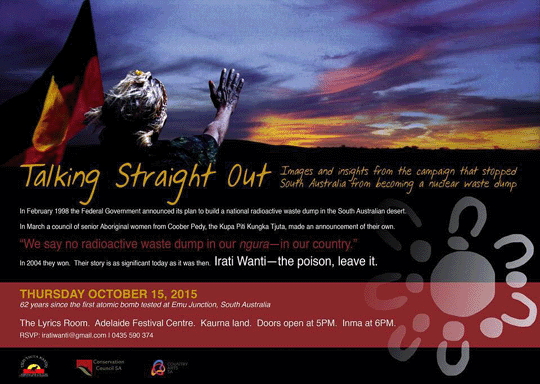
We are the Aboriginal Women. Yankunytjatjara, Antikarinya and Kokatha. We know the country. The poison the Government is talking about will poison the land. We say, “No radioactive dump in our ngura – in our country. It’s strictly poison, we don’t want it.”
We do not want nuclear anything on our Land – Anangu Pitjantjatjara Yankunytjatjara Law and Culture
APY LAW & CULTURE – CONCERNS FOR NUCLEAR WASTE, Coober Pedy Regional Times, 24 Sept 15, Anangu Pitjantjatjara Yankunytjatjara Law and Culture is declaring its intention to move away from the APY Administration. For a long time our committee has been worried about the direction the APY Administration is taking.
On several occasions we have been told Law and Culture is a side committee, that it is second to the APY.
Law and Culture comes first. It always has. The administration needs to understand this. All Anangu know that our Law and Culture comes first, our Law and Culture must be at the heart of decision making. We have decided to stand alone. Our Law and Culture will come first. Our lives depend on it. We will source alternate funding.
One of our big concerns is the Royal Commission into Nuclear Energy. Law and Culture says no to APY Lands being used to mine uranium or dump the waste.
Renewable Energy way ahead of nuclear – Rebecca Keane’s Submission to #NuclearCommissionSAust
 http://nuclearrc.sa.gov.au/app/uploads/2015/09/Rebecca-Keane-23-07-2015.pdf I am astonished that South Australia is even being considered as a site for nuclear power plants and/or radioactive waste dumps. Australia’s rapid and widespread progress in the harnessing of our virtually unlimited solar energy resource is evident in the fact that currently 1.4 million households have rooftop solar installations!. The huge potential for expansion in this field negates any need for the pursuit of such a highly dangerous enterprise as nuclear power generation.
Solar thermal energy supply, where solar energy is stored as heat is also highly efficient and offers
tremendous opportunities in this country. Moreover, our nation’s geographical conditions are extremely favourable to the massive development of other renewable sources such as wind, hydro and wave power. Wind energy is emerging as a highly cost-effective resource and vertical axis wind turbines are particularly effective and create no noise issues.
The West Australian coast is subject to the world’s strongest wind system (The Roaring Forties) with the energy released each year from the pounding of the waves influenced by this system, equating to five times Australia’s annual total energy usage2. Over 85% of Australians live in close proximity to the
coast.
A combination of the utilisation ofrenewable intermittent sources such as solar, wind
and wave energy with back-up hydro and gas-driven turbines is recognized by experts throughout the world as being highly comparable in terms of both adequacy and reliability of supply, to existing coal-driven technology. Over 24,000 people are employed in Australia’s renewable energy industries compared to 10,000 in coalmining for the domestic market 3 Continue reading
South Australian govt removes regulatory hurdle on renewable energy
If South Australia were a nation, it would be second only to Denmark in regard to wind energy. It’s no slouch on solar power either. While it may not host the largest number of solar panel systems in Australia; it leads the nation based on the percentage of households with home solar installed.
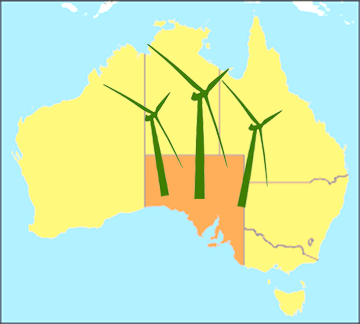 More Of South Australia Opened Up To Renewable Energy Projects http://www.energymatters.com.au/renewable-news/south-australia-renewables-em5081/ September 22, 2015 Energy Matters The South Australian Government has reduced regulatory burdens on renewable energy projects on state Crown lands; a move it says will provide greater certainty to investors and make South Australia even more competitive.
The proclamation of the Pastoral Land Management and Conservation (Renewable Energy) Amendment Act 2014 means wind farm developer can now apply for 25-year licences on Crown land; subject to pastoral lease tenure. Developers will also be given the option to renew for another 25 years.
“Securing investor confidence is key to the long-term future of the renewable energy industry, and this Act serves to cement South Australia’s position as the preferred destination for renewable energy development,” said Climate Change Minister Ian Hunter.
Additionally, the Act will expedite access for the development of solar farms and also ensure local communities reap the benefits of renewables investments; with 95 per cent of licence payments flowing through to pastoral lessees and native title holders. Continue reading
Electrical trades Union of Australia dispels the hype about Generation IV Nuclear Reactors
Electrical Trades Union, Graham Glover Submission to South Australian Government Nuclear Fuel Cycle Royal Commission http://nuclearrc.sa.gov.au/app/uploads/2015/09/Electrical-Trades-Union-03-08-2015.pdf

Adelaide Hills site suitable for nuclear reactor – #NuclearCommissionSAust
Nuclear Fuel Cycle Royal Commission hears Adelaide Hills site earmarked as suitable for nuclear reactor http://www.adelaidenow.com.au/news/south-australia/nuclear-fuel-cycle-royal-commission-hears-adelaide-hills-site-earmarked-as-suitable-for-nuclear-reactor/story-fni6uo1m-1227533674218 September 18, 2015 CHIEF REPORTER Paul Starick The Advertiser SITES in the Adelaide Hills and Port Augusta have been earmarked as suitable for a nuclear power plant should one be built in South Australia, a royal commission has heard.
The operator of the state’s high-voltage electricity network said the existing power station site at Port Augusta, which is slated for closure, would be suitable for a nuclear reactor.
ElectraNet executive manager asset management Rainer Korte also said this was among four suitable sites in the network – the others in Adelaide and the Hills. Those in Adelaide were unlikely to be used for a nuclear power plant, he said.
Mr Korte was responding to a question by Chad Jacobi, counsel assisting the Nuclear Fuel Cycle Royal Commission, about where a 1000-megawatt nuclear power plant could be connected to the SA electricity network. He said: “One of them is at Davenport, which is near Port Augusta, which is where essentially the current northern power station is connected.
“The other two are in Adelaide, in the Adelaide metropolitan area where you arenot likely to see any major development of a power station for environmental reasons and others.
The royal commission, headed by former governor Kevin Scarce, is conducting public sessions to inform a final report due by May next year. It is investigating the potential for SA to be involved in nuclear power, waste storage, enrichment and further exploration and milling.
An Adelaide Hills site described as in the Mt Lofty Ranges or just east was previously identified as a possible place for a nuclear reactor in a 1997 federal Cabinet submission, leaked in 2006. Sites at Woomera and Olympic Dam also were among 14 places across Australia detailed in the submission, prepared for then science minister Peter McGauran.
In other royal commission evidence on Friday afternoon, SA Power Networks senior manager Mark Vincent said forecasts predicted solar energy would be used by two-thirds of SA households in about 20 years. In the same period, it was predicted about 100,000 electric cars would be using SA roads – for which Premier Jay Weatherill is planning new road laws.
Exposing Michels Warren and Nuclear Waste Dumping in South Australia
Nuclear Fuel Chain Royal Commission WEEK 11 – MANAGEMENT,  STORAGE AND DISPOSAL OF NUCLEAR AND RADIOACTIVE WASTE, Jim3 17 Sept 11115
Michels Warren is a PR company working for the Nuclear Fuel Cycle Royal Commission. The company was involved in the Howard government’s failed 6-year attempt to impose a national nuclear waste dump in South Australia. A great deal of information is available about the role of Michels Warren in this controversy thanks to documents released under Freedom of Information (FoI) legislation.
A September 27, 2000 email written by Stephen Middleton from Michels Warren talked about the need  to “soften up the community” and “sell” the repository: “We will lose ground once again unless we can soften up the community on the need for the repository and the reasons why SA has been identified as the best location. The prospect of the Minister announcing the preferred site before we can get to the community with something that explains what it all means makes my head spin. The wider research into issues such as Lucas Heights, uranium mining, the nuclear fuel cycle etc etc can be tackled as a separate issue. It should not hold up anything we are doing in terms of selling the repository to South Australians. The rest of the country probably doesn’t care less about the repository, but it is a big issue in SA. Further delays could be potentially disastrous.”
Why was a South Australian company willingly involving itself in the federal government’s nuclear dump plans? After all, Michels Warren itself acknowledges that the dump is an unwanted imposition on SA.
A 2003 Michels Warren document released under FoI legislation stated: “The National Repository could never be sold as “good news” to South Australians. There are few, if any, tangible benefits such as jobs, investment or improved infrastructure. Its merits to South Australians, at the most, are intangible and the range and complexity of issues make them difficult to communicate.”
So why was Michels Warren dumping on its home state? Money, of course. In total, Michels Warren was paid at least $487,000 to dump on SA … and possibly much more. Michels Warren staff were paid at rates up to $192.50 per hour for their work on the nuclear dump campaign.

An August 16, 2000 “high priority” email reveals that Caroline Perkins, a senior official in the  Department of Industry, Science and Resources – at that time under the direction of Senator Nick Minchin – was asked to compile information on protesters. “[T[he minister wants a short biography of our main opponents in the Ivy campaign by about 11am our time (pre-rally)”, the email said. The rest of the email is blacked out under FoI provisions. The email refers to a Michels Warren employee – no doubt Michels Warren helped compile the biographies. Continue reading
Transport and storage of nuclear spent fuel is just too dangerous
Nuclear Fuel Chain Royal Commission WEEK 11 – MANAGEMENT,
STORAGE AND DISPOSAL OF NUCLEAR AND RADIOACTIVE WASTE, dan 17 Sept 11115 Any risk assessment for the management of spent nuclear fuel should firstly consider the current management practice internationally. In considering the possible establishment of a new facility, it should firstly be accepted that transportation of spent nuclear fuel to any centralized facility presents risk which could be avoided entirely if waste is managed at or near its present locations.
In some cases, spent nuclear fuel is currently stored in closer proximity to human populations than desirable, so I can understand some host nations’ desire to export their spent nuclear fuel liability to a distant receiving country like Australia. I also acknowledge the position presented by Barry Brook and Ben Heard that future reprocessing technology may be able to separate uranium and plutonium from the spent fuel and produce electricity as a by-product of this process. The risk associated with this vision of the future is that such technology currently expressed in theory may never eventuate, and the spent nuclear fuel may thus prove to be an extremely long-lived management liability.
 Risks which Australia should consider if considering the prospect of importing spent nuclear fuel include the possible appropriation of shipments by terrorist groups either in transit or after receipt. Similarly, a transport vessel may be attacked and join the number of sunken nuclear-fuelled submarines slowly corroding on the seabed around the world, destined to have unknown ecological impacts. As this Commission is no doubt aware, spent nuclear fuel can be reprocessed to obtain plutonium and uranium, both of which can be then repurposed as weapons material. This has serious implications for nuclear weapons proliferation risk.
Following receipt of spent nuclear fuel, the responsibility for protecting this material would presumably become Australia’s and would remain so for centuries (pending some technological breakthough in speculative technology). Should Australia enter war during the course of the life of the radioactivity contained in the stored spent fuel, or otherwise become a future terrorist target, any centralized repository of spent nuclear fuel represents a potential air-strike or bomb target.
If such an attack were to occur, storage vessels may be ruptured and release radioactive material to the atmosphere, essentially functioning as a ‘dirty bomb’. Wherever spent nuclear fuel is stored, it is my opinion that every measure should be made to protect it from air-strike or terrorist attack. The fallout from such an event would lead to the establishment of a new sacrifice zone, akin to those surrounding stricken Chernobyl and Fukushima nuclear power plants. Consequences for human health would take years to manifest and be demonstrably linked to such an event- meanwhile displaced persons would suffer anguish and may, as in the case of Fukushima, lead to people taking their own lives. Should such a facility be located in the South Australian outback, those most directly affected would likely be indigenous Australians, who would mourn the event as a colossal, cultural loss as their connection to country is severely damaged.
Obviously wartime or terror attack-proofing of spent fuel storage is not achieved in many locations where spent nuclear fuel is currently stored. I would assume that the quantity of these stores would be smaller than any proposed new facility, dedicated exclusively to the storage of spent nuclear fuel. Perhaps there is a case for improving management of spent nuclear fuel at or near existing storage.
Should a new facility be constructed, it should (in my opinion) be secure and underground, in a position where water infiltration is extremely unlikely. Examples of corrosion and water infiltration proving problematic for nuclear waste storage facilities include Orchid Island (Taiwan) and Yucca Mountain (USA).
When all is thoroughly considered, it might be concluded that the improvement and standardisation of current storage practise at or near locations where spent fuel is currently held provides an alternative pathway to proceed down if the objective of this exercise is risk minimisation.
Crisis of confidence in the process of #NuclearCommissionSAust
 Submission to the South Australian Nuclear Fuel Chain Royal Commission, by Senator Scott Ludlam
Extract The Australian Greens have cautiously welcomed the idea of a Royal Commission to settle the issue of the nuclear industry in Australia once and for all.
For decades there have been the protagonists for and against the industry. There have been reports and case studies, public debates, political debates but nuclear power always comes up as unfeasible and hugely unpopular.
It is disappointing that this opportunity to examine the industry has been designed to exclude so many important issues and many voices on those issues. The process, independence and good fa ith of the Royal Commission has been damaged by narrow terms of reference, an unbalanced expert panel and consultation failures in remote and regional communities.
The terms of reference have been designed to exclude any review of the existing problems with uranium mining and waste management, the ongoing costs and liabilities from closed mines and processing facilities- costs that are left to the tax-payer.
The panel is in no way independent or balanced; it has been dominated by the nuclear industry and their advocates. We note complaints from Aboriginal communities in South Australia about the first round of ·engagement. Many people did not know about hearings or had limited warning about hearings. Others have not been given access to documents and or do not have access to the Internet, or do not speak English. We have had reports that hearings have been held in pubs at 11am – completely inappropriate for working people, and those who wouldn’t set foot in a pub.
There have been significant barriers put up for people in remote and regional communities. Inaccessible meetings and information, language barriers and the added constraint of getting submissions approved by a justice of the Peace all serve to exclude participation in the process. People in remote areas of SA have been most affected by South Australia’s involvement in the nuclear industry, and they are also the ones who are most likely to be affected by any future industrial nuclear activities. We are at a point where is a crisis of confidence in the process…..”
#NuclearCommissionSAust – a preliminary analysis of submissions
Companies and individuals who sent in submissions (as published so far at http://nuclearrc.sa.gov.au/submissions/?search=Submissions)
- they bundle people’s submissions together under whatever heading (i.e Issues Paper number) they feel like.
- If separate submissions were sent in, as I did – sending 4 separate, they don’t necessarily all appear, or if they do appear, not under the heading they were intended for.
- While companeis and agencies like ANSTO are listed alphabetically, individuals are listed under their first name, not surname – alphabetically. (makes it hard to find e.g if you looked for Dr Diesendorf)
- It is difficult to work out how many individuals and organisations actually sent in submissions, as many people have put in several. My list below is just of those who sent in submissions, whether they sent in just one submission or several, I have counted each only once.
- Anti -nuclear total 75
- Pro nuclear total 66
- Pro nuclear – something to gain – business, career,and
- Anti nuclear – for the public good
Nuke power too expensive, too inflexible: energy expert
14 Sept 15 Leading energy expert Dr Mark Diesendorf will be in Adelaide today to give evidence before the Nuclear Fuel Cycle Royal Commission.
“Nuclear power is simply not a practical option for South Australia. It’s hugely expensive compared to the alternatives and its inflexibility, like coal, makes it a poor partner for your state’s high proportion of renewable energy,” said Dr Diesendorf.
“My research shows that South Australia has a real opportunity to get to 100% renewable energy generation before any nuclear power plant could ever be built here,” he said.
The Conservation Council of SA commissioned Dr Diesendorf from the University of NSW to research whether SA could reach 100% renewable energy generation by 20301. His team found that it was feasible and affordable.
“Australia’s National Electricity Market could be operated reliably on 100% commercially available renewable energy technologies”, Dr Diesendorf said. “Such an ecologically sustainable, renewable energy system would be affordable and could create thousands of new jobs in manufacturing and installation.”
Distinguished economist Professor Ross Garnaut told the Royal Commission last week that nuclear power is unlikely to become economically viable in South Australia as the state’s “exceptional” renewable energy sources become cheaper.
Conservation SA chief Craig Wilkins said “As each day passes, the gap between the cost of renewables and the cost of nuclear power grows. Renewables are getting cheaper, while the cost of nuclear power – already massive – rises ever higher.
“Just last week, French nuclear giant Areva conceded that the cost estimate for a new reactor at Flamanville has reached a staggering $16.8 billion – three times the initial estimate.”2
“When we’re already a world leader in renewable power. nuclear power simply doesn’t make sense for our state,” he said.
1www.conservationsa.org.au/images/100_Renewables_for_SA_Report_-_Dr_Mark_Diesendorf_-_web_version.pdf
2 www.world-nuclear-news.org/NN-Flamanville-EPR-timetable-and-costs-revised-0309154.html
Media Contacts: Dr Mark Diesendorf, University of NSW: 0402 940 892 Craig Wilkins, Conservation SA: 0417 879 439
A Submission to #NuclearCommissionSAust raises objections to its whole modus operandi
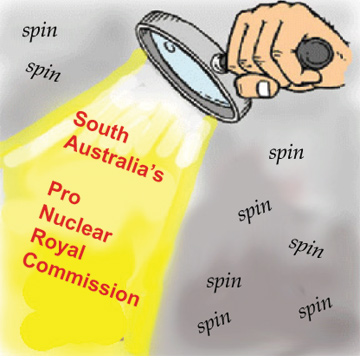 Submission to the SA Nuclear Fuel Cycle Royal Commission Ally Fricker & Bob Lamb for ENuFF (Everyone for a Nuclear Free Future)
A few introductory objections about the RC:
* The 4 Issues Papers provided by the RC became available throughout the early part of May 2015, and the RC was still holding information meetings until the 3rd week of May, thereby, limiting the time available in which people could, reasonably, be expected to respond to the complexities of the nuclear fuel cycle
* The highly structured format required in which to respond including the unnecessary requirement for a statutory declaration
* The bias in the “objective” information provided followed by “questions to be answered”; indeed, the questions are so loaded that frequently they, in themselves, determine the answer – or hope to. We noted information only from industry and/or government sources. No authors critical of the industry were cited
* The timing of the federal government’s adverts calling for tenders for long-term disposal for Lucas Height’s waste concurrent to the commencement of the RC
* The likelihood that the mining lobby and other pro-nuclear interests had prior notice – a couple of high-profile conferences were held in Adelaide at the time of the announcement of the RC which gave first Tim Stone (March 12) and shortly after Barry Brook timely and extensive media opportunities to spruik their pro-nuclear arguments and
* The timing of Premier Jay Wetherill’s enthusiastic comments about opportunities for SA which could come from an expansion of the nuclear industry in SA in stark contrast to previous concerns expressed by him and former Premier Mike Rann.
For these and other reasons we consider that there is little likelihood that the RC will come to any conclusion that is not in the interests of the military/civilian nuclear industry in collaboration with SA and federal governments.
The history of this industry leads us to have zero trust in its statements, its modus operandi and its motivation in South Australia, at this time…… http://nuclearrc.sa.gov.au/app/uploads/2015/09/ENUFF-30-07-2015.pdf
Ross Garnaut not up to date about uranium enrichment
Philip White 11 Sept 15, So Ross Garnaut says nukes are too expensive for Australia. We didn’t need a Royal Commission to tell us that. Just look at the fiasco of the way over budget, way behind schedule new nuclear plants being built in France, Finland, and the US, not to mention the exorbitant subsidies being offered for the planned new plant in the UK.1 This month


Help Aunty Sue Protect Her Land and Sacred Sites From Destructive Rocket Testing.
.

Australians deserve the truth
about
AUKUS – https://aukuspublicinquiry.com/

PETITION – To: Prime Minister Anthony Albanese and the Australian Labor Government

of the week – Australians for War Powers Reform (AWPR)
To see nuclear-related stories in greater depth and intensity

