 Kynard 3 August 15
Yes, people understand that the outcome of commission is a foregone conclusion meant to placate those who are given the impression of having a say.
The only thing that would stop it now is incompetence or the simple fact that in the end the dollars may not add up. Or both.
Particularly the idea of a dump is making certain personality-types swoon the kind of greed which indicates that they’ve already counted the profits and discounted the risks.
Future generations don’t get a say. I’m sure that that far down the track, the countries who’ve dumped their waste on us won’t be paying us to babysit it anymore. The overall trend as all resources decline is continued economic contraction. The only sane growth is degrowth. One way or another we’ll be forced to embrace it. And that’s what people and particularly politicians don’t want to talk about. http://m.indaily.com.au/opinion/2015/08/03/sas-nuclear-debate-lost-in-translation/
August 3, 2015
Posted by Christina Macpherson |
NUCLEAR ROYAL COMMISSION 2016 |
Leave a comment
A couple of weeks ago, the Nuclear Royal Commission held a forum at the Marion Cultural Centre as one of a series aimed at engaging the South Australian people in the commission’s work.
The problem is, not one person came. Nobody.
Whether this raises alarm bells for the commission and the Weatherill Government depends on whether they genuinely want to create a community debate, or if they are just going through the motions.
 SA’s nuclear debate lost in translation http://m.indaily.com.au/opinion/2015/08/03/sas-nuclear-debate-lost-in-translation/ CRAIG WILKINS | 3 AUGUST 2015 The nuclear fuel cycle royal commission is so bureaucratic that it has failed to engage South Australians in the debate, argues the Conservation Council’s Craig Wilkins.
What if an expensive, high profile inquiry held a public meeting and no-one turned up?
In early February this year, while most of us were slowly emerging out of South Australia’s long, lazy summer break, Premier Weatherill made a surprise announcement. South Australia would hold a first for Australia: a royal commission into the future role our state should play in the nuclear industry.
This came as a bolt from the blue, especially from a Government that had campaigned successfully a decade ago to stop a similar federal push to establish a nuclear waste dump in Woomera. Then Premier Mike Rann was so determined to stop a nuclear dump he enshrined it in state law.
And the timing was strange, with our state strongly embracing renewable energy, and the nuclear industry languishing in a post Fukushima downturn.
So while a typical royal commission is created by a government under pressure to respond to a major issue dominating talkback and dinner table discussions, the task given to ex-Governor Kevin Scarce was both challenging and unusual.
Not only would Scarce have to explore the huge technical and economic challenges of an expensive, divisive energy source with big waste and security issues, he would need to get the South Australian community interested enough to pay attention in the first place.
A couple of weeks ago, the Nuclear Royal Commission held a forum at the Marion Cultural Centre as one of a series aimed at engaging the South Australian people in the commission’s work.
The problem is, not one person came. Nobody.
Whether this raises alarm bells for the commission and the Weatherill Government depends on whether they genuinely want to create a community debate, or if they are just going through the motions.
As a fierce advocate for public involvement in decision-making, I believe the problem lies in the way the commission is going about its task.
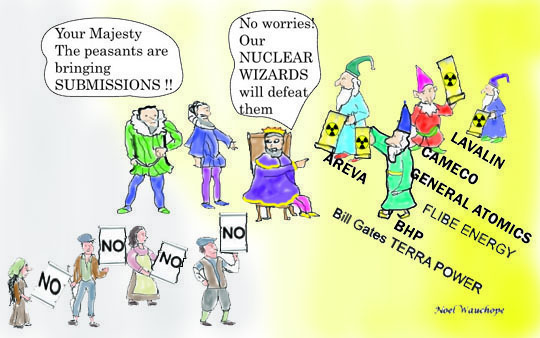
 The Issues Papers released to stimulate public submissions are an eye-watering challenge – dry, technical and full of assumptions. They appear aimed at industry players, not the general public. They have not been translated into other languages, despite non-English speaking Aboriginal communities being ground zero for any debate over a toxic dump.
Until far too late in the process, no-one with any expertise in engaging with Aboriginal communities was employed to work in the north of the state.
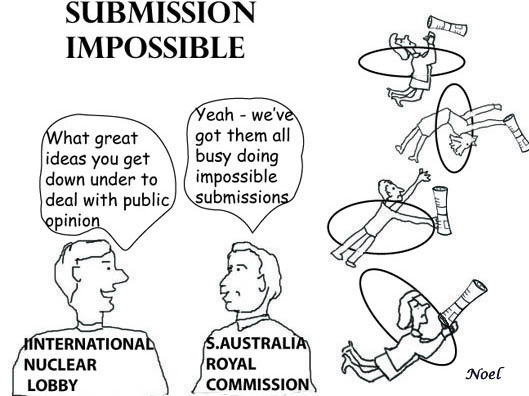
To put in a submission is an exercise in acrobatic hoop jumping including the requirement to appear in 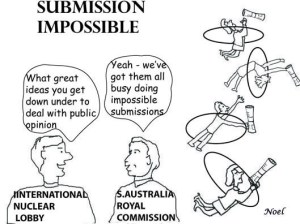 person before a Justice of the Peace – a huge challenge for anybody in rural or remote SA, and a totally unnecessary step not required for other similar inquiries.The ‘Community Forums’ that have been held so far have missed the mark, focusing on imparting information on the process, rather than an opportunity to debate issues in detail.
Also, Scarce in all his public statements has strongly emphasised that he is seeking “evidence” and “facts”, leaving little room for traditional cultural knowledge, or the perspective of a grandmother who doesn’t want to leave a toxic legacy for her grandchildren. Continue reading →
August 3, 2015
Posted by Christina Macpherson |
NUCLEAR ROYAL COMMISSION 2016 |
1 Comment
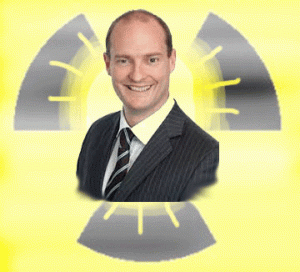 Mr Kenyon, now a backbench MP, refused to comment on the report.
The Sunday Mail understands it was not presented to Cabinet but became instrumental in prompting the current Royal Commission into the potential for the nuclear fuel cycle to revive the SA economy.
The report found there needed to be a good public relations campaign to convince people of the safety of the plan, and that money raised should be spent on infrastructure like the SA leg of a high speed rail to Melbourne.
It also proposed a model in which SA generate more money by leasing yellowcake mined here and taking it back as waste, and as a trade off people be guaranteed there will be no nuclear power plants in SA.
 Nuclear waste dump should be first cab off the rank, report finds by: MILES KEMP From: Sunday Mail (SA) Originally published as Nuclear dump could be key to our riches August 01, 2015 Available on The Australian website http://www.theaustralian.com.au/news/nuclear-waste-dump-should-be-first-cab-off-the-rank-report-finds/story-e6frg6n6-1227466384020
A BRIEFING paper delivered to the State Government recommended the state accept Taiwan’s nuclear waste, access that nation’s $10 billion disposal fund and establish an Outback nuclear waste dump to revive the economy.
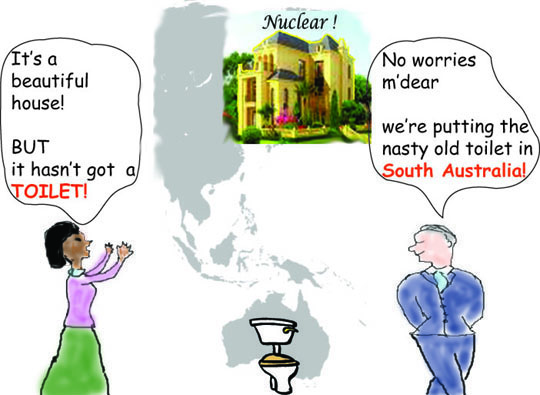
As the Nuclear Fuel Cycle Royal Commission explores the option to help solve SA’s jobs crisis, the Sunday Mail has obtained a copy of a report prepared for former Employment and Science Minister Tom Kenyon which argues the case for a waste dump near Woomera. Continue reading →
August 3, 2015
Posted by Christina Macpherson |
AUSTRALIA - NATIONAL, NUCLEAR ROYAL COMMISSION 2016, politics, South Australia |
Leave a comment
 SA Nuclear royal commission: Waste dump best economic option for state, Business SA says ABC News 3 Aug 15 Establishing an outback nuclear waste dump would be the best economic move for South Australia if the State Government decides to expand its role in the nuclear industry, Business SA says.
It has been revealed Premier Jay Weatherill last year received a report commissioned by former Employment and Science Minister Tom Kenyon, which found setting up a waste dump near Woomera could reap billions for the local economy.
A royal commission headed by Kevin Scarce is in the process of examining the potential for an expansion of the state’s role in the nuclear industry, including whether a nuclear power station or nuclear waste 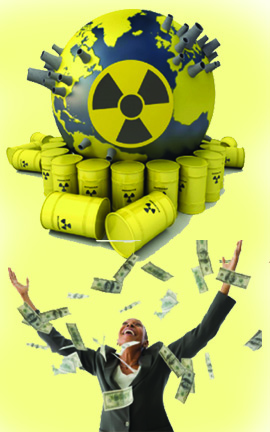 dump should be built.
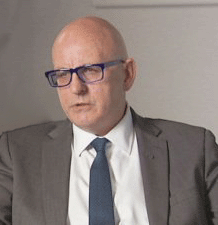
Business SA’s chief executive Nigel McBride (above, at left) said countries such as Japan and South Korea would pay handsomely to dump their nuclear waste in the state’s outback.
We know that there are huge potential financial benefits from being able to provide that service, and it’s logical that they’ve identified somewhere in the Woomera region as a potential site because of course it’s very remote,” Mr McBride said.
“There is a huge market out of countries like South Korea who has got a lot of nuclear waste they need to deal with, Japan and other Asian countries and of course countries around the world.”………..
Mr McBride said South Australia was the ideal location for a waste dump, and could store the nuclear fuel safely.
He said the biggest concern would be transportation options……
More than a decade ago, South Australia’s Labor Government fought and won a vigorous battle against the Howard government to stop a low-level nuclear waste dump being located in far north South Australia.
The royal commission is expected to hand down its findings by May 2016. http://www.abc.net.au/news/2015-08-02/nuclear-waste-dump-best-economic-option-business-sa-says/6666212
August 3, 2015
Posted by Christina Macpherson |
NUCLEAR ROYAL COMMISSION 2016, South Australia, wastes |
Leave a comment
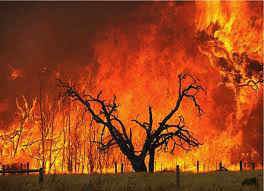 Dangers of Bushfires-Wildfires & Nuclear Business miningawareness, 3 August 15
 “………
According to the South Australia Country Fire Service, nearly 1/2 of people living in bushfire prone areas don’t understand the threat. This is apparently true of those proposing adding nuclear
anything in Australia.
For, in such a context, the risks of nuclear anything are clearly even higher than average. And, the solar potential in Australia is higher than average. The choice should be clear……..
In January of this year (2015) over 700 South Australian Country Fire Service volunteers fought the Sampson Flat bushfire series, helped by teams from New South Wales Rural Fire Service and Victoria Fire Authority, over the course of a week. On “Black Sunday” 1955 in South Australia, 1,000 Emergency Fire Service volunteers fought fires, but were overwhelmed and 2,500 citizens volunteered to help. For the 1983 Ash Wednesday Bushfires (II), 130,000 firefighters, defence force personnel, relief workers and support crews worked to fight the bushfires.Clearly this is serious business and dangerous in the best of
circumstances.
Adding nuclear to firestorms is even more dangerous than the Fukushima earthquake-tsunami disaster…………
Continue reading →
August 3, 2015
Posted by Christina Macpherson |
climate change - global warming, environment, safety, South Australia |
Leave a comment
 The role of water in Australia’s uncertain future, The Conversation Amgad Elmahdi Manager Water Resources Assessment Section at Australian Bureau of Meteorology Matthew Hardy Manager, Urban Water at Australian Bureau of Meteorology August 3, 2015 “…….Water security is threatened by a number of factors. These include climate change, rainfall variability, population growth, economic development, and drought.
For instance, across southern Australia climate change is projected to decrease winter and spring rainfall by up to 15% by 2030 regardless of whether greenhouse gas emissions are reduced.
Rainfall declines are amplified in reduced streamflow and in turn the water in storages. Southwestern Australia has seen streamflow declines of 50% since 1970, while streamflow during the Millennium Drought (1996-2010) in southeastern Australia was half of the long-term average………
Australia also has naturally highly variable rainfall influenced by events such as El Niño and La Niña. An El Niño was declared in May 2015.
The El Niño’s likely impact will be drier and warmer conditions across inland eastern Australia. Importantly the strength of an El Niño does not always indicate how severely Australia may be affected.
 These dryer conditions, should they arise, will place increased pressure on the water supply of effected regions. In particular, increased water demands and reduced stream flows will see declining surface water storage volumes. This could mean we need to develop and use more climate resilient sources………https://theconversation.com/the-role-of-water-in-australias-uncertain-future-45366
August 3, 2015
Posted by Christina Macpherson |
AUSTRALIA - NATIONAL, climate change - global warming, South Australia |
Leave a comment
Olympic Dam Mine: Largest User of Energy in S. Australia; Largest User of Australia’s Precious Water Resource – The Great Artesian Basin 31 Friday Jul 2015 by miningawareness The largest single user of electricity in South Australia is the Olympic Dam uranium, copper, gold, silver mine. Almost 60% of the energy in South Australia comes from renewables! Why would they need nuclear? Why a “Royal Commission”? They clearly want nuclear power so that they can sell their uranium to make energy to mine more uranium. Furthermore, the wise shun uranium, so to keep mining it in Australia, they need to dump it on Australia in the form of depleted uranium from enrichment, nuclear power, and the too often forgotten nuclear waste, to go with the radioactive tailings which they already have.
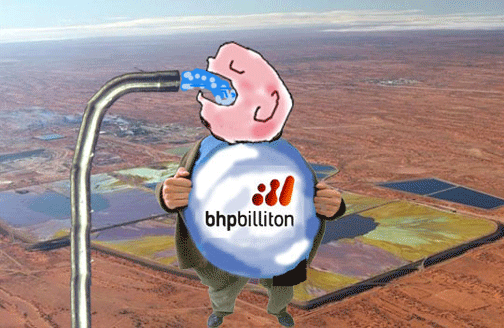
The largest user of underground water in the Southern Hemisphere is the Olympic Dam! Australia has a generally dry climate, and is highly dependent upon the same groundwater, underground aquifer, which is pumped for mining and most assuredly polluted by mining. Wikipedia says the Olympic Dam mine is the largest industrial user of underground water in the Southern Hemisphere. But, no single individual would use so much, so it much be the largest single user. Thus, it is also the largest single user of Australia’s precious Great Artesian Basin water.
August 1, 2015
Posted by Christina Macpherson |
South Australia, water |
2 Comments
Alinta Energy to close Port Augusta power stations and Leigh Creek coal mine early, ABC News 30 July 15 Alinta Energy has brought forward its deadline to close its power stations in Port Augusta and coal mine at Leigh Creek.
The company announced last month it would close the power stations and mine at some point between next March and March 2018…….http://www.abc.net.au/news/2015-07-30/alinta-energy-brings-forward-closure-power-station/6661082
July 31, 2015
Posted by Christina Macpherson |
energy, South Australia |
Leave a comment
 Open Letter to Flinders Uni – Keep Us Bjorn-Free http://www.aycc.org.au/bjorn_free
To Flinders University Vice Chancellor Colin Stirling and Deputy Vice Chancellor (Research) Robert Saint,
We, the below signatories, object to controversial Danish academic Bjorn Lomborg being offered $4 million to set the Australian Consensus Centre at Flinders University. We are students, teachers, academics, alumni, and the general public. We are concerned that Flinders would consider such a reputationally risky and academically damaging appointment.
Lomborg’s “Consensus Centre” has already been kicked out of Denmark for its dangerous opinions that don’t align with scientific consensus . Flinders should learn from the decision of the University of Western Australia, where Lomborg was ousted because of his outdated views on climate change and record of poor academic integrity.
In a time when young people are attending university to equip themselves with the skills they need to make a positive impact on the world, there is no place for Lomborg’s backwards views at Flinders University.
This funding allocation sits outside of the competitive research grant process – an insult to students and researchers who are facing hefty cuts and job losses, doing important scientific research.
Lomborg’s views are dangerous. He trumpets the same ideology as the fossil fuel lobby – that we can solve energy poverty with coal, that Pacific Islanders don’t care about climate change, and that climate action should not be a priority for governments.
Bjorn Lomborg’s views on climate change, fossil fuels and economics are outdated and have been repeatedly discredited.
We will not stand by while ideologically motivated fossil-fuel industry mouthpieces are invited onto university campuses for political gain.
In the name of science, academic integrity and a safe future, we are calling on the Vice Chancellor to reject the appointment of Bjørn Lomborg.
July 31, 2015
Posted by Christina Macpherson |
climate change - global warming, South Australia |
Leave a comment
Submissions on this Issue are due by August 3rd. Check tips on submitting.
3.2 Are there commercial reactor technologies (or emerging technologies which may be commercially available in the next two decades) that can be installed and connected to the NEM?
There are commercial technologies available, such as the General Electric Mark 1 Boiling Water Reactor, that would be available in the next two decades. However, this is the same type of reactor as the ones at Fukushima Daiichi, and has been known to have safety flaws. (1) Then there is the Generation 3+ EPR reactor, currently being built at Olkiluoto, Finland, and at Flamanville, France. However, this might not be available within two decades. The history of its development is one of delays and over-running costs.(2) Recently, cracks in its pressure vessel have caused problems, that shed doubt on its safety. (3)
There are no “emerging” technologies that are at all likely to be available within the next two decades. The Generation IV reactors include : the Gas-cooled Fast Reactor (GFR), the Leadcooled Fast Reactor (LFR), the Molten Salt Reactor (MSR), the Supercritical Water-cooled Reactor (SCWR), the Sodium-cooled Fast Reactor (SFR) and the Very High Temperature Reactor (VHTR). (4)
The French Radiological Protection Agency (IRSN) has carried out a review of these systems from the point of view of safety and radiation protection. On the basis of its examination, IRSN considers the SFR system to be the only one of the six to have reached a degree of maturity compatible with the construction of a Generation IV reactor prototype during the first half of the 21st century.
Even then this will depend on further studies. DECC estimate in their 2013 Nuclear Energy Research and Development Roadmap that the first commercial Generation IV reactors should be operating by 2040. (4)
3.3. Are there commercial reactor technologies (or emerging technologies which may be commercially available in the next two decades) that can be installed and connected in an off-grid setting?
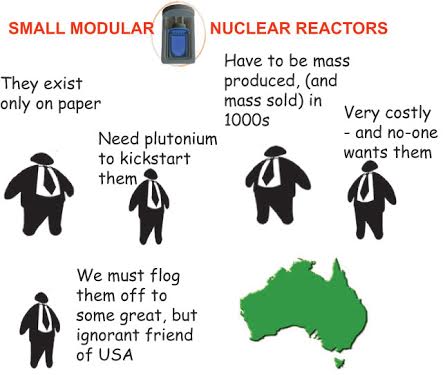
The suggested Small Modular Reactors , including the PRISM reactor have serious disadvantages, especially economiic ones . SMRs are likely to have higher costs per unit of output than conventional reactors. (5) Even if SMRs could eventually be more cost-effective than larger reactors due to mass production, this advantage would only come into play if large numbers of SMRs were ordered. But utilities are unlikely to order an SMR until they are seen to produce competitively priced electricity. This Catch-22 suggests the technology will require significant government financial help to get off the ground.
Even industry executives and regulators believe the SMR technology will have costs that are substantially higher than the failed “nuclear renaissance” technology on a per unit of output. The higher costs result from
- lost economies of scale in containment structures, dedicated systems for control,
management and emergency response, and the cost of licensing and security,
- operating costs between one-fifth and one-quarter higher, and
- decommissioning costs between two and three times as high.(6)
As to these “off-grid” technologies being available within the next two decades, I have been unable to find any credible reference that states that this is the case. I conclude that, even if design and testing of these small reactors were to be completed, it would be many decades before they would be commercially available. For reasons of regulatory processes, but more importantly, of uncertainty over economic viability, commercial availability is decades away, if ever to be achieved. (7)
3.4. What factors affect the assessment of viability for installing any facility to generate electricity in the NEM?
The major factor in assessing the viability of installing nuclear power for electricity generation in South Australia is the increasing practical and economic success of the alternative – truly modern power – renewable energy. (8) Combine that progress with the revolutionary developments in battery storage, and nuclear reactors of any size look like unnecessary and uneconomic dinosaurs in the electricity providing sector.(9)
3.7. What place is there in the generation market, if any, for electricity generated from nuclear fuels to play in the medium or long term?
Referring to my answers to previous questions, I would have to say – No place.
3.8 What issues should be considered in a comparative analysis of the advantages and disadvantages of the generation of electricity from nuclear fuels as opposed to other sources? What are the most important issues?
The most important issues are health, safety and environmental protection. Nuclear power of whatever design loses out on all those counts.(10)
However, that hardly matters in a world where economics is king. Fortunately as nuclear power is widely recognised now to be getting more and more expensive, while renewable energy and energy efficient technologies are getting cheaper, it is indeed economics that provide the killer disadvantage for nuclear power (9)
3.11. How might a comparison of the emission of greenhouse gases from generating electricity in South Australia from nuclear fuels as opposed to other sources be quantified, assessed or modelled?
For one thing, Greenhouse gases are emitted at all stages of the nuclear fuel chain. (10) However, in practical terms, nuclear power as a solution to climate change, is irrelevant – action on climate change is needed now , not in 20 -30 years.(11) Furthermore, climate change itself makes nuclear power an impractical and increasingly dangerous solution. – water shortage, water over-heating, (12) sea level rise (13) Storm surges (14)
3.12 and 313 . What are the wastes (other than greenhouse gases) produced in generating electricity from nuclear and other fuels and technologies?
What risks for health and safety?
Nuclear reactors produce dangerously toxic radioactive isotopes, come previous unknown on the planet, – plutonium – decaying to three types of radiation – alpha, beta, and gamma, caesium 137, iodine 131 , strontium 90 (15) No other technologies produce these toxic, carcinogenic wastes.
(1) http://www.globalresearch.ca/fukushima-general-electric-knew-its-nuclear-reactor-design-was-unsafe-so-why-isnt-ge-getting-any-heat-for-fukushima/5361300
(2) http://yle.fi/uutiset/french_auditors_slam_areva_for_olkiluoto_nuclear_project_in_finland/7358244?origin=rss
(3) http://yle.fi/uutiset/nuclear_watchdog_seeks_re-check_of_olkiluoto_3_reactor/7937448
(4) Generation IV International Forum https://www.gen-4.org/gif/jcms/c_40465/generation-iv-systems 2. IRSN 27th April 2015http://www.irsn.fr/EN/newsroom/News/Pages/20150427_Generation-IVnuclear-energy-systems-safety-potential-overview.aspx.
Nuclear Energy Research and Development Roadmap: Future Pathways, Dec 2013 https://www.gov.uk/government/uploads/system/uploads/attachment_data/file/168043/bis-13-632-nuclearenergy-research-and-development-roadmap-future-pathway.pdf.
Nuclear Engineering International 2013 http://www.neimagazine.com/opinion/opinionwhy-theenvironmental-movement-is-important-for-nuclear-power-4559455
(5) http://www.nuclearpolicy.info/docs/news/NFLA_Small_Nuclear_Reactor_report.pdf
(6) http://216.30.191.148/Cooper%20SMRs%20are%20Part%20of%20the%20Problem,%20Not%20the%20Solution%20FINAL2.pdf
(7) https://www.nirs.org/reactorwatch/newreactors/cooper-smrsaretheproblemnotthesolution.pdf
(8) http://qz.com/456931/half-the-world-already-gets-more-power-from-renewables-than-from-nuclear/(9)https://www.newscientist.com/article/mg22730312-100-the-battery-revolution-that-will-let-us-all-be-power-brokers/
(9) http://reneweconomy.com.au/2015/solar-and-wind-substantially-cheaper-than-nuclear-even-in-uk-10393
http://reneweconomy.com.au/2015/french-government-study-95-renewable-mix-cheaper-than-nuclear-and-gas-37241
(10) http://www.psr.org/resources/nuclear-power-factsheet.html?referrer=https://www.google.com.au/
(11) http://www.counterpunch.org/2015/02/05/why-nuclear-power-is-not-low-carbon/
(12) http://www.nirs.org/factsheets/nukesclimatefact614.pdf
(12) http://www.theenergycollective.com/globalwarmingisreal/107461/how-climate-change-may-affect-nuclear-power-plants
(13) http://www.climatecentral.org/news/sea-level-rise-brings-added-risks-to-coastal-nuclear-plants
(14) http://www.desmogblog.com/2014/01/21/push-nuclear-power-climate-change-concerns-overlooked
(15) https://en.wikipedia.org/wiki/Plutonium#Toxicity
http://www.geigercounter.org/radioactivity/isotopes.htm
July 28, 2015
Posted by Christina Macpherson |
NUCLEAR ROYAL COMMISSION 2016 |
Leave a comment
 I am currently struggling with my Submission to the Commission on the questions in Issues Paper 3 – “Electricity Generation From Nuclear Fuels”. it’s a doozy. They’ve excelled themselves this time – with questions designed to elicit lovely answers from nuclear companies Transatomic, Bill Gates’ Terra Power , SNC Lavalin, NuScale, – anyone but you and me.
Given that the nuclear lobby’s plan is for Australia to be the guinea pigs for new untested (not yet existent) gee whiz reactors, Those companies are gonna love questions like this:
3.2 Are there commercial reactor technologies (or emerging technologies which may be commercially available in the next two decades) that can be installed and connected to the NEM?
3.3. Are there commercial reactor technologies (or emerging technologies which may be commercially available in the next two decades) that can be installed and connected in an off-grid setting?
3.6. What are the specific models and case studies that demonstrate the best practice for the establishment and operation of new facilities for the generation of electricity from nuclear fuels?
July 27, 2015
Posted by Christina Macpherson |
Christina reviews, NUCLEAR ROYAL COMMISSION 2016 |
Leave a comment
Computational General Equilibrium Modelling Assessments for the Nuclear Fuel Cycle Royal Commission

Issued by Attorney Generals Department |
|
AGD 027826
Computational General Equilibrium Modelling Assessments for the Nuclear Fuel Cycle Royal Commission |
24 July 2015 |
10 August 2015 |
Link to Tender |
AGD 027828
Quantitative Analyses and Initial Business Case for establishing a Nuclear Power Plant and Systems in South Australia |
https://www.tenders.sa.gov.au/tenders/tender/display/tender-details.do?id=27826&action=display-tender-details
July 27, 2015
Posted by Christina Macpherson |
NUCLEAR ROYAL COMMISSION 2016 |
Leave a comment
If the radiation leak lasts more than a few hours, there is no viable safe plan. If the radiation plume passes, the ground will probably still be contaminated
Wildfires also threaten Nuclear Waste and Nuclear Waste Shipments
Wildfires and Nuclear Don’t Mix: Lessons from San Onofre and Chernobyl to Australia https://wordpress.com/read/post/feed/4410547/762849951 [good photos] miningawareness 27 July 15 As the deadline looms (3 Aug.) for comments regarding the risks of the nuclear fuel chain for South Australia – whether uranium mining, which is already occurring, or any proposed additions (uranium enrichment, nuclear energy, nuclear waste), foremost in everyone’s minds should be the risk of Bushfires (Wildfires), as well as endangerment to the Great Artesian Basin (GAB) aquifer, upon which so much of Australia is dependent for water, and which is being depleted, and most assuredly contaminated, by uranium and other mining:https://miningawareness.wordpress.com/2015/07/25/nuclearcommissionsaust-have-your-say-for-the-future-of-south-australia-submissions-close-soon-july-theme/ (Australia’s uranium mining “generates less than 0.2 per cent of national export revenue and accounts for less than 0.02 per cent of jobs in Australia.”http://www.conservationsa.org.au/images/Nuclear_Royal_Commission_issues.pdfMeanwhile it is laying waste to the land and provided nuclear fuel for Fukushima)
“The Australian climate is generally hot, dry and prone to drought. At any time of the year, some parts of Australia are prone to bushfires with the widely varied fire seasons reflected in the continent’s different weather patterns. For most of southern Australia, the danger period is summer and autumn.” http://www.ga.gov.au/scientific-topics/hazards/bushfire/basics/where
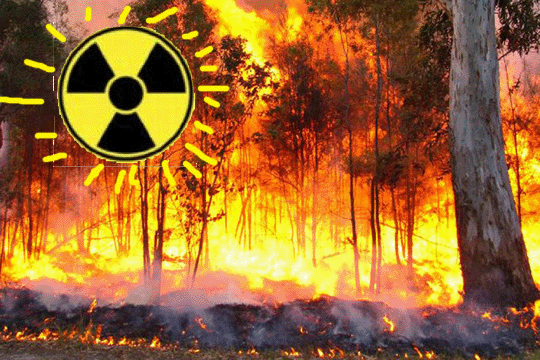
2015 Wildfires Near Chernobyl http://www.mns.gov.ua/news/40286.html
In April of this year, and again from the end of June into mid July, hundreds of firefighters in the Ukraine bravely battled fires in the area of the Chernobyl nuclear power station. Smoldering peat fires were the hardest to put out.
July 27, 2015
Posted by Christina Macpherson |
AUSTRALIA - NATIONAL, climate change - global warming, NUCLEAR ROYAL COMMISSION 2016, South Australia |
Leave a comment
I think that it is criminal of Australia’s government to deny action on climate change. And for a “pro business” government, what can they be thinking? Abbott’s “go slow” policy on climate action is harming so many businesses, and so many jobs. Now it’s the wine industry! Sacré bleu !
When Abbott finally decides that climate change matters, (i.e when he openly touts nuclear power), let’s not forget that nuclear power endangers the wine industry, too!
Climate change hitting where it hurts: your wine, The Age, 27 July Michael Pascoe BusinessDay contributing editor Spend a day at a wine grape growers’ summit and, among many other things, you’re left with no doubt about the reality of climate change.
Spend another day with a savvy grape grower touring the Barossa and you’re left with no doubt about the cost of it and the uncertainty about where it’s heading.
That’s not news for those who follow the wine industry closely at the production level, but for those of us who concentrate on consumption, the matter-of-factness of the change is rather startling.
Grapes ripening a month earlier, the compression of what were the usual different ripening times of different varieties, the search for varieties capable of handling hotter weather, the hunt for new terroir as climate bands move, the threat to traditional varieties in regions whose reputations depend on them.
Would you believe French champagne houses are buying fields in Britain?
Sweden, an important customer for Australian wine makers, now has a fledgling wine industry as a result of longer, warmer summers.
But you don’t have to go to the other end of the earth to see the story. Turns out climate change is a force in developing the Tasmanian industry as warmer weather leads mainland producers to invest in the island’s cooler climate. There’s no end of science on the issue, if that counts any more……….
And this is climate change, not just global warming. The heat is there, but the Scholz fields copped a frost that they hadn’t seen before, wiping out the crop. OK, it was a 1-in-100-year event – except that it happened again the next year. Now giant $55,000 electric fans increasingly dot vineyards, automatically triggered into action by a thermometer to suck in higher, warmer air and blow it across the vines to fight the killing drop of cold air. http://www.smh.com.au/business/the-economy/climate-change-hitting-where-it-hurts-your-wine-20150726-gikmuc.html#ixzz3h334o3XH
July 27, 2015
Posted by Christina Macpherson |
climate change - global warming, South Australia |
Leave a comment
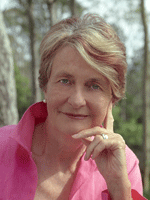 Submission to the Nuclear Fuel Cycle Royal Commission, by Helen Caldicott on July 24, 2015 I begin my submission to the Nuclear Fuel Cycle Royal Commission by posting an article which I wrote for the Australian Medical Student Journal, which outlines in some detail the medical implications of the whole nuclear fuel chain.
The impact of the nuclear crisis on global health
Due to my personal concerns regarding the ignorance of the world’s media and politicians about radiation biology after the dreadful accident at Fukushima in Japan, I organized a 2 day symposium at the NY Academy of Medicine on March 11 and 12, 2013 … [ to read the full text of this article, click on this link: http://www.helencaldicott.com/the-impact-of-the-nuclear-crisis-on-global-health/. The link will open in a new tab or window. Close it to return to this page ]
Now to answer some of the questions posed by the Royal Commission Continue reading →
July 25, 2015
Posted by Christina Macpherson |
NUCLEAR ROYAL COMMISSION 2016, Submissions to Royal Commission S.A. |
Leave a comment



 Antinuclear