“Our strategy has always been about the diversification of the South Australian economy and I think that we’ve been working on many fronts. Whether it’s education, health industries, tourism, defence … this is an economy of many moving parts,” Mr Weatherill said.
SA Premier Jay Weatherill refuses to explain BHP Billiton’s ‘bad news’ after jobs cut announcement 891 ABC Adelaide , 11 Aug 15,
The South Australian Government will not explain BHP Billiton’s “bad news” again after the company revealed plans to axe 380 jobs at its Olympic Dam mine at Roxby Downs, Premier Jay Weatherill says.
Mr Weatherill said the company needed to “front the media” after its announcement this week that jobs would go at the mine, including those of technicians, scientists, engineers and supervisors.
It follows on from the loss of 230 positions in South Australia earlier this year.
Mr Weatherill defended the Government’s record on embracing the mining industry and BHP’s expansion plans for the mine. Continue reading →
August 12, 2015
Posted by Christina Macpherson |
business, politics, South Australia |
1 Comment
CONSTRUCTION FORESTRY MINING ENERGY UNION excerpt…
”The fact that the Commission has made the process of making a submission so complex and
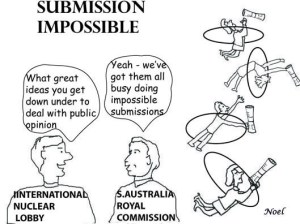
bureaucratic, indicates that the views that they consider relevant are extremely limited. For example Aboriginal representatives, who have stated that the difficulty in translating the papers alone is going to prevent many of their communities from participating in this process at all.
In addition, each and every question posed in the Issues Papers is fundamentally biased in favour of what the government is proposing. Not only that, but parties wishing to make a submission are limited to the questions given – and if any further comment is to be made, it is only allowed to be annexed to answers to the questions. It must also be noted that most (if not all) of the questions posed in these Papers have already been answered in various research papers, submissions and inquiries into these issues over the last decade or so…..
 URANIUM FREE NSW ISSUES PAPER ONE: EXPLORATION, EXTRACTION AND MILLING The first 6 questions seemed to be aimed at industry to easily to enable their argument for expansion. They are akin to the Royal Commission/Government asking “how can we facilitate the expansion of the industry?” UFNSW is opposed to the expansion or the nuclear industry in SA or anywhere, hence has not answered these questions………
1.13 Would an increase in extraction activities give rise to negative impacts on other sectors of the economy? Have such impacts been demonstrated elsewhere in Australia or in other economies similar to Australia?
• It would undoubtedly have a negative impact on tourism.
• It would mitigate against the movement of families/residents choosing to stay or move into the area…….
APPENDIX ISSUES
- Only deals with economic viability, but even then ignore issues of reparations, compensation, or insurance costs in the event of exposure, spills, accidents, or even routine emissions.
- The paper quotes the International Energy Agency (IEA) as saying that the expansion of the nuclear industry “depends on listening to, and addressing public concerns, about the technology.”
- Doesn’t address fundamental question of should uranium be mined at all. The entire process is underpinned by an assumption that uranium mining is good and looks at the supposed best ways to go about it.
- Nothing regarding keeping profits in Australia
- Environmental impacts are minimised to native vegetation, water is not separate. Scope very narrow • Minimisation of environmental impacts is not a good enough aim given time of radioactivity, it is unmanageable and difficult or impossible to remediate or rehabilitate sufficiently • This Issues Paper does not provide information regarding direct or indirect Government funding of the nuclear industry, in the past, present or potential future.
- No mention made of the social or environmental costs of Radium Hill, Roxby Downs, Honeymoon, Beverley and Four Mile. Traded price of uranium is provided in a graph, but not costs
- Paper states that international demand for uranium is primarily driven by its use in electricity generation, however it is undoubtedly influenced by the supply and demand for uranium to be used in weapons. Market is influenced by uranium from dismantled nuclear weapons is released onto the uranium market, which is presumably harder to predict
- The issues papers seem to ignore the impacts of radiation on health • No mention of ionising radiation
- The issues papers questions ask about economic and some environmental impact, but completely ignore any cultural or social impacts • No mention on the length of time materials are radioactive and need to be managed for
- Seems to treat uranium like coal or iron, materials that have far lesser risks The questions seem to be written in such a way as to set up opposition to nuclear expansion as emotional and hence discredit it.
August 10, 2015
Posted by Christina Macpherson |
Submissions to Royal Commission S.A. |
Leave a comment
 ANNIE MCGOVERN Excerpt …
this writer has witnessed a declaration by on station owner to the North declare that their borefloqw had been significantly depleted by Roxby’s misuse and phenomienal extraction rate of Great Artesian Basin (G.A.B.) water. The people of the Marree region where this extraction occurrs, have been actively engaged in objecting to the Borefield activities for the past 32 years.
1.10 Any further developments to mine and mill Uranium would further compromise both the environment and the people of S.A. Roxby is already depleting the G.A.B. to the detriment of all in the vicinity, plus those dependant on its waters in both Queensland (Qld.) and New South Wales (N.S.W.). The draw-down effects of the 42 million litres/day licence has depleted the basin to its furthest extremities with little thought given as to why places like Longreach (Qld.) are in almost permanent drought despite rainfalls recorded in recent years that should have been able to sustain some productivity. This is the single largest body of water in S.A. and is no longer sustainable…..where is there water for any expansion?
1.11 The flow of water beneath the mine at Roxby Downs is part of an underground river system which flows to the top of Lake Torrens and empties into the underground sytem of Lake Torrens….to where does this highly contamminated water ultimately flow? The answer is unknown. Mining activities at every level contamminate the surrounds. Underground blasting, mining and fracturing destabilises fault zones that are prominently featured in this landscape. 10% of S.A.’s available electricity is designated for the production of the industry. Where is the room for more?,
August 10, 2015
Posted by Christina Macpherson |
Submissions to Royal Commission S.A. |
Leave a comment
 PAUL HARRIS – EXCELLENT OVERALL submission covering all 4 Issues Papers and ULRIKE HECK Also very good overall
GLADSTONE UNITING CHURCH SA Response to Issues Paper One…Exploration, Extraction & Milling ” Excerpt..….
- As responsible Australians we request an explanation as to why our government did not advertise more widely about the Nuclear Royal Commission as many people were unaware of this very serious issue.
- The safety of uranium exploration hasn’t been proven to be 100% safe in the world.
- Will SA Emergency Services be supported adequately by our government for the events of accidents, spillages or radioactive fall out similar to Marralinga?
- How would the finished product be transported?
- Major concerns are…underground water/soil contamination which will effect farmers etc & our environment…therefore touching every person’s life & for every generation to come in our area.
- Huge concerns also for our native wild life as well as farm animals. This can also contaminate the animals making them unsafe for human consumption.
NGOPPON TOGETHER INC Excerpt – …. Mining uranium has caused immense suffering and displacement of Aboriginal communities. in SA as well as elsewhere in Australia. Some of our members recall the Kokatha in the sandhills of Roxby Downs in the 1980s in the desperate hope of stopping the Roxby uranium mine before such a mine wreaked havoc on Kokatha country and on the ancient waters of the Arabunna. Regarding the proposed expansion of Olympic Dam we know that the Traditional Owners were not even consulted. BHP Billiton held all the cards and merely had to say that they wanted to continue the (exremely favourable to them) previous conditions. ….
August 10, 2015
Posted by Christina Macpherson |
Submissions to Royal Commission S.A. |
Leave a comment
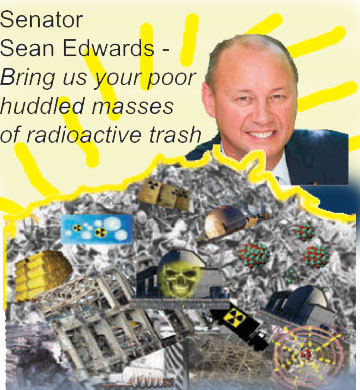 South Australia’s future role in the nuclear industry, The Saturday Paper, 8 Aug 15 PHILIP DORLING“……..Perhaps the most interesting twist in these proceedings, however, has been the role of South Australian Liberal senator Sean Edwards, who in April outlined a radical plan for an integrated nuclear industry embracing nuclear waste storage and recycling, fuel fabrication and power production.
Edwards has demonstrated a sustained interest in nuclear issues since he entered federal parliament in 2011.
He argues that East Asian countries could pay up to $1 million a tonne to send used fuel rods to South Australia for storage. By using a new form of reactor, an integral fast reactor (specifically the power reactor innovative small module – PRISM – design proposed by GE Hitachi Nuclear Energy), 95 per cent of the energy could be extracted from the rods, with electricity generation as a byproduct.
“We could end up with zero or low-cost power,’’ Edwards told The Sydney Institute in April. “It could revitalise the industrial sector in South Australia. The more you reprocess, the more electricity you have to get rid of.”
After consultation with a group of pro-nuclear advocates and technical experts, Edwards has submitted an as-yet-unpublished 213-page submission to the royal commission, arguing that South Australia can take advantage of the “under-serviced market for the management of used nuclear fuel. Several nations are holding quarantined budgets in the tens of billions of dollars with no satisfactory pathway to discharge responsibility for this material”.
Edwards’ submission proposes the establishment of a multinational spent fuel storage installation, an industrial pilot-scale fuel recycling and fabrication facility, a new “fourth generation” fast-breeder reactor, and deep borehole disposal of short-lived waste products.
Substantially funded by foreign investment, Edwards estimates the project could deliver $28 billion to South Australia, including very low-cost, even free, electricity for the state.
During the past 18 months, Edwards has also engaged in discussions with the nuclear industries in several Asian countries, which he says have expressed “considerable interest”. He is currently not prepared to identify the countries involved, but The Saturday Paper has established they include South Korea and Japan.
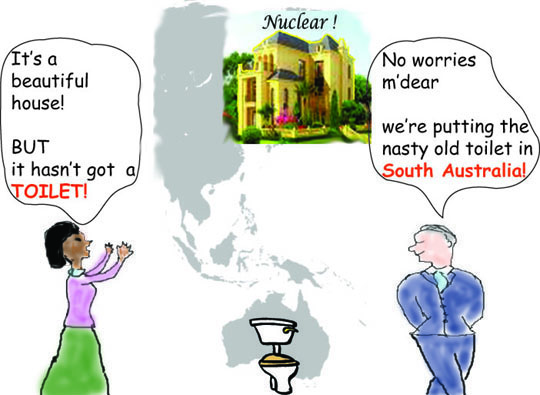
Edwards has also briefed Abbott, Industry Minister Ian Macfarlane and Trade Minister Andrew Robb.
It remains to be seen whether Edwards’ scheme stands critical scrutiny from the royal commission and wider debate. There are already plenty of critics. The Australian Greens have expressed strong opposition to the entire royal commission process, so too has veteran anti-nuclear campaigner Helen Caldicott. Nuclear researcher Richard Leaver, formerly of Flinders University, points out that no so-called fourth-generation reactors have been built and they are not expected to be available for commercial construction before 2030-40. ……..https://www.thesaturdaypaper.com.au/news/politics/2015/08/08/south-australias-future-role-the-nuclear-industry/14389560002222
August 7, 2015
Posted by Christina Macpherson |
AUSTRALIA - NATIONAL, NUCLEAR ROYAL COMMISSION 2016, politics, South Australia |
Leave a comment
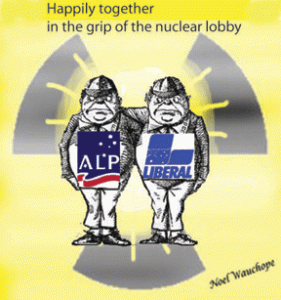 South Australia’s future role in the nuclear industry, The Saturday Paper, 8 Aug 15 PHILIP DORLING
 The South Australian government’s flirtation with nuclear energy threatens to turn its relationship with federal Labor into a ticking time bomb. South Australia was in the news this week thanks to Prime Minister Tony Abbott’s announcement of a new naval construction plan that, if implemented, will see Adelaide confirmed as Australia’s naval shipbuilding hub.
Behind the headlines, however, South Australia’s emerging nuclear ambitions may ultimately prove to be a more significant development, politically and economically, for the state and the nation.
Continue reading →
August 7, 2015
Posted by Christina Macpherson |
AUSTRALIA - NATIONAL, politics, South Australia |
Leave a comment
 Work on Hornsdale Wind Farm near Jamestown to create 250 construction jobs http://www.adelaidenow.com.au/news/south-australia/work-on-hornsdale-wind-farm-near-jamestown-to-create-250-construction-jobs/story-fni6uo1m-1227471864726 BELINDA WILLIS THE ADVERTISER AUGUST 06, 2015
WORK on a new 100-turbine wind farm in the state’s mid-north is expected to start within months, creating up to 250 jobs during construction.
Canberra-headquartered Neoen Australia’s $250 million investment in the Hornsdale Wind Farm near Jamestown was signed off by state Planning Minister John Rau on Friday, with its first stage of 100 megawatts production planned to be in operation in 2017.
Two South Australian firms, Catcon for civil construction and CPP for electrical works, have been confirmed as contractors by Neoen Australia managing director Franck Woitiez.
It is believed to be the state’s first new wind farm construction since the Federal Government’s political compromise in May on reducing the nation’s Renewable Energy Target to 33,000 gigawatt hours by 2020, down from 41,000 gigawatt hours. Continue reading →
August 7, 2015
Posted by Christina Macpherson |
South Australia, wind |
Leave a comment
MAPW & PHAA make joint submission to the SA Nuclear Fuel Cycle Royal Commission http://www.mapw.org.au/news/mapw-phaa-make-joint-submission-sa-nuclear-fuel-cycle-royal-commission05/08/2015
MAPW in partnership with the Public Health Association of Australia have lodged a joint submission addressing the terms of reference of the South Australia Nuclear Fuel Cycle Royal Commission.
MAPW would like to thank everyone who contributed to the submission and would welcome the opportunity to provide evidence in person to the commission if required.
For further information please contact Phyllis Campbell-McRae on 03 9023 1958
Click here to read the executive summary
Click here to read the full submission
If you would like any further information about the submission please contact Phyllis Campbell-McRae 03 9023 7958
http://www.mapw.org.au/news/mapw-phaa-make-joint-submission-sa-nuclear-fuel-cycle-royal-commission
(This must-read 77-page submission and the 3-page Executive Summary can be downloaded here or via links on the MAPW Resources webpage at: http://www.mapw.org.au/resources)
August 7, 2015
Posted by Christina Macpherson |
Submissions to Royal Commission S.A. |
Leave a comment
 Kynard 3 August 15
Yes, people understand that the outcome of commission is a foregone conclusion meant to placate those who are given the impression of having a say.
The only thing that would stop it now is incompetence or the simple fact that in the end the dollars may not add up. Or both.
Particularly the idea of a dump is making certain personality-types swoon the kind of greed which indicates that they’ve already counted the profits and discounted the risks.
Future generations don’t get a say. I’m sure that that far down the track, the countries who’ve dumped their waste on us won’t be paying us to babysit it anymore. The overall trend as all resources decline is continued economic contraction. The only sane growth is degrowth. One way or another we’ll be forced to embrace it. And that’s what people and particularly politicians don’t want to talk about. http://m.indaily.com.au/opinion/2015/08/03/sas-nuclear-debate-lost-in-translation/
August 3, 2015
Posted by Christina Macpherson |
NUCLEAR ROYAL COMMISSION 2016 |
Leave a comment
A couple of weeks ago, the Nuclear Royal Commission held a forum at the Marion Cultural Centre as one of a series aimed at engaging the South Australian people in the commission’s work.
The problem is, not one person came. Nobody.
Whether this raises alarm bells for the commission and the Weatherill Government depends on whether they genuinely want to create a community debate, or if they are just going through the motions.
SA’s nuclear debate lost in translation http://m.indaily.com.au/opinion/2015/08/03/sas-nuclear-debate-lost-in-translation/ CRAIG WILKINS | 3 AUGUST 2015 The nuclear fuel cycle royal commission is so bureaucratic that it has failed to engage South Australians in the debate, argues the Conservation Council’s Craig Wilkins.
What if an expensive, high profile inquiry held a public meeting and no-one turned up?
In early February this year, while most of us were slowly emerging out of South Australia’s long, lazy summer break, Premier Weatherill made a surprise announcement. South Australia would hold a first for Australia: a royal commission into the future role our state should play in the nuclear industry.
This came as a bolt from the blue, especially from a Government that had campaigned successfully a decade ago to stop a similar federal push to establish a nuclear waste dump in Woomera. Then Premier Mike Rann was so determined to stop a nuclear dump he enshrined it in state law.
And the timing was strange, with our state strongly embracing renewable energy, and the nuclear industry languishing in a post Fukushima downturn.
So while a typical royal commission is created by a government under pressure to respond to a major issue dominating talkback and dinner table discussions, the task given to ex-Governor Kevin Scarce was both challenging and unusual.
Not only would Scarce have to explore the huge technical and economic challenges of an expensive, divisive energy source with big waste and security issues, he would need to get the South Australian community interested enough to pay attention in the first place.
A couple of weeks ago, the Nuclear Royal Commission held a forum at the Marion Cultural Centre as one of a series aimed at engaging the South Australian people in the commission’s work.
The problem is, not one person came. Nobody.
Whether this raises alarm bells for the commission and the Weatherill Government depends on whether they genuinely want to create a community debate, or if they are just going through the motions.
As a fierce advocate for public involvement in decision-making, I believe the problem lies in the way the commission is going about its task.
 The Issues Papers released to stimulate public submissions are an eye-watering challenge – dry, technical and full of assumptions. They appear aimed at industry players, not the general public. They have not been translated into other languages, despite non-English speaking Aboriginal communities being ground zero for any debate over a toxic dump.
Until far too late in the process, no-one with any expertise in engaging with Aboriginal communities was employed to work in the north of the state.
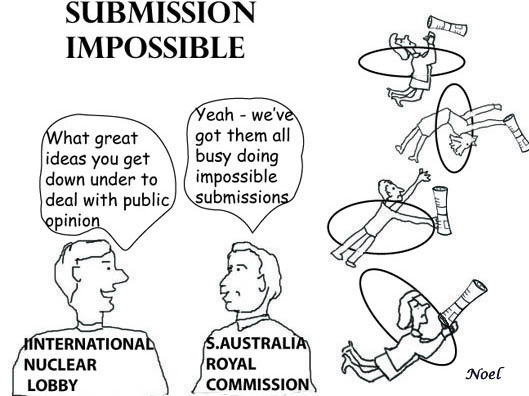
To put in a submission is an exercise in acrobatic hoop jumping including the requirement to appear in person before a Justice of the Peace – a huge challenge for anybody in rural or remote SA, and a totally unnecessary step not required for other similar inquiries.The ‘Community Forums’ that have been held so far have missed the mark, focusing on imparting information on the process, rather than an opportunity to debate issues in detail.
Also, Scarce in all his public statements has strongly emphasised that he is seeking “evidence” and “facts”, leaving little room for traditional cultural knowledge, or the perspective of a grandmother who doesn’t want to leave a toxic legacy for her grandchildren. Continue reading →
August 3, 2015
Posted by Christina Macpherson |
NUCLEAR ROYAL COMMISSION 2016 |
1 Comment
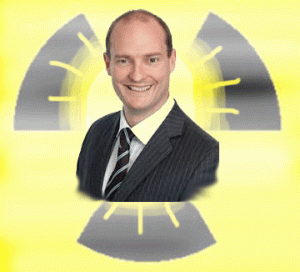 Mr Kenyon, now a backbench MP, refused to comment on the report.
The Sunday Mail understands it was not presented to Cabinet but became instrumental in prompting the current Royal Commission into the potential for the nuclear fuel cycle to revive the SA economy.
The report found there needed to be a good public relations campaign to convince people of the safety of the plan, and that money raised should be spent on infrastructure like the SA leg of a high speed rail to Melbourne.
It also proposed a model in which SA generate more money by leasing yellowcake mined here and taking it back as waste, and as a trade off people be guaranteed there will be no nuclear power plants in SA.
Nuclear waste dump should be first cab off the rank, report finds by: MILES KEMP From: Sunday Mail (SA) Originally published as Nuclear dump could be key to our riches August 01, 2015 Available on The Australian website http://www.theaustralian.com.au/news/nuclear-waste-dump-should-be-first-cab-off-the-rank-report-finds/story-e6frg6n6-1227466384020
A BRIEFING paper delivered to the State Government recommended the state accept Taiwan’s nuclear waste, access that nation’s $10 billion disposal fund and establish an Outback nuclear waste dump to revive the economy.
As the Nuclear Fuel Cycle Royal Commission explores the option to help solve SA’s jobs crisis, the Sunday Mail has obtained a copy of a report prepared for former Employment and Science Minister Tom Kenyon which argues the case for a waste dump near Woomera. Continue reading →
August 3, 2015
Posted by Christina Macpherson |
AUSTRALIA - NATIONAL, NUCLEAR ROYAL COMMISSION 2016, politics, South Australia |
Leave a comment
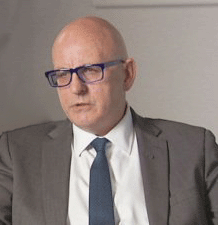 SA Nuclear royal commission: Waste dump best economic option for state, Business SA says ABC News 3 Aug 15 Establishing an outback nuclear waste dump would be the best economic move for South Australia if the State Government decides to expand its role in the nuclear industry, Business SA says.
It has been revealed Premier Jay Weatherill last year received a report commissioned by former Employment and Science Minister Tom Kenyon, which found setting up a waste dump near Woomera could reap billions for the local economy.
A royal commission headed by Kevin Scarce is in the process of examining the potential for an expansion of the state’s role in the nuclear industry, including whether a nuclear power station or nuclear waste  dump should be built.
Business SA’s chief executive Nigel McBride (above, at left) said countries such as Japan and South Korea would pay handsomely to dump their nuclear waste in the state’s outback.
We know that there are huge potential financial benefits from being able to provide that service, and it’s logical that they’ve identified somewhere in the Woomera region as a potential site because of course it’s very remote,” Mr McBride said.
“There is a huge market out of countries like South Korea who has got a lot of nuclear waste they need to deal with, Japan and other Asian countries and of course countries around the world.”………..
Mr McBride said South Australia was the ideal location for a waste dump, and could store the nuclear fuel safely.
He said the biggest concern would be transportation options……
More than a decade ago, South Australia’s Labor Government fought and won a vigorous battle against the Howard government to stop a low-level nuclear waste dump being located in far north South Australia.
The royal commission is expected to hand down its findings by May 2016. http://www.abc.net.au/news/2015-08-02/nuclear-waste-dump-best-economic-option-business-sa-says/6666212
August 3, 2015
Posted by Christina Macpherson |
NUCLEAR ROYAL COMMISSION 2016, South Australia, wastes |
Leave a comment
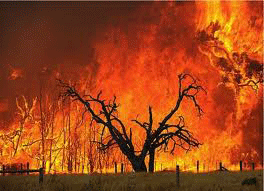 Dangers of Bushfires-Wildfires & Nuclear Business miningawareness, 3 August 15
 “………
According to the South Australia Country Fire Service, nearly 1/2 of people living in bushfire prone areas don’t understand the threat. This is apparently true of those proposing adding nuclear
anything in Australia.
For, in such a context, the risks of nuclear anything are clearly even higher than average. And, the solar potential in Australia is higher than average. The choice should be clear……..
In January of this year (2015) over 700 South Australian Country Fire Service volunteers fought the Sampson Flat bushfire series, helped by teams from New South Wales Rural Fire Service and Victoria Fire Authority, over the course of a week. On “Black Sunday” 1955 in South Australia, 1,000 Emergency Fire Service volunteers fought fires, but were overwhelmed and 2,500 citizens volunteered to help. For the 1983 Ash Wednesday Bushfires (II), 130,000 firefighters, defence force personnel, relief workers and support crews worked to fight the bushfires.Clearly this is serious business and dangerous in the best of
circumstances.
Adding nuclear to firestorms is even more dangerous than the Fukushima earthquake-tsunami disaster…………
Continue reading →
August 3, 2015
Posted by Christina Macpherson |
climate change - global warming, environment, safety, South Australia |
Leave a comment
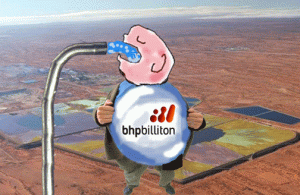 The role of water in Australia’s uncertain future, The Conversation Amgad Elmahdi Manager Water Resources Assessment Section at Australian Bureau of Meteorology Matthew Hardy Manager, Urban Water at Australian Bureau of Meteorology August 3, 2015 “…….Water security is threatened by a number of factors. These include climate change, rainfall variability, population growth, economic development, and drought.
For instance, across southern Australia climate change is projected to decrease winter and spring rainfall by up to 15% by 2030 regardless of whether greenhouse gas emissions are reduced.
Rainfall declines are amplified in reduced streamflow and in turn the water in storages. Southwestern Australia has seen streamflow declines of 50% since 1970, while streamflow during the Millennium Drought (1996-2010) in southeastern Australia was half of the long-term average………
Australia also has naturally highly variable rainfall influenced by events such as El Niño and La Niña. An El Niño was declared in May 2015.
The El Niño’s likely impact will be drier and warmer conditions across inland eastern Australia. Importantly the strength of an El Niño does not always indicate how severely Australia may be affected.
These dryer conditions, should they arise, will place increased pressure on the water supply of effected regions. In particular, increased water demands and reduced stream flows will see declining surface water storage volumes. This could mean we need to develop and use more climate resilient sources………https://theconversation.com/the-role-of-water-in-australias-uncertain-future-45366
August 3, 2015
Posted by Christina Macpherson |
AUSTRALIA - NATIONAL, climate change - global warming, South Australia |
Leave a comment
Olympic Dam Mine: Largest User of Energy in S. Australia; Largest User of Australia’s Precious Water Resource – The Great Artesian Basin 31 Friday Jul 2015 by miningawareness The largest single user of electricity in South Australia is the Olympic Dam uranium, copper, gold, silver mine. Almost 60% of the energy in South Australia comes from renewables! Why would they need nuclear? Why a “Royal Commission”? They clearly want nuclear power so that they can sell their uranium to make energy to mine more uranium. Furthermore, the wise shun uranium, so to keep mining it in Australia, they need to dump it on Australia in the form of depleted uranium from enrichment, nuclear power, and the too often forgotten nuclear waste, to go with the radioactive tailings which they already have.
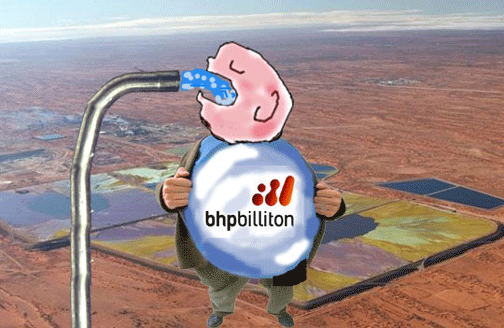
The largest user of underground water in the Southern Hemisphere is the Olympic Dam! Australia has a generally dry climate, and is highly dependent upon the same groundwater, underground aquifer, which is pumped for mining and most assuredly polluted by mining. Wikipedia says the Olympic Dam mine is the largest industrial user of underground water in the Southern Hemisphere. But, no single individual would use so much, so it much be the largest single user. Thus, it is also the largest single user of Australia’s precious Great Artesian Basin water.
August 1, 2015
Posted by Christina Macpherson |
South Australia, water |
2 Comments