Concentrated Solar Power pre-feasibility study now being finalised at Port Augusta
 The transition from fossil to renewable energy The Fifth Estate, Graham Davies, Engineers Australia | 13 July 2015“…………It is encouraging that Alinta, with financial support from ARENA and the SA Government, is currently finalising a pre-feasibility study into concentrated solar thermal power at Port Augusta – a project that has the full support of the community. At present the capex of CSP is too high for a company to meet what is required for shareholder returns, but costs will decrease as the technology develops further. If government were to contribute an amount equivalent to saved externalities (such as adverse health effects associated with continuing the coal power station) it is probable that the project would be economically viable now.
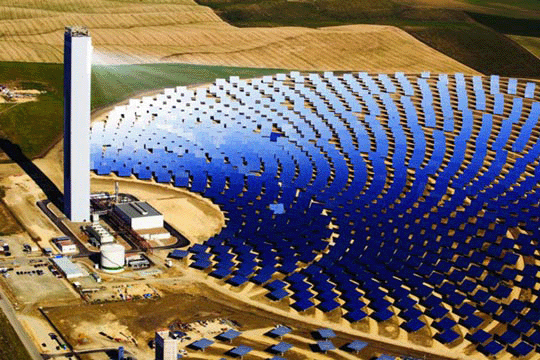
CSP is of particular value to a renewable grid, as it has the ability to efficiently store energy, be despatchable and provide synchronous generation and grid stability. These capabilities will circumvent the need for inflexible base load generators such as coal, CCGT and nuclear, with their many externalities. Port Augusta is an ideal location for CSP and presents a great opportunity for the future.
The closure of the Port Augusta Power Station may initially appear as bad news, but it may galvanise South Australia in becoming the iconic turning point for a new future – a future in which Australia again leads in solar development and export; where energy security is based on the sun and not the fossil reserves; where long-term thinking is built into economic analysis; and where prosperity is not measured by GDP but by net wealth and wellbeing.
Graham Davies is incoming chair of Engineers Australia’s Sustainable Engineering Society. http://www.thefifthestate.com.au/spinifex/the-transition-from-fossil-to-renewable-energy/75484
SCARCELY ACCURATE: NUCLEAR FUEL CYCLE ROYAL COMMISSION ‘ISSUES PAPER’ INACCURATE
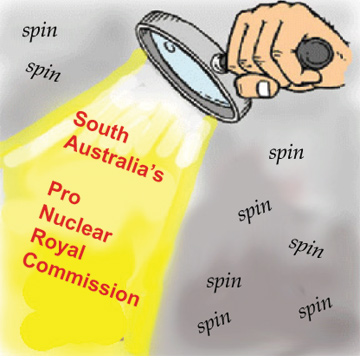 Nectaria Calan, 13 July 15, Friends of the Earth have informed Royal Commissioner Kevin Scarce and the Nuclear Fuel Cycle Royal Commission of a significant inaccuracy in Issues Paper 1, regarding the current and future legal framework for the nuclear industry in South Australia. According to the Royal Commission, the Issues Papers are intended to provide factual information and background to assist the public in making submissions.
Issues Paper 1, which deals with the exploration, extraction and milling of uranium, states that Aboriginal sites of significance are protected by the Aboriginal Heritage Act 1988.
“This is not the case for BHP Billiton, South Australia’s biggest miner,” explained Nectaria Calan of Friends of the Earth Adelaide. “Under the Indenture Act, which applies solely to BHP Billiton, the company’s Olympic Dam mine and some 15, 000 square kilometres of the surrounding Stuart Shelf, are exempt from the Aboriginal Heritage Act 1988. This exemption would also apply to any future expansion of uranium mining by BHP Billiton at Olympic Dam or in the surrounding area.”
“This inaccuracy is significant as it misrepresents existing regulatory and legal arrangements and potential arrangements in the future, issues on which the Issue Paper invites public comment,” said Ms Calan. “The largest of the two operating uranium mines in the state is exempt from the Aboriginal Heritage Act 1988, alongside a further 15, 000 square kilometres of South Australia. BHP Billiton is also the most likely candidate for the expansion of uranium mining, also the subject of Issues Paper 1. It is negligent to omit that this company is subject to a different legal framework than other companies operating in the state.”
“We have requested that the Royal Commission address this mistake, adequately publicise the required corrections, and extend the upcoming deadline for submissions to allow people to consider the new information that the Royal Commission should provide. The public cannot make submissions based on inaccurate information.”
N.B. Legal details are provided as an appendix.
For comment contact: Nectaria Calan 0432 388 665 Friends of the Earth Adelaide
Appendix
Legal details: Continue reading
Submission Points to Issues Paper 4 – Nuclear Royal Commission
Submissions Issues Paper 4 (Storage and Disposal of Waste) are due by 24 July, 2015
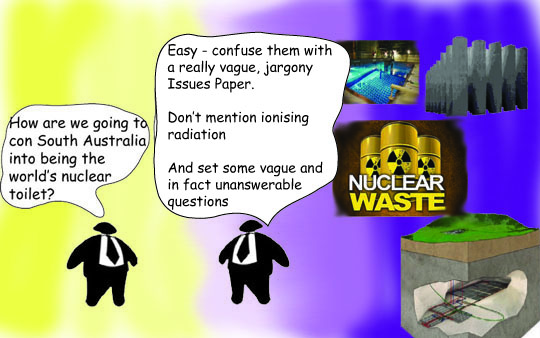
4.1 Are the physical conditions in South Australia, including its geology, suitable for the establishment and operation of facilities to store or dispose of intermediate or high level waste either temporarily or permanently?
Earthquake hazard: For either temporary or permanent storage of radioactive wastes, South Australia poses great risks. While the whole State has a small earthquake hazard zone, there are large sections which have an increased earthquake hazard. Particularly in the South of the State (1)
Risk to precious artesian water. While the South of the State has earthquake risks, almost the entire of the rest of the State covers the Great Artesian Basin. (2)
Effectively, this means there is almost no part of South Australia that could safely store radioactive trash for decades, let alone for thousands of years.
- 3 What would the (overseas) holders of radioactive wastes be willing to pay for disposal and storage of radioactive wastes in South Australia?
This question really has no answer. At present every country with nuclear facilities is struggling with the unanswered question of what do do with their radioactive trash. Even Finland, which has built a 500 metre deep burial place, will not have enough space for their accumulating radioactive trash. So far, there is no room for Fennovoima’s waste in the Onkalo repository in Olkiluoto. (3)
At this stage there are no proposals for exporting nuclear waste. Royal Commissioner Kevin Scarce, in his recent report on the Commission’s overseas visit, said “We haven’t done the financial study”. When anyone does do the financial study, they will need to factor in the financial costs of insurance, of security for hundreds, thousands, of years, as well as of environmental degradation.
Another factor would be the comparison of the commercial value of renewable energy not pursued, tourist and agricultural opportunities lost as government money went into fostering nuclear schemes rather than South Australia’s more positive activities.
4.4 What sorts of mechanisms would need to be established to fund the costs associated with the future storage or disposal of either Australian or international nuclear or radioactive wastes?
A mechanism has been put forward by Oscar Archer. (4) In Archer’s words “it goes like this. Australia establishes the world’s first multinational repository for used fuel – what’s often called nuclear waste” he wants the funding to be provided by “our international partners”, on condition that “This is established on the ironclad commitment [my emphasis] to develop a fleet of integral fast reactors to demonstrate the recycling of the used nuclear fuel” This would be a highly unsatisfactory arrangement. As the nuclear industry now struggles to fund these as yet not developed Generation IV reactors – South Australia would find itself locked in – in a sort of blackmail position, to buying a technology that very likely has no future.
4.5 What are the specific models and case studies that demonstrate the best practice for the establishment, operation and regulation of facilities for the storage or disposal of nuclear or radioactive waste?
The massively expensive 500 metre deep bunker being developed in Finland is so far the only facility that has appears to have relative safety, but that can accomodate only some of Finland’s radioactive trash . Meanwhile in USA, the Waste Isolation Pilot Plant has been as disaster. (5)
4.6 What are the security implications created by the storage or disposal of intermediate or high level waste at a purpose-built facility?
In the short term (i.e a period of decades) the above ground concrete containers are vulnerable to terrorist attack. In the long term , i.e. thousands of years, deep waste reposiitories run risk of climate and seismic events, as well as possible terrorism. They need to to be guarded virtually forever, or else, as they are forgotten, pose risks to future generations.
4.9 Bearing in mind the measures that would need to be taken in design and siting, what environmental risks would the establishment of such facilities present?
Climate change continues to increase risks of extreme weather events, and it is possible that seismic activity, already a risk, would increase.
4.10 What are the risks associated with transportation of nuclear or radioactive wastes for storage or disposal in South Australia?
Extreme weather, transport accidents that would spread ionising radiation , terrorist attack.
4.12 Would the establishment and operation of such facilities give rise to impacts on other sectors of the economy?
In the past, countries like France accepted the risks of nuclear power, and their other industries thrived. Now, even in France, there is concern about polluting industries. For some time after the Chernobyl nuclear catastrophe, the French wine industry was severely depressed., because the wine growing regions were squarely in the path of the ionising radiation fallout. (6) There is concern in Washington State about the impact of Hanford nuclear waste facility on the wine industry. (7)
(1) https://www.sa.gov.au/__data/assets/pdf_file/0005/17168/Earthquake_hazard_zones_SA.pdf
(2) http://www.environment.gov.au/water/environment/great-artesian-basin
(3) http://yle.fi/uutiset/battle_for_nuclear_waste_disposal_site/5097360
(4) http://www.abc.net.au/radio/programitem/pgJrGaLDL7.
(5) 1 6 June 2014, ‘Fire and leaks at the world’s only deep geological waste repository’, Nuclear Monitor #787,www.wiseinternational.org/node/4245 222 27 Nov 2014, ‘New Mexico nuclear waste accident a ‘horrific comedy of errors’ that exposes deeper problems’, The Ecologist,
(6) http://wineeconomist.com/2008/01/26/the-science-of-unintended-consequences/
(7) http://www.thedailybeast.com/articles/2015/03/28/hanford-nuclear-site-could-be-threatening-washington-state-s-best-vineyards.html
radophilia = the irrational love of radioactive poisons that harm children.
 Brett Stokes, 10 July 15 Kevin Scarce is challenged over the “fuel cycle” deceptive language and Scarce responds with a straight face, academy award stuff – I could not help coughing, something caught in my throat.
Scarce was challenged by an audience member at Flinders Uni in May 2015, regarding the diagram showing reprocessing as though that part of “the nuclear fuel cycle” was fully happening
Scarce’s response was a bold denial of the obvious, saying “we’re not trying to make it sound better than it is. We’re not trying to gild the lily” at 1:15:40 to 1:15:46 in https://www.youtube.com/watch?v=R2rexEyELig&feature=youtu.be
South Australia’s Just About Impossible Submission Process For Nuclear Royal Commission
 Submission Impossible: SA Royal Commission into nuclear fuel cycle, Independent Australia, 10 July 2015, The SA Royal Commission into the nuclear fuel cycle is calling for submissions but the mechanics involved have made it Submission Impossible, writes Noel Wauchope.
THE SOUTH AUSTRALIAN Labor government has ordered a Royal Commission, to inquire into the Nuclear Fuel Cycle: ‘Investigating opportunities and risks for South Australia’. This fast moving Royal Commission will receive submissions on this topic
All sounds good, doesn’t it? And who is supposed to send these submissions in? Well, any person or organisation in South Australia. As the Royal Commission (RC) has received little or no publicity outside South Australia, then it is likely that submissions will not be appreciated nor forthcoming from the other States.
However, the RC has invited nuclear technology companies from overseas, to put in submissions.
The RC has published four Issues Papers, with points for discussion. I could digress here, into the wording of these points, which are very much geared to receive input from nuclear companies. But my interest here is not so much in the content of submissions, but rather in the mechanics of actually writing, and sending in a submission. Submissions are due by 24 the July (for two Issues Paper topics) and by 3rd August (for the other two)
This is what is required:
- First, go to the RC’s website, Click on ISSUES PAPERS, and read the papers for each Issue………
Well, I’m thinking that the mechanics of this exercise pretty well trumps the content.
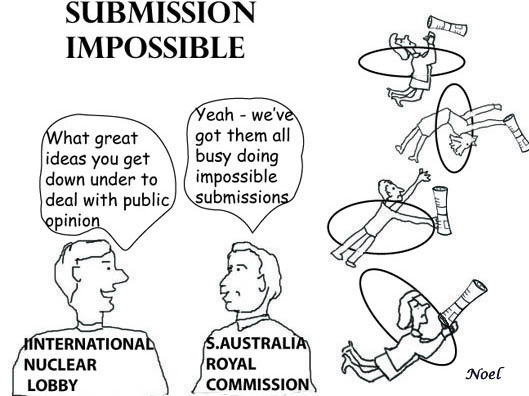
Imagine the scene … scenario 1:
You’re an executive of the French nuclear company AREVA, or of the Canadian nuclear company,SNC-Lavalin. (AREVA is in desperate financial straits and SNC-Lavalin in strife for corrupt practices). See report in the Financial Times 4 June 2015 ‘AREVA loses its reactor heart to EDF under French state plan’. Both companies are absolutely dependent on selling their nuclear technology overseas.
You have access to highly paid top lawyers, nuclear lobbyists and strategists, and access to top electronic equipment and computer skills. Indeed, this sort of thing is their job, and the company is well pleased to give them time to do this submission very thoroughly.
Submissions from a nuclear company do not need to be published. The Royal Commission deems that they can be kept private.
Imagine the scene … scenario 2:
You’re an ordinary citizen of South Australia, perhaps living in a rural area. Do you have access to the Internet, for a start? Well, you could make the effort, using a town library’s facilities. Then there’s the printing off of the ISSUES PAPERS, with those required question points. Then there’s the typing and printing of your Submission …. the JP …. the scanning … the PDF …. and so on. Your Submission will be published on the Internet, with your name.
What if you’re an Aboriginal, and your command of English is not great? No problem. The RC will send an officer to guide you. Mmmm … is there a problem in this?
I haven’t even touched on the content. I wonder … do I really need to?
Most of the questions appear to me to be squarely aimed at the nuclear companies…….. Some people have criticised the plentiful graphs and diagrams in the Issues Papers as sometimes inappropriate. I don’t know. It hardly matters. Many ordinary people, who are worried about the prospect of the entire nuclear fuel chain being established in South Australia will be sufficiently intimidated by the whole process anyway — never mind the graphs, or even the written content.
Perhaps that was the Royal Commission’s intention? https://independentaustralia.net/environment/environment-display/submission-impossible-sa-royal-commission-into-nuclear-fuel-cycle,7917
Is #NuclearCommissionSAust ignorant, or conflict of interest, as it goes to America?
Kevin Scarce sometimes scarce on nuclear reality, Online opinion, Noel Wauchope, 7 July 15 “……..The Royal Commission next goes to USA and Canada for 8 days, from July 9th. They’re particularly interested in the Small Modular Reactor idea. I hope that they’re aware that Westinghouse abandoned their Small Modular Reactor project, and that Babcock and Wilcox pulled back from this – unable to get any contracts or investors.
What I’m worried about, is that the Commission will end up recommending the plan explained recently by Oscar Archer, on ABC Radio National – that South Australia make an “ironclad commitment [my emphasis] to develop a fleet of integral fast reactors to demonstrate the recycling of the used nuclear fuel”
As for the Commission visiting Canada, Kevin Scarce enthused about the similarity between Canada and Australia. Really? What about the difference in climate, in the amount of sunshine, that surely makes Australia ideal for solar power?
Worst of all, as Scarce enthused about Canada’s “very productive nuclear industry” I wondered if the Commission is aware that the World Bank has Canada at the very top of its Corrupt Companies Blacklist, and that this dubious honour is due entirely to its nuclear industry. In particular SNC Lavalin is the culprit – the very company that is trying to sell thorium reactors overseas.
I would like to think that South Australia’s Nuclear Fuel Chain Commission is both well informed and impartial. I really would. But, listening to Kevin Scarce, I am not reassured. Nor is it reassuring to read the background nuclear industry links of Scarce and his research team. Kevin Scarce is a shareholder in Rio Tinto Group – the owner and operator of Ranger and Rossing uranium mines in Australia and Namibia. His prominent team leader is Greg Ward – Ward is also the director of two companies:Prism Defence (for which he is also CEO) and Protegic. The latter is a project management service provider with clients including the Rio Tinto Group, BHP Billiton and Endeavour Energy. Four of the five members of the research team named on the NFCRC website have known prior or current associations with nuclear industrial entities. http://www.onlineopinion.com.au/view.asp?article=17489
Aboriginal elder Kevin Buzzacott speaks at strong anti nuclear protest in Adelaide
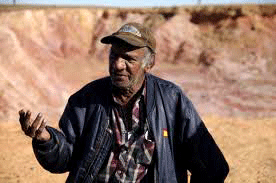 Nuclear dump would destroy our land: elder http://www.9news.com.au/national/2015/07/09/15/23/elders-students-protest-sa-nuclear-dump Aboriginal elders from across the country have joined scores of university students camping out in a stand against the storing of nuclear waste in Australia.
Protesters from far and wide have set up a tent community at Flinders University in Adelaide in protest against plans for a nuclear waste dump, in South Australia or anywhere else.
“To the South Australian government, to the federal government, to the mining giants – don’t worry about trying to put the waste dump here,” Arabunna elder Kevin Buzzacott said on Thursday.
It also coincides with South Australia’s royal commission into nuclear power, which is looking at whether the state should expand its involvement in the nuclear industry.
At least one SA Liberal senator says it should, with Sean Edwards recently urging the state to cash in by becoming a global player in the spent nuclear fuel recycling industry.
But Mr Buzzacott said a storage facility would destroy the sacred land of the country’s traditional owners. “We’ve lost a lot of sacred sites as it is,” he said. “We don’t want to lose any more. “We’ve been here 40,000 years. We’ve never touched the land – we love the land.”
The Nuclear Royal Commission’s whole aim – to build a case for importing global radioactive trash ?
If it did take more than 25 years to build a nuclear power plant then the technology could be made obsolete by renewables.
Last October, South Australia managed for the first time to get more than 100 per cent of its electricity needs for a working day between 9.30am to 6pm, from a combination of wind and solar energy. Overall it gets more than 30 per cent of its power from renewables, and has a target of 50 per cent to be achieved within 10 years.
Prof Diesendorf said it would only take 15 to 20 years to go to 100 per cent renewables in the state.
“The global enrichment market is oversaturated, and no-one credibly believes nuclear power is a realistic proposition for the sparse South Australian grid,” Greens senator Scott Ludlam argued in a column for New Matilda.
 “That leaves only the probability that this whole exercise is designed to build the case for a national or international radioactive waste dump.”
Is building a nuclear waste dump in Australia really the best idea? THE ADVERTISER, CHARIS CHANG JULY 09, 2 “………….at least one expert believes the [Nuclear expansion] scenario is too good to be true, and would do little to help the state’s economy in the short to medium term. The technology Senator Edwards has suggested is still in development and will not be feasible for more than 20 years.
Retired researcher Richard Leaver, formerly of Flinders University, told news.com.au that no Generation IV reactors had yet been built. These reactors are not generally expected to be available for commercial construction before 2030-40.
“And sodium cooling has, so far, a four-decade history of failure and serious accident,” Mr Leaver said.He said the state government should wait until someone managed to get the reactor working on an industrial scale before accepting anyone’s spent nuclear fuel.
Even if researchers could develop a Generation IV generator as a working technology, this would likely reduce the potential economic benefits. Continue reading
#NuclearCommissionSAust – Even Kevin Scarce has big doubts about thorium reactors
Kevin Scarce sometimes scarce on nuclear reality, Online opinion, Noel Wauchope, 7 July 15 On June 29 Kevin Scarce, chief of South Australia’s Nuclear Royal Commission, was interviewed by Ian Henschke on ABC Radio 891 Adelaide. Scarce had just returned from a Royal Commission whirlwind tour of Taiwan, Japan, Europe and the UK. The interview can be heard here.
I was pretty amazed, not only at the speed at which the Commission examined the nuclear industry, at so many places, from 26 May 12 June 2015, and at the complicated facilities that they examined, but also at how much information was left out of Scarce’s report, and at the apparent inadequacy of their grasp of current developments in the nuclear industry.
First and most obvious were two questions, both which Kevin Scarce had emphasised at his pre-tour community forums in South Australia. Scarce had stressed that the Commission would be consulting people on both sides of the nuclear debate – those for the nuclear industry, and those against it. In the whole interview, in all the places and organisations that Scarce described – not one word about meeting anyone remotely anti-nuclear.
Secondly, at the pre-tour meetings, Scarce had repeatedly said that the Commission would be studying renewable energy as well as nuclear. In his talk with Ian Henschke, it was clear that the Commission had not visited any renewable energy organisations or facilities. Indeed, when the interviewer brought up the subject of renewable energy, Scarce glossed over it very quickly – pointing out that Germany was “a way away’ from their renewables goal, and saying “We are certainly looking at renewables”.
Their first visit was to Taiwan, as Scarce said “to talk to the Taiwanese about their spent reactor fuel and about how they were going to manage it.” Well, it’s not surprising that Scarce did not go on to explain how the Taiwanese are going to manage their spent nuclear fuel, because the Taiwanese themselves do not know what to do with it. They are probablyretiring one reactor early, due to its accumulating wastes, and are also trying to work out a plan to export their nuclear wastes, but facing opposition in their legislature to this plan.
Then on to Japan…….
Reporting on France, Scarce was fairly reticent, considering that they spent so much time talking to AREVA, the State owned nuclear company. But that’s understandable. The South Australian Nuclear Royal Commission arrived at AREVA on 4th June. On 3rd June, the French government announced the break-up of AREVA, due to its disastrous financial record, to prevent it from bankruptcy……..
Questioned about new Generation IV nuclear reactors, Scarce emphasised their safety features, and, to be fair to him, he did point out the “enormous uncertainty” about when they would be commercially available – “not much before 2040″. He was asked about thorium reactors, and again, admitted to not knowing much about them, and that “2040 might be optimistic for thorium reactors“. Scarce said that with these reactors, thorium, not uranium, is the source of power. That’s not actually correct, as uranium 233 is the power source in thorium reactors. They need plutonium or enriched uranium to trigger the transformation of the inert thorium, to the fissile uranium.
To give credit to Kevin Scarce, he did mention the fact that this process is not so clean, meaning that plutonium or enriched uranium are a radioactive problem issue. He said “so some of your benefit in terms of a clean fuel source isn’t there”. Also, to be fair to Kevin Scarce, he did point out that thorium reactors have been tried in the past, in America, and closed down, and that he was doubtful about their future.
Henschke asked Scarce if he saw “state of the art” nuclear reactors. Yes, the Commission had been to both Olkiluoto and to Flamanville in France, and had seen the pressurised water reactors – the very ones that are now described as afinancial and safety fiasco. No wonder that Scarce did not elaborate on these visits……. http://www.onlineopinion.com.au/view.asp?article=17489

Submission Points to Royal Commission Issues Paper 1 EXPLORATION, EXTRACTION AND MILLING
Submissions to this Paper are due by July 24 POINTS TO CONSIDER
They want you to direct your answers to the points they have set out in http://nuclearrc.sa.gov.au/our-reports/exploration-extraction-and-milling/ SO: here are a few ideas:
1.1 and 1.2. (economics of uranium industry) Australia’s uranium production of 5,000 tonnes in 2014 was the lowest for 16 years. The industry generates less than 0.2 per cent of national export revenue and accounts for less than 0.02 per cent of jobs in Australia. (1)
Nowhere in this Issues Paper is information given on Government funding of the nuclear industry either directly in the form of grants and through government supplied services.
1.12 (Uranium enrichment) and 1.7 (Future of uranium market) The 2006 Switkowski Review concluded that “there may be little real opportunity for Australian companies to extend profitably” into enrichment. (2) Conditions are no more conducive to the establishment of an enrichment industry now than they were in 2006. Former World Nuclear Association executive Steve Kidd noted in July 2014 that “the world enrichment market is heavily over-supplied”.(3)
1.8. (health effects) There is a well established link between uranium mining and lung cancer. (4) Exposure to even low-level radiation is a health hazard. That is the position of all relevant expert bodies such as the United Nations Scientific Committee on the Effects of Atomic Radiation. As the the US National Academy of Sciences’ Committee on the Biological Effects of Ionising Radiation states, “the risk of cancer proceeds in a linear fashion at lower doses without a threshold and … the smallest dose has the potential to cause a small increase in risk to humans.”
1.10 (risks) Enrichment plants can produce both low-enriched uranium for reactors and highly-enriched uranium for weapons.
1.13 (effects on other industries). South Australia’s remarkable success in renewable energy, and its reputation for clean agricultural produce would clearly be threatened by further development in the uranium/nuclear industry
(1) http://www.conservationsa.org.au/images/Nuclear_Royal_Commission_issues_summary.pdf
(2) http://www.ansto.gov.au/__data/assets/pdf_file/0005/38975/Umpner_report_2006.pdf
(3) Nuclear Engineering International Magazine, May 2014
(4) http://www.mapw.org.au/files/downloads/Nuclear-power-uranium-mining-&-public-health_MAPW-Factsheet.pdf
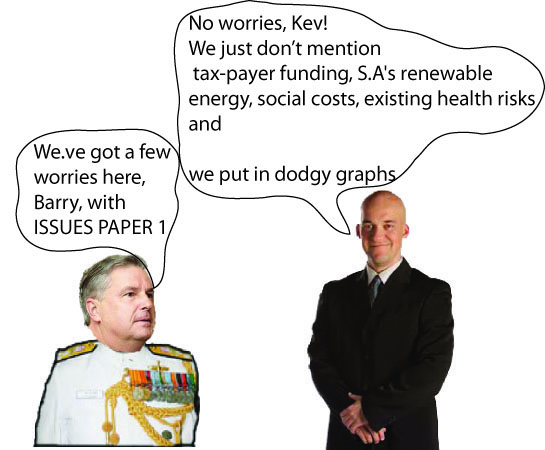
Answer Points to Nuclear Royal Commission on Importing Nuclear Waste
The nuclear-lobby-stacked Royal Commission faces stiff opposition in South Australia
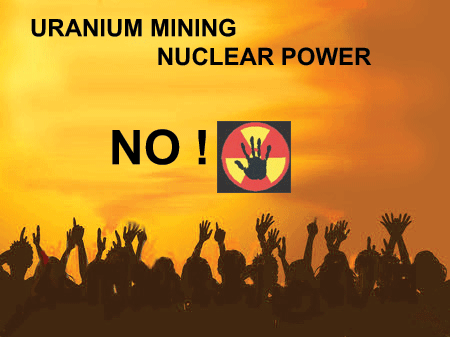 Renewables now! Nuclear not an option, Green Left, July 4, 2015 What about the new South Australian royal commission into the nuclear industry?
“……..South Australia has a nuclear industry the government wants to expand. There is uranium enrichment, but that is an economic non-starter, and then there is nuclear power, which is theoretically possible but very expensive and controversial.
The nuclear lobby is driving the idea that if you import other countries’ high-level waste, those countries would pay billions of dollars to get it off their hands. So there is all sorts of nonsense flying around South Australia, especially in the Murdoch press, that these billions of dollars would cover the entire cost of building nuclear reactors and would also allow the abolition of all state taxes.
But even with that sort of propaganda being circulated in the Adelaide Advertiser — a Murdoch tabloid — they found that fewer than one in six South Australians want a high-level nuclear waste dump.
It is a massive challenge, as the royal commission is stacked by pro-nuclear lobbyists. So it will issue a pro-nuclear report and we are doing the best we can to dull their enthusiasm.
We are building a separate campaign against the expansion. Traditional owners held a meeting in Port Augusta in April and this is the starting point to building an ongoing campaign.
A lot of these traditional owners have already experienced a track record of the industries of pollution and lies and they don’t want to be a part of it. They have seen the outrageous divide and rule tactics used by Heathgate against Adnyamathanha traditional owners. Then there is the long history of Olympic Dam uranium mine, and attempts to dump nuclear waste on Aboriginal land despite their ferocious opposition. Or go back to the Maralinga bomb tests in South Australia — there is a lot of history with people still suffering the varied impacts of that.
There is a lot of campaign strength in South Australia. Certainly we are putting in submissions to the royal commission but we don’t want to get sucked into their campaign too much because it is a fraud and the more important thing for us is to build campaigns and support Aboriginal people who want to build campaigns…..” https: //www.greenleft.org.au/node/59400
The writing is on the wall for coal-fired power in Australia
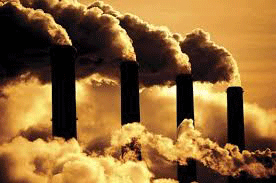 Say goodbye to coal power in Australia, The Age July 5, 2015 Mark Diesendorf The writing is on the wall for coal-fired power in Australia. Despite federal government attempts to stop the growth of renewable energy, all they can do is delay the inevitable transition.
Tasmania already has almost 100 per cent renewable electricity, based on hydro supplemented by wind. The ACT is on track to reach its target of 90 per cent net renewable electricity by 2020, based on solar and wind.
South Australia, with no freshwater hydro-electric potential, is the leading mainland state in the transition to renewable energy. Last year 33 per cent of its annual electricity consumption was generated by the wind and 6 per cent from rooftop solar. Furthermore, its electricity system has already operated reliably and stably for hours when the contribution of variable renewable energy reached two-thirds of demand. Recently wind power and gas coped admirably when the coal-fired Northern power station went unexpectedly offline.
Coal power will soon disappear from SA and eventually from the whole country. Because wind has no fuel cost, it can bid the lowest price into the electricity market and so is ranked higher in operating order than coal. The result: coal is displaced from operating as base-load (24/7) power, coal’s economics become worse and incidentally the wholesale price of electricity decreases.
This is the real reason our Prime Minister is trying to stop the growth in wind power. It has nothing to do with aesthetics or the sham ‘wind turbine syndrome’, but everything to do with Mr Abbott’s misguided commitment to coal. Continue reading
Transcript of Nuclear Royal Commission’s second meeting at Coober Pedy
Jon Bok representing the Royal Commission. Small attendance (5 people)
This is not a perfect transcript, but is largely accurate. Where you see 1. that means a question from the attendees.
Bok: I’m here to help with providing information for the community, and particularly the Aboriginal community, as the Commissioner looks at risks and opportunities for expanding the nuclear industry in South Australia.
- Is there some reason why we are being targeted? We’ve had two Royal Commission community forums, and Roxby Downs hasn’t had one.
Bok: I’m out an about in the region. I’m going back to Port Augusta in the coming weeks.
- You’re not looking at the underground tunnels, are you? – I don’t mean you personally; I mean the government in general.
Bok: It’s a much broader process. It is my opportunity to meet people who are interested.
- AREVA is sending back a shipload of nuclear waste to Australia. What are we going to do with that, when it gets here?
Bok: I simply don’t know. The Commissioner is looking broadly at South Australia. One question is – should we take nuclear waste in, to South Australia?
I’m not aware if Australia has the obligation to take that waste back. The question is: is it viable to take back nuclear waste?. The Terms of Reference ask about the feasibility and viability of the four questions . Continue reading
#NuclearCommissionSAust Have your say for the future of South Australia – submissions close soon – July theme
Submissions for the Royal Commission into the Nuclear Fuel Cycle are closing soon.
This Commission could change our State forever.
Make sure you have a say in it. The Conservation SA team 26 June 15
This is too big an issue not to have your voice heard. Currently, our State government is weighing up a future that could see nuclear power, uranium enrichment and nuclear waste dumping here in South Australia. The window for the public to make comment on these issues closes in a month.
We encourage you to make a submission and draw on our resources to assist you.
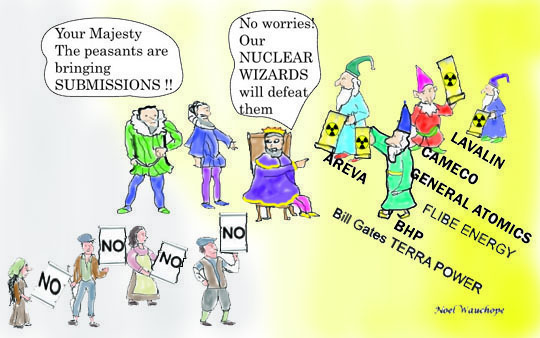
In May nuclear expert Dr Jim Green produced some information resources about each of the issues the Royal Commission into the Nuclear Fuel Cycle is investigating. Please see a summary and full report here.
Only last week renewables expert Dr Mark Diesendorf from the University of NSW finished an exciting report showing that South Australia could be run on 100% renewable energy is just 15 years. You can view and download the summary version and Dr Mark Diesendorf’s full report online here.
The issue papers generated by the Royal Commission are available here and submissions are due:
- Issues Paper 1 (Extraction) and/or Issues Paper 4 (Storage and Disposal of Waste) is 24 July, 2015
- Issues Paper 2 (Further Processing) and/or Issues Paper 3 (Electricity Generation) is 3 August, 2015.
If you wish to provide a consolidated written submission addressing all Issues Papers you have until Monday August 3, 2015.
If you wish to make an oral submission call the Royal Commission on 08 8207 1480 to make arrangements.
It’s critical that your voice is heard. This commission could change our State for generations to come.
Now is the time to act.
1 This month

of the week – Australians for War Powers Reform (AWPR)
To see nuclear-related stories in greater depth and intensity
 Antinuclear