Solar air conditioning, solar power the clean way to keep cool
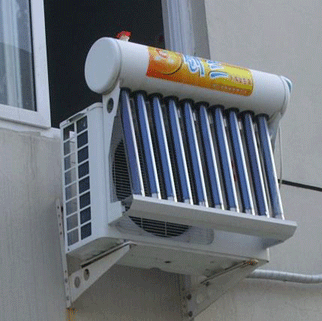 Over one million Australian homes now have solar and our power pricing doesn’t handle them well either
under the status quo, those without air conditioning and with solar are being slugged unfairly.
Matthew Warren: The way we pay for electricity is out of date and urgently needs reform MATTHEW WARREN THE ADVERTISER FEBRUARY 03, 2014 THE recent intense heatwave across south-eastern Australia stretched many things to breaking point.Heatwaves provide a rare, but important examination of the power system.On a normal summer’s day in South Australia the peak load is around 1890 megawatts. In the heatwave it topped 3000 megawatts for almost three days straight. That put the network right at the edge of its capacity.
There is one key reason for these spikes in demand: increased deployment of airconditioners. On the hottest of days they are all turned on at once and this sends demand skyrocketing……
A large part of your household power bill is to pay for these infrequent events. It would make sense if those households with large air conditioners paid more than those who have only a small unit or none at all.
But they don’t. Continue reading
South Australian government gives grant to uranium leach mining company
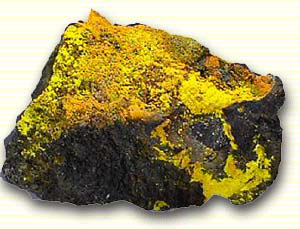 UraniumSA receives grant for Samphire Uranium project in South Australia Friday, January 17, 2014 by Proactive Investors UraniumSA (ASX:USA) has received a $50,000 grant from the South Australian Government to advance metallurgical test work for its Samphire uranium deposits in South Australia
UraniumSA will work in collaboration with the University of South Australia’s Ian Walk Research Institute to focus on finding a more efficient process for the removal and recovery of uranium from saline leach solutions, and to advance UraniumSA’s existing data and process understanding.
This grant will facilitate the continuation of recent research and test work by UraniumSA which aims to optimise pathways for uranium recovery from hyper-saline solution……http://www.proactiveinvestors.com.au/companies/news/51977/uraniumsa-receives-grant-for-samphire-uranium-project-in-south-australia-51977.html
A step forward for solar thermal plant in Port Augusta
 Australian Youth Climate Coalition 16 Jan 14 We’re excited to share a great win with Repower Port Augusta

Today the Australian Renewable Energy Agency and the South Australian Government announced that they have committed to funding for Alinta Energy to run a feasibility study into building solar thermal in Port Augusta.
This is a huge step forward in building our first solar thermal plant!
You can read more here:http://www.businessspectator.com.au/news/2014/1/15/energy-markets/arena-funds-port-augusta-solar-thermal-study
The Australian Greens BREAKING NEWS: South Australia is one step closer to having a solar thermal plant!
On a day when we are sweltering under record-breaking heat, and climate change looms large, it has just been announced Alinta Energy has received ARENA funding for a feasibility study into solar thermal in Pt Augusta.
A huge effort from the team at Repower Port Augusta who have worked tirelessly on this project, and great news for the Port Augusta community. Bring on a healthy clean energy future!
How Australia caved in to Britain, in not properly cleaning up Maralinga bomb sites
 Why cabinet sought only a partial clean-up of British nuclear test site Archives give new insight into Hawke government’s response to royal commission on weapons testing in Maralinga region Paul Chadwick theguardian.com, Wednesday 1 January 2014
 Gareth Evans, the energy minister at the time, said ‘a non-confrontational approach’ had been adopted in dealing with the Thatcher government.
The complete rehabilitation of areas of Australia used to test British nuclear weapons may not be possible, the Hawke cabinet was advised in 1986.
Cabinet was warned that a full clean-up may have been more expensive than the British government would be willing to contemplate, according to documents released this week by theNational Archives.
They provide new insights into the Hawke government’s response to the recommendations of the McClelland royal commission into British nuclear tests in Australia. Continue reading

Australia’s inadequate decontamination of radioactive nuclear test sites
 Cabinet Papers 1986-87: The struggle for indigenous land rights, SMH, Damien Murphy, 28 Dec 13, “……….. Decontaminating radioactive sites The McClelland royal commission on British nuclear tests in Australia had recommended that the Maralinga and Emu test sites should be decontaminated to a standard suitable for unrestricted habitation by the traditional owners.
But a technical assessment group found that even the expenditure of hundreds of millions of dollars would not achieve complete decontamination.
The Resources and Energy Minister, Senator Gareth Evans, recommended that Cabinet consider the lesser option of decontamination sufficient to allow casual access to a larger area than was currently permissible. This option might cost between $20 and $30 million, “much more within the ball park that the UK Government is likely, on present indications, to be prepared to contemplate”.
Cabinet also decided that compensation claims for diseases that might have been caused by radiation would be resisted if the Commonwealth did not believe that a liability existed……….
Traditional owners had been dispersed to Yalata and the Pitjantjatjara lands in South Australia and Coonana in Western Australia. Cabinet allocated an initial $500,000 for projects of lasting and general community benefit…….. http://www.smh.com.au/federal-politics/political-news/cabinet-papers-198687-the-struggle-for-indigenous-land-rights-20131228-3017r.html
Australian government didn’t want to know about Aborigines affected by atomic tests
Cabinet rejected the royal commission’s recommendation for the creation of a new register of persons who may have been exposed to “black mist” or radiation at the tests.
The actions of previous Australian government [sic] in shepherding Aboriginal people from their traditional lands for the purpose of conducting atomic tests were both immoral and appallingly executed.
Why cabinet sought only a partial clean-up of British nuclear test site Paul Chadwick theguardian.com, Wednesday 1 January 2014 “…………An aerial survey of radioactivity around the test sites would be followed by a more detailed ground survey. Five studies would “define the areas – hopefully quite small – which must remain surrounded by fences, and further outer areas in which activities such as food gathering and excavation should not occur”.
A report by technical experts attached to the cabinet submission states: “Aboriginals living and gathering food on the Maralinga lands may be exposed [to contaminants] … in three major ways – by inhalation, by ingestion and by entry of contaminated material through open flesh wounds and abrasions.”
The experts considered options for burial of contaminated soil. They noted that since one of the contaminants had a half life of 24,000 years it was a prerequisite to make a prediction about the sort of changes in the earth expected to occur in the Maralinga area in the timeframe. Continue reading
Unsettling truths about Australia’s uranium and nuclear history
a few unsettling home truths about Australia, as a far-flung outpost of what the writer B. Wongar has called the ‘Nuclear Empire’.
the plunder of native land for its enormous reserves of uranium has entrenched the country’s problematic engagement in world nuclearism and undermined its international credentials as a leading proponent of nuclear non-proliferation.
Anzac, New Mexico: Placing Australia in the Nuclear Empire, Meanjin, Robin Gerster, Dec 13 It is a lament that many Australian readers will recognise: an indigenous narrator is telling the story of colonial dispossession, from the time of white settlement to the rampant mining activity of today, expressing his helplessness in the face of an implacable force that reinscribes the very landscape it has taken over, mapped and mined………….
In August 1945, unable to boast a military role in such a king-hit to its hated enemy Japan, Australia sought another way to take a small slice of the wretched glory. Two days after the Hiroshima bombing, the claim was circulated that ‘Little Boy’ was fuelled by Australian uranium: ‘Uranium from S.A. source’, ran a story on page one of the Sydney Morning Herald. But the text itself says nothing more than the fact that uranium is vital to nuclear fission, that it had been mined at Mt Painter in South Australia, and (portentously) that supplies of the element had been ‘flown out’ from the mine’s newly constructed aerodrome. The Herald soon retracted the story, quoting Prime Minister Ben Chifley to the effect that ‘though Australia attempted to secure uranium for the atomic bomb, the production stage was never undertaken’. This was a minor humiliation in the scheme of things, but a reminder that Australia’s part in these epochal events was essentially peripheral. Undeterred, a Courier-Mail correspondent on 9 August, the day of reckoning for Nagasaki, claimed that Australia ‘gained prestige’ from the advent of the atomic bomb merely by being one of the world’s leading sources of the element.
Australia’s miserable history as part of the global nuclear empire
the outrage committed against the land and communities of Aboriginal Australia.
A small community of Aborigines at a nearby station was poisoned by the fallout, though it was unacknowledged at the time and for years afterwards.
Anzac, New Mexico: Placing Australia in the Nuclear Empire, Meanjin, Robin Gerster, Dec 13 “…………The Fox Report fiasco is indicative of contradictions in Australian political attitudes to the nuclear industry. Australia refuses to contemplate nuclear power plants on its own soil, but it is happy to peddle its uranium to numerous countries in Asia and Europe. The meltdown at Fukushima in Japan in 2011 (in a reactor complex owned and operated by a big buyer of Australian uranium) temporarily rocked the markets and embarrassed advocates of nuclear energy…..
The state governments of mining mainstays such as South and Western Australia have a cheerfully gung-ho attitude to uranium. Distant Fukushima is out of mind as well as well out of sight. In addition to hosting established mega-concerns such as BHP Billiton, operator of the Olympic Dam mine near Roxby Downs, South Australia is rolling out the red carpet for new players…….
At Four Mile in the northern Flinders Ranges, another mine has been given the go-ahead. It is majority-owned by a subsidiary of Heathgate Resources, operator of the existing mine at Beverley in the same region, which is itself an affiliate of the nuclear arms maker General Atomics…. ‘Nuclear-free’ Australia has some alarming business connections. …
After the Second World War, Australia wanted to keep some atomic stuff for itself in addition to supplying the product to the United States and Britain. Continue reading
Olympic Dam uranium mine won’t replace Holden jobs
 27 Dec 13 “The stalled Olympic Dam mine expansion is not the answer to job
  creation in South Australia, despite the Prime Minister’s vivid imagination”, according to Greens SA Parliamentary Leader, Mark Parnell MLC
“What the PM should be doing instead is focusing on how best to help South Australian industries create jobs in areas where we have a real competitive and natural advantage. 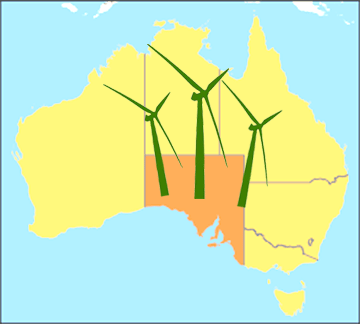 If he opened his mind to the possibilities, he would see that SA is a leader in renewable energy and there is great potential for jobs growth in wind power, solar PV and in the emerging area of Solar Thermal, such as that proposed for Port Augusta to replace the existing dirty coal fired power stations. [See:http://bze.org.au/repower-port-augusta]
“That’s why the Prime Minister’s decision to axe the Clean Energy Finance Corporation is bad news for South Australia. It’s also why we should be very worried about his likely decision to water down the Renewable Energy Target. This target is the reason why so many energy companies chose to invest in South Australia over the last few years – because our abundant wind and solar resources give us the edge over other States in the grid.
“Liberal leader, Steven Marshall should be horrified at what his party is doing to South Australia’s future economic opportunities and he should be calling on the PM to change direction. Continue reading
University College London (Australia) pushing its nuclear agenda with a survey

Mr Parnell said nuclear power did not have to be pushed into a survey about alternative energy” Lumping nuclear energy in with low-carbon technologies is just wrong,”
Anger after nuclear option placed on alternative energy survey news.com.au DECEMBER 22, 2013 NUCLEAR power has been put on the table in a survey that asks country South Australians about their preferred alternative energy options.
The survey, commissioned by Regional Development Australia, asks residents in the Yorke Peninsula and the Mid North to respond to a “community preferences survey” regarding their views on solar panels, solar farms, nuclear, household, wind turbines, wind farms, hydro, geothermal facilities, waste-to-energy/plant and biomass plants.
RDA, funded by federal and state governments as well as the region’s local councils, states on its website that the survey is part of a “project to determine how best to prepare the region for renewable energy and other low-carbon technologies as part of the state’s climate change adaptation strategy”.
But Greens MLC Mark Parnell slammed the survey and said the proponents, the region’s councils, had been pushing an anti-wind generation agenda. Continue reading
Adelaide’s University College London (UCL) -pro nuclear research funded by nuclear interests
 Professors slam UCL Australia’s nuclear and shale gas research http://london-student.net/news/11/18/professors-slam-ucl-australias-nuclear-shale-gas-research/ by James Burley on November 18, 2013
- Two biggest donors are uranium and shale gas producers
• Academics say this makes idea research was independent “laughable”
Senior professors have spoken out against University College London (UCL) Australia’s pro-nuclear, pro-shale gas research, claiming that strong industry ties make the idea it is independent “laughable”.
UCL’s Adelaide-based campus released one green paper calling for Australia to acquire nuclear submarines and another advocating the use of shale gas in the country. Of its two biggest sponsors, one mines uranium – needed to fuel nuclear submarines – and the other produces shale gas.
Speaking on the condition of anonymity, UCL professors told London Student: “The idea that research favouring nuclear submarines and shale gas extraction could possibly be independent (taking into account relevant alternatives) is laughable – UCL Australia has not produced a single piece of research on sustainable, greener, or alternative energies.”
“A university should not only be academically independent and impartial but also be seen to be so. In these matters UCL’s academic integrity is in jeopardy.” Continue reading
Now on the endangered list- the critically important South Australian Environmental Defenders Office
 SOUTH AUSTRALIAN ENVIRONMENTAL DEFENDERS OFFICE (EDO) FACES CLOSURE AFTER FEDERAL GOVERNMENT FUNDING CUTS 18 December 2013 The Federal government yesterday cut $10 million in funding for across Australia. EDOs specialise in public interest environmental and planning laws. A further $810,000 in funding will cease from mid-2014, reducing Federal support to zero.
The shock funding cuts will result in an immediate significant decline in services and the likely closure of the South Australian EDO office by June 2014. The EDO provides numerous individuals and community groups across the state with free legal advice on environmental and planning laws relating to building or mining developments, water issues, pollution, and heritage issues. Clients are provided with advice and assistance on how decisions are made and potential ways to challenge those decisions. The EDO also has an integral role in providing responses to proposed changes to environmental law and policy.
The SA EDO has run a number of high profile cases including in relation to the proposed expansion of the Olympic Dam mine, a project likely to have significant impacts on the Great Artesian Basin and the Upper Spencer Gulf marine environment.
“This is an extremely disappointing decision for many South Australians whose access to expert legal advice to help them protect their environment will be severely curtailed. The community should be alarmed about the very real threat to the survival of the EDO – we are now on the endangered list. We call on the Federal Government to restore the funding otherwise defending property rights, community amenity and the environment could become unaffordable for many South Australians.” said Melissa Ballantyne, Coordinator and Principal Solicitor of the EDO.
BHP not keen to waste more money developing uneconomic Olympic Dam
 Where Olympic Dam is concerned, it’s the outlook for the main commodity—uranium—rather than potential investors that it mostly dislikes.
BHP Warms to Partnerships, But Olympic Dam Remains in the Cold WSJ 10 Dec 13, BHP Billiton Ltd. wants to share the love to get its $10 billion Jansen potash project in Canada off the ground. But the world’s biggest mining company is being a determined single when it comes to another costly development: Australia’s Olympic Dam…….
BHP’s reluctance to seek a partner for an expanded Olympic Dam project in South Australia may surprise as it’s stuck on the back burner, squeezed by low commodity prices and high development costs estimated by analysts at around $30 billion. In August last year, BHP said it would look for a less costly design for the Olympic Dam mine, which had been expected to bring in billions in tax dollars and create thousands of jobs. Up to now, it hasn’t announced any new plans for the site.
At first glance, finding a competitor to share development costs and risks with BHP makes sense. If they also bring in new technology then so much the better.
The problem for BHP is that a partner might actually want to get the project moving, even at a much-reduced scale. That would test BHP’s desire to keep annual spending below $15 billion in future, down by a third from last year’s bill totaling $21.7 billion. With uranium prices continuing to hover near eight-year lows, and several countries debating nuclear power in their energy mix, BHP can avoid such tough decisions by keeping full control of the asset.
“We like partnerships,” Mr Mackenzie told U.S. investors. Where Olympic Dam is concerned, it’s the outlook for the main commodity—uranium—rather than potential investors that it mostly dislikes. http://blogs.wsj.com/moneybeat/2013/12/10/bhp-warms-to-partnerships-but-olympic-dam-remains-in-the-cold/
Waubra Foundation calls South Australian Environment Protection Authority “corrupt”
Waubra Foundation attacks EPA Shannon Twomey Weekly Times, December 3, 2013 THE Waubra Foundation labels the South Australian Environment Protection Authority corrupt and is calling for an external inquiry.
The anti-wind farm group attacked SA EPA over its Waterloo Wind Farm Noise Study findings which were conducted during April and June. The results were released on November 26.
The study found the Waterloo Wind Farm meets relevant SA and international standards and there was no evidence linking the noise from the wind farm to adverse impacts on residents.
But in a letter sent yesterday to South Australian Premier Jay Weatherill, Waubra Foundation chief executive Sarah Laurie said the EPA staff involved in the study were deliberately attempting to corrupt the data and mislead residents.
…….The letter concludes with five “necessary actions” that Ms Laurie has urged from the Premier including an immediate external public inquiry into the SA EPA to investigate breaches of integrity, respect and accountability.
SA EPA’s operations director of science, assessment and planning Peter Dolan said noise from the Waterloo Wind Farm did not breach EPA guidelines.
He said infrasound levels from the wind farm were below the internationally threshold for perception and in many cases analyses of audio records and data were unable to demonstrate associations with events described in noise diaries……http://www.weeklytimesnow.com.au/article/2013/12/03/590978_national-news.html
Largest native title area – South Australia win for Aboriginal people
Native title recognised after 18-year legal battle ABC Indigenous News, November 28, 2013 South Australia’s largest native title determination will be granted to Aboriginal people in the state’s far west next week. The claim covers 80-thousand square kilometres of land from the Western Australian border, to Tarcoola in the north and Streaky Bay in the south.
The recognition comes after nearly 18 years of struggle by the Wirangu, Kokatha, Mirning and Anangu people. The groups’ connection to the land will be formally recognised at a special Federal Court hearing at Lake Pidinga, north of Yalata, next Thursday……..
National Park gets new name Last year, the Arabana people were granted native title over 70,000 square kilometres of land in the state’s far north, including Lake Eyre. Lake Eyre National Park has now been officially renamed to include the traditional Aboriginal name for the landmark. At the request of the newly-formed Arabana Parks Advisory Committee, the park will now be known as Kati Thanda – Lake Eyre National Park. The park is co-managed between the State Government and Arabana people.http://www.abc.net.au/news/2013-11-28/aboriginal-groups-granted-native-title-in-far-west-sa/5122788/?site=indigenous&topic=latest
1 This month


Help Aunty Sue Protect Her Land and Sacred Sites From Destructive Rocket Testing.
.

Australians deserve the truth
about
AUKUS – https://aukuspublicinquiry.com/

PETITION – To: Prime Minister Anthony Albanese and the Australian Labor Government

of the week – Australians for War Powers Reform (AWPR)
To see nuclear-related stories in greater depth and intensity

