South Australian Environment Protection Authority (EPA) finds Wind Farm Not Harming Residents
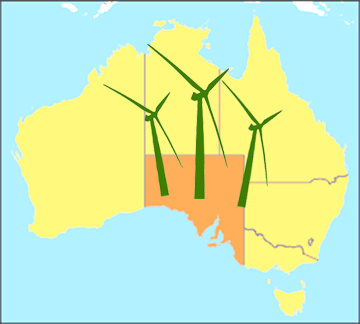 EPA study finds no evidence wind farm noise impacting residents ABC News, 27 Nov 2013, A study into the Waterloo Wind Farm, south-east of Clare, has found there is no evidence linking noise from the farm to any adverse effects on local residents.
The study was undertaken by the Environment Protection Authority (EPA) during April and June.
It has found noise produced does not breach authority guidelines and that low frequency infrasound levels are below internationally-accepted thresholds for perception.
The authority also says in some situations there was no association between events described by residents in noise diaries with audio records and data.
The authority’s Peter Dolan says he cannot say why local residents are complaining about health effects…….http://www.abc.net.au/news/2013-11-27/epa-study-finds-no-evidence-wind-farm-noise/5119556
Uranium loses its glow at SA mining conference
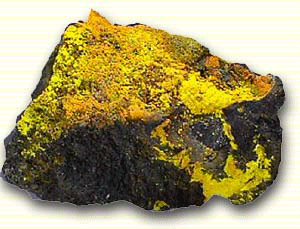 AUSTRALIAN CONSERVATION FOUNDATION, 26 Nov 13, Uranium hopefuls will be hard pressed to find a positive story about the embattled sector at a mining industry conference this week in South Australia. The last two weeks have seen further evidence of the continuing market fallout from Fukushima on SA’s embattled uranium sector with the closure of the Honeymoon operation and the decision by Marathon Resources to exit the uranium trade, declaring the sector’s ‘risks outweigh the rewards’.
 The news comes as a set of uranium junior companies join with the Beverley project’s Heathgate Resources to talk up the sector at the 2013 Mining South Australia conference, which starts today in Whyalla.
Australia’s uranium industry is suffering from:
- · The scrapping of plans for a massive expansion of BHP Billiton’s Olympic Dam mine in SA because of the ‘uncertain’ uranium market
- · A fall in the uranium commodity price of around 50 per cent and larger falls in the share value of uranium mining companies since Fukushima – a continuing crisis directly fuelled by Australian uranium
- · Sustained losses and operational failures at ERA’s Ranger mine in Kakadu
- · Attempts by Queensland uranium promoters to receive ‘royalty relief’ and public concessions even before making any formal applications to mine
- · Projects stalled, scrapped or deferred in WA, SA and the NT
“The uranium industry has long caused trouble, now it is increasingly in trouble,” said Australian Conservation Foundation nuclear free campaigner Dave Sweeney. “Uranium mining is a high-risk, low-return sector that poses unique, unresolved and long-lived threats and does not enjoy secure social license.
“It is time for politicians to stop accepting industry promises and start genuinely examining industry performance. “ACF urges state and federal governments to give effect to the UN Secretary General’s call that Australia conduct ‘an in-depth assessment of the net cost impact of the impacts of mining fissionable material (uranium) on local communities and ecosystems’.
“Instead of misplaced industry enthusiasm it is time for a comprehensive and independent assessment of the costs and consequences of the uranium sector.”
Bikini nuclear tests as cause of 1954 Adelaide earthquake?
The electromagnetic pulse and ionization of the atmosphere resulting from the high-yield nuclear bomb Bravo was clearly associated with Adelaide earthquake.
 The Castle Bravo nuclear explosion of 1954. Part 1: Bobby 1’s Blog 21 Nov 13 In the Adelaide, Australia earthquake in the early morning of March 1, 1954, residents of Adelaide, Australia were awakened to a violent shaking in their beds. When they went outside, they saw a brilliant glow in the east. The United States had just set off the Castle Bravo nuclear bomb on Bikini Island, 3,600 miles away.On March 1, 1954, the detonation of an estimated 15 megaton thermonuclear weapon, known as “Bravo” took place – as part of the “Castle” test series. According to the U.S. Radiochemistry Society, “the Bravo test created the worst radiological disaster in US history ….the yield of Bravo dramatically exceeded predictions, being about 2.5 times higher than the best guess and almost double the estimated maximum possible yield (6 Mt predicted, estimated yield range 4-8 Mt).” The bomb was over 1000 times more powerful than those exploded over Hiroshima and Nagasaki in 1945. The Bravo crater in the atoll reef had a diameter of 6,510 ft, with a depth of 250 ft. The cloud top rose and peaked at 130,000 feet (almost 40 km) after only six minutes. Eight minutes after the test the cloud had reached its full dimensions with a diameter of 100 km, a stem 7 km thick, and a cloud bottom rising above 55,000 feet (16.5 km), and after 10 minutes had a diameter of more than 60 miles.
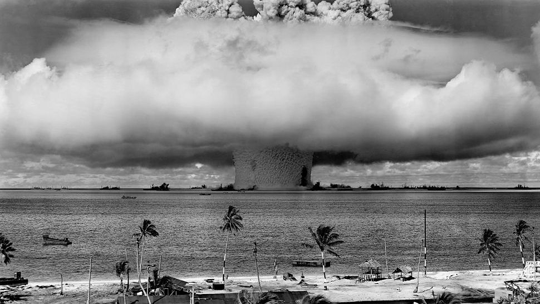
The radioactive fallout from Bravo covered the planet, including the Southern Hemisphere. It was a fission-fusion-fission bomb, designed to release high levels of radioactivity. Its yield was 15 megatons, but it released almost seven times as much radiation than the Russian Tsar Bomba, which had a yield of 50 megatons. Continue reading
Marathon uranium project closed – unviable due to poor uranium market
 Explorer says uranium project unviable Yahoo 7 Finance 21 Nov 13, Minerals exploration company Marathon Resources has turned its back on the uranium industry for good. The company says its experience suggests the “risks were more likely to exceed rewards” in a sector hit by low ore prices.
“Both the political and regulatory regimes have deterred us permanently from the uranium industry,” chairman Peter Williams told the company’s annual meeting in Adelaide on Thursday. Marathon previously has been involved in exploring a section of South Australia’s Flinders Ranges with a view to developing a significant uranium deposit.
However, it fell foul of the South Australian government over the disposal of waste while the government eventually moved to ban all mining in the environmentally-sensitive area anyway.
Since then, the uranium industry has been hit by falling commodity prices which also has prompted mining giant BHP Billiton to mothball its plans for a $30 billion expansion of its Olympic Dam copper and gold operations…… industry is presently witnessing that part of the cycle where the spot price for product has fallen dramatically below production costs sufficient to amortise large capital costs,” he said…….. http://au.finance.yahoo.com/news/explorer-says-uranium-project-unviable-032809245.html
Arabunna elder highlights the costs of BHP’s uranium trade at annual meeting
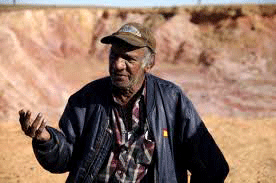 21 Nov 13, Mr Kevin Buzzacott, the President of the Australian Nuclear Free Alliance and a respected Arabunna elder will today take his concerns over the proposed expansion of the Olympic Dam uranium mine in South Australia to BHP Billiton’s annual meeting in Perth. Mr Buzzacott has been vocal in opposing the Olympic Dam uranium mine and the planned expansion. Mr Buzzacott unsuccessfully tried to halt the expansion through the courts and has now been ordered to pay court costs to the Government and to BHPB. At today’s meeting he will be asking whether BHP, the world’s largest miner, will be seeking to follow this cost order.
“I’m an Arabunna elder and I’ve spent the last thirty years trying to protect my country and the water from my country from this monster mine,” said Mr Buzzacott. “Now I’ve come all the way from South Australia because this is so important for me, I’m getting old and this could be my last chance to get BHPB to quit to shut Olympic Dam down and leave the desert and us in peace.”
“All my life I’ve stood up for my country because that is the right thing, that’s what we’re taught to do. Now BHPB have a choice whether they’re going to penalise me, take me for the court costs, for standing up for my country – or whether they’re going to respect my rights to protect those sacred places.”
The planned massive expansion of Olympic Dam has been shelved because of low uranium prices and market uncertainty. The current Olympic Dam mine consumes over thirty five million litres of water day from the Great Artesian Basin from Arabunna country and any future expansion would increase pressure on water resources.
“Now you say the expansion is on hold well we have a right to know whether you’re going to try and get this expansion happening or not. I mean it doesn’t make sense to dig deeper when people are waking up and saying no to the nuclear industry around the world.”
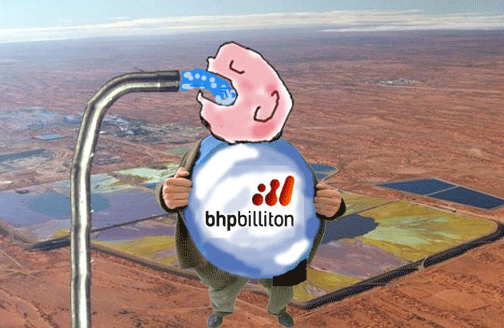
“Our land is our life and we will follow BHP Billiton to the ends of the earth to stop this mine from damaging our country and draining our water,” concluded Mr Buzzacott.
South Australian Aboriginal Call For a Treaty
Don’t take our lands – Yami Lester The Stringer, by Gerry Georgatos November 16th, 2013 “……..South Australia’s Kaurna Elder and Chair of the Kaurna Nation Cultural Heritage Association, Lynette Crocker said that instead of 99-year leases Governments should settle their differences once and for all with Aboriginal peoples with a Treaty “and instead do the right thing by all Aboriginal peoples.”
“Treaty should have come in South Australian regions in the 1830s when the colonialists dispossessed our peoples, and similarly so around Australia. But our Government does not care about Treaties, or about land rights or of doing the right thing. But we will keep the battle up and fight for Treaty. We will get it.”
“What little we have did not come easy. What happened to Australia was the Aboriginal voice rose, Gough Whitlam came along, a friend to our peoples, then the Wik decision and Eddie Mabo. Don’t’ ever imagine that Australian Governments want to give us anything. I approached the then Prime Minister, Julia Gillard about Treaty, and she responded to me, ‘We don’t’ need any more bits of paper.”
“The Prime Minister said to me ‘there will be no Treaty’. We have to raise our voices to get it, we have to come together because look what is happening otherwise – land rights are disappearing, lands are being taken back, and this is what the 99-year-leases are about to make sure we lose back to them – the control of our Countries.”…… http://thestringer.com.au/dont-take-our-lands-yami-lester/#.Uo5eU9Jwo7o
As USA’s nuclear plants bite the dust, so do Australian uranium mines?
 South Australian uranium Honeymoon mine to stop production, jobs in doubt NEWS.COM.AU NOVEMBER 11, 2013 THE Honeymoon uranium mine in South Australia’s far northeast is expected to be mothballed. Low uranium prices and production difficulties at the plant have put pressure on the mine. The future of about 70 employees was not immediately known but far fewer employees would be needed when the mine is put under “care and maintenance”.
Honeymoon, which began producing uranium in 2011 , became wholly owned by Russian state company JSC Atomredmetzoloto in mid-October.
Previously it had been 49 per cent owned-and-operated by Canada’s Uranium One……..
Honeymoon is about 500km north by road from Adelaide, 80kms northwest of Broken Hill.It uses an in-situ leach method – where liquids are pumped underground to dissolve the uranium with the mineral extracted from the pregnant solution at the surface. SA is Australia’s leading uranium producer with Olympic Dam and Beverley in operation. Ranger in the NT is the only other mine. The Four Mile mine – near Beverley – has been approved but is yet to be built….. http://www.news.com.au/national/south-australia/south-australian-uranium-honeymoon-mine-to-stop-production-jobs-in-doubt/story-fnii5yv4-1226757697638
South Australia gets world’s first wave energy converter
 Oceanlinx launches wave energy converter in Australia, Renewable Energy Magazine, Dan McCue Monday, 04 November 2013 Australian wave energy company Oceanlinx team launched the world’s first 1 MW wave energy converter — called ‘greenWAVE’ — on 25 October 2013 in TechPort Adelaide in Australia. By the end of the year, Oceanlinx Ltd.along with the Port MacDonnell community will be celebrating the long awaited connection of the ‘greenWAVE’ energy converter unit to the grid in South Australia.
Built and launched from TechPort in Adelaide, the $7 million project will be the first of its kind to be commissioned in the world. The groundbreaking demonstration unit received $4 million from the federal government in a bid to make the project ready for market.
Once connected to the grid, the unit will be rigorously tested for the best part of 2014, the company said in a written statement.
Based on the Oscillating Water Column principle, the technology is one of the most tested and matured technologies in the wave energy sector.
The unit is completely environmentally friendly sitting under its own weight on the seabed in shallow water with no anchors, mooring or attachment to the seabed. It is expected to act as an artificial reef for sea life. It has no moving parts under the water and is designed to withstand the most aggressive sea conditions. With ease of access to the weather tight power house placed above the sea level, the through life management costs are kept to the minimum…….http://www.renewableenergymagazine.com/article/oceanlinx-launches-wave-energy-converter-in-australia-20131104
South Australia Power Networks punish home energy storage
Home Energy Storage Penalised In South Australia http://www.energymatters.com.au/index.php?main_page=news_article&article_id=4004 3 Nov 13, SA Power Networks seems to have taken a dim view of mains-connected solar households incorporating battery storage systems. While countries such as Germany are actively encouraging the uptake of home energy storage, it appears South Australia is actively discouraging it.
In an industry news bulletin from earlier this month; SA Power Networks have declared that customers installing energy storage will lose their feed in tariff incentive. According to the document: Continue reading
South Australian Govt’s plan to keep ‘unsuitable’ people out of body governng Aborignal lands.
New APY rules to vet ‘unsuitable people ‘http://www.theaustralian.com.au/national-affairs/politics-news/new-apy-rules-to-vet-unsuitable-people/story-fn59nqld-1226733838565 SARAH MARTIN OCTOBER 07, 2013 NEW rules for the executive body that governs South Australia’s troubled northern Aboriginal Lands are being considered by the state Labor government, as it embarks on a review of the APY Land Rights Act.
The terms of reference for the review, obtained by The Australian, show that the government wants to prevent unsuitable people being appointed to the Anangu Pitjantjatjara Yankunytjatjara Lands executive through a new “fit and proper person” test.
“The criteria would cover, but would not be limited to, demonstration of competency, experience, skills and ability, personal integrity, reputation, diligence, independence of mind, fairness and absence of convictions or civil liabilities,” the terms of reference say.
“To give confidence the nominees for election to the APY executive have the necessary skills, experience, ability and commitment to carry out the role, it is considered only fair and reasonable for some form of ‘fit and proper’ criteria to be applied.”………
Uniting Communities indigenous policy spokesman Jonathan Nicholls said he was concerned about the scope of the review.
“It is unlikely this review will do much to address the governance and capacity problems that have plagued the APY executive for a number of years.” http://www.theaustralian.com.au/national-affairs/politics-news/new-apy-rules-to-vet-unsuitable-people/story-fn59nqld-1226733838565#sthash.WAfwHGWH.dpuf
Australian Renewable Energy Agency backed award winning wave energy project
Even before completion of the Port MacDonnell demonstration project, funded by the federal government’s Australian Renewable Energy Agency and private backers, Greenwave has caused a stir worldwide. Mr Baghaei said the company was in talks with governments and businesses in Asia, Europe and the US on deployment of the technology under licence. “We feel we are one of the leaders in this sector,”
Oceanlinx award buoys wave-energy’s future http://www.theaustralian.com.au/business/companies/oceanlinx-award-buoys-wave-energys-future/story-fn91v9q3-1226724729334 CHERYL JONES THE AUSTRALIAN SEPTEMBER 23, 2013
A CONCRETE structure taking shape at the Techport facility in Adelaide is helping to lay the foundations of a new Australian export industry — wave power technology.
The structure, a one-megawatt “wave energy converter” — the most powerful such unit in the world and capable of powering about 1000 households — is being built by Oceanlinx to demonstrate technology developed by the small Sydney company. Continue reading
South Australia’s renewable energy success, as its electricity prices fall

The Australian Energy Market Operator has predicted that the amount of rooftop solar could triple by 2020. Depending on how much wind energy is built between now and 2020 – and that will depend on whether the new government retains the current renewable energy target – the state’s renewable energy capacity is expected to soar well above 50 per cent by then.
South Australia’s perfect energy mix: Cleaner, greener, cheaper REneweconomy, By Giles Parkinson on 18 September 2013 Not only has South Australia achieved the highest level of wind energy and rooftop solar in the country, and has cut its emissions by a third in the last few years, its consumers have also had a windfall in generation costs: they are paying generators much less for their electricity than they did before the boom in wind farm and household solar began in 2009.
A study by energy analyst firm Pitt & Sherry finds that in 2012/13, the average South Australian paid generators $88 a year less for the electricity he or she consumed than they did in 2009-10.
And that is even after the introduction of a carbon price. If the impact of the carbon price is taken out, the average price paid per capita to generators in South Australia has fallen by $188 over the last four years – during which time the wind industry has grown from virtually nothing to more than 1,200MW, and rooftop solar has done the same (it is now 400MW). Continue reading
Adelaide’s 100% solar powered bus – a world first!
 The World’s First 100% Solar Powered Bus http://www.energymatters.com.au/index.php?main_page=news_article&article_id=3945 17 Sept 13, The world’s first solar powered bus is located in Adelaide, South Australia – which makes it especially heaps good*.
Tindo – the name of Adelaide City Council’s electric solar bus – is the first in the world to be recharged using 100% solar power. Continue reading
Distnguished Aboriginal Elder, Yami Lester, explains the dismantling of Anangu Pitjantjatjara Yankunytjatjara (APY) lands
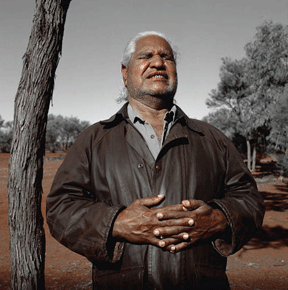 “As an elder of the Yankunytjatjara and the APY Lands I state my absolute disappointment and disgust with the governments of South Australia and the Commonwealth. I say “NO” to mining in APY Lands and I say “NO” to homeless centres being built for our people away from their traditional homelands.”
Elder believes the APY Land is being dismantled http://cooberpedyregionaltimes.files.wordpress.com/2008/11/coober-pedy-regional-times-12-09-2013.pdf, by Yami Lester, (OAM) Order of Australia Medal)
Yankunytjatjara Elder Yami Lester is deeply disturbed by the exodus of Anangu from the APY Lands over the past several years. Big mining has been approved for the area but there are no jobs.. He says many families are not returning, causing a decline in the population of the lands. Lester who was awarded the Order of Australia medal in 1981 for service in the field of Aboriginal Welfare says,“The governments are now impatient to mix Anangu into the mainstream, hundreds of kilometres from their homelands.
 interests is a cruel and racist act,” said Yami Lester.
South Australian uranium mine to be 100% Russian owned
Honeymoon Well uranium mine to go into Russian hands ABC Rural By Babs McHugh 7 Sept 13, The Honeymoon Well uranium mine in South Australia is set to be 100 per cent Russian owned by the September quarter.
Shareholders of Canadian company Uranium One have approved a buyout offer from the Russian State Corporation for Nuclear Energy, Rosatom.
A Rosatom subsidiary already owns 49 per cent of Uranium One and, once the deal is completed, the new entity will be private.
Honeymoon Well is is the smallest of Australia’s operating uranium mines. The others are Olympic Dam in South Australia, Ranger Mine in the Northern Territory and Beverley Mine in South Australia…… http://www.abc.net.au/news/2013-09-06/russia-to-own-honeymoon-well-uranium-mine/4941128
1 This month



Help Aunty Sue Protect Her Land and Sacred Sites From Destructive Rocket Testing.
.

Australians deserve the truth
about
AUKUS – https://aukuspublicinquiry.com/

PETITION – To: Prime Minister Anthony Albanese and the Australian Labor Government

of the week – Australians for War Powers Reform (AWPR)
To see nuclear-related stories in greater depth and intensity

