Summary of Australian federal and state/territory nuclear/uranium laws and prohibitions.

Current prohibitions on nuclear activities in Australia: a quick guide
From Jim Green, 30 May 2024
https://www.aph.gov.au/About_Parliament/Parliamentary_departments/Parliamentary_Library/pubs/rp/rp2324/Quick_Guides/NuclearActivitiesProhibitions
PDF Version [564KB]
Dr Emily Gibson
Science, Technology, Environment and Resources; Law and Bills Digest Sections
This quick guide provides an overview of current prohibitions on nuclear activities under Commonwealth, state and territory laws. It considers the primary legislation most relevant to current policy debates about domestic nuclear energy only and consequently does not consider recent changes to Commonwealth law to facilitate Australia’s acquisition of conventionally-armed, nuclear-powered submarines under the AUKUS partnership.[1] It also does not include consideration of Australia’s international obligations in respect of nuclear activities, including the safeguarding of nuclear materials and the non-proliferation of nuclear weapons.
If a domestic nuclear energy industry were to progress, it is expected that a comprehensive framework for the safety, security and safeguarding of the related nuclear material would need to be legislated to accommodate such an industry.[2] Consideration of these issues is beyond the scope of this paper.
What are nuclear activities?
A nuclear activity is any process or step in the utilisation of material capable of undergoing nuclear fission; that is, any activities in the nuclear fuel cycle.[3] Nuclear activities therefore include:
- mining of nuclear or radioactive materials such as uranium and thorium milling, refining, treatment, processing, reprocessing, fabrication or enrichment of nuclear material
- the production of nuclear energy
- the construction, operation or decommissioning of a mine, plant, facility, structure, apparatus or equipment used in the above activities
- the use, storage, handling, transportation, possession, acquisition, abandonment or disposal of nuclear materials, apparatus or equipment.
Prohibitions on nuclear activities
Commonwealth
Nuclear activities are regulated under the Australian Radiation Protection and Nuclear Safety Act 1998 (ARPANS Act) and the Environment Protection and Biodiversity Conservation Act 1999 (EPBC Act).
Australian Radiation Protection and Nuclear Safety Act 1998
The ARPANS Act establishes a licensing framework for controlled persons (including a Commonwealth entity or a Commonwealth contractor) in relation to controlled facilities (a nuclear installation, a prescribed radiation facility, or a prescribed legacy site).[4] A nuclear installation includes a nuclear reactor for research or the production of radioactive materials for industrial or medical use, and a radioactive waste storage or disposal facility with an activity that is greater than the activity level prescribed by the Australian Radiation Protection and Nuclear Safety Regulations 2018.[5]
The ARPANS Act allows the CEO of the Australian Radiation Protection and Nuclear Safety Agency (ARPANSA) to issue licences for controlled facilities.[6] In issuing a facility licence, the CEO ‘must take into account the matters (if any) specified in the regulations, and must also take into account international best practice in relation to radiation protection and nuclear safety’.[7]
However, subsection 10(2) of the Act expressly prohibits the CEO from granting a licence for the construction or operation of any of the following nuclear installations: a nuclear fuel fabrication plant; a nuclear power plant; an enrichment plant; or a reprocessing facility.[8] This prohibition does not appear to apply to a radioactive waste storage or disposal facility.
Environment Protection and Biodiversity Conservation Act 1999
The EPBC Act establishes 9 matters of national environmental significance (MNES) and provides for the assessment and approval of these actions if the action has, will have, or is likely to have a significant impact on the MNES.[9] ‘Nuclear actions’ are one of the MNES.[10] Where a nuclear action is determined to be a controlled action (that is, one likely to have a significant impact and requiring assessment and approval under the Act), the assessment considers the impact of a nuclear action on the environment generally (including people and communities).[11]
The Act establishes offences for the taking of nuclear actions in those circumstances.[14]
Similarly, the Act provides that a relevant entity (as set out below) must not take an action (including a nuclear action) unless a requisite approval has been obtained under Part 9 of the Act or a relevant exception applies:
- a person must not take a relevant action on Commonwealth land that has, will have or is likely to have a significant impact on the environment[15]
- a person must not take a relevant action outside Commonwealth land if the action has, will have or is likely to have a significant impact on the environment on Commonwealth land[16]
- the Commonwealth or a Commonwealth agency must not take inside or outside the Australian jurisdiction an action that has, will have or is likely to have a significant impact on the environment inside or outside the Australian jurisdiction.[17]
The Act establishes offences and civil penalty provisions for the taking of an action in those circumstances.[18]
Subsection 140A(1) prohibits the Minister for the Environment from granting an approval for a nuclear action relating to specified nuclear installations. These installations are a nuclear fuel fabrication plant, a nuclear power plant, an enrichment plant, and a reprocessing facility.
Potential reform of the nuclear action trigger
The second independent review of the EPBC Act, completed in October 2020 by Professor Graeme Samuel (Samuel Review), recommended that the nuclear actions MNES be retained.[19] The review recommended that ‘the EPBC Act and the regulatory arrangements of [ARPANSA] should be aligned, to support the implementation of best-practice international approaches based on risk of harm to the environment, including the community’.[20]
In 2022, the Government’s Nature Positive Plan adopted this approach and stated, ‘[a] uniform national approach to regulation of radiation will be delivered through the new National Environmental Standards’.
In February 2024, a policy draft of the National Environmental Standard for Matters of National Environmental Significance indicates that ‘nuclear actions’ will be renamed ‘radiological exposure actions’ and states:
Relevant decisions must:
Not be inconsistent with the ARPANSA national codesfor protection from radiological exposure actions including in relation to:
- human health and environmental risks and outcomes; and. radiological impacts on biological diversity,
- the conservation of species and the natural health of ecosystems.[22]
States and territories
States and territories generally regulate nuclear and radiation activities through either the health or the environmental protection portfolios. The relevant legislation provides for the protection of health and safety of people, and the protection of property and the environment, from the harmful effects of radiation by establishing licensing regimes to regulate the possession, use, and transportation of radiation sources and substances.[23] Mining of radioactive materials is regulated through the resources portfolio.
In addition, as outlined below, the states and territories have legislation prohibiting certain nuclear activities or the construction and operation of certain nuclear facilities. Importantly, where permitted, nuclear activities (including mining) would also be subject to assessment and approvals under a range of other legislation, including planning and environmental impact assessment, native title and cultural heritage, and radiation licensing laws at the state or territory and Commonwealth level.
New South Wales
Exploration for uranium has been permitted under the Mining Act 1992 since 2012.[24] However, the mining of uranium is prohibited by the Uranium Mining and Nuclear Facilities (Prohibitions) Act 1986 (NSW Prohibitions Act).[25]
The NSW Prohibitions Act also prohibits the construction and operation of certain nuclear facilities, including uranium enrichment facilities, fabrication and reprocessing plants, nuclear power plants, and storage and waste disposal facilities (other than for the storage and disposal of waste from research or medical purposes, or the relevant radiological licensing Act).[26]
Northern Territory
The Atomic Energy Act 1953 (Cth) provides that the Commonwealth owns all uranium found in the territories.[27] Uranium exploration and mining in the Northern Territory (NT) is regulated under both NT mining laws (the Mineral Titles Act 2010 and the Mining Management Act 2001) and the Atomic Energy Act.[28] The Ranger Uranium Mine operated until 2021 and is now undergoing rehabilitation.[29]
The Nuclear Waste Transport, Storage and Disposal (Prohibition) Act 2004 (NT) prohibits the construction and operation of nuclear waste storage facilities, as well as the transportation of nuclear waste for storage at a nuclear waste storage facility in the NT.[30] Nuclear waste is defined as including waste material from nuclear plants or the conditioning or reprocessing of spent nuclear fuel.[31]
This Act also:
- prohibits public funds from being expended, granted or advanced to any person for, or for encouraging or financing any activity associated with the development, construction or operation of a nuclear waste storage facility
- would require the NT Parliament to hold an inquiry into the likely impact of a nuclear waste storage facility proposed by the Commonwealth on the cultural, environmental and socio‑economic wellbeing of the territory.[32]
Queensland
Exploration for and mining of uranium are permitted under the Mineral Resources Act 1989. However, it has been government policy to not grant mining leases for uranium since 2015.[33] The government policy ban extends to the treatment or processing of uranium within the state.[34]
The Nuclear Facilities Prohibition Act 2007, in similar terms to the NSW Prohibitions Act, prohibits the construction and operation of nuclear reactors and other nuclear facilities in the nuclear fuel cycle.[35]
Unlike other state and territory prohibition legislation, the Nuclear Facilities Prohibition Act would require the responsible Queensland Minister to hold a plebiscite to gain the views of the Queensland population if the Minister was satisfied that the Commonwealth Government has taken, or is likely to take, steps to amend a Commonwealth law or exercise a power under a Commonwealth law to facilitate the construction of a prohibited nuclear facility, or if the Commonwealth Government adopts a policy position of supporting or allowing the construction of a prohibited nuclear facility in Queensland.[36]
South Australia
The exploration and mining of radioactive material (including uranium) is permitted in South Australia (SA), subject to approvals under the Mining Act 1971 and the Radiation Protection and Control Act 2021 (RP&C Act).[37] For example, uranium is mined at Olympic Dam, Four Mile and Honeymoon. However, conversion and enrichment activities are prohibited by the RP&C Act.[38]
The Nuclear Waste Storage Facility (Prohibition) Act 2000 prohibits the construction or operation of a nuclear waste storage facility, and the import to SA or transport within SA of nuclear waste for delivery to a nuclear waste storage facility.[39]
The Nuclear Waste Storage Facility (Prohibition) Act prohibits the SA Government from expending public funds to encourage or finance the construction or operation of nuclear waste storage facilities.[40] The Act would also require the SA Parliament to hold an inquiry into the proposed construction or operation of a nuclear waste storage facility in SA authorised under a Commonwealth law.[41]
Tasmania
The exploration and mining of atomic substances (which includes uranium and thorium) is permitted under the Mineral Resources Development Act 1995 (Tas), subject to approval.
Victoria
The Nuclear Activities (Prohibitions) Act 1983 prohibits a range of activities associated with the nuclear fuel cycle, including the exploration and mining of uranium and thorium, and the construction or operation of facilities for the conversion or enrichment of any nuclear material, nuclear reactors and facilities for the storage and disposal of nuclear waste from those prohibited activities.[42]
Western Australia
Exploration for and mining of uranium is permitted under the Mining Act 1978. A state policy ban on mining approvals was overturned in November 2008;[43] however, this was reinstated in June 2017, with a ‘no uranium’ condition on future mining leases.[44] The ban does not apply to 4 projects that had already been approved by the previous government.
The Nuclear Activities Regulation Act 1978 aims to protect the health and safety of people and the environment from possible harmful effects of nuclear activities, including by regulating the mining and processing of uranium and the equipment used in those processes. The Nuclear Waste Storage and Transportation (Prohibition) Act 1999 also prohibits the storage, disposal or transportation in Western Australia of certain nuclear waste (including waste from a nuclear plant or nuclear weapons).[45]
Can the Commonwealth override a state ban on nuclear activities?
The Commonwealth Parliament only has the power to make laws in relation to matters specified in the Constitution of Australia, including in sections 51, 52 and 122. Assuming the Commonwealth has a sufficient head of power to legislate, section 109 of the Constitution specifically provides for circumstances in which there might be an inconsistency between Commonwealth and state laws:
When a law of a State is inconsistent with a law of the Commonwealth, the latter shall prevail, and the former shall, to the extent of the inconsistency, be invalid.
Therefore, even though some states have enacted prohibitions on certain nuclear activities within their jurisdictions, the Commonwealth Parliament could enact specific legislation in relation to nuclear activities so that such activities can take place within those jurisdictions. One such example is the National Radioactive Waste Management Act 2012 (Cth), which provides for the establishment of a national radioactive waste management facility at a site to be declared by the responsible Commonwealth Minister. Section 12 of that Act provides that state and territory laws have no effect in regulating, hindering, or preventing such a facility
Further information
- ‘Who we regulate’, ARPANSA
- ‘State & territory regulators’, ARPANSA
- ‘Uranium and thorium’, in Geoscience Australia, Australia’s Energy Commodity Resources, 2023 Edition, (Canberra: Geoscience Australia, 2023).
Green light for nuclear ships, submarines in Tasmanian port
Perth Now, Dominic Giannini AAP, August 25, 2023
A Tasmanian port has been given the green light to host nuclear-powered vessels after being verified by the national safety agency.
A quarterly report by the Australian Radiation Protection and Nuclear Safety Agency said staff completed work at the Hobart port to ensure it could host such vessels and respond in an emergency.
Staff also travelled to Western Australia for a visit by two US nuclear submarines………..
American and British nuclear submarines will begin more frequent rotations and visits through Australian ports as part of the alliance known as AUKUS.
Dave Sweeney from the Australian Conservation Foundation said on an “economic self-interest level” there was a strong case for Tasmania to shun nuclear submarines.
“It is known for its food, tourism and clean air, art and cultures – none of these are helped by elevated radioactive risk,” he said.
The City of Hobart council has previously expressed an anti-nuclear stance, with the lord mayor joining the International Campaign to Abolish Nuclear Weapons………………
The Albanese government established the Australian Submarine Agency to oversee the nuclear submarine program from cradle to grave, including how nuclear waste was managed.
The Australian Conservation Foundation said the government had not yet adequately addressed the nuclear waste issue. https://www.perthnow.com.au/politics/green-light-for-nuclear-ships-submarines-in-tas-port-c-11703346
Tasmania may get cold, but sunburn is still very much a threat
Tasmania may get cold, but sunburn is still very much a threat https://www.abc.net.au/news/2022-02-14/uv-rays-not-heat-the-cause-of-sunburn/100774662, By Glen Perrin If you think you cannot get sunburnt in chilly old Tasmania, you are sorely mistaken — the island state has more than its fair share of dangerous ultraviolet rays.
What is sunburn? What is UV?
Sunburn occurs when skin exposed to ultraviolet (UV) radiation is damaged.
The exposed skin becomes red, hot, and often painful.
If you think you cannot get sunburnt in chilly old Tasmania, you are sorely mistaken — the island state has more than its fair share of dangerous ultraviolet rays.
Additional melanin, the skin’s natural protector, is produced when the skin is exposed to UV radiation.However, when the levels of UV radiation exceed the protecting abilities of melanin, sunburn occurs.This can occur in less than 15 minutes depending on the time of year, the location and skin type.
Skin can turn red from sunburn within two to six hours of being burnt.Long-term excessive exposure to UV radiation may also cause skin damage, eye damage, premature ageing or even skin cancer, with Australia and New Zealand having the highest rates of melanoma in the world. UV radiation is a type of energy that we cannot feel (it does not make us feel hot) or see.Three bands of UV radiation are emitted by the sun: UVA, UVB and UVC.
UVB radiation is the main contributor to sunburn, despite the fact most UVB radiation (around 85 to 90 per cent) is absorbed by the ozone layer in the stratosphere about 15 to 30 kilometres above the surface of the earth.Australia has some of the highest UV levels in the world.
Why is sunburn a concern in Tasmania?
Many people relate getting sunburnt to temperature and incorrectly believe that in Tasmania, being generally cooler, means they won’t get sunburnt.Sunburn can occur on hot and cool days. It is intensity of the UV that is important.Such levels of UV are seen in Tasmania throughout most of the year, except for the winter months. It is also possible to burn in the morning and early evening, not just in the middle of the day.
Although cloud can decrease the amount of UV reaching the surface (with thick unbroken cloud reflecting and absorbing more UV than thin cloud), a break in or thinning of the cloud will still allow enough UV through to cause damage.Partly cloudy conditions can even increase the amount of UV at the surface by reflecting it towards the ground from the sides of the clouds.
Pollutants in the air can absorb some UV radiation or reflect it away from the surface.By comparison, air free from pollutants, such as in Tasmania, results in more UV radiation reaching the surface. Although the ozone hole occurs well to the south of Tasmania, ozone depletion can play a role in sunburn.
The ozone hole typically occurs between August and mid-December.When the ozone hole has broken down, it is possible for pockets of ozone-depleted air to mix with mid-latitude air.This air may then move over Tasmania, resulting in more UVB radiation reaching the surface.
What is the UV Index? How does it work?
The UV Index describes a daily UV radiation intensity and ranges from 1 (low) to 11+ (extreme).
A computer model generates the Index considering ozone concentrations, date, time of day, latitude and altitude and assumes a cloud-free and pollution-free sky.
Temperature is not considered.
Sun protection is recommended when the Index reaches 3 and above.
Sunburn occur any time of the year and at any location
UV levels, and therefore the UV Index, do change through the year, being lowest in winter (below 3 and in the low range in Tasmania) and highest in summer (mostly between 10 and 12 in Tasmania and in the very high to extreme range).
But exposure to excessive UV radiation can occur at any time of the year and can be enhanced by being at alpine locations (where the atmosphere is thinner, allowing more UV radiation to reach the surface), in the snow, swimming, or near other reflective surfaces such as concrete.
UV levels are higher towards the equator, as a result of having to travel though a smaller column of the atmosphere to reach the surface than at higher latitudes.
The UV Index is provided by the Bureau of Meteorology as part of city and town forecasts and through UV maps, tables and the BOM Weather App.
You can use the Cancer Council’s SunSmart app to view sun protection times and current UV levels.
The UV Index in city and town forecasts is also accompanied by a sun protection time when the UV Index is 3 or above.
This represents a time-period in which it is recommended that you slip, slop, slap, seek and slide to protect yourself from sunburn.
Remember you can still get burnt on cool or cloudy days – so think UV, not heat.
More information about UV and sun protection times can be found on the BOM website.
Glen Perrin is a senior meteorologist with the Bureau of Meteorology in Tasmania
Tasmania: Liberals vote down Greens climate emergency motion with Premier claiming it ‘frightens’ children
Tasmania
Liberals vote down Greens climate emergency motion with Premier claiming it ‘frightens’ children
Premier Peter Gutwein has accused the Greens of “frightening” children after the party attempted to move a motion declaring a climate emergency based on the findings of the latest Intergovernmental Panel on Climate Change report.–
Are The Greens taking over from Labor as Australia’s progressive party – Tasmanian election results suggest this.
Have the Greens taken over the progressive mantle from Labor? South Wind, 4 May 2021 by Peter Boyer
Peter Gutwein’s win on Saturday is only part of the story of a fascinating election. ”……….. Predictably, Peter Gutwein won the election on the back of his fine response to COVID-19, recording an exceptional personal vote. People appreciated that this leader, in response to expert scientific advice, could make tough, confronting decisions.
But as the Greens’ Cassy O’Connor pointed out on Saturday night, while the premier chose to follow the science around contagious disease, he has relegated to a secondary position the science that warns of an unfolding climate catastrophe.
In building the Greens as a political force, founding leader Bob Brown fostered the view – perhaps unintentionally – that his party was the only way to environmental salvation. In times past I’ve found myself irritated by what seemed to be the Greens’ uncompromising approach to wicked policy dilemmas. Kevin Rudd’s doomed carbon pricing scheme was one such case.
In 2010, for the first and still the only time in Australia, the Greens became an integral part of government in Tasmania. Leader Nick McKim and then Cassy O’Connor took on the climate challenge on the basis that this responsibility is shared by all jurisdictions, everywhere.
That work culminated in O’Connor’s 2013 strategic plan, which remains the standout among a plethora of such documents that have arrived with fanfare over the years before being quietly shelved. Eight years later, her election night speech showed that this was no accident.
The buzz of leadership doesn’t rest easily with complex, slow-burning issues like climate change. Perhaps taking a cue from Rudd’s unseemly demise in 2010, Australia’s major party leaders and MPs continue to avoid making climate a front-rank policy issue.
Nowhere was that better illustrated than in the last parliament, in a debate over whether Tasmania should declare itself to be in a climate emergency. The only MPs arguing cogently for this fully justified move were O’Connor and her deputy, Rosalie Woodruff, while the rest of the parliament played partisan games.
On Saturday night O’Connor spoke of the Greens’ proposal for a bill to mandate planning for sequestering carbon, adapting to climate change, and annual sectoral emission targets, contrasting that with the major parties’ failure to come up with any coherent climate policy: “a shameful indictment”.
“We hear some Liberals gloating about the state’s climate record while they accelerate native forest logging,” she said. “Tasmania’s status as a net carbon sink is the result of decades of commitment and heart from the broader conservation movement and civil society, and the Greens’ hard work to protect this island’s extraordinary carbon rich forests.”…….
It was a long speech, bringing to mind another politician inclined to go on a bit, Gough Whitlam. The point about both is that they covered a lot of ground and had things to say that mattered, about life, community and government. O’Connor is a leader of real substance……
A century ago another small progressive party was said to be a mere annoyance that would soon disappear. The Labor Party rose to power as a voice for the powerless. On Saturday night, the most effective voice for that noble cause was O’Connor’s….. https://southwind.com.au/2021/05/04/have-the-greens-taken-over-the-progressive-mantle-from-labor/
How are Australian States progressing on renewable energy? South Australia way ahead
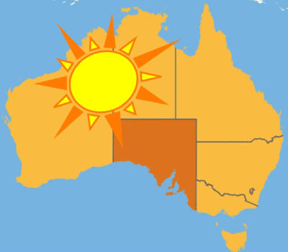 South Australia leading the nation in renewable energy, https://thenewdaily.com.au/news/national/2019/11/25/renewable-energy-winners/ Samantha Dick
South Australia is shifting to renewable energy faster than any other state or territory.
This is despite the federal government’s “lack of leadership” and continued support for major fossil fuel projects, says the Climate Council.
|
Progress is based on how much electricity is derived from renewable energy, proportion of households with rooftop solar, large-scale wind and solar capacity per capita, and policies to support the transition. South Australia earned this year’s top spot for generating more than half of its electricity from wind and solar, and for setting a target of net 100 per cent renewable energy in the 2030s. Following closely in second place was the Australian Capital Territory, which is on track for 100 per cent renewable energy from 2020. The ACT has also announced impressive plans to achieve net zero emissions by 2045 by cutting emissions from transport and cities. Tasmania was in third place for making headwinds toward 100 per cent renewable energy by 2022, and for researching three pumped hydro sites that could supply energy to Victoria over the next 10 to 15 years. Victoria was ranked fourth, winning points for planning the nation’s most ambitious large-scale wind and solar projects, and for legislating a renewable energy target of 50 per cent by 2030. However, more than 80 per cent of the state’s power still comes from fossil fuels, meaning it has a long way to go to catch up to the frontrunners. Further behind in fifth place was Queensland, where nearly half of Australia’s large-scale renewable energy projects were completed last year. But despite making big improvements, the Queensland government lost marks for continuing to support new fossil-fuel projects like the Adani coal mine. The Adani coal mine, backed by the federal government, will put out an estimated 7.7 billion tonnes of greenhouse gases over 60 years through extracting 2.3 billion tonnes of coal. It is also unlikely the Sunshine State will meet its target of 50 per cent renewable energy by 2030.
|
|
Tasmanian renewable energy projects tipped to pour $6.5 billion in state’s economy
Premier Will Hodgman says the state will benefit from an economic injection of $6.5 billion through two key renewable energy projects.
Mr Hodgman said the business case for a second interconnector was stronger after new analysis from TasNetworks showed the Marinus Link project would be able to transport a higher amount of energy to the mainland as previously anticipated……. https://www.examiner.com.au/story/6423824/states-energy-potential-better-than-anticipated/?cs=95
We’ve always had floods and bushfires, but climate change is making them worse
Queensland floods: Townsville reels under record water levels as more rain arrives, There are several more days to go in this 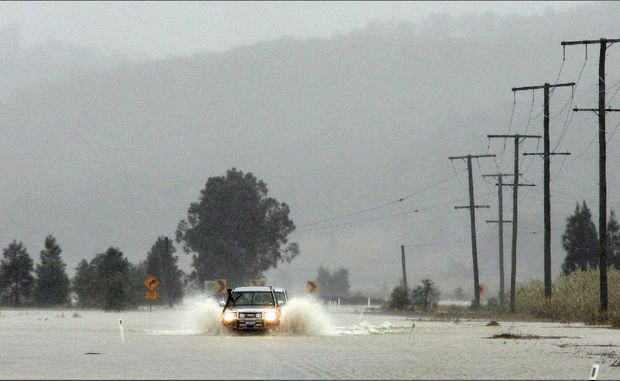 flood event, Bureau of Meteorology warns, Guardian, 2 Feb 2019,
Queensland authorities have said the state’s north was entering “unprecedented territory” as monsoon rains battered the city of Townsville, setting record flood levels and destroying homes.
Homes and businesses have been destroyed as flash floods washed through streets, sweeping away cars, equipment and livestock……..https://www.theguardian.com/australia-news/2019/feb/02/queensland-floods-townsville-reels-under-record-water-levels-as-more-rain-arrives
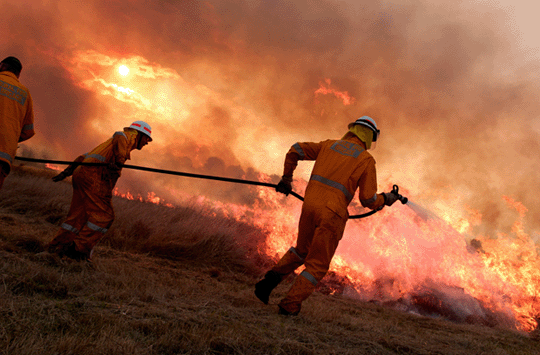
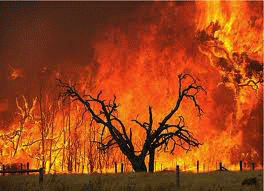 Bushfires threaten homes across Victoria , The Age, By Nicole Precel, 3 February 2019,Out-of-control bushfires threatened homes and lives on Sunday as more than 1000 firefighters battled major blazes across Victoria.Firefighters were stretched to the limit, fighting several large fires throughout the state.
A fire in Hepburn, in central Victoria was the major focus for the day with residents warned at daybreak to evacuate the town.
Two firefighters who were fighting the Hepburn fires were treated for heat exhaustion and over-exertion and were taken to hospital as a precaution.
Elsewhere, as almost 50 new fires sparked, emergency warnings were issued at various times for fires including days-old blazes in Timbarra in Gippsland and Grantville on the Bass Coast……..
As of Sunday afternoon, there were 69 aircraft working “very, very hard” and “effectively”.
The fires were fanned by soaring temperatures, hitting 43.3 degrees in the Mallee, 43.1 degrees in Hopetoun, 42.2 in Mildura, 41.1 at Melbourne Airport and 38.2 in Melbourne’s CBD.
The Bureau of Meteorology’s Richard Russell said high winds and thunderstorms were expected throughout the night……….. https://www.theage.com.au/national/victoria/bushfires-threaten-homes-across-victoria-20190203-p50vf8.html
 Tasmania’s fire disaster revealed in satellite images showing the extent of the damage
It’s easy to get warning fatigue, and, with only a handful or properties impacted so far, dismiss the fires as all bark and no bite.
But satellite images reveal the scale of the destruction so far.
The Gell River blaze, in the state’s south-west, was the first to start, ignited by a dry lightning strike in late December.
“It seems really like ancient history,” professor of pyrogeography and fire service at the University of Tasmania David Bowman said.
“It started at the end of last year and escalated in early January, so we’re looking at a fire situation that’s now gone for a full calendar month.”
Images taken by the European Space Agency’s Sentinel-2 satellite on January 3 show what seems, relative to the lakes around it, like a small blackened patch of wilderness……..
“There are multiple major fire events occurring simultaneously, which is extremely challenging for firefighters and fire managers because of the requirement to spread resources and make very difficult prioritising decisions.” …….
“This is definitely a historic event, it’s unprecedented,” Professor Bowman said.
“The area burnt is very substantial, I can barely keep up with the numbers.”
This week the fire service did put a number on it — 187,000 hectares.
At the same time as the Central Plateau fire ramped up, the Tahune fire was also burning out of control.
Of all the fires burning across Tasmania, this one has caused the most displacement, forcing hundreds of people to evacuate from communities in the Huon Valley south of Hobart.
Since last week, firefighters have issued almost daily warnings to residents, cautioning that only those prepared to defend their properties should stay behind.
A satellite image taken on January 30 shows how the fire, having burnt through more than 56,000 hectares, was still sending smoke over towns to its east. …..https://www.abc.net.au/news/2019-02-02/tasmanian-bushfires-from-the-air-satellite-images/10771528
Hobart mayoral candidate Anna Reynolds offers a practical and economic solar plan
 Climate right for solar plan: Reynolds, HOBART residents and
  businesses would be able to install solar energy systems with no upfront costs under an initiative proposed by mayoral candidate Anna Reynolds. HELEN KEMPTON, news.com.au Sunday Tasmanian OCTOBER 14, 2018
HOBART residents and businesses would be able to install solar energy systems with no upfront costs under an initiative proposed by mayoral candidate Anna Reynolds.
Ald Reynolds says the city should strive to double solar installations over the next five years.
Hobart is a poor performer compared with other Tasmanian local government areas with Sustainable Living Tasmania figures placing it 16th in terms of solar installations per capita.
“Council has taken action to install solar panels on its own buildings but there is so much more we can do,” Ald Reynolds said.
“I will advocate for a solar saver program to help Hobart residents, businesses and organisations install solar panels.
“Council will pay the upfront cost for the system and you, or your landlord, pay it off over 10 years, interest free.
“The savings made on energy bills will more than outweigh the payments to council, leaving you better off.”
The independent candidate’s push is backed by the chief strategist of climate advocacy group 350 Australia……..https://www.news.com.au/national/tasmania/climate-right-for-solar-plan-reynolds/news-story/1aa9c5761666dbbb411a35f424b0c8a0
Computer modelling is valuable for fire prevention: prescribed burning is inadequate
Unfortunately, due to climate change, we are going to see a lot more catastrophic days in the future in Tasmania and indeed globally.
To fight the catastrophic fires of the future, we need to look beyond prescribed burning California is burning – a sentence we’ve heard far too often this year. Sydney is currently on bushfire alert, as firefighters battle a fire in the Hunter Valley region and temperatures are set to top 40℃.
A cocktail of factors, from climate change to centuries of ignoring indigenous burning practises, means that catastrophic fires are likely to become more common.
One of Australia’s favourite fire prevention measures is prescribed burning – using carefully controlled fires to clear out flammable materials. We’re almost obsessed with it. Indeed, it seems the outcome of every major inquiry is that we need to do more of it.
The Royal Commission inquiry that followed Victoria’s 2009 Black Saturday fires recommended that 5% of all public land in Victoria be treated per year – a doctrine that was subsequently dropped due to impracticality.
Yet our research, published today in the International Journal of Wildland Fire, modelled thousands of fires in Tasmania and found that nearly a third of the state would have to be burned to effectively lower the risk of bushfires.
The question of how much to burn and where is a puzzle we must solve, especially given the inherent risk, issues caused by smoke smoke and shrinking weather windows for safe burning due to climate change.
Why use computer simulations?
The major problem fire science faces is gathering data. Landscape-scale experiments involving extreme fire are rare, for obvious reasons of risk and cost. When a major bushfire happens, all the resources go into putting it out and protecting people. Nobody has the time to painstakingly collect data on how fast it is moving and what it is burning. We are therefore restricted to a few limited data sources to reconstruct the behaviour and impact of fire: we can analyse the scar on the landscape after a fire, look at case studies, or run simulations of computer models. Continue reading
Decentralised energy solutions looking better than centralised
Will Tasmania be the ‘battery of the nation’? http://reneweconomy.com.au/will-tasmania-battery-nation-43911/ By Jack Gilding on 7 November 2017 Lately we have been subjected to Prime-ministerial statements on energy policy that jump from Snowy 2.0 to propping up aged coal-fired power stations in NSW, to government support for a new “clean” coal power station in Queensland and back to pumped hydro in Tasmania. Long term strategy seems to have gone missing.
The latest announcement is a feasibility study of pumped hydro in Tasmania supported by ARENA.
Is investing in Tasmania as the ‘battery of the nation’ likely to be a sensible idea?
Tasmania itself doesn’t need more centralised energy storage. At full capacity, our dams hold more than a year’s supply of electricity. Tasmania’s problem is lack of renewable generation, which leaves our energy security dependent on imports from Victoria and increasingly expensive gas fired electricity.
The mainland grid would certainly benefit from more large scale renewable generation backed by storage. Implementing this would require both a bipartisan consensus on closing down aged coal infrastructure and a long term policy in support of low emission renewable energy.
Pumped hydro is the most cost-effective form of large scale energy storage but it requires a stable investment climate, and in some locations, significant investment in transmission infrastructure.
Snowy 2.0 does have the advantage of being well connected to the NSW and Victorian grids. If the national battery is located in Tasmania it would require a billion dollar second interconnector to the mainland.
The sorts of big national project preferred by politicians are not the only solution. Our electricity system is rapidly moving from centralised energy generation to distributed generation and storage.
CSIRO and the Australian electricity network operators have developed one of the most credible scenarios for the future of the grid.
It anticipates that by 2050, 30-45% of our electricity would come from customer owned generators. The plan identifies the need for incentives to ensure that customer battery systems provide benefits to the network as well as to customers.
A recent ANU study has identified 22,000 potential sites for off-river pumped storage around Australia in a range of sizes. Only a few of these are likely to provide viable but they offer possible advantages in being smaller investments that can address local requirements and reduce rather than increase the need for network enhancements.
If there is a role for large scale pumped hydro storage, is Tasmania likely to be the most cost effective place to build it?
As Everett Dirksen never actually said, “A billion here, a billion there, pretty soon, you’re talking real money”. At over $1bn for a second interconnector, $2bn for a 600 MW wind farm on King Island or over $1bn for the Robbins Island and Jim’s Plain wind farms, and Hydro Tasmania’s estimate of $5bn to build 2500 MW of pumped storage, we are talking ‘real money’.
And it is ultimately our money, whether the infrastructure is built as a regulated asset (added to our electricity bill), by government grant (our taxes) or by private investment (including our super).
Investments on this scale take the best part of a decade to plan, fund and build, and are paid for by users over a 40 year period or more.
We need to be very sure that this is the most cost effective way to meet our energy security in an electricity market where the significant trends are to increased energy efficiency, local generation and storage, and demand management.
The detailed analysis of pumped hydro funded by Hydro Tasmania and ARENA will be a welcome contribution to the public debate. But big schemes may well have had their day.
Hydro Tasmania dropped work on the King Island project and the Tamblyn report on the viability of a second interconnector was lukewarm on its viability to say the least.
My prediction is that the market will have provided decentralised solutions to the challenge of reliable, affordable clean electricity long before these big schemes see the light of day. The flurry of announcements and feasibility studies mainly serves to convince the public that the politicians are dealing with the problem.
Jack Gilding is the Executive Officer of the Tasmanian Renewable Energy Alliance but the views in this article are entirely personal. This article first appeared in The Mercury and is republished here with permission of the author,
Malcolm Turnbull in Tasmania – praising wind and solar power!
 Turnbull trumpets Tasmania’s ability to lead the country in renewable energy, ETHAN JAMES, AAP, Mercury, August 18, 2017 Prime Minister Malcolm Turnbull has trumpeted Tasmania’s ability to lead the nation in renewable energy at the state’s Liberal Party council meeting.Mr Turnbull today addressed 250 delegates at the annual conference in Launceston, the party’s final gathering before a state election in March. He praised Liberal Premier Will Hodgman’s economic management in a speech that touched on energy, terrorism and mental health.
Space for more wind farms in Tassie
TASMANIA has the capacity to support two or three more wind farms before it needs to invest in its electricity transmission infrastructure, energy analysts say.
http://www.themercury.com.au/business/space-for-more-wind-farms-in-tasmania-before-infrastructure-investment-is-needed/news-story/2bfaec7ca841b5a2ca274aa0758984c3
Tasmania’s energy efficiency loans scheme now open
 Tasmanian households and small businesses can increase their energy efficiency through a new no-interest loan scheme, BLAIR RICHARDS, State Political Editor, Mercury

Tasmania’s $3 billion hydro plans – some doubts, with Victoria’s renewable energy and batteries rising
 Plunging battery costs raise doubts over Tasmania’s $3 billion hydro plans http://reneweconomy.com.au/plunging-battery-costs-raise-doubts-over-tasmanias-3-billion-hydro-plans-39326/ By Giles Parkinson on 21 April 2017
The idea of adding 2,500MW of pumped hydro into Tasmania’s existing hydro system – and using this and its considerable wind resources as a “renewable energy battery” for the mainland – was unveiled with much fanfare by prime minister Malcolm Turnbull, premier Will Hodgman and Hydro Tasmania on Thursday.
But the crucial ingredient in the plan is the construction of a new $1 billion inter-connector to carry all that renewable power to the mainland. And a study by John Tamblyn released on the same day raises considerable doubts about the economic viability of such an investment.
In one “neutral” scenario, drawn up by the Australian Energy Market Operator, the benefits might outweigh costs over a 20 year period by just $20 million. And these benefits might be eroded if battery storage costs continue to fall and utility-scale batteries become widespread, as many predict.
Further complicating the matter is Victoria’s own renewable energy target, which will likely deliver 5,000MW of new capacity by 2025.
“That means that building new renewable generation in Tasmania (1,200MW of wind), timed to coincide with commissioning of the second Bass Strait inter-connector, would not increase projected market benefits,” the report says. Instead, it is likely to “lead to oversupply in the southern regions (Victoria, Tasmania, and South Australia).” Continue reading
1 This month

of the week – Australians for War Powers Reform (AWPR)
To see nuclear-related stories in greater depth and intensity
 Antinuclear