Nazi taunt for Julian Assange’s mother on Melbourne’s 3AW radio
 Assange’s mother subjected to Nazi taunts The Age August 19, 2012 – Julian Assange’s mother has hung up the phone on a Melbourne radio host after he taunted her with a Nazi slogan when she backed out of an interview.
Christine Assange was due to speak to 3AW’s Sunday morning show about her son, the founder of whistleblower website WikiLeaks, and his successful appeal for asylum in Ecuador.
But she changed her mind after hearing how co-host John-Michael Howson had treated a previous guest.
“I won’t be doing an interview with you because you’re acting like a pig,” Ms Assange said. Howson responded by screaming on air: “Sieg Heil! Sieg Heil! Sieg Heil!”
Ms Assange then hung up the phone…… http://www.theage.com.au/national/assanges-mother-subjected-to-nazi-taunts-20120819-24g2f.html
Victoria’s Baillieu government destroying wind industry in that State
the Baillieu government has introduced severe planning restrictions, with 14 of the 18 previously publicly announced wind farm proposals that are now unlikely to proceed located in that state.
The wind farms that Baillieu killed. REneweconomy By Giles Parkinson 9 August 2012 If Victorian Premier Ted Baillieu came to power with a determination to kill off opportunities for wind farm development in Victoria, then he can be proud of his work.
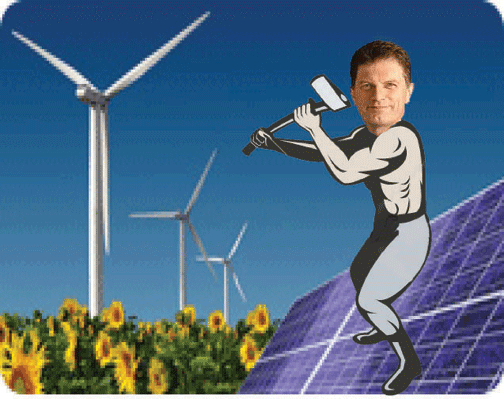
The annual Electricity Statement of Opportunities released today by the Australian Energy Market Operator highlights how much the opportunities for wind farm developments in Victoria have been reduced in the past year. Continue reading
Lower income suburbs in Victoria taking to solar energy in a big way
 Tarneit and neighbouring suburbs Hoppers Crossing and Truganina have more solar power installed than any other postcode in the state – 2564 systems, with a capacity of 5.1 megawatts.
Werribee, just a little further down the Princes Freeway, is second on the list of Victorian solar postcodes. The top five are rounded out by other lower-income, outer-suburban areas: Cranbourne, Caroline Springs and Grovedale in Geelong.
”I don’t think the government or public have appreciated just how profound or rapid the change will be in the solar market over the next couple of years.”
Out on the fringe, solar comes of age, The Age, July 28, 2012,  Adam Morton UNTIL recently, Tarneit, about 25 kilometres west of the Melbourne CBD, was mostly grazing paddocks, a place without a post
office. Now there is barely a cow left. Between the 2006 and 2011 censuses, the population of the outer suburb boomed, tripling to more than 20,000 as the city sprawled and first home buyers snapped up new affordable housing.
The residents of Tarneit are much like those in other developing areas on the city’s fringe. As you might expect, they earn less than the average Victorian. Perhaps less predictably, they are also much more likely to have solar panels on their roofs.
While the myth of solar panels as a purely upper-middle-class luxury persists, new data released by the Clean Energy Regulator suggests it is misplaced. Continue reading
Victoria’s outstanding potential for renewable energy is being neglected
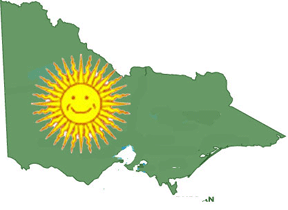 Victoria missing out on renewable energy http://www.abc.net.au/news/2012-07-23/victoria-missing-out-on-renewable-energy/4147502?section=vic July 23, 2012 Victoria is “blessed” with its renewable energy capacity: Tim Flannery. The Climate Commission says Victoria’s renewable energy resources are barely being tapped.
Chief climate commissioner Professor Tim Flannery says we are entering a new chapter of climate change and Victoria should be making a sharp shift to renewable energy such as wind and solar power. “Victoria has got fabulous wind resources, the envy of places like Europe and fantastic solar resources too,” Professor Flannery said. Continue reading
World’s Biggest Wave Energy Turbine for Victoria
 World’s Largest Wave Turbine Gets New Grant from Australian Government Clean Technica, JULY 3, 2012 BY GILES PARKINSON The Australian government as upped its investment in two nascent, Australian-developed wave energy technologies, announcing new grants worth almost $10 million to help bring the two new systems to the market, including what is believed to be the world’s biggest wave energy turbine.
The government is providing $5.6 million to BioPower Systems to install a 250kW full-scale pilot plant of its bioWAVE technology off the coast of Victoria, and is also providing just under $4 million to Oceanlinx, to install a 1MW demonstration plan of its Greenwave technology in South Australia.
Both grants are being made under the $126 million Emerging Renewables program, and follow an earlier $9 million grant to Carnegie Wave Energy, which is building a $31 million, 2MW grid-connected demonstration of its CETO technology near Fremantle in Western Australia.
BioPower CEO Tim Finnigan said the grant, along with a $5 million grant from the Victorian state government, means that its $15 million project was now fully funded. “This puts us into a position to complete the project, get it on the grid, and prove the technology at scale,” he told RenewEconomy. “It’s a pretty big development for us.”…… http://cleantechnica.com/2012/07/03/worlds-largest-wave-turbine-gets-new-grant-from-australian-government/
Despite Victorian Government’s opposition, the wind energy industry hopes for a new wind farm
 Wind farm hopes remain http://www.abc.net.au/news/2012-06-26/wind-farm-hopes-remain/4092612 June 26, 2012 A central Victorian renewable energy group says it will hold on for as long as it can, after its government contract runs out at the end of the month.
The Woodend Integrated Sustainable Energy Group has been pushing for a community-owned wind farm to be established in the Macedon Ranges. It erected a 60-metre high wind mast last year with a $50,000 State Government grant. The group’s president, Barry Mann, says the mast can remain in place until November 2014.
“We want to get to that point where we can reinvest money generated from clean energy, our best resource which is our wind, and put it back into other things like revegetation, Landcare type stuff, solar panels on sporting clubs and have a sustainability project,” he said.
Community owned solar farm plan for Bacchus Marsh, Victoria
Solar farm proposed for Bacchus Marsh, Melton Weekly, Moorabool Weekly, BY CLAIRE KNOX, 26 Jun, 2012 STATE and federal governments need to encourage smaller-scale community renewable energy (CRE) projects, according to sustainability leaders. They say promoting community-owned models could be the key to engaging the wider public in lowering carbon emissions.
Deb Porter, secretary of Moorabool Environment Group (MEG), said the group was looking at developing a community solar farm in Bacchus Marsh, with people purchasing shares. Continue reading
Electric cars – no greenhouse emissions IF POWERED BY RENEWABLE ENERGY
 Electric cars silently make a charge in trial , The Age, Adam Carey June 23, 2012 YOU might not see it coming – and you certainly won’t hear it coming – but the day when electric cars start to appear on our roads could be just around the corner.
Small, speedy and near silent, there are just 100 or so electric cars on the road in Victoria now, the Department of Transport says. About half of them are being used in a trial it is doing to learn more about how people might use them here.
One-hundred-and-eighty households and 60 organisations are being given a three-month loan of an electric car during the trial, which is due to wrap up in 2014…..
People in the electric car industry accept price is a sticking point. The Nissan Leaf, which went on sale in Australia this week, retails for $51,500. But about $15,000 of the cost is in the rechargeable
battery….
.. the cars release no direct carbon emissions, and potentially zero emissions if powered by renewable energy.
http://www.theage.com.au/victoria/electric-cars-silently-make-a-charge-in-trial-20120622-20tu7.html#ixzz1yeulK3KA
Australia’s energy generation – community-owned renewable projects are the way forward.
 The Hepburn Community Wind Farm consists of two turbines built by the community, after locals decided nearly seven years ago to take responsibility for their own energy needs.
Citizen-owned energy is way of the future. Power Engineering, 17 June 12, AUSTRALIA’S carbon tax is just two weeks away. The cost of electricity is set to rise from July 1, with a national renewable energy target of 20 per cent by 2020.
Large-scale wind farms are increasing, solar energy is booming and hydro schemes are being adopted across the country.
But the real future of energy generation is in community- owned renewable energy projects, according to one of the men involved in setting up Australia’s first citizen-owned wind farm. Now he has his sights set on Tasmania. Continue reading
Wind farms supported by majority of people in South Australia, Victoria and NSW
those who opposed wind power were “out of step with community thinking”.
Two-thirds (67 per cent) of people believed a farmer’s right to generate income from their land was more important than a resident’s right to a view clear of wind turbines.
‘People worrying themselves sick’ over windfarms http://www.adelaidenow.com.au/news/south-australia/people-worrying-themselves-sick-over-windfarms/story-e6frea83-1226388175640 Political Reporter Lauren Novak June 07, 2012 MORE than 80 per cent of people believe health concerns about wind farms will “turn out to be nothing to worry about”, a survey commissioned by the Clean Energy Council says. Continue reading
Wind farm development stalled in Bailleiu’s Victoria
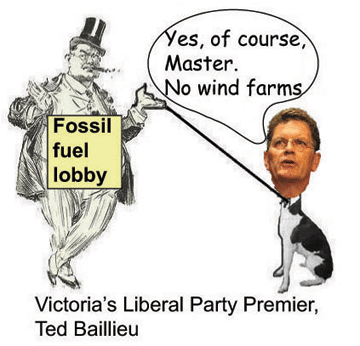 the delay in construction and state government rules giving households right-of-veto over turbines planned within two kilometres of their homes could stop the country meeting the 20 per cent target…..
Country’s largest wind turbine maker sacks 24 workers, The Age, Adam Morton, June 7, 2012 AS AUSTRALIA prepares to launch into what is billed as a clean energy future, its largest wind turbine manufacturer has sacked 24 staff because of a lack of business…
… The market for renewable energy certificates created through clean projects has been flooded with credits from rooftop solar panels.
It has suppressed the certificate price, stymieing the development of
the cheapest large-scale clean energy – wind farms.
Parliament tackled the problem in 2010 by dividing the market into
large and small-scale renewable energy schemes, but the certificate
price is yet to fully recover. Continue reading
Member for Northern Victoria Donna Petrovich called to account on her claims against wind power
 there is an onus on Ms Petrovich to come clean on her research if she is to stand by her claim that communities right across the Macedon and McHarg Ranges and big chunks of Central Victoria are “not appreciative” of this form of green and sustainable energy.
Yes to renewables
http://yes2renewables.org/2012/05/07/where-did-the-no-go-zones-come-from/Where did the ‘No Go’ zones come from? May 7, 2012 by Cam Walker The following is a letter from last weeks Macedon Ranges Weekly. Where did the ‘No Go’ zones come from? Last year, the state government created a series of ‘No Go’ zones, which block wind energy developments across much of Victoria, including the Macedon – McHarg Ranges. The government seems to think these ranges extend almost as far north as Bendigo.
Member for Northern Victoria Donna Petrovich has said in state parliament that the No Go zones were “carefully” selected where communities “on the whole have told us that they are not appreciative of wind farms”.
Given the controversial nature of the No Go zones, and the widespread support for the Macedon and Castlemaine community wind proposals, it would be useful to understand how Ms Petrovich consulted the community
to reach her conclusion that wind power is unpopular. Continue reading
Australian company selling award-winning solar panels to Bulgaria
 REC Inks 20MW Bulgarian Solar Panel Deals, by Energy Matters, 7 May 12, http://www.energymatters.com.au/index.php?main_page=news_article&article_id=3193 Renewable Energy Corporation (REC) has signed agreements to supply 20 MW of its award-winning solar panels for facilities throughout Bulgaria.
The company says it signed a deal for 10 MW with ALMA-D Ltd. to provide its 240 watt Peak Energy series modules to a 6 MW solar farm in Kamenar and a 4 MW plant in Kameno – both near the Black Sea in Bulgaria.
REC also signed three separate contracts with local Bulgarian partner Elektro-Solar Systems Ltd. for 2, 3 and 5 MW solar electric generation plants; all of which will be constructed this year.
The company says the latest deals bring the total amount of REC modules installed in Bulgaria to 50 MW; boosting REC’s share in Bulgaria’s solar market to 15%.
Among the other accolades for REC – a nomination for 2010’s prestigious Intersolar Photovoltaics Award and a Solar Industry Award for Module Innovation, also in 2010.
REC’s Peak Energy solar modules have become a common sight on the rooftops of Australian homes after Melbourne-based Energy Matters introduced the panels to the local home solar power market in June 2010.
Energy Matters is a REC Platinum Partner – the only company in the Asia-Pacific region to achieve that standing. The company was also Australia’s first accredited REC Solar Professional and is able to offer an extra 2 years product warranty on REC solar panels the firm installs.
Australia’s State governments fervently slashing renewable energy
Not so fast to the green scheme graveyard Crikey, by Fergus Green, climate change lawyer and policy analyst, 2 May 12, Federalism of the co-operative and unco-operative variety is back in the news. As the July 1 start date for the federal government’s carbon pricing scheme looms, the uppity conservative state premiers’ league is out in force, crying foul about the “tax” and fervently slashing “redundant” and “costly” state-based climate change schemes. Meanwhile, federal programs such as the Renewable Energy Target are under the microscope, with the Coalition and big business calling for an end to this kind of “green tape”
Victoria’s Baillieu government recently accepted the recommendation 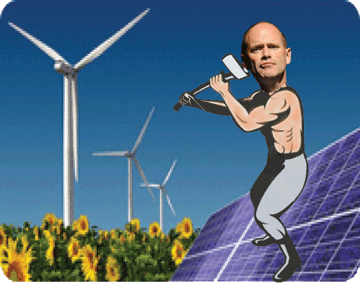 of a review of the Victorian Climate Change Act to scrap the state’s 20% emissions reduction target by 2020 — the latest in a long line of anti-environment, pro-fossil fuels policy developments during its first 16 months in office. Queensland’s newly elected Newman government has opted for a more expeditious approach, axing just about every Queensland government program with a tinge of green — from the $430 million Queensland Climate Change Fund (which provides $30 million a year for climate change initiatives) to the $50 million Smart Energy Savings Program (which helps businesses improve energy efficiency).
Amid this carnage, it is worth considering just what is the appropriate role of complementary state and federal policies in tackling climate change in the context of the new carbon price……
The federal cap only covers a limited number of emissions-producing sectors – notably energy generation, industrial processes, landfill waste and fugitive emissions (for example, methane released from coalmines). Sectors not covered by the scheme include agriculture, forestry and (via changes to the fuel tax and rebate regimes) parts of transport.* Any state or federal government policies that reduce emissions in these sectors will result in abatement beyond that brought about by the federal cap. As the PC points out in its Garnaut Review submission, policies to target these sectors make sense to the extent that they would reduce the costs of achieving an overall national emissions reduction target.
Emissions embodied in the fossil fuels we export, which far exceed our domestic emissions, are not subject to the carbon price either. This gives states (which largely control mining policy) a critical role in influencing global greenhouse gas emissions. http://www.crikey.com.au/2012/05/01/not-so-fast-to-the-green-scheme-graveyard/
Victoria’s Baillieu government YES to coal, NO to wind – despite the facts
— A wind farm cannot be built within two kilometres of a person’s home without their consent. But a coal mine can be opened within 100 meters of a home without the owner’s consent.
— Wind farms are now excluded from ‘no go’ zones stretching across the state. But coal mines face no such ‘no go’ zones: the only place they are excluded from is national parks (for now).
— All wind farms require planning approval from the local council. Coal projects, on the other hand, can avoid the need to obtain certain planning approvals at all in some cases.
— Wind farms must comply with environmental laws like any other project. Coal projects, on the other hand, are exempt from parts of key laws like the Environment Protection Act 1970 (Vic).
Coal or wind in your backyard? http://www.climatespectator.com.au/commentary/coal-or-wind-your-backyard Michael Power, 30 April 12, If you’re going to ‘pick winners’ from the energy market, you at least want to choose wisely. So it’s hard to see why Victorian laws treat coal and coal seam gas more favourably than renewable energy.
The Environment Defenders Office (Victoria) (EDO) released a report last week that finds Victoria’s laws give the mining industry privileged treatment that few other industries enjoy. In particular, they now make it easier to obtain approval for a coal mine than a wind farm in Victoria.
The planning rules for wind farms introduced by the state government last year are some of the toughest that apply to any type of development anywhere in the country. No new wind projects have been proposed in Victoria since they have been introduced.
At the same time, the government has moved to relax the laws that apply to new mining projects, developing a strategy to encourage brown coal export in Victoria, and initiating a Parliamentary Inquiry to identify and remove barriers to further ‘Greenfields’ minerals exploration and mining. Continue reading
1 This month
To see nuclear-related stories in greater depth and intensity
– go to https://nuclearinformation.wordpress.com/


 Antinuclear