Solar and wind reach 100 pct of demand in biggest isolated grid, as batteries allow it to keep its thermals on.
Solar and wind reached a remarkable new milestone in Western Australia’s
isolated grid over the weekend, reaching 100 per cent of demand at various
occasions on Sunday morning, as the state’s growing fleet of batteries
allowed coal and gas generators to keep running in the background. The W.A.
grid, with no links to other states, is becoming a fascinating focal point
for the green energy transition, largely because of the huge impact of
rooftop solar and the high levels of variable renewables seen on almost a
daily basis.
Renew Economy 2nd Dec 2025, https://reneweconomy.com.au/solar-and-wind-reach-100-pct-of-demand-in-biggest-isolated-grid-as-batteries-allow-it-to-keep-its-thermals-on/
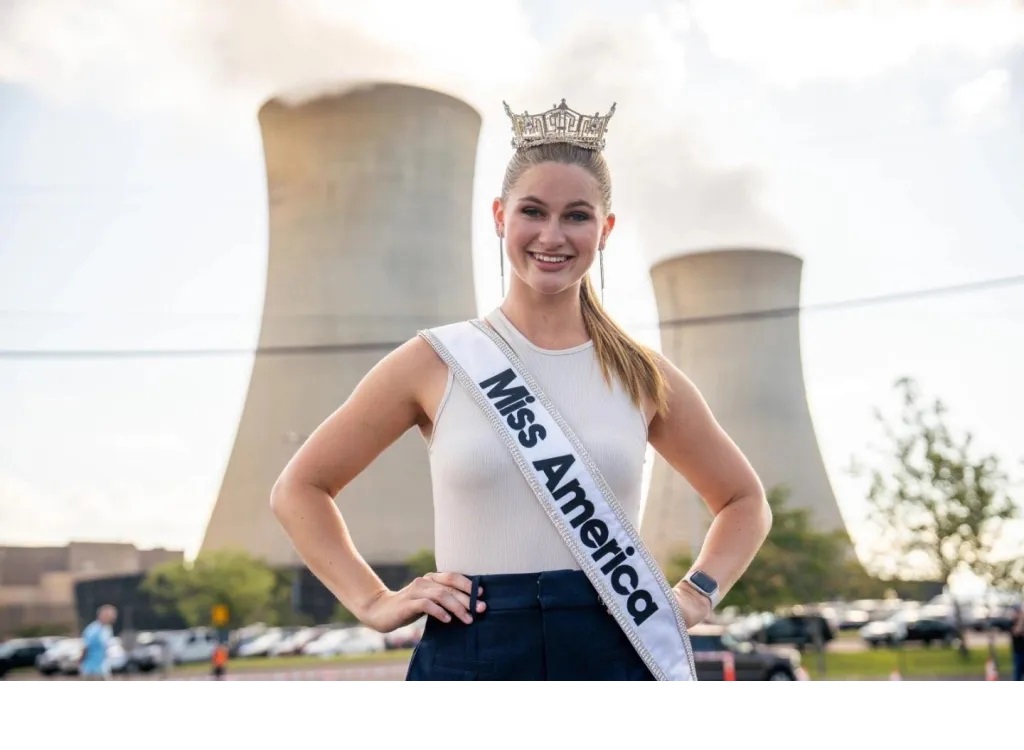
Former US beauty queen and nuclear energy expert Grace Stanke promotes nuclear in WA
“The perception from a lot of the community is they were using beauty to brainwash.”
By Kate Forrester, ABC South West WA
In short:
A campaign by proponents of nuclear have funded former Miss America and engineer Grace Stanke’s pro-nuclear tour of Australia.
Attendees say they had mixed emotions to whether or not the campaign message was what locals needed to hear.
What’s Next?
The tour, funded by Australian electronics mogul, Dick Smith will see the 22-year-old visit locations around Australia over the next week, to advocate for a nuclear future.
Nuclear energy advocates have begun a national tour to win the hearts and minds of coal towns promised nuclear facilities by the opposition.
Last year, federal opposition leader Peter Dutton identified seven sites across the nation to transition coal-fired power stations into nuclear power plants.
The South West town of Collie, 200 kilometres south of Perth, is one of seven sites identified by Mr Dutton.
Collie was the first stop on the campaign, spearheaded by former Miss America and nuclear fuels engineer Grace Stanke…………………………………..
One of the points the American presented to the crowd was jobs being transferable.
“I think for this town specifically, a lot of the skills current coal workers have can translate into a nuclear power plant or multiple power plants,” she said.
Differing opinions
Greg Busson, Secretary of the Mining and Energy Union, went to the meeting on Thursday night.
He disagreed with Ms Stanke’s position on jobs being transferable from coal to nuclear but said hearing another perspective was always worth it. ….majority of the workers I cover in Collie are coal miners. I don’t see where the link is there. They’ve never worked in a powerhouse.
“We don’t mine uranium, so where do those people fit in? What other industries are there that are linked to the nuclear industry that will give those coal workers comfort?”
Mr Busson said, looking around the hall, he thought a lot of the attendees had come from out of town.
“I think part of the problem is they portrayed Grace as a beauty queen, not just as a nuclear engineer,” Mr Busson said.
“The perception from a lot of the community is they were using beauty to brainwash.”…………………………………..more https://www.abc.net.au/news/2025-01-31/former-beauty-queen-grace-stanke-promotes-nuclear-in-wa-/104881056
‘Don’t want nuclear power’: Wild scenes as protestors storm Perth’s CBD during inquiry into nuclear energy.
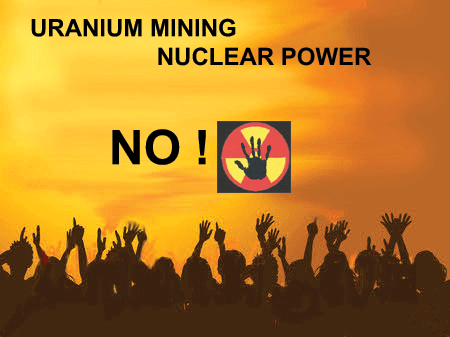
Wild scenes have erupted in one Aussie city’s CBD as protestors stormed the area during an inquiry into nuclear energy – with one protest leader calling it a “front” for the “fossil fuel industry”.
Emma Kirk, news.com.au December 18, 2024 -NewsWire
Wild scenes have erupted in Perth’s CBD after protestors attempted to crash an inquiry into nuclear power being held in the city.
Members from Nuclear Free WA, community groups and the public provided evidence to the inquiry on Tuesday, but it was not open to everyone.
Nuclear Free WA convener Liam Lilly said the Perth protest was an opportunity for people who could not attend the inquiry to have their voices heard in opposition to nuclear power in Australia.
Protestors were allegedly blocked from entering an inquiry held in the southwest town of Collie earlier this year, where a nuclear energy power station has been proposed.
Mr Lilly said it showed how much of a democratic process and the type of democratic values the proponents of the proposal were trying to push.
“They are just trying to bury opposition to these proposals and not have a fair democratic process in that regard,” he said.
“We do not want nuclear power in WA, we have better options in renewables.
“We also have great concerns about the longevity of waste products which remain radioactive for tens of thousands of years, if not hundred thousands.
“Unfortunately, the Coalition want to go ahead with nuclear.” Mr Lilly said in the time it would take Australia to move towards nuclear energy the climate crisis would be exacerbated.
“This is just a front for the coalition to extend the life of the fossil fuel industry,” he said……………………………………..
Climate Change and Energy Minister Chris Bowen said Australia needed new, cheap power now, not expensive power in 20 years.
“Ageing, expensive and unreliable coal plants are closing and we have to fill the gap. Dutton’s nuclear scheme would have us short on power for two decades – a sure-fire recipe for rolling and expensive blackouts,” he said. https://www.news.com.au/national/western-australia/dont-want-nuclear-power-wild-scenes-as-protestors-storm-perths-cbd-during-inquiry-into-nuclear-energy/news-story/4ac311659be07d70160723983dc08b0b
Western Australia Statement: Nuclear is No Climate Solution
| SIGN THE STATEMENT Please take action to protect WA from the threat of nuclear power by signing the statement “Nuclear is No Climate Solution.” Please help grow the support to stop Dutton’s nuclear power push in the West. |
| Unlike other states WA does not have a prohibition on nuclear power. With the Federal election increasingly uncertain we face a very real risk of a Federal Coalition advancing nuclear power in WA. We are pushing the State government to legislate a prohibition as the best legal protection against a Federal Coalition who seek to impose nuclear power in WA and we need your help to get the WA government to act. |
Peter Dutton’s proposal for WA is to build Small Modular Nuclear Reactors (SMNRs) at the Muja Coal fired power station in Collie which is due to be closed in 2027. There are new developments in the region for hydrogen power steel recycling, wind farms and battery storage all feeding into the South West grid.
The irresponsible and reckless nuclear proposal for Collie undermines and derails climate action, creates uncertainty for renewable energy investors and locks in gas and fossil fuels for longer. We cannot underestimate how serious Peter Dutton is on nuclear power and we do not have time to delay climate action.
You can download a sign on sheet to collect signatures and send back to us Nuclear Free WA c/o CCWA PO Box 883, West Perth, WA 6872.
Thanks so much for helping grow the momentum to stop nuclear power in WA.
Mia Pepper
Nuclear Free WA Committee Member
Basing US Nuclear Subs at Stirling on Garden Island makes Western Australia a nuclear target, while risking “catastrophic conditions” in a N-Sub reactor accident.
Briefer by David Noonan, Independent Environment Campaigner, 07 Sept 2024
What price should West Australian’s pay for AUKUS ? see “AUKUS: The worst defence and
foreign policy decision our country has made” by ex-FA Minister Gareth Evans (17 August 2024):
“… the price now being demanded by the US for giving us access to its nuclear
propulsion technology is, it is now becoming ever more clear, extraordinarily high.
Not only the now open-ended expansion of Tindal as a US B52 base; not only the
conversion of Stirling into a major base for a US Indian Ocean fleet, making Perth
now join Pine Gap and the North West Cape – and increasingly likely, Tindal – as a
nuclear target …”
No Emergency capability exists to respond to a nuclear weapons strike on Stirling off Freo
Nor can Federal and WA Labor claim to have a ‘social license’ for a US N-Sub Base at Stirling
while failing to inform affected community of the nuclear Health & Safety risks they could face.
Community has a basic ‘Right to Know’, a right to full disclosure of nuclear risks in advance of
decisions. A Labor Bill to declare Stirling a “Designated Nuclear Zone” is before Parliament
after a Senate Report. Now 3 yrs into AUKUS, it is long past time for Labor to inform community.
Federal & WA Labor Ministers Joint Ministerial Statement on Nuclear Reactors on Agricultural
Land (18 July 2024) have tackled Dutton over his crazy nuclear ‘power’ reactors at Muja, citing
accident impacts out to 80 km, but Labor fails to be transparent on nuclear risks they impose.
Federal and WA Labor have failed to make public required Health Impact Studies and
Nuclear Accident Scenario Modelling for US N-Sub visits and for a N-Sub Base at Stirling.
The WA State Hazard Plan “HAZMAT Annex A Radiation Escape from a Nuclear Powered
Warship” (update 20 Nov 2023) provides only scant over-view information to the public.
Federal Emergency provisions apply in event of a US N-Sub reactor accident at Stirling. The
federal civilian nuclear safety regulator ARPANSA sets out required Health Impact Studies,
Emergency response measures and Zones that are to be put in place (see “Guide for Radiation
Protection in Emergency Exposure Situations, Part 1 & 2, 2019).
A Defence Operations Manual “OPSMAN 1” (update 2023) is supposed to ‘operationalise’ the
Emergency measures for US N-Sub nuclear reactor accidents in Australian Ports and waters.
An “Urgent Protective Action Zone” of up to 2.8 km radius around the site of a US N-Sub
accident requires an Evacuation Plan for workers and affected residents. An “Extended
Planning Distance”, where “the surrounding population may be subject to hazards”, is set at
‘several kms’ around an accident site. This can extend to 5 km in UK N-Sub Emergency Zones.
ARPANSA and Defence also require studies of a local population out to 15 km from a US NSub mooring – as you can’t tell how far a radioactive pollution plume will spread by wind…
Children are at untenable Health risk in a nuclear strike OR in a US N-Sub reactor accident:
In a military nuclear reactor accident at Stirling the ARPANSA Guide Part 2 (p.18-19 & Table 3.1)
‘authorises’ ionising radiation health exposures to affected civilian workers AND to residents
and their children at a high dose of up to 50 mSv (milli-Sievert). Firty times more than Health
Authorities recommended maximum allowed dose of 1 mSv per year for members of the public.
Exposed residents and especially children need to be able to take stable iodine tablets ASAP to
try to reduce the radiological health risk of contracting thyroid cancer. Evacuees could have to
undergo ‘decontamination’ and need medical treatment, care which may have to be ongoing.
.
The Impact of Nuclear Weapons on Children (ICAN Report, August 2024) “shows in compelling
and often gut-wrenching detail, it is children who would suffer the most in the event of a nuclear
attack against a city today”. The Report is a dire warning that urgent action is needed to rid the
world of nuclear weapons. Australia must Sign & Ratify the Nuclear Weapons Ban Treaty.
WA Emergency workers could face “catastrophic conditions” at a N-Sub reactor accident:
In event of a severe US N-Sub reactor accident at Stirling the ARPANSA “Guide for Radiation
Protection in Emergency Exposure Situations (The Guide Part 2, p.18-19 & Table 3.1) authorises
“actions to prevent the development of catastrophic conditions” by designated WA workers.
‘Category 1 Emergency workers’ could “receive a dose of up to 500 mSv”, a dangerously high
ionising radiation dose exposure that is up to 500 times the public’s max allowed annual dose:
“Emergency workers may include workers employed by an operating organisation, as
well as personnel of response organisations, such as police officers, firefighters,
medical personnel, and drivers and crews of vehicles used for evacuation. …
- Category 1: Emergency workers undertaking mitigatory actions and urgent protective
actions on-site, including lifesaving actions, actions to prevent serious injury, actions
to prevent the development of catastrophic conditions that could significantly affect
people and the environment, and actions to prevent severe tissue reactions. … They
may also receive a dose of up to 500 mSv for life saving actions, to prevent the
development of catastrophic conditions and to prevent severe tissue reactions.”
The ARPANSA Guide Part 1 (Annex A, p.64 Table A.1, 2019) states in stark terms that Emergency
workers can be called upon to ‘volunteer’ for actions “to prevent the development of
catastrophic conditions” in event of a severe US N-Sub nuclear reactor accident:
“… under circumstances in which the expected benefits to others clearly outweigh
the emergency worker’s own health risks”.
As evidence of the extent of nuclear risks to the health of Emergency workers, the ARPANSA
Guide Part 1 (Annex A, p.63) requires female workers to be excluded from these roles:
“…female workers who might be pregnant need to be excluded from taking actions
that might result in an equivalent dose exceeding 50 mSv”
Note: the ‘safety’ of N-Subs in UK Ports has been found seriously wanting, see a Report (2009)
by Large and Associates Consulting Engineers on UK off-site Emergency Planning Measures.
Racist statements by mining magnate Lang Hancock, and claims that he had Aboriginal children

Lest we forget – the great mining magnates have not been so great on human rights.
This becomes an issue now, when their names can be attached to Australian sports teams. Surely an embarrassing whitewash of despicable public persons.
THE families of people claiming to be children born out of wedlock to Lang Hancock work in his mines, it was claimed yesterday. http://www.heraldsun.com.au/news/more-news/daughter-claims-lang-hancocks-descendants-work-in-mines/story-fn7x8me2-1226271180226 Gemma Jones From:Herald Sun February 15, 2012
Aboriginal elder Hilda Kickett, 68, who has been accepted as Mr Hancock’s love child by his widow, Rose Porteous, said some of the relatives of seven other suspected part-Aboriginal children of the late mining magnate were even paid royalties from mines opened on their traditional land.
Many of Mr Hancock’s suspected grandchildren have taken jobs in family mines and others in the vast northwest of Western Australia, which was opened up by the businessman……
Mr Hancock, who discovered iron ore in the Pilbara, once called for part-Aboriginals to be sterilised.
He also dismissed indigenous land claims, saying: “The question of Aboriginal land rights and things of this nature shouldn’t exist.”
He referred to part-Aboriginal people as “no-good half-castes” and said to deal with those who were unemployed he would “dope the water up so that they were sterile and would breed themselves out in the future”. ….. http://www.heraldsun.com.au/news/more-news/daughter-claims-lang-hancocks-descendants-work-in-mines/story-fn7x8me2-1226271180226
Western Australia rules out uranium mining policy change amid nuclear energy push from Peter Dutton

ABC Goldfields / By Jarrod Lucas, 8 Aug 24
In short:
WA Mines Minister David Michael has ruled out any change to the Cook government’s long-standing policy on uranium mining.
There is an effective ban on mining the mineral in WA, where only one uranium mine is permitted to operate.
Peter Dutton says the ban is “ideologically based” and should be overturned.
Western Australia’s mines minister has rejected calls from federal Liberal leader Peter Dutton to overturn the state’s long-standing ban on uranium mining and insisted that future energy needs will be met by renewable sources.
The state has had an effective ban on mining the nuclear fuel since Labor was swept to power in 2017, while Mr Dutton has made nuclear power development the centrepiece of the Coalition’s energy policy.
Speaking on the sidelines of this week’s Diggers and Dealers Mining Forum in Kalgoorlie-Boulder, Mr Dutton said the WA policy should be scrapped.
But WA Mines Minister David Michael, who attended the final day of the forum, poured cold water on the idea and said the state government’s stance on uranium would not be changing anytime soon.
“WA Labor, for two elections, has committed to not approving any uranium mines and there is no intention to change that policy,” Mr Michael said……………………………………………………………………………………..
Mr Michael said he spoke with officials from Deep Yellow at Diggers and Dealers and believed renewables such as wind, solar and battery storage were a safer bet than uranium.
“I think it’s more important to focus on critical minerals in terms of the renewable future,” he said.
“We know that renewable energy is what the world moves to sooner or later.
“We know that’s what we need to tool up for in WA, and we’re doing it.”…………………………………………………………. more https://www.abc.net.au/news/2024-08-08/wa-uranium-mining-policy-to-stay-despite-nuclear-energy-push/104196130
Resources Minister Madeleine King challenges Peter Dutton to name Western Australia nuclear power station sites
Joe Spagnolo, The West Australian, Sat, 8 June 2024
WA Federal Labor Minister Madeleine King has challenged Peter Dutton to come clean on where nuclear power stations would be located in WA — as the Federal Liberal leader spruiks nuclear energy for Australia.
Addressing the media in Kwinana on Saturday morning, the Resources Minister said WA communities like Collie, Kwinana and Fremantle could all be targets for a nuclear power station under a Dutton-led Federal Government…………………. (Subscribers only) https://thewest.com.au/politics/state-politics/resources-minister-madeleine-king-challenges-peter-dutton-to-name-wa-nuclear-power-station-sites-c-14953838
“We haven’t been consulted:” Coal town on transition to renewables is not interested in nuclear
ReNewEconomy, Aaron Bunch, Jun 2, 2024
A Western Australian coal town lined up as a potential site for a nuclear power station by the federal Coalition says the plan is a distraction as it works to ditch fossil fuels and transition to renewables and storage.
The federal coalition has floated plans to add nuclear energy to the power grid should it win government by building reactors at sites currently home to either coal or gas-fired power stations.
The sites have not yet been announced but the list is widely reported to include Collie, 200km south of Perth and home to about 7500 people, where a state government-supported pivot away from the coal industry is underway. It is the site for two of the country’s biggest battery storage projects.
Shire President Ian Miffling said the state $662 million Just Transition plan had created a “buzz” in the town and the federal coalition’s nuclear power plan hadn’t received much attention.
“Collie hasn’t been consulted at all and we don’t know any of the details of the policy and what they propose, so we’ve not given it too much credence at this stage,” he told AAP…………………
Mr Miffling said locals were focused on bolstering their skills for jobs in new industries, like the recently approved green steel mill and Synergy’s $1.6 billion battery to store renewable energy once coal is retired as an energy supply in 2030.
“The potential for nuclear, which would be a long way down the track, is a bit of a distraction and it really doesn’t need us to spend too much time talking about it at this point,” he said………………..
Local state Labor MP Jodie Hanns said federal opposition leader Peter Dutton and the coalition were out of touch with what was happening on the ground in Collie and floating plans for a reactor in the town was “arrogant and disrespectful”……………………….
“No one I’ve spoken to is in support of a nuclear reactor being put in Collie … my house will be up for sale if this becomes a reality.”
AMWU state secretary Steve McCartney said Collie workers had been discussing for years what they wanted for the town after coal mining ended, “and I can guarantee you one of the things wasn’t a nuclear power station”…………… https://reneweconomy.com.au/we-havent-been-consulted-coal-town-on-transition-to-renewables-is-not-interested-in-nuclear
Summary of Australian federal and state/territory nuclear/uranium laws and prohibitions.
Current prohibitions on nuclear activities in Australia: a quick guide
From Jim Green, 30 May 2024
https://www.aph.gov.au/About_Parliament/Parliamentary_departments/Parliamentary_Library/pubs/rp/rp2324/Quick_Guides/NuclearActivitiesProhibitions
PDF Version [564KB]
Dr Emily Gibson
Science, Technology, Environment and Resources; Law and Bills Digest Sections
This quick guide provides an overview of current prohibitions on nuclear activities under Commonwealth, state and territory laws. It considers the primary legislation most relevant to current policy debates about domestic nuclear energy only and consequently does not consider recent changes to Commonwealth law to facilitate Australia’s acquisition of conventionally-armed, nuclear-powered submarines under the AUKUS partnership.[1] It also does not include consideration of Australia’s international obligations in respect of nuclear activities, including the safeguarding of nuclear materials and the non-proliferation of nuclear weapons.
If a domestic nuclear energy industry were to progress, it is expected that a comprehensive framework for the safety, security and safeguarding of the related nuclear material would need to be legislated to accommodate such an industry.[2] Consideration of these issues is beyond the scope of this paper.
What are nuclear activities?
A nuclear activity is any process or step in the utilisation of material capable of undergoing nuclear fission; that is, any activities in the nuclear fuel cycle.[3] Nuclear activities therefore include:
- mining of nuclear or radioactive materials such as uranium and thorium milling, refining, treatment, processing, reprocessing, fabrication or enrichment of nuclear material
- the production of nuclear energy
- the construction, operation or decommissioning of a mine, plant, facility, structure, apparatus or equipment used in the above activities
- the use, storage, handling, transportation, possession, acquisition, abandonment or disposal of nuclear materials, apparatus or equipment.
Prohibitions on nuclear activities
Commonwealth
Nuclear activities are regulated under the Australian Radiation Protection and Nuclear Safety Act 1998 (ARPANS Act) and the Environment Protection and Biodiversity Conservation Act 1999 (EPBC Act).
Australian Radiation Protection and Nuclear Safety Act 1998
The ARPANS Act establishes a licensing framework for controlled persons (including a Commonwealth entity or a Commonwealth contractor) in relation to controlled facilities (a nuclear installation, a prescribed radiation facility, or a prescribed legacy site).[4] A nuclear installation includes a nuclear reactor for research or the production of radioactive materials for industrial or medical use, and a radioactive waste storage or disposal facility with an activity that is greater than the activity level prescribed by the Australian Radiation Protection and Nuclear Safety Regulations 2018.[5]
The ARPANS Act allows the CEO of the Australian Radiation Protection and Nuclear Safety Agency (ARPANSA) to issue licences for controlled facilities.[6] In issuing a facility licence, the CEO ‘must take into account the matters (if any) specified in the regulations, and must also take into account international best practice in relation to radiation protection and nuclear safety’.[7]
However, subsection 10(2) of the Act expressly prohibits the CEO from granting a licence for the construction or operation of any of the following nuclear installations: a nuclear fuel fabrication plant; a nuclear power plant; an enrichment plant; or a reprocessing facility.[8] This prohibition does not appear to apply to a radioactive waste storage or disposal facility.
Environment Protection and Biodiversity Conservation Act 1999
The EPBC Act establishes 9 matters of national environmental significance (MNES) and provides for the assessment and approval of these actions if the action has, will have, or is likely to have a significant impact on the MNES.[9] ‘Nuclear actions’ are one of the MNES.[10] Where a nuclear action is determined to be a controlled action (that is, one likely to have a significant impact and requiring assessment and approval under the Act), the assessment considers the impact of a nuclear action on the environment generally (including people and communities).[11]
The Act establishes offences for the taking of nuclear actions in those circumstances.[14]
Similarly, the Act provides that a relevant entity (as set out below) must not take an action (including a nuclear action) unless a requisite approval has been obtained under Part 9 of the Act or a relevant exception applies:
- a person must not take a relevant action on Commonwealth land that has, will have or is likely to have a significant impact on the environment[15]
- a person must not take a relevant action outside Commonwealth land if the action has, will have or is likely to have a significant impact on the environment on Commonwealth land[16]
- the Commonwealth or a Commonwealth agency must not take inside or outside the Australian jurisdiction an action that has, will have or is likely to have a significant impact on the environment inside or outside the Australian jurisdiction.[17]
The Act establishes offences and civil penalty provisions for the taking of an action in those circumstances.[18]
Subsection 140A(1) prohibits the Minister for the Environment from granting an approval for a nuclear action relating to specified nuclear installations. These installations are a nuclear fuel fabrication plant, a nuclear power plant, an enrichment plant, and a reprocessing facility.
Potential reform of the nuclear action trigger
The second independent review of the EPBC Act, completed in October 2020 by Professor Graeme Samuel (Samuel Review), recommended that the nuclear actions MNES be retained.[19] The review recommended that ‘the EPBC Act and the regulatory arrangements of [ARPANSA] should be aligned, to support the implementation of best-practice international approaches based on risk of harm to the environment, including the community’.[20]
In 2022, the Government’s Nature Positive Plan adopted this approach and stated, ‘[a] uniform national approach to regulation of radiation will be delivered through the new National Environmental Standards’.
In February 2024, a policy draft of the National Environmental Standard for Matters of National Environmental Significance indicates that ‘nuclear actions’ will be renamed ‘radiological exposure actions’ and states:
Relevant decisions must:
Not be inconsistent with the ARPANSA national codesfor protection from radiological exposure actions including in relation to:
- human health and environmental risks and outcomes; and. radiological impacts on biological diversity,
- the conservation of species and the natural health of ecosystems.[22]
States and territories
States and territories generally regulate nuclear and radiation activities through either the health or the environmental protection portfolios. The relevant legislation provides for the protection of health and safety of people, and the protection of property and the environment, from the harmful effects of radiation by establishing licensing regimes to regulate the possession, use, and transportation of radiation sources and substances.[23] Mining of radioactive materials is regulated through the resources portfolio.
In addition, as outlined below, the states and territories have legislation prohibiting certain nuclear activities or the construction and operation of certain nuclear facilities. Importantly, where permitted, nuclear activities (including mining) would also be subject to assessment and approvals under a range of other legislation, including planning and environmental impact assessment, native title and cultural heritage, and radiation licensing laws at the state or territory and Commonwealth level.
New South Wales
Exploration for uranium has been permitted under the Mining Act 1992 since 2012.[24] However, the mining of uranium is prohibited by the Uranium Mining and Nuclear Facilities (Prohibitions) Act 1986 (NSW Prohibitions Act).[25]
The NSW Prohibitions Act also prohibits the construction and operation of certain nuclear facilities, including uranium enrichment facilities, fabrication and reprocessing plants, nuclear power plants, and storage and waste disposal facilities (other than for the storage and disposal of waste from research or medical purposes, or the relevant radiological licensing Act).[26]
Northern Territory
The Atomic Energy Act 1953 (Cth) provides that the Commonwealth owns all uranium found in the territories.[27] Uranium exploration and mining in the Northern Territory (NT) is regulated under both NT mining laws (the Mineral Titles Act 2010 and the Mining Management Act 2001) and the Atomic Energy Act.[28] The Ranger Uranium Mine operated until 2021 and is now undergoing rehabilitation.[29]
The Nuclear Waste Transport, Storage and Disposal (Prohibition) Act 2004 (NT) prohibits the construction and operation of nuclear waste storage facilities, as well as the transportation of nuclear waste for storage at a nuclear waste storage facility in the NT.[30] Nuclear waste is defined as including waste material from nuclear plants or the conditioning or reprocessing of spent nuclear fuel.[31]
This Act also:
- prohibits public funds from being expended, granted or advanced to any person for, or for encouraging or financing any activity associated with the development, construction or operation of a nuclear waste storage facility
- would require the NT Parliament to hold an inquiry into the likely impact of a nuclear waste storage facility proposed by the Commonwealth on the cultural, environmental and socio‑economic wellbeing of the territory.[32]
Queensland
Exploration for and mining of uranium are permitted under the Mineral Resources Act 1989. However, it has been government policy to not grant mining leases for uranium since 2015.[33] The government policy ban extends to the treatment or processing of uranium within the state.[34]
The Nuclear Facilities Prohibition Act 2007, in similar terms to the NSW Prohibitions Act, prohibits the construction and operation of nuclear reactors and other nuclear facilities in the nuclear fuel cycle.[35]
Unlike other state and territory prohibition legislation, the Nuclear Facilities Prohibition Act would require the responsible Queensland Minister to hold a plebiscite to gain the views of the Queensland population if the Minister was satisfied that the Commonwealth Government has taken, or is likely to take, steps to amend a Commonwealth law or exercise a power under a Commonwealth law to facilitate the construction of a prohibited nuclear facility, or if the Commonwealth Government adopts a policy position of supporting or allowing the construction of a prohibited nuclear facility in Queensland.[36]
South Australia
The exploration and mining of radioactive material (including uranium) is permitted in South Australia (SA), subject to approvals under the Mining Act 1971 and the Radiation Protection and Control Act 2021 (RP&C Act).[37] For example, uranium is mined at Olympic Dam, Four Mile and Honeymoon. However, conversion and enrichment activities are prohibited by the RP&C Act.[38]
The Nuclear Waste Storage Facility (Prohibition) Act 2000 prohibits the construction or operation of a nuclear waste storage facility, and the import to SA or transport within SA of nuclear waste for delivery to a nuclear waste storage facility.[39]
The Nuclear Waste Storage Facility (Prohibition) Act prohibits the SA Government from expending public funds to encourage or finance the construction or operation of nuclear waste storage facilities.[40] The Act would also require the SA Parliament to hold an inquiry into the proposed construction or operation of a nuclear waste storage facility in SA authorised under a Commonwealth law.[41]
Tasmania
The exploration and mining of atomic substances (which includes uranium and thorium) is permitted under the Mineral Resources Development Act 1995 (Tas), subject to approval.
Victoria
The Nuclear Activities (Prohibitions) Act 1983 prohibits a range of activities associated with the nuclear fuel cycle, including the exploration and mining of uranium and thorium, and the construction or operation of facilities for the conversion or enrichment of any nuclear material, nuclear reactors and facilities for the storage and disposal of nuclear waste from those prohibited activities.[42]
Western Australia
Exploration for and mining of uranium is permitted under the Mining Act 1978. A state policy ban on mining approvals was overturned in November 2008;[43] however, this was reinstated in June 2017, with a ‘no uranium’ condition on future mining leases.[44] The ban does not apply to 4 projects that had already been approved by the previous government.
The Nuclear Activities Regulation Act 1978 aims to protect the health and safety of people and the environment from possible harmful effects of nuclear activities, including by regulating the mining and processing of uranium and the equipment used in those processes. The Nuclear Waste Storage and Transportation (Prohibition) Act 1999 also prohibits the storage, disposal or transportation in Western Australia of certain nuclear waste (including waste from a nuclear plant or nuclear weapons).[45]
Can the Commonwealth override a state ban on nuclear activities?
The Commonwealth Parliament only has the power to make laws in relation to matters specified in the Constitution of Australia, including in sections 51, 52 and 122. Assuming the Commonwealth has a sufficient head of power to legislate, section 109 of the Constitution specifically provides for circumstances in which there might be an inconsistency between Commonwealth and state laws:
When a law of a State is inconsistent with a law of the Commonwealth, the latter shall prevail, and the former shall, to the extent of the inconsistency, be invalid.
Therefore, even though some states have enacted prohibitions on certain nuclear activities within their jurisdictions, the Commonwealth Parliament could enact specific legislation in relation to nuclear activities so that such activities can take place within those jurisdictions. One such example is the National Radioactive Waste Management Act 2012 (Cth), which provides for the establishment of a national radioactive waste management facility at a site to be declared by the responsible Commonwealth Minister. Section 12 of that Act provides that state and territory laws have no effect in regulating, hindering, or preventing such a facility
Further information
- ‘Who we regulate’, ARPANSA
- ‘State & territory regulators’, ARPANSA
- ‘Uranium and thorium’, in Geoscience Australia, Australia’s Energy Commodity Resources, 2023 Edition, (Canberra: Geoscience Australia, 2023).
WA Liberals reject Peter Dutton’s nuclear plan
New Daily, AAP, May 26, 2024,
The Western Australia Liberal Party has poured cold water on the federal Coalition’s plan for nuclear power in the state, while backing coal to keep the lights on.
Energy spokesman Steve Thomas says federal Opposition Leader Peter Dutton’s plan for nuclear power won’t work in WA.
“To get approvals and construction happening on a nuclear power plant, whatever the size is, is probably a 15-to-20-year timeframe,” he told reporters on Sunday.
“In the meantime, we have to keep the lights on we have to keep the air conditioners running and we have to do it at a cost that the community can afford.”
WA’s power system was small and a large cost-effective nuclear power plant wouldn’t work, Mr Thomas said.
“The size of the unit would matter significantly because as CSIRO has said, the small ones which will fit into our marketplace are more than two-to-three times as expensive per unit of electricity as the large ones,” he said.
“There might one day be room for a small one when the time is right and the business case steps up and the community accepts it.”
A CSIRO report released last week found building a large-scale nuclear power plant in Australia would take 15 years, cost at least $8.5 billion and produce electricity about twice the cost of renewables.
Any nuclear plant in WA would need significant federal government investment and Mr Thomas said he was happy to look at Mr Dutton’s business case and continue talks.
“This is a long, ongoing discussion and we the state Liberals are not afraid of nuclear energy … but it has to stack up and it has to have support,” he said………………………………… https://www.thenewdaily.com.au/news/2024/05/26/wa-liberals-reject-dutton-nuclear-plan
Senior Western Australia Liberal calls for Australia to become nuclear weapons power

Brisbane Times, Hamish Hastie, March 11, 2024
A two-time WA Liberal candidate and party office bearer says Australia should have nuclear weapons.
Jim Seth made the argument at a Liberal Party state council meeting this month, saying nuclear weapons had made North Korea untouchable and suggested Australia should follow suit.
At the party’s March 2 meeting, details of which were leaked to WAtoday, Seth asked the question-and-answer panel:
“North Korea, a small country, has got nuclear fire, right? Nobody can do a mimicry [sic] on them, no neighbour can touch them, why we as first world country not nuclear react?”
Seth, who was a WA Liberals candidate for Bassendean in 2017 and for Morley in 2021 and is now the marketing committee chair and state executive member, furthered his point in a follow-up question about the Australian Navy’s capabilities to counter drone attacks…………………..
Seth claimed $90 million was being paid every day to Canberra public servants to create federal policies and suggested this money could be better spent on making Australia a nuclear power.
“We could have spent that money into making Australia a nuclear power, so nobody can come and do mimicry [sic] on us,” he said………………………….
WAtoday contacted Seth to clarify whether he was talking about nuclear energy or weapons, and he said “as a patriotic Australian” he believed Australia should have nuclear weapons.
He did not respond to follow-up requests for comment.
Australia has since 1970 been a signatory to the United Nations Nuclear Non-Proliferation Treaty, which binds the country to an agreement not to acquire nuclear weapons.
According to the Department of Foreign Trade and Affairs Australia has been one of the treaty’s strongest supporters and was a key player in ensuring the treaty was extended indefinitely in 1995.
Seth’s comments alarmed Nuclear Free WA co-convener Mia Pepper who said nuclear weapons would make Australia a target, not safer.
“Nuclear weapons have no strategic utility and would not enhance Australia’s defence or security,” she said.
“In a time of growing conflict and uncertainty, Australia should be proliferating peace and diplomacy, not fuelling nuclear tensions and threat.”………………… https://www.brisbanetimes.com.au/politics/western-australia/senior-wa-liberal-calls-for-australia-to-become-nuclear-weapons-power-20240308-p5fazr.html?ref=rss&utm_medium=rss&utm_source=rss_feed
‘Like a radioactive cloud’: elegance and horror combine in powerful Yhonnie Scarce exhibition
Australia’s forgotten nuclear history and its dehumanisation of Aboriginal people come together in First Nations glass artist’s fiercely intellectual work.
Guardian, by Rosamund Brennan, 2 Apr 24
Yhonnie Scarce grew up in the grim aftermath of nuclear weapons testing in South Australia in the 50s and 60s, not far from her birthplace of Woomera. From the tender age of ten, she heard stories from elders about a cataclysmic roar, the sky turning red and a poisonous black mist hovering over the desert, like an apparition.
Born in 1973, the Kothakha and Nukunu glass artist has spent much of her career researching the British government’s testing of nuclear weapons in Maralinga and Emu Field, which she says “lit a fire in my heart that hasn’t been extinguished”.
The blasts wreaked havoc on generations of Aboriginal people, as well as military personnel and non-Aboriginal civilians – sending radioactive clouds thousands of kilometres, causing burns, blindness, birth defects and premature death.
When the toxic plumes reached Ceduna, where Scarce’s family lived, radioactive slag rained down from the sky, singeing their skin. Their concerns about the burns were rebuffed by doctors, who spuriously claimed there was a measles outbreak. But today, according to Scarce, cancer is prevalent in the town.
“I call this a mass genocide,” Scarce says. “I don’t know if we’ll ever find out how many Aboriginal people died over that 10-year period. But I can imagine it’s thousands.”………………………………………………………………………………………………..
The series is revelatory of Scarce’s practice: at once fiercely intellectual, deeply felt and elegant in its materiality. As a glass-blower, Scarce quite literally breathes life into her work, animating its delicate, molten surface, giving form to invisible pain and loss.
Glass holds special significance for Scarce: crafted from silica, or sand, it emerges from the very essence of the landscape. As Australia’s only professional Indigenous glass-blower, she veered away from working with traditional forms like decorative vases or bowls, instead drawing from what she calls the “bush supermarket”: depicting yams, plums and bush bananas to convey the history of her people.
Conceived by Wardandi and Badimaya curator Clothilde Bullen, the career-spanning exhibition at AGWA also features works which examine the dehumanisation and exploitation of Aboriginal people through displacement, indentured labour and institutionalised racism. One such work is In The Dead House, which features glass bush bananas laid out on a mortuary trolley, their bodies split wide open.
……………………………………………………………………………………………… In a seemingly fated moment, when those monstrous atomic bombs exploded at Maralinga almost 70 years ago, the red desert sand melted into thousands of green shards of glass that still litter the site today. Across Scarce’s 20-year career, it’s as if she’s been slowly collecting the disaster’s shattered remains and, piece by piece, crystallising a dark, hidden chapter of Australia’s history. Like a radioactive cloud, her astonishing body of work engulfs you in its sheer power and potency.
https://www.theguardian.com/artanddesign/2024/apr/02/yhonnie-scarce-light-of-day-art-gallery-western-australia
- Yhonnie Scarce: Light of Day is showing at the Art Gallery of Western Australia until 19 May 2024
Western Australia’s Premier Cook goes nuclear on Dutton’s ‘simplistic, ridiculous’ power plan
SMH, Hamish Hastie, March 5, 2024 —
A Coalition proposal to build nuclear power stations at the sites of retired or retiring coal stations is ridiculous and a distraction from efforts to reach net zero using renewables, West Australian Premier Roger Cook has said.
Opposition leader Peter Dutton floated the idea of building nuclear power stations on sites of retired coal stations – which could include the South West town of Collie – as a zero-emissions solution to the nation’s energy woes.
Cook blasted the Coalition proposal that federal Nationals leader David Littleproud was spruiking in WA this week as a fantasy.
“The rollout of small nuclear reactors or modular reactors in other countries has been halted because it’s not commercial, it’s not viable,” he said.
“In addition to that, Australia has no experience in nuclear power generation so we don’t have the workforce, we don’t have the know-how to be able to bring them in.
“You simply cannot plonk these things into a landscape and plug it into the grid. These simplistic sort of ideas are ridiculous.
“What we need to do is accept that climate change is a reality and move to exploit the abundance of wind and solar that we have at our disposal.
“There’s no quick fix here, you’ve got actually do the hard work and this is simply a sound grab by the Nationals to distract people from the real hard work which is being done.”……………………………………………………… https://www.smh.com.au/politics/western-australia/cook-goes-nuclear-on-dutton-s-simplistic-ridiculous-power-plan-20240305-p5fa0r.html
Perth nuclear waste storage facility planned for AUKUS submarines at HMAS Stirling on Garden Island
ABC, By Rebecca Trigger and Isabel Moussalli,18 Dec 2023
Low-level radioactive waste generated by nuclear-powered submarines stationed in Perth could be stored elsewhere, WA’s Premier says, despite new documents revealing plans for a local waste facility.
Key points:
- The ABC has revealed AUKUS nuclear waste will be stored at HMAS Stirling
- WA’s Premier believes it could still be sent elsewhere
- Experts say they aren’t overly concerned, but community perception may be negative
Federal government AUKUS briefing notes obtained by the ABC reveal details of a nuclear waste storage facility being planned as part of general infrastructure works at the HMAS Stirling defence base on Garden Island, south of Perth.
The notes, made public through a Freedom of Information application, say the radioactive material will at least be temporarily stored in WA from 2027.
But WA Premier Roger Cook said where the waste ultimately goes remained unclear.
“Around the issue of low-level radioactive waste, well obviously we have significant capability in that, particularly in South Australia, but that will be an issue that will be decided into the future,” he told reporters on Monday.
Greens Senator Sarah Hanson-Young said any plans for a nuclear waste management facility in Western Australia wouldn’t be popular among the community.
“Australians are vehemently opposed to nuclear waste being stored in Australia, in particular international nuclear waste,” she said.
“We know the South Australian community have been very opposed to this for a long time, our cousins in WA are not going to look on this fondly, either.”
A South Australian government spokesperson said it would listen to advice on the best place to store the waste……………………………………..
he question of what to do with the nuclear waste is an ongoing debate, with a dedicated national agency to manage the subs only created in July………………………………….
However when nuclear-powered subs are decommissioned it will create intermediate and high-level waste that will need to be closely managed as it is weapons-grade material.
Federal government plans for a dump near the South Australian town of Kimba were scrapped earlier this year after traditional owners, the Barngarla people, mounted a Federal Court challenge.
Is there any cause for concern?
Griffith University emeritus professor Ian Lowe said low-level radioactive waste was usually relatively benign but communities have historically rejected proposals to store it in their region.
“We still have no system for managing our low-level radioactive waste let alone the much more intractable waste from nuclear submarines,” he said.
“I wouldn’t be particularly concerned about low-level waste, because if that’s under a couple of metres of earth the radiation at the surface isn’t much more than the background radiation to which we’re all exposed.
“What I would be worried about is that this might be the forerunner to a proposal to store the used reactors from nuclear submarines there, and that’s very nasty waste that I certainly would not want either in my backyard or within 20 kilometres of where I live.”
Professor Lowe, also a past president of the Australian Conservation Foundation, said once the most recent proposal to store low-level radioactive waste at Kimba in South Australia, the federal government then said it would be used to store intermediate-level waste.
“If I were in the environs of this proposal in Western Australia I’d be worried that the same thing might happen,” professor Lowe said……………………………………. https://www.abc.net.au/news/2023-12-18/aukus-submarine-nuclear-waste-disposal-in-perth-hmas-stirling/103242730
1 This month

of the week – Australians for War Powers Reform (AWPR)
To see nuclear-related stories in greater depth and intensity
 Antinuclear