A Sustainable Energy Future for Western Australia
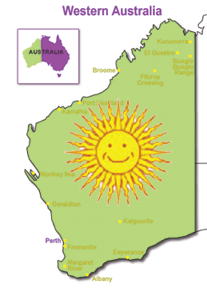 Creating a sustainable energy future for Western Australia http://www.infolink.com.au/c/Sustainable-Energy-Association-of-Australia/Creating-a-sustainable-energy-future-for-Western-Australia-n2501656 1 March 2013, The Sustainable Energy Association of Australia promotes the development and adoption of renewable energy, energy efficiency and sustainable energy technologies and services.
SEA released its policy position recently, ahead of the Western Australian State Election on 09 March 2013.
The policy document ‘Creating a sustainable energy future for Western Australia’ draws on the substantive views of SEA members who were surveyed on what they would like to see from the next State Government.
Five key recommendations: Continue reading
Western Australia: Greens show a practical plan for transition to renewable energy
Renewable energy could have a major impact on Western Australia http://www.hydrogenfuelnews.com/renewable-energy-could-have-a-major-impact-on- western-australia/859050/ BY
– FEBRUARY 21, 2013
State could reach 100% energy sustainability through solar and windWestern Australia is one of the largest energy consumers in the world. The state relies heavily on fossil-fuels, such as coal, but has been working to adopt renewable energy in recent years. According to the Greens, the state can meet its energy needs in a variety of ways that do not involve the use of fossil-fuels. The document released by the Greens highlights solar thermal and storage technologies as an adequate way for the South West Interconnected System. Western Australia’s expansive energy utility, to break away from fossil-fuels. Another option is to use photovoltaic solar energy systems and wind energy.
Costs of renewable energy considered viableThe cost for solar and wind energy has dropped significantly over the past two years. The Greens suggest that no major advances in technology are required for Western Australia to reap the economic benefits of adopting renewable energy. According to the political party, renewable energy in the region can range from $208 to $221 per megawatt-hour. This estimation represents a $60 billion upfront cost for the state to expand its use of solar and wind energy. The cost may be high, but the Greens suggest that it is significantly lower than the costs associated with a continued focus on fossil-fuels.
Politics likely to dictate future of renewable powerAs Australia’s smallest political party, the Greens have limited influence over the adoption of renewable energy throughout the country. This is particularly problematic because renewable energy is often made into a political issue rather than one of sustainability or economics. The Greens study of renewable energy and its potential to help Western Australia reach 100% energy sustainability has, nonetheless, generated a fair amount of hype in the political space.
Mining billionaire Andrew Forrest fights Cauldron Energy for uranium mining rights
Billionaire Miner Fights Rivals to Halt Digs on His Ranch. Business Week. By Elisabeth Behrmann and Joe Schneider on February 17, 2013 Andrew Forrest, Australia’s richest man who made his fortune digging up iron ore, is fighting bids to exploit the mineral wealth under his own half-a-million acre family ranch in the nation’s remote northwest outback.
Forrest, 51, founder and executive chairman of Fortescue Metals Group Ltd., the biggest seller of high-yield debt in the mining industry, sued to block attempts to search for uranium on his Minderoo ranch and last month failed in a bid to halt sand mining on the property….
“In Australia, by law, you only own the top meter, everything underneath, that is owned by the people of Australia,” Peter Strachan, a resources analyst at Perth-based StockAnalysis, said in a phone interview. “If someone puts in a request to explore on your land, you have to deal with that and make sure you’re compensated for access.”…..
Forrest is also fighting on a second legal front. Cauldron Energy Ltd., chaired by another mining entrepreneur, Tony Sage, applied for exploration licenses over some of Minderoo on April 4 for its Yanrey uranium project. Forrest & Forrest filed objections on May 8. A hearing date hasn’t been set yet………http://www.businessweek.com/news/2013-02-17/billionaire-miner-fights-rivals-to-halt-digs-on-his-ranch
Energy 2029 – an initiative of Western Australia’s Greens, led by Sen Scott Ludlam
WA Greens Launch Energy 2029 http://www.energymatters.com.au/index.php?main_page=news_article&article_id=3592, 14 Feb 13, Western Australia’s Greens say its Energy 2029 study offers credible scenarios for meeting the state’s south-west grid electricity demand through clean technologies and energy efficiency strategies that already exist.
The solar based scenario focuses on large-scale solar thermal facilities that provide the majority of dispatchable electricity, with balance of demand supplied by large-scale wind farms, solar PV and a smaller number of biomass, wave and geothermal generators.
In the event of a number of cloudy days and calm conditions, backup electricity would be provided by biomass ‘co-firing’ at the solar plants, pumped hydro storage and a small number of mid-tier biomass plants.
The Greens say the overall cost of a planned transition to renewable energy is similar to the cost of continuing with a ‘business as usual’ approach as while the initial costs are higher for renewables, they become more competitive over time as future fuel costs are non-existent, except for the biomass backup.
“The debacle of the refurbishment of the obsolete Muja coal-fired power station demonstrates the underlying cost of business as usual, with Western Australians asked to spend a quarter of a billion dollars to upgrade a highly polluting coal fired power station,” states the study summary.
“… the only barrier to a massive increase in clean energy here in Western Australia, is political inertia.”
The Energy 2029 initiative has been led by Senator Scott Ludlam.
“This study is a project that we should not have had to undertake,” he states in the executive summary. “Perhaps people who come across this document deeper into the age of climate change will shake their heads at the degree to which we have to contend with the monetary costs of the transition.”
With regard to nuclear options, “There is no place in this study for the obsolete failures of the nuclear industry.”
The full Energy 2029 report can be viewed here (PDF).
Solar pholtovoltaic energy plant planned for Kalgoorlie, Western Australia
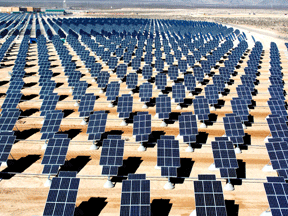 Investec plans 50MW solar PV plant near Kalgoorlie, REneweconomy By Giles Parkinson 13 February 2013 Global banking and asset management group Investec is working on a proposal to build a 50MW solar PV power plant near Kalgoorlie, in what is likely to be the first solar plant of its size in Australia.
Investec is hopeful of sealing land tenure at Mungari, about 26kms from Kalgoorlie, in the next month or so, and then will go to market to seek a power purchase agreement and lock in project finance. Construction on the project could begin next year.
The Mungari project is one of two currently being studied by Investec in WA – the other being the Chapman solar PV project near Geraldton, which was originally billed as a solar hybrid but may emerge as a solar PV only project.
WA is emerging as one potentially of the hottest regions for the utility scale solar industry, thanks to its excellent solar resources and relatively high electricity prices.
Bloomberg New Energy Finance last week said that solar PV plants in WA would have an estimated levellised cost of energy of around $157/MWh, compared to more than $190/MWh for new coal-fired generation in the state, where the cost of coal is expensive. BNEF expects the LCOE of solar PV to fall below $100/MWh by 2020.
Despite this, and helping fund the country’s first utility scale solar plant, a 10MW facility near Geraldton, the conservative state government is focused on new coal-fired generators, and is currently restoring its ageing Muja coal fired generator near Collie (and facing a major cost blow-out).Investec project manager Lynne Lagan said Kalgoorlie made sense because of its excellent solar resources and its location at the edge of the South-West Interconnected System – the grid that services the south west corner of the state.
Lagan said there was a single 220kW line going to Kalgoorlie, so a limited amount of generation could be brought in. “It makes sense to put some generation in this part of the network,” she told RenewEconomyby phone from Kalgoorlie on Tuesday.
“That’s why chosen this location. We been working on project for 18 months on land tenure and we are now looking to finalise those arrangements.”
Lagan said Investec’s numbers on the cost of the solar plant were about the same as Bloomberg New Energy Finance. And she noted there was a huge amount of interest from miners, many who operate on remote locations but are forced to truck in gas or diesel at horrendous costs – often at around 400/MWh or even more. Building this plant could open up further opportunities.
“This sort of project makes sense regardless of whether it considered as a “renewables” project,” she said. “There is a lot of expensive diesel generation here and we are having discussions with some of mining operations. They just want power that makes sense at a sensible price.”……
City of Kalgoorlie Boulder CEO Don Burnett told ABC radio that the region was a perfect and secure location for a large scale solar station because of the guaranteed sunshine.
“It’s a great location for a solar proposal and the benefits to the city and the region would be immense, but also it’s a great opportunity for the state and federal governments to be involved in innovation in sustainable energy.” http://reneweconomy.com.au/2013/investec-plans-50mw-solar-pv-plant-near-kalgoorlie-22039
Western Australia’s opportunity to lead in renewable energy
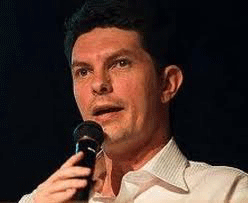 Greens’ plan for clean power by 2029 http://www.watoday.com.au/wa-news/state-election-2013/greens-plan-for-clean-power-by-2029-20130210-2e6in.html#ixzz2KclQE7OS February 11, 2013 Robyn Preston Switching over to 100 per cent renewable energy by 2029 is not only achievable, it will save the average family money, according to Greens’ party leader Scott Ludham. WA Greens’ party leader Scott Ludham launched the Green Energy 2029 proposal on Sunday and said Western Australia cannot afford to wait decades to make the change to renewable energy sources.
The Greens say that with WA’s abundance of sunlight, wind and geothermal resources, changing to renewable energy over the next 16 years will not cost anymore than what has been proposed by the Liberal-National Government he said.
“The state government is actually proposing to spend a quarter of a billion dollars refurbishing the obselete Muja coal-fired power station and that for me is all you need to know about how wrong this government’s prorities are,” said Mr Ludham. Continue reading
Dramatic success of Perth Solar City Program
 Perth Solar City’s Stunning Success http://www.energymatters.com.au/index.php?main_page=news_article&article_id=3573 by Energy Matters, 31 Jan 13, Over 16,000 households have participated in the Perth Solar City Program and collectively saved over a million dollars on their electricity bills last year. The most comprehensive energy efficiency initiative in Western Australia, the Perth Solar City Program developed and implemented more than 30 energy efficiency and renewable energy projects within Perth’s Eastern Region.
The Program together with SunPower installed 673 residential solar panel systems at an average size of 2.30kW, for a total installed capacity of 1.56MW. Analysis shows the average solar household used 41% less electricity from the network, or 8.15kWh per day. Continue reading
China the major shareholder in Western Australia’s new uranium exploration company Zeus
China backs new WA uranium play Nick Sas, The West Australian January 18, 2013, China Inc has joined WA’s uranium hunt, with the State-backed China Metallurgical Geology Bureau revealed as the major shareholder in new uranium explorer Zeus Resources.
In a deal that ignores the gloom surrounding Australia’s limp initial public offering market, Zeus will hit the boards on Monday after successfully raising $13.5 million to jump-start its uranium exploration projects scattered around WA…… China National Nuclear Corporation chairman said last year it would speed up investments in overseas uranium mining exploration, with a particular focus on Australia and Africa, in order to meet the energy company’s growing demand for uranium.
In March last year China Guangdong Nuclear Power Group completed the $2.2 billion takeover of WA’s Extract Resources, which owns the Husab uranium asset in Namibia…. http://au.news.yahoo.com/thewest/business/a/-/wa/15872030/china-backs-new-wa-uranium-play/

In Western Australia it’s the battler households taking up solar panels
Battler Households Driving Western Australia’s Solar Uptake http://www.energymatters.com.au/index.php?main_page=news_article&article_id=3550 by Energy Matters, 15 Jan 13, In Western Australia, like elsewhere in the nation, solar power uptake isn’t being driven by the rich, but by the mortgage belt. Western Australia now boasts over 100,000 rooftop solar panel arrays across Perth and the South West.
According to The West Australian, figures provided by Synergy show the southern suburb of Canning Vale had highest number of solar panel installations (2239) as of December 19, followed by Thornlie (1513), Baldivis (1376), Willetton (1299) and Ellenbrook (1198).
None of Perth’s affluent suburbs featured in Synergy’s top 20 list of solar panel installations in Western Australia.
The results again bust the myth that solar rebates and subsidies have primarily benefited the wealthy. Western Australia’s experience has been repeated throughout the country.
In an analysis of solar energy systems installed under the Renewable Energy Target carried out last year by REC Agents Association (RAA); the Association found suburbs with the highest solar uptake were typically in the outer metropolitan mortgage belt.
The Clean Energy Council’s Solar Power Australia 2011-12 report states over half of solar households have an annual income of less that $100,000 annually and more than a quarter earn less than $65,000 a year.
Solar panel uptake is being driven primarily by ongoing and substantial electricity price rises.
According to solar provider Energy Matters, a 3kW solar power system installed in Perth will generate more than 12kWh a day on average. Based on the price of a good quality system supplied and installed by the company; the electricity produced will work out to cost under 6c per kilowatt hour over the life of the system – far cheaper than retail rates.
Households in Western Australia can also benefit from the state’s feed in tariff that pays 8 – 50c per kilowatt hour for surplus electricity exported to the mains grid, depending on location. Solar feed in tariff incentives are also available in other states; but with the price of electricity so expensive now the focus is increasingly on self-consumption.
Kimberley gas hub an election issue – Compulsory Acquisition pressure on Aboriginal people
The Barnett/Grylls government’s act of Compulsory Acquisition…is simply another episode in the dispossession of
Aboriginal people. Compulsory acquisition can never promote nor lead
to self-determination. By no measure was the James Price Point Native
Title Agreement made with ‘free, prior and informed consent’,
consistent with the United Nations Declaration on the Rights of
Indigenous Peoples.
The Greens say that it is morally wrong to use Compulsory Acquisition
to pressure native title holders to trade their country for services
and benefits that are entitlements of citizenship…….
 Greens Candidate Chris Maher says the proposed Kimberley gas hub is
the central election issue this year. Kimberley Page, 10 Jan 13,
“But the election will be about more than just the gas hub; it will be
about a vision for the future of the Kimberley,” Mr Maher said. Chris
Maher
The Greens Candidate for the Kimberley. 8 January 2013 The central
issue for the Kimberley in this year’s WA State Election is the
proposed LNG processing factory at James Price Point, just north of
Broome Continue reading
How the Western Australian govt and mining companies sabotaged Aboriginal land rights
 By December 1984, the government’s commitment to national land rights
was in disarray as the mining industry dug in and Mr Burke introduced
legislation that did not permit any veto over mining or exploration,
restricted Aboriginal applications to land with little economic
potential, retained the state’s power to resume land and imposed a
four-year time limit on claims.
 Miners and Brian Burke sank land rights hope
http://www.theaustralian.com.au/in-depth/cabinet-papers/miners-and-brian-burke-sank-land-rights-hope/story-fngr9pxq-1226545827125
BY: STUART RINTOUL The Australian January 01, 2013 A CONCERTED
campaign by the mining industry, backed by the Burke Labor government
in Western Australia, left the commonwealth’s commitment to national
land rights in disarray by the end of 1984. Continue reading
Resources scientist questions management of tailings and water for Wiluna uranium project
 Dr Mudd also highlighted the use and contamination of ground water
sources in the area as a key issue, saying there have been issues at
other uranium mines across Australia and it remains unclear where
water for this site will come from or what techniques will be used to
source it
Monash mining expert examines Wiluna uranium proposal
Science Network, 23 December 2012 AN AUSTRALIAN expert on mining
sustainability has highlighted some of the key environmental aspects
for West Australia, as the state moves closer to its first uranium
mine.
Resources company Toro Energy recently received state government
environmental approval to develop WA’s first uranium mine near Wiluna,
with the company now seeking federal environmental approval.
Monash University mining expert Gavin Mudd says the primary issues
concern the management of tailings and waste rock, as well as water
use, contamination and other aspects local to the mine site. Continue reading
Toro Energy’s new female leadership now landed with government rebuff for uranium project
 No green light for Toro uranium mine, The Age, December 18, 2012 – Peter Ker Resources reporter Uranium aspirant Toro Energy has been dealt a blow on the eve of the Christmas break, with Environment Minister Tony Burke refusing toapprove the company’s plans for Australia’s next uranium mine at Wiluna.
While Mr Burke has not rejected the proposal, he has not approved it today as many in the market had expected.
Instead he has told Toro that more information on certain matters is required before the mine – located in Western Australia’s harsh interior – can proceed. Mr Burke has extended the deadline for a decision to be made to March 31, 2013, but has also indicated he may give his ruling earlier than that…..
While the market may not have expected a delay to approvals for the Wiluna mine, environment groups had been confidently predicting for some time that Toro had not done enough to satisfy the approval conditions.
A recent consultant’s report commissioned by the Conservation Council of Western Australia predicted that certain measures around storage of tailings were not adequate to meet federal approval. Council spokeswoman Mia Pepper said Mr Burke’s decision was prudent and responsible.
”The Toro project is ill-conceived,” she said. Australian Conservation Foundation spokesman Dave Sweeney said Toro
was a small company that would struggle to raise the funds needed to get the Wiluna project off the ground.
Toro will have a change of leadership in February when Mr Hall steps down and is replaced by Dr Vanessa Guthrie.
That transition has already made headlines for making Toro what is believed to be the only ASX company with an-all female leadership,given that its chairman is Erica Smyth.
http://www.theage.com.au/business/mining-and-resources/no-green-light-for-toro-uranium-mine-20121218-2bku9.html#ixzz2FWbwfzw7
Australian government refuses Toro ‘s Wiluna uranium project, requires further scrutiny
Peak state and national environment groups today welcomed the Federal Environment Minister’s increased scrutiny of WA’s first planned uranium mine – Toro Energy’s Wiluna project.
The Australian Conservation Foundation and the Conservation Council of Western Australia described Tony Burke’s refusal to approve the Toro Wiluna uranium project and to require further project detail as prudent and responsible.
“The Toro project is ill-conceived and the WA assessment has been dangerously deficient,” said CCWA campaigner Mia Pepper.
“The WA Government has broken its promise of a world’s best practice uranium industry and has failed to meet national standards. “Premier Barnett and the WA Government now urgently need to re-examine the environmental assessment process in WA and hold a comprehensive public inquiry into uranium mining.” Continue reading
Toro Energy gives Dr Vanessa Guthrie the poisoned uranium chalice
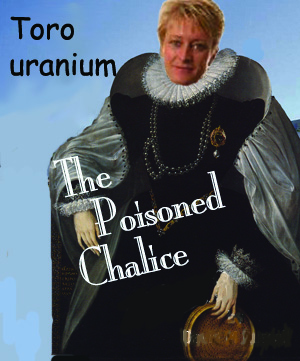 It looks as if Toro Energy, with its planned uranium mine Wiluna, Western Australia might be following an Australian tradition – of giving “the poisoned chalice” to a woman.
Australia’s had quite a history of giving women impossible jobs – I’m thinking mainly here of some State Premiers – Carmel Lawrence, Joan Kirner, Kristina Keneally. But it can happen in industry, too.
At Toro Energy, Dr Vanessa Guthrie, with a background in environmental sustainability, joins nuclear enthusiast Dr Erica Smyth. Smyth has been advocating nuclear power for Australia, nuclear powered desalination plants, and she presided over Toro’s propaganda campaign, with Doug Boreham preaching low level radiation as beneficial to health.
“There are serious flaws in the state assessment process and the studies Toro provided to the State Government. The project is a long way from being approved and the company faces serious financing constraints.
“Under new mine closure guidelines Toro has to find 100% of the mine closure costs in order to get approval to mine. So Toro needs $150 million to close a mine even before it has raised the $300 million to open it. The combination of a uranium price in free-fall and rising mine costs make this project increasingly unviable.” – Mia Pepper
Toro Energy’s uranium mining push comes as proven miners, including BHP Billiton and Cameco, defer or get out of planned uranium projects in WA. – Christina Macpherson
Women lead in ASX first, The Age, Peter Ker, December 5, 2012 THE branding is positively male, but the executive ranks of Toro Energy are about to take on a feminine look. In what is believed to be a unique set of circumstances in Australia, Toro will soon have women occupying both the chief executive and chairman roles, after announcing the departure of long-serving chief executive Greg Hall on Tuesday.
The situation will be formalised on February 8, when Dr Vanessa Guthrie replaces Mr Hall in running the company that is close to developing Australia’s next uranium mine.
Her chairman will be Erica Smyth, who has led the Toro board for more than three years. While it is difficult to be certain, most gender diversity experts believe the change will make Toro the only ASX-listed company to boast the female quinella. Continue reading
1 This month

of the week – Australians for War Powers Reform (AWPR)
To see nuclear-related stories in greater depth and intensity
 Antinuclear