

 Preface This article, number 28 in the series, discusses nuclear power via a thorium molten-salt reactor (MSR) process. (Note, this is also sometimes referred to as LFTR, for Liquid Fluoride Thorium Reactor) The thorium MSR is frequently trotted out by nuclear power advocates, whenever the numerous drawbacks to uranium fission reactors are mentioned. To this point in the TANP series, uranium fission, via PWR or BWR, has been the focus. Some critics of TANP have already stated that thorium solves all of those problems and therefore should be vigorously pursued. Some of the critics have stated that Sowell obviously has never heard of thorium reactors. Quite the contrary, I am familiar with the process and have serious reservations about the numerous problems with thorium MSR.
UN report calls for shift from coal to renewables
THE IPCC REPORT ALSO RECOMMENDED THAT BY 2050:
Coal’s share of electricity supply should be cut to 2 percent or less.
Renewables should supply 70 percent to 85 percent of power generation.
| Climate Crisis Spurs UN Call for $2.4 Trillion Fossil Fuel Shift https://www.bloomberg.com/news/articles/2018-10-08/scientists-call-for-2-4-trillion-shift-from-coal-to-renewables?srnd=climate-changed, By Reed Landberg, Chisaki Watanabe, and Heesu Lee, October 8, 2018,
World on track to warm 3 degrees, overshooting 2015 Paris goal ·UN panel releases report on capping warming at 1.5 degrees The world must invest $2.4 trillion in clean energy every year through 2035 and cut the use of coal-fired power to almost nothing by 2050 to avoid catastrophic damage from climate change, according to scientists convened by the United Nations. Continue reading |
IPCC Summary omits some of the biggest risks of climate change
 The IPCC global warming report spares politicians the worst details https://www.theguardian.com/commentisfree/2018/oct/08/world-leaders-climate-change-ipcc-report, Bob Ward 8 Oct 18 dangers if governments ignore efforts to limit warming to 1.5C are more grave than the summary makes out
A report by the Intergovernmental Panel on Climate Change confirms the enormous wisdom that governments showed in Paris in December 2015, when they agreed to the goal of “pursuing efforts” to limit global warming to 1.5C.
The report’s summary for policymakers paints a sobering picture of the potentially terrible impacts of allowing global mean surface temperature to rise by 2C compared with pre-industrial levels: more extreme weather, sea level rise and ocean acidification, with detrimental effects on wildlife, crops, water availability and human health.
But the policymakers, or at least their aides, should make the effort to read the whole report. Incredibly, the stark summary is still a relatively conservative assessment of the consequences we might face if global warming does exceed 1.5C.
The report is a comprehensive review of the published evidence painstakingly compiled by hundreds of authors and reviewers over the past two and a half years. The summary of the report was approved line by line by governments, including the US, Australia and Saudi Arabia, during long and intensive discussions last week in South Korea.
It is written in matter-of-fact language, but it omits some of the biggest risks of climate change, which are described in the full text.
For instance, the summary indicates that warming of 2C would have very damaging impacts on many parts of the world. But it does not mention the potential for human populations to migrate and be displaced as a result, leading to the possibility of war. Continue reading
Earth’s climate monsters could be unleashed as temperatures rise
“Even at the current level of warming of about 1C above pre-industrial, we may have already crossed a tipping point for one of the feedback processes (Arctic summer sea ice), and we see instabilities in others – permafrost melting, Amazon forest dieback, boreal forest dieback and weakening of land and ocean physiological carbon sinks.
And we emphasise that these processes are not linear and often have built-in feedback processes that generate tipping point behaviour. For example, for melting permafrost, the chemical process that decomposes the peat generates heat itself, which leads to further melting and so on.”

Guardian As a UN panel prepares a report on 1.5C global warming, researchers warn of the risks of ignoring ‘feedback’ effects This week, hundreds of scientists and government officials from more than 190 countries have been buzzing around a convention centre in the South Korean city of Incheon.
Trump administration to weaken radiation safeguards, embracing quack “hormesis” science
CAN SMALL DOSES OF RADIATION HARM YOU? THE EPA ISN’T CONVINCED. A new rule might open the door for regulation rollbacks on radiation and harmful chemicals. Pacific Standard, EMMA SARAPPO, OCT 3, 2018
On Tuesday, the Associated Press reported that the Trump administration was quietly seeking to roll back the Environmental Protection Agency’s regulations on radiation exposure. The story took a closer look at a rule the EPA proposed back in April called “Strengthening Transparency in Regulatory Science.” When it was released, most coverage focused on the proposal’s potential limitation of what studies the EPA could and could not use in decision-making—it essentially demanded the EPA not use any studies based on data that isn’t publicly available.
Ironically, the transparency rule is hiding another agenda. Paragraphs scattered throughout the document make it clear that the proposed rule is meant to re-evaluate the science behind “the dose response data and models that underlie what we are calling ‘pivotal regulatory science.'” That jargon means the EPA wants to challenge the assumptions that underlie its current guidelines on toxic exposure.
“The so-called transparency rule is an insidious dodge,” said Rush D. Holt, a former congressman and current president of the American Association for the Advancement of Science, before a Senate subcommittee on October 3rd. “It apparently is about reducing regulation.” And though the actual rule is vague, comments in the press release and a July update to the EPA guidelines on radiation exposure make it seem that nuclear regulation is on the chopping block.
Currently, the nuclear industry, the EPA, and other groups operate on the assumption that there is no safe dose of radiation, no matter how small. This is based on the “linear no-threshold” model (LNT). The LNT model is based on studies of people exposed to high and medium doses of radiation, including survivors of Hiroshima, Chernobyl, and Fukushima. That data shows that the higher the dose of radiation you receive, the more severe the consequences—in other words, that the response to doses is linear. The more radiation, the more health effects.
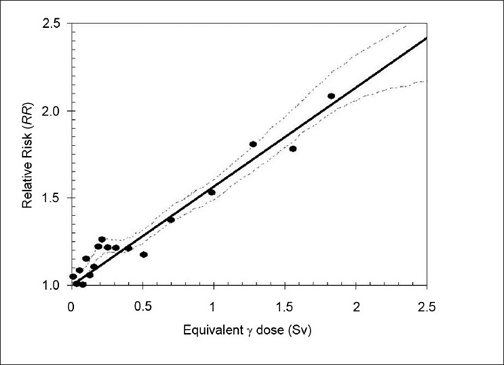
Because it’s much harder to accurately measure small doses of radiation in large populations over long periods of time, there isn’t much data available on the lower end. Still, most scientists agree that the relationship stays the same for small amounts of ionizing radiation: Small doses increase the aggregate risk of cancer by a relatedly small amount. LNT’s prevalence pushes regulatory agencies, professional associations, and medical fields to keep radiation doses “as low as reasonably achievable” in all people, especially considering some groups (children, especially) are more vulnerable to radiation than others.
……..in a larger public-health sense, LNT is cautious and prudent. Just because there isn’t documented proof of harm at very low doses doesn’t mean harm isn’t being done, and an inaccurate model means that it’s also possible that LNT sometimes underestimates cancer risks from low doses. In the absence of more definitive data, multiple groups and studies—the National Academy of Sciences, the International Commission on Radiological Protection, and more—have recommended holding fast to regulations that keep radiation exposure as low as possible, at least until a new model is robustly tested and accepted.
 Others go even further and argue that small doses of radiation are good for you. Edward Calabrese, a professor at the University of Massachusetts, is quoted in the April EPA press release—he was glad the agency was “recognizing the widespread occurrence of non-linear dose responses,” and he appeared in the October 3rd Senate hearing on the rule.
Calabrese is a major critic of the LNT model. He is famous for championing “hormesis”—the idea that small amounts of radiation are beneficial, or “hormetic,” ………
Although Calabrese focused on more mainstream criticisms of LNT before the Senate, his hormesis work is controversial. In 2010, Kristin Shrader-Frechette used Calabrese’s work as a case study of “special-interest science.” Shrader-Frechette compares Calabrese and others to the Queen of Hearts in Lewis Carroll’s Through the Looking Glass. “Just as the Queen claimed she could believe six impossible things before breakfast, SIS proponents often use scientific concepts/methods in ways that are ‘impossible,'” she wrote. She points out that Calabrese’s CV shows significant research funding from Atlantic Richfield Oil (ARCO), Dow Chemical, ExxonMobil, Proctor and Gamble, and R.J. Reynolds Tobacco. And despite Calabrese’s nearly 20 years of advocacy for the theory, even friendly reviews indicate radiation hormesis needs further scientific support.
……the rule promises to give special consideration to studies exploring “various threshold models across the exposure range” and pledges to “evaluate the appropriateness” of using the LNT model. If it’s approved, the EPA’s accepted scientific standard for acceptable radiation doses could change from “as low as reasonably achievable” to a standard that identifies no effect or positive effects from low doses. That could lead to the repeal of strict regulations on radiation containment, which the EPA might deem unnecessary. https://psmag.com/news/can-small-doses-of-radiation-harm-you-the-epa-isnt-convinced
Nuclear Waste Shipments Expose Populations to Toxic Radiation
 https://sputniknews.com/analysis/201810061068647605-nuclear-waste-shipments-expose-populations-radiation/
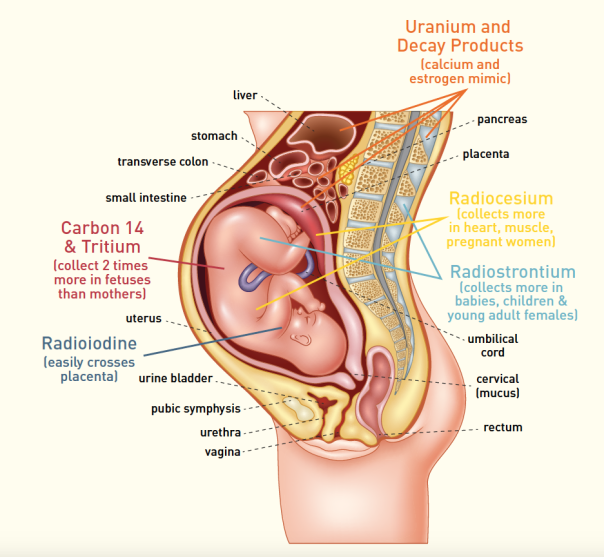
06.10.2018 Pregnant women in the United States could be exposed to ionizing radioactivity from nuclear waste shipped around the nation, a radioactive waste watchdog told Radio Sputnik’s Loud & Clear this week.
Given the number of shipments of nuclear waste traveling around the country, “Pregnant women and the fetus and the womb should not be exposed to any ionizing radioactivity if it can be avoided. This is going to happen. Given these kinds of shipment numbers — many thousands — there’s going to be exposures to pregnant women in this country,” says Kevin Kamps, radioactive waste specialist at Beyond Nuclear.
Nuclear waste is shipped past Americans all the time without many of us knowing it. Even waste passing by on a train is emitting radioactive particulates, and some of those can have negative consequences over time.
“It’s like an X-ray. It will cause harm,” Kamps said. Nurses often ask patients to wear protective aprons while taking X-rays to minimize exposure to the radiation, since X-rays are technically a carcinogen according to the World Health Organization. Medical News Today has reported that approximately 0.4 percent of cancers in the US are triggered by CT scans. (CT scans use X-rays and computer imagery to generate pictures of the body to help doctors with diagnoses.)
Transporting nuclear waste products is a risky business for public health outside the US, too
“If you have exterior, or external contamination, on the shipment — which has happened hundreds of times in France, 50 times in the US that we know of — those dose rates increase significantly. In France, on average, it was 500 times the permissible [amount of contamination] on one-third of the shipments. In one case it was 3,300 times [the] permissible [amount]. So if that’s one to two chest X-rays per hour, times 3,300 times permissible, that’s 6,600 chest X-rays per hour,” Kamps told Loud & Clear.
Climate change: IPCC’s special report comes at a crucial point.

Why the next three months are crucial for the future of the planet Two forthcoming major climate talks offer governments an opportunity to respond to this year’s extreme weather with decisive action https://www.theguardian.com/environment/2018/oct/05/why-the-next-four-months-are-crucial-for-future-of-planet-climate-change Fiona Harvey Environment correspondent 5 Oct 2018 This week, scientists are gathering in South Korea to draw together the last five years of advances in climate science to answer key questions for policymakers. The UN’s Intergovernmental Panel on Climate Change (IPCC) celebrates its 30th birthday this year with what is likely to be a landmark report to be released on Monday 8 October. What is expected to emerge will be the strongest warning yet that these unusual occurrences will add up to a pattern that can only be overcome with drastic action. Thousands of the world’s leading climate experts collaborate on the periodic reports, released roughly every half-decade. They have grown clearer over the years in the certainty of their evidence that climate change is occurring as a result of human actions, and firmer in their warnings of the disruptive consequences. This time, the scientists will attempt to answer whether and how the world can meet the “aspiration” set in the Paris agreement of 2015 to hold warming to no more than 1.5C, beyond which many low-lying states and islands are likely to face dangerous sea level rises. When the scientists deliver their verdict, the onus will pass to politicians to translate their advice into concrete action. Already in recent weeks, global initiatives have begun aimed at doing so: the Global Climate Action Summit in San Francisco last month spurred protests, and dozens of local governments and multinational companies to make pledges; the second One Planet Summit saw advances in climate finance; while at the UN General Assembly, secretary general António Guterres urged world leaders to step up, calling climate change “the defining issue of our time”. The warning signals of climate change that have hit people around the world in the last few months must be heeded by national governments at key meetings later this year, political leaders and policy experts are urging, as the disruption from record-breaking weather continues in many regions. Extreme weather events have struck around the world – from the drought and record temperatures in northern Europe, to forest fires in the US, to heatwaves and drought in China, to an unusually strong monsoon that has devastated large areas of southern India. As the northern hemisphere summer closes, polar observations have just established that the Arctic sea ice narrowly missed a record low this year. The sea ice extent was tied for the sixth lowest on record with 2008 and 2010. Sea currents and wind conditions can have large effects on sea ice extent from year to year, but the trend is starkly evident. “Put simply, in the last 10 years the Arctic is melting faster than it ever has previously since records began,” said Julienne Stroeve, professor at University College London. “We have lost over half of the summer sea ice coverage since the late 1970’s and it is realistic to expect an ice-free Arctic sea in summer in the next few decades.” Of particular concern is the decline in thick ice which forms over several years. “The older ice has been replaced by more and more first-year ice, which is easier to melt out each summer,” she explained. Not all of the effects of this year’s extraordinary weather, which has also seen the UK’s joint hottest summer on record, can be traced directly to climate change. However, scientists are clear that the background of a warming planet has made extremes of temperature, and accompanying droughts and floods, more likely. This week, scientists are gathering in South Korea to draw together the last five years of advances in climate science to answer key questions for policymakers. The UN’s Intergovernmental Panel on Climate Change (IPCC) celebrates its 30th birthday this year with what is likely to be a landmark report to be released on Monday 8 October. What is expected to emerge will be the strongest warning yet that these unusual occurrences will add up to a pattern that can only be overcome with drastic action. Thousands of the world’s leading climate experts collaborate on the periodic reports, released roughly every half-decade. They have grown clearer over the years in the certainty of their evidence that climate change is occurring as a result of human actions, and firmer in their warnings of the disruptive consequences. This time, the scientists will attempt to answer whether and how the world can meet the “aspiration” set in the Paris agreement of 2015 to hold warming to no more than 1.5C, beyond which many low-lying states and islands are likely to face dangerous sea level rises. When the scientists deliver their verdict, the onus will pass to politicians to translate their advice into concrete action. Already in recent weeks, global initiatives have begun aimed at doing so: the Global Climate Action Summit in San Francisco last month spurred protests, and dozens of local governments and multinational companies to make pledges; the second One Planet Summit saw advances in climate finance; while at the UN General Assembly, secretary general António Guterres urged world leaders to step up, calling climate change “the defining issue of our time”. Nicholas Stern, co-chair of the Global Commission on the Economy and Climate, which produced the study, said: “Current economic models fail to capture both the powerful dynamics and very attractive qualities of new technologies and structures [that reduce carbon]. Thus we know that we are grossly underestimating the benefits of this new growth story. Further, it becomes ever clearer that the risks of the damage from climate change are immense, and tipping points and irreversibilities getting ever closer.” The existence of tipping points – thresholds of temperature beyond which certain natural processes become irreversible, such as the melting of permafrost, which may release the greenhouse gas methane and create runaway warming effects – is a key concern of many climate scientists. The faster emissions rise, the sooner we may unwittingly pass some of these key points. For all these reasons, the IPCC’s special report comes at a crucial point. Scientists and economists have warned that if the world cannot shift course within the next few years, the consequences will be dire, as new infrastructure built now – in energy generation, transport and the built environment – will be made either to low-emissions standards or in the high-emissions habits of the past. As the IPCC’s next comprehensive assessment of climate science will not be available until 2021, this year’s report will be vital in shaping policy. Ted Chaiban, director of programmes at Unicef, urged governments to seize the opportunities for action offered by this year’s series of political meetings offers for action. “Over the past few months, we have seen a stark vision of the world we are creating for future generations,” he said. “As more extreme weather events increase the number of emergencies and humanitarian crises, it is children who will pay the highest price,” he said. “It is vital that governments and the international community take concrete steps. The worst impacts of climate change are not inevitable, but the time for action is now.” After the IPCC publication, the world will face a key test of faith in the 2015 Paris agreement, the only global pact stipulating action on temperature rises. This December in Poland, the UN’s climate change arm will hold a two-week meeting aimed at turning the political resolve reached in Paris three years ago into a set of rules for countries to follow on reducing emissions. The political situation is more fraught than it was in the runup to Paris. The US is pulling out of the landmark climate agreement and is likely to play little part in the talks. Australia’s government is also in turmoil over climate actions. Now the challenger for Brazil’s presidency, Jair Bolsonaro, is threatening to withdraw its participation – a potential blow to the Paris consensus, as Brazil was a linchpin among rapidly developing nations. All eyes will be on China, which has shown remarkable progress on renewable energy and emissions reduction, and India, where climate champions have found common cause with opponents of increasingly damaging air pollution. Patricia Espinsoa, the UN’s top climate official, warned that only “uneven progress” had been made so far on the 300-page rulebook for implementing the Paris targets, leaving the rest of the work for December. While the dangerous weather of the first half of 2018 has raised concerns worldwide that we are seeing climate change in action, many leading experts told the Guardian they were optimistic that political and business leaders this year would help set the world on a different course to avoid the worse predictions of untrammelled warming. Achim Steiner, administrator of the UN Development Programme, said the past few years had seen “extraordinary progress” in areas such as renewable energy and the take-up of low-carbon technology: “This is real, not in the future but happening now. We are showing that we can do this, we can bring down emissions, it doesn’t need to be a disaster.” Adopting low-carbon aims now would set developing countries on a course to a brighter future, added Ngozi Okonjo-Iweala, former economic minister of Nigeria and a member of the Global Commission on the Economy and Climate. “Now is the time to do this, before we lock in high-carbon infrastructure,” she said. “Now is the opportunity for real sustainable growth.” Political leaders will find that global investors back them up in opting for low-carbon policies, predicted Frank Rijsberman of the Global Green Growth Institute. “I see this from investors, from businesses,” he said. “They are ready, and they see low-carbon as the future.” Felipe Calderón, former president of Mexico, called on political leaders to take note: “We can turn better [economic] growth and a better climate into reality. It is time we decisively legislate, innovate, govern and invest our way to a fairer, safer, more sustainable world.” Evidence showing that tackling climate change can be an economic boost rather than a brake has been growing. The recently published New Climate Economy report says more than 65m new low-carbon jobs could be created in just over a decade, and that 700,000 premature deaths from air pollution could be avoided every year by government action on climate change. A further $2.8tn could be added to government revenues by 2030 by reforming perverse incentives to burn fossil fuels. Nicholas Stern, co-chair of the Global Commission on the Economy and Climate, which produced the study, said: “Current economic models fail to capture both the powerful dynamics and very attractive qualities of new technologies and structures [that reduce carbon]. Thus we know that we are grossly underestimating the benefits of this new growth story. Further, it becomes ever clearer that the risks of the damage from climate change are immense, and tipping points and irreversibilities getting ever closer.” The existence of tipping points – thresholds of temperature beyond which certain natural processes become irreversible, such as the melting of permafrost, which may release the greenhouse gas methane and create runaway warming effects – is a key concern of many climate scientists. The faster emissions rise, the sooner we may unwittingly pass some of these key points. For all these reasons, the IPCC’s special report comes at a crucial point. |
Exposing the false claims about Generation IV nuclear reactors
 Generation IV reactors that consume waste instead of producing waste and couldn’t be used for weapons production … sounds pretty good but the claims are fanciful. A recent article in the Bulletin of the Atomic Scientists ‒ co-authored by a former chair of the US Nuclear Regulatory Commission ‒ states that “molten salt reactors and sodium-cooled fast reactors – due to the unusual chemical compositions of their fuels – will actually exacerbate spent fuel storage and disposal issues.” It also raises proliferation concerns about ‘integral fast reactor’ and MSR technology: “Pyroprocessing and fluoride volatility-reductive extraction systems optimized for spent fuel treatment can – through minor changes to the chemical conditions – also extract plutonium (or uranium 233 bred from thorium).”
Here’s a summary:
Generation IV nuclear waste claims debunked Continue reading
David Attenborough ridiculed Donald Trump’s withdrawal from the Paris climate change accords
The iNews 4th Oct 2018 David Attenborough ridiculed Donald Trump’s withdrawal from the Paris climate change accords saying the US’s ‘outdated’ position would be ‘overcome’ eventually as there is a groundswell of support for action across the world. Talking to BBC’s Newsnight the biologist and TV presenter said the Paris agreement showed nations had ‘come to their senses’ and Donald Trump’s attempts to roll back on the fight on climate change would be unsuccessful. He said: “I suppose actually up to five years ago I was really very, very pessimistic. The Paris agreement, as you say, seemed at the time to be, at last, nations coming to their senses.”
https://inews.co.uk/news/environment/david-attenborough-paris-agreement-climate-change-bbc-newsnight-interview-video/
Report: Global offshore wind industry to ‘be worth £30bn per year by 2030’
 Edie 2nd Oct 2018 British companies are among the most likely to reap the rewards from the growth of the global offshore wind sector, which is set to be worth more than £30bn annually by 2030. That is the key conclusion of a new report from the Offshore Wind Industry Council (OWIC) and trade body RenewableUK, which claims that wind products and services provided by UK-based firms are expected to be worth £4.9bn a year by 2030.
Published on Monday (1October), the Offshore Wind Industry Prospectus reveals that if the UK Government was to publish a Sector Deal requiring at least a third of the nation’s electricity to be generated from offshore wind by 2030, the industry would employ 27,000 workers. The 21-page document also hails UK companies as world leaders in key services such as designing, building and operating offshore wind farms, as well as manufacturing blades and cables.
It claims that the likes of China, Germany, India and the US are likely to seek British expertise on offshore wind in the near future.
https://www.edie.net/news/10/-Report–Global-offshore-wind-industry-to–be-worth–30bn-per-year-by-2030-report/
Beyond Nuclear counteracts the industry’s false propaganda about ionising radiation
nations that rely on the use — and marketing — of nuclear technology, will do everything possible to 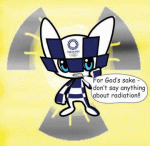 suppressknowledge about its dangers. This has resulted in public relations campaigns endeavoring to persuade its citizens — as is happening in post-Fukushima Japan —that their “hysteria” and “radiophobia” are causing more illnesses than any radiation that might have gotten out.
This tactic is embedded in a strategy to “normalize” radiation exposures so that exposure limits can be raised. In Japan, the 1 millisievert a year “acceptable” level of exposure was raised to 20 mSv a year after the Fukushima disaster, simply because the Japanese government cannot ever hope to “clean up” areas contaminated with radioactivity back down to the 1 mSv level. Thus, an annual dose rate that is completely unacceptable, especially for children, becomes the new “normal.”
|
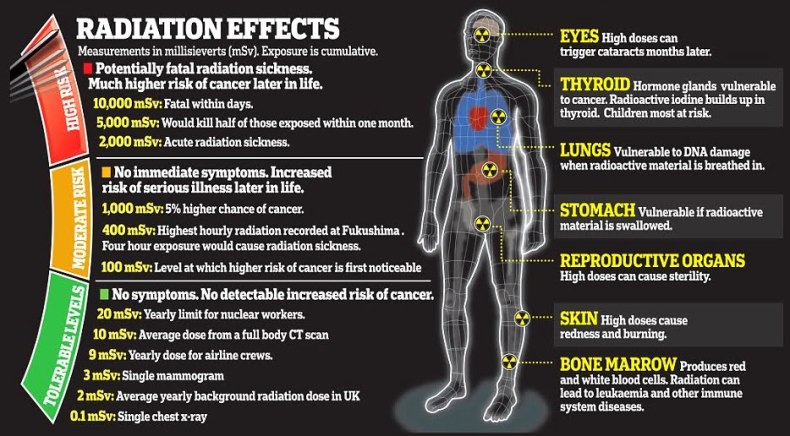
A “small” dose can do immense damage; our new handbook explains how and why, By Cindy Folkers and Linda Pentz Gunter, 4 Oct 18All nuclear power plants routinely release radioactive gases and water contaminated with radioactive isotopes. When a nuclear plant has a serious accident — as occurred at Three Mile Island, Chernobyl and Fukushima — orders of magnitude more radioactivity is released into the environment. Uranium mining also releases harmful radioactive isotopes and leaves behind radioactive waste. The 1979 uranium tailings pond spill at Church Rock, NM — 90 million gallons of liquid radioactive waste and 1,100 tons of solid mill waste — was the largest accidental release of radioactive waste in US history and permanently contaminated the Puerco River. Radioactive releases occur all along the uranium fuel chain, beginning with uranium mining and culminating in radioactive waste “management.” All of these releases — whether large or small (because there is no “safe” dose) — impact human health with The fact remains, however, that both the immediate and long-term damage done to human health — which can last for generations — is the single, most compelling reason not to continue with the use of nuclear power and the extractive, polluting industries that must support it. The Radiation and Harm to Human Health chapter of the Beyond Nuclear anti-nuclear handbook, is available now for download and printing as a standalone booklet. In it, we endeavor to both explain and synthesize the many ways that radioactivity released through the nuclear power sector damages human health, especially the most vulnerable members of our population — women, pregnancy, babies and young children.
We begin with some simple explanations about radiation and radioactive releases. When we make the case that nuclear power harms us, it’s necessary to understand the differences between types of radiation and exactly what is released by the different phases of the nuclear industry fuel chain.
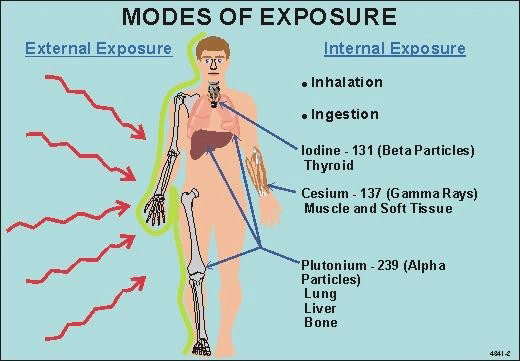
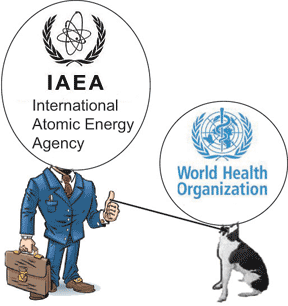
We also break down the “natural” versus “man-made” argument. Too often, you may hear suggestions that exposures caused by nuclear plants are no worse than flying in an airplane. The sin of omission is a common tactic by the nuclear lobby. In this booklet, we describe why these arguments are deliberately misleading and unscientific. It is important to remember that the negative health effects caused by the uranium fuel chain are not restricted to radiation exposures. Uranium mining, for example, also releases heavy metals such as lead and even arsenic, just as harmful and in some cases even worse than radiation, depending on the dose. The whole issue of “dose,” of course, and what this means, is also used to cloud facts with mythology in order to suggest that some radioactive releases are not high enough to do real damage. But differentiating between high and low doses is very tricky, depending on whether the doses are delivered to a whole body, an individual organ, or a few cells. For example, even just a single alpha-emitting isotope — such as uranium, radon or thorium —when inhaled or ingested, can impart a huge dose to the cell or cells it travels through. The dose may sound small, but the damage is immense. Medical science is in agreement that women are more susceptible to damage from radiation exposure than men. Accidents such as Chernobyl have led to lasting and widespread health problems. But these have been hard to record and quantify. Many affected people were never registered, others moved away or have died. The “burden of proof” that Chernobyl harmed them remains on the victim rather than the obvious perpetrator. This has allowed authorities such as the International Atomic Energy Agency (whose mandate is to promote the use of nuclear power) to capitalize on uncertainty by spreading statistics that grossly underestimate the health impacts of nuclear accidents such as Chernobyl.
Similarly, nations that rely on the use — and marketing — of nuclear technology, will do everything possible to suppress knowledge about its dangers. This has resulted in public relations campaigns endeavoring to persuade its citizens — as is happening in post-Fukushima Japan —that their “hysteria” and “radiophobia” are causing more illnesses than any radiation that might have gotten out. This tactic is embedded in a strategy to “normalize” radiation exposures so that exposure limits can be raised. In Japan, the 1 millisievert a year “acceptable” level of exposure was raised to 20 mSv a year after the Fukushima disaster, simply because the Japanese government cannot ever hope to “clean up” areas contaminated with radioactivity back down to the 1 mSv level. Thus, an annual dose rate that is completely unacceptable, especially for children, becomes the new “normal.” Our handbook chapter on Radiation and Harm to Human Health endeavors to keep things concise and simple. We hope you will use it to help educate residents, politicians and the press about the true risks of accepting uranium mining operations, nuclear power plants or radioactive waste management schemes into your communities. We understand that a handbook should be something you can carry in your hand! To that end, we are raising funds to print copies of this booklet. If you would like to contribute, so that we can get this handbook out to the communities that most need it, please donate here. Choose “Handbook” from the pulldown menu to designate your gift. And thank you! Cindy Folkers is the radiation and health specialist at Beyond Nuclear and the primary author of the Radiation and Harm to Human Health handbook. Linda Pentz Gunter is the international specialist at Beyond Nuclear. If you’d like to be the first to read stories like these, sign up for our Monday email digest. We will send you a very brief synopsis of the new stories on our site, with links to read them and learn more. Sign up today! |
|
|
The new U.N. climate report will reveal urgent disastrous climate change now on the way
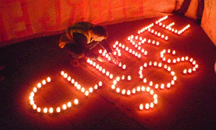 Climate scientists are struggling to find the right words for very bad news https://www.washingtonpost.com/energy-environment/2018/10/03/climate-scientists-are-struggling-find-right-words-very-bad-news/?utm_term=.1540529e507a Climate scientists are struggling to find the right words for very bad news https://www.washingtonpost.com/energy-environment/2018/10/03/climate-scientists-are-struggling-find-right-words-very-bad-news/?utm_term=.1540529e507a
A much-awaited report from the U.N.’s top climate science panel will show an enormous gap between where we are and where we need to be to prevent dangerous levels of warming. By Chris Mooney and Brady Dennis October 3 2018 In Incheon, South Korea, this week, representatives of over 130 countries and about 50 scientists have packed into a large conference center going over every line of an all-important report: What chance does the planet have of keeping climate change to a moderate, controllable level? When they can’t agree, they form “contact groups” outside the hall, trying to strike an agreement and move the process along. They are trying to reach consensus on what it would mean — and what it would take — to limit the warming of the planet to just 1.5 degrees Celsius, or 2.7 degrees Fahrenheit, when 1 degree Celsius has already occurred and greenhouse gas emissions remain at record highs. “It’s the biggest peer-review exercise there is,” said Jonathan Lynn, head of communications for the United Nations’ Intergovernmental Panel on Climate Change. “It involves hundreds or even thousands of people looking at it.” The IPCC, the world’s definitive scientific body when it comes to climate change, was awarded the Nobel Peace Prize a decade ago and has been given what may rank as its hardest task yet. It must not only tell governments what we know about climate change — but how close they have brought us to the edge. And by implication, how much those governments are failing to live up to their goals for the planet, set in the 2015 Paris climate agreement. 1.5 degrees is the most stringent and ambitious goal in that agreement, originally put there at the behest of small island nations and other highly vulnerable countries. But it is increasingly being regarded by all as a key guardrail, as severe climate change effects have been felt in just the past five years — raising concerns about what a little bit more warming would bring. “Half a degree doesn’t sound like much til you put it in the right context,” said Durwood Zaelke, president of the Institute for Governance and Sustainable Development. “It’s 50 percent more than we have now.” The idea of letting warming approach 2 degrees Celsius increasingly seems disastrous in this context. Parts of the planet, like the Arctic, have already warmed beyond 1.5 degrees and are seeing alarming changes. Antarctica and Greenland, containing many feet of sea-level rise, are wobbling. Major die-offs have hit coral reefs around the globe, suggesting an irreplaceable planetary feature could soon be lost. It is universally recognized that the pledges made in Paris would lead to a warming far beyond 1.5 degrees — more like 2.5 or 3 degrees Celsius, or even more. And that was before the United States, the world’s second-largest emitter, decided to try to back out. “The pledges countries made during the Paris climate accord don’t get us anywhere close to what we have to do,” said Drew Shindell, a climate expert at Duke University and one of the authors of the IPCC report. “They haven’t really followed through with actions to reduce their emissions in any way commensurate with what they profess to be aiming for.” The new 1.5 C report will feed into a process called the “Talanoa Dialogue,” in which parties to the Paris agreement begin to consider the large gap between what they say they want to achieve and what they are actually doing. The dialogue will unfold in December at an annual United Nations climate meeting in Katowice, Poland. But it is unclear what concrete commitments may result. At issue is what scientists call the ‘carbon budget’: Because carbon dioxide lives in the atmosphere for so long, there’s only a limited amount that can be emitted before it becomes impossible to avoid a given temperature, like 1.5 degrees Celsius. And since the world emits about 41 billion tons of carbon dioxide per year, if the remaining budget is 410 billion tons (for example), then scientists can say we have 10 years until the budget is gone and 1.5 C is locked in. Unless emissions start to decline — which gives more time. This is why scenarios for holding warming to 1.5 degrees C require rapid and deep changes to how we get energy. The window may now be as narrow as around 15 years of current emissions, but since we don’t know for sure, according to the researchers, that really depends on how much of a margin of error we’re willing to give ourselves. And if we can’t cut other gases — such as methane — or if the Arctic permafrost starts emitting large volumes of additional gases, then the budget gets even narrower. “It would be an enormous challenge to keep warming below a threshold” of 1.5 degrees Celsius, said Shindell, bluntly. “This would be a really enormous lift.” So enormous, he said, that it would require a monumental shift toward decarbonization. By 2030 — barely a decade away — the world’s emissions would need to drop by about 40 percent. By the middle of the century, societies would need to have zero net emissions. What might that look like? In part, it would include things such as no more gas-powered vehicles, a phaseout of coal-fired power plants and airplanes running on biofuels, he said. “It’s a drastic change,” he said. “These are huge, huge shifts … This would really be an unprecedented rate and magnitude of change.” And that’s just the point — 1.5 degrees is still possible, but only if the world goes through a staggering transformation. An early draft (leaked and published by the website Climate Home News) suggests that future scenarios of a 1.5 C warming limit would require the massive deployment of technologies to remove carbon dioxide from the air and bury it below the ground. Such technologies do not exist at anything close to the scale that would be required. “There are now very small number of pathways [to 1.5C] that don’t involve carbon removal,” said Jim Skea, chair of the IPCC’s Working Group III and a professor at Imperial College London. It’s not clear how scientists can best give the world’s governments this message — or to what extent governments are up for hearing it. An early leaked draft of the report said there was a “very high risk” that the world would warm more than 1.5 degrees. But a later draft, also leaked to Climate Home News, appeared to back off, instead saying that “there is no simple answer to the question of whether it is feasible to limit warming to 1.5 C . . . feasibility has multiple dimensions that need to be considered simultaneously and systematically.” None of this language is final. That’s what this week in Incheon — intended to get the report ready for an official release on Monday — is all about. “I think many people would be happy if we were further along than we are,” the IPCC’s Lynn said Wednesday morning in Incheon. “But in all the approval sessions that I’ve seen, I’ve seen five of them now, that has always been the case. It sort of gets there in the end.” |
Suggestion that Australia get nuclear weapons
Nuclear Weapons Time for Australia? Could this happen? The National Interest
We face no such risk these days. Nevertheless, we now have the prospect—for the first time since World War II—of a potential major-power adversary threatening us with high-intensity military conflict in our neighborhood. This is not to identify China as an inevitable adversary, but prudent defense planning needs to accept that Beijing is developing the conventional military capabilities to threaten us seriously—were its intentions to change. Military developments in our region of primary strategic concern now require a change to our assessments about intelligence warning time.
President Donald Trump’s attitude towards US friends and allies has been negative, which raises important questions about the need for us to become more self-reliant. Because of the uncertainties now surrounding America’s commitment to its allies, we may also need to revisit the reassurance about extended nuclear deterrence that we have enjoyed since the creation of ANZUS in 1951…….https://nationalinterest.org/blog/buzz/nuclear-weapons-time-australia-32572
Thorium Molten Salt Nuclear reactor (MSR) No Better Than Uranium Process
The safety issue is also not resolved, as stated above: pressurized water leaking from the steam generator into the hot, radioactive molten salt will explosively turn to steam and cause incredible damage. The chances are great that the radioactive molten salt would be discharged out of the reactor system and create more than havoc. Finally, controlling the reaction and power output, finding materials that last safely for 3 or 4 decades, and consuming vast quantities of cooling water are all serious problems.
The greatest problem, though, is likely the scale-up by a factor of 500 to 1, from the tiny project at ORNL to a full-scale commercial plant with 3500 MWth output. Perhaps these technical problems can be overcome, but why would anyone bother to try, knowing in advance that the MSR plant will be uneconomic due to huge construction costs and operating costs, plus will explode and rain radioactive molten salt when (not if) the steam generator tubes leak.
The Truth About Nuclear Power – Part 28, Sowells Law Blog , 14 July 2014 Thorium MSR No Better Than Uranium Process
Preface This article, number 28 in the series, discusses nuclear power via a thorium molten-salt reactor (MSR) process. (Note, this is also sometimes referred to as LFTR, for Liquid Fluoride Thorium Reactor) The thorium MSR is frequently trotted out by nuclear power advocates, whenever the numerous drawbacks to uranium fission reactors are mentioned. To this point in the TANP series, uranium fission, via PWR or BWR, has been the focus. Some critics of TANP have already stated that thorium solves all of those problems and therefore should be vigorously pursued. Some of the critics have stated that Sowell obviously has never heard of thorium reactors. Quite the contrary, I am familiar with the process and have serious reservations about the numerous problems with thorium MSR.It is interesting, though, that nuclear advocates must bring up the MSR process. If the uranium fission process was any good at all, there would be no need for research and development of any other type of process, such as MSR and fusion. Continue reading
Town Council election becomes a debate on nuclear waste hosting
 Hornepayne, Ont., municipal election to become debate on nuclear waste, Community one of three in northwestern Ontario to consider hosting nuclear waste J · CBC News Oct 04, 2018 Voters in the small northwestern Ontario town of Hornepayne will have more to consider at the ballot box than tax rates and economic growth.
Wind farming – a benefit and source of pride to farmers
 WINDS OF CHANGE A SOURCE OF PRIDE AND INCOME, Winds of
  change a source of pride and income James Dennis, 2 Oct 18, Putting wind turbines on his farm has been the right decisionhttps://www.weeklytimesnow.com.au/news/opinion/winds-farms-a-source-of-pride-and-income/news-story/33899c0e04ce6af30a2d122305c841f0
WHEN the opportunity to have wind turbines on my property for the Mount Gellibrand Wind Farm in Colac arose many years ago, it was a big decision.But now, with the wind farm up and running, I can confidently say it was the right move. …. (subscribers only).
1 This month

of the week – Australians for War Powers Reform (AWPR)
To see nuclear-related stories in greater depth and intensity
 Antinuclear