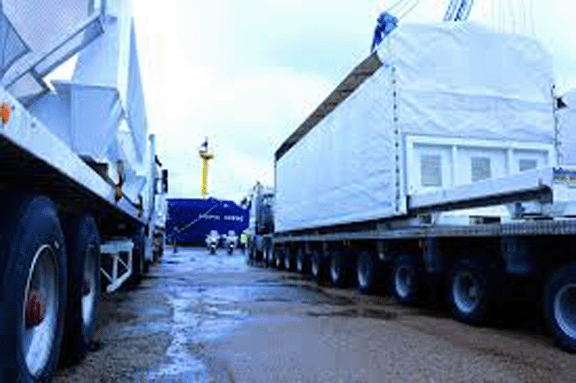
The possibility of a shipment of spent nuclear fuel on Michigan highways to Port Huron and into Canada has members of a nuclear watchdog group concerned and asking questions.
The Nuclear Regulatory Commission received a request for approval of a highway shipment route for spent nuclear fuel from LaSalle County Nuclear Generating Station to Port Huron and Michigan’s port of exit.
A July 13 letter from the NRC indicates the agency received the application, dated May 13, 2018, and the NRC has a goal to complete the review within 45 days, by late August.
LaSalle County Generating Station, near Chicago, has two nuclear reactors that produce 2,320 megawatts of energy, or enough to power 2.3 million homes, according to Exelon Generation, the company that operates the plant.
The company said the proposed shipment is for nine fuel rods, weighing around five pounds each, that will be shipped to a testing facility in Canada after reaching Port Huron.
Beyond Nuclear, an advocacy group working to push for a future free of nuclear energy and nuclear weapons, found the letter posted online on July 23, among hundreds of documents on the Nuclear Regulatory Commission’s online library.
The group, along with other advocates, criticized the possible shipping route.
“We have serious concerns about shipping high-level radioactive waste from Exelon’s LaSalle reactors to a port city,” said David Kraft, director of the Chicago-based Nuclear Energy Information Service. “Except in cases of extreme emergency, we believe that irradiated fuel should only be moved once for permanent isolation.”
Kay Cumbow of Great Lakes Environmental Alliance in Port Huron said a spill, release or fire in the area or near waterways that flow into the St. Clair River could potentially ruin one of the largest fresh water deltas in the world, the St. Clair Flats. ………
Beyond Nuclear believes the application’s wording suggests a possible water route to the destination, according to a news release from the advocacy organization.
Michael Keegan, spokesperson for Don’t Waste Michigan and Coalition for a Nuclear Free Great Lakes, in Monroe, Michigan, said, “Why risk sending deadly radioactive wastes through our communities and Great Lakes watersheds?”
Even minor sea-level rise, by as much as a foot, poses greater risks VIRGINIA TECH 16 Aug 18
As sea levels rise due to climate change, so do the global hazards and potential devastating damages from tsunamis, according to a new study by a partnership that included Virginia Tech.
Even minor sea-level rise, by as much as a foot, poses greater risks of tsunamis for coastal communities worldwide.
The threat of rising sea levels to coastal cities and communities throughout the world is well known, but new findings show the likely increase of flooding farther inland from tsunamis following earthquakes. Think of the tsunami that devasted a portion of northern Japan after the 2011 Tohoku-Oki earthquake, causing a nuclear plant to melt down and spread radioactive contamination.
These findings are at the center of a new Science Advances study, headed by a multi-university team of scientists from the Earth Observatory of Singapore, the Asian School of the Environment at Nanyang Technological University, and National Taiwan University, with critical support from Virginia Tech’s Robert Weiss, an associate professor in the Department of Geosciences, part of the College of Science.
“Our research shows that sea-level rise can significantly increase the tsunami hazard, which means that smaller tsunamis in the future can have the same adverse impacts as big tsunamis would today,” Weiss said, adding that smaller tsunamis generated by earthquakes with smaller magnitudes occur frequently and regularly around the world. For the study, Weiss was critical in helping create computational models and data analytics frameworks.
At Virginia Tech, Weiss serves as director of the National Science Foundation-funded Disaster Resilience and Risk Management graduate education program and is co-lead of Coastal@VT, comprised of 45 Virginia Tech faculty from 13 departments focusing on contemporary and emerging coastal zone issues, such as disaster resilience, migration, sensitive ecosystems, hazard assessment, and natural infrastructure.
For the study, Weiss and his partners, including Lin Lin Li, a senior research fellow, and Adam Switzer, an associate professor, at the Earth Observatory of Singapore, created computer-simulated tsunamis at current sea level and with sea-level increases of 1.5 feet and 3 feet in the Chinese territory of Macau. Macau is a densely populated coastal region located in South China that is generally safe from current tsunami risks.
At current sea level, an earthquake would need to tip past a magnitude of 8.8 to cause widespread tsunami inundation in Macau. But with the simulated sea-level rises, the results surprised the team.
The sea-level rise dramatically increased the frequency of tsunami-induced flooding by 1.2 to 2.4 times for the 1.5-foot increase and from 1.5 to 4.7 times for the 3-foot increase. “We found that the increased inundation frequency was contributed by earthquakes of smaller magnitudes, which posed no threat at current sea level, but could cause significant inundation at higher sea-level conditions,” Li said.
n the simulated study of Macau – population 613,000 – Switzer said, “We produced a series of tsunami inundation maps for Macau using more than 5,000 tsunami simulations generated from synthetic earthquakes prepared for the Manila Trench.” It is estimated that sea levels in the Macau region will increase by 1.5 feet by 2060 and 3 feet by 2100, according to the team of U.S.-Chinese scientists.
The hazard of large tsunamis in the South China Sea region primarily comes from the Manila Trench, a megathrust system that stretches from offshore Luzon in the Philippines to southern Taiwan. The Manila Trench megathrust has not experienced an earthquake larger than a magnitude 7.8 since the 1560s. Yet, study co-author Wang Yu, from the National Taiwan University, cautioned that the region shares many of the characteristics of the source areas that resulted in the 2004 Sumatra-Andaman earthquake, as well as the 2011 earthquake in northern Japan, both causing massive loss of life.
These increased dangers from tsunamis build on already known difficulties facing coastal communities worldwide: The gradual loss of land directly near coasts and increased chances of flooding even during high tides, as sea levels increase as the Earth warms.
“The South China Sea is an excellent starting point for such a study because it is an ocean with rapid sea-level rise and also the location of many mega cities with significant worldwide consequences if impacted. The study is the first if its kind on the level of detail, and many will follow our example,” Weiss said.
Policymakers, town planners, emergency services, and insurance firms must work together to create or insure safer coastlines, Weiss added.
“Sea-level rise needs to be taken into account for planning purposes, for example for reclamation efforts but also for designing protective measures, such as seawalls or green infrastructure.”
He added, “What we assumed to be the absolute worst case a few years ago now appears to be modest for what is predicted in some locations. We need to study local sea-level change more comprehensively in order to create better predictive models that help to make investments in infrastructure that are or near sustainable.”
Paul Richards 17 Aug 18 ‘The San Onofre’ transport/storage cask, was, and remain placed next to the ocean, in a high-risk area for a Tsunami. In a state that has over 75% of the seismic activity in North America, within close proximity of the well-known earthquake fault line in California.
The citizens of Orange, & San Diego County along with Los Angeles were assured these casks were guaranteed for a hundred years. As opposed to the many thousands of years needed in guarantee for future generations, yet there were and still are signs of cask breakdown in under twenty years.
Let that sink in, U N D E R 2 0 Y E A R S.
It was the typical, nuclear industry message when this plant was phased out as economically and environmentally unviable, demonstrating the nuclear energy experiment had failed:
“Trust us, we know best, these casks are world best practice…”
What are the probabilities after over 70 years of using the same line of logic others in the Nuclear State have;
* that this industry has solved its spent nuclear fuel cask containment problem, or ever will?
Even without going into the long-term storage issues, of a final dump site, as a repository for the indefinite cost of backdoor waste, the IAEA acknowledges has no solution; the whole concept of nuclear energy looks far more trouble, in terms of cost, wasted development and risk to life on earth be relied on.
However, that’s subjective, to whether an individual or group actually considers emerging and future generations life of value.
A premise where a win at all cost, tailors into the mantra of efficiencies, and ROI – profit, for senior executives, shareholders, stakeholders, and financiers, is put before ‘social responsibility’.
Dump clarity Letter to the Editor, The Advertiser, 17 August 2018
IT is little wonder that the Barngala group is using legal action on the Kimba and Hawker vote on nuclear waste.
The Federal minister misrepresents fully what is happening by telling us that it is a low-level waste dump, when it is also a dump to receive intermediate waste “temporarily” for 100 years.
We were told more than three years ago it was a low-level dump until the Government reluctantly admitted that it was about intermediate waste as well. The local federal MP has said it was about more money. Last month, the Government boosted the employment numbers from 15 to 45 and the money from $2 million to $31 million just before the vote due to start on Monday.
It is vital that we have the full truth on this issue.
BARRY WAKELIN, Kimba
State lawmakers maintained they will have a say in a proposed facility to store high-level nuclear waste near Carlsbad and Hobbs, despite an opinion issued by New Mexico Attorney General Hector Balderas suggesting New Mexico will have a limited role in licensing the project.
New Mexico Sen. Jeff Steinborn (D-36), who chairs the New Mexico Radioactive and Hazardous Waste Committee said Balderas’ opinion was informative but did not preclude lawmakers from preventing the facility from operating.
The committee convened in May to study the project proposed by New Jersey-based Holtec International, and held its third meeting on Wednesday at University of New Mexico-Los Alamos.
Opposed to the project, Steinborn said state lawmakers owe their constituents a full review of the proposal.
More: Who is Holtec? International company touts experience in nuclear storage
“I think it’s kind of a troubling deficiency in the government if the state doesn’t have to give consent to have something like this foisted upon it,” he said. “The State of New Mexico owes it to the people to look at every aspect of it.”
In Balderas’ response to multiple questions asked by Steinborn, he cited numerous past cases that Balderas said created a precedent that state governments have almost no role in federal licensing for nuclear facilities.
More: Attorney general: New Mexico has little say in Holtec proposal
He said the federal Nuclear Regulatory Commission (NRC) has the sole authority to license the facility, and the state’s authority would likely begin once it went into operation, providing some recourse if something goes wrong.
“While it is abundantly clear that the state cannot license or otherwise directly regulate interim storage facilities, the Supreme Court has repeatedly held that state tort law can provide a remedy for injuries suffered as a result of nuclear plant operation,” Balderas wrote.
But Steinborn said he and the committee intended to make their voices heard well before the plant could go into operation.
He said even if the federal NRC does issue Holtec the needed license, the state could fight back by blocking utilities and infrastructure such as water and transportation access – cutting off the facility’s ability to operate. Continue reading →
Kim Mavromatis No Nuclear Waste Dump Anywhere in South Australia, 16 Aug 18
Transporting Radioactive Nuclear Waste from all over Australia (upto 10,000 times more radioactive than uranium ore), thousands of kms several times a week thru Spencer Gulf cities, roads and ports (Port Pirie, Whyalla and Port Augusta) and dumping it on farmland or floodplain in one of the most seismically active regions in Australia, is pure insanity.
25 million people will be effected as our national highways become Nuclear Waste superhighways and the fate of the whole nation is confined to just 600 people (living within 50km radius of the proposed sites) in Kimba and Hawker who will vote this month FOR or AGAINST a Nuclear Waste Dump in our backyard. When a Nuclear Waste accident happens (and it will happen), don’t expect insurance companies to cover you for Nuclear Waste exposure. When is the next federal election? https://www.facebook.com/groups/1314655315214929/?multi_permalinks=2495669147113534%2C2494037980609984¬if_id=1534319355546488¬if_t=group_activity
Scientists have for the first time been able to estimate the amount of radioactive cesium-rich microparticles released by the disaster at the Fukushima power plant in 2011. This work, which will have significant health and environmental implications, is presented at the Goldschmidt geochemistry conference in Boston*.
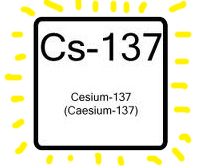
The flooding of the Fukushima Daiichi Nuclear Power Plant (FDNPP) after the disastrous earthquake on March 11 2011 caused the release of significant amounts of radioactive material, including cesium (Cs) isotopes 134Cs (half-life, 2 years) and 137Cs (half-life, 30 years). Continue reading →
People in Hornepayne will show their opposition to the possibility that the town will be chosen as a site to store nuclear waste.
Hornepayne is one of five Ontario communities being considered by the Nuclear Waste Management Organization (NWMO) to host an underground storage facility for nuclear waste.
But rally organizer Alison Morrison doesn’t think the benefits outweigh the risks.
Morrison said the three potential sites around Hornepayne are well outside of the community, and wouldn’t contribute to the tax base. She also has concerns over the project’s impact on tourism, and notes there isn’t any housing available in Hornepayne for those working at a nuclear waste storage site.
“I’m not seeing how we’re going to get economic benefit from this industry coming here,” she said. “There might be a little bit, but is it worth the risks of nuclear, and all the negative connotations?” No decision about whether or not Hornepayne will host a storage site has been made.
The NWMO website states preliminary site assessments are taking place in the Hornepayne area. The agency’s current plans say those assessments could be complete by about 2022, but the project will only move forward if the communities themselves are interested.
Tuesday’s rally begins at 3 p.m. at Rock’s Hunt Camp, at Highway 631 South and Airport Road.
After that, a march will take place, ending at the Royal Canadian Legion Branch 194, where an address by Gordon Edwards, president of the Canadian Coalition for Nuclear Responsibility will take place.
Steve DaleNuclear Fuel Cycle Watch South Australia, 12 Aug 18“ANSTO is expanding nuclear activities, which will mean massive increases in wastes.” – why are countries sending us 45 tonnes of Silicon ingots each year to be irradiated and then sent back overseas?
opposition in New Mexico to siting the facility there, and opposition along any potential transportation routes, would doom the idea
“It’s extremely troubling because they are going to be handling a decommissioning fund of almost a billion dollars,” Tauro said. “This really points to the need absolutely for the independent oversight board. To lend this whole deal transparency and independence, and having people on that board who have absolutely nothing to gain.”
Once a privately held company is in charge of decommissioning, she said, transparency will be lost.
A high-level nuclear waste storage facility doesn’t exist yet, since the federal government stopped its attempts in 2011 to develop the Yucca Mountain facility in Nevada in the face of local and regional opposition.
So, for the foreseeable future, nuclear plants’ spent fuel must be stored on site of both operating and closed plants.
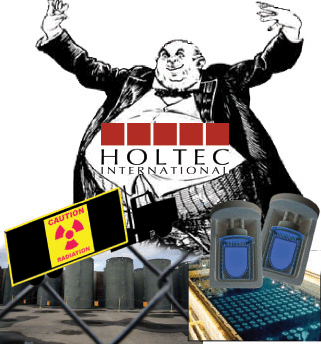
But Holtec International, which is trying to buy the Oyster Creek plant in Lacey Township for decommissioning, has an application before the Nuclear Regulatory Commission to open a short-term facility in New Mexico. It proposes to store high-level nuclear waste there, such as spent fuel rods from nuclear plants. A Holtec spokesperson did not respond to requests for information.
Holtec would likely try to transport Oyster Creek’s waste to the New Mexico facility. That and the fact that Holtec manufactures casks for storage of nuclear waste bring up conflicts of interest, said Clean Water Action Board Chairwoman Janet Tauro, of Brick Township. She has been fighting to get the Oyster Creek plant closed for years.
Tauro said whoever does the decommissioning should have to choose the best and safest cask and storage options, not the ones that will make the most money for them.
“How do you do that if it’s all your stuff, if Holtec is managing the decommissioning and buying their own casks and choosing to store at a Holtec-owned site in New Mexico?” asked Tauro.
Tauro is especially concerned about Holtec casks, since some of them malfunctioned at the decommissioned San Onofre nuclear plant in San Diego County, California, she said
NRC spokesman Neil Sheehan said the problem was discovered Feb. 20 “during a mandatory pre-loading inspection of multipurpose canisters, the stainless-steel casks that hold the spent fuel.”
He said it involved a broken shim standoff bolt inside the cask. The loose bolt — about 4 inches long and 7/16th of an inch in diameter — was found in the bottom of one of the casks.
It was shipped back to Holtec, Sheehan said. Holtec inspected other canisters at its facility in Camden and found another with a broken standoff bolt.
On March 6, Southern California Edison, which owns San Onofre, halted its dry cask loading activities. The site subsequently resumed that work, using casks with a different approved shim design, Sheehan said.
Other plants that have casks with the same design are Vermont Yankee, Dresden, Grand Gulf, Hatch, Columbia, Watts Bar and Callaway.
The New Mexico storage facility is unlikely to become a reality, said New Jersey Sierra Club Director Jeff Tittel, since it would require moving high-level radioactive waste across the country. Continue reading →
Transportation Eyed for State Role Nuclear watchdogs concur that the federal government doesn’t need New Mexico’s approval to award a license. But the state could do more to stop the project’s progress if leaders want to.
The cities of Albuquerque and Las Cruces, as well as Bernalillo County, have voted to formally oppose Holtec’s project.
A proposed nuclear storage project in Utah, for example, received a license but never accepted waste after opponents there raised questions about transportation, as well as other concerns.
New Mexico’s attorney general thinks the state can do little to stop Holtec International’s application to temporarily store high-level waste from commercial nuclear reactors, but that doesn’t deter critics of the project.
A state lawmaker and an environmentalist, who oppose the project to store the toxic trash in New Mexico before it is buried forever at Nevada’s Yucca Mountain or another site, said they believe the state—and not just the federal Nuclear Regulatory Commission—can exert some influence over the Holtec project’s future.
New Mexico Attorney General Hector Balderas (D) recently assessed the state’s role in regulating Holtec’s plan to store the radioactive materials in rural southeast New Mexico near the the Waste Isolation Pilot Plant (WIPP). An Energy Department facility that stores a different type of nuclear waste generated from weapons production, WIPP was subject to some state reviews before opening in 1999.
Holtec has an application before the NRC for a temporary place to keep nuclear waste from commercial power plants throughout the U.S. while the federal government develops permanent storage deep underground. There’s no timeline for permanent storage, as work on Yucca Mountain has long been stalled and has been met with
Intense opposition from Nevada lawmakers.
The plan to consolidate used fuel in New Mexico has drawn support for its potential economic impact and criticism for a range of health of safety concerns. Candidates running in November to replace Gov. Susana Martinez (R) have had conflicting views on the project.
But of all the factors that the NRC considers when awarding a license for temporary storage, “state approval is not among them,” said the attorney general’s July 19 letter, released to Bloomberg Environment under New Mexico’s public-records law.
Herald 11th Aug 2018 Police Scotland is expecting a £4 million windfall from external
organisations for protecting nuclear waste shipments and policing sporting
events. The force has made almost £1 million this year so far for
providing logistical support for nuclear waste transfers and policing
football matches. The ongoing logistical support — known as Operation
Ailey — is understood to involve traffic management and public order
protection for nuclear waste travelling from the decommissioned Dounreay
nuclear plant for reprocessing at Sellafield in Cumbria. http://www.heraldscotland.com/news/16412532.nuclear-convoys-and-sports-give-police-4m-windfall/
Zac Eagle Fight To Stop Nuclear Waste Dump In Flinders Ranges SA10 Aug 18 In 2004 the then Premier M Rann said “a nuclear waste dump would have tarnished SA’s image on the world scene and would have caused particular damage to the tourism, wine and food industries.
We’re trying to sell ourselves around the world as a clean, green place, he said.
So I did not want South Australia tagged as the nuclear dump state by every comic on TV”
And what about Marshall’s position? His silence is deafening. https://www.facebook.com/groups/344452605899556/
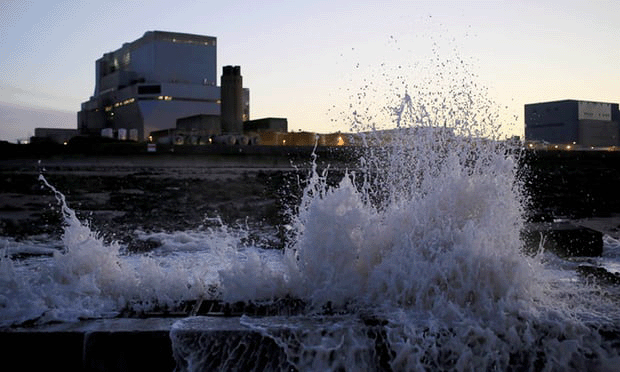
Plans to weather erosion and storm surges for new nuclear power plants may not be up to date, some experts say.The outer defensive wall of what is expected to be the world’s most expensive nuclear power station is taking shape on the shoreline of the choppy gray waters of the Bristol Channel in western England.
By the time the US$25 billion Hinkley Point C nuclear station is finished, possibly in 2028, the concrete seawall will be 12.5 meters (41 feet) high, 900 meters (3,000 feet) long and durable enough, the UK regulator and French engineers say, to withstand the strongest storm surge, the greatest tsunami and the highest sea-level rise.
But will it? Independent nuclear consultant Pete Roche, a former adviser to the UK government and Greenpeace, points out that the tidal range along this stretch of coast is one of the highest in the world, and that erosion is heavy. Indeed, observers reported serious flooding on the site in 1981 when an earlier nuclear power station had to be shut down for a week. following a spring tide and a storm surge. However well built, says Roche, the new seawall does not adequately take into account sea-level rise due to climate change.
“The wall is strong, but the plans were drawn up in 2012, before the increasing volume of melting of the Greenland ice cap was properly understood and when most experts thought there was no net melting in the Antarctic,” he says. “Now estimates of sea level rise in the next 50 years have gone up from less than 30 centimeters to more than a meter, well within the operating lifespan of Hinkley Point C — let alone in 100 years time when the reactors are finally decommissioned or the even longer period when spent nuclear fuel is likely to be stored on site.”
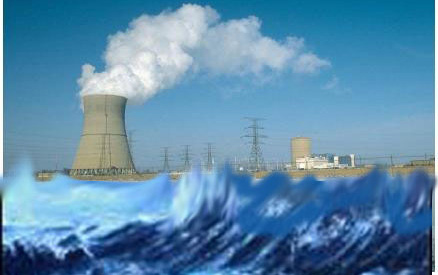
In fact, research by Ensia suggests that at least 100 U.S., European and Asian nuclear power stations built just a few meters above sea level could be threatened by serious flooding caused by accelerating sea-level rise and more frequent storm surges.
Some efforts are underway to prepare for increased flooding risk in the future. But a number of scientific papers published in 2018 suggest that climate change will impact coastal nuclear plants earlier and harder than the industry, governments or regulatory bodies have expected, and that the safety standards set by national nuclear regulators and the United Nations’ nuclear watchdog, the International Atomic Energy Agency (IAEA), are out of date and take insufficient account of the effects of climate change on nuclear power.
The Problem With Flooding
Flooding can be catastrophic to a nuclear power plant because it can knock out its electrical systems, disabling its cooling mechanisms and leading to overheating and possible meltdown and a dangerous release of radioactivity. Flooding at the Fukushima Daiichi plant in Japan as a result of the March 2011 tsunami caused severe damage to several of the plant’s reactors and only narrowly avoided a catastrophic release of radioactivity that could have forced the evacuation of 50 million people.
According to maps prepared by the World Association of Nuclear Operators (WANO), around one in four of the world’s 460 working commercial nuclear reactors are situated on coastlines. Many were built only 10–20 meters (30–70 feet) above sea level at a time when climate change was barely considered a threat.
(At left flooded Fort Calhoun nuclear plant, USA) In the U.S., where nine nuclear plants are within 2 miles (3 kilometers) of the ocean and four reactors have been identified by Stanford academics as vulnerable to storm surges and sea-level rise, flooding is common, says David Lochbaum, a former nuclear engineer and director of the nuclear safety project at the Union of Concerned Scientists (UCS).
Lochbaum says over 20 flooding incidents have been recorded at U.S. nuclear plants since the early 1980s. “The most likely [cause of flooding] is the increasing frequency of extreme events,” he says.
“There was no consideration of climate change when most U.S. plants were built,” says Natalie Kopytko, a University of Leeds researcher who has studied nuclear power plant adaptations to climate change. “They used conservative models of historical reference. Also, they were largely built at a calm period, when there were not many major storms.”
“While an accident has never yet happened due solely to sea-level rise and storms, the flooding experienced at Fukushima resembles what could occur in the future from sea-level rise,” says Kopytko.
Considering Climate Change
IAEA’s current global safety standards were published in 2011. These state that operators should only “take into account” the 18- to 59-centimeter (7- to 23-inch) sea-level rise projected by 2100 in the Intergovernmental Panel on Climate Change (IPCC)’s fourth assessment report, published in 2007.
But those safety standards don’t factor in the most recent assessment of the IPCC, published in 2013–14. This scientific consensus report has seas rising 26 centimeters (10 inches) to 1 meter (39 inches) by 2100, depending on how far temperature continue to rise and the speed at which the polar ice caps melt.
A 1-meter (39-inch) increase, combined with high tides and a storm surge, significantly increases the risk of coasts and nuclear stations being swamped, says Michael Mann, director of the Earth System Science Center at Pennsylvania State University.
“Nuclear stations are on the front line of climate change impacts both figuratively and quite literally,” Mann says. “We are likely profoundly underestimating climate change risk and damages in coastal areas.”
A recent study from NASA’s Goddard Space Flight Center expects the mean average rise to be a minimum of 65 centimeters (26 inches) by 2100.
“This 65-centimeter [rise] is almost certainly a conservative estimate,” says NASA lead author Steve Nerem, a professor of aerospace engineering sciences at the University of Colorado Boulder. “Our [study] assumes that sea level continues to change in the future as it has over the last 25 years. Given the large changes we are seeing in the ice sheets today, that’s not likely.”
Apr 15, 2026 01:00 AM in Canberra, Melbourne, Sydney
Join the International Physicians for the Prevention of Nuclear War (IPPNW) on Tuesday, April 14th for a timely webinar exploring the risks associated with nuclear power and challenging the myth that it offers a simple, safe, carbon-free solution to the climate crisis

 Huron and into Canada has members of a nuclear watchdog group concerned and asking questions.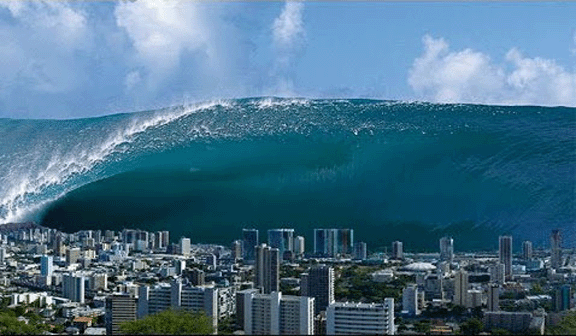









 Antinuclear