As hibakusha numbers dwindled – a plea to carry on the campaign to get rid of nuclear weapons

Keep up the fight to eliminate nuclear weapons, Japan Times, 10 Aug 18 “……… The number of surviving hibakusha as of the end of March was 154,859, a decline of 9,762 from a year earlier. In recent years, nearly 10,000 hibakusha have been passing away annually. Their average age has surpassed 82. This nation’s firsthand experience of the atomic bombings will fade with time. That is all the more reason for us to keep pushing for the elimination of nuclear weapons.
In his address during this year’s anniversary ceremony marking the Hiroshima atomic bombing, Hiroshima Gov. Hidehiko Yuzaki summed up the danger of believing in the balance of power ensured by nuclear deterrence by asking how would you explain it to your children.
“You see, we don’t get along well with our next-door neighbor. So we have set a bomb that can blow up their house with all the family inside, just in case. We can press the button to set off this bomb any time. Our neighbor, on the other hand, has also set a bomb to blow up our house. Of course, neither family wants both families to end up dead, so I feel assured that they will never press the button. We will never do so, either. In short, we will never go into battle against each other. And the bombs will probably not malfunction. And we won’t press the button by mistake, either, I hope. So you don’t have to worry,” the governor said, adding, “How many of you could seriously offer such an explanation to your children?”
How can we continue with a policy that we cannot explain to our next generation? https://www.japantimes.co.jp/opinion/2018/08/10/editorials/keep-fight-eliminate-nuclear-weapons/#.W24MLyQzbGg
Cheaper, more reliable medical isotopes from a cyclotron – non nuclear, environmentally safe
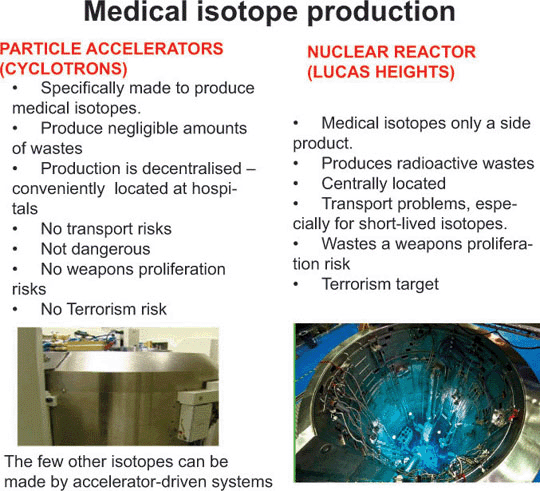
QUANTM Irradiation System™ Earns CE Mark Approval https://business.financialpost.com/pmn/press-releases-pmn/business-wire-news-releases-pmn/quantm-irradiation-system-earns-ce-mark-approval
VANCOUVER, British Columbia — ARTMS Products today announced it received CE marking approval for its first-in-class, advanced technology QUANTM Irradiation System™ for producing high-value radioisotopes, such as Tc-99m and Ga-68, on medical cyclotrons. Cyclotron facilities are constantly facing higher isotope costs and poor supply availability. Now, with CE marking, ARTMS’ QUANTM Irradiation System™ will help ease these issues.
“CE marking is an important milestone for ARTMS,” remarked Dr. Kaley Wilson, CEO of ARTMS Products. “There is a huge opportunity in providing a cost effective and secured supply of radioisotopes to hospitals and research institutions. ARTMS provides a more economical, environmentally safe and secured supply of important radioisotopes than reactor-based sources. Now, with CE marking approval, ARTMS can be readily integrated in a standardized fashion into existing and emerging facilities which ultimately leads to improved patient access and care across Europe.”
Giving Cyclotron Facilities More Control Over the Supply of Medical Isotopes
Unlike traditional reactor and generator production methods, which are growing increasingly more expensive and cannot consistently supply user requirements, the ARTMS QUANTM Irradiation System™ combines both local production control and a cost-effective, easy-to-use solid target system for production of radioisotopes on medical cyclotrons. Medical radioisotopes are used in the field of nuclear medicine on a daily basis for both medical diagnostic imaging and therapy, particularly in the fields of oncology, cardiology and neurology.
The ARTMS QUANTM Irradiation System™ is currently available for most OEM cyclotron systems and has been installed and is operating in a number of countries.
About ARTMS Products
Based in Vancouver, British Columbia, ARTMS Products Inc. is a leader in the development of novel technologies and products which enable the production of the world’s most-used diagnostic imaging isotope, technetium-99m (Tc-99m), using local, hospital-based medical cyclotrons. ARTMS holds the exclusive global commercialization rights to award-winning and proprietary Canadian inventions which address these challenges, and which offer the prospect of revolutionizing the nuclear medicine industry.
For more information on the QUANTM Irradiation System™ and ARTMS Products, please follow us on Twitter @Quantm99 and LinkedIn and visit http://www.artms.ca/
Cyclotrons can be upgraded to produce Technetium99 right now.
Steve Dale shared a link.Nuclear Fuel Cycle Watch South Australia, 10 Aug 18
“Unlike traditional reactor and generator production methods, which are growing increasingly more expensive and cannot consistently supply user requirements, the ARTMS QUANTM Irradiation System™ combines both local production control and a cost-effective, easy-to-use solid target system for production of radioisotopes on medical cyclotrons.” …..
“The ARTMS QUANTM Irradiation System™ is currently available for most OEM cyclotron systems and has been installed and is operating in a number of countries.”
https://www.facebook.com/groups/1021186047913052/
Climate change has increased USA’s wildfires
 Factcheck: How global warming has increased US wildfires , Carbon Brief , 9 Aug 18
In the midst of record or near-record heatwaves across the northern hemisphere this summer, deadly wildfires have swept through many regions, such as the western US, Europe and Siberia. This has focused a great deal of public attention on the role that climate change plays in wildfires.
Recently, some commentators have tried to dismiss recent increases in the areas burnt by fires in the US, claiming that fires were much worse in the early part of the century. To do this, they are ignoring clear guidance by scientists that the data should not be used to make comparisons with earlier periods.
The US National Interagency Fire Center (NIFC), which maintains the database in question, tells Carbon Brief that people should not “put any stock” in numbers prior to 1960 and that comparing the modern fire area to earlier estimates is “not accurate or appropriate”.
Here, Carbon Brief takes a look at the links between climate change and wildfires, both in the US and across the globe. As with any environmental issue, there are many different contributing factors, but it is clear that in the western US climate change has made – and will continue to make – fires larger and more destructive.
As one scientist tells Carbon Brief: “There is no question whatsoever that climate plays a role in the increase in fires.”
More area burned………
US wildfires and climate change
The recent period of large wildfires in forested areas of the western US has coincided with near-record warm temperatures……… https://www.carbonbrief.org/factcheck-how-global-warming-has-increased-us-wildfires
UN chief and Nagasaki mayor warn on need for nuclear disarmament
U.N. chief offers a warning on anniversary of last nuclear attack, CBC News, 9 August 18 TOKYO –– Nagasaki marked the anniversary of the world’s second atomic bombing Thursday with the United Nations chief and the city’s mayor urging global leaders to take concrete steps toward nuclear disarmament. Secretary-General Antonio Guterres, the first United Nations chief to visit Nagasaki, said fears of nuclear war are still present 73 years after the Nagasaki and Hiroshima bombings and that the attacks should never be repeated.
He raised concerns about slowing efforts to denuclearize, saying existing nuclear states are modernizing their arsenals.
“Disarmament processes have slowed and even come to a halt,” Guterres told the audience at the Nagasaki peace park. “Here in Nagasaki, I call on all countries to commit to nuclear disarmament and to start making visible progress as a matter of urgency.” Guterres added that nuclear weapons states should take the lead. “Let us all commit to making Nagasaki the last place on Earth to suffer nuclear devastation,” he said.
More than 5,000 citizens, including Nagasaki atom bomb survivors, and representatives of about 70 countries remembered the victims as they observed a minute of silence at 11:02 a.m., the moment the plutonium bomb Fatman hit the city……..
Guterres said the peace and nuclear disarmament movement started by survivors of the atomic bombings has spread around the world but frustration over the slow progress led to last year’s adoption of the Treaty on the Prohibition of Nuclear Weapons.
Japan, despite being the only country in the world to have suffered nuclear attacks, has not signed the treaty because of its sensitive position as an American ally protected by the U.S. nuclear umbrella……. https://www.cbsnews.com/news/nuclear-weapons-threat-un-chief-anniversary-atomic-bomb-nagasaki-japan/
The huge water cost of nuclear power plants
The hidden water footprint of fossil fuel and nuclear power plants You probably have no idea just how much water is needed to produce electricity Quartz, By Akshat Rathi, August 9, 2018 “…. The trouble is that thermal electricity generation—a category that includes coal, natural gas, and nuclear power—doesn’t just require fuel, but also water. And a lot of it. Continue reading
WalkatjurraWalkabout epic anti-uranium protest walk
Walkers Raisley (accessed) 8th Aug 2018 Walkatjurra Walkabout is an epic one-month protest walk in the remote desert of the WA Goldfields, covering over 250 kilometers against uranium mining.
The walkers will visit the proposed Wiluna and Yeelirrie uranium projects
before walking into the Leonora community in solidarity and support of
Traditional Owners who have stopped uranium mining on their country for
over 40 years. https://walkers.raisely.com/
Opinion divided on proposed nuclear dump for South Australia
http://www.abc.net.au/radionational/programs/breakfast/opinion-divided-on-proposed-nuclear-dump-for-south-australia/10104926 10 August 2018 (view full episode)
The process has divided the town of Kimba on the Eyre Peninsula, which has two potential sites, and Hawker in the northern Flinders Ranges.
This afternoon, residents of those towns will gather round their screens to watch an online discussion canvassing both sides of the debate.
Barb Walker No Nuclear Waste Dump Anywhere in South Australia Interesting to note in Fran’s closing comment, “communities get to make the final decision”. …and they wonder why people get confused when RN can’t even get it right. A few weeks ago we were told by government officials, the vote will be a gauge of community sentiment and the minister will have the final say.
How much is community sentiment 51%…65%….75%??? At a community meeting the minister and other government officials refused to tell us what percentage for the YES or NO vote will be broad community support.
If there is no line in the sand how do we know what their version of broad community support is?
Get ready to have the goal posts moved again people! ttps://www.facebook.com/groups/1314655315214929/?multi_permalinks=2481403758540073¬if_id=1533863099706843¬if_t=group_activity
Thorium nuclear reactors can produce material for nuclear weapons
The half-lives of the protactinium isotopes work in the favor of potential proliferators. Because protactinium 232 decays faster than protactinium 233, the isotopic purity of protactinium 233 increases as time passes. If it is separated from its uranium decay products a second time, this protactinium will decay to equally pure uranium 233 over the next few months. With careful attention to the relevant radiochemistry, separation of protactinium from the uranium in spent thorium fuel has the potential to generate uranium 233 with very low concentrations of uranium 232—a product suitable for making nuclear weapons.
Thorium power has a protactinium problem https://thebulletin.org/2018/08/thorium-power-has-a-protactinium-problem/ By Eva C. Uribe, August 6, 2018 In 1980, the International Atomic Energy Agency (IAEA) observed that protactinium, a chemical element generated in thorium reactors, could be separated and allowed to decay to isotopically pure uranium 233—suitable material for making nuclear weapons. The IAEA report, titled “Advanced Fuel Cycle and Reactor Concepts,” concluded that the proliferation resistance of thorium fuel cycles “would be equivalent to” the uranium/plutonium fuel cycles of conventional civilian nuclear reactors, assuming both included spent fuel reprocessing to isolate fissile material.
Decades later, the story changed. “Th[orium]-based fuels and fuel cycles have intrinsic proliferation resistance,” according to the IAEA in 2005. Mainstream media have repeated this view ever since, often without caveat. Several scholars have recognized the inherent proliferation risk of protactinium separations in the thorium fuel cycle, but the perception that thorium reactors cannot be used to make weapons persists. While technology has advanced, the fundamental radiochemistry that governs nuclear fuel reprocessing remains unchanged. Thus, this shift in perspective is puzzling and reflects a failure to recognize the importance of protactinium radiochemistry in thorium fuel cycles. Continue reading
Will Holtec nuclear waste cans be safe long after Holtec ceases to exist ?
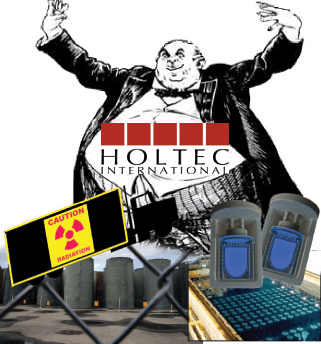 Holtec and SNC-Lavalin presumably make money if the decommissioning can be done for less than $1 billion. What the public and the regulators need to watch now is how well it is done — no cutting corners, no substandard materials, no shoddy work. We need to know that the oceanfront site in Plymouth will be safe for generations to come with no health risk to people in Southeastern Massachusetts. If that isn’t the case when Holtec leaves, it is taxpayers who will have to pick up the tab to make things right. We don’t want that to happen.
OUR OPINION: Keep a watchful eye on decommissioning of Plymouth nuclear plant Metro West Daily News 9 Aug 18
First the good news: In 10 years, the Pilgrim nuclear power plant in Plymouth could be gone.
Now the bad news: Well, there really isn’t any, if everything goes exactly as planned and if someplace in New Mexico decides it wants to house some of the nation’s most incredibly dangerous nuclear leftovers.
Those are pretty big ifs, as is everything about decommissioning a nuclear power plant. And it is a very long shot that there won’t be 60 or so big tanks sitting upright on the plant site in 2028. They will be filled with rods containing the spent nuclear fuel that powered the plant. That spent fuel will be intensely radioactive for many thousands of years.
………. Entergy announced last week (Wednesday, Aug. 1) that it was selling Pilgrim to Holtec International of Florida. Continue reading
Remembering the Atomic Bombings of Hiroshima and Nagasaki in Perilous Times
 BY Joseph Gerson, Truthout –
The consensus among US historians is that the atomic bombings of Hiroshima and Nagasaki — in addition to being moral abominations against civilians — were also opposed by senior military leaders, including General (later President) Eisenhower, who did not see them as politically necessary.
While making no excuses for Japanese militarism and imperial aggressions, we should remember that in the months prior to the US’s atomic bombings, the Japanese government attempted to surrender on terms the US ultimately accepted after the atomic bombings: unconditional surrender with the exception of the emperor remaining on his throne. According to my own research for my book, most senior US military leaders thought that the bombings were unnecessary and wrong.
Craven domestic political calculations, racism and bureaucratic momentum contributed to former President Harry Truman’s decision to usher in the nuclear age with the annihilation of the people of Hiroshima and Nagasaki, but as General Leslie Groves, who led the Manhattan Project, remarked in 1943, the atomic bomb project was no longer about Germany or Japan. It was about Russia. Hiroshima and Nagasaki were vaporized, incinerated, poisoned and traumatized to ensure that the US would not have to share influence with the Soviet Union in Northern China, Manchuria and Korea. Further, Truman thought that the atomic bomb gave him “a hammer” with which he could dominate the Kremlin with the threat of nuclear annihilation.
Despite the Hibakusha‘s fundamental truth that human beings and nuclear weapons cannot coexist, the illusion that nuclear weapons have worked and can serve as the ultimate enforcer of empire, compounded by lies and mistaken beliefs about nuclear deterrence, have repeatedly brought us to the brink of nuclear omnicide and have driven nuclear weapons proliferation. In Helsinki, Finland, Russian President Vladimir Putin again illuminated the madness and injustice of nuclear apartheid. “As major nuclear powers,” he said, “we bear special responsibility for maintaining international security.” He and Trump believe that their nuclear arsenals give them the right to intimidate and dictate how the world’s nations and peoples live and possibly die.
- A Perilous Time
We live in a perilous time of rising great power tensions, the ascendency of right-wing autocracies, uncertainties, and renewed nuclear and high-tech arms races. This is compounded by the reality that there are no longer any givens in US foreign and military policies or to the future of liberal democracy in the US.
Following Trump’s secretive summit with Putin and the political and media circus that followed, Trump was confronted by his most senior staff who insisted that he deny or reverse a number of statements and commitments he had made in Helsinki…….
- Independent of Trump, though, the gears of empire grind on. The Pentagon budget has been increased by an amount equal to Russia’s total military budget. Despite Trump’s embrace of Putin, the Pentagon’s new National Strategy prioritizes preparations for great power war against China or Russia — the two countries military leaders believe threaten“American power, influence and interests.”
This explains the $1.2 trillion spending plan for the new generation of US offensive nuclear weapons and their delivery systems and Trump’s new “Space Command” to dominate Earth from space.
………. Two Minutes to Midnight
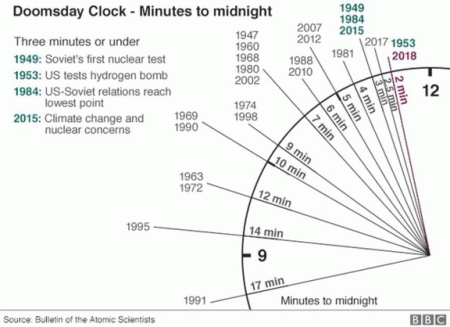
All of this is deeply related to continuing US preparations for omnicidal nuclear war. This past winter, the Bulletin of the Atomic Scientists sent the world a warning by moving the hands of their Doomsday Clock to two minutes to midnight. This is the closest to apocalyptic nuclear war since 1953 and worse than during the 1962 Cuban Missile Crisis.
Why the warning? They cited the Trump administration’s Nuclear Posture Review (NPR), decrying increased US reliance on nuclear weapons; its staggering investments in new nuclear weapons that are driving “modernization” of the world’s other nuclear arsenals; the return to Cold War rhetoric; and the total absence of US-Russian arms control negotiations. They warned about the dangerous lack of coherent US foreign and military policies that undermine global security, North Korea’s nuclear weapons program, South Asian rivalries, Trump’s threat to the nuclear deal with Iran, and climate change.
- The NPR follows on the Pentagon’s new National Strategy that prioritizes preparations for a great power war and includes a more aggressive US first-strike nuclear war-fighting doctrine. …….
- Perhaps the most dangerous element of Trump’s $1.2 trillion NPR is its blurring of the distinction between conventional and nuclear war and the increased role for nuclear weapons in US war-fighting strategies. ………https://truthout.org/articles/remembering-the-bombings-of-hiroshima-and-nagasaki-in-perilous-times/

Australian govt not consulting communities on the nuclear waste transport route
 Robyn Wood, 7 Aug 18
Port Pirie Regional Council has been blindsided by reports that suggest the  city’s port could be used to transfer nuclear waste to a proposed national storage facility.
Port Pirie Mayor, John Rohde, said the council was unaware of the possibility, but if the city’s port is selected as a transfer site, he expects the Federal Government to consult the community.
“I would have thought that is absolutely critical to anything the [Federal] Government does in relation to this matter,” he said.
The port was identified as a possible receival point for radioactive waste in two site characterisastion reports, due to its proximity to rail and road networks near proposed sites at Hawker and Kimba.
Ports at Whyalla and Port Lincoln were also suggested as viable options.
A Department of Industry, Innovation and Science spokesperson said transport plans will be finalised by an operator once a site is selected.
The spokesperson said any consultation won’t be as in depth as the current site selection process, because waste will only be travelling through the communities.
Insanity of placing a nuclear waste dump in farmland on a flood plain

Australia’s risk of mortality from extreme heat set to rise
In three of Australia’s great cities, deaths from heat waves will have risen by more than 470%.
https://independentaustralia.net/environment/environment-display/australias-risk-of-mortality-from-extreme-heat-set-to-rise,11762 Climate News Network
BY THE CLOSE of the century, the two-fisted assault of extreme heat and humidity could make the North China Plain a deadly zone.
As water vapour rises from irrigated farmland – in heat extremes which are likely if humans go on burning ever-greater quantities of fossil fuels – then air temperatures and moisture conditions could become such that outdoor workers could no longer cool by perspiration.
In such circumstances, no normal healthy person could survive more than six hours. Continue reading
Children are highly vulnerable to health risks of a changing climate
https://www.eurekalert.org/pub_releases/2018-08/cums-noc080618.php, COLUMBIA UNIVERSITY’S MAILMAN SCHOOL OF PUBLIC HEALTH Young children are far more vulnerable to climate-related disasters and the onus is on adults to provide the protection and care that children need, according to research by Columbia University’s Mailman School of Public Health and Columbia University Irving Medical Center. In a paper published in PLoS Medicine, researchers set out some specific challenges associated with the impacts of climate change on the world’s 2.3 billion children and suggest ways to address their underprioritized needs.
“Because of their anatomic, cognitive, immunologic, and psychologic differences, children and adolescents are more vulnerable to climate change-related events like floods, droughts, and heatwaves than adults,” says Madeleine Thomson, PhD, a research scholar in the Department of Environmental Health Sciences, faculty member at Columbia’s Earth Institute, a guest editor in PLOS One Medicine’s Special Issue on Climate Change and Health in the International Research Institute for Climate and Society.
Because of their small surface-to-body ratio, infants and children are particularly vulnerable to dehydration and heat stress. During heat waves, children are more likely to be affected by respiratory disease, kidney disease, electrolyte imbalance, and fever. Heat waves have also been shown to exacerbate allergens and air pollution which impact children more severely than adults because of their underdeveloped respiratory and immune systems and because they breathe at a faster rate than adults.
The authors write that hotter temperatures may also expand the range of vector-borne diseases, including the Zika virus which, following the 2015 epidemic, has profoundly affected the lives of children and their families across Latin America and the Caribbean. Even children who were asymptomatic at birth may develop problems later in life.
After Hurricane Maria made landfall in Puerto Rico in September 2017 medical responders encountered increases in gastroenteritis, asthma exacerbations and skin infections. Children were also at increased risk for mosquito-borne diseases such as Chikungunya and Dengue, as well as leptospirosis through the drinking of contaminated water. Flood waters from Hurricane Harvey a few weeks earlier dropped record breaking rain. Most of the Harvey-related toxic releases were never publicized and the long-term implications for children’s health is unknown. Studies suggest that climate change is increasing the intensity of North Atlantic hurricanes and the likelihood that the severe consequences for children’s health will grow.
In rural households droughts can have significant impacts on child development through increased food insecurity and dietary changes [17]. Droughts may also contribute to conflict and forced migration in resource poor settings, thereby increasing children’s vulnerability to a wide range of health issues.
To begin to address the specific needs of children confronted with climate-change related health disasters, Thomson and colleagues are proposing the following:
- Establish an international consortium of experts to develop adoptable medical and behavioral protocols and to set research agendas to address the unmet child specific needs that arise from climate-related natural disasters.
- Develop best practice guidelines for climate-change related event planning that incorporates strategies for addressing the health-related needs of children.
- Fund mechanisms designed to help the most vulnerable nations prepare for and respond to climate related disasters must consider funding the development of responses that specifically address the unmet needs of children’s health.
1 This month
15 April – Zoom –Nuclear Power is Not the Solution
Apr 15, 2026 01:00 AM in Canberra, Melbourne, Sydney

Join the International Physicians for the Prevention of Nuclear War (IPPNW) on Tuesday, April 14th for a timely webinar exploring the risks associated with nuclear power and challenging the myth that it offers a simple, safe, carbon-free solution to the climate crisis

of the week – Australians for War Powers Reform (AWPR)
To see nuclear-related stories in greater depth and intensity
 Antinuclear