FILM: UNDERMINED: TALES FROM THE KIMBERLEY
 D Nicholas Wrathall | Australia (2018)
L English Nyikina Kriol
‘Award-winning director Nicholas Wrathall investigates the true costs of development in the world-famous Kimberley,
where mega-mining and pastoral developments threaten not just the pristine environment
but more than 200 Indigenous communities and their peoples’ sacred links to Country.
‘Kimberley Traditional Owners – including activist, musician and Bardi man Albert Wiggan
and academic and Yimardoowarra woman Dr Anne Poelina
– question what meaningful negotiation looks like and offer humanising portraits of those at the
centre of this battle in Australia’s spectacular north-west corner,
which governments aspire to make “the future economic powerhouse of Australia”.
‘With the highest percentage of Aboriginal people living on Country in Australia,
what will this mean for the Kimberley’s custodians, lands and cultures,
and will they survive these pressures?
‘Supported by the MIFF Premiere Fund, Wrathall (Gore Vidal: The United States of Amnesia, MIFF 2013)
delivers a powerful and urgent film that, while distinctly Australian, tells a sadly universal story of the
David-and-Goliath battles Indigenous peoples face against development on their homelands.
‘Undermined: Tales from The Kimberley asks for whose benefit is development of this scale and,
ultimately, what is the path to social justice for first peoples in 2018?
‘The World Premiere screening on 8 August will include a Welcome to Country,
a Q&A with the film’s director, producer and subjects,
including activist/musician Albert Wiggan, who will also give a musical performance.’
‘The session on Saturday 11 August will screen with open captions
to assist patrons who are Deaf or hard of hearing.
‘This film will also screen as part of the MIFF Travelling Showcase: miff.com.au/travelling
miff.com.au/program/film/undermined-tales-from-the-kimberley
Low-dose radiation exposure linked to leukemia in large retrospective study
https://dceg.cancer.gov/news-events/research-news-highlights/2018/low-dose-rad-leukemia National Cancer Institute. Division of Cancer Epidemiology and Genetics July 20, 2018 Using data from nine historical cohort studies, investigators in the Radiation Epidemiology Branch and colleagues from other institutions, led by senior investigator
USA State of New Mexico unable tom stop Holtec nuclear waste project
 Lack of New Mexico say in nuclear waste project draws ire https://www.sfchronicle.com/news/article/Lack-of-New-Mexico-say-in-nuclear-waste-project-13126304.php Aug. 2, 2018 SANTA FE, N.M. (AP) — The chair of a New Mexico legislative committee that monitors radioactive and hazardous materials in the state says he finds it troubling Attorney General Hector Balderas has concluded the state cannot legally stop a New Jersey-based company from the building a nuclear waste storage facility.
Former uranium workers call for compensation expansion
 Noel Lyn Smith, Farmington Daily Times NM’s Tom Udall one of six senators sponsoring bill
SHIPROCK — Brimhall resident Leslie Begay Jr. worked as an underground miner for eight years in a uranium mining operation in Church Rock near Gallup.
The work done by Begay in the late 1970s to early 1980s is now impacting his health, including a diagnosis of interstitial lung disease, which requires him to use an oxygen tank.
On Tuesday, during a public meeting here, Begay voiced support for federal legislation to expand compensation under the Radiation Exposure Compensation Act to include those who worked in uranium mines after 1971 and those exposed to radiation from testing sites in the West and the Pacific Islands.
“As far as I’m concerned, we deserve it because we were never told how we can get so sick from this,” he said.
The U.S. Environmental Protection Agency has reported that approximately 30 million tons of uranium ore was removed from the Navajo reservation from 1944 to 1986.
Former uranium workers and their relatives provided comments about the proposal in addition to remarks about problems in seeking compensation and health benefits during the public meeting at the Phil L. Thomas Performing Arts Center.
U.S. Sen. Tom Udall, D-N.M., is among six senators sponsoring the bill, which was introduced in January 2017 by Sen. Mike Crapo, R-Idaho.
A similar measure was introduced in April 2017 by U.S. Rep. Ben Ray Luján, D-N.M., who has called on the House Judiciary Committee to conduct a hearing on the proposal.
Tribal and federal officials spoke in favor of the RECA amendments in a June 27 hearing in the Senate Judiciary Committee.
Cal Curley, a field representative for Udall’s office, said this was the first time the proposal had been heard in a Senate committee hearing, despite the senator repeatedly sponsoring the legislation over the years.
Cudeii resident Phillip A. Harrison, who was a miner for 15 years in Arizona and Colorado, said the medical community needs to be more open to conducting the screening process for former miners who are seeking compensation claims……https://www.daily-times.com/story/news/local/navajo-nation/2018/08/01/former-uranium-workers-call-compensation-expansion/883472002/
Spent nuclear fuel moved by road from ANSTO to Port Kembla in late-night operation
Bega District News, Murray Trembath 30 July 18, “……..
ANSTO said the spent fuel was being shipped overseas in state-of-the-art cask for reprocessing.
“This will involve:
- “Extraction many kilograms of uranium and plutonium for recycling in energy and research programs only (in line with the relevant government-level treaties); and
- “Immobilisation of the remaining non-recoverable waste in glass, in a process called vitrification, which ensures safe and stable behaviour.”……..https://www.begadistrictnews.com.au/news/national/5555516/nuclear-waste-shipment-leaves-lucas-heights/
Climate change: heat waves affecting Europe’s nuclear power stations
 The heatwave across Europe in late July required some nuclear plants to
reduce electricity after cooling water was affected by high temperatures.
Plants in Finland, Sweden, Germany, France and Switzerland have been
affected.
While air temperatures have been above 90 degrees Fahrenheit (32
degrees Celsius) in many parts, water temperatures have reached 75 degrees
Fahrenheit (23.8 degrees Celsius) or more. The Loviisa nuclear plant, which
produced 10% of Finland’s power in 2017, began reducing its output on 25
July, according to chief of operations, Timo Eurasto. He said customers
were not affected, because other power plants were satisfying electricity
demand. Loviisa previously reduced output in 2010 and 2011, due to warm
water, but Eurasto said the current heatwave has been more severe.
Reactorsin Sweden and Germany also reduced production because of cooling problems,Reuters reported. A spokesperson for Sweden’s nuclear energy regulator saidthe Forsmark had cut energy production “by a few percentage points”.
http://www.neimagazine.com/news/newseuropes-heatwave-affects-npps-6271432
Most governments, energy companies, investors, now realise that climate change is real
 FT 31st July 2018, Environmentalists have won the battle of a generation: after years of campaigning, they have largely persuaded the world that man-made climate change is real and that fossil fuels are to blame. Remaining sceptics -chief among them US president Donald Trump – are outnumbered even in their own countries.
Instead, most governments, energy companies, investors and
others are beginning the pivot towards supporting low-carbon energy
sources. That poses a fresh challenge for environmentalists: though
transition is under way, scientists say only more action than is planned
will avoid the catastrophic effects of unabated global warming.
Campaigners are divided on the tactics to achieve this. At one end are grassroots groups such as Friends of the Earth and Greenpeace, which are well known for protests that aim to obstruct polluters and mobilise public opinion. They have no plans to abandon such tactics, even as one-time foes including oil majors slowly begin to address their contribution to climate change.
This month, Greenpeace protesters dangled from a Canadian bridge for 38 hours to block an oil sands tanker. “Those bold statements are needed more than ever,” says Jennifer Morgan, executive director of Greenpeace
International, “because we’re in a climate crisis and it’s very clear that
the pace of change is not adequate enough.”
There is also a new breed of campaigners who prefer to exert pressure inside boardrooms. These groups, including activist shareholders, investors and analysts, say there is a pragmatic case against continued investment in coal, oil and gas. Among them is Carbon Tracker Initiative, an early pioneer in arguing the risks and rewards for investors. Founded nine years ago by sustainable investment analyst Mark Campanale with philanthropic funding, the think-tank spent several years telling investors that many of their fossil fuel assets would become “unburnable” in a low-carbon economy.
https://www.ft.com/content/94ca31f0-7ac4-11e8-af48-190d103e32a4
American town opposes transport and storage of nuclear wastes

 City approves resolution opposing nuclear storage
  facility https://www.timesunion.com/news/article/City-approves-resolution-opposing-nuclear-storage-13114846.php – 29 July 18 LAS CRUCES, N.M. (AP) — Las Cruces has become the latest community in New Mexico to voice opposition to building a nuclear waste storage facility in the southeast corner of the state.
The Las Cruces Sun-News reports the Las Cruces City Council on Monday approved a resolution opposing the transport and storage of high-level nuclear waste in the state.
Holtec International, a New Jersey-based company specializing in nuclear storage, has applied to the U.S. Nuclear Regulatory Commission for a license to construct a nuclear waste storage facility about 35 miles east of Carlsbad.
The Nuclear Regulatory Commission is accepting public comment on the proposal through July 30. The council voted in support of the resolution after discussing the issue for nearly two-and-a-half hours.
Once nuclear waste casks are sealed , it’s nearly impossible to see what’s going on inside.
 Sandia researchers study spent nuclear fuel storage https://www.abqjournal.com/1202154/sandians-collecting-important-spent-nuclear-fuel-data.html By Maddy Hayden / Journal Staff Writer, July 28th, 2018
Heat waves – deadly for workers

Heat waves can be deadly for workers and will drain the US economy https://www.vox.com/2018/7/27/17611940/heat-wave-2018-cost-workers-deaths-health-climate-change
Extreme heat has already killed several outdoor workers this summer.
Hot weather is really bad news for the nuclear industry
Hot Weather Spells Trouble For Nuclear Power Plants https://www.npr.org/2018/07/27/632988813/hot-weather-spells-trouble-for-nuclear-power-plants July 27, 2018 Nuclear power plants in Europe have been forced to cut back electricity production because of warmer-than-usual seawater.
Plants in Finland, Sweden and Germany have been affected by a heat wave that has broken records in Scandinavia and the British Isles and exacerbated deadly wildfiresalong the Mediterranean.
Air temperatures have stubbornly lingered above 90 degrees in many parts of Sweden, Finland and Germany, and water temperatures are abnormally high — 75 degrees or higher in the usually temperate Baltic Sea.
That’s bad news for nuclear power plants, which rely on seawater to cool reactors.
Finland’s Loviisa power plant, located about 65 miles outside Helsinki, first slightly reduced its output on Wednesday. “The situation does not endanger people, [the] environment or the power plant,” its operator, the energy company Fortum, wrote in a statement.
The seawater has not cooled since then, and the plant continued to reduce its output on both Thursday and Friday, confirmed the plant’s chief of operations, Timo Eurasto. “The weather forecast [means] it can continue at least a week. But hopefully not that long,” he said.
Eurasto says customers have not been affected by the relatively small reduction in output, because other power plants are satisfying electricity demand. The power plant produced about 10 percent of Finland’s electricity last year.
The company also cut production at the Loviisa facility in 2010 and 2011, also due to warm water, but Eurasto said this summer’s heatwave has been more severe than previous ones.
Nuclear power stations in Sweden and Germany have also reduced production because of cooling problems, Reuters reported. A spokesperson for Sweden’s nuclear energy regulator told the wire service on Tuesday that the Forsmark nuclear power plant in Sweden had cut energy production “by a few percentage points.”
Cooling issues at nuclear power plants may get worse in the future. Climate change is causing global ocean temperatures to rise and making heat waves more frequent and severe in many parts of the world. A 2011 report by the Union of Concerned Scientists warned that warmer seas could affect the efficiency of nuclear power plants, noting:
“…during times of extreme heat, nuclear power plants operate less efficiently and are dually under the stress of increased electricity demand from air conditioning use. When cooling systems cannot operate, power plants are forced to shut down or reduce output.”
It’s not just warmer oceans that could spell trouble for nuclear power plants. Climate change is also producing more powerful storms and contributing to drought conditions, threatening facilities on coasts with wave and wind damage, and reducing the amount of water available to plants that cool their reactors with fresh water.
Climate change will bring repeated heatwaves
Expect more heat waves due to climate change, experts warn, Jakarta Post, LIN TAYLOR, REUTERS London | Fri, July 27, 2018 The effects of climate change mean the world can expect higher temperatures and more frequent heat waves, climate experts have warned, with poor communities likely to be worst affected.
Heat is neglected because it is both an invisible and hard-to-document disaster that claims lives largely behind closed doors, they said, and because hot weather does not strike many people as a serious threat.
The warning comes as hot weather has swept the northern hemisphere. Britain has sweltered in a prolonged heat wave, with temperatures set to test national records, the country’s Meteorological Office said…..
Fires have also caused devastation in Greece, Sweden and the United States. In Greece, rescuers are searching scorched land and the coastline for survivors three days after a wildfire destroyed a village outside Athens killing at least 82 people.
Health risks
The past three years were the hottest on record, the United Nations’ World Meteorological Organization said in March.
The World Health Organization says heat stress, linked to climate change, is likely to cause 38,000 extra deaths a year worldwide between 2030 and 2050.
Two weeks into Japan’s blistering heat wave, at least 80 people have died and thousands have been rushed to emergency rooms, as officials urged citizens to stay indoors to avoid temperatures exceeding 40 degrees Celsius (104°F) in some areas.
n a heat wave in May, more than 60 people died in Karachi, Pakistan, when the temperature rose above 40C ( 104F ).
“Heat waves are becoming more frequent, and that is likely due to climate change because the global temperature is rising,” Sven Harmeling, head of climate change and resilience policy at aid group CARE International, said by phone.
He said climate change was altering weather patterns, and “we have to prepare for more of these consequences”.
……..Nearly one in three people around the world are already exposed to deadly heat waves, and that will rise to nearly half of people by 2100 even if the world moves aggressively to cut climate-changing emissions, a University of Hawaii study found in 2017.
……About 1.1 billion people in Asia, Africa and Latin America are at risk from a lack of air conditioning to keep them cool as global warming brings more high temperatures, the non-profit Sustainable Energy for All said in a study last week…..http://www.thejakartapost.com/life/2018/07/27/expect-more-heat-waves-due-to-climate-change-experts-warn.html
Small Modular Nuclear Reactors (SMRs) not commercially viable, but helpful to nuclear weapons industry
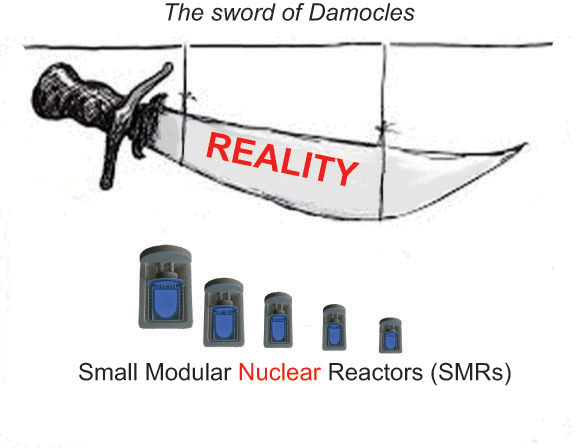 Small modular reactors have little appeal https://climatenewsnetwork.net/small-modular-reactors-have-little-appeal/ July 27, 2018, by Paul Brown , London
The last hope of the nuclear industry for competing with renewables is small modular reactors, but despite political support their future looks bleak.
On both sides of the Atlantic billions of dollars are being poured into developing small modular reactors. But it seems increasingly unlikely that they will ever be commercially viable.
The idea is to build dozens of the reactors (SMRs) in factories in kit form, to be assembled on site, thereby reducing their costs, a bit like the mass production of cars. The problem is finding a market big enough to justify the building of a factory to build nuclear power station kits.
For the last 60 years the trend has been to build ever-larger nuclear reactors, hoping that they would pump out so much power that their output would be cheaper per unit than power from smaller stations. However, the cost of large stations has escalated so much that without massive government subsidies they will never be built, because they are not commercially viable.
To get costs down, small factory-built reactors seemed the answer. It is not new technology, and efforts to introduce it are nothing new either, with UK hopes high just a few years ago. Small reactors have been built for decades for nuclear submarine propulsion and for ships like icebreakers, but for civilian use they have to produce electricity more cheaply than their renewable competitors, wind and solar power.
One of the problems for nuclear weapons states is that they need a workforce of highly skilled engineers and scientists, both to maintain their submarine fleets and constantly to update the nuclear warheads, which degrade over time. So maintaining a civil nuclear industry means there is always a large pool of people with the required training.
Although in the past the UK and US governments have both claimed there is no link between civil and military nuclear industries, it is clear that a skills shortage is now a problem.
It seems that both the industry and the two governments have believed SMRs would be able to solve the shortage and also provide electricity at competitive rates, benefitting from the mass production of components in controlled environments and assembling reactors much like flat-pack furniture.
This is now the official blueprint for success – even though there are no prototypes yet to prove the technology works reliably. But even before that happens, there are serious doubts about whether there is a market for these reactors.
Among the most advanced countries on SMR development are the US, the UK and Canada. Russia has already built SMRs and deployed one of them as a floating power station in the Arctic. But whether this is an economic way of producing power for Russia is not known.
Finding investors
A number of companies in the UK and North America are developing SMRs, and prototypes are expected to be up and running as early as 2025. However, the next big step is getting investment in a factory to build them, which will mean getting enough advance orders to justify the cost.
A group of pro-nuclear US scientists, who believe that nuclear technology is vital to fight climate change, have concluded that there is not a large enough market to make SMRS work.
Their report, published in the Proceedings of the National Academy of Sciences, says that large reactors will be phased out on economic grounds, and that the market for SMRs is too small to be viable. On a market for the possible export of the hundreds of SMRs needed to reach viability, they say none large enough exists.
They conclude: “It should be a source of profound concern for all who care about climate change that, for entirely predictable and resolvable reasons, the United States appears set to virtually lose nuclear power, and thus a wedge of reliable and low-carbon energy, over the next few decades.”
Doubts listed
In the UK, where the government in June poured £200 million ($263.8) into SMR development, a parliamentary briefing paper issued in July lists a whole raft of reasons why the technology may not find a market.
The paper’s authors doubt that a mass-produced reactor could be suitable for every site chosen; there might, for instance, be local conditions requiring extra safety features.
They also doubt that there is enough of a market for SMRs in the UK to justify building a factory to produce them, because of public opposition to nuclear power and the reactors’ proximity to population centres. And although the industry and the government believe an export market exists, the report suggests this is optimistic, partly because so many countries have already rejected nuclear power.
The paper says those countries still keen on buying the technology often have no experience of the nuclear industry. It suggests too that there may be international alarm about nuclear proliferation in some markets. – Climate News Network
Media shows an unreasonable bias against North Korea
They have thus obscured the reality that the fate of the negotiations depends not only North Korean policy but on the willingness of the United States to make changes in its policy toward the DPRK and the Korean Peninsula that past administrations have all been reluctant to make.
These stories also underscore a broader problem with media coverage of the US-North Korean negotiations: a strong underlying bias toward the view that it is futile to negotiate with North Korea. The latest stories have constructed a dark narrative of North Korean deception that is not based on verified facts. If this narrative is not rebutted or corrected, it could shift public opinion—which has been overwhelmingly favorable to negotiations with North Korea—against such a policy.
How the Media Wove a Narrative of North Korean Nuclear Deception 38 North, BY: GARETH PORTER, JULY 26, 2018
Since the June 12 Singapore Summit between US President Trump and North Korean leader Kim Jong Un, the US media has woven a misleading narrative that both past and post-summit North Korean actions indicate an intent to deceive the US about its willingness to denuclearize. The so-called intelligence that formed the basis of these stories was fed to reporters by individuals within the administration pushing their own agenda.
The Case of the Secret Uranium Enrichment Sites
In late June and early July, a series of press stories portrayed a North Korean policy of deceiving the United States by keeping what were said to be undeclared uranium enrichment sites secret from the United States. The stories were published just as Secretary of State Mike Pompeo was preparing for the first meetings with North Korean officials to begin implementing the Singapore Summit Declaration.
The first such story appeared on NBC News on June 29, which reported: Continue reading
Nuclear waste dump opposed by Aboriginals, and will stigmatise the whole State of South Australia
Dump opposition, Adelaide Advertiser, JILLIAN MARSH, 25 July 18
AS AN Adnyamathanha person I confirm that the overwhelming majority of Adnyamathanha do not support the proposed nuclear waste dump.
Our Native Title body reflects this position. We have clearly stated our opposition from the very beginning of this imposed government and industry process. Our rights to say no must be respected on cultural grounds, as well as on environmental and economic grounds.
 All the evidence we have provided to date supports this. We ask that government and industry do the right thing and back off, leave us alone, listen to what we have to say, hear what we have to say.
Nuclear stigma R. WOOD, Valley View
THE majority of South Australians do not want a nuclear waste dump built at Kimba or near Hawker to house Australia’s nuclear waste according to a recent poll (The Advertiser, 24/7/18). It is the whole of SA who will bear the stigma of being the national nuclear waste state, just as we are successfully benefiting from our clean, green agriculture, food and tourism industries.
1 This month
15 April – Zoom –Nuclear Power is Not the Solution
Apr 15, 2026 01:00 AM in Canberra, Melbourne, Sydney

Join the International Physicians for the Prevention of Nuclear War (IPPNW) on Tuesday, April 14th for a timely webinar exploring the risks associated with nuclear power and challenging the myth that it offers a simple, safe, carbon-free solution to the climate crisis

of the week – Australians for War Powers Reform (AWPR)
To see nuclear-related stories in greater depth and intensity
 Antinuclear