Public can request federal hearings on Holtec proposal for nuclear storage


 Adrian C Hedden, Carlsbad Current-Argus 29 July 18
Continuing production of medical radioisotopes with no need of nuclear reactor

Covenant Radiation Center expanding, adding second linear accelerator Midland Daily NewsAs part of the health system’s commitment to maintaining a quality-driven, state-of-the-art cancer treatment facility, Covenant HealthCare is adding a second linear accelerator to the Covenant Radiation Center.
In 2016, Covenant unveiled the first linear accelerator at the radiation center. In 2017, the team of cancer providers saw the need to add additional resources in the fight against cancer. After state approval in spring of 2018, construction began at 4141 Tittabawassee Road, Saginaw. Construction will continue through the summer and will be followed by rigorous testing. The second system will begin treating patients in February of 2019, allowing the radiation team to treat more patients with shorter wait-times. Continue reading
Global TV news media fails to cover unprecedented global heat wave
 Global heat wave: an epic TV news fail https://thebulletin.org/2018/07/global-heat-wave-an-epic-tv-news-fail/?utm_source=Bulletin%20newsletter&utm_medium=iContact%20email&utm_campaign=July20
By Dawn Stover, July 19, 2018
This month’s scorching heat wave broke records around the  world. The Algerian city of Ouargla, with a population of half a million, had a temperature of 124.3 degrees Fahrenheit on July 6, the hottest reliably measured temperature on record in Africa. In Ireland and Wales, the unusually hot weather revealed ancient structures normally hidden by grass or crops. In Chino, California, the mercury soared to 120 degrees. Another round of hazardous summer heat is expected this week, with record high temperatures possible in the southern United States.
The prolonged heat wave has been a staple of television news for weeks. However, most of the coverage has been sorely lacking in context: Humans are warming the planet, and scientists have already linked some heat waves to climate change. A recent analysis published in the journal Nature Climate Change concludes that human-driven climate change, rather than natural variability, will be the leading cause of heat waves over the western United States and Great Lakes region as early as the 2020s and 2030s, respectively.
Like the heat itself, much of the media coverage was stupefying. “Major broadcast TV networks overwhelmingly failed to report on the links between climate change and extreme heat,” according to a Media Matters survey. “Over a two-week period from late June to early July, ABC, CBS, and NBC aired a combined 127 segments or weathercasts that discussed the heat wave, but only one segment, on CBS This Morning, mentioned climate change.”
TV coverage would undoubtedly improve if weather forecasters were better informed about climate science. But four Republican senators with close ties to the fossil fuel industry are trying to eliminate government funding for a National Science Foundation designed to help forecasters (and by extension, the general public) “become more familiar with the science behind how their local weather and its trends are related to the dynamics of the climate.”
For how long will nuclear waste canisters be safe? It’s all experimental
World Nuclear News 19th July 2018, A scaled test assembly that simulates a dry cask storage container for used nuclear fuel has been constructed by researchers at the USA’s Sandia National Laboratories. It will be used to study how fuel temperatures change during storage and how the fuel’s peak temperatures affect the integrity of the metal cladding surround the fuel.
The inaccessibility of the interior of an actual storage cask and the high radioactivity of the used fuel make it difficult to monitor the temperature, Sandia said. During a three-year project for the Department of Energy and the Nuclear
Regulatory Commission, a team at Sandia designed and constructed a dry cask simulator for boiling water reactor assemblies. Everything inside the cask was built to closely simulate the way it would be for a utility storing
used nuclear fuel. However, instead of actual used fuel, the simulator features electrical heaters shaped like fuel rods.
Thorium market is limited by health and environmental concerns
Thorium Market Regulations and Competitive Landscape Outlook to 2025 July 18, 2018 tanuj Market Research “….health and environmental concerns due to radioactive nature of thorium is expected to hinder the growth of the thorium market. Release of thorium in large amount in the environment contaminates the flora and fauna of the ecosystem. Another factor to be considered is the waste disposal which is performed strictly under appropriate local, state and federal regulations…”
New research backs the Linear No Threshold theory of ionising radiation
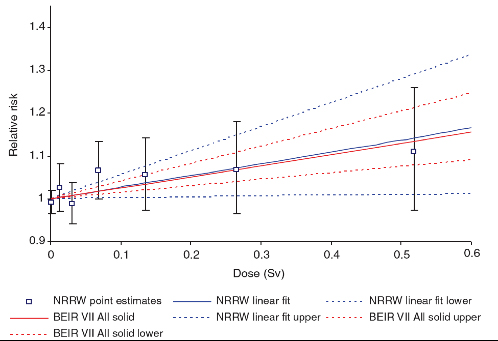
Implications of recent epidemiologic studies for the linear nonthreshold model and radiation protection https://www.researchgate.net/publication/326387649_Implications_of_recent_epidemiologic_studies_for_the_linear_nonthreshold_model_and_radiation_protection
Sweden worst affected as wildfires rage in Arctic Circle
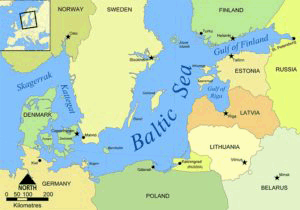 Wildfires rage in Arctic Circle as Sweden calls for help http://www.inkl.com/news/sweden-calls-for-help-as-arctic-circle-hit-by-wildfires?sharer=20552, By Jonathan Watts, July 18, 2018
At least 11 wildfires are raging inside the Arctic Circle as the hot, dry summer turns an abnormally wide area of Europe into a tinderbox.
The worst affected country, Sweden, has called for emergency assistance from its partners in the European Union to help fight the blazes, which have broken out across a wide range of its territory and prompted the evacuations of four communities.
Tens of thousands of people have been warned to remain inside and close windows and vents to avoid smoke inhalation. Rail services have been disrupted.
The Copernicus Earth observation programme, which gives daily updates of fires in Europe, shows more than 60 fires burning across Sweden, with sites also ablaze in Norway, Finland and Russia, including in the Arctic Circle.
Norway has sent six fire-fighting helicopters in response to its neighbour’s request for assistance. Italy is sending two Canadair CL-415s – which can dump 6,000 litres of water on each run – to Örebro in central southern Sweden.
In western Sweden, fire-fighting operations were temporarily halted near an artillery training range near Älvdalen forest due to concernsthat unexploded ordnance might be detonated by the extreme heat.
Residents in Uppsala said they could see the plumes of smoke and have been banned from barbecuing in national parks, after 18 consecutive days without rain.
“This is definitely the worst year in recent times for forest fires. Whilst we get them every year, 2018 is shaping up to be excessive,” said Mike Peacock, a university researcher and local resident.
There have been huge fires in the past in Sweden, but not over such a wide area. This appears to be a trend as more and bigger blazes are reported in other far northern regions like Greenland, Alaska, Siberia and Canada.
The sparks come from a variety of sources: BBQs, cigarettes and increasingly lightning, which is becoming more frequent as the planet warms.
Swedish authorities say the risk of more fires in the days ahead is “extremely high” due to temperatures forecast in excess of 30C. Much of the northern hemisphere has sweltered in unusually hot weather in recent weeks, breaking records from Algeria to California and causing fires from Siberia to Yorkshire. Ukraine has been hit especially hard by wildfires.
The European Forest Fire Information System warned fire danger conditions were likely to be extreme across much of central and northern Europe in the coming weeks.
EU officials said many of this year’s fires are outside the traditional European fire zone of the Mediterranean, and are increasingly taking place at unexpected times of year. 2017 was the worst fire year in Europe’s history, causing destruction to thousands of hectares of forest and cropland in Portugal, Spain and Italy, as late as November. “There are clear trends of longer fire seasons and frequent critical periods in Europe that are leading to dangerous fire situations,” said a European commission official.
Climate scientists said the Arctic and other areas that were once relatively fire-free are likely to become more vulnerable.
“What we’re seeing with this global heatwave is that these areas of fire susceptibility are now broadening, with the moors in north-west England and now these Swedish fires a consequence of that,” said Vincent Gauci, professor of global change ecology at the Open University.
“Both these areas are typically mild and wet which allows forests and peatlands to develop quite large carbon stores,” he added. “When such carbon-dense ecosystems experience aridity and heat and there is a source of ignition – lightning or people – fires will happen.”
India’s summer heat becoming physically unbearable
 In India, summer heat could soon be unbearable — literally
An analysis of South Asia’s biggest cities found that if current warming trends continued, wet bulb temperatures — a measure of heat and humidity indicating when the body can no longer cool itself — will become so high people directly exposed for six hours or more would die.
Somini Sengupta-Seattle Times, July 18, 2018
The New York Times
NEW DELHI — On a sweltering Wednesday in June, a rail-thin woman named Rehmati gripped the doctor’s table with both hands. She could hardly hold herself upright, the pain in her stomach was so intense.
She had traveled for 26 hours in a hot oven of a bus to visit her husband, a migrant worker here in the Indian capital. By the time she got here, the city was an oven, too: 111 degrees by lunchtime, and Rehmati was in an emergency room.
The doctor, Reena Yadav, did not know exactly what had made Rehmati sick, but it was clearly linked to the heat. Yadav suspected dehydration, possibly aggravated by fasting during Ramadan. Or it could have been food poisoning, common in summer because food spoils quickly.
Yadav put Rehmati, who is 31 and goes by one name, on a drip. She held her hand and told her she would be fine. Rehmati leaned over and retched.
Extreme heat can kill, as it did by the dozens in Pakistan in May. But as many of South Asia’s already-scorching cities get even hotter, scientists and economists are warning of a quieter, more far-reaching danger: Extreme heat is devastating the health and livelihoods of tens of millions more.
If global greenhouse-gas emissions continue at their current pace, they say, heat and humidity levels could become unbearable, especially for the poor.
It is already making them poorer and sicker.
…….Indeed, a recent analysis of climate trends in several of South Asia’s biggest cities found that if current warming trends continue, by the end of the century, wet bulb temperatures — a measure of heat and humidity that can indicate the point when the body can no longer cool itself — would be so high that people directly exposed for six hours or more would not survive.
In many places, heat only magnifies the more thorny urban problems, including a shortage of basic services, like electricity and water.
…The science is unequivocally worrying. Across the region, a recent World Bank report concluded, rising temperatures could diminish the living standards of 800 million people.
Worldwide, among the 100 most populous cities where summer highs are expected to reach at least 95 degrees Fahrenheit by 2050, according to estimates by the Urban Climate Change Research Network, 24 are in India.
………Delhi’s heat index, a metric that takes average temperatures and relative humidity into account, has risen sharply — by 0.6 degrees Celsius in summer and 0.55 degrees during monsoons per decade between 1951 and 2010, according to one analysis based on data from 283 weather stations across the country.
Some cities are getting hotter at different times of year. The average March-to-May summertime heat index for Hyderabad had risen by 0.69 degrees per decade between 1951 and 2010. In Kolkata, a delta city in the east, where summers are sticky and hot anyway, the monsoon is becoming particularly harsh: The city’s June-September heat index climbed by 0.26 degrees Celsius per decade.
Joyashree Roy, an economist at Jadavpur University in Kolkata, found that already, most days in the summer are too hot and humid to be doing heavy physical labor without protection, with wet-bulb temperatures far exceeding the thresholds of most international occupational health standards. of most international occupational health standards……… https://www.seattletimes.com/nation-world/in-india-summer-heat-could-soon-be-unbearable-literally/
The ultimate nightmare – Trump’s plan for nuclear weapons in space
Star wars returns – Free speech tv. 1 of 3
“The heavens are going to be littered with radioactive debris.”
The Commander-in-Chief, President Donald Trump, has announced a new mission into the realm of martial excess. It is one is that will surely enrich the aerospace industry while spreading the global battlefield to a new dimension.
Trump is calling for the creation of a new Space Force as a sixth branch of the U.S. military, to militarize the heavens.
“It is not enough to merely have an American presence in space,” Trump told a meeting of the National Space Council in mid-June. “We must have American dominance in space.”
To this end, the President has taken a page from Ronald Reagan’s Star Wars playbook. Reagan’s scheme, according to a recent article by Karl Grossman, was built around “nuclear reactors and plutonium systems on orbiting battle platforms providing the power for hypervelocity guns, particle beams and laser weapons.”
Grossman, a journalism professor at State University of New York/College of New York and author of the book The Wrong Stuff: The Space Program’s Nuclear Threat to Our Planet, has been reporting on the militarization of space for decades, says the move will likely spur a new international competition to weaponize space. Continue reading
Nuclear power is now recognised as not economically viable
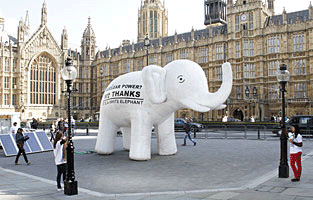
 Ecologist 18th July 2018 Nuclear power is now recognised as not economically viable. This confirms
that renewable energy really does deserve its place in the sun, argues Bruce Davis, the managing director of Abundance Investment.
The UK has long been a welcoming habitat for a number of white elephants. Normally, these
rare and massive beasts roam freely, grazing on political expediency. However, now and again their existence is threatened by outbreaks of political honesty and economic necessity.
This week saw calls for the humane culling of one species of white elephant in particular, namely our
political obsession with nuclear energy. This is an obsession that continues despite the industry’s inability to reduce the risks of construction, costs of production and – most importantly – find a sustainable and morally acceptable way to deal with long-term storage of radioactive waste.
https://theecologist.org/2018/jul/18/white-nuclear-elephants-move-endangered-list
Lavene Ngatokorua Lifetime Achievement Award winner spoke out against nuclear waste dump plan
Tim Bickmore No Nuclear Waste Dump Anywhere in South Australia, 18 July 18
Lavene has spoken strongly against the nuke dump. Here is part of what she told the Senate Committee in Hawker earlier this month:
“When they had those cultural monitors out there—I will talk really quickly of the cultural monitors that went out there—I wouldn’t participate in it, but I was out there when the ground shook four times in that one week that we were there. I watched two of my cousins. They were at that meeting of the 20th saying, ‘Yeah, go for it,’ but, when they came back after the ground shook, they were singing out to their great-grandparents for help because they thought that they had done something wrong, that they shouldn’t have been out there, that the land was speaking to them. It’s really hard to understand. People might think that’s a whole lot of rubbish, but they were mentally and physically distraught because of what had taken place. That sound out there was like a road train coming through, and they felt that they had messed up just by being present there in looking at the land.” https://www.facebook.com/groups/1314655315214929/
Lavene Ngatokorua wins Lifetime Achievement Award, Transcontinental Marco Balsamo 17 July 18 Because of her, we can!
This year’s National Aborigines and Islanders Day Observance Committee (NAIDOC) Week theme is an apt way to describe Lavene Ngatokorua.
Lavene has contributed over 30 years of her life to her community through an endless list of positions.
In addition to her unpaid role as CEO of the Davenport Community Council, Lavene is a board member for both the South Australian Native Title Services and the Adnyamathanha Traditional Lands Association.
She is also the Director of both Umeewarra Aboriginal Media and Vimba Warta Civil and Mining, which was named the 2018 Port Augusta NAIDOC Organisation of the Year…….https://www.transcontinental.com.au/story/5529970/lavenes-life-of-leadership/?cs=1916
Advance in medical diagnosis without need of nuclear reactors
NO RADIATION NEEDED: 3D TOOL CREATES MAPS OF PATIENTS’ HEARTS BEFORE PROCEDURES
by Danielle Prieur (WMFE)
A new mapping technology is helping doctors determine where to place life-saving catheters in patients with irregular heartbeats without the use of radiation. It’s being used at Florida Hospital. One of these patients is 14-year-old Grayson Abraham who has a heart condition that can cause sudden cardiac death in young athletes. He credits the procedure with helping him get back on the field.
“I could play sports again and my heart wouldn’t do anything wrong anymore. It was just a week of not doing heavy lifting, it was an easy recovery.”
Mayo Clinic says estimates young athletes account for 1 in every 50,000 sudden cardiac deaths a year.
To listen to the full story, please click on the clip above. (AUDIO on original) http://www.wmfe.org/no-radiation-needed-3d-tool-creates-maps-of-patients-hearts-before-procedures/89334
Investment in nuclear power declined 45% last year
 Investment in new nuclear declines to five-year low, WNN 17 July 2018 Global energy investment fell for the third consecutive year in 2017, according to the International Energy Agency (IEA). Investment in nuclear power declined by nearly 45% last year to USD17 billion. Although spending on new reactors reached the lowest level in five years, investment on upgrades of existing units increased………
Of the four new reactors commissioned last year, three were in China. More than 5 GWe of nuclear generating capacity was retired, leading to a net reduction of about 2 GWe in total nuclear capacity worldwide. Capacity was still about 10 GW higher than in 2007. While around 60 GWe of nuclear power remains under construction worldwide, new construction starts totalled just over 3 GWe.
Modernisations and upgrades of existing reactors represented about half of total nuclear investment last year. “Large investments have recently been made in OECD countries to extend lifetime operation and power uprates of the existing nuclear fleet,” the IEA said. “In general, spending on existing plants yields more output per dollar invested.”
……… Access to both direct and indirect government finance remains vital for investments in nuclear power, the report says. “Most investment in new nuclear capacity has occurred in markets where the government retains full ownership or a majority stake in most of the utilities.” Investment in nuclear power also remains highly dependent on government involvement in various areas, including market structure, price regulation and financing………http://www.world-nuclear-news.org/NP-Investment-in-new-nuclear-declines-to-five-year-low-1707185.html
Concern over nuclear waste transport incident
 Herald 16th July 2018 , AN INVESTIGATION has been launched after a freight train carrying nuclear
material ran a stop signal near to Kingussie on Friday night. The service
was carrying spent fuel from the Dounreay Power Station to the
decommissioning site at Sellafield, Cumbria. It came to a stop after
travelling past a red light before being moved to a “position of safety” by
concerned officials. Direct Rail Services (DRS), the company which handles
shipments between the two sites on behalf of the Nuclear Decommissioning
Authority (NDA), said they understand there was no risk of collision due to
the error.
However, concerns have been raised as to why a train loaded with
radioactive material was allowed to sit there for almost two hours. An
investigation has since been launched into the circumstances of the
“highly-disturbing” incident. DRS has been transporting spent fuel between
the two sites for a number of years. The material is taken from Dounreay to
Georgemas Junction and loaded on to the train to Carlisle and then onto
Sellafield.
Tor Justad, chairperson of the Highlands Against Nuclear
Transport group, said: “We’ve been campaigning for these shipments to be
stopped and for the material to be kept on site. Storing nuclear material
is hazardous enough but it’s when you go to transport it that accidents can
happen. And obviously an incident like this is highly-disturbing. We know
that low-level radiation is emitted from these canisters so to hear that
the train was sitting at Kingussie for hours is concerning.”
http://www.heraldscotland.com/news/16356092.investigation-launched-after-train-carrying-nuclear-material-ran-stop-signal-at-kingussie/
Government lack of transparency about interim storage of nuclear wastes
Lawmaker says he can’t get info on waste plan https://www.abqjournal.com/1195897/legislator-citizens-deserve-to-have-answers-about-nuclear-facility.html, By Maddy Hayden / Journal Staff Writer July 12th Albuquerque Journal
1 This month
15 April – Zoom –Nuclear Power is Not the Solution
Apr 15, 2026 01:00 AM in Canberra, Melbourne, Sydney

Join the International Physicians for the Prevention of Nuclear War (IPPNW) on Tuesday, April 14th for a timely webinar exploring the risks associated with nuclear power and challenging the myth that it offers a simple, safe, carbon-free solution to the climate crisis

of the week – Australians for War Powers Reform (AWPR)
To see nuclear-related stories in greater depth and intensity
 Antinuclear